transmission LEXUS LX470 2007 Owners Manual
[x] Cancel search | Manufacturer: LEXUS, Model Year: 2007, Model line: LX470, Model: LEXUS LX470 2007Pages: 426, PDF Size: 10.95 MB
Page 2 of 426
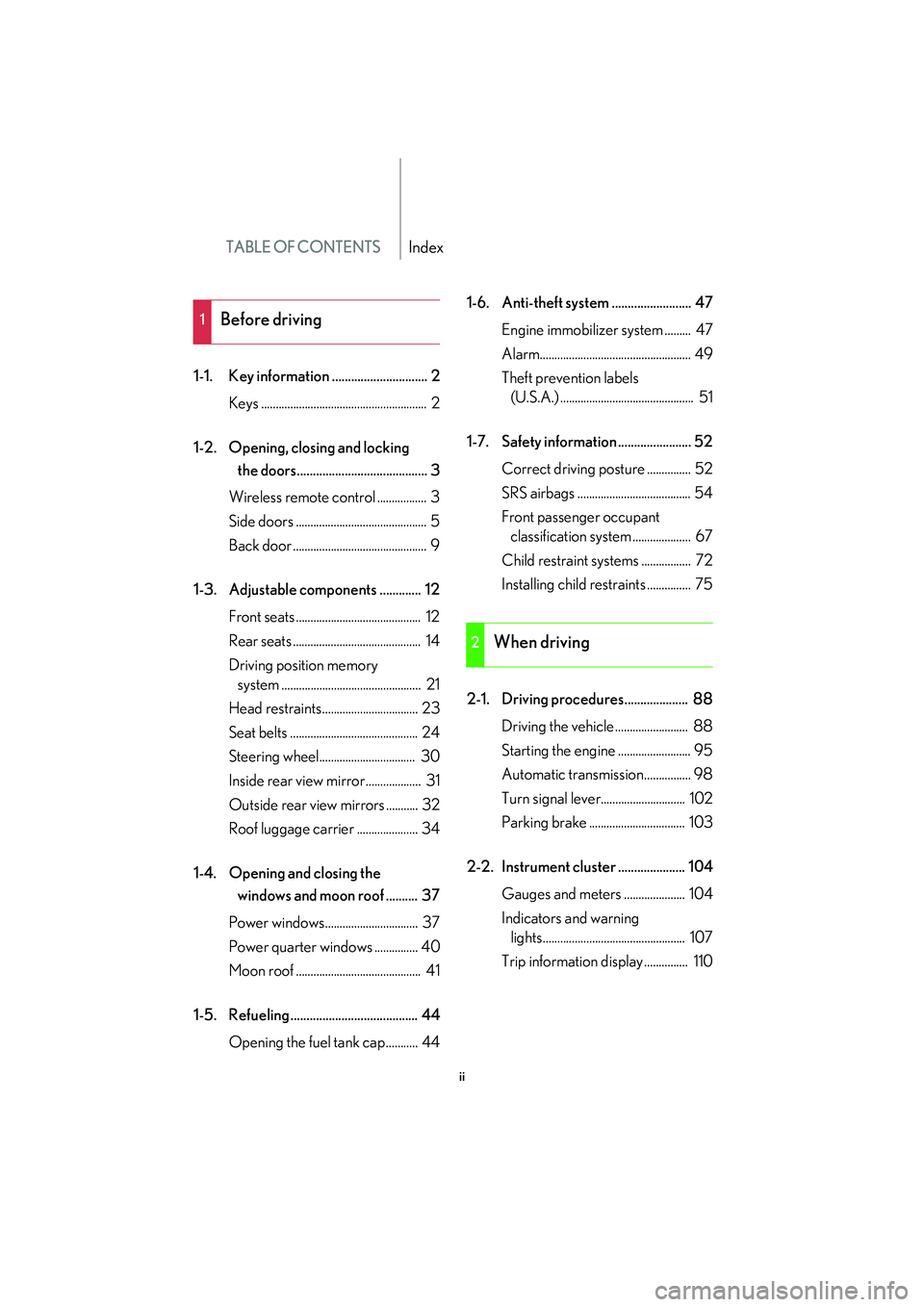
TABLE OF CONTENTSIndex
ii
1-1. Key information .............................. 2Keys ......................................................... 2
1-2. Opening, closing and locking the doors......................................... 3
Wireless remote control ................. 3
Side doors ............................................. 5
Back door .............................................. 9
1-3. Adjustable components ............. 12 Front seats ........................................... 12
Rear seats ............................................ 14
Driving position memory system ................................................ 21
Head restraints................................. 23
Seat belts ............................................ 24
Steering wheel................................. 30
Inside rear view mirror ................... 31
Outside rear view mirrors ........... 32
Roof luggage carrier ..................... 34
1-4. Opening and closing the windows and moon roof .......... 37
Power windows................................ 37
Power quarter windows ............... 40
Moon roof ........................................... 41
1-5. Refueling ........................................ 44 Opening the fuel tank cap ........... 44 1-6. Anti-theft system ......................... 47
Engine immobilizer system ......... 47
Alarm.................................................... 49
Theft prevention labels (U.S.A.) .............................................. 51
1-7. Safety information ....................... 52 Correct driving posture ............... 52
SRS airbags ....................................... 54
Front passenger occupant classification system .................... 67
Child restraint sy stems ................. 72
Installing child restraints ............... 75
2-1. Driving procedures.................... 88 Driving the vehicle ......................... 88
Starting the engine ......................... 95
Automatic transmission................ 98
Turn signal lever............................. 102
Parking brake ................................. 103
2-2. Instrument cluster ..................... 104 Gauges and meters ..................... 104
Indicators and warning lights................................................. 107
Trip information display ............... 110
1Before driving
2When driving
Page 105 of 426
When driving2
87
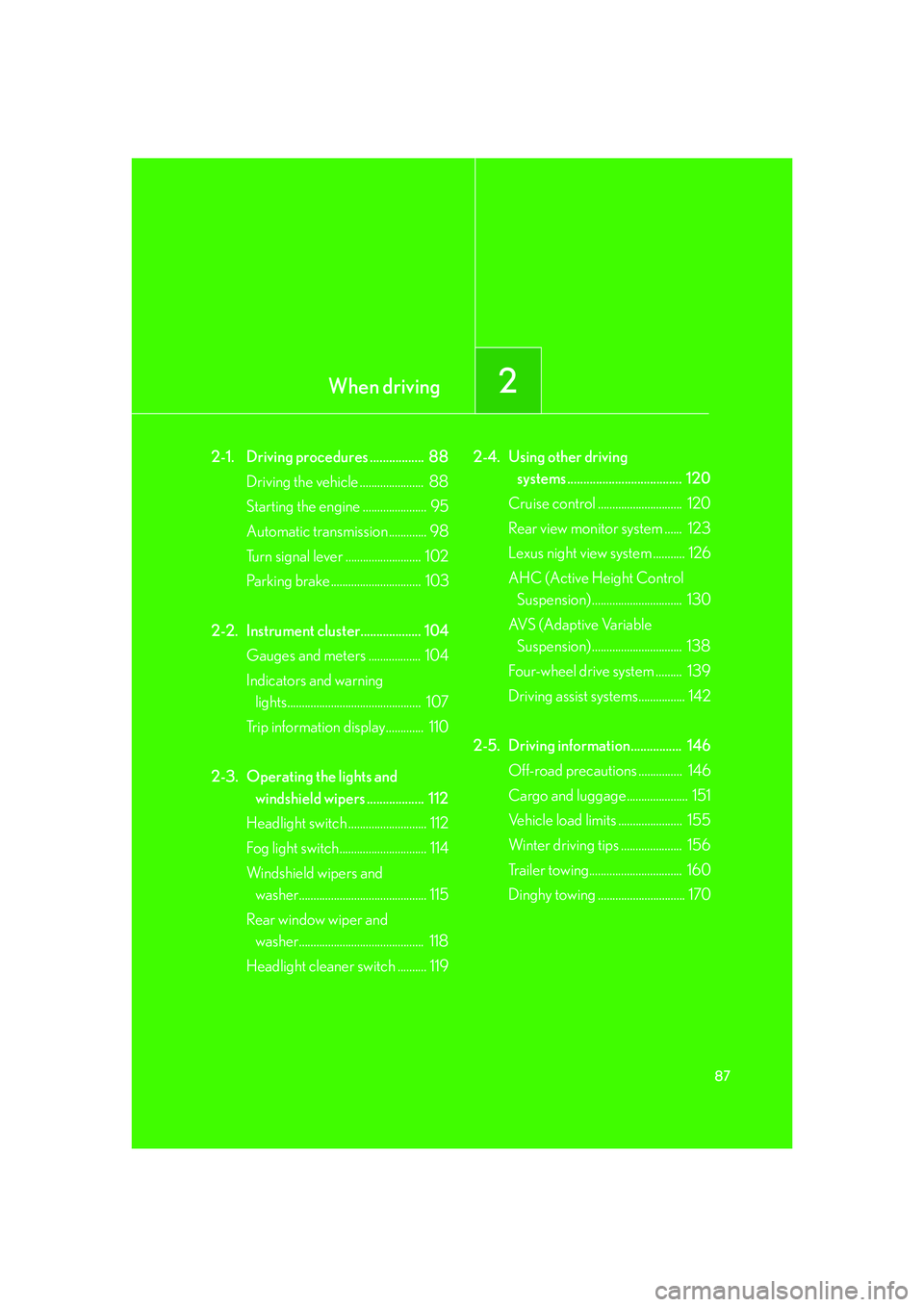
2-1. Driving procedures ................. 88Driving the vehicle ...................... 88
Starting the engine ...................... 95
Automatic transmission ............. 98
Turn signal lever .......................... 102
Parking brake ............................... 103
2-2. Instrument cluster................... 104 Gauges and meters .................. 104
Indicators and warning lights.............................................. 107
Trip information display............. 110
2-3. Operating the lights and windshield wipers .................. 112
Headlight switch ........................... 112
Fog light switch.............................. 114
Windshield wipers and washer............................................ 115
Rear window wiper and washer........................................... 118
Headlight cleaner switch .......... 119 2-4. Using other driving
systems .................................... 120
Cruise control ............................. 120
Rear view monitor system ...... 123
Lexus night view system ........... 126
AHC (Active Height Control Suspension) ............................... 130
AVS (Adaptive Variable Suspension) ............................... 138
Four-wheel drive system ......... 139
Driving assist systems................ 142
2-5. Driving information................ 146 Off-road precautions ............... 146
Cargo and luggage..................... 151
Vehicle load limits ...................... 155
Winter driving tips ..................... 156
Trailer towing................................ 160
Dinghy towing .............................. 170
Page 108 of 426
90
2-1. Driving procedures
CAUTION
■When starting the vehicle
Always keep your foot on the brake pedal while stopped with the engine running.
This prevents the vehicle from creeping.
■When driving the vehicle
●Do not drive if you are unfamiliar with the location of the brake and accelerator
pedals to avoid depressing the wrong pedal.
Accidentally depressing the accelerator pedal instead of the brake pedal will
result in sudden acceleration that may lead to an accident that could result in
death or serious injury.
●Do not drive the vehicle over or stop the vehicle near flammable materials.
●Do not let the vehicle roll backwards while the shift lever is in a driving position, or
roll forward while the shift lever is in “R”.
Doing so may cause the engine to stall or lead to poor brake and steering perfor-
mance, resulting in an accident or damage to the vehicle.
●If the smell of exhaust is noticed inside the vehicle, open the windows and check
that the back door is closed.
Large amounts of exhaust in the vehicle can cause driver drowsiness and eventu-
ally, death. Have the cause of the problem inspected immediately.
●Do not under any circumstances shift the shift lever to “P”, “R” or “N” while the
vehicle is moving.
Doing so can cause significant damage to the transmission and may result in a
loss of vehicle control.
●Do not shift the shift lever to “N” while the vehicle is moving.
Doing so may cause the engine brake not to operate properly and lead to an
accident.
●Do not turn the engine off while driving.
The power steering and brake booster systems will not operate properly if the
engine is off.
Page 116 of 426

98
2-1. Driving procedures
Automatic transmission
Select a shift position appropriate for the driving conditions.
■Shifting the shift lever
While the ignition key is
in the “ON” position,
depress the brake pedal
and move the shift lever.
Page 126 of 426
108
2-2. Instrument cluster
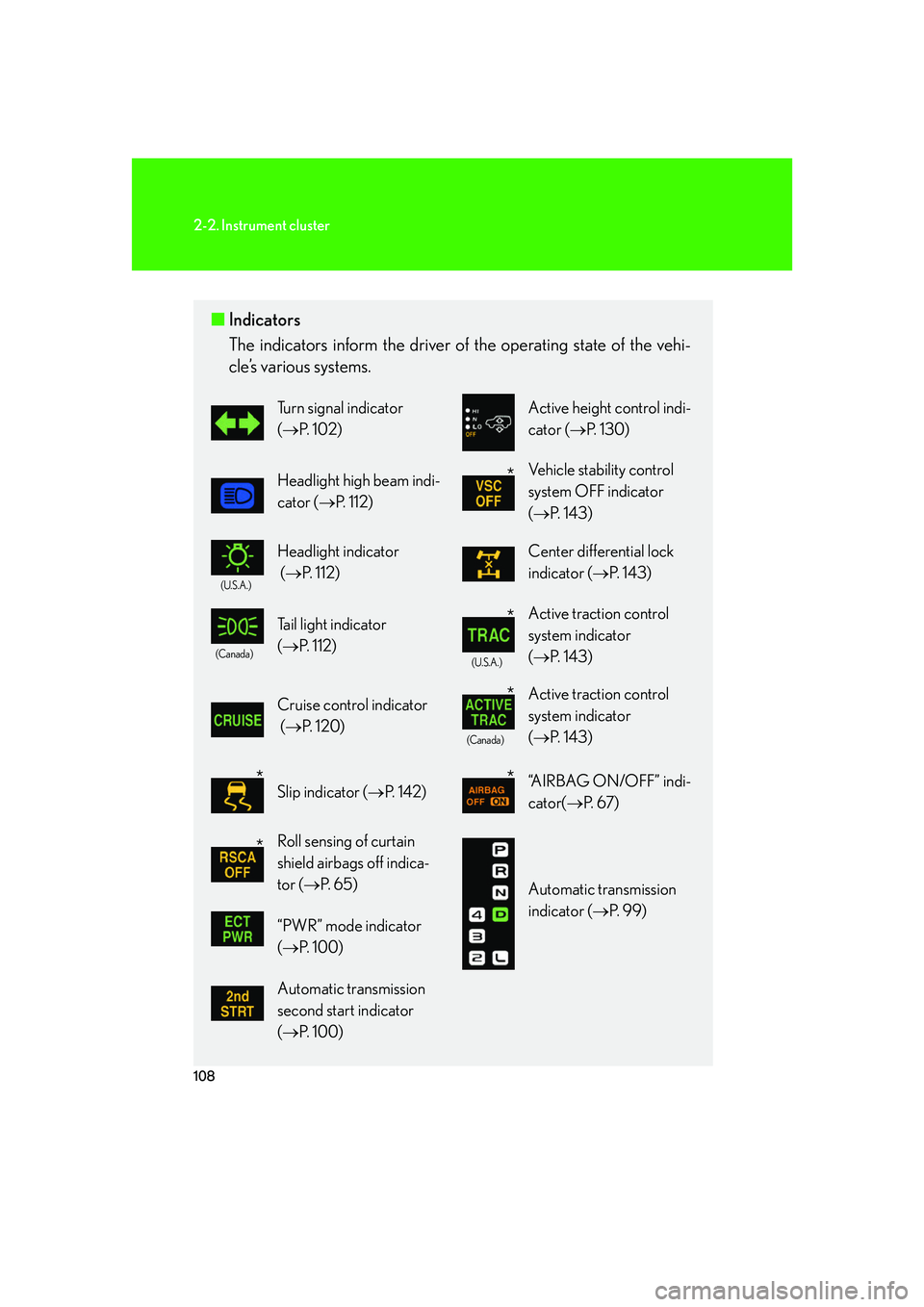
■Indicators
The indicators inform the driver of th e operating state of the vehi-
cle’s various systems.
Turn signal indicator
( P. 1 0 2 )Active height control indi-
cator ( P. 1 3 0 )
Headlight high beam indi-
cator (P. 112)Vehicle stability control
system OFF indicator
(P. 1 4 3 )
(U.S.A.)
Headlight indicator
( P. 112)Center differential lock
indicator ( P. 1 4 3 )
(Canada)
Tail light indicator
(P. 112)
(U.S.A.)
Active traction control
system indicator
(P. 1 4 3 )
Cruise control indicator
( P. 1 2 0 )
(Canada)
Active traction control
system indicator
( P. 1 4 3 )
Slip indicator ( P. 1 4 2 )“AIRBAG ON/OFF” indi-
cator( P. 6 7 )
Roll sensing of curtain
shield airbags off indica-
tor ( P. 6 5 )
Automatic transmission
indicator ( P. 99)
“PWR” mode indicator
( P. 1 0 0 )
Automatic transmission
second start indicator
(P. 1 0 0 )
*
*
*
**
*
Page 158 of 426
140
2-4. Using other driving systems
■Advice for driving on slippery roads in “L” (low speed position)
●If you shift the four-wheel drive control lever to “L” and the shift lever to “2” while
driving in steep off-road areas, the output of the brake can be controlled effec-
tively by the active traction control system, which assists the driver to control the
driving power of 4 wheels.
●Use the “L” position of the shift lever for maximum power and traction when
your wheels get stuck or when you drive down a steep incline. In the following
cases, the output of the brake can be co ntrolled by the active traction control
system if the engine speed is un der 3,000 rpm (normally under 3,000 rpm
when the wheels get unstuck).
• The four-wheel drive control lever in the “L” position and the shift lever in the
“L” position or the shift lever in the “D”, “4”, “3” or “2” with the transmission
downshifting to first gear.
• The four-wheel drive control lever in the “L” position and the shift lever in the
“R” position.
■The center differential lock/unlock button can be operated when
●The ignition key is in the “ON” position, and
●The four-wheel drive control lever is in the “H” or “L” position.
■Locking /unlocking the center differential
●When the center differential is locked, VSC (vehicle stability control) is auto-
matically turned off. (Center differenti al lock and “VSC OFF” indicator light
come on.)
●When the operation is not completed, th e center differential lock indicator
blinks. If the indicator light does not go off when unlocking the center differen-
tial, drive straight ahead while accelerating or decelerating, or drive in reverse.
●The center differential lock system operation is not completed within 5 seconds
while the cruise control system is set, cancel the cruise control system.
Page 167 of 426
149
2-5. Driving information
2
When driving
CAUTION
■Off-road driving precautions
Always observe the following precautions to help minimize the risk of serious per-
sonal injury or damage to your vehicle:
●Drive carefully when off the road. Do not take unnecessary risks by driving in
dangerous places.
●Do not grip the steering wheel spokes wh en driving off-road. A bad bump could
jerk the wheel and injure your hands. Keep both hands and especially your
thumbs on the outside of the rim.
●Always check your brakes for effectiveness immediately after driving in sand,
mud, water or snow.
●After driving through tall grass, mud, rock, sand, rivers, etc., check that there is no
grass, bush, paper, rags, stone, sand, etc. adhering or trapped on the underbody.
Clear off any such matter from the underbody. If the vehicle is used with these
materials trapped or adhering to the underbody, a breakdown or fire could occur.
●When driving off-road or in rugged te rrain, do not drive at excessive speeds,
jump, make sharp turns, strike objects, etc. This may cause loss of control or vehi-
cle rollover causing death or serious injury. You are also risking expensive dam-
age to your vehicle’s suspension and chassis.
NOTICE
■To prevent the water damage
Take all necessary safety measures to ensure that water dama ge to the engine or
other components does not occur.
●Water entering the engine air intake will cause severe engine damage.
●Water entering the automatic transmission will cause deterioration in shift quality,
locking up of your transmission accompanied by vibration, and ultimately dam-
age.
●Water can wash the grease from wheel bearings, causing rusting and premature
failure, and may also enter the differentials, transmission and transfer case, reduc-
ing the gear oil’s lubricating qualities.
Page 182 of 426
164
2-5. Driving information
■Before towing
Check that the following conditions are met:
●The vehicle’s tires are properly inflated. (P. 3 0 2 )
●Trailer tires are inflated according to the trailer manufacturer’s recommenda-
tion.
●All trailer lights work.
●All lights work each time you connect them.
●The trailer ball is set up at the proper height for the coupler on the trailer.
●The vehicle remains level when a loaded or unloaded trailer is hitched. Do not
drive if the vehicle is not level, and check for improper tongue load, overloading,
worn suspension, or other possible causes.
●The trailer cargo is securely loaded.
●The rear view mirrors conform to all applicable federal, state/provincial or local
regulations. If they do not, install rear view mirrors appropriate for towing pur-
poses.
■Break-in schedule
Lexus recommends that you do not use a new vehicle or a vehicle with any new
power train components (engine, transmission, differential, wheel bearings, etc.) to
tow a trailer for the first 500 miles (800 km) of driving.
■Maintenance
●If you tow a trailer, your vehicle will require more frequent maintenance due to
the additional load. (See “Warranty and Services Guide/ Owner’s Manual Sup-
plement/ Scheduled Maintenance”.)
●Retighten the fixing bolts of the towing ball and bracket after approximately
600 miles (1000 km) of trailer towing.
Page 185 of 426

167
2-5. Driving information
2
When driving
●Reversing with a trailer attached is difficult and requires practice Grip
the bottom of the steering wheel and move your hand to the left to
move the trailer to the left. Move yo ur hand to the right to move the
trailer to right. (This is generally opposite to reversing without a trailer
attached.) Avoid sharp or prolon ged turning. Have someone guide
you when reversing to reduce the risk of an accident.
● As stopping distance is increased when towing a trailer, vehicle-to-
vehicle distance should be increas ed. For each 10 mph (16 km/h) of
speed, allow at least one vehicle and trailer length.
● Avoid sudden braking as you may sk id, resulting in jackknifing and loss
of control. This is especially true on wet or slippery surfaces.
● Avoid jerky starts or sudden acceleration.
● Avoid jerky steering and sharp turn s, and slow down before making
turns.
● Note that when making a turn, the tr ailer wheels will be closer than the
vehicle wheels to the inside of th e turn. Compensate by making a
larger than normal turning radius.
● Crosswinds and rough roads will ad versely affect handling of your
vehicle and trailer, causing sway. Peri odically check the rear to prepare
for being passed by large trucks or buses, which may cause your vehi-
cle and trailer to sway. If swaying occurs, firmly grip the steering wheel,
reduce speed immediately but gradually, and steer straight ahead.
Never increase speed. If you make no extreme correction with the
steering or brakes, your vehi cle and trailer will stabilize.
● Take care when passing other vehi cles. Passing requires considerable
distance. After passing a vehicle, do not forget the length of your
trailer, and be sure you have plenty of room before changing lanes.
● In order to maintain efficient eng ine braking and electrical charging
performance, do not use overdrive. Transmission shift range position
must be in 4.
Page 186 of 426
![LEXUS LX470 2007 Owners Manual 168
2-5. Driving information
●Due to the added load of the trailer, your vehicle’s engine may overheat
on hot days (at temperatures over 85
F[30C] when driving up a long
or steep grade. If](/img/36/58005/w960_58005-185.png "LEXUS LX470 2007 Owners Manual 168
2-5. Driving information
●Due to the added load of the trailer, your vehicle’s engine may overheat
on hot days (at temperatures over 85
F[30C] when driving up a long
or steep grade. If")
168
2-5. Driving information
●Due to the added load of the trailer, your vehicle’s engine may overheat
on hot days (at temperatures over 85
F[30C] when driving up a long
or steep grade. If the engine coolant temperature gauge indicates
overheating, immediately turn off th e air conditioning (if in use), pull
your vehicle off the road and stop in a safe spot. (
P. 363)
● Always place wheel blocks under both the vehicle and the trailer
wheels when parking. Apply the pa rking brake firmly, and put the
transmission in P. Avoid parking on a slope, but if unavoidable, do so
only after performing the following:
Apply the brakes and keep them applied.
Have someone place wheel blocks under both the vehicle and
trailer wheels.
When the wheel blocks are in pl ace, release the brakes slowly
until the blocks absorb the load.
Apply the parking brake firmly.
Shift into “P” and turn off the engine.
● When restarting after parking on a slope:
With the transmission in the “P” position, start the engine. Be sure
to keep the brake pedal pressed.
Shift into 3, 2, 1, or “R” position (if reversing).
Release the parking brake and br ake pedal, and slowly pull or
back away from the wheel blocks. Stop and apply the brakes.
Have someone retrieve the blocks.
STEP1STEP1
STEP2STEP2
STEP1STEP3STEP3
STEP1STEP4
STEP1STEP5STEP5
STEP1STEP1
STEP2STEP2
STEP1STEP3STEP3
STEP1STEP4