trailer LEXUS LX570 2014 User Guide
[x] Cancel search | Manufacturer: LEXUS, Model Year: 2014, Model line: LX570, Model: LEXUS LX570 2014Pages: 956, PDF Size: 16.4 MB
Page 353 of 956

3532-4. Using other driving systems
2
When driving
LX570_OM_OM60L21U_(U) CAUTION■
When Active TRAC, VSC and Trailer Sway Control are off
Be especially careful and drive at a speed appropriate to the road conditions. As
these are systems to help to ensure vehicle stability and driving force, do not turn off
Active TRAC, VSC and Trailer Sway Control unless necessary. ■
When the VSC and Trailer Sway Control are activated
The slip indicator light flashes. Always drive carefully.
Reckless driving may cause an accident. Ex ercise particular care when the indica-
tor light flashes. ■
Replacing tires
Make sure that all tires are of the same size, brand, tread pattern and total load
capacity. In addition, make sure that the ti res are inflated to the specified tire pres-
sure level.
The Multi Terrain ABS, Active TRAC, VSC and Trailer Sway Control will not func-
tion correctly if different tires are fitted on the vehicle.
Contact your Lexus dealer for further info rmation when replacing tires or wheels.■
Handling of tires and suspension
Using tires with any kind of problem or modifying the suspension will affect the driv-
ing assist systems, and may cause the system to malfunction.
Page 354 of 956

3542-4. Using other driving systems
LX570_OM_OM60L21U_(U) CAUTION■
Trailer Sway Control precaution
The Trailer Sway Control system is not able to reduce trailer sway in all situations.
Depending on many factors such as the conditions of the vehicle, trailer, road sur-
face, and driving environment, the Trailer Sway Control system may not be effec-
tive. Refer to your trailer owner’s manual for information on how to tow your trailer
properly. ■
If trailer sway occurs
Observe the following precautions.
Failing to do so may cause death or serious injury. ●
Firmly grip the steering wheel. Steer straight ahead.
Do not try to control trailer sway ing by turning the steering wheel.●
Begin releasing the accelerator pedal im mediately but very gradually to reduce
speed.
Do not increase speed. Do not apply vehicle brakes.
If you make no extreme correction with the steering or brakes, your vehicle and
trailer should stabilize. ( P. 395)
Page 368 of 956

3682-5. Driving information
LX570_OM_OM60L21U_(U) Capacity and distribution
Cargo capacity depends on the to tal weight of the occupants.
(Cargo capacity) = (Total load capa city) — (Total weight of occupants)
Steps for Determining Correct Load Limit—
(1) Locate the statement “The combined weight of occupants and
cargo should never exceed XXX kg or XXX lbs.” on your vehicle’s
placard.
(2) Determine the combined weight of the driver and passengers that
will be riding in your vehicle.
(3) Subtract the combined weight of the driver and passengers from
XXX kg or XXX lbs.
(4) The resulting figure equals the av ailable amount of cargo and lug-
gage load capacity.
For example, if the “XXX” amount equals 1400 lbs. and there will be
five 150 lb passengers in your vehi cle, the amount of available cargo
and luggage load capacity is 650 lbs. (1400 - 750 (5 150) = 650
lbs.)
(5) Determine the combined weight of luggage and cargo being
loaded on the vehicle. That weight may not safely exceed the avail-
able cargo and luggage load capacity calculated in Step 4.
(6) If your vehicle will be towing a tr ailer, load from your trailer will be
transferred to your vehicle. Consu lt this manual to determine how
this reduces the available cargo an d luggage load capacity of your
vehicle. ( P. 373)
Page 373 of 956
3732-5. Driving information
2
When driving
LX570_OM_OM60L21U_(U) Vehicle load limits
■
Total load capacity and seating capacity
These details are also described on th e tire and loading information label.
( P. 7 7 1 )
CAUTION■
Overloading the vehicle
Do not overload the vehicle.
It may not only cause damage to the tire s, but also degrade steering and braking
ability, resulting in an accident.Vehicle load limits include total load capacity, seating capacity, TWR
(Trailer Weight Rating) and cargo capacity.
■ Total load capacity (vehicle capacity weight): P. 8 8 0
Total load capacity means the comb ined weight of occupants, cargo
and luggage.
■ Seating capacity: 8 occupants (Front 2, Rear 6)
Seating capacity means the maximu m number of occupants whose
estimated average weight is 150 lb. (68 kg) per person.
Even if the number of occupants ar e within the seating capacity, do
not exceed the total load capacity.
■ TWR (Trailer Weight Rating): P. 384, 880
TWR means the maximum gross trailer weight (trailer weight plus its
cargo weight) that you vehicle is able to tow.
■ Cargo capacity
Cargo capacity may inc rease or decrease depending on the weight
and the number of occupants.
Page 379 of 956
3792-5. Driving information
2
When driving
LX570_OM_OM60L21U_(U) Trailer towing Your vehicle is designed primarily as a passenger-and-load-carrying vehi-
cle. Towing a trailer can have an adverse impact on handling, performance,
braking, durability, and fuel consumpt ion. For your safety and the safety of
others, you must not overload your vehicle or trailer. You must also ensure
that you are using appropriate towing equipment, that the towing equip-
ment has been installed correctly and used properly, and that you employ
the requisite driving habits.
Vehicle-trailer stability and braking performance are affected by trailer
stability, brake performance and settin g, trailer brakes, the hitch and hitch
systems (if equipped).
To tow a trailer safely, use extreme care and drive the vehicle in accor-
dance with your trailer’s characteristics and operating conditions.
Lexus warranties do not apply to damage or malfunction caused by towing
a trailer for commercial purposes.
Contact your Lexus dealer for further information about additional
requirements such as towing kits, etc.
Page 380 of 956
3802-5. Driving information
LX570_OM_OM60L21U_(U) Towing related terms
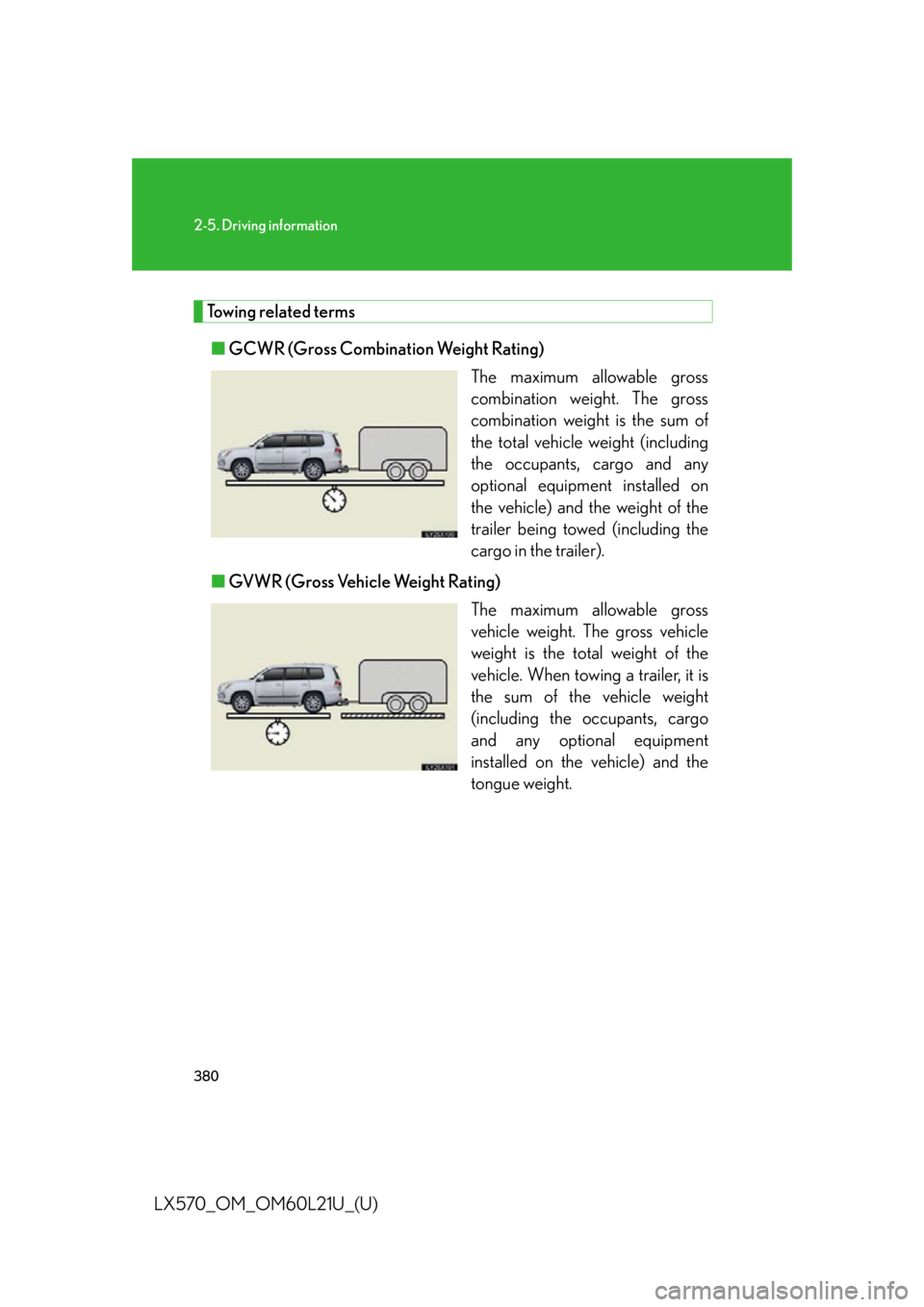
■ GCWR (Gross Combination Weight Rating)
The maximum allowable gross
combination weight. The gross
combination weight is the sum of
the total vehicle weight (including
the occupants, cargo and any
optional equipment installed on
the vehicle) and the weight of the
trailer being towed (including the
cargo in the trailer).
■ GVWR (Gross Vehicle Weight Rating)
The maximum allowable gross
vehicle weight. The gross vehicle
weight is the total weight of the
vehicle. When towing a trailer, it is
the sum of the vehicle weight
(including the occupants, cargo
and any optional equipment
installed on the vehicle) and the
tongue weight.
Page 381 of 956
3812-5. Driving information
2
When driving
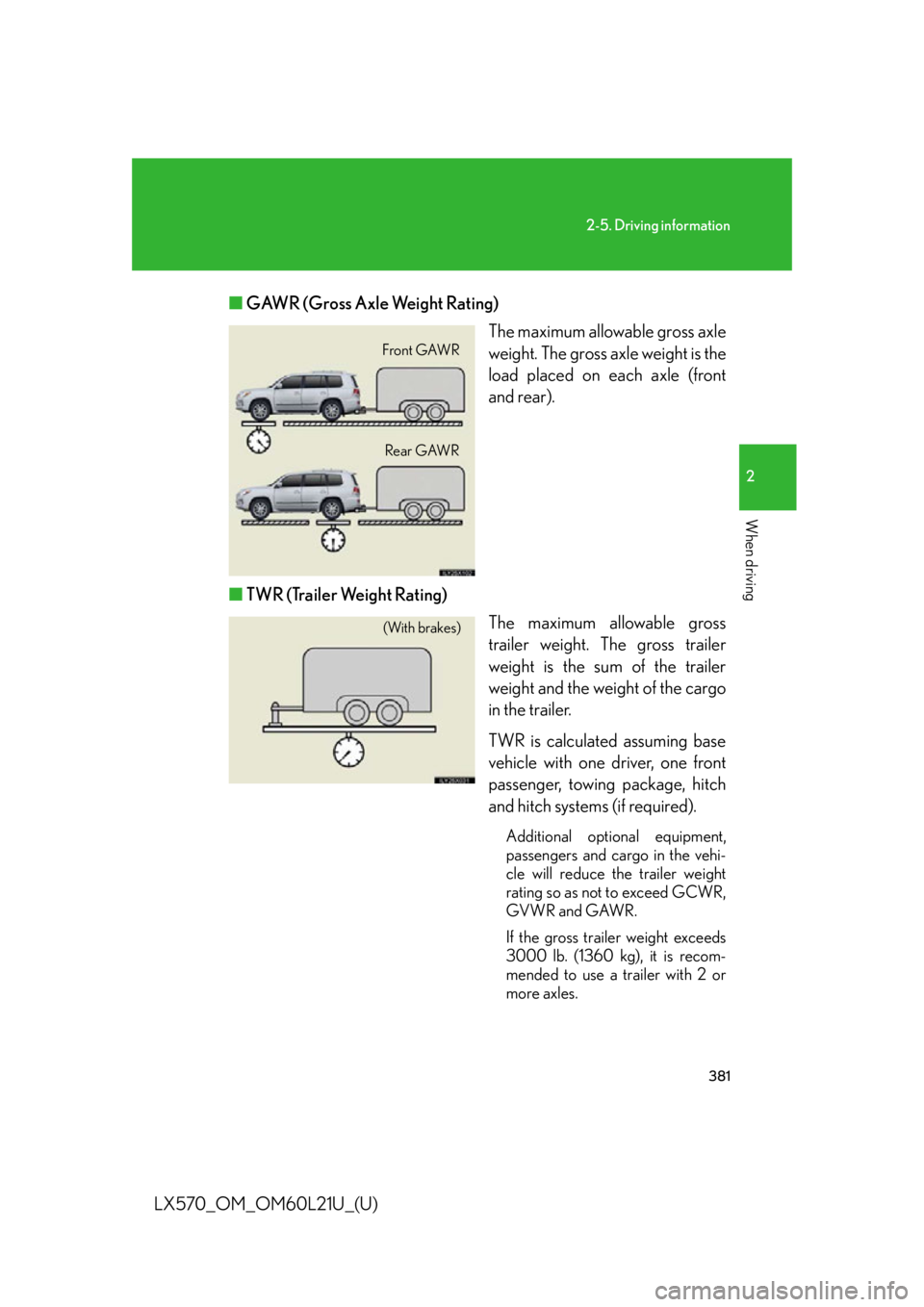
LX570_OM_OM60L21U_(U) ■ GAWR (Gross Axle Weight Rating)
The maximum allowable gross axle
weight. The gross axle weight is the
load placed on each axle (front
and rear).
■ TWR (Trailer Weight Rating)
The maximum allowable gross
trailer weight. The gross trailer
weight is the sum of the trailer
weight and the weight of the cargo
in the trailer.
TWR is calculated assuming base
vehicle with one driver, one front
passenger, towing package, hitch
and hitch systems (if required). Additional optional equipment,
passengers and cargo in the vehi-
cle will reduce the trailer weight
rating so as not to exceed GCWR,
GVWR and GAWR.
If the gross trailer weight exceeds
3000 lb. (1360 kg), it is recom-
mended to use a trailer with 2 or
more axles.Front GAWR
Rear GAWR
(With brakes)
Page 382 of 956
3822-5. Driving information
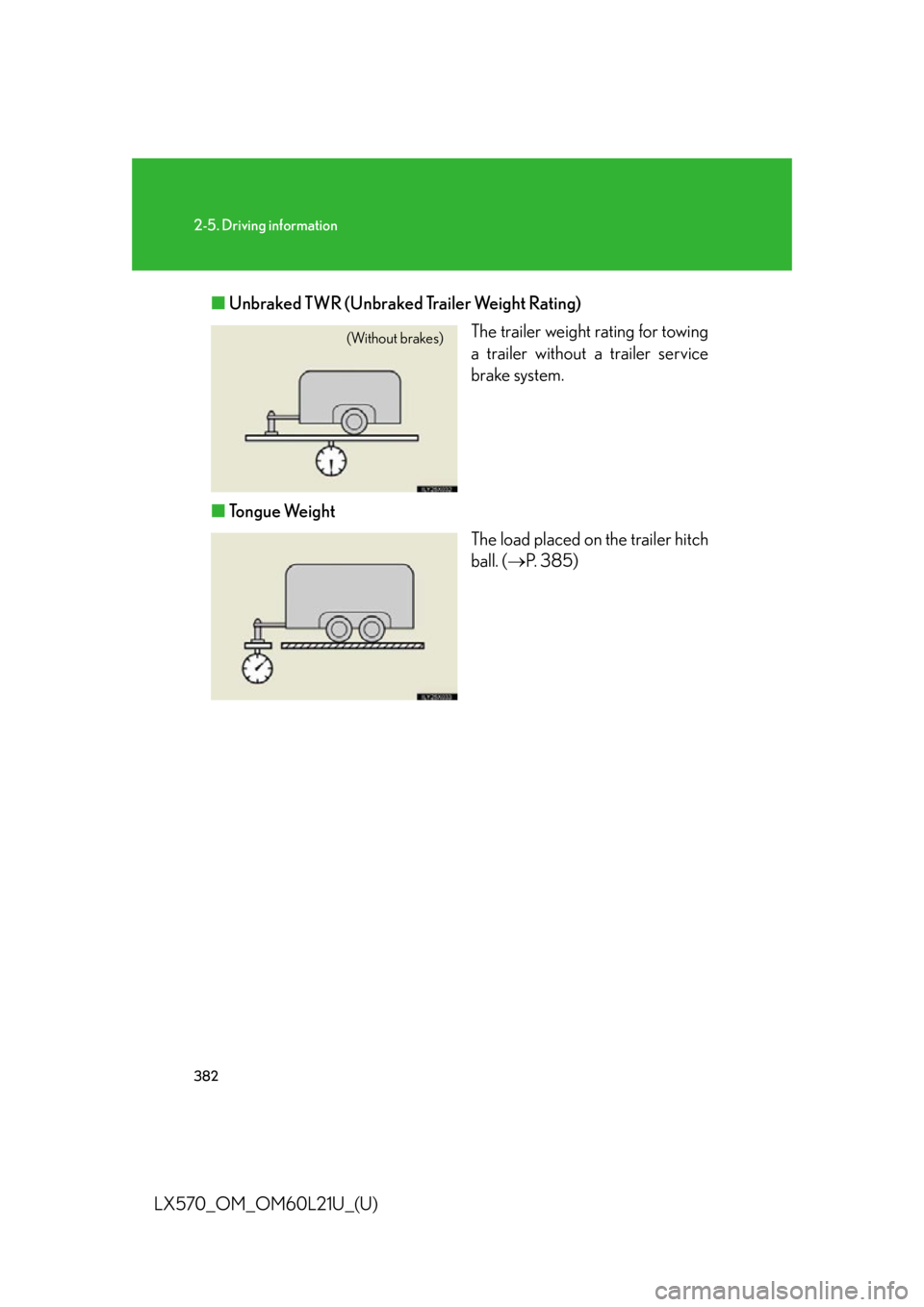
LX570_OM_OM60L21U_(U) ■ Unbraked TWR (Unbraked Trailer Weight Rating)
The trailer weight rating for towing
a trailer without a trailer service
brake system.
■ Tongue Weight
The load placed on the trailer hitch
ball. ( P. 385)(Without brakes)
Page 383 of 956

3832-5. Driving information
2
When driving
LX570_OM_OM60L21U_(U) Weight limits
● The gross trailer weight must never exceed 7000 lb. (3175 kg).
● The gross combination weight must never exceed 13400 lb.
(6078 kg).
● The gross vehicle weight must
never exceed the GVWR indi-
cated on the Certification Label.
● The gross axle weight on each
axle must never exceed the
GAWR indicated on the Certifi-
cation Label.
● If the gross trailer weight is over the unbraked TWR, trailer service
brakes are required.
● If the gross trailer weight is over 2000 lb. (907 kg), a sway control
device with sufficient capacity is required.
● If the gross trailer weight is over 5000 lb. (2268 kg), a weight distrib-
uting hitch with sufficient capacity is required.
Page 384 of 956

3842-5. Driving information
LX570_OM_OM60L21U_(U) GCWR, TWR, Unbraked TWR, Fifth wheel and Gooseneck towing
TWR
Confirm that the gross trailer weight, gross combination weight, gross vehi-
cle weight, gross axle weight and tongue weight are all within the limits.
■ GCWR
*13400 lb. (6078 kg)
■ TWR
*7000 lb. (3175 kg)
■ Unbraked TWR
*1000 lb. (454 kg)
* : This model meets the tow-vehicle traile ring requirement of SAE International
per SAE J2807.