weight LEXUS LX570 2014 User Guide
[x] Cancel search | Manufacturer: LEXUS, Model Year: 2014, Model line: LX570, Model: LEXUS LX570 2014Pages: 956, PDF Size: 16.4 MB
Page 382 of 956
3822-5. Driving information
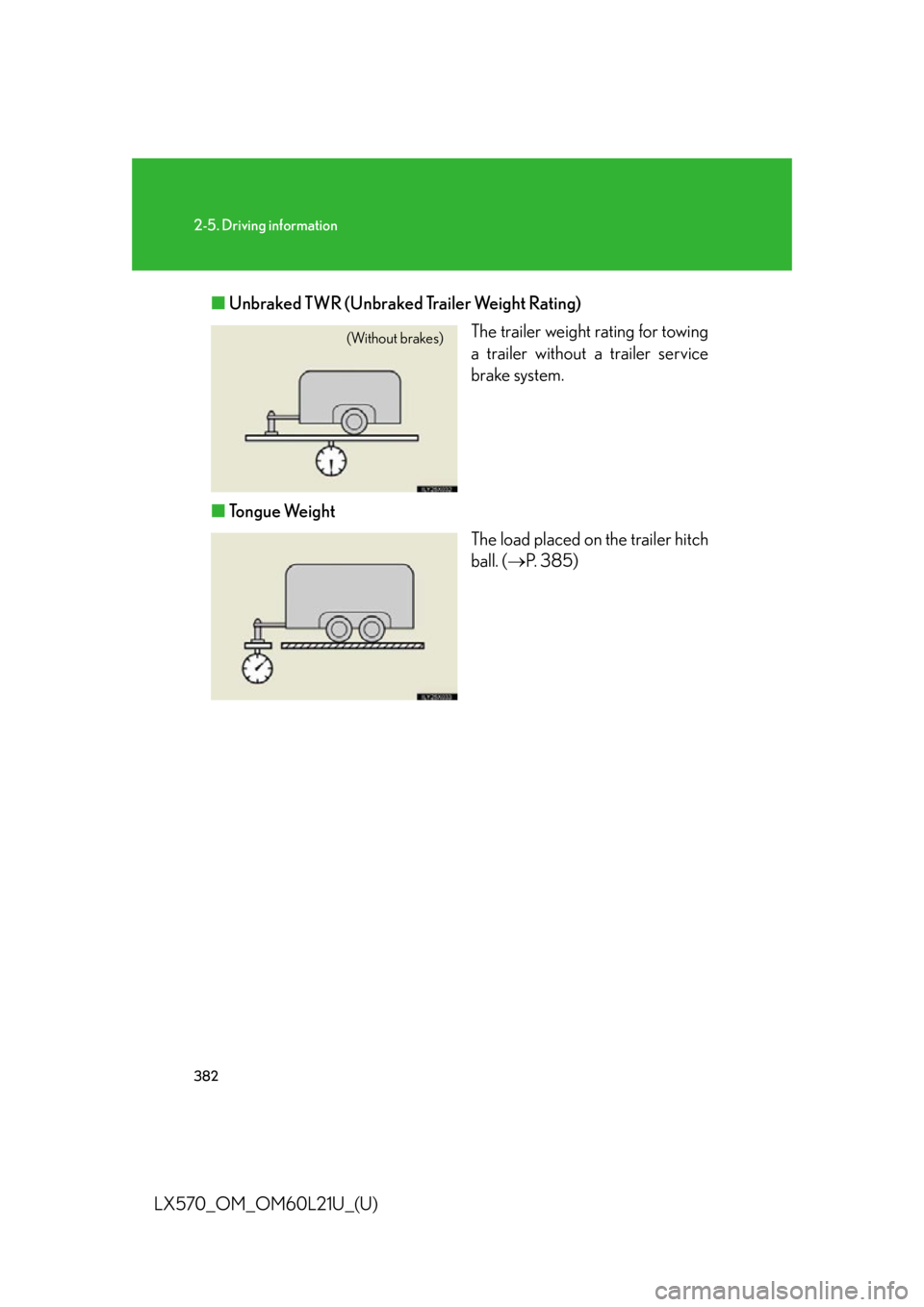
LX570_OM_OM60L21U_(U) ■ Unbraked TWR (Unbraked Trailer Weight Rating)
The trailer weight rating for towing
a trailer without a trailer service
brake system.
■ Tongue Weight
The load placed on the trailer hitch
ball. ( P. 385)(Without brakes)
Page 383 of 956
3832-5. Driving information
2
When driving
LX570_OM_OM60L21U_(U) Weight limits
● The gross trailer weight must never exceed 7000 lb. (3175 kg).
● The gross combination weight must never exceed 13400 lb.
(6078 kg).
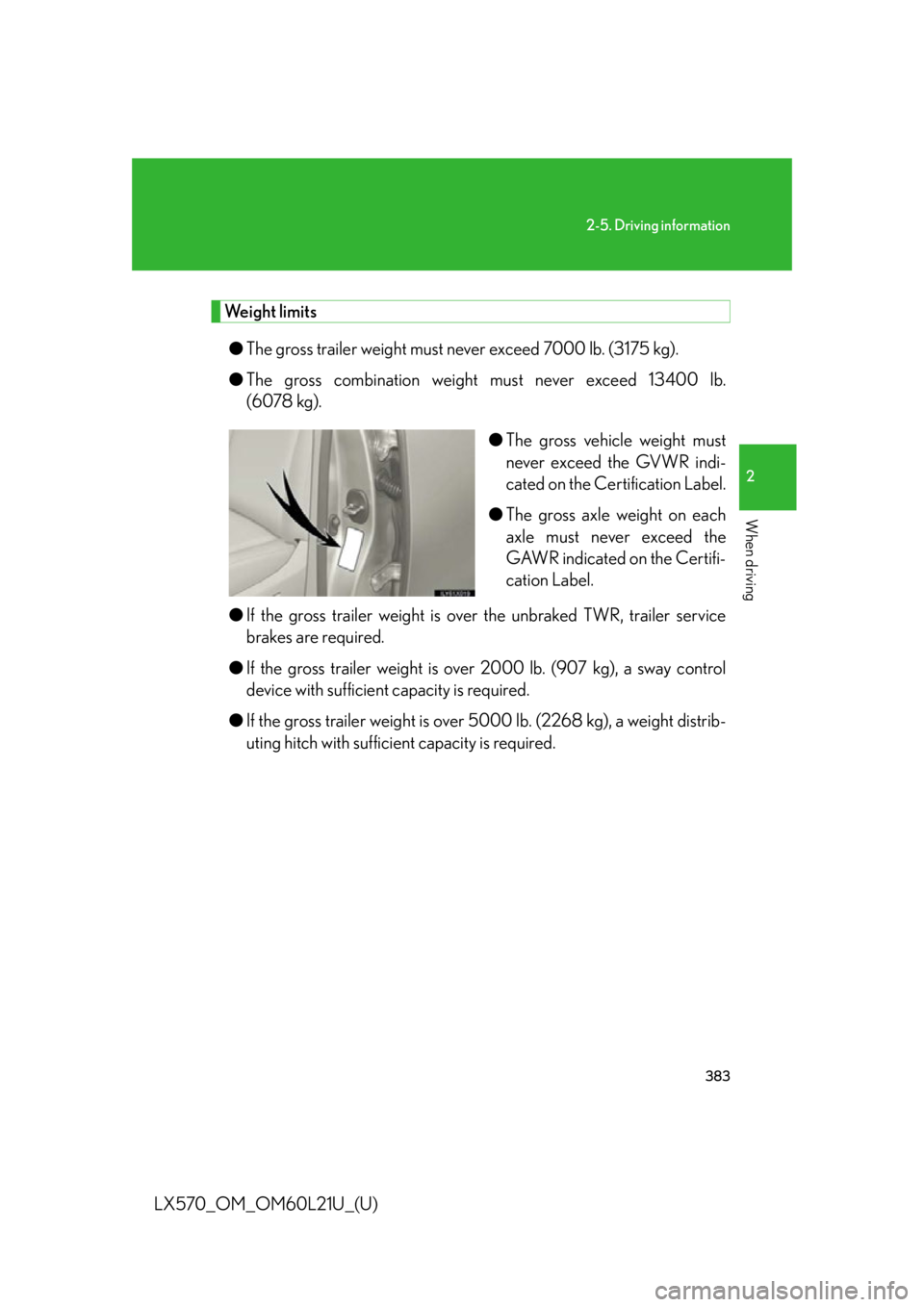
● The gross vehicle weight must
never exceed the GVWR indi-
cated on the Certification Label.
● The gross axle weight on each
axle must never exceed the
GAWR indicated on the Certifi-
cation Label.
● If the gross trailer weight is over the unbraked TWR, trailer service
brakes are required.
● If the gross trailer weight is over 2000 lb. (907 kg), a sway control
device with sufficient capacity is required.
● If the gross trailer weight is over 5000 lb. (2268 kg), a weight distrib-
uting hitch with sufficient capacity is required.
Page 384 of 956

3842-5. Driving information
LX570_OM_OM60L21U_(U) GCWR, TWR, Unbraked TWR, Fifth wheel and Gooseneck towing
TWR
Confirm that the gross trailer weight, gross combination weight, gross vehi-
cle weight, gross axle weight and tongue weight are all within the limits.
■ GCWR
*13400 lb. (6078 kg)
■ TWR
*7000 lb. (3175 kg)
■ Unbraked TWR
*1000 lb. (454 kg)
* : This model meets the tow-vehicle traile ring requirement of SAE International
per SAE J2807.
Page 385 of 956
3852-5. Driving information
2
When driving
LX570_OM_OM60L21U_(U) Trailer Tongue Weight
● A recommended tongue weight varies in accordance with the types of
trailers or towing as described below.
● To ensure the recommended values shown below, the trailer must be
loaded by referring to the following instructions.
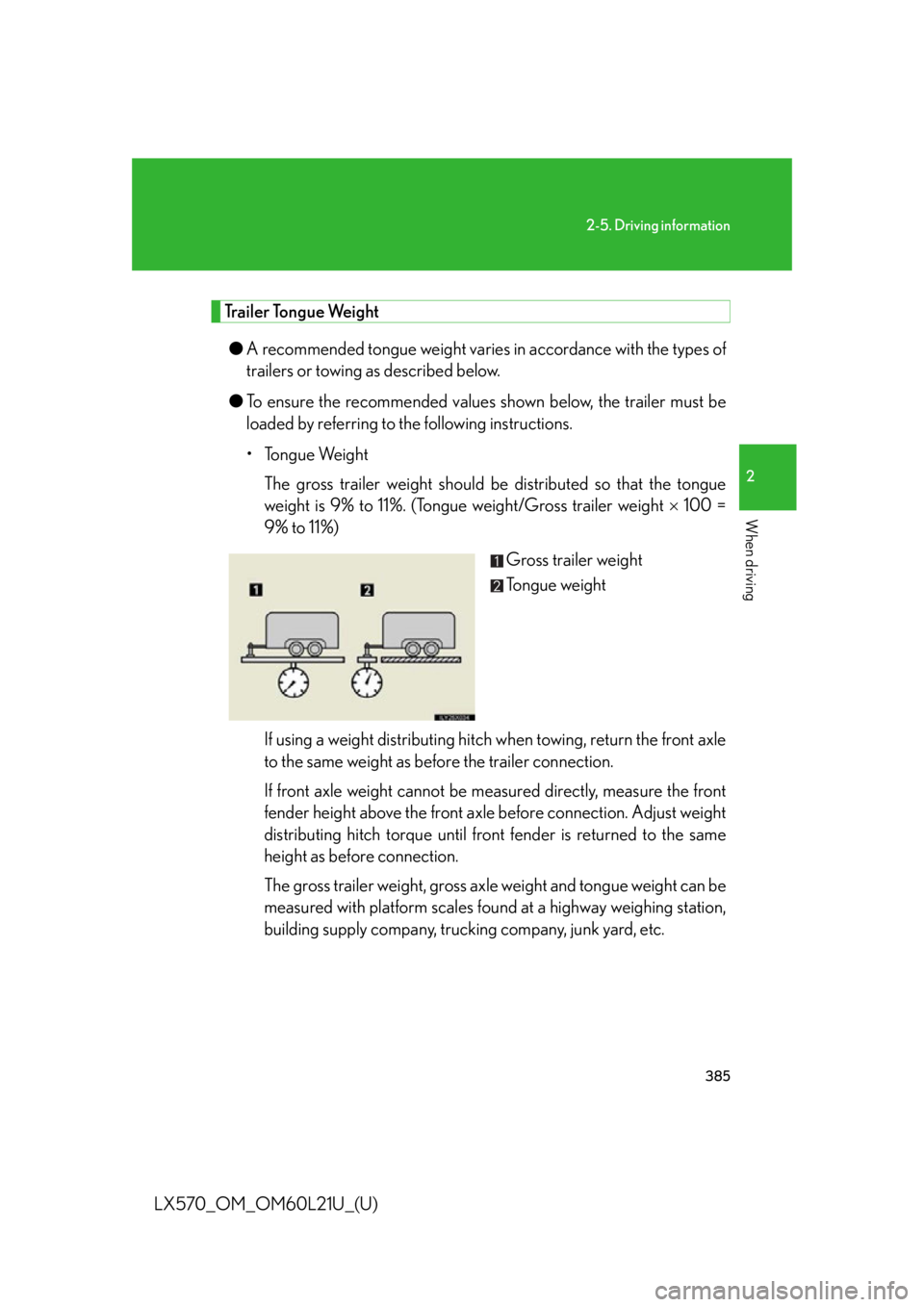
• Tongue Weight
The gross trailer weight should be distributed so that the tongue
weight is 9% to 11%. (Tongue we ight/Gross trailer weight 100 =
9% to 11%)
Gross trailer weight
Tongue weight
If using a weight distri buting hitch when towing , return the front axle
to the same weight as before the trailer connection.
If front axle weight cannot be mea sured directly, measure the front
fender height above the front axle before connection. Adjust weight
distributing hitch torque until fr ont fender is returned to the same
height as before connection.
The gross trailer weight, gross axle weight and tongue weight can be
measured with platform scales foun d at a highway weighing station,
building supply company, truck ing company, junk yard, etc.
Page 386 of 956
3862-5. Driving information
LX570_OM_OM60L21U_(U) Hitch
Trailer hitch assemblies have differ ent weight capacities. Lexus recom-
mends the use of Lexus hitch/bracket for your vehicle. For details, con-
tact your Lexus dealer.
● If you wish to install a trailer hitch, contact your Lexus dealer.
● Use only a hitch that conforms to the gross tr ailer weight requirement
of your vehicle.
● Follow the directions supplied by the hitch manufacturer.
● Lubricate the hitch ball with a light coating of grease.
● Remove the trailer hitch whenever you are not towing a trailer. After
removing the hitch, seal any mount ing hole in the vehicle body to pre-
vent entry of any substances into the vehicle.
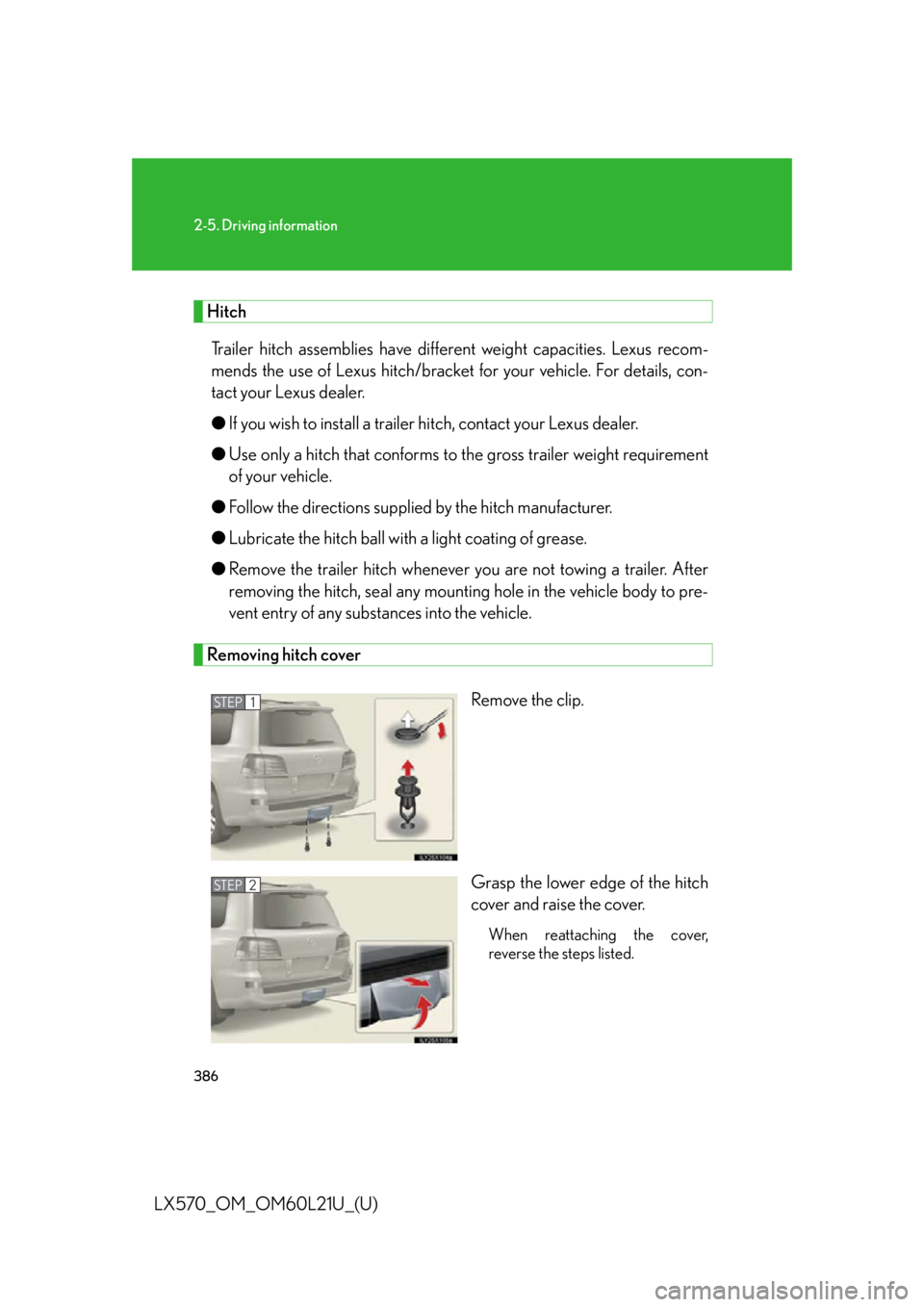
Removing hitch cover
Remove the clip.
Grasp the lower edge of the hitch
cover and raise the cover. When reattaching the cover,
reverse the steps listed.STEP 1
STEP 2
Page 387 of 956
3872-5. Driving information
2
When driving
LX570_OM_OM60L21U_(U) Selecting trailer ball
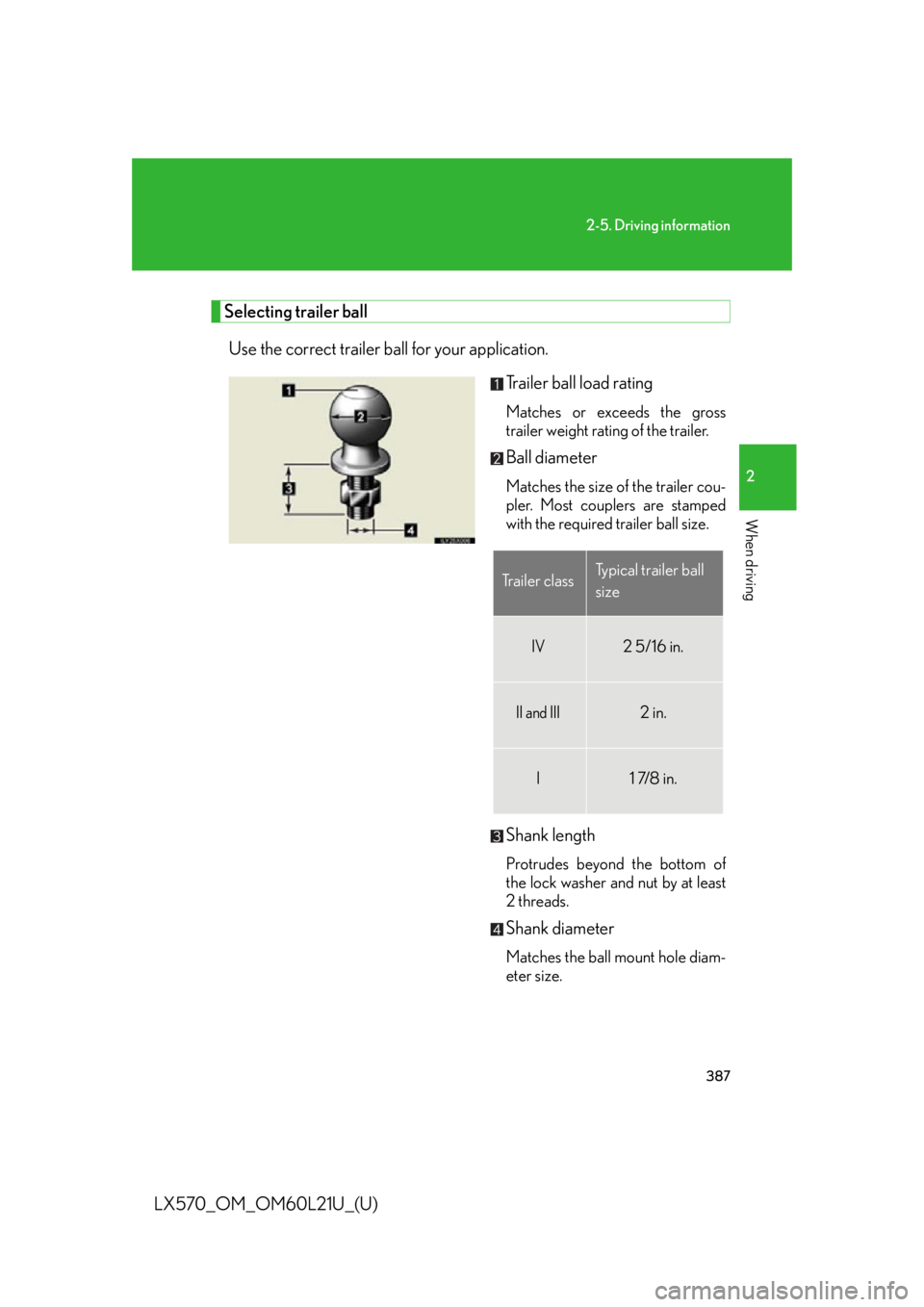
Use the correct trailer ball for your application.
Trailer ball load rating Matches or exceeds the gross
trailer weight rating of the trailer.
Ball diameter Matches the size of the trailer cou-
pler. Most couplers are stamped
with the required trailer ball size.
Shank length Protrudes beyond the bottom of
the lock washer and nut by at least
2 threads.
Shank diameter Matches the ball mount hole diam-
eter size.Trailer class Typical trailer ball
size
IV 2 5/16 in.
II and III 2 in.
I 1 7/8 in.
Page 394 of 956
3942-5. Driving information
LX570_OM_OM60L21U_(U) ■
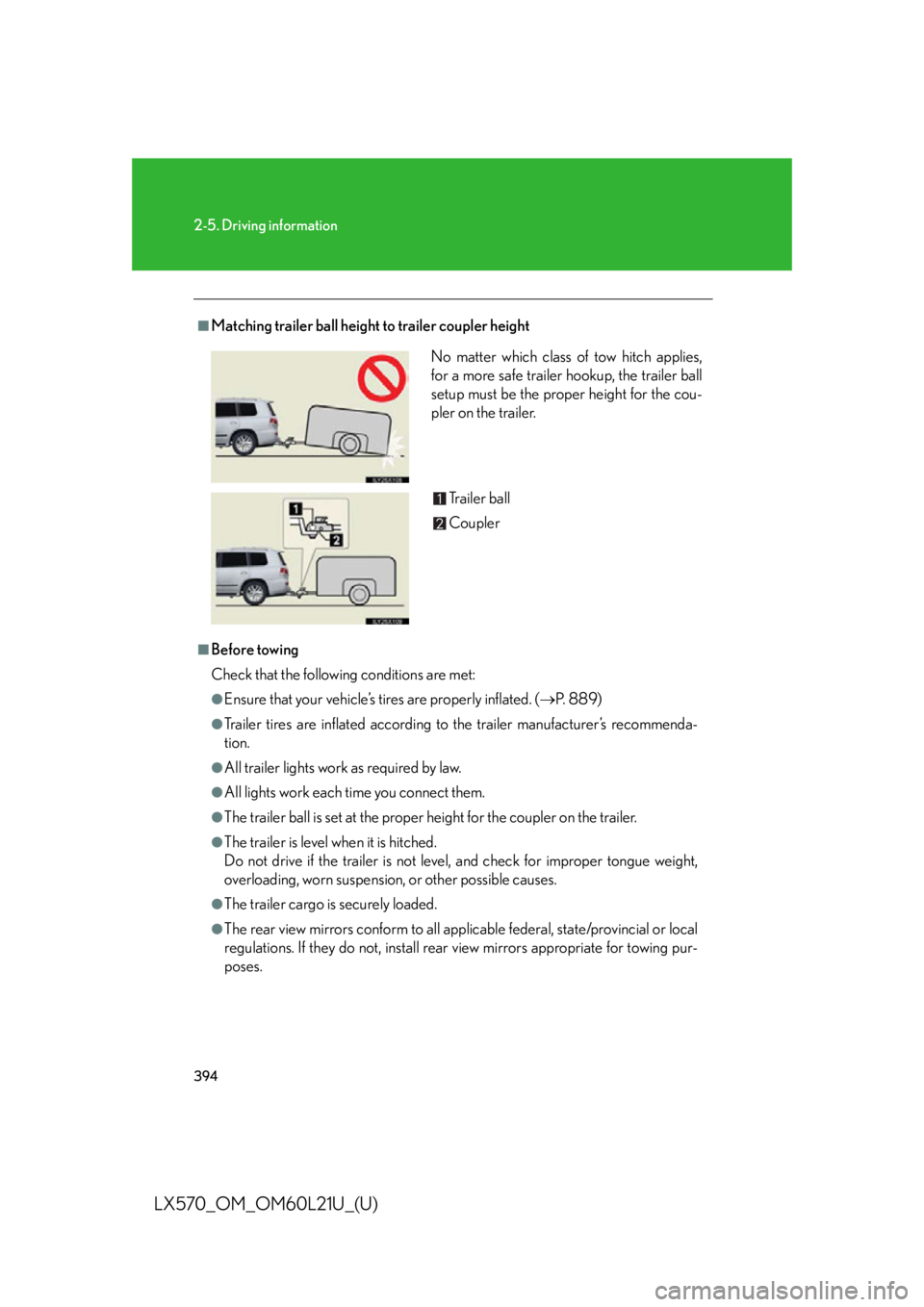
Matching trailer ball height to trailer coupler height
■
Before towing
Check that the following conditions are met: ●
Ensure that your vehicle’s tires are properly inflated. ( P. 8 8 9 )●
Trailer tires are inflated according to the trailer manufacturer’s recommenda-
tion. ●
All trailer lights work as required by law. ●
All lights work each time you connect them. ●
The trailer ball is set at the proper height for the coupler on the trailer. ●
The trailer is level when it is hitched.
Do not drive if the trailer is not level, and check for improper tongue weight,
overloading, worn suspension , or other possible causes.●
The trailer cargo is securely loaded. ●
The rear view mirrors conform to all applicable federal, state/provincial or local
regulations. If they do not, install rear view mirrors appropriate for towing pur-
poses. No matter which class of tow hitch applies,
for a more safe trailer hookup, the trailer ball
setup must be the proper height for the cou-
pler on the trailer.
Trailer ball
Coupler
Page 396 of 956

3962-5. Driving information
LX570_OM_OM60L21U_(U) ●
After the trailer swaying has stopped:
• Stop in a safe place. Get all occupants out of the vehicle.
• Check the tires of the vehicle and the trailer.
• Check the load in the trailer.
Make sure the load has not shifted.
Make sure the tongue weight is appropriate, if possible.
• Check the load in the vehicle.
Make sure the vehicle is not ov erloaded after occupants get in.
If you cannot find any problems, the speed at which trailer swaying occurred is
beyond the limit of your particular vehicle-trailer combination.
Drive at a lower speed to prevent instability. Remember that swaying of the towing
vehicle-trailer increases as speed increases.
CAUTION■
Trailer towing precautions ●
To tow a trailer safely, use extreme care and drive the vehicle in accordance with
the trailer’s characteristics and operating conditions. Failure to do so could cause
an accident resulting in death or seriou s injury. Vehicle stability and braking per-
formance are affected by trailer stability, brake setting and performance, and the
hitch. Your vehicle will handle differently when towing a trailer.●
Set the vehicle height to the “LO” mode and turn off the 4-Wheel AHC when you
connect a trailer, otherwise the vehicle height may change due to the automatic
leveling function, and you may catch part of your body in the vehicle, resulting in
an accident. ( P. 3 1 8 )
Page 397 of 956
3972-5. Driving information
2
When driving
LX570_OM_OM60L21U_(U) CAUTION■
To avoid accident or injury ●
Do not exceed the TWR, unbraked TWR, GCWR, GVWR or GAWR. ●
If the gross trailer weight is over 2000 lb. (907 kg), a sway control device with
sufficient capacity is required. ●
If the gross trailer weight is over 5000 lb . (2268 kg), a weight distributing hitch
with sufficient capacity is required. ●
Adjust the tongue weight within the appropriate range. Place heavier loads as
close to the trailer axle as possible. ●
Do not exceed 65 mph (104 km/h), the posted towing speed limit or the speed
limit for your trailer as set forth in your trailer owner’s manual, whichever is lowest.
Slow down sufficiently before making a turn, in crosswinds, on wet or slippery
surface, etc. to help avoid an accident. If you experience a vehicle-trailer instabil-
ity from reducing a certain speed, slow down and make sure you keep your vehi-
cle speed under the speed of which you experience the instability. ●
Do not make jerky, abrupt or sharp turns. ●
Do not apply the brakes suddenly as you may skid, resulting in jackknifing and
loss of vehicle control. This is especially true on wet or slippery surfaces. ●
Do not exceed the trailer hitch assembly weight, gross vehicle weight, gross axle
weight and trailer tongue weight capacities. ●
Do not use cruise control when towing. ●
Slow down and downshift before descending steep or long downhill grades. Do
not make sudden downshifts while descending steep or long downhill grades. ●
Vehicle-trailer instability is more likely on steep long down hills. Before descend-
ing steep or long downhill grades, slow down and downshift. Do not make sudden
downshifts when descending steep or lo ng downhill grades. Avoid holding the
brake pedal down too long or applying the brakes too frequently. This could
cause the brakes to overheat and result in reduced braking efficiency.
Page 398 of 956
3982-5. Driving information
LX570_OM_OM60L21U_(U) CAUTION■
Hitch
Trailer hitch assemblies have different weight capacities established by the hitch
manufacturer. Even though the vehicle may be physically capable of towing a
higher weight, the operator must determin e the maximum weight rating of the par-
ticular hitch assembly and never exceed the maximum weight rating specified for
the trailer-hitch. Exceeding the maximum weight rating se t by the trailer-hitch man-
ufacturer can cause an accident resulting in death or serious personal injuries. ■
When towing a trailer
Lexus recommends trailers with brakes that conform to any applicable federal and
state/provincial regulations. ●
If the gross trailer weight exceeds unbraked TWR, trailer brakes are required.
Lexus recommends trailers with brakes that conform to all applicable federal and
state/provincial regulations. ●
Never tap into your vehicle’s hydraulic system, as this will lower the vehicle’s brak-
ing effectiveness. ●
Never tow a trailer without using a safety chain securely attached to both the
trailer and the vehicle. If damage occurs to the coupling unit or hitch ball, there is
danger of the trailer wand ering into another lane.
NOTICE■
When installing a trailer hitch
Use only the position recommended by your Lexus dealer. Do not install the trailer
hitch on the bumper; this may cause body damage. ■
Do not directly splice trailer lights
Do not directly splice trailer lights. Direct ly splicing trailer li ghts may damage your
vehicle’s electrical system and cause a malfunction.