belt LEXUS LX570 2014 Workshop Manual
[x] Cancel search | Manufacturer: LEXUS, Model Year: 2014, Model line: LX570, Model: LEXUS LX570 2014Pages: 956, PDF Size: 16.4 MB
Page 159 of 956
1591-7. Safety information
1
Before driving
LX570_OM_OM60L21U_(U) ■
Laws and regulations pe rtaining to Anchors
The LATCH system conforms to FMVSS225 or CMVSS210.2.
Child restraint systems co nforming to FMVSS213 or CMVSS213 specifications
can be used.
This vehicle is designed to conform to the SAE J1819.
CAUTION■
When installing a booster seat
Do not fully extend the shoulder belt to prevent the belt from going to ALR lock
mode: ( P. 9 5 )
ALR mode causes the belt to tighten only which could cause injury or discomfort to
the child. ■
When installing a child restraint system
Follow the directions given in the child re straint system installa tion manual and fix
the child restraint system securely in place.
If the child restraint system is not correctl y fixed in place, the child or other passen-
gers may be seriously injured or even killed in the event of sudden braking, sudden
swerving or an accident. ●
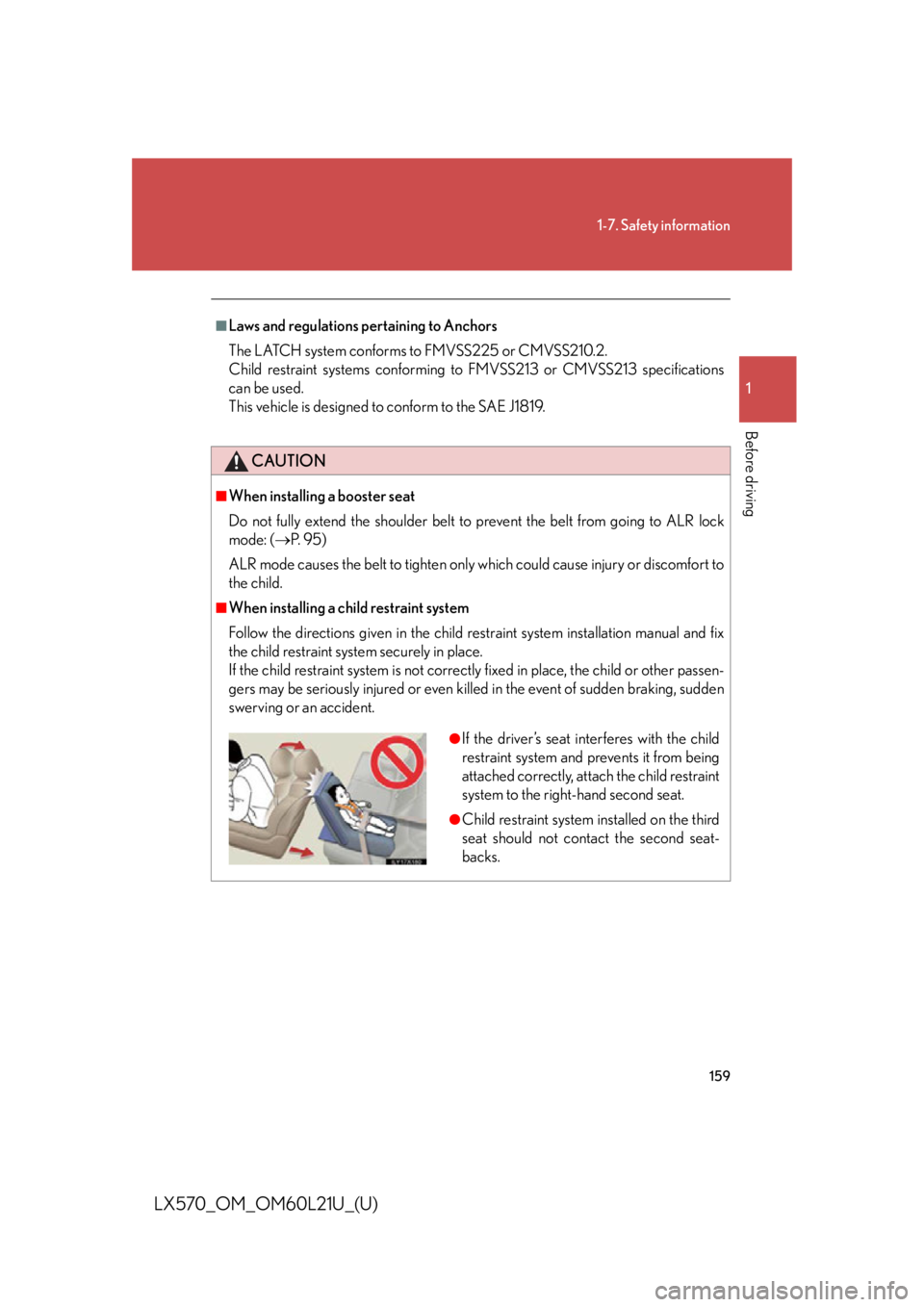
If the driver’s seat interferes with the child
restraint system and prevents it from being
attached correctly, attach the child restraint
system to the right-hand second seat. ●
Child restraint system installed on the third
seat should not cont act the second seat-
backs.
Page 160 of 956
1601-7. Safety information
LX570_OM_OM60L21U_(U) CAUTION■
When installing a child restraint system
●
When using the LATCH anchors for a child restraint system, move the seat as far
back as possible, with the seatback close to the child restraint system. ●
When a booster seat is installed, always ensure that the shoulder belt is posi-
tioned across the center of the child’s sh oulder. The belt should be kept away from
the child’s neck, but not so that it could fall off the child’s shoulder. Failing to do so
may result in death or serious injury in the event of sudden braking, sudden
swerving or an accident. ●
Ensure that the belt and tab are securely locked and the seat belt is not twisted. ●
Shake the child restraint system left and right, and forward and backward to
ensure that it has be en securely installed.●
After securing a child restraint system, never adjust the seat. ●
Follow all installation instructions provid ed by the child restraint system manufac-
turer.■
Do not use a seat belt extender
If a seat belt extender is used when inst alling a child restraint system, the seat belt
will not securely hold the child restraint system, which could cause death or serious
injury to the child or other passengers in the event of sudden braking, sudden
swerving or an accident. ●
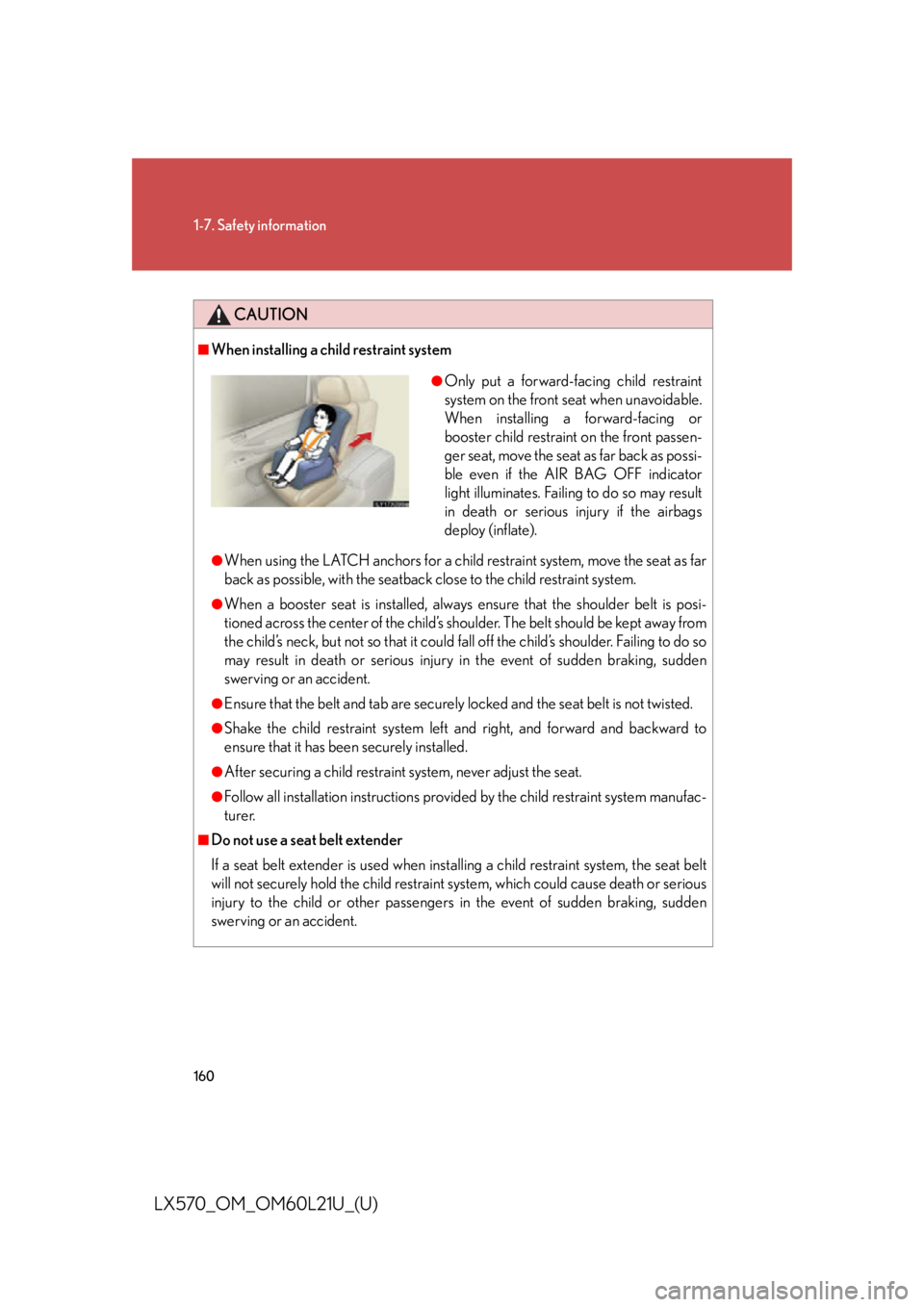
Only put a forward-facing child restraint
system on the front seat when unavoidable.
When installing a forward-facing or
booster child restraint on the front passen-
ger seat, move the seat as far back as possi-
ble even if the AIR BAG OFF indicator
light illuminates. Failing to do so may result
in death or serious injury if the airbags
deploy (inflate).
Page 161 of 956

1611-7. Safety information
1
Before driving
LX570_OM_OM60L21U_(U) CAUTION■
To correctly attach a child restraint system to the anchors
When using the LATCH anchors, be sure that there are no foreign objects around
the anchors and that the seat belt is no t caught behind the child restraint system.
Make sure the child restraint system is se curely attached, or it may cause death or
serious injury to the child or other passen gers in the event of a sudden stop, sudden
swerve or accident.
Page 355 of 956

3552-4. Using other driving systems
2
When driving
LX570_OM_OM60L21U_(U) Pre-Collision System
: If equippedWhen the radar sensor detects possibilit y of a frontal collision, the pre-col-
lision systems such as the brakes and seat belts are automatically engaged
to lessen impact as well as vehicle damage.
■ Pre-collision seat belts (front seats only) If the pre-collision sensor detects that a collision is unavoidable, the pre-
collision system will retract the seat belt before the collision occurs.
The same will happen if the driver makes an emergency braking or loses
control of the vehicle. ( P. 9 4 )
However, when the VSC system is disabled, the system will not operate in
the event of skidding.
■ Pre-collision brake assist When there is a high possibility of a frontal collision, the system applies
greater braking force in relation to how strongly the brake pedal is
depressed.
■ AVS control When the system determines that there is a high possibility of a frontal col-
lision, the AVS optimizes the damping effect. ( P. 3 2 9 )
Page 356 of 956

3562-4. Using other driving systems
LX570_OM_OM60L21U_(U) Radar sensor
Detects vehicles or other obsta-
cles on or near the road ahead and
determines whether a collision is
imminent based on the position,
speed, and heading of the obsta-
cles.When traveling on a road with very light traffic and very little to reflect the radar
waves emitted by the radar sensor, the system may decide that the radar sensor
is dirty, even if the sensor is not actually dirty. The system will automatically
restore itself when reflected radar waves are detected. ■
Obstacles not detected
The sensor cannot detect plastic obstacles such as pylons. There may also be occa-
sions when the radar sensor cannot detect pedestrians, animals, bicycles, motorcy-
cles, trees, or snowdrifts. ■
The pre-collision system is operational when ●
Pre-collision seat belts (situation 1)
• Vehicle speed is greater than about 4 mph (5 km/h).
• The speed at which your vehicle is approaching the obstacle or the vehicle
running ahead of you is greater than about 19 mph (30 km/h).
• The front occupants are wearing a seat belt. ●
Pre-collision seat belts (situation 2)
• Vehicle speed is greater than about 19 mph (30 km/h).
• The system detects sudd en braking or skidding.
• The front occupants are wearing a seat belt.
Page 357 of 956

3572-4. Using other driving systems
2
When driving
LX570_OM_OM60L21U_(U) ●
Pre-collision brake assist
• Vehicle speed is greater than about 19 mph (30 km/h).
• The speed at which your vehicle is approaching the obstacle or the vehicle
running ahead of you is greater than about 19 mph (30 km/h).
• The brake pedal is depressed. ●
AV S
• Vehicle speed is greater than about 4 mph (5 km/h).
• The speed at which your vehicle is approaching the obstacle or the vehicle
running ahead of you is greater than about 19 mph (30 km/h).■
Conditions that may trigger the system even if there is no possibility of collision ●
When there is an object by the roadside at the entrance to a curve ●
When passing an oncoming vehicle on a curve ●
When driving over a narrow iron bridge●
When there is a metal object on the road surface ●
When driving on an uneven road surface (nose up, nose down)●
When passing an oncoming vehicle on a left-turn ●
When your vehicle rapidly closes on the vehicle in front ●
When a grade separation/interchange, sign, billboard, or other structure
appears to be directly in the vehicle’s line of travel ●
When climbing a steep hill causes an over head billboard or ot her metallic struc-
ture to appear directly in the vehicle’s line of travel ●
When an extreme change in vehicle height occurs ●
When the axis of the radar is out of adjustment ●
When passing through certain toll gates ●
When passing through an overpass ●
When passing through a tunnel
When the system is activated in the situations described above there is also a possi-
bility that the seat belts will retract quickly and the brakes will be applied with a force
greater than normal. When the seat belt is locked in the retracted position, stop the
vehicle in a safe place, release the seat belt and refasten.
Page 362 of 956

3622-5. Driving information
LX570_OM_OM60L21U_(U) CAUTION■
Off-road vehicle precautions
Always observe the following precautions to minimize the risk of serious personal
injury or damage to your vehicle: ●
In a rollover crash, an unbelted person is significantly more likely to die than a
person wearing a seat belt. Therefore, the driver and all passengers should fasten
their seat belts whenever the vehicle is moving. ●
Avoid sharp turns or abrupt maneuvers, if at all possible.
Failure to operate this vehicle correctly may result in loss of control or vehicle roll-
over causing death or serious injury. ●
Loading cargo on the roof luggage carrier will make the center of the vehicle
gravity higher. Avoid high speeds, sudden starts, sharp turns, sudden braking or
abrupt maneuvers, otherwise it may result in loss of control or vehicle rollover
due to failure to operate this vehicle correctly. ●
Always slow down in gusty crosswinds. Because of its profile and higher center of
gravity, your vehicle is more sensitive to side winds than an ordinary passenger
car. Slowing down will allow you to have better control. ●
Do not drive horizontally across steep slop es. Driving straight up or straight down
is preferred. Your vehicle (or any similar off-road vehicle) can tip over sideways
much more easily than forward or backward.
Page 370 of 956

3702-5. Driving information
LX570_OM_OM60L21U_(U) CAUTION■
Things that must not be carri ed in the luggage compartment
The following things may cause a fire if loaded in the luggage compartment. ●
Receptacles containing gasoline ●
Aerosol cans■
Storage precautions
Observe the following precautions.
Failing to do so may result in death or serious injury. ●
Stow cargo and luggage in the lugga ge compartment whenever possible.●
Do not stack anything in the luggage compartment higher than the seatbacks.
Such items may be thrown about and possib ly injure people in the vehicle during
sudden braking, sudden swerving or in an accident. ●
Do not place cargo or luggage in or on the following locations as the items may
get under the brake or accelerator pedal and prevent the pedals from being
depressed properly, block the driver’s vision, or hit the driver or passengers,
causing an accident.
•Driver’s feet
• Front passenger or rear seats (when stacking items)
•Instrument panel
•Dashboard
• Auxiliary box or tray that has no lid ●
Secure all items in the occupant compartment, as they may shift and injure some-
one during sudden braking, sudd en swerving or an accident.●
When you fold down the rear seats, long items should not be placed directly
behind the front seats. ●
Never allow anyone to ride in the luggage compartment. It is not designed for
passengers. They should ride in their seat s with their seat belt s properly fastened.
Otherwise, they are much more likely to suffer death or serious injury, in the
event of sudden braking, sudd en swerving or an accident.
Page 736 of 956
7344-1. Maintenance and care
LX570_OM_OM60L21U_(U) ■
Caring for leather areas
Lexus recommends cleaning the interior of the vehicle at least twice a year to main-
tain the quality of the vehicle’s interior. ■
Shampooing the carpets
There are several commercial foaming-type cleaners available. Use a sponge or
brush to apply the foam. Rub in overlappin g circles. Do not apply water. Excellent
results are obtained by keeping the carpet as dry as possible. ■
Seat belts
Clean with mild soap and lukewarm water using a cloth or sponge. Also check the
belts periodically for excessive wear, fraying or cuts.
CAUTION■
Water in the vehicle ●
Do not splash or spill liquid in the vehicle.
Doing so may cause electrical components etc. to malfunction or catch fire.●
Do not get any of the SRS components or wiring in the vehicle interior wet.
( P. 1 2 6 )
Electrical malfunction may cause the airbag s to deploy or not function properly,
resulting in death or serious injury.■
Cleaning the interior (especially instrument panel)
Do not use polish wax or polish cleaner. The instrument panel may reflect off the
windshield, obstructing the driver’s view and leading to an accident, resulting in
death or serious injury.
Page 742 of 956
7404-2. Maintenance
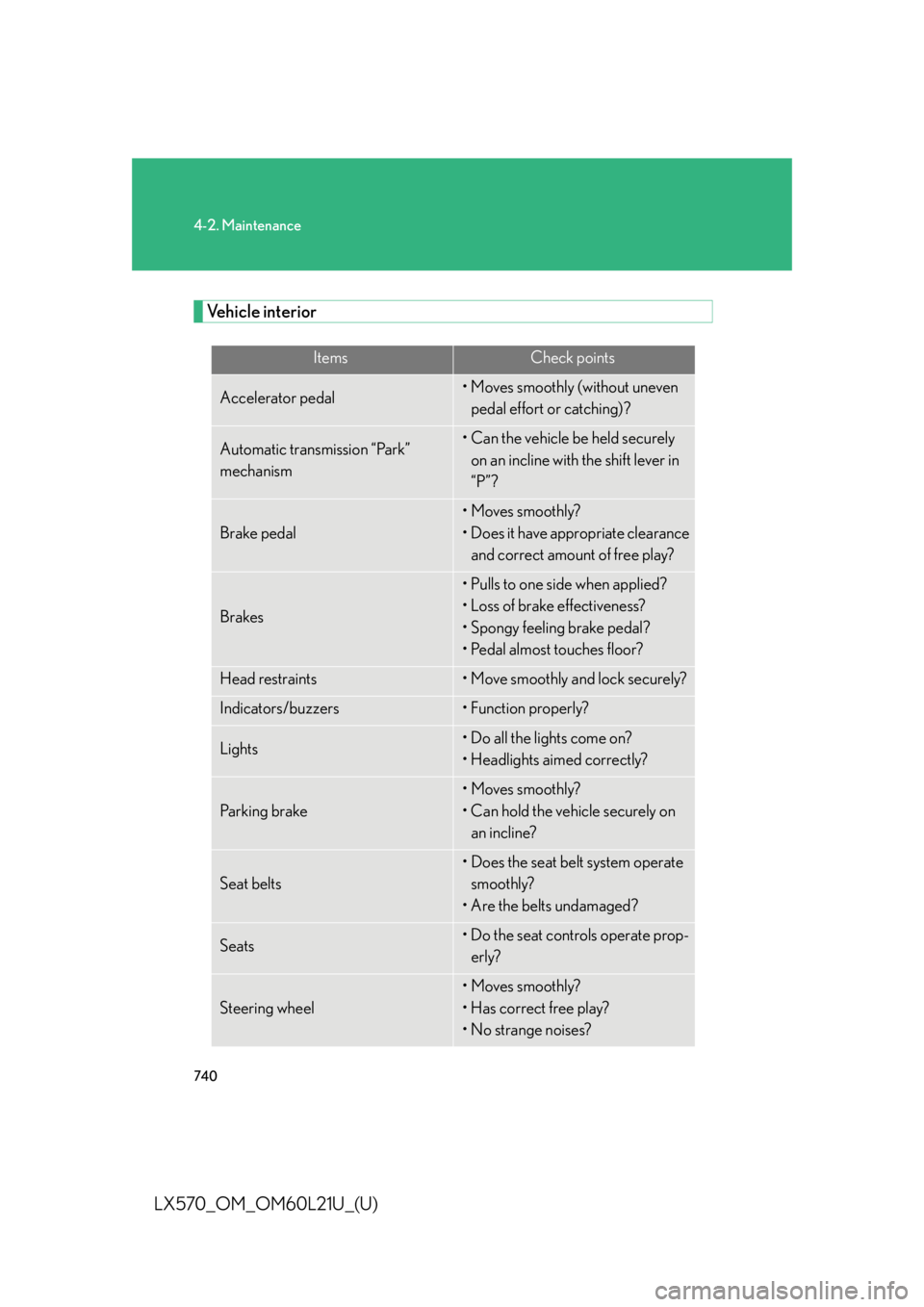
LX570_OM_OM60L21U_(U) Vehicle interior Items Check points
Accelerator pedal • Moves smoothly (without uneven
pedal effort or catching)?
Automatic transmission “Park”
mechanism • Can the vehicle be held securely
on an incline with the shift lever in
“P”?
Brake pedal • Moves smoothly?
• Does it have appropriate clearance
and correct amount of free play?
Brakes • Pulls to one side when applied?
• Loss of brake effectiveness?
• Spongy feeling brake pedal?
• Pedal almost touches floor?
Head restraints • Move smoothly and lock securely?
Indicators/buzzers • Function properly?
Lights • Do all the lights come on?
• Headlights aimed correctly?
Pa r k i n g b r a ke • Moves smoothly?
• Can hold the vehicle securely on
an incline?
Seat belts • Does the seat belt system operate
smoothly?
• Are the belts undamaged?
Seats • Do the seat controls operate prop-
erly?
Steering wheel • Moves smoothly?
• Has correct free play?
• No strange noises?