ECU LEXUS LX570 2014 Manual PDF
[x] Cancel search | Manufacturer: LEXUS, Model Year: 2014, Model line: LX570, Model: LEXUS LX570 2014Pages: 956, PDF Size: 16.4 MB
Page 862 of 956

8605-2. Steps to take in an emergency
LX570_OM_OM60L21U_(U) CAUTION■
Using the tire jack
Improper use of the tire jack may lead to death or serious injuries due to the vehicle
suddenly falling off the jack. ●
Do not use the tire jack for any purpose ot her than replacing tires or installing and
removing tire chains. ●
Only use the tire jack that comes with this vehicle for replacing a flat tire.
Do not use it on other vehicles, and do no t use other tire jacks for replacing tires
on this vehicle. ●
Always check that the tire jack is securely set to the jack point.●
Be sure to turn off the 4-Wh eel AHC and stop the engine.●
Do not put any part of your body under the vehicle supported by a jack. ●
Do not start or run the engine while your vehicle is supported by the jack. ●
Do not raise the vehicle while someone is in it. ●
When raising the vehicle, do not put an object on or under the jack. ●
Do not raise the vehicle to a height greate r than that required to replace the tire.●
Use a jack stand if it is necessary to get under the vehicle.
Take particular care when lowering the vehicle to ensure that no one working on or
near the vehicle will be injured. ■
Using the jack handle
Tighten all the jack handle bolts securely using a Phillips-head screwdriver, to pre-
vent the extension parts from coming apart unexpectedly.
Page 880 of 956

8785-2. Steps to take in an emergency
LX570_OM_OM60L21U_(U) If your vehicle has to be stopped in an emergency
CAUTION■
If the engine has to be turned off while driving
Power assist for the brakes and steering wh eel will be lost, making the brake pedal
harder to depress and the steering wheel heavier to turn. Decelerate as much as
possible before turning off the engine.Only in an emergency, such as if it becomes impossible to stop the vehicle
in the normal way, stop the vehicle using the following procedure:
Steadily step on the brake pe dal with both feet and firmly
depress it. Do not pump the brake pedal repeatedly as this will increase the
effort required to slow the vehicle.
Shift the shift lever to “N”.
If the shift lever is shifted to “N”
After slowing down, stop the vehicl e in a safe place by the road.
Stop the engine.
If the shift lever cannot be shifted to “N”
Keep depressing the brake pedal with both feet to reduce vehi-
cle speed as much as possible.
To stop the engine, press and
hold the “ENGINE START
STOP” switch for 2 consecutive
seconds or more, or press it
briefly 3 times or more in suc-
cession.
Stop the vehicle in a safe place by the road. STEP 1
STEP 2
STEP 3
STEP 4
STEP 3
STEP 4
Press and hold for 2 seconds or more,
or press briefly 3 times or more STEP 5
Page 909 of 956
9056-1. Specifications
6
Vehicle specifications
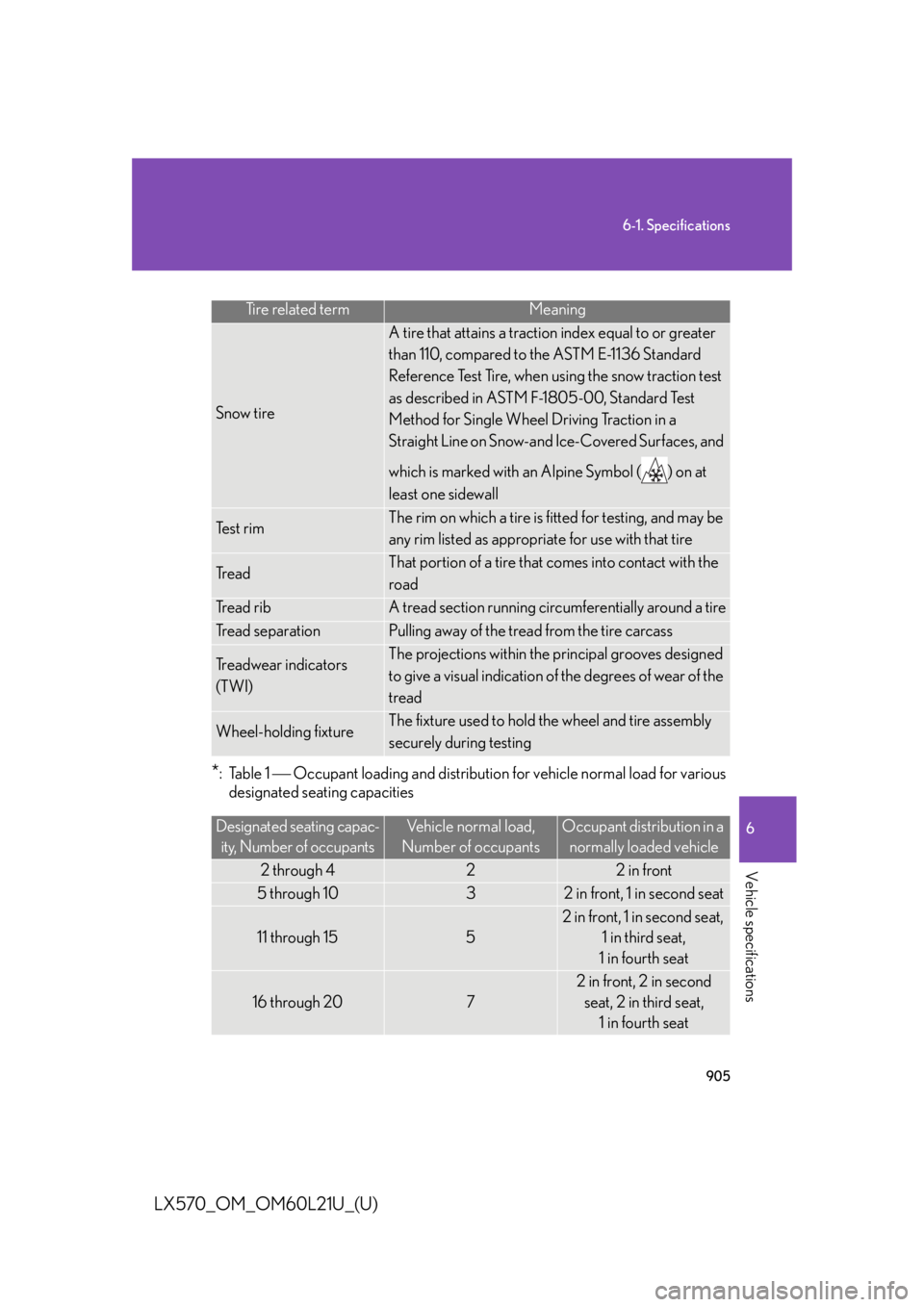
LX570_OM_OM60L21U_(U) * : Table 1 Occupant loading and distribution for vehicle normal load for various
designated seating capacities Tire related term Meaning
Snow tire A tire that attains a traction index equal to or greater
than 110, compared to the ASTM E-1136 Standard
Reference Test Tire, when using the snow traction test
as described in ASTM F-1805-00, Standard Test
Method for Single Wheel Driving Traction in a
Straight Line on Snow-and Ice-Covered Surfaces, and
which is marked with an Alpine Symbol ( ) on at
least one sidewall
Te s t r i m The rim on which a tire is fitted for testing, and may be
any rim listed as appropriate for use with that tire
Tr e a d That portion of a tire that comes into contact with the
road
Tr e a d r i b A tread section running circumferentially around a tire
Tread separation Pulling away of the tread from the tire carcass
Treadwear indicators
(TWI) The projections within the principal grooves designed
to give a visual indication of the degrees of wear of the
tread
Wheel-holding fixture The fixture used to hold the wheel and tire assembly
securely during testing
Designated seating capac-
ity, Number of occupants Vehicle normal load,
Number of occupants Occupant distribution in a
normally loaded vehicle
2 through 4 2 2 in front
5 through 10 3 2 in front, 1 in second seat
11 through 15 5 2 in front, 1 in second seat,
1 in third seat,
1 in fourth seat
16 through 20 7 2 in front, 2 in second
seat, 2 in third seat,
1 in fourth seat