flat tire LEXUS LX570 2015 Service Manual
[x] Cancel search | Manufacturer: LEXUS, Model Year: 2015, Model line: LX570, Model: LEXUS LX570 2015Pages: 960, PDF Size: 11.33 MB
Page 867 of 960
5
When trouble arises
8655-2. Steps to take in an emergency
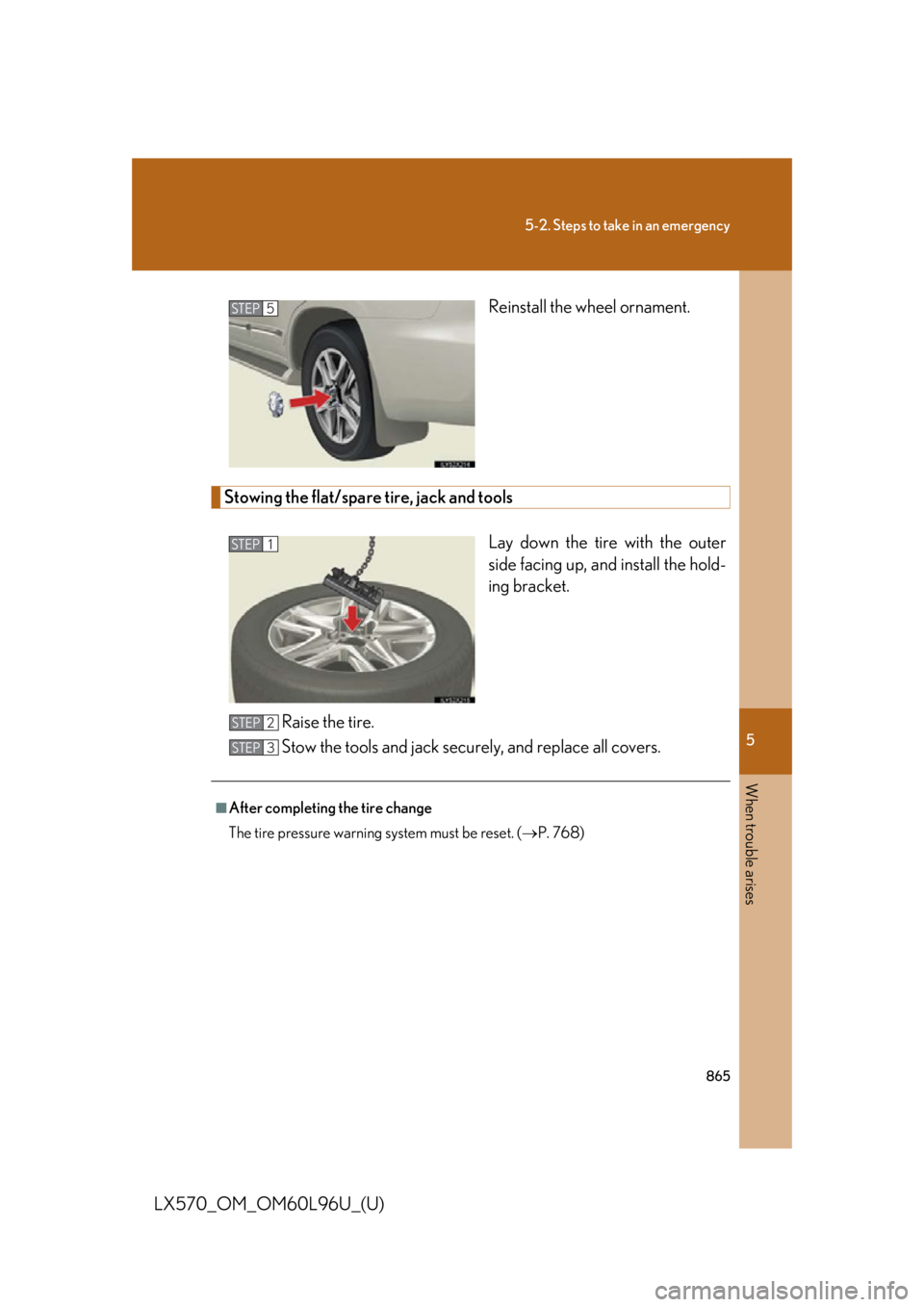
LX570_OM_OM60L96U_(U) Reinstall the wheel ornament.
Stowing the flat/spare tire, jack and tools
Lay down the tire with the outer
side facing up, and install the hold-
ing bracket.
Raise the tire.
Stow the tools and jack secu rely, and replace all covers.STEP 5
STEP 1
■
After completing the tire change
The tire pressure warning system must be reset. ( P. 768)STEP 2
STEP 3
Page 868 of 960

8665-2. Steps to take in an emergency
LX570_OM_OM60L96U_(U) CAUTION■
Using the tire jack
Improper use of the tire jack may lead to death or serious injuries due to the vehicle
suddenly falling off the jack. ●
Do not use the tire jack for any purpose other than replacing tires or installing
and removing tire chains. ●
Only use the tire jack that comes with this vehicle for replacing a flat tire.
Do not use it on other vehicles, and do no t use other tire jack s for replacing tires
on this vehicle. ●
Always check that the tire jack is securely set to the jack point. ●
Be sure to turn off the 4-Wheel AHC and stop the engine. ●
Do not put any part of your body un der the vehicle supported by a jack.●
Do not start or run the engine while your vehicle is supported by the jack. ●
Do not raise the vehicle while someone is in it. ●
When raising the vehicle, do not put an object on or under the jack. ●
Do not raise the vehicle to a height greate r than that required to replace the tire.●
Use a jack stand if it is necessary to get under the vehicle.
Take particular care when lowering the vehi cle to ensure that no one working on or
near the vehicle will be injured. ■
Using the jack handle
Tighten all the jack handle bolts securely using a Phillips-head screwdriver, to pre-
vent the extension parts from coming apart unexpectedly.
Page 869 of 960
5
When trouble arises
8675-2. Steps to take in an emergency
LX570_OM_OM60L96U_(U) CAUTION■
Replacing a flat tire ●
Observe the following precautions.
Failure to do so may result in serious injury:
• Lower the spare tire completely to the ground before removing it from under
the vehicle.
• Do not try to remove the wheel ornament by hand. Take due care in handling
the ornament to avoid unexpected personal injury.
• Do not touch the disc wheels or the area around the brakes immediately after
the vehicle has been driven.
After the vehicle has been driven the disc wheels and the area around the
brakes will be extremely hot. Touching these areas with hands, feet or other
body parts while changing a ti re, etc. may result in burns.
• Turn off the vehicle height control.
The vehicle height may change due to the automatic leveli ng function and
you may catch part of your body in th e vehicle, resulting in an accident.
( P. 320)●
Failure to follow these precautions could cause the wheel nuts to loosen and the
tire to fall off, resulting in death or serious injury.
• Never use oil or grease on the wheel bolts or wheel nuts.
Oil and grease may cause the wheel nuts to be excessively tightened, leading
to bolt or disc wheel damage. In addition, the oil or grease can cause the
wheel nuts to loosen and the wheel may fall off, causing a serious accident.
Remove any oil or grease from the wheel bolts or wheel nuts.
• Have the wheel nuts tightened with a torque wrench to 97 ft
• lbf (131 N
• m,
13.4 kgf
• m) as soon as possible after changing wheels.
• When installing a tire, only use whee l nuts that have been specifically
designed for that wheel.
• If there are any cracks or deformations in the bolt screws, nut threads or bolt
holes of the wheel, have the vehicle inspected by your Lexus dealer.
• Do not attach a heavily damaged wheel ornament, as it may fly off the wheel
while the vehicle is moving.
Page 870 of 960
8685-2. Steps to take in an emergency
LX570_OM_OM60L96U_(U) CAUTION■
Replacing a flat tire for vehicles with power back door
In cases such as when replacing tires, ma ke sure to turn off the power back door
main switch ( P. 57). Failure to do so may cause the back door to operate unin-
tentionally if the power back door switch is accidentally touched, resulting in hands
and fingers being caught and injured.
NOTICE■
Do not drive the vehicle with a flat tire.
Do not continue driving with a flat tire.
Driving even a short distance with a flat tire can damage the tire and the wheel
beyond repair. ■
When stowing the flat tire
Ensure that there is no object caught between the tire and the vehicle underbody. ■
When replacing the tires ●
When removing or fitting the wheels, tires or the tire pressure warning valve and
transmitter, contact your Lexus dealer as the tire pressure warning valve and
transmitter may be damaged if not handled correctly.●
Replace the grommets for th e tire pressure warning valves and transmitters as
well.■
To avoid damage to the tire pressure warning valves and transmitters
When a tire is repaired with liquid seal ants, the tire pressu re warning valve and
transmitter may not operate properly. If a liquid sealant is used, contact your Lexus
dealer or other qualified serv ice shop as soon as possible. Make sure to replace the
tire pressure warning valve and tran smitter when replacing the tire. ( P. 767)
Page 899 of 960

8956-1. Specifications
6
Vehicle specifications
LX570_OM_OM60L96U_(U) Suspension
Tires and wheels Fluid type Suspension fluid AHC
Tire size P285/50R20 111V
Tire inflation pressure
(Recommended cold tire inflation
pressure) Normal driving
Front:
33 psi (230 kPa, 2.3 kgf/cm 2
or bar)
Rear:
33 psi (230 kPa, 2.3 kgf/cm 2
or bar)
Spare:
33 psi (230 kPa, 2.3 kgf/cm 2
or bar)
Trailer towing
Add 2 psi (10 kPa, 0.1 kgf/cm 2
or bar) to the
rear tires.
Wheel size 20 8 1/2J
Wheel nut torque 97 ft•lbf (131 N•m, 13.4 kgf•m)
Page 905 of 960
9016-1. Specifications
6
Vehicle specifications
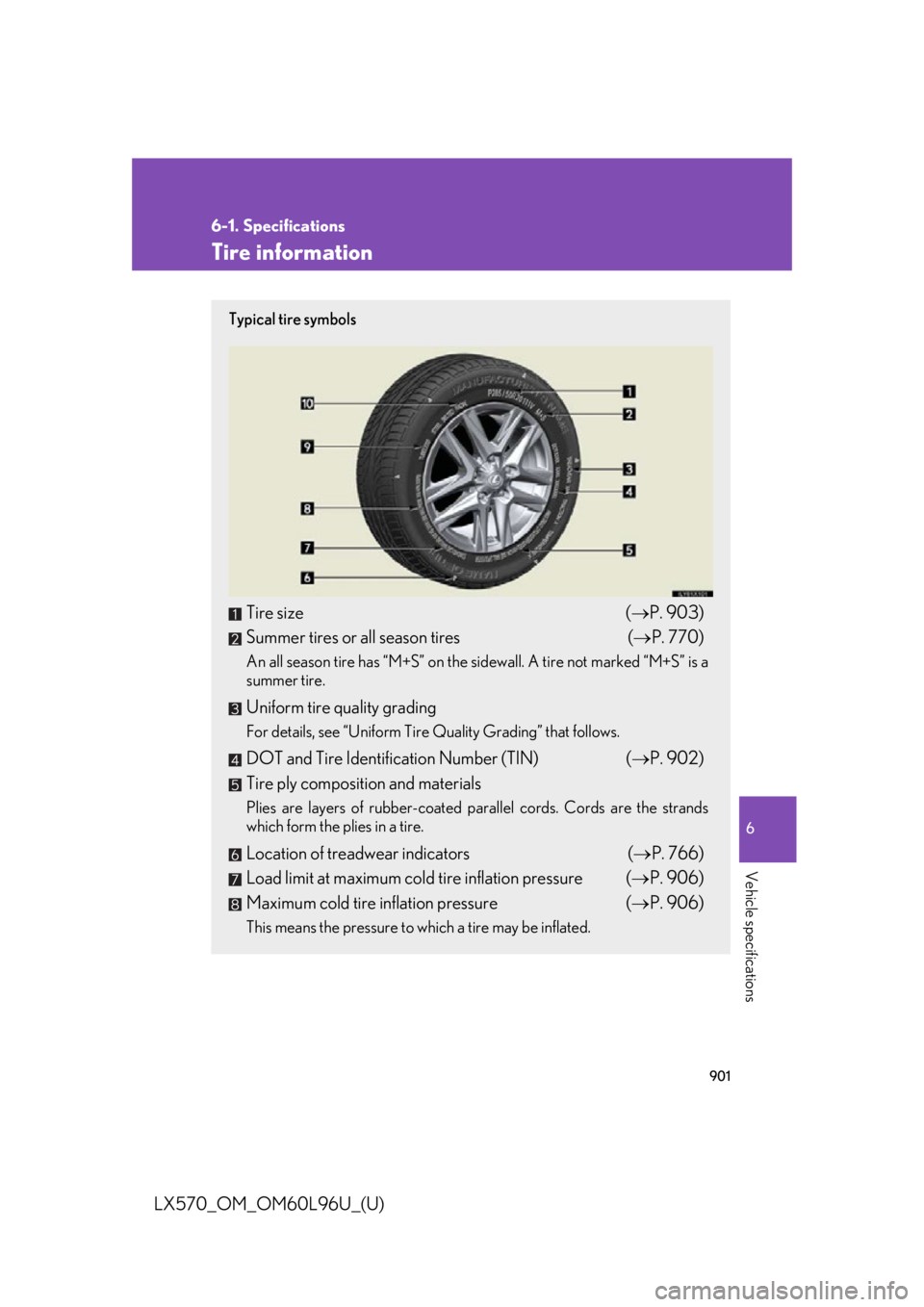
LX570_OM_OM60L96U_(U) Tire information Typical tire symbols
Tire size ( P. 903)
Summer tires or all season tires ( P. 770)An all season tire has “M+S” on the si dewall. A tire not marked “M+S” is a
summer tire.
Uniform tire quality grading For details, see “Uniform Tire Quality Grading” that follows.
DOT and Tire Identification Number (TIN) ( P. 902)
Tire ply composition and materials Plies are layers of rubber-coated pa rallel cords. Cords are the strands
which form the plies in a tire.
Location of treadwear indicators ( P. 766)
Load limit at maximum co ld tire inflation pressure ( P. 906)
Maximum cold tire inflation pressure ( P. 906)This means the pressure to wh ich a tire may be inflated.
Page 910 of 960

9066-1. Specifications
LX570_OM_OM60L96U_(U) Warning: The temperature grades of a tire assume that it is properly inflated
and not overloaded.
Excessive speed, underinflation, or exce ssive loading, either separately or
in combination, can cause heat bu ildup and possible tire failure.
Glossary of tire terminology Tire related term Meaning
Cold tire inflation
pressure Tire pressure when the vehicle has been parked for
three hours or more, or ha s not been driven more
than 1 mile or 1.5 km under that condition
Maximum inflation pres-
sure The maximum cold inflated pressure to which a tire
may be inflated, shown on the sidewall of the tire
Recommended inflation
pressure Cold tire inflation pressure recommended by a manu-
facturer
Accessory weight The combined weight (in excess of those standard
items which may be replaced) of automatic transmis-
sion, power steering, power brakes, power windows,
power seats, radio and heater, to the extent that these
items are available as f actory-installed equipment
(whether installed or not)
Curb weight The weight of a motor vehi cle with standard equip-
ment, including the maximum capacity of fuel, oil and
coolant, and if so equipped, air conditioning and addi-
tional weight optional engine
Maximum loaded
vehicle weight The sum of:
(a) Curb weight
(b) Accessory weight
(c) Vehicle capacity weight
(d) Production options weight
Normal occupant weight 150 lb. (68 kg) times the nu mber of occupants speci-
fied in the second column of Table 1
* that follows
Occupant distribution Distribution of occupants in a vehicle as specified in
the third column of Table 1
* below
Page 911 of 960

9076-1. Specifications
6
Vehicle specifications
LX570_OM_OM60L96U_(U) Tire related term Meaning
Production options weight The combined weight of installed regular production
options weighing over 5 lb. (2.3 kg) in excess of the
standard items which they replace, not previously
considered in curb weig ht or accessory weight,
including heavy duty brakes, ride levelers, roof rack,
heavy duty battery, and special trim
Rim A metal support for a tire or a tire and tube assembly
upon which the tire beads are seated
Rim diameter
(Wheel diameter) Nominal diameter of the bead seat
Rim size designation Rim diameter and width
Rim type designation The industry manufacturer’s designation for a rim by
style or code
Rim width Nominal distance between rim flanges
Vehicle capacity weight
(Total load capacity) The rated cargo and luggage load plus 150 lb. (68 kg)
times the vehicle’s designated seating capacity
Vehicle maximum load on
the tire The load on an individual ti re that is determined by
distributing to each axle its share of the maximum
loaded vehicle weight, and dividing by two
Vehicle normal load on the
tire The load on an individual ti re that is determined by
distributing to each axle its share of curb weight,
accessory weight, and normal occupant weight (dis-
tributed in accordance with Table 1
* below), and
dividing by two
Weather side The surface area of the rim not covered by the inflated
tire
Bead The part of the tire that is made of steel wires,
wrapped or reinforced by pl y cords and that is shaped
to fit the rim
Page 912 of 960
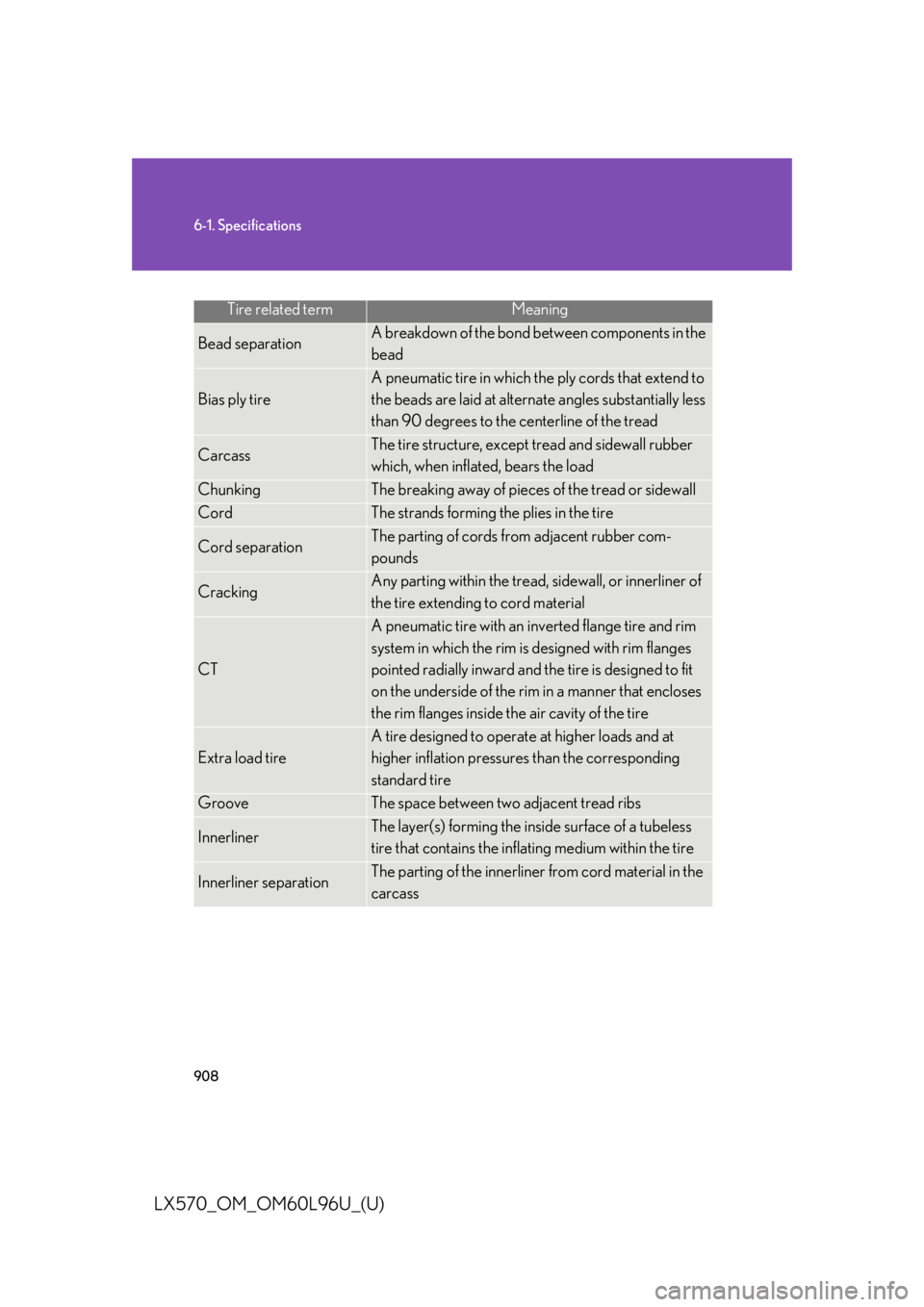
9086-1. Specifications
LX570_OM_OM60L96U_(U) Tire related term Meaning
Bead separation A breakdown of the bond between components in the
bead
Bias ply tire A pneumatic tire in which th e ply cords that extend to
the beads are laid at alternate angles substantially less
than 90 degrees to the centerline of the tread
Carcass The tire structure, except tread and sidewall rubber
which, when inflated, bears the load
Chunking The breaking away of pieces of the tread or sidewall
Cord The strands forming the plies in the tire
Cord separation The parting of cords from adjacent rubber com-
pounds
Cracking Any parting within the tread, sidewall, or innerliner of
the tire extending to cord material
CT A pneumatic tire with an inverted flange tire and rim
system in which the rim is designed with rim flanges
pointed radially inward and the tire is designed to fit
on the underside of the rim in a manner that encloses
the rim flanges inside the air cavity of the tire
Extra load tire A tire designed to operate at higher loads and at
higher inflation pressures than the corresponding
standard tire
Groove The space between two adjacent tread ribs
Innerliner The layer(s) forming the inside surface of a tubeless
tire that contains the inflating medium within the tire
Innerliner separation The parting of the innerliner from cord material in the
carcass
Page 913 of 960

9096-1. Specifications
6
Vehicle specifications
LX570_OM_OM60L96U_(U) Tire related term Meaning
Intended outboard side-
wall (a)The sidewall that contains a whitewall, bears white
lettering, or bears manufact urer, brand, and/or model
name molding that is higher or deeper than the same
molding on the other sidewall of the tire, or
(b)The outward facing sidewall of an asymmetrical tire
that has a particular side that must always face out-
ward when mounted on a vehicle
Light truck (LT) tire A tire designated by its manufacturer as primarily
intended for use on lightweig ht trucks or multipurpose
passenger vehicles
Load rating The maximum load that a tire is rated to carry for a
given inflation pressure
Maximum load rating The load rating for a tire at the maximum permissible
inflation pressure for that tire
Maximum permissible
inflation pressure The maximum cold inflation pressure to which a tire
may be inflated
Measuring rim The rim on which a tire is fitted for physical dimension
requirements
Open splice Any parting at any junction of tread, sidewall, or inner-
liner that extends to cord material
Outer diameter The overall diameter of an inflated new tire
Overall width The linear distance between the exteriors of the side-
walls of an inflated tire, including elevations due to
labeling, decorations, or protective bands or ribs