wheel LEXUS LX570 2016 Owners Manual
[x] Cancel search | Manufacturer: LEXUS, Model Year: 2016, Model line: LX570, Model: LEXUS LX570 2016Pages: 632, PDF Size: 10.34 MB
Page 544 of 632
544 7-2. Steps to take in an emergency
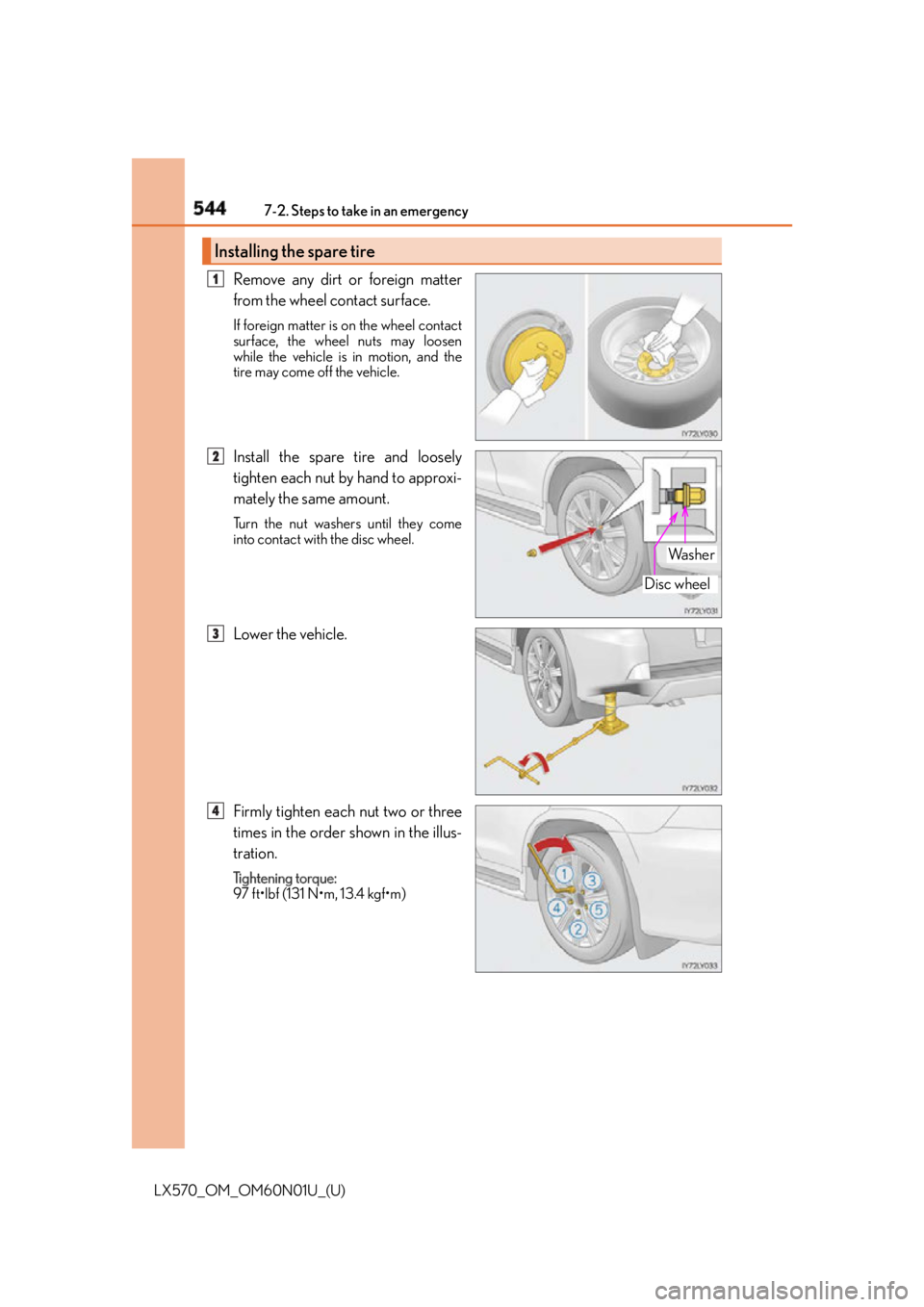
LX570_OM_OM60N01U_(U) Remove any dirt or foreign matter
from the wheel contact surface. If foreign matter is on the wheel contact
surface, the wheel nuts may loosen
while the vehicle is in motion, and the
tire may come off the vehicle.
Install the spare tire and loosely
tighten each nut by hand to approxi-
mately the same amount. Turn the nut washers until they come
into contact with the disc wheel.
Lower the vehicle.
Firmly tighten each nut two or three
times in the order shown in the illus-
tration. Tightening torque:
97 ft•lbf (131 N•m, 13.4 kgf•m)Installing the spare tire 1
Disc wheel Wa s h e r2
3
4
Page 545 of 632
5457-2. Steps to take in an emergency
LX570_OM_OM60N01U_(U) 7
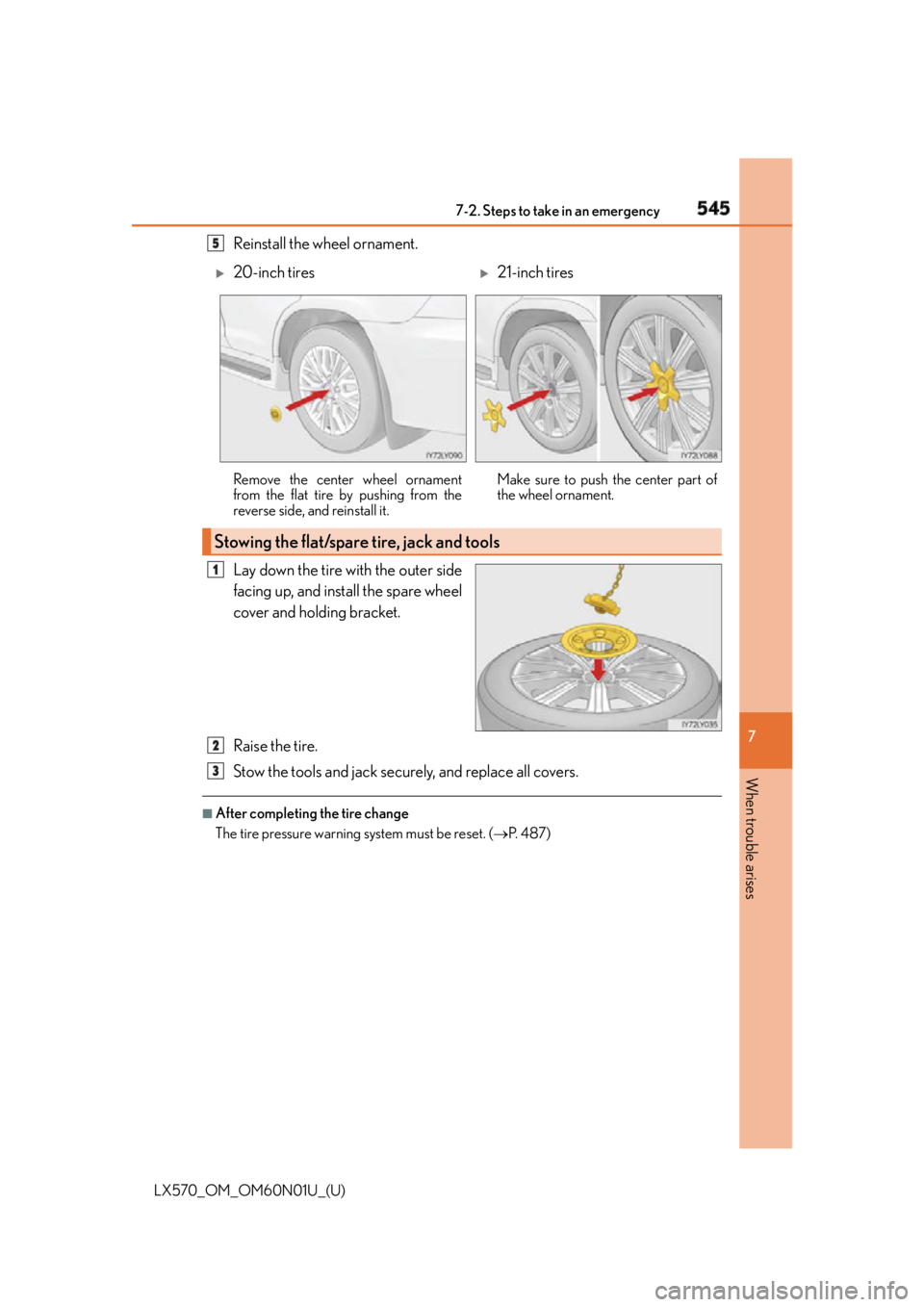
When trouble arises Reinstall the wheel ornament.
Lay down the tire with the outer side
facing up, and install the spare wheel
cover and holding bracket.
Raise the tire.
Stow the tools and jack securely, and replace all covers. ■
After completing the tire change
The tire pressure warning system must be reset. ( P. 4 8 7 )5
20-inch tires
21-inch tires
Remove the center wheel ornament
from the flat tire by pushing from the
reverse side, and reinstall it. Make sure to push the center part of
the wheel ornament.
Stowing the flat/spare tire, jack and tools 1
2
3
Page 546 of 632

546 7-2. Steps to take in an emergency
LX570_OM_OM60N01U_(U) NOTICE ■
When stowing the flat tire
Ensure that there is no object caught between the tire and the vehicle underbody. ■
When replacing the tires ●
When removing or fitting the wheels, tires or the tire pressure warning valve and
transmitter, contact your Lexus dealer as the tire pressure warning valve and trans-
mitter may be damaged if not handled correctly. ●
Replace the grommets for the tire pressure warning valves and transmitters as well. ■
To avoid damage to the tire pressu re warning valves and transmitters
When a tire is repaired with liquid sealants, the tire pressure warning valve and trans-
mitter may not operate properly. If a liquid se alant is used, contact your Lexus dealer or
other qualified service shop as soon as possible. Make sure to replace the tire pressure
warning valve and transmitter when replacing the tire. ( P. 4 8 7 )
Page 559 of 632
559
LX570_OM_OM60N01U_(U) 7
When trouble arises 7-2. Steps to take in an emergency
If the vehicle becomes stuck Stop the engine. Set the parking brake and shift the shift lever to P.
Remove the mud, snow or sand from around the rear wheels.
Place wood, stones or some other materi al under the rear wheels to help pro-
vide traction.
Restart the engine.
Shift the shift lever to the D or R position and release the parking brake. Then,
while exercising caution, depress the accelerator pedal. ■
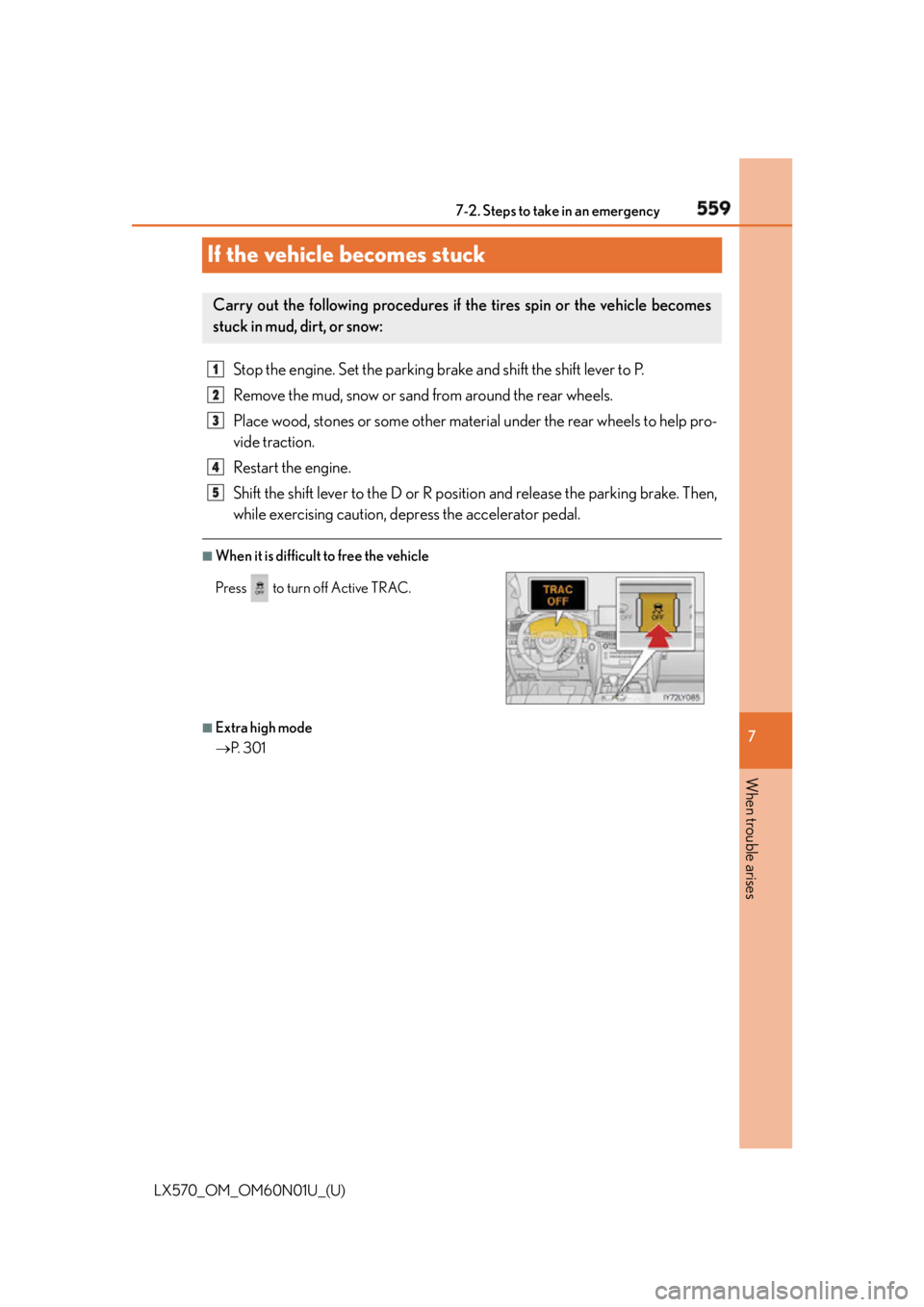
When it is difficult to free the vehicle
■
Extra high mode
P. 3 0 1Carry out the following procedures if the tires spin or the vehicle becomes
stuck in mud, dirt, or snow:
Press to turn off Active TRAC. 1
2
3
4
5
Page 560 of 632

560 7-2. Steps to take in an emergency
LX570_OM_OM60N01U_(U) WA R N I N G ■
When attempting to free a stuck vehicle
If you choose to push the vehicle back and forth to free it, make sure the surrounding
area is clear, to avoid striking other vehicles, objects or people. The vehicle may also
lunge forward or lunge back suddenly as it becomes free. Use extreme caution. ■
When shifting the shift lever
Be careful not to shift the shift lever with the accelerator pedal depressed.
This may lead to unexpected rapid accelerati on of the vehicle that may cause an acci-
dent and result in death or serious injury.
NOTICE ■
To avoid damaging the transmission and other components ●
Avoid spinning the rear wheels and depressing the accelerator pedal more than nec-
essary. ●
If the vehicle remains stuck even after th ese procedures are performed, the vehicle
may require towing to be freed. ●
When a warning message for the automatic transmission fluid temperature is dis-
played while attempting to free a stuck vehicle, immediately remove your foot from
the accelerator pedal and wait until the warning message disappears. Otherwise, the
transmission may become damaged. ( P. 5 3 2 )
Page 562 of 632
562
LX570_OM_OM60N01U_(U) 8-1. Specifications
Maintenance data (fuel, oil level, etc.)
* 1
: Unladen vehicles
* 2
: Vehicles without roof rail
* 3
: Vehicles with roof rail
* 4
: Vehicles with 20-inch tires
* 5
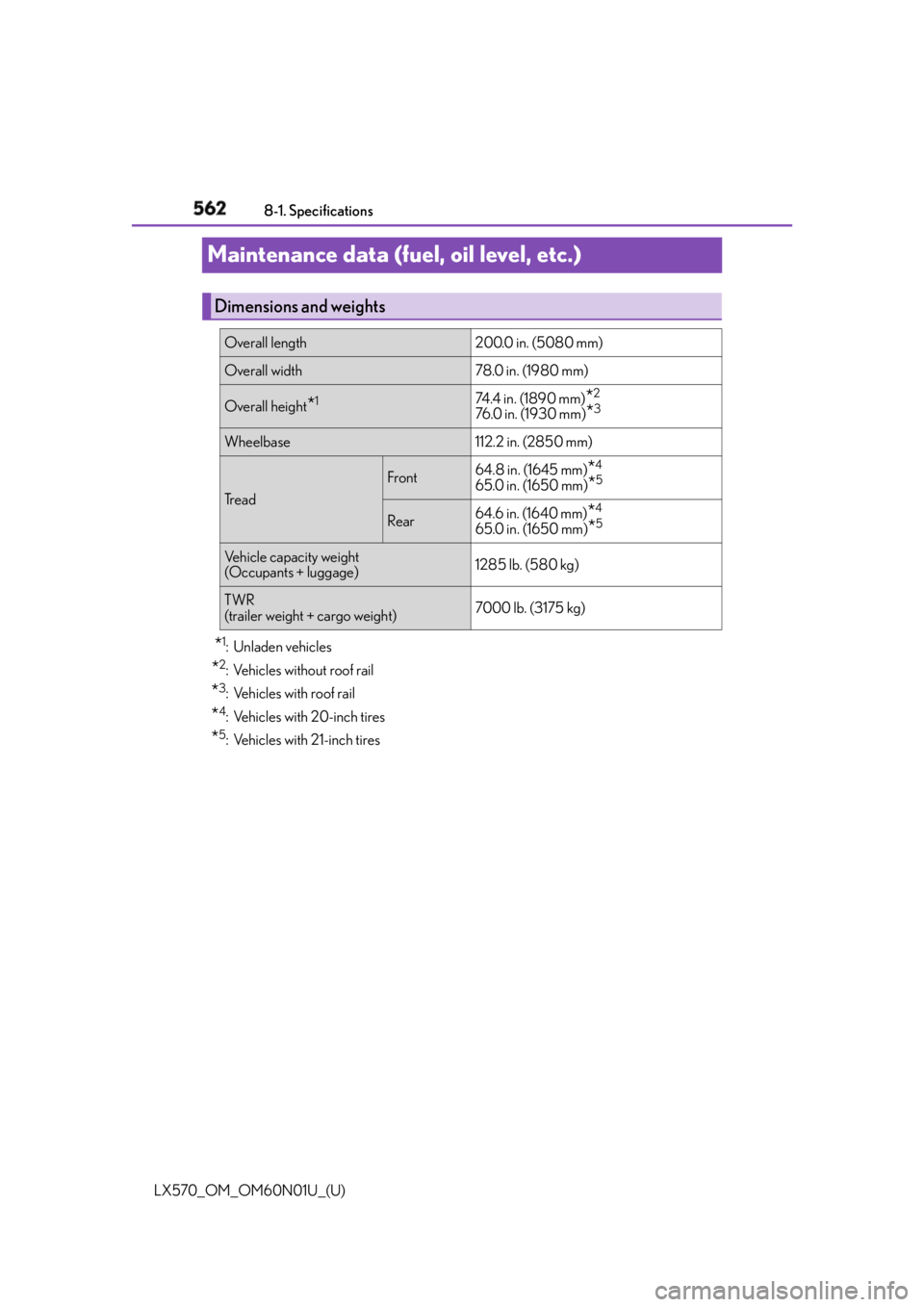
: Vehicles with 21-inch tiresDimensions and weights Overall length 200.0 in. (5080 mm)
Overall width 78.0 in. (1980 mm)
Overall height
* 1
74.4 in. (1890 mm)
* 2
76 . 0 i n . ( 1 9 3 0 m m )
* 3
Wheelbase 112.2 in. (2850 mm)
Tr e a d Front 64.8 in. (1645 mm)
* 4
65.0 in. (1650 mm)
* 5
Rear 64.6 in. (1640 mm)
* 4
65.0 in. (1650 mm)
* 5
Vehicle capacity weight
(Occupants + luggage) 1285 lb. (580 kg)
TWR
(trailer weight + cargo weight) 7000 lb. (3175 kg)
Page 569 of 632
LX570_OM_OM60N01U_(U) 5698-1. Specifications
8
Vehicle specifications
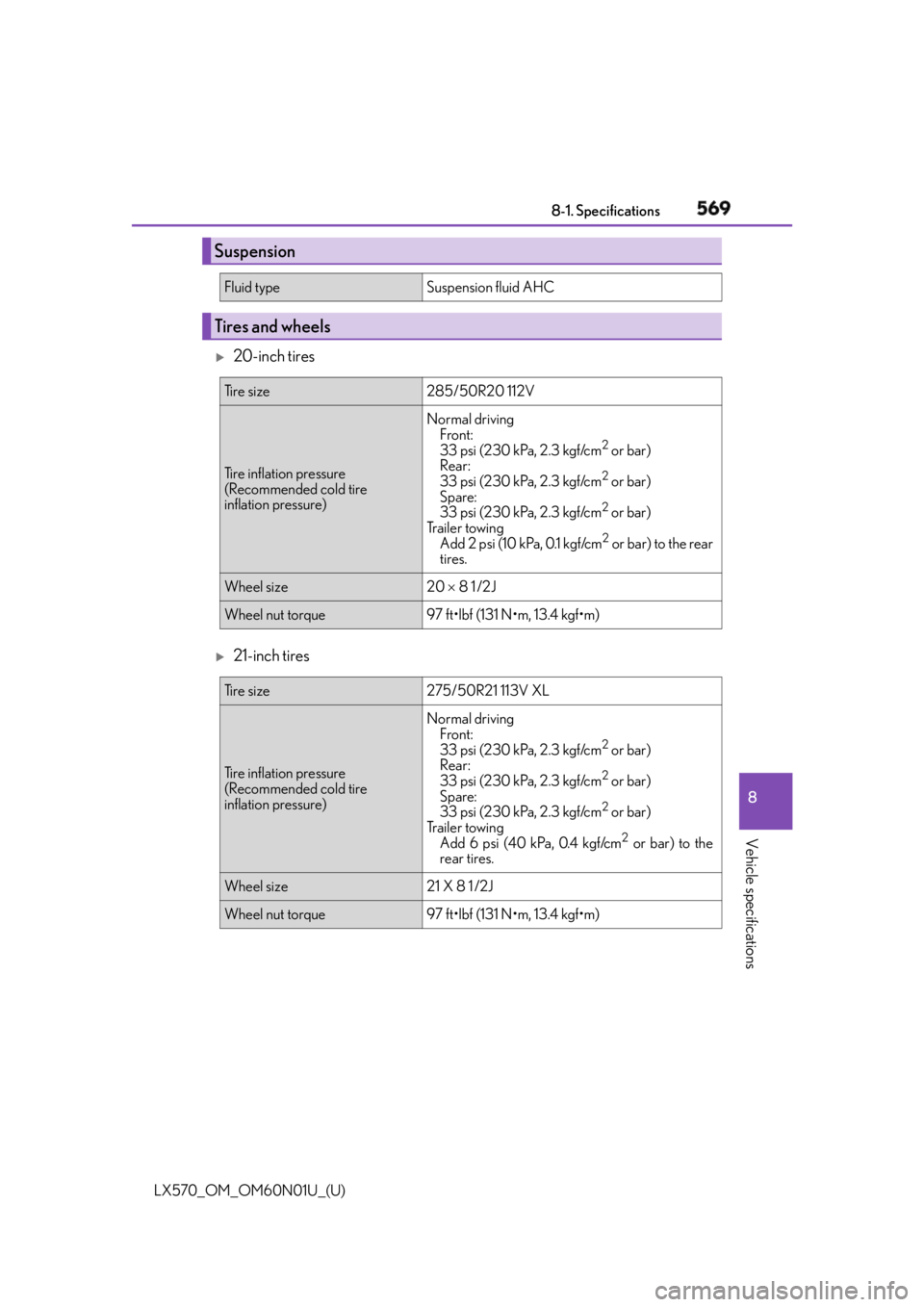
20-inch tires
21-inch tiresSuspension Fluid type Suspension fluid AHC
Tires and wheels Ti r e s i z e 285/50R20 112V
Tire inflation pressure
(Recommended cold tire
inflation pressure) Normal driving
Front:
33 psi (230 kPa, 2.3 kgf/cm 2
or bar)
Rear:
33 psi (230 kPa, 2.3 kgf/cm 2
or bar)
Spare:
33 psi (230 kPa, 2.3 kgf/cm 2
or bar)
Trailer towing
Add 2 psi (10 kPa, 0.1 kgf/cm 2
or bar) to the rear
tires.
Wheel size 20 8 1 /2J
Wheel nut torque 97 ft•lbf (131 N•m, 13.4 kgf•m)
Ti r e s i z e 275/50R21 113V XL
Tire inflation pressure
(Recommended cold tire
inflation pressure) Normal driving
Front:
33 psi (230 kPa, 2.3 kgf/cm 2
or bar)
Rear:
33 psi (230 kPa, 2.3 kgf/cm 2
or bar)
Spare:
33 psi (230 kPa, 2.3 kgf/cm 2
or bar)
Trailer towing
Add 6 psi (40 kPa, 0.4 kgf/cm 2
or bar) to the
rear tires.
Wheel size 21 X 8 1 /2J
Wheel nut torque 97 ft•lbf (131 N•m, 13.4 kgf•m)
Page 576 of 632
576
LX570_OM_OM60N01U_(U) 8-1. Specifications
■
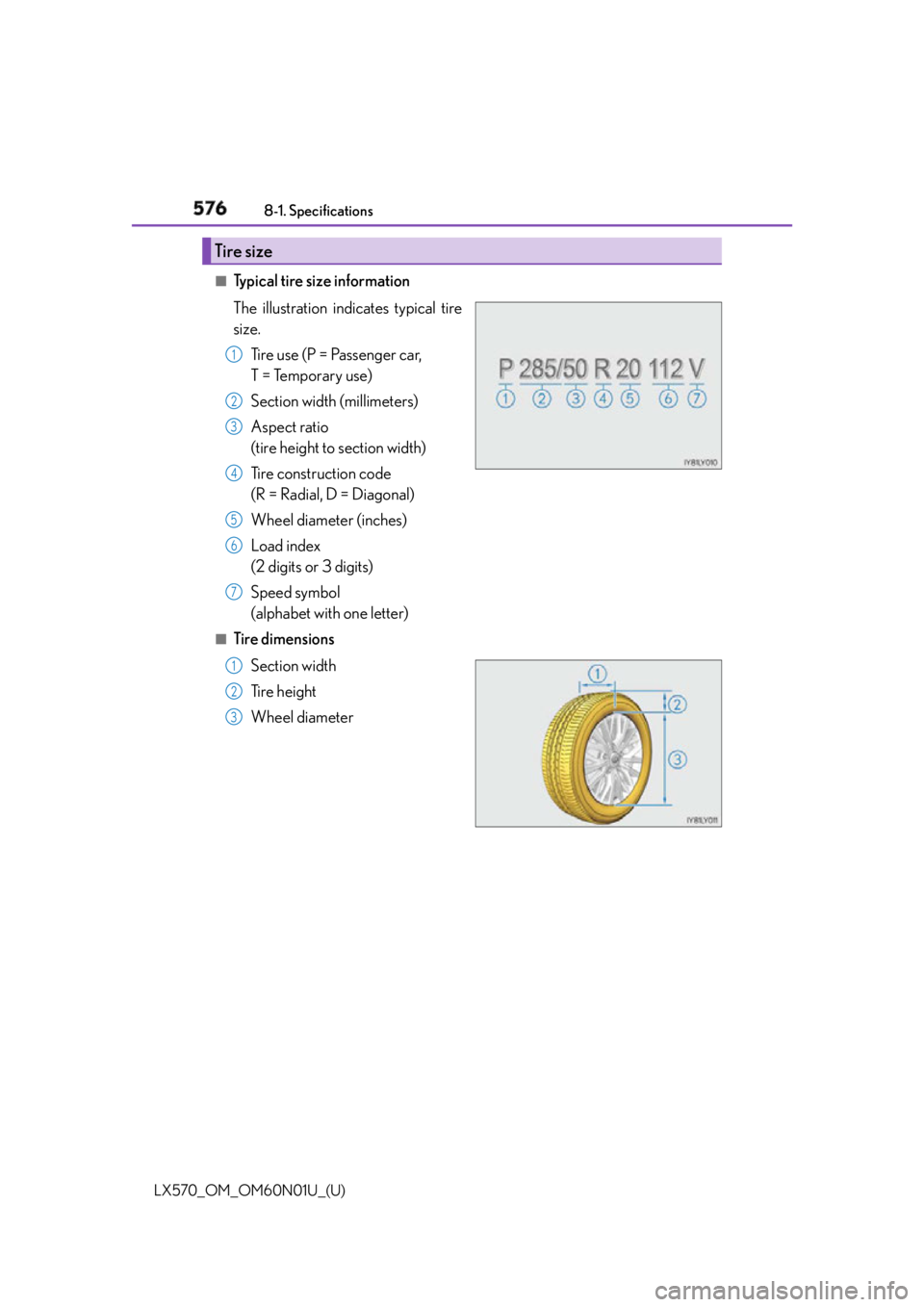
Typical tire size information
The illustration indicates typical tire
size.
Tire use (P = Passenger car,
T = Temporary use)
Section width (millimeters)
Aspect ratio
(tire height to section width)
Tire construction code
(R = Radial, D = Diagonal)
Wheel diameter (inches)
Load index
(2 digits or 3 digits)
Speed symbol
(alphabet with one letter)■
Tire dimensions
Section width
Tire height
Wheel diameterTire size 1
2
3
4
5
6
7
1
2
3
Page 579 of 632

LX570_OM_OM60N01U_(U) 5798-1. Specifications
8
Vehicle specifications ■
Temperature A, B, C
The temperature grades are A (the highes t), B, and C, representing the tire’s
resistance to the generation of heat and its ability to dissipate heat when
tested under controlled conditions on a specified indoor laboratory test
wheel. Sustained high temperature can cause the material of the tire to degenerate and
reduce tire life, and excessive temperature can lead to sudden tire failure.
Grade C corresponds to a level of perfor mance which all passenger car tires must
meet under the Federal Motor Vehicle Safety Standard No. 109.
Grades B and A represent higher levels of performance on the laboratory test
wheel than the minimum required by law.
Warning: The temperature grades of a tire assume that it is properly inflated and
not overloaded.
Excessive speed, underinflation, or excessiv e loading, either separately or in com-
bination, can cause heat buildup and possible tire failure.
Page 581 of 632
LX570_OM_OM60N01U_(U) 5818-1. Specifications
8
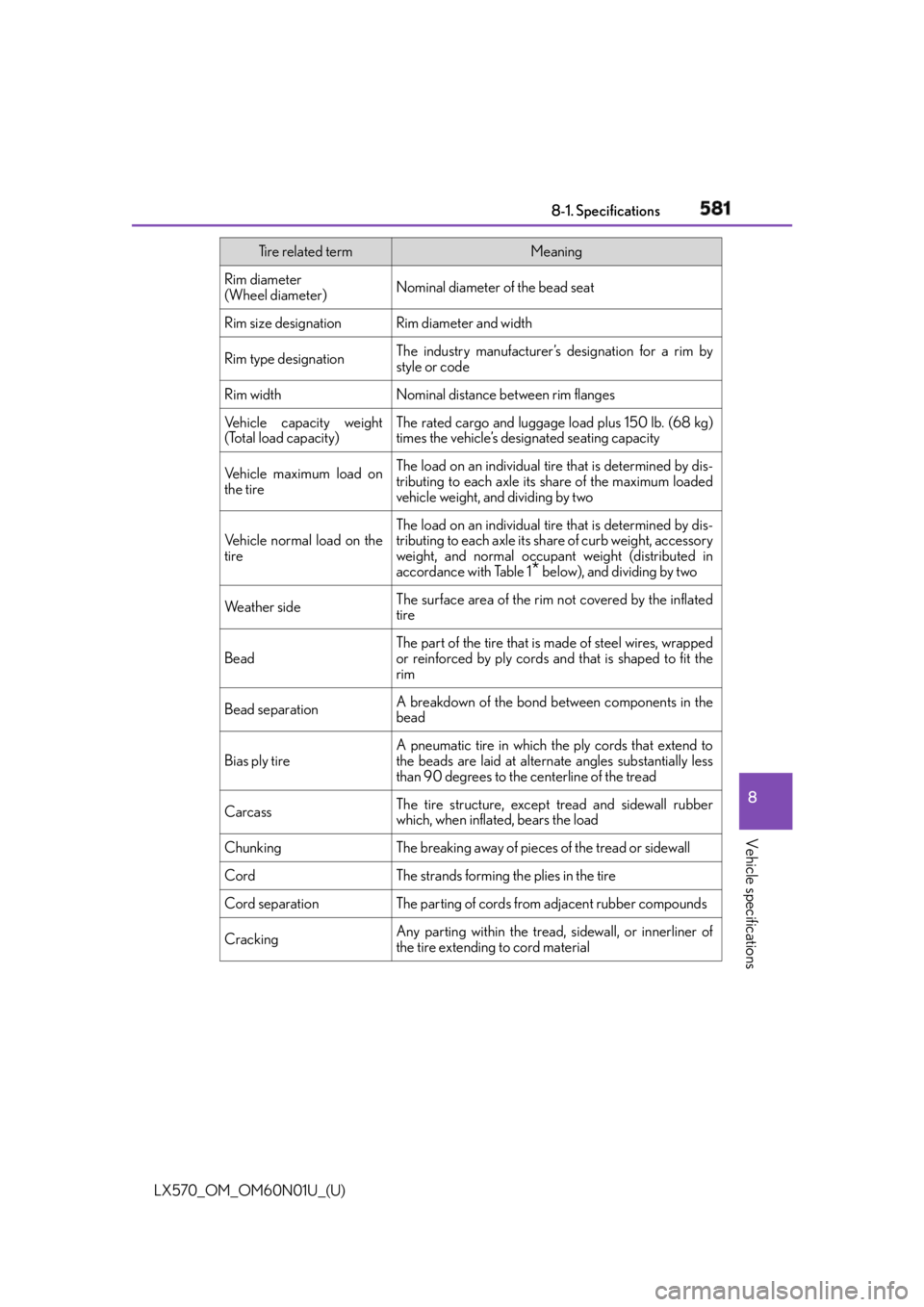
Vehicle specifications Rim diameter
(Wheel diameter) Nominal diameter of the bead seat
Rim size designation Rim diameter and width
Rim type designation The industry manufacturer’s designation for a rim by
style or code
Rim width Nominal distance between rim flanges
Vehicle capacity weight
(Total load capacity) The rated cargo and luggage load plus 150 lb. (68 kg)
times the vehicle’s designated seating capacity
Vehicle maximum load on
the tire The load on an individual tire that is determined by dis-
tributing to each axle its share of the maximum loaded
vehicle weight, and dividing by two
Vehicle normal load on the
tire The load on an individual tire that is determined by dis-
tributing to each axle its sh are of curb weight, accessory
weight, and normal occupant weight (distributed in
accordance with Table 1
* below), and dividing by two
We a t h e r s i d e The surface area of the rim not covered by the inflated
tire
Bead The part of the tire that is made of steel wires, wrapped
or reinforced by ply cords and that is shaped to fit the
rim
Bead separation A breakdown of the bond be tween components in the
bead
Bias ply tire A pneumatic tire in which the ply cords that extend to
the beads are laid at altern ate angles substantially less
than 90 degrees to the centerline of the tread
Carcass The tire structure, except tread and sidewall rubber
which, when inflated, bears the load
Chunking The breaking away of pieces of the tread or sidewall
Cord The strands forming th e plies in the tire
Cord separation The parting of cords from adjacent rubber compounds
Cracking Any parting within the tread, sidewall, or innerliner of
the tire extending to cord materialTire related term Meaning