brakes LEXUS LX570 2018 Owner's Manual
[x] Cancel search | Manufacturer: LEXUS, Model Year: 2018, Model line: LX570, Model: LEXUS LX570 2018Pages: 628, PDF Size: 12.38 MB
Page 382 of 628

382
LX570_OM_OM60Q78U_(U) 4-6. Driving tips
Winter driving tips ●
Use fluids that are appropriate to the prevailing outside temperatures.
•Engine oil
• Engine coolant
• Washer fluid ●
Have a service technician inspect the condition of the battery. ●
Have the vehicle fitted with four snow tires or purchase a set of tire chains for
the rear tires.
*Ensure that all tires are the same size and br and, and that chains match the size of the
tires.
* : Tire chains cannot be mounted on vehicles with 21-inch tires
Perform the following according to the driving conditions: ●
Do not try to forcibly open a window or move a wiper that is frozen. Pour
warm water over the frozen area to me lt the ice. Wipe away the water imme-
diately to prevent it from freezing. ●
To ensure proper operation of the c limate control system fan, remove any
snow that has accumulated on the air inlet vents in front of the windshield. ●
Check for and remove any excess ice or snow that may have accumulated on
the exterior lights, vehicle’s roof, chassi s, around the tires or on the brakes.●
Remove any snow or mud from the bottom of your shoes before getting in the
vehicle.Carry out the necessary preparations an d inspections before driving the vehi-
cle in winter. Always drive the vehicle in a manner appropriate to the prevail-
ing weather conditions.
Pre-winter preparations
Before driving the vehicle
Page 389 of 628

LX570_OM_OM60Q78U_(U) 3894-6. Driving tips
4
Driving WARNING ■
Off-road driving precautions
Always observe the following precautions to minimize the risk of death, serious injury
or damage to your vehicle: ●
Drive carefully when off the road. Do not ta ke unnecessary risks by driving in danger-
ous places. ●
Do not grip the steering wheel spokes when driving off-road. A bad bump could jerk
the wheel and injure your hands. Keep both hands and especially your thumbs on the
outside of the rim. ●
Always check your brakes for effectiveness immediately after driving in sand, mud,
water or snow. ●
After driving through tall grass, mud, rock , sand, rivers, etc., check that there is no
grass, bush, paper, rags, stone, sand, etc. adhering or trapped on the underbody.
Clear off any such matter from the underbody. If the vehicle is used with these materi-
als trapped or adhering to the underbody, a breakdown or fire could occur. ●
When driving off-road or in rugged terrain , do not drive at excessive speeds, jump,
make sharp turns, strike obje cts, etc. This may cause loss of control or vehicle rollover
causing death or serious injury. You are also risking expensive damage to your vehi-
cle’s suspension and chassis.
Page 467 of 628
LX570_OM_OM60Q78U_(U) 4676-2. Maintenance
6
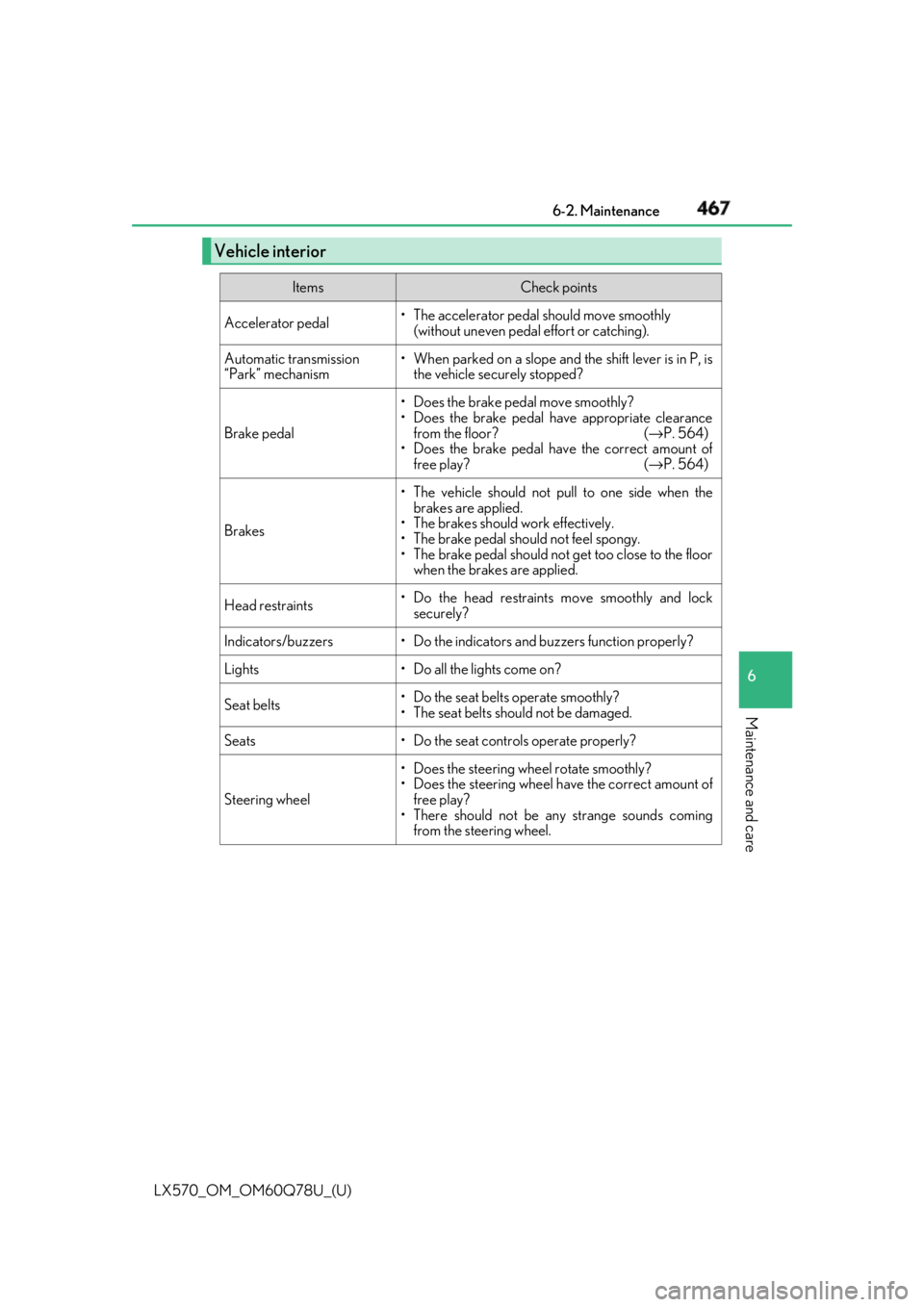
Maintenance and care Vehicle interior Items Check points
Accelerator pedal • The accelerator pedal should move smoothly
(without uneven pedal effort or catching).
Automatic transmission
“Park” mechanism • When parked on a slope and the shift lever is in P, is
the vehicle securely stopped?
Brake pedal • Does the brake pedal move smoothly?
• Does the brake pedal have appropriate clearance
from the floor? ( → P. 564)
• Does the brake pedal have the correct amount of
free play? ( → P. 564)
Brakes • The vehicle should not pull to one side when the
brakes are applied.
• The brakes should work effectively.
• The brake pedal should not feel spongy.
• The brake pedal should no t get too close to the floor
when the brakes are applied.
Head restraints • Do the head restraints move smoothly and lock
securely?
Indicators/buzzers • Do the indicators and buzzers function properly?
Lights • Do all the lights come on?
Seat belts • Do the seat belts operate smoothly?
• The seat belts should not be damaged.
Seats • Do the seat controls operate properly?
Steering wheel • Does the steering wheel rotate smoothly?
• Does the steering wheel have the correct amount of
free play?
• There should not be any strange sounds coming
from the steering wheel.
Page 511 of 628
511
LX570_OM_OM60Q78U_(U) 7
When trouble arises 7-1. Essential information
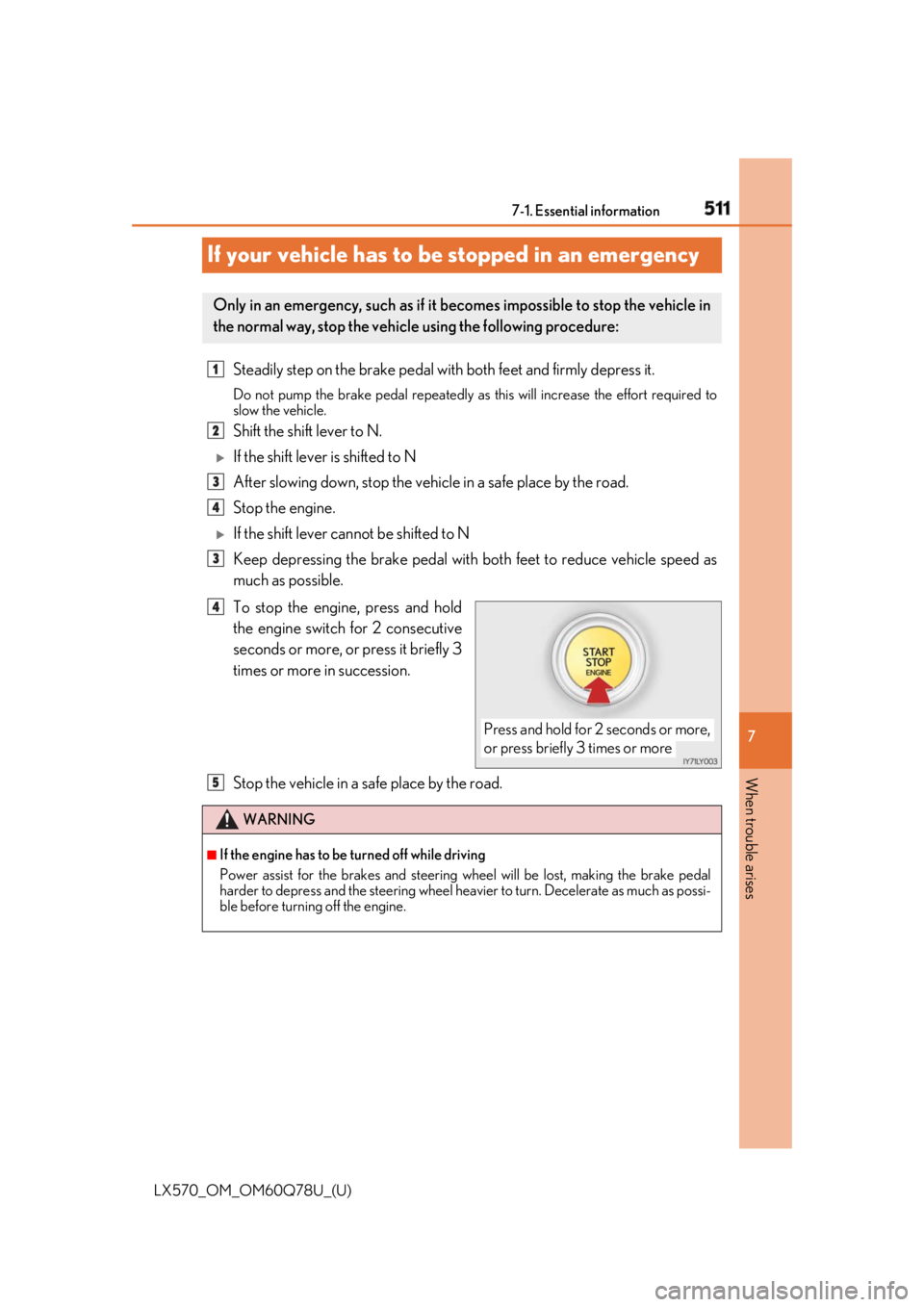
If your vehicle has to be stopped in an emergencySteadily step on the brake pedal with both feet and firmly depress it.Do not pump the brake pedal repeatedly as this will increase the effort required to
slow the vehicle.
Shift the shift lever to N.
If the shift lever is shifted to N
After slowing down, stop the vehicle in a safe place by the road.
Stop the engine.
If the shift lever cannot be shifted to N
Keep depressing the brake pedal with both feet to reduce vehicle speed as
much as possible.
To stop the engine, press and hold
the engine switch for 2 consecutive
seconds or more, or press it briefly 3
times or more in succession.
Stop the vehicle in a safe place by the road.Only in an emergency, such as if it becomes impossible to stop the vehicle in
the normal way, stop the vehicl e using the following procedure:1
2
3
4
3
Press and hold for 2 seconds or more,
or press briefly 3 times or more4
WARNING ■
If the engine has to be turned off while driving
Power assist for the brakes and steering wheel will be lost, making the brake pedal
harder to depress and the steering wheel heav ier to turn. Decelerate as much as possi-
ble before turning off the engine. 5
Page 514 of 628
514 7-2. Steps to take in an emergency
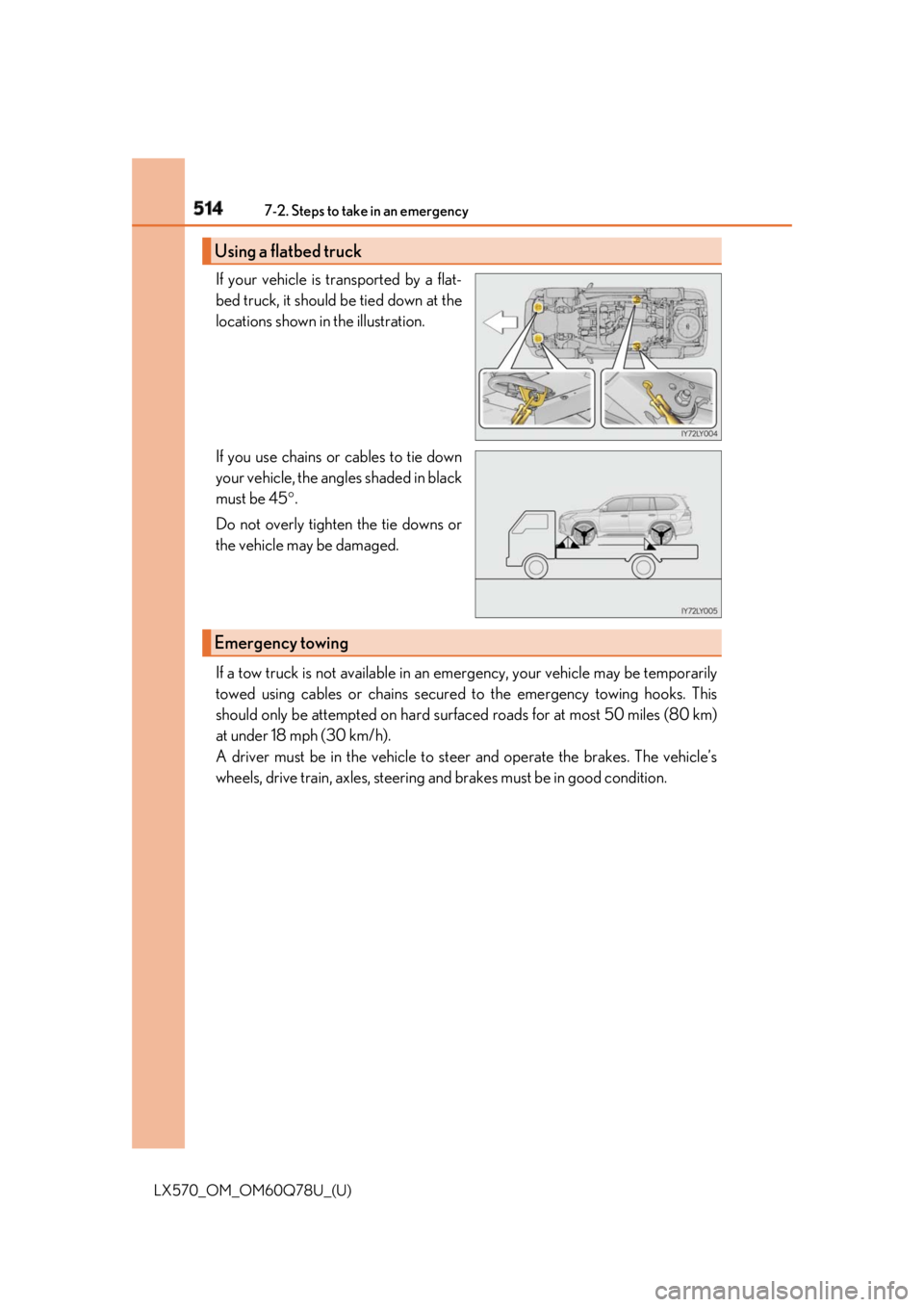
LX570_OM_OM60Q78U_(U) If your vehicle is transported by a flat-
bed truck, it should be tied down at the
locations shown in the illustration.
If you use chains or cables to tie down
your vehicle, the angles shaded in black
must be 45 ° .
Do not overly tighten the tie downs or
the vehicle may be damaged.
If a tow truck is not available in an em ergency, your vehicle may be temporarily
towed using cables or chains secured to the emergency towing hooks. This
should only be attempted on hard su rfaced roads for at most 50 miles (80 km)
at under 18 mph (30 km/h).
A driver must be in the vehicle to st eer and operate the brakes. The vehicle’s
wheels, drive train, axles, steering an d brakes must be in good condition.Using a flatbed truck
Emergency towing
Page 515 of 628
5157-2. Steps to take in an emergency
LX570_OM_OM60Q78U_(U) 7
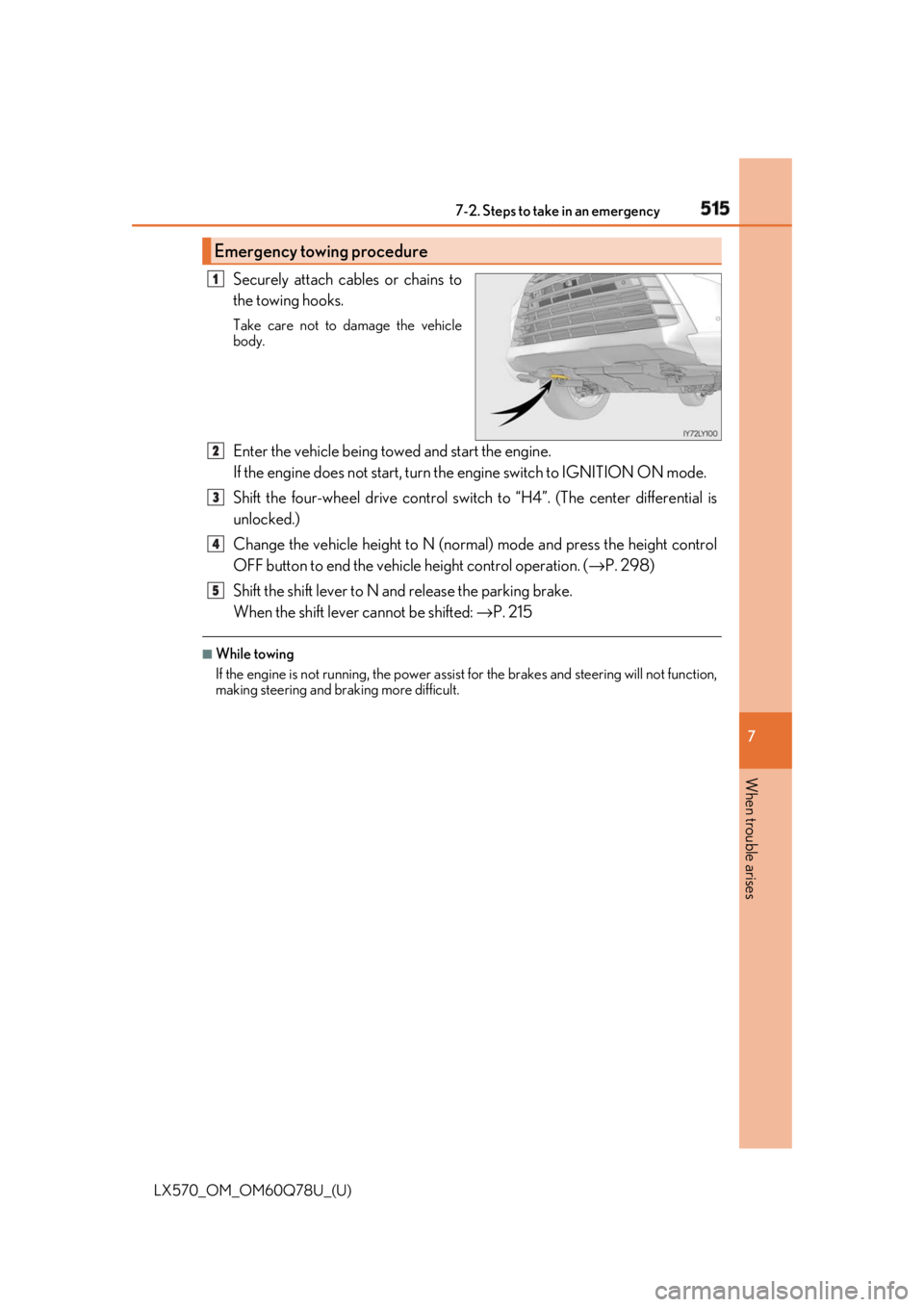
When trouble arises Securely attach cables or chains to
the towing hooks. Take care not to damage the vehicle
body.
Enter the vehicle being towed and start the engine.
If the engine does not start, turn th e engine switch to IGNITION ON mode.
Shift the four-wheel drive control switch to “H4”. (The center differential is
unlocked.)
Change the vehicle height to N (norma l) mode and press the height control
OFF button to end the vehicle height control operation. ( → P. 298)
Shift the shift lever to N and release the parking brake.
When the shift lever cannot be shifted: → P. 215■
While towing
If the engine is not running, the power assist for the brakes and steering will not function,
making steering and br aking more difficult.Emergency towing procedure 1
2
3
4
5
Page 526 of 628
526 7-2. Steps to take in an emergency
LX570_OM_OM60Q78U_(U) WARNING ■
If both the ABS and the brake sy stem warning lights remain on
Stop your vehicle in a safe place immediat ely and contact your Lexus dealer. The vehi-
cle will become extremely unstable during br aking, and the ABS system may fail, which
could cause an accident resultin g in death or serious injury.■
If the tire pressure warning light comes on
Be sure to observe the following precautions. Failure to do so could cause loss of vehi-
cle control and result in death or serious injury. ●
Stop your vehicle in a safe place as soon as possible. Adjust the tire inflation pressure
immediately. ●
If the tire pressure warning light comes on even after tire inflation pressure adjust-
ment, it is probable that you have a flat tire. Check the tires. If the tire is flat, change to
the spare tire and have the flat tire repaired by the nearest Lexus dealer. ●
Avoid abrupt maneuvering and braking. If the vehicle tires deteriorate, you could lose
control of the steering wheel or the brakes. ■
If a blowout or sudden air leakage should occur
The tire pressure warning system may not activate immediately.
Page 539 of 628
5397-2. Steps to take in an emergency
LX570_OM_OM60Q78U_(U) 7
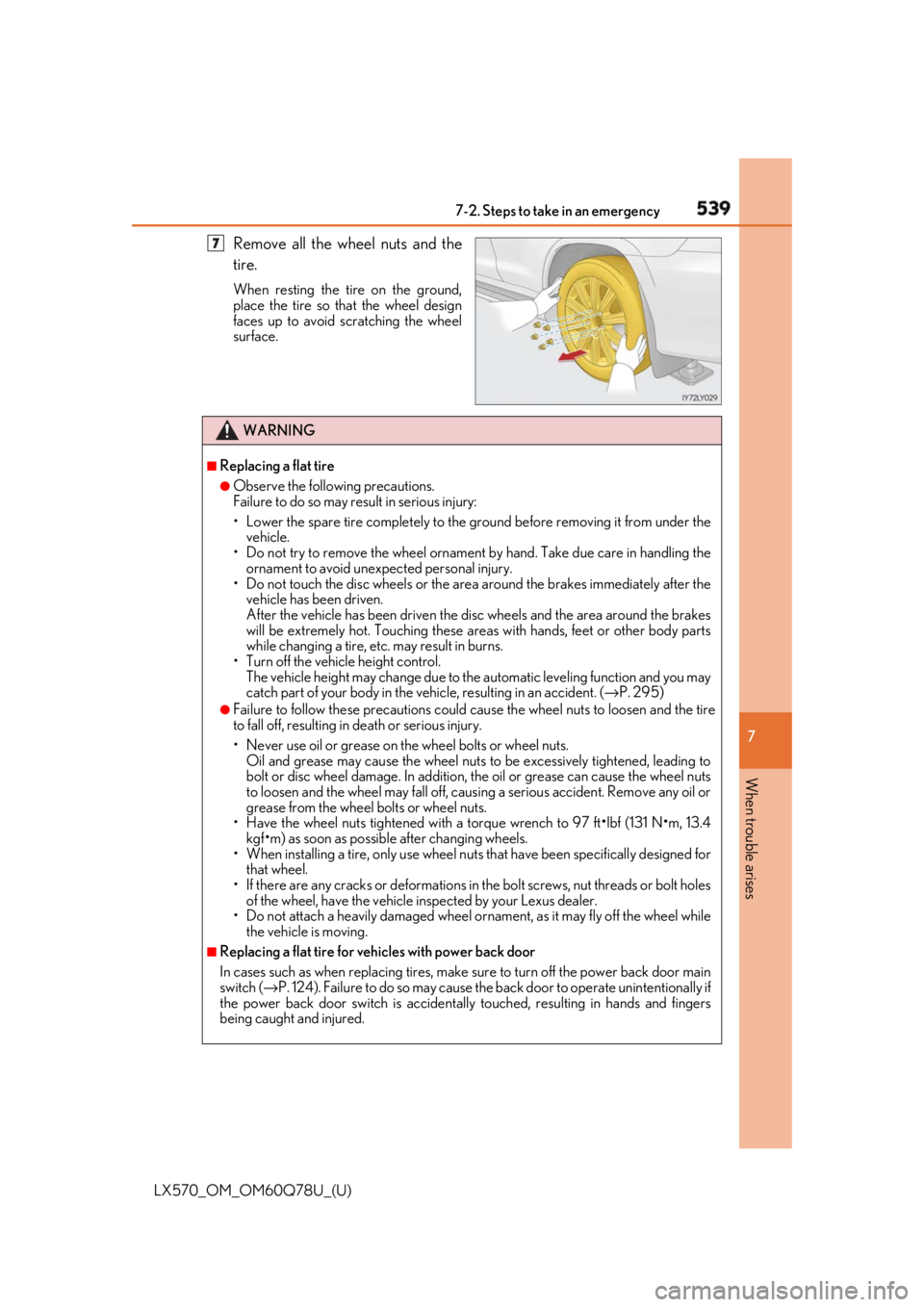
When trouble arises Remove all the wheel nuts and the
tire. When resting the tire on the ground,
place the tire so that the wheel design
faces up to avoid scratching the wheel
surface. 7
WARNING ■
Replacing a flat tire ●
Observe the following precautions.
Failure to do so may result in serious injury:
• Lower the spare tire completely to the ground before removing it from under the
vehicle.
• Do not try to remove the wheel ornament by hand. Take due care in handling the
ornament to avoid unexpected personal injury.
• Do not touch the disc wheels or the area around the brakes immediately after the
vehicle has been driven.
After the vehicle has been driven the disc wheels and the area around the brakes
will be extremely hot. Touching these areas with hands, feet or other body parts
while changing a tire, etc. may result in burns.
• Turn off the vehicle height control.
The vehicle height may change due to th e automatic leveling function and you may
catch part of your body in the ve hicle, resulting in an accident. ( → P. 295)●
Failure to follow these precautions could cau se the wheel nuts to loosen and the tire
to fall off, resulting in death or serious injury.
• Never use oil or grease on the wheel bolts or wheel nuts.
Oil and grease may cause the wheel nuts to be excessively tightened, leading to
bolt or disc wheel damage. In addition, the oil or grease can cause the wheel nuts
to loosen and the wheel may fall off, causing a serious accident. Remove any oil or
grease from the wheel bolts or wheel nuts.
• Have the wheel nuts tightened with a torque wrench to 97 ft
• lbf (131 N
• m, 13.4
kgf
• m) as soon as possible after changing wheels.
• When installing a tire, only use wheel nuts that have been specifically designed for
that wheel.
• If there are any cracks or deformations in the bolt screws, nut threads or bolt holes
of the wheel, have the vehicle inspected by your Lexus dealer.
• Do not attach a heavily damaged wheel or nament, as it may fly off the wheel while
the vehicle is moving.■
Replacing a flat tire for vehicles with power back door
In cases such as when replacing tires, make sure to turn off the power back door main
switch ( → P. 124). Failure to do so may cause the back door to operate unintentionally if
the power back door switch is accidentally touched, re sulting in hands and fingers
being caught and injured.
Page 564 of 628
564
LX570_OM_OM60Q78U_(U) 8-1. Specifications
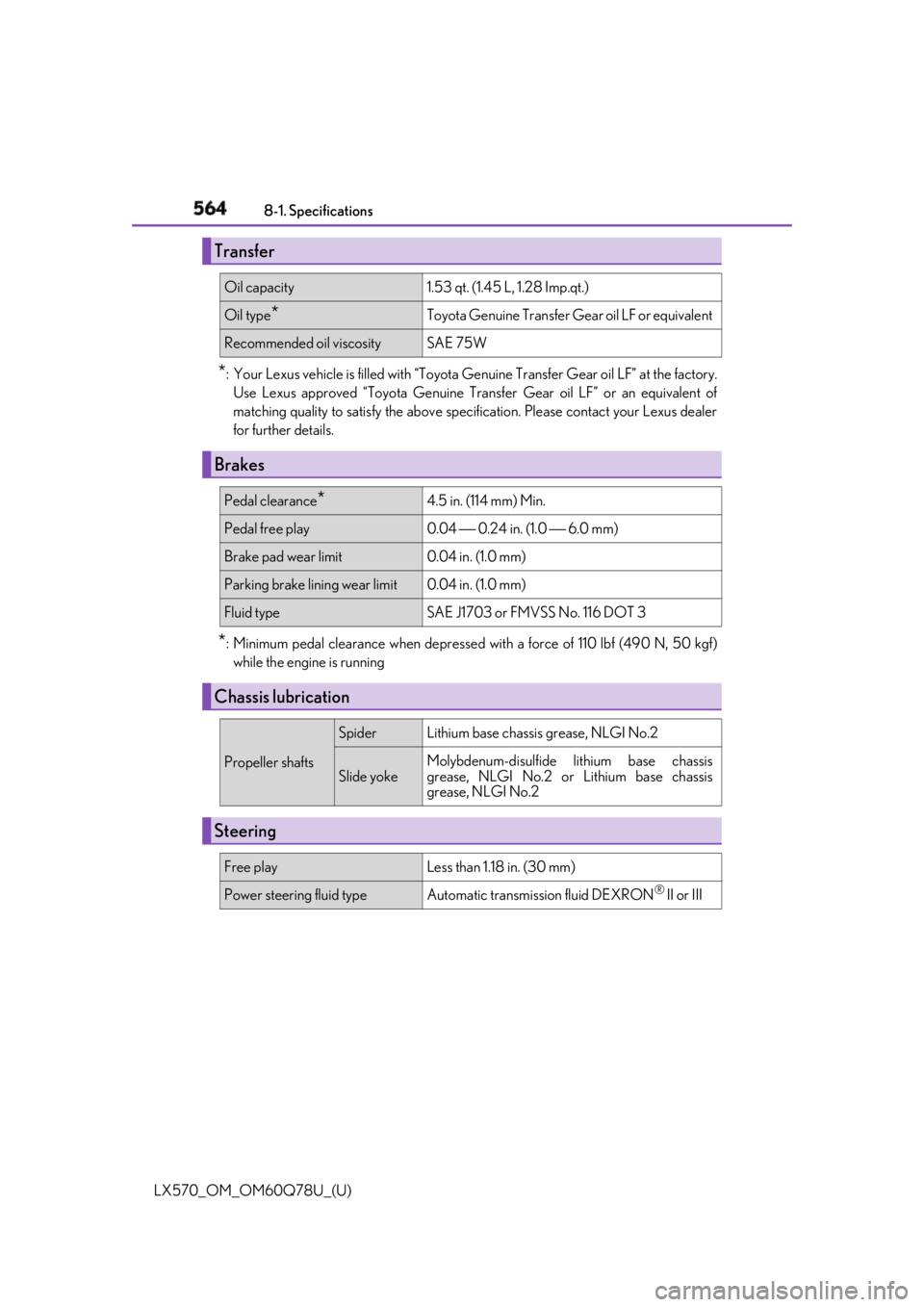
* : Your Lexus vehicle is filled with “Toyota Ge nuine Transfer Gear oil LF” at the factory.
Use Lexus approved “Toyota Genuine Transf er Gear oil LF” or an equivalent of
matching quality to satisfy the above specification. Please contact your Lexus dealer
for further details.
* : Minimum pedal clearance when depressed wi th a force of 110 lbf (490 N, 50 kgf)
while the engine is runningTransfer Oil capacity 1.53 qt. (1.45 L, 1.28 Imp.qt.)
Oil type
* Toyota Genuine Transfer Gear oil LF or equivalent
Recommended oil viscosity SAE 75W
Brakes Pedal clearance
* 4.5 in. (114 mm) Min.
Pedal free play 0.04 ⎯ 0.24 in. (1.0 ⎯ 6.0 mm)
Brake pad wear limit 0.04 in. (1.0 mm)
Parking brake lining wear limit 0.04 in. (1.0 mm)
Fluid type SAE J1703 or FMVSS No. 116 DOT 3
Chassis lubrication Propeller shafts Spider Lithium base chassis grease, NLGI No.2
Slide yoke Molybdenum-disulfide lithium base chassis
grease, NLGI No.2 or Lithium base chassis
grease, NLGI No.2
Steering Free play Less than 1.18 in. (30 mm)
Power steering fluid type Automatic transmission fluid DEXRON ®
II or III
Page 575 of 628
LX570_OM_OM60Q78U_(U) 5758-1. Specifications
8
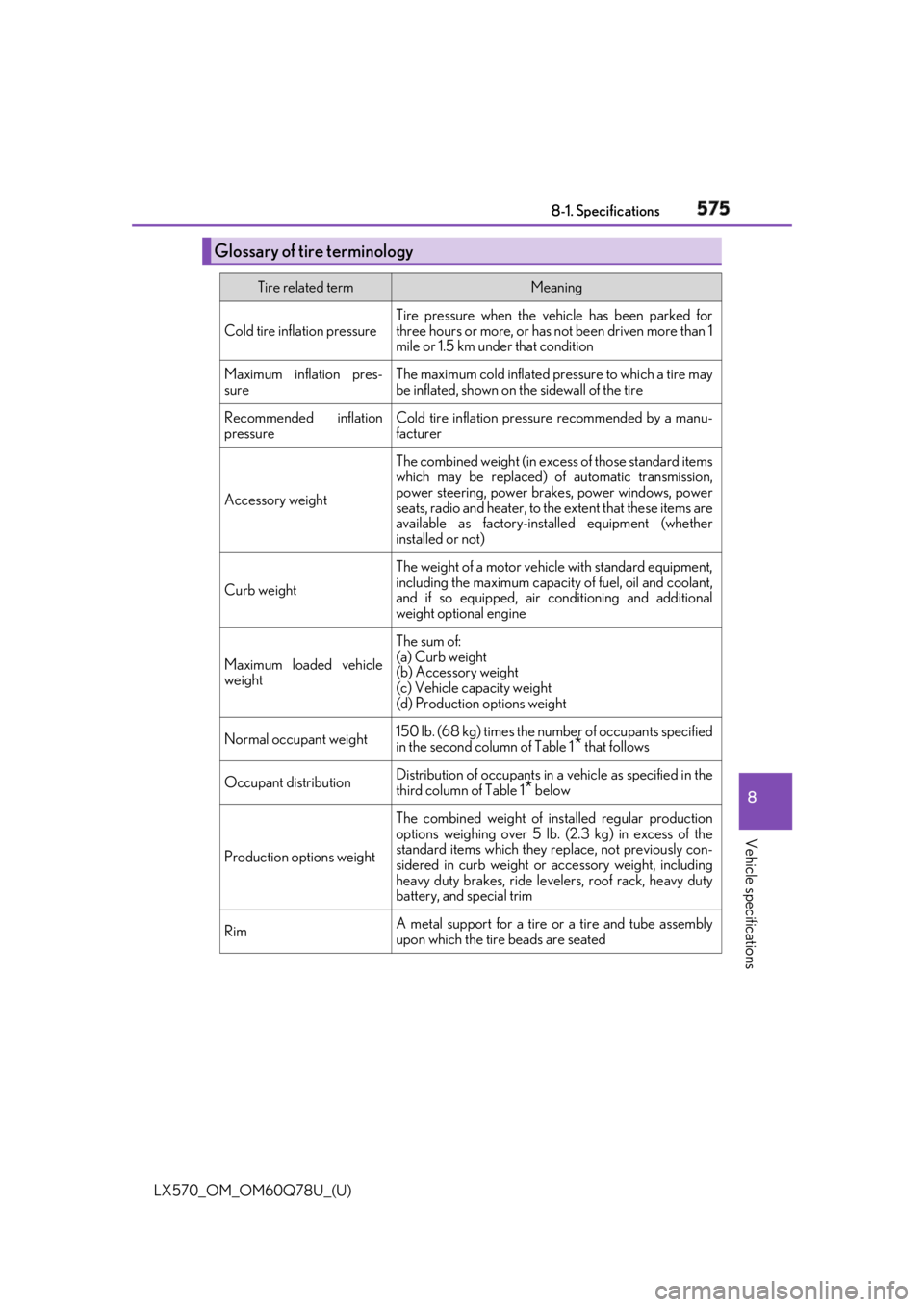
Vehicle specifications Glossary of tire terminology Tire related term Meaning
Cold tire inflation pressure Tire pressure when the vehicle has been parked for
three hours or more, or has no t been driven more than 1
mile or 1.5 km un der that condition
Maximum inflation pres-
sure The maximum cold inflated pr essure to which a tire may
be inflated, shown on the sidewall of the tire
Recommended inflation
pressure Cold tire inflation pressure recommended by a manu-
facturer
Accessory weight The combined weight (in exce ss of those standard items
which may be replaced) of automatic transmission,
power steering, power brakes, power windows, power
seats, radio and heater, to the extent that these items are
available as factory-installed equipment (whether
installed or not)
Curb weight The weight of a motor vehicle with standard equipment,
including the maximum capacity of fuel, oil and coolant,
and if so equipped, air co nditioning and additional
weight optional engine
Maximum loaded vehicle
weight The sum of:
(a) Curb weight
(b) Accessory weight
(c) Vehicle capacity weight
(d) Production options weight
Normal occupant weight 150 lb. (68 kg) times the numb er of occupants specified
in the second column of Table 1
* that follows
Occupant distribution Distribution of occupants in a vehicle as specified in the
third column of Table 1
* below
Production options weight The combined weight of in stalled regular production
options weighing over 5 lb. (2.3 kg) in excess of the
standard items which they re place, not previously con-
sidered in curb weight or accessory weight, including
heavy duty brakes, ride leve lers, roof rack, heavy duty
battery, and special trim
Rim A metal support for a tire or a tire and tube assembly
upon which the tire beads are seated