ESP LEXUS LX570 2018 Workshop Manual
[x] Cancel search | Manufacturer: LEXUS, Model Year: 2018, Model line: LX570, Model: LEXUS LX570 2018Pages: 628, PDF Size: 12.38 MB
Page 554 of 628
554 7-2. Steps to take in an emergency
LX570_OM_OM60Q78U_(U) WARNING ■
When inspecting under the hood of your vehicle
Observe the following precautions.
Failure to do so may result in serious injury such as burns.●
If steam is seen coming from under the h ood, do not open the hood until the steam
has subsided. The engine compartment may be very hot. ●
Keep hands and clothing (especially a tie, a scarf or a muffler) away from the fans and
belts. Failure to do so may cause the hands or clothing to be caught, resulting in seri-
ous injury. ●
Do not loosen the radiator cap or the cool ant reservoir cap while the engine and radi-
ator are hot. High temperature steam or coolant could spray out.
NOTICE ■
When adding engine coolant
Add coolant slowly after the engine has cool ed down sufficiently. Adding cool coolant
to a hot engine too quickly can cause damage to the engine. ■
To prevent damage to the cooling system
Observe the following precautions: ●
Avoid contaminating the coolant with foreig n matter (such as sand or dust etc.).●
Do not use any coolant additive.
Page 574 of 628

574
LX570_OM_OM60Q78U_(U) 8-1. Specifications■
Temperature A, B, C
The temperature grades are A (the highes t), B, and C, representing the tire’s
resistance to the generation of heat and its ability to dissipate heat when
tested under controlled conditions on a specified indoor laboratory test
wheel. Sustained high temperature can cause the ma terial of the tire to degenerate and
reduce tire life, and excessive temperature can lead to sudden tire failure.
Grade C corresponds to a level of perfor mance which all passenger car tires must
meet under the Federa l Motor Vehicle Safety Standard No. 109.
Grades B and A represent higher levels of performance on the laboratory test
wheel than the minimum required by law.
Warning: The temperature grades of a tire assume that it is properly inflated and
not overloaded.
Excessive speed, underi nflation, or excessive loading, either separately or in com-
bination, can cause heat buildup and possible tire failure.
Page 577 of 628
LX570_OM_OM60Q78U_(U) 5778-1. Specifications
8
Vehicle specifications CT A pneumatic tire with an inverted flange tire and rim
system in which the rim is designed with rim flanges
pointed radially inward and the tire is designed to fit on
the underside of the rim in a manner that encloses the
rim flanges inside the air cavity of the tire
Extra load tire A tire designed to operate at higher loads and at higher
inflation pressures than the corresponding standard tire
Groove The space between two adjacent tread ribs
Innerliner The layer(s) forming the insi de surface of a tubeless tire
that contains the inflating medium within the tire
Innerliner separation The parting of the innerliner from cord material in the
carcass
Intended outboard sidewall (a) The sidewall that contai ns a whitewall, bears white
lettering, or bears manufacturer, brand, and/or
model name molding that is higher or deeper than
the same molding on the ot her sidewall of the tire,
or
(b) The outward facing sidewa ll of an asymmetrical tire
that has a particular side that must always face out-
ward when mounted on a vehicle
Light truck (LT) tire A tire designated by its manufacturer as primarily
intended for use on lightweig ht trucks or multipurpose
passenger vehicles
Load rating The maximum load that a tire is rated to carry for a given
inflation pressure
Maximum load rating The load rating for a tire at the maximum permissible
inflation pressure for that tire
Maximum permissible infla-
tion pressure The maximum cold inflation pr essure to which a tire may
be inflated
Measuring rim The rim on which a tire is fitted for physical dimension
requirements
Open splice Any parting at any junction of tread, sidewall, or inner-
liner that extends to cord material
Outer diameter The overall diameter of an inflated new tireTire related term Meaning
Page 578 of 628

578
LX570_OM_OM60Q78U_(U) 8-1. Specifications
Overall width The linear distance between the exteriors of the side-
walls of an inflated tire, including elev ations due to label-
ing, decorations, or protective bands or ribs
Passenger car tire A tire intended for use on passenger cars, multipurpose
passenger vehicles, and trucks, that have a gross vehicle
weight rating (GVWR) of 10,000 lb. or less.
Ply A layer of rubber-coat ed parallel cords
Ply separation A parting of rubber compou nd between adjacent plies
Pneumatic tire A mechanical device made of rubber, chemicals, fabric
and steel or other materials, that, when mounted on an
automotive wheel, provides the traction and contains
the gas or fluid that sustains the load
Radial ply tire A pneumatic tire in which the ply cords that extend to
the beads are laid at substa ntially 90 degrees to the
centerline of the tread
Reinforced tire A tire designed to operate at higher loads and at higher
inflation pressures than the corresponding standard tire
Section width The linear distance between the exteriors of the side-
walls of an inflated tire, excluding elevations due to
labeling, decoration, or protective bands
Sidewall That portion of a tire between the tread and bead
Sidewall separation The parting of the rubber compound from the cord
material in the sidewall
Snow tire A tire that attains a traction index equal to or greater
than 110, compared to the ASTM E-1136 Standard Ref-
erence Test Tire, when using the snow traction test as
described in ASTM F-1805-00, Standard Test Method
for Single Wheel Driving Traction in a Straight Line on
Snow-and Ice-Covered Surf aces, and which is marked
with an Alpine Symbol ( ) on at least one sidewallTire related term Meaning
Page 605 of 628
LX570_OM_OM60Q78U_(U) 605
9
For owners AVERTISSEMENT ■
Précautions relatives aux coussins gonflables SRS
●
N’accrochez pas de cintres ni d’autres ob jets rigides sur les crochets porte-vête-
ments. Tous ces objets pourraient se tran sformer en projectiles et vous occasionner
des blessures graves, voire mortelles, en cas de déploiement des coussins gonflables
SRS en rideau. ●
Si le recouvrement de vinyle est placé sur la zone de déploiement du coussin gon-
flable SRS de protection des genoux, veillez à le retirer.●
N’utilisez pas d’accessoires recouvrant les parties du siège où les coussins gonflables
SRS latéraux se déploient, car ces access oires pourraient entraver le déploiement
des coussins gonflables. De tels accessoir es peuvent empêcher les coussins gonfla-
bles latéraux de se déployer correctement, rendre le système inopérant ou provo-
quer accidentellement le déploiement des coussins gonflables latéraux,
occasionnant des blessures graves, voire mortelles. ●
Ne frappez pas et n’appliquez pas une pr ession importante à l’emplacement des
composants des coussins gonflables SRS.
Cela peut provoquer un mauvais foncti onnement des coussins gonflables SRS.●
Ne touchez à aucun composant des coussi ns gonflables SRS immédiatement après
leur déploiement (gonflage), ca r ils pourraient être chauds.●
Si vous avez de la difficulté à respirer après le déploiement des coussins gonflables
SRS, ouvrez une portière ou une glace pour laisser entrer l’air, ou quittez le véhicule
si vous pouvez le faire en toute sécurité. Dès que possible, nettoyez tous les résidus
afin d’éviter les irritations cutanées. ●
Si les emplacements de stockage des coussi ns gonflables SRS, te ls que le tampon de
volant et les garnitures des montants avant, latéraux et arrière, sont endommagés ou
fissurés, faites-les remplacer par votre concessionnaire Lexus. ●
Ne placez aucun objet, par exemple un coussin, sur le siège du passager avant. Cela
disperserait le poids du passager, ce qui empêcherait le capteur de le détecter cor-
rectement. Cela pourrait empêcher le déploiement des coussins gonflables SRS du
passager avant en cas de collision. ●
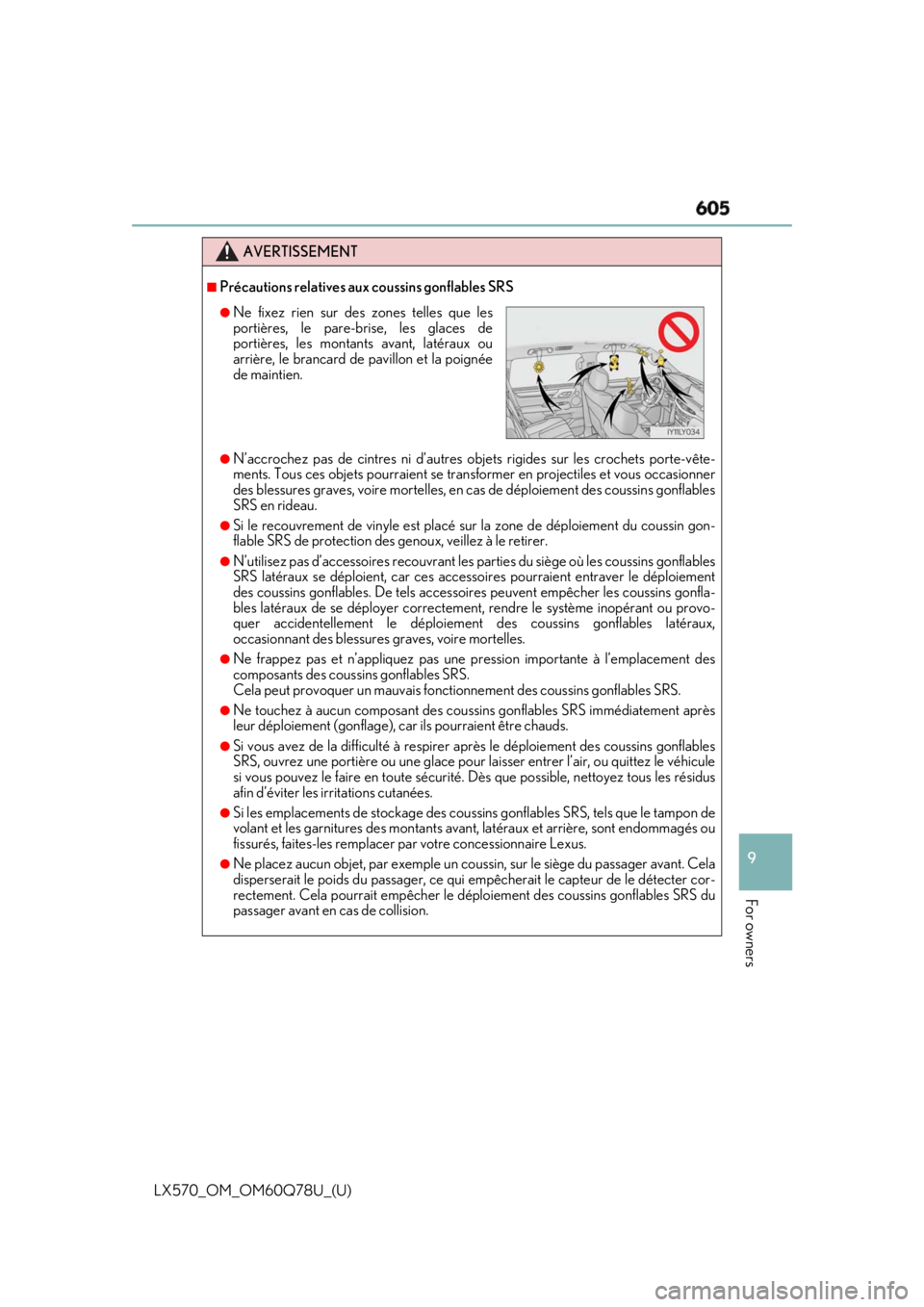
Ne fixez rien sur des zones telles que les
portières, le pare-b rise, les glaces de
portières, les montants avant, latéraux ou
arrière, le brancard de pavillon et la poignée
de maintien.