engine compartment LEXUS NX300 2020 User Guide
[x] Cancel search | Manufacturer: LEXUS, Model Year: 2020, Model line: NX300, Model: LEXUS NX300 2020Pages: 468, PDF Size: 10.24 MB
Page 332 of 468

3326-3. Do-it-yourself maintenance
LEXUS NX300 Owners Manual_USA_M78389_en
Tire inflation
pressure
( P.351)• Tire pressure gauge
• Compressed air
source
Washer fluid
( P.342)
• Water or washer fluid
containing antifreeze
(for winter use)
• Funnel (used only for adding water or
washer fluid)
WARNING
The engine compartment contains many
mechanisms and fluids that may move
suddenly, become hot, or become elec-
trically energized. To avoid death or seri-
ous injury, observe the following
precautions.
■When working on the engine com-
partment
●Keep hands, clothi ng and tools away
from the moving fan and engine drive
belt.
●Be careful not to touch the engine,
radiator, exhaust manifold, etc. right
after driving as they may be hot. Oil
and other fluids may also be hot.
●Do not leave anything that may burn
easily, such as paper and rags, in the
engine compartment.
●Do not smoke, cause sparks or expose
an open flame to fuel or the battery.
Fuel and battery fumes are flammable.
●Be extremely cautions when working
on the battery. It contains poisonous
and corrosive sulfuric acid.
ItemsParts and tools■When working near the electric cool-
ing fans or radiator grille
Be sure the engine switch is off.
With the engine switch in IGNITION
ON mode, the electric cooling fans may
automatically start to run if the air condi-
tioning is on and/or the coolant tempera-
ture is high. ( P.339)
■Safety glasses
Wear safety glasses to prevent flying or
falling material, fluid spray, etc. from get-
ting in your eyes.
NOTICE
■If you remove the air cleaner filter
Driving with the air cleaner filter
removed may cause excessive engine
wear due to dirt in the air.
Page 335 of 468

3356-3. Do-it-yourself maintenance
LEXUS NX300 Owners Manual_USA_M78389_en
6
Maintenance and care
Fuse box (P.358)
Engine coolant reservoir ( P.338)
Engine oil filler cap ( P.336)
Engine oil level dipstick ( P.336)
Intercooler coolant reservoir ( P.338)
Battery ( P.340)
Brake fluid reservoir ( P.340)
Radiator ( P.339)
Condenser ( P.339)
Electric cooling fans
Washer fluid tank ( P.342)
Engine compartment
Components
A
B
C
D
E
F
G
H
I
J
K
Page 336 of 468

3366-3. Do-it-yourself maintenance
LEXUS NX300 Owners Manual_USA_M78389_en
■Removing the engine compart-
ment cover
■Installing the clips
1
Insert
2
Press With the engine at operating tempera-
ture and turned off, check the oil level
on the dipstick.
■Checking the engine oil
1
Park the vehicle on level ground.
After warming up the engine and
turning off the engine, wait more
than 5 minutes for the oil to drain
back into the bottom of the engine.
2
Holding a rag under the end, pull
the dipstick out.
3
Wipe the dipstick clean.
4
Reinsert the dipstick fully with its
protruding areas ( in the illustra-
tion) pointing towards engine.
Engine compartment cover
NOTICE
■After installing an engine compart-
ment cover
Make sure that the cover is securely
installed in its original position.
Checking and adding the engine
oil
A
Page 340 of 468

3406-3. Do-it-yourself maintenance
LEXUS NX300 Owners Manual_USA_M78389_en
■Checking fluid level
The brake fluid level should be
between the “MAX” and “MIN” lines
on the tank.
■Adding fluid
Make sure to check the fluid type and
prepare the necessary item.
Fluid type
FMVSS No.116 DOT 3 or SAE J1703;
FMVSS No.116 DOT 4 or SAE J1704
brake fluid
Items
Clean funnel
■Brake fluid can absorb moisture from
the air
Excess moisture in the brake fluid can cause a dangerous loss of braking efficiency. Use
only newly opened brake fluid.
Check the battery as follows.
■Battery exterior
Make sure that the battery terminals
are not corroded and that there are no
loose connections, cracks, or loose
clamps.
Terminals
Hold-down clamp
WARNING
■When the electric cooling fans are
operating
Do not touch the engine compartment.
With the engine switch in IGNITION
ON mode, the electric cooling fans may
automatically start to run if the air condi-
tioning is on and/or the coolant tempera-
ture is high. Be sure the engine switch is
off when working near the electric cool-
ing fans or radiatorgrille.
Checking and adding the brake
fluid
WARNING
■When filling the reservoir
Take care as brake fluid can harm your
hands and eyes and damage painted sur-
faces.
If fluid gets on your hands or in your eyes,
flush the affected area with clean water
immediately.
If you still experience discomfort, see a
doctor.
NOTICE
■If the fluid level is low or high
It is normal for the brake fluid level to go
down slightly as the brake pads wear out
or when the fluid leve l in the accumulator
is high.
If the reservoir need s frequent refilling,
there may be a serious problem.
Checking the battery
A
B
Page 358 of 468

3586-3. Do-it-yourself maintenance
LEXUS NX300 Owners Manual_USA_M78389_en
1Turn the engine switch off.
2 Open the fuse box cover.
Engine compartment: type A fuse
box
Push the tab in and lift the lid off.
Engine compartment: type B fuse
box
Push the tab in and lift the lid off.
Left side instrument panel
Remove the lid.
3Remove the fuse.
Only type A fuse can be removed using the
pullout tool.
4Check if the fuse is blown.
Replace the blown fuse with a new fuse of
an appropriate amperage rating. The
amperage rating can be found on the fuse
box lid.
Type A
Normal fuse
Blown fuse
Checking and replacing
fuses
If any of the electrical components
do not operate, a fuse may have
blown. If this happens, check and
replace the fuses as necessary.
Checking and replacing fuses
A
B
Page 362 of 468

3626-3. Do-it-yourself maintenance
LEXUS NX300 Owners Manual_USA_M78389_en
■Bulbs that need to be replaced by
the Lexus dealer
Headlights
Front turn signal lights (LED type)
Parking lights and Daytime running
lights
Front fog lights
Cornering lights (if equipped)
Front side marker lights (LED type)
Side turn signal lights
Stop/tail lights
Rear side marker lights
Back-up light
Rear turn signal light
High mounted stoplight
License plate lights
Outer foot lights
■LED lights
The lights other than the front side marker
lights (bulb type) and front turn signal lights
(bulb type) each consist of a number of
LEDs. If any of the LEDs burn out, take your
vehicle to your Lexus dealer to have the
light replaced.
■Condensation build-up on the inside of
the lens
Temporary condensation build-up on the
inside of the headlight lens does not indi-
cate a malfunction. Contact your Lexus
dealer for more information in the following
situations:
●Large drops of water ha ve built up on the
inside of the lens.
●Water has built up inside the headlight.
■When replacing light bulbs
P.359
Before replacing, check the wattage of
the light bulb to be replaced. ( P.415)
■Front side marker lights (bulb type)
1 Turn the bulb base counterclock-
wise.
2 Remove the light bulb.
3 When installing, reverse the steps
listed.
■Front turn signal lights (bulb type)
1 Open the hood and remove the
cover for engine compartment
cover. ( P.333, 336)
2 Remove the cover.
Push the center of the clip and remove
Replacing light bulbs
A
Page 363 of 468

3636-3. Do-it-yourself maintenance
LEXUS NX300 Owners Manual_USA_M78389_en
6
Maintenance and care
the clip and cover .
3Turn the bulb base counterclock-
wise.
4 Remove the light bulb.
5 Replace the light bulb. 6
Turn clockwise and set the bulb
base.
7 Attach the clip to the cover.
Push up on the center of the clip and attach
the clip .
8Attach the cover.
Align the 2 tabs positions and close the
cover and fix the cover by pushing the
center of the clip .
9Install the engine compartment
cover. ( P.336)
B
A
A
B
Page 372 of 468
3727-2. Steps to take in an emergency
LEXUS NX300 Owners Manual_USA_M78389_en
and operate the brakes. The vehicle’s
wheels, drivetrain, axles, steering and
brakes must be in good condition.
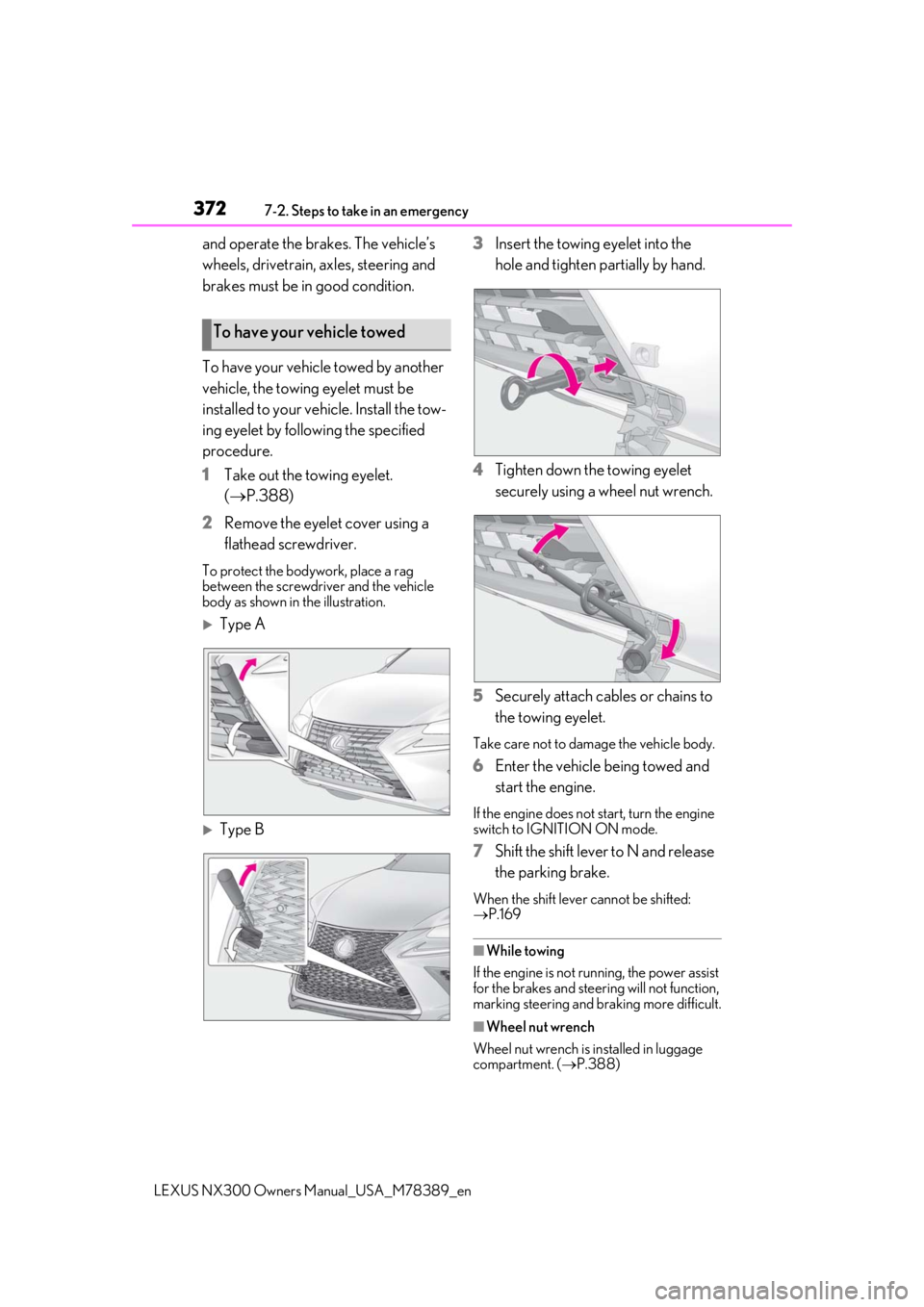
To have your vehicle towed by another
vehicle, the towing eyelet must be
installed to your vehicle. Install the tow-
ing eyelet by following the specified
procedure.
1 Take out the towing eyelet.
(P.388)
2 Remove the eyelet cover using a
flathead screwdriver.
To protect the bodywork, place a rag
between the screwdriver and the vehicle
body as shown in the illustration.
Type A
Type B 3
Insert the towing eyelet into the
hole and tighten partially by hand.
4 Tighten down the towing eyelet
securely using a wheel nut wrench.
5 Securely attach cables or chains to
the towing eyelet.
Take care not to damage the vehicle body.
6Enter the vehicle being towed and
start the engine.
If the engine does not start, turn the engine
switch to IGNITION ON mode.
7Shift the shift lever to N and release
the parking brake.
When the shift lever cannot be shifted:
P.169
■While towing
If the engine is not running, the power assist
for the brakes and steering will not function,
marking steering and braking more difficult.
■Wheel nut wrench
Wheel nut wrench is installed in luggage
compartment. ( P.388)
To have your vehicle towed
Page 397 of 468

3977-2. Steps to take in an emergency
LEXUS NX300 Owners Manual_USA_M78389_en
7
When trouble arises
1Remove the cover inside the lug-
gage compartment by inserting a
screwdriver.
When removing the cover, to pre-
vent damage, cover the tip of the
screwdriver with a rag.
2
After removing the cover, pull the
lever to unlock the fuel filler door
and it will be ready to open as usual.
■Things to check before taking measures
●Make sure that the smart access system
with push-button start has not been deac-
tivated in the customizat ion setting. If it is
off, turn the function on.
●Check if battery-saving mode is set. If it is
set, cancel the function. ( P.117)
Use the mechanical key ( P.98) to
perform the following operations.
If the fuel filler door cannot
b
e opened
If the fuel filler door opener switch
cannot be operated, the following
procedure can be used to open the
fuel filler door.
Opening the fuel filler door
If the electronic key does not
o
perate properly
If communication between the
electronic key and vehicle is inter-
rupted ( P.118) or the electronic
key cannot be used because the
battery is depleted, the smart
access system with push-button
start and wireless remote control
cannot be used. In such cases, the
doors can be opened and the
engine can be started by following
the procedure below.
NOTICE
■In case of a smart access system with
push-button start malfunction or
other key related problems
Take your vehicle with all the electronic
keys provided with your vehicle, includ-
ing the card key, to your Lexus dealer.
Locking and unlocking the doors
Page 458 of 468

458Alphabetical Index
LEXUS NX300 Owners Manual_USA_M78389_en
Drive information ........................................... 83
Drive-start control ..............................147, 168
Driver’s seat belt reminder light ............ 379
Driver’s seat position memory .................128
Driving Break-in tips ................................................... 147
Correct posture ............................................ 25
Driving mode select switch ..................258
Procedures .....................................................146
Winter drive tips......................................... 266
Driving position memory............................128 Memory recall function ............................ 129
Dynamic radar cruise control with full- speed rangeFunction .......................................................... 225
Warning message.....................................384
E
Eco Driving Indicator.................................... 78
Eco mode........................................................ 258
EDR (Event data recorder) ............................7
Electric Power Steering (EPS) Function ..........................................................260
Warning light ................................................377
Electronic key Battery-saving function ..............................117
If the electronic key does not operate properly....................................................... 397
Replacing the battery...............................356
Emergency flashers .................................... 366
Emergency, in case of If a warning buzzer sounds .................. 375
If a warning light turns on ...................... 375
If a warning message is displayed.....384
If the battery is discharged ................... 400
If the electronic key does not operate properly....................................................... 397 If the engine will not start....................... 395
If the fuel filler do
or cannot be opened
.......................................................................... 397
If the vehicle is trapped in rising water .......................................................................... 367
If you have a flat tire ..................................387
If you lose your keys ................................ 396
If you think something is wrong.......... 373
If your vehicle becomes stuck ............ 406
If your vehicle has to be stopped in an emergency ................................................ 366
If your vehicle needs to be towed .... 369
If your vehicle overheats ....................... 403
Engine Accessory mode......................................... 166
Compartment..............................................335
Engine switch ................................................ 165
Hood ................................................................333
How to start the engine ........................... 165
Identification number .............................. 409
If your vehicle has to be stopped in an emergency ................................................ 366
Ignition switch (Engine switch) ............ 165
Overheating ................................................ 403
Engine compartment cover .................... 336
Engine coolant Capacity ............................................................ 411
Checking ...................................................... 338
Preparing and checking before winter..........................................................................266
Warning light ............................................... 376
Engine coolant temperature gauge ........79
Engine immobilizer system ........................ 68
Engine oil Capacity .......................................................... 410
Checking .......................................................336
Warning light ...............................................375