height LEXUS NX300 2020 User Guide
[x] Cancel search | Manufacturer: LEXUS, Model Year: 2020, Model line: NX300, Model: LEXUS NX300 2020Pages: 468, PDF Size: 10.24 MB
Page 247 of 468

2474-5. Using the driving support systems
LEXUS NX300 Owners Manual_USA_M78389_en
4
Driving
• The vehicle is driven on a gravel road or
in an area with tall grass
• Ice, snow, dirt, etc., has adhered to the sensor (if removed, the system returns to
normal)
• Heavy rain or water strikes the vehicle
• In severe weather such as fog, snow or a sand storm
●Influence from other sonic waves
• An ultrasonic wave source is nearby, such
as the horn or clearance sonar of another
vehicle, a vehicle detector, a motorcycle
engine or the air brake of a large vehicle
• Electronic components (such as a backlit license plate (especially fluorescent
types), fog lights, a fender pole or a wire-
less antenna) are installed near the sen-
sors
●Changes in the vehicle
• The vehicle is tilted a large amount
• The height of the vehicle has drastically changed due to the carried load (the
nose tilts up or down)
• The direction of the sensor has deviated
due to a collision or other impact
■When “Parking Support Brake Unavail-
able” is displayed on the multi-informa-
tion display and the PKSB OFF indicator
flashes
●Ice, snow, dirt, etc., may have adhered to
the sensor. If this occurs, remove the ice,
snow, dirt, etc., from the sensor to return
the system to normal. Also, a warning message may be dis-
played at low temperatures due to ice
forming on the sensor, and the sensor
may not detect static objects. Once the
ice melts, the system will return to normal.
●If this message is
shown even after
removing dirt from the sensor, or shown
when the sensor was not dirty to begin
with, have the vehicle inspected by your
Lexus dealer.
●System initialization may not have been
performed after remova l and installation
of the battery. Perform system initializa-
tion.
■When removing and installing the bat-
tery
The system needs to be initialized.
The system can be initialized by driving the
vehicle straight ahead for 5 seconds or
more at a speed of approximately 22 mph
(35 km/h) or higher.
■When “Parking Support Brake Mal-
function Visit Your Dealer” is displayed
on the multi-information display, the
PKSB OFF indicator flashes and the
buzzer sounds
The system may not be operating properly.
Have the vehicle inspected by your Lexus
dealer.
WARNING
■In order for the system to operate
properly
Make sure to observe the following pre-
cautions regarding the sensors
( P.239). Failure to observe these pre-
cautions may cause the sensors not to
operate properly, and may result in an
unexpected accident.
●Do not perform work such as modifi-
cation, disassembly or painting
●Only perform replacements using
genuine parts
●Do not subject the area around the
sensors to any impacts
Page 248 of 468

2484-5. Using the driving support systems
LEXUS NX300 Owners Manual_USA_M78389_en
When the engine output restriction
control or brake control operates, the
buzzer sounds and a message is dis-
played on the multi-information dis- play, head-up display and
navigation/multimedia system screen
to alert the driver.
Depending on the situation, output restric-
tion control operates to either limit accel-
eration or restrict output as much as
possible.
■Engine output restriction control is
operating (acceleration limitation
control)
■Engine output restriction control is
operating (control to restrict out-
put as much as possible)
WARNING
●Do not damage the sensors, and
always keep them clean
■Handling the suspension
Do not modify the suspension, as
changes to the height or incline of the
vehicle may prevent the sensors from
correctly detecting static objects, may
cause the system not operate, or may
cause the system to operate unnecessar-
ily.
NOTICE
■Preventing unnecessary operation
In the following situations, turn the Park-
ing Support Brake func tion (for static
objects) OFF. The system may operate
even though there is no possibility of a
collision.
●A chassis roller, chassis dynamo, free
roller or similar equipment is being
used for an inspection, etc.
●The vehicle is being loaded onto a ship,
truck or other transport vessel
●The suspension has been lowered or
tires that have a different size than the
genuine tires are equipped
●The height of the vehicle has drastically
changed due to the carried load (the
nose tilts up or down).
●A towing hook is installed
●When using an automatic car wash
Display and buzzer for engine
output restriction control and
brake control
Situation
Acceleration at a certain
speed or higher is not possible.
Multi-informa-tion dis-
play/Head-up display
“Object Detected Accel- eration Reduced”
Naviga-
tion/multime- dia system screen
PKSB OFF IndicatorNot illuminated
Buzzer
Situation
A stronger than normal
brake operation is neces- sary
Multi-informa-tion dis-
play/Head-up display
“BRAKE!”Naviga-
tion/multime- dia system screen
Page 254 of 468
2544-5. Using the driving support systems
LEXUS NX300 Owners Manual_USA_M78389_en
consecutive curves, or uneven surfaces
• When vehicle lanes are wide, or when driving on the edge of a lane, and the
vehicle in an adjacent lane is far away
from your vehicle
• When towing a trailer (vehicles with tow-
ing package)
• When items such as a bicycle carrier are installed on the rear of the vehicle
• When there is a significant difference in height between your vehicle and the
vehicle that enters the detection area
• Immediately after the Blind Spot Monitor function is turned on
●Instances of the Blind Spot Monitor func-
tion unnecessarily detecting a vehicle
and/or object may increase in the follow-
ing situations:
• When the sensor is misaligned due to a strong impact to the sensor or its sur-
rounding area
• When the distance between your vehicle and a guardrail, wall, etc. that enters the
detection area is short
• When driving up an d down consecutive
steep inclines, such as hills, dips in the
road, etc.
• When vehicle lanes are narrow, or when driving on the edge of a lane, and a vehi-
cle traveling in a lane other than the adja- cent lanes enters the detection area
• When driving on roads with sharp bends, consecutive curves, or uneven surfaces
• When the tires are slipping or spinning
• When the distance between your vehicle and a following vehicle is short
• When a bicycle carrier or other acces- sory is installed to the rear of the vehicle
• When towing a trailer (vehicles with tow-
ing package)
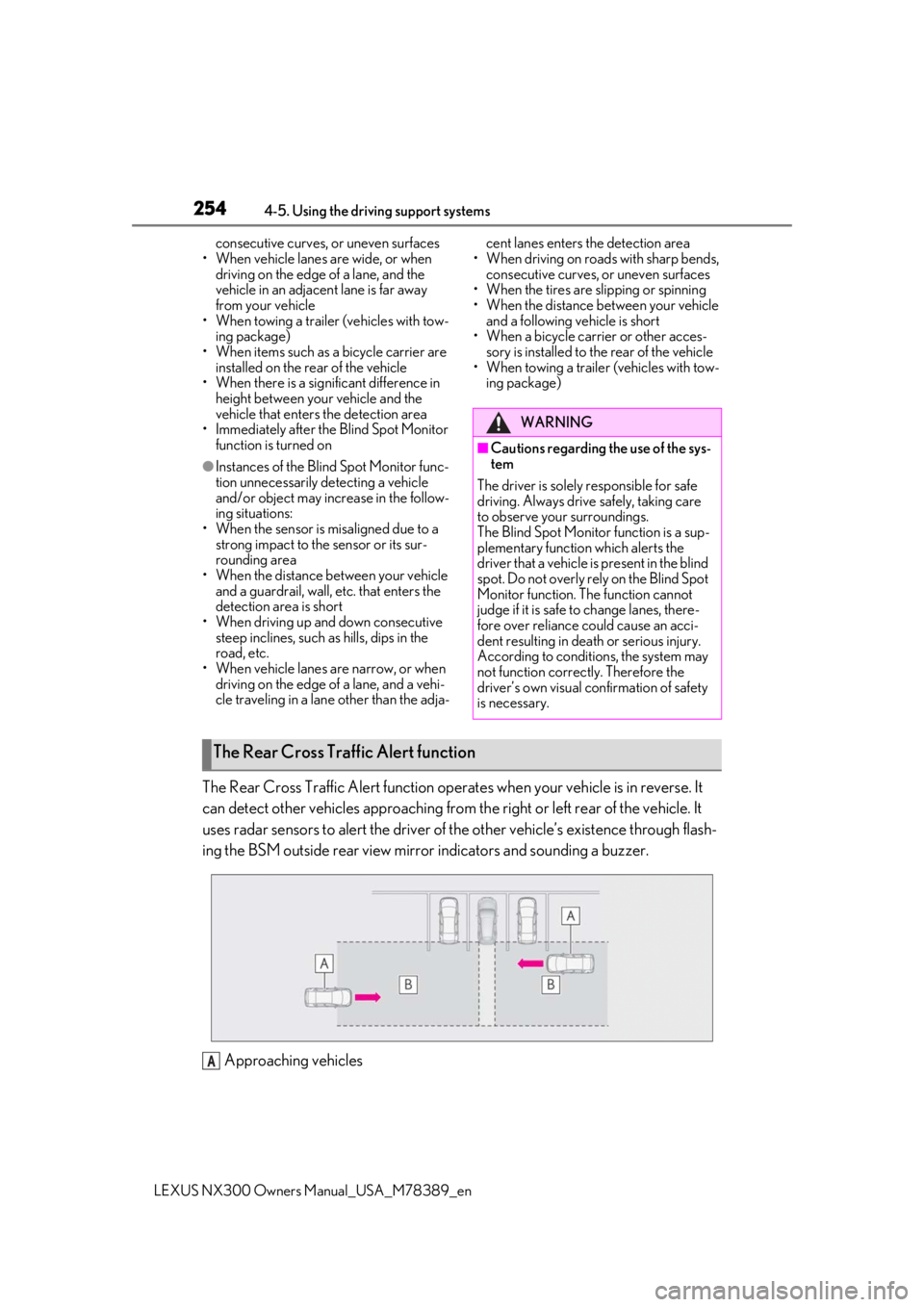
The Rear Cross Traffic Alert function operates when your vehicle is in reverse. It
can detect other vehicles approaching from the right or left rear of the vehicle. It
uses radar sensors to alert the driver of the other vehicle’s existence through flash-
ing the BSM outside rear view mirror indicators and sounding a buzzer.
Approaching vehicles
WARNING
■Cautions regarding the use of the sys-
tem
The driver is solely responsible for safe
driving. Always drive safely, taking care
to observe your surroundings.
The Blind Spot Monitor function is a sup-
plementary function which alerts the
driver that a vehicle is present in the blind
spot. Do not overly rely on the Blind Spot
Monitor function. The function cannot
judge if it is safe to change lanes, there-
fore over reliance could cause an acci-
dent resulting in death or serious injury.
According to conditions, the system may
not function correctly. Therefore the
driver’s own visual confirmation of safety
is necessary.
The Rear Cross Traffic Alert function
A
Page 269 of 468

2694-6. Driving tips
LEXUS NX300 Owners Manual_USA_M78389_en
4
Driving
Specific design characteristics give
it a higher center of gravity than
ordinary passenger cars. This vehi-
cle design feature causes this type
of vehicle to be more likely to roll-
over. Utility vehicles have a signifi-
cantly higher rollover rate than
other types of vehicles.
An advantage of the higher ground
clearance is a better view of the
road allowing you to anticipate
problems.
It is not designed for cornering at
the same speeds as ordinary pas-
senger cars anymore than low-slung
sports cars designed to perform sat-
isfactorily under of f-road conditions.
Therefore, sharp turns at excessive
speeds may cause rollover. Your vehicle is not designed to be
driven off-road. However, in the event
that off-road driving cannot be
avoided, please observe the following
precautions to help avoid the areas
prohibited to vehicles.
Drive your vehicle only in areas
where off-road vehicles are permit-
ted to travel.
Respect private property. Get
owner’s permission before entering
private property.
Do not enter areas that are closed.
Honor gates, barriers and signs that
Utility vehicle precautions
This vehicle belongs to the utility
vehicle class, which has higher
ground clearance and narrower
tread in relation to the height of its
center of gravity.
Utility vehicle feature
WARNING
■Utility vehicle precautions
Always observe the following precau-
tions to minimize the risk of death or seri-
ous injury or damage to your vehicle:
●In a rollover crash, an unbelted person
is significantly more likely to die than a
person wearing a seat belt. Therefore,
the driver and all passengers should
always fasten th eir seat belts.
●Avoid sharp turns or abrupt maneu-
vers, if at all possible.
Failure to operate this vehicle correctly
may result in loss of control or vehicle
rollover causing death or serious
injury.
●Loading cargo on the roof luggage
carrier (if equipped) will make the cen-
ter of the vehicle gravity higher. Avoid
high speeds, sudd en starts, sharp
turns, sudden braking or abrupt
maneuvers, otherwise it may result in
loss of control or vehicle rollover due
to failure to operate this vehicle cor-
rectly.
●Always slow down in gusty crosswinds.
Because of its profile and higher cen-
ter of gravity, your vehicle is more sen-
sitive to side winds than an ordinary
passenger car. Slowing down will allow
you to have better control.
●Do not drive horizontally across steep
slopes. Driving straight up or straight
down is preferred. Your vehicle (or any
similar off-road vehicle) can tip over
sideways much more easily than for-
ward or backward.
Off-road driving
Page 389 of 468
3897-2. Steps to take in an emergency
LEXUS NX300 Owners Manual_USA_M78389_en
7
When trouble arises
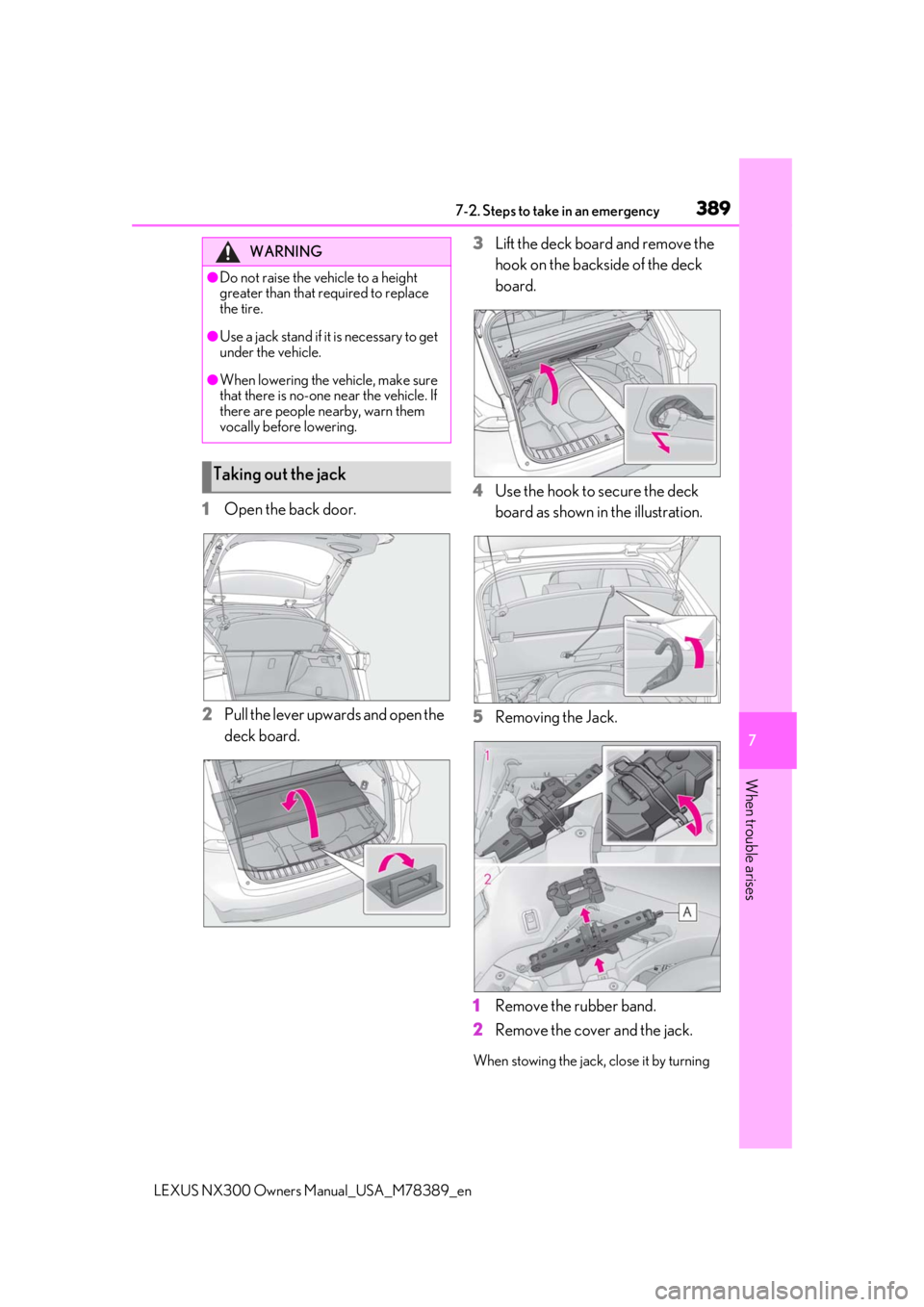
1Open the back door.
2
Pull the lever upwards and open the
deck board. 3
Lift the deck board and remove the
hook on the backside of the deck
board.
4
Use the hook to secure the deck
board as shown in the illustration.
5
Removing the Jack.
1
Remove the rubber band.
2
Remove the cover and the jack.
When stowing the jack, close it by turning
WARNING
●Do not raise the vehicle to a height
greater than that required to replace
the tire.
●Use a jack stand if it is necessary to get
under the vehicle.
●When lowering the vehicle, make sure
that there is no-one near the vehicle. If
there are people nearby, warn them
vocally before lowering.
Taking out the jack
Page 408 of 468

4088-1. Specifications
LEXUS NX300 Owners Manual_USA_M78389_en
8-1.Specifications
*1:Unladen vehicle
*2: Vehicles with towing package
■Vehicle identification number
The vehicle identification number
(VIN) is the legal identifier for your
vehicle. This is the primary identifica-
tion number for your Lexus. It is used in
registering the ownership of your vehi-
cle.
This number is stamped on the top left
of the instrument panel. This number is also on the Certification
Label.
Maintenance data (fuel, oil level, etc.)
Dimensions and weight
Overall length182.7 in. (4640 mm)
Overall width72.6 in. (1845 mm)
Overall height*164.8 in. (1645 mm)
Wheelbase104.7 in. (2660 mm)
Front and rear tread
Vehicles with
225/65R17 and
225/60R18 tires
62.2 in. (1580 mm)
Vehicles with
235/55R18 tires61.8 in. (1570 mm)
Vehicle capacity weight
(Occupants + luggage)895 lb. (405 kg)
Trailer Weight Rating*2
(Trailer weight + cargo weight)2000 lb. (910 kg)
Vehicle identification
Page 420 of 468

4208-1. Specifications
LEXUS NX300 Owners Manual_USA_M78389_en
mark
Manufacturer’s code
Manufacturing week
Manufacturing year
*:The DOT symbol certifies that the tire
conforms to applicable Federal Motor
Vehicle Safety Standards.
■Typical tire size information
The illustration indicates typical tire
size.
Tire use
(P = Passenger car,
T = Temporary use)
Section width (millimeters)
Aspect ratio
(tire height to section width)
Tire construction code
(R = Radial, D = Diagonal)
Wheel diameter (inches)
Load index (2 digits or 3 digits)
Speed symbol (alphabet with one
letter)
■Tire dimensionsSection width
Tire height
Wheel diameter
Bead
Sidewall
Shoulder
Tread
Belt
Inner liner
Reinforcing rubber
Carcass
Rim lines
Bead wires
Tire size
D
E
F
A
B
C
D
E
F
G
Tire section names
A
B
C
A
B
C
D
E
F
G
H
I
J
Page 436 of 468

4368-2. Customization
LEXUS NX300 Owners Manual_USA_M78389_en
*:If equipped
■Power back door*1 ( P.104)
*1: If equipped
*2: Configured by operating the sw itch of the lower back door. (P.115)
*3: While carrying the electronic key on your person, press the back door opener switch.
*4: When the towing hitch is installed, the kick sensor does not work
Excess speed notification
methodDisplay only
No notification
—OO—Display and
buzzer
Others notification methodDisplay only
No notification
—OO—Display and buzzer
Excess speed notification
level1 mph (2 km/h)3 mph (5 km/h)—OO—5 mph (10 km/h)
FunctionDefault settingCustomized set- ting
Back door automatic open
and stop position5
Stop at the
desired position
(height)
*2O——O
1 to 5
Back door opener switch
operationsWhen the back
door is locked
*3When the back
door is unlocked——O—
Power back door operationsOnOff—O——
Operation buzzer volume31—O——2
Kick Sensor*1, 4OnOff—O——
FunctionDefault settingCustomized set- tingABCD
ABCD
Page 463 of 468

LEXUS NX300 Owners Manual_USA_M78389_en
Alphabetical Index463
Rear turn signal lights
Replacing light bulbs................................ 362
Turn signal lever ........................................... 172
Rear view mirror Inside rear view mirror..............................134
Outside rear view mirrors ......................136
Rear window defogger .............................280
Rear window wiper...................................... 189
Refueling ............................................................ 191 Capacity .........................................................409
Fuel types.......................................................409
Opening the fuel tank cap ....................... 191
When the fuel filler door cannot be opened ........................................................ 397
Remote Touch ...............................................274
Replacing Electronic key battery..............................356
Fuses ............................................................... 358
Light bulbs..................................................... 362
Tires .................................................................. 387
Reporting safety defects for U.S. owners .......................................................................... 440
Resetting the message indicating mainte- nance is required ...................................... 326
RSA (Road Sign Assist) ............................ 223
S
S-FLOW mode ............................................ 284
Safety Connect.................................................. 61
Seat belts............................................................ 26 Adjusting the seat belt shoulder anchor height............................................................... 30
Automatic Locking Retractor ................ 28
Child restraint system installation ......... 48
Cleaning and maintaining the seat belt ......................................................................... 323 Emergency Locking Retractor .............. 28
How to wear your seat belt ..................... 27
How your child should wear the seat belt
............................................................................. 27
Pregnant women, proper seat belt use ............................................................................. 26
Reminder light and buzzer ...... 379, 380
Seat belt extender......................................... 27
Seat belt instructions for Canadian own- ers .................................................................. 440
Seat belt pretensioners ..............................30
SRS warning light....................................... 376
Seat heaters ................................................... 287
Seat position memory..................................128
Seat ventilators .............................................288
Seating capacity.............................................154
Seats Adjustment ............................................122, 123
Adjustment precautions .................122, 124
Child seats/child restraint system installa-tion ....................................................................48
Cleaning ......................................................... 323
Driving position memory ........................ 128
Folding down the rear seatbacks ........124
Front seat heaters ......................................287
Head restraint ................................................. 131
Power easy access system .................... 128
Properly sitting in the seat ........................ 25
Rear seat heaters ....................................... 287
Seat position memory .............................. 128
Seat ventilators ........................................... 288
Sécurité de l’enfant Précautions avec les coussins gonflables.......................................................................... 444