weight LEXUS NX300h 2015 User Guide
[x] Cancel search | Manufacturer: LEXUS, Model Year: 2015, Model line: NX300h, Model: LEXUS NX300h 2015Pages: 681, PDF Size: 9.14 MB
Page 191 of 681
1914-1. Before driving
4
Driving
NX300h_U_OM78007U ●
A recommended tongue weight varies in accordance with the types of trailers
or towing as described below. ●
To ensure the recommended values shown below, the trailer must be loaded
by referring to the following instructions.
•Tongue Weight
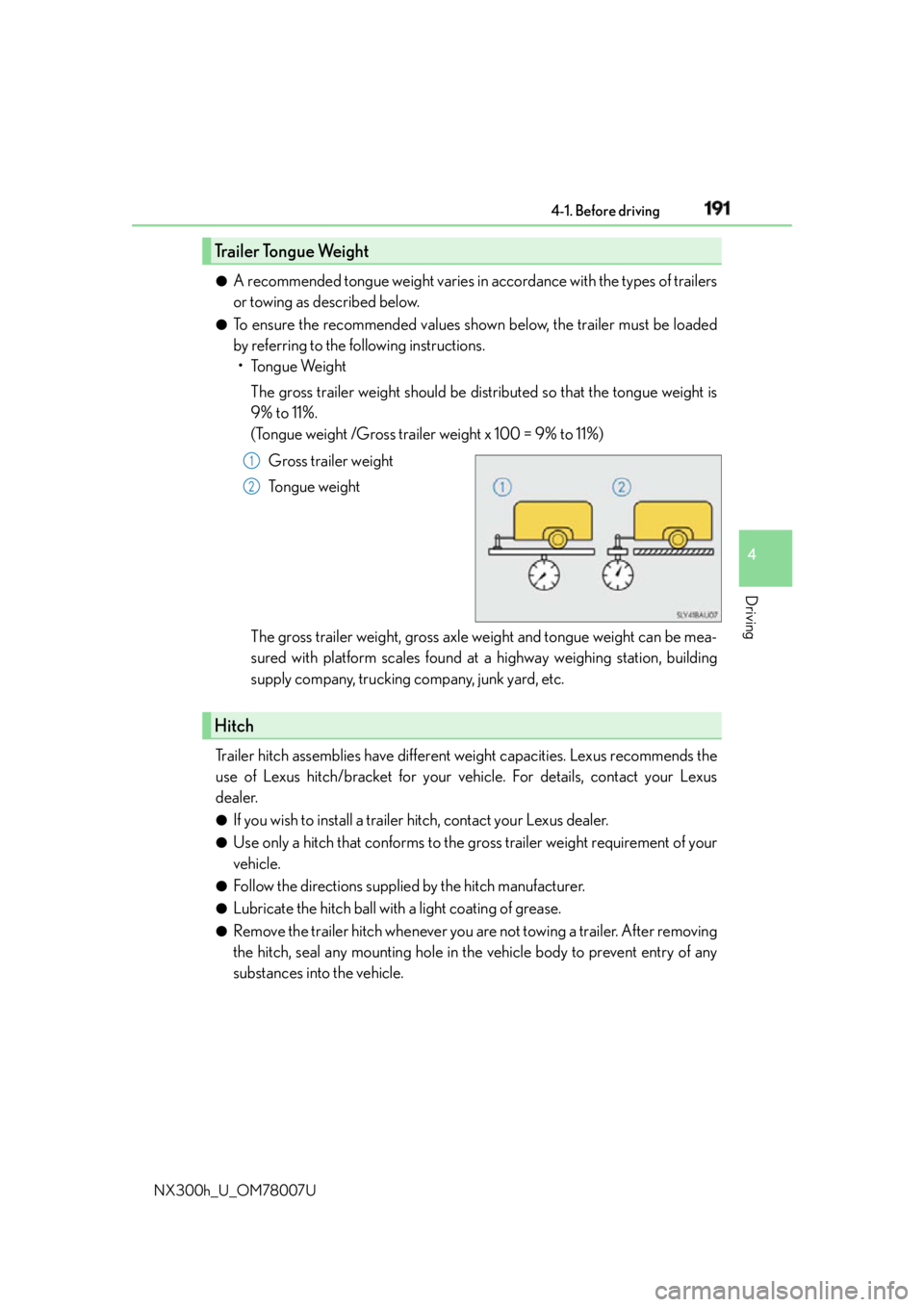
The gross trailer weight should be dist ributed so that the tongue weight is
9% to 11%.
(Tongue weight /Gross trailer weight x 100 = 9% to 11%)
Gross trailer weight
Tongue weight
The gross trailer weight, gross axle we ight and tongue we ight can be mea-
sured with platform scales found at a highway weighing station, building
supply company, trucking company, junk yard, etc.
Trailer hitch assemblies have different weight capacities. Lexus recommends the
use of Lexus hitch/bracket for your vehicle. For details, contact your Lexus
dealer. ●
If you wish to install a trailer hitch, contact your Lexus dealer. ●
Use only a hitch that conforms to the gross trailer weight requirement of your
vehicle. ●
Follow the directions supplied by the hitch manufacturer. ●
Lubricate the hitch ball with a light coating of grease. ●
Remove the trailer hitch whenever you are not towing a trailer. After removing
the hitch, seal any mounting hole in the vehicle body to prevent entry of any
substances into the vehicle.Trailer Tongue Weight 1
2
Hitch
Page 192 of 681
192 4-1. Before driving
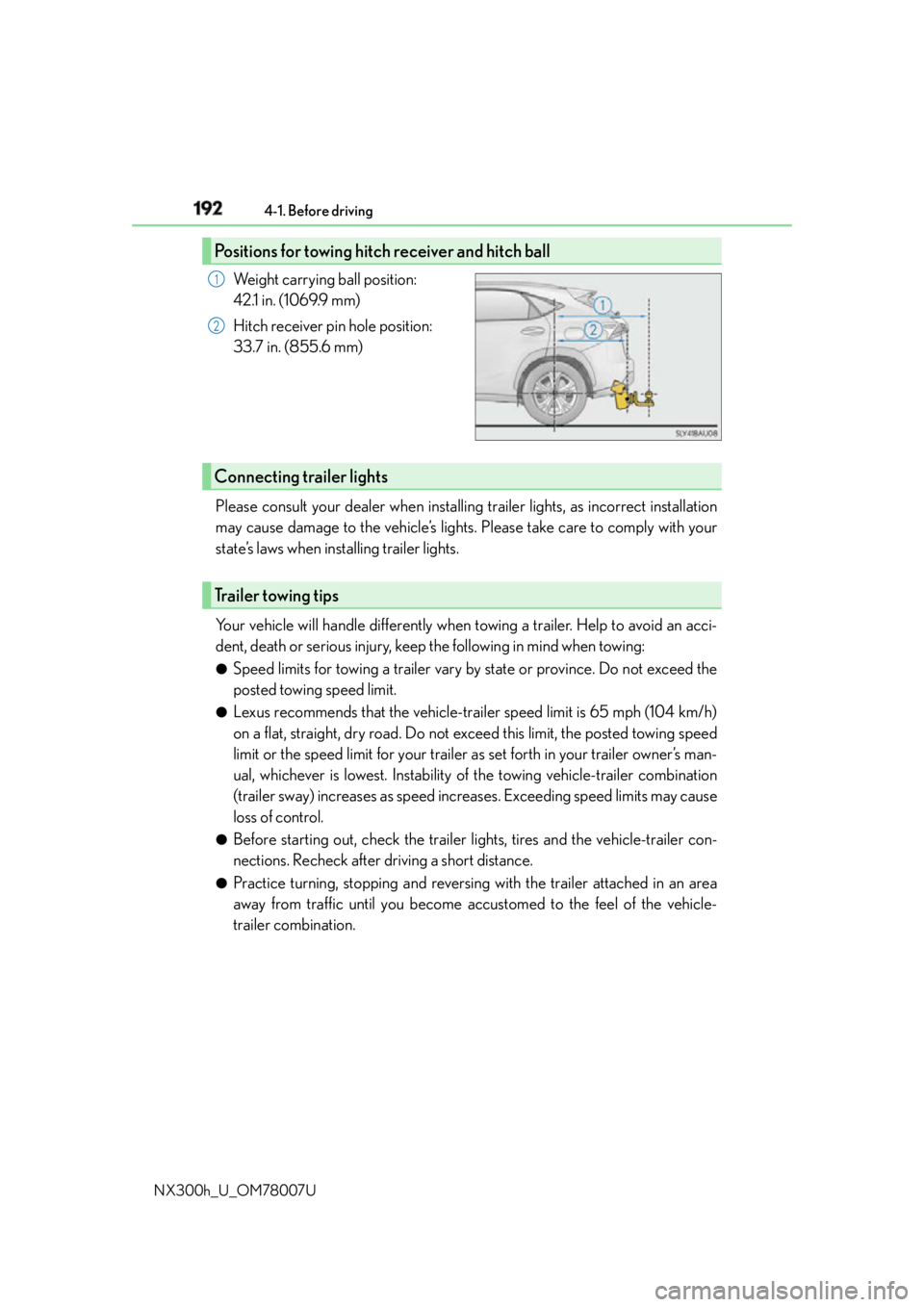
NX300h_U_OM78007U Weight carrying ball position:
42.1 in. (1069.9 mm)
Hitch receiver pin hole position:
33.7 in. (855.6 mm)
Please consult your dealer when installin g trailer lights, as incorrect installation
may cause damage to the vehicle’s lights. Please take care to comply with your
state’s laws when installing trailer lights.
Your vehicle will handle differently when towing a trailer. Help to avoid an acci-
dent, death or serious injury, keep the following in mind when towing: ●
Speed limits for towing a trailer vary by state or province. Do not exceed the
posted towing speed limit. ●
Lexus recommends that the vehicle-trailer speed limit is 65 mph (104 km/h)
on a flat, straight, dry road. Do not exceed this limit, the posted towing speed
limit or the speed limit for your trailer as set forth in your trailer owner’s man-
ual, whichever is lowest. Instability of the towing vehicle-trailer combination
(trailer sway) increases as speed increases. Exceeding speed limits may cause
loss of control. ●
Before starting out, check the trailer lights, tires and the vehicle-trailer con-
nections. Recheck after driving a short distance. ●
Practice turning, stopping and reversing with the trailer attached in an area
away from traffic until you become accustomed to the feel of the vehicle-
trailer combination.Positions for towing hitch receiver and hitch ball 1
2
Connecting trailer lights
Trailer towing tips
Page 195 of 681
1954-1. Before driving
4
Driving
NX300h_U_OM78007U ■
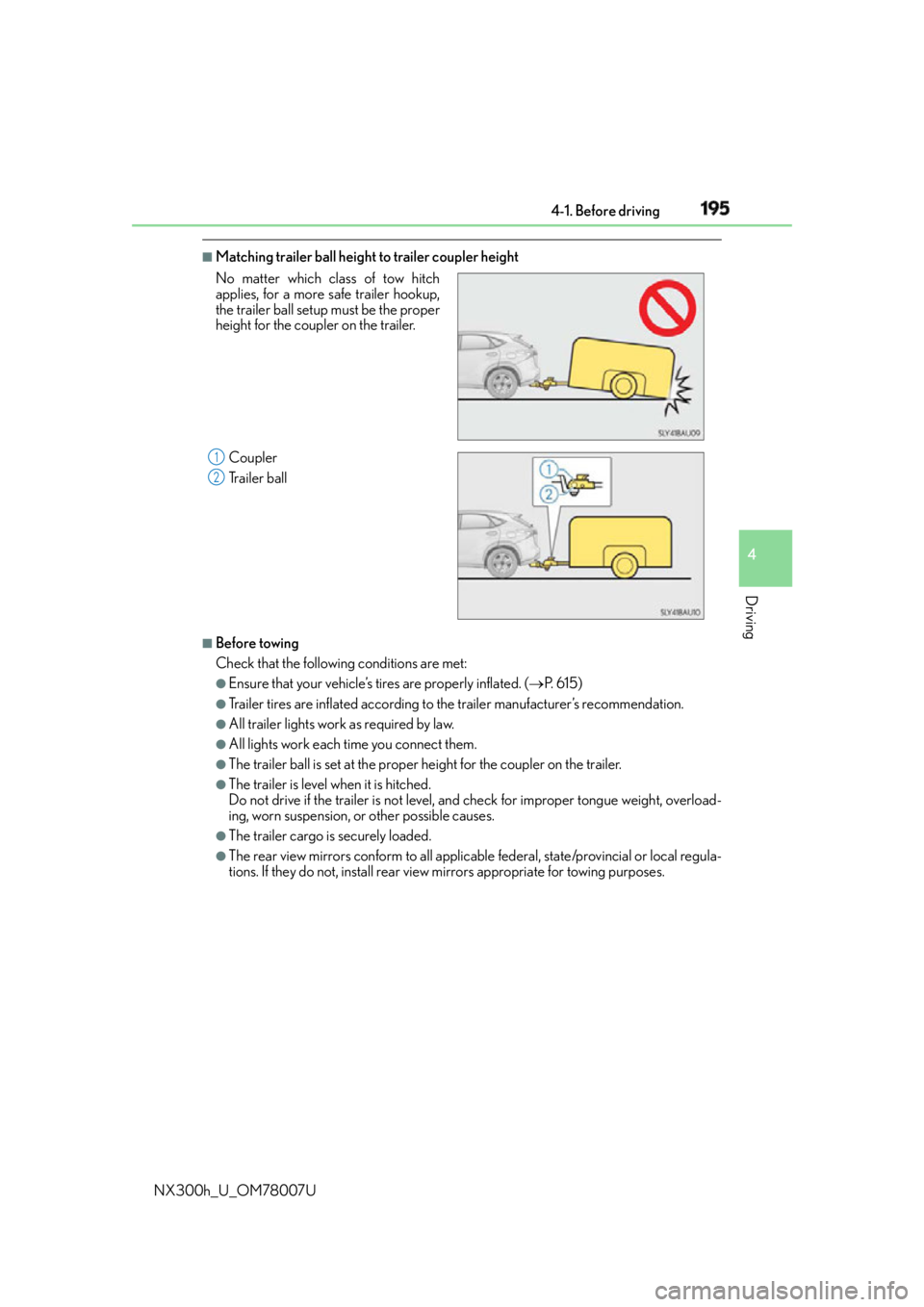
Matching trailer ball height to trailer coupler height
■
Before towing
Check that the followin g conditions are met:●
Ensure that your vehicle’s tires are properly inflated. ( P. 6 1 5 )●
Trailer tires are inflated according to the trailer manufacturer’s recommendation. ●
All trailer lights work as required by law. ●
All lights work each time you connect them. ●
The trailer ball is set at the proper height for the coupler on the trailer.●
The trailer is level when it is hitched.
Do not drive if the trailer is not level, an d check for improper to ngue weight, overload-
ing, worn suspension, or other possible causes. ●
The trailer cargo is securely loaded. ●
The rear view mirrors conform to all applicable federal, state/provincial or local regula-
tions. If they do not, install rear view mirrors appropriate for towing purposes.No matter which class of tow hitch
applies, for a more safe trailer hookup,
the trailer ball setup must be the proper
height for the coupler on the trailer.
Coupler
Trailer ball 1
2
Page 196 of 681

196 4-1. Before driving
NX300h_U_OM78007U ■
Break-in schedule
If your vehicle is new or equipped with any new power train components (such as an
engine, transmission, differential or wheel bearing), Lexus recommends that you do not
tow a trailer until the vehicle has been driven for over 500 miles (800 km).
After the vehicle has been driven for over 500 miles (800 km), you can start towing.
However, for the next 500 miles (800 km), drive the vehicle at a speed of less than
50 mph (80 km/h) when towing a trailer, and avoid full throttle acceleration.■
Maintenance ●
If you tow a trailer, your vehicle will requir e more frequent maintenance due to the addi-
tional load. (See “Warranty and Services Guide”, “Owner’s Manual Supplement” or
“Scheduled Maintenance”.) ●
Retighten the fixing bolts of the towing ba ll and bracket after approximately 600 miles
(1000 km) of trailer towing. ■
If trailer sway occurs
One or more factors (crosswinds, passing vehicles, rough roads, etc.) can adversely
affect handling of your vehicle and trailer, causing instability.●
If trailer swaying occurs:
• Firmly grip the steering wheel. Steer straight ahead.
Do not try to control trailer sway ing by turning the steering wheel.
• Begin releasing the accelerator pedal i mmediately but very gradually to reduce
speed.
Do not increase speed. Do not apply vehicle brakes.
If you make no extreme correction with the steering or brakes, your vehicle and trailer
should stabilize. ●
After the trailer sw aying has stopped:
• Stop in a safe place. Get all occupants out of the vehicle.
• Check the tires of the vehicle and the trailer.
• Check the load in the trailer.
Make sure the load has not shifted.
Make sure the tongue weight is appropriate, if possible.
• Check the load in the vehicle.
Make sure the vehicle is not overloaded after occupants get in.
If you cannot find any problems, the speed at which trailer swaying occurred is beyond
the limit of your particular vehicle-trailer combination. Drive at a lower speed to pre-
vent instability. Remember that swaying of the towing vehicle-trailer increases as
speed increases.
Page 197 of 681

1974-1. Before driving
4
Driving
NX300h_U_OM78007U WA R N I N G ■
Trailer towing precautions
To tow a trailer safely, use extreme care and drive the vehicle in accordance with the
trailer’s characteristics and op erating conditions. Failure to do so could cause an acci-
dent resulting in death or serious injury. Vehicle stability and braking performance are
affected by trailer stability, brake setting and performance, and the hitch. Your vehicle
will handle differently when towing a trailer. ■
To avoid accident or injury ●
Do not exceed the TWR, unbrak ed TWR, GCWR, GVWR or GAWR.●
Adjust the tongue weight within the approp riate range. Place heavier loads as close
to the trailer axle as possible. ●
Do not exceed 65 mph (104 km/h), the posted towing speed limit or the speed limit
for your trailer as set forth in your trailer owner’s manual, whichever is lowest. Slow
down sufficiently before making a turn, in cr oss winds, on wet or slippery surface, etc.
to help avoid an accident. If you experience a vehicle-trailer instability from reducing
a certain speed, slow down and make sure you keep your vehicle speed under the
speed of which you expe rience the instability.●
Do not make jerky, abrupt or sharp turns. ●
Do not apply the brakes suddenly as you ma y skid, resulting in ja ckknifing and loss of
vehicle control. This is especially true on wet or slippery surfaces. ●
Do not exceed the trailer hitch assembly weight, gross vehicle weight, gross axle
weight and trailer tongue weight capacities. ●
Do not use the following systems when trailer towing.
• Cruise control (if equipped)
• Dynamic radar cruise control (if equipped)
• Dynamic cruise control with full-speed range (if equipped)●
Slow down and downshift before descending steep or long downhill grades. Do not
make sudden downshifts while descen ding steep or long downhill grades.●
Vehicle-trailer instability is more likely on steep long downhills. Before descending
steep or long downhill grades, slow down and downshift. Do not make sudden down-
shifts when descending stee p or long downhill grades. Avoid holding the brake pedal
down too long or applying the brakes too frequently. This could cause the brakes to
overheat and result in reduced braking efficiency. ●
Vehicles with a compact spare tire: Do no t tow a trailer when the compact spare tire
is installed on your vehicle. ■
Hitch
Trailer hitch assemblies have different weight capacities established by the hitch manu-
facturer. Even though the vehicle may be physically capable of towing a higher weight,
the operator must determine the maximum weig ht rating of the particular hitch assem-
bly and never exceed the maximum weight rating specified for the trailer-hitch.
Exceeding the maximum weight rating set by the trailer-hitch manufacturer can cause
an accident resulting in death or serious personal injuries.
Page 198 of 681

198 4-1. Before driving
NX300h_U_OM78007U WA R N I N G ■
When towing a trailer
Lexus recommends trailers with brakes that conform to any applicable federal and
state/provincial regulations. ●
If the gross trailer weight exceeds unbraked TWR, trailer brakes are required. Lexus
recommends trailers with brakes that conform to all applicable federal and state/pro-
vincial regulations. ●
Never tap into your vehicle’s hydraulic system, as this will lower the vehicle’s braking
effectiveness. ●
Never tow a trailer without using a safety ch ain securely attached to both the trailer
and the vehicle. If damage occurs to the coupling unit or hitch ball, there is danger of
the trailer wandering into another lane.
NOTICE ■
When installing a trailer hitch
Use only the position recommended by your Lexus dealer. Do not install the trailer
hitch on the bumper; this may cause body damage. ■
Do not directly splice trailer lights
Do not directly splice trailer lights. Dire ctly splicing trailer lights may damage your
vehicle’s electrical system and cause a malfunction.
Page 517 of 681

5177-3. Do-it-yourself maintenance
7
Maintenance and care
NX300h_U_OM78007U Your vehicle is equipped with a tire pressure warning system that uses tire pres-
sure warning valves and transmitters to detect low tire inflation pressure before
serious problems arise. ●
If the tire pressure drops below a predet ermined level, the driver is warned by
a warning light. ( P. 5 6 7 )
◆ Installing tire pressure warning valves and transmitters
When replacing tires or wheels, tire pressure warning valves and transmitters
must also be installed.
When new tire pressure warning valves and transmitters are installed, new ID
codes must be registered in the tire pressure warning computer and the tire
pressure warning system must be initialized. Have tire pressure warning valve
and transmitter ID codes registered by your Lexus dealer. ( P. 5 1 9 )
◆ Initializing the tire pressure warning system ■
The tire pressure warning system must be initialized in the following circum-
stances: ●
When changing the tire inflation pressure ●
When the tire inflation pressure is changed such as when changing travel-
ing speed or load weight. ●
When rotating the tires ●
When changing the tire.
When the tire pressure warning system is initialized, the current tire inflation
pressure is set as the benchmark pressure.Tire pressure warning system ●
The tire pressure detected by the tire
pressure warning system can be dis-
played on the multi-information display.
Page 520 of 681

520 7-3. Do-it-yourself maintenance
NX300h_U_OM78007U ■
Maximum load of tire
Check that the maximum load of the replacem ent tire is greater than 1 /2 of the Gross
Axle Weight Ratings (GAWR) of either the front axle or the rear axle, whichever is
greater.
■
Tire types ●
Summer tires
Summer tires are high-speed performance tires best suited to highway driving under
dry conditions. Since summer tires do not have the same traction performance as
snow tires, summer tires are inadequate for driving on snow-covered or icy roads. For
driving on snow-covered roads or icy roads, the use of snow tires is recommended.
When installing snow tires, be sure to replace all four tires. ●
All season tires
All season tires are designed to provide better traction in snow and to be adequate for
driving in most winter condit ions as well as for use year-round. All season tires, how-
ever, do not have adequate traction performance compared with snow tires in heavy
or loose snow. Also, all season tires fall short in acceleration and handling perfor-
mance compared with summer tires in highway driving. ●
Snow tires
For driving on snow-covered roads or icy roads, we recommend using snow tires. If
you need snow tires, select tires of the same size, construction and load capacity as the
originally installed tires. Since your vehicle has radial tires as original equipment, make
sure your snow tires also have radial cons truction. Do not install studded tires without
first checking local regulations for possible re strictions. Snow tires should be installed
on all wheels. ( P. 3 2 6 )■
Initializing the tire pressure warning system
Initialize the system with the tire inflation pressure adjusted to the specified level. ■
If the tread on snow tires wears down below 0.16 in. (4 mm)
The effectiveness of the tires as snow tires is lost.For the GAWR, see the Certification Label. For
the maximum load of the tire, see the load limit
at maximum cold tire inflation pressure men-
tioned on the sidewall of the tire. ( P. 6 2 1 )
Page 527 of 681

5277-3. Do-it-yourself maintenance
7
Maintenance and care
NX300h_U_OM78007U ■
Instructions for checking tire inflation pressure
When checking tire inflation pressure, observe the following: ●
Check only when the tires are cold.
If your vehicle has been parked for at least 3 hours or has not been driven for more than
1 mile or 1.5 km, you will get an accurate cold tire inflation pressure reading. ●
Always use a tire pressure gauge.
It is difficult to judge if a tire is pro perly inflated based only on its appearance.●
It is normal for the tire inflation pressure to be higher after driving as heat is generated
in the tire. Do not reduce tire inflation pressure after driving. ●
Never exceed the vehicle capacity weight.
Passengers and luggage weight should be placed so that the vehicle is balanced.
WA R N I N G ■
Proper inflation is critical to save tire performance
Keep your tires properly inflated.
If the tires are not properly inflated, the following conditions may occur which could
lead to an accident resulting in death or serious injury: ●
Excessive wear ●
Uneven wear ●
Poor handling ●
Possibility of blowouts result ing from overheated tires●
Air leaking from between tire and wheel ●
Wheel deformation and/or tire damage ●
Greater possibility of tire damage while driving (due to road hazards, expansion
joints, sharp edges in the road, etc.)
NOTICE ■
When inspecting and adjust ing tire inflation pressure
Be sure to put the tire valve caps back on.
If a valve cap is not installed, dirt or moisture may get into the valve and cause an air
leak, resulting in decreased tire inflation pressure.
Page 528 of 681
528 7-3. Do-it-yourself maintenance
NX300h_U_OM78007UWheels When replacing wheels, care should be taken to ensure that they are equivalent
to those removed in load capacity , diameter, rim width and inset
* .
Replacement wheels are available at your Lexus dealer.
* : Conventionally referred to as “offset”.
Lexus does not recommend using the following: ●
Wheels of different sizes or types ●
Used wheels ●
Bent wheels that have been straightened ●
Use only Lexus wheel nuts and wrenches designed for use with your alumi-
num wheels. ●
When rotating, repairing or changing your tires, check that the wheel nuts are
still tight after driving 1000 miles (1600 km). ●
Be careful not to damage the aluminum wheels when using tire chains. ●
Use only Lexus genuine balance weights or equivalent and a plastic or rubber
hammer when balancing your wheels. ■
When replacing wheels
The wheels of your vehicle are equipped with tire pressure warning valves and transmit-
ters that allow the tire pressure warning system to provide advance warning in the event
of a loss in tire inflation pressure. Whenever wheels are replaced, tire pressure warning
valves and transmitters must be installed. ( P. 5 1 7 , 5 2 9 )If a wheel is bent, cracked or heavily corroded, it should be replaced. Other-
wise, the tire may separate from the whee l or cause a loss of handling control.
Wheel selection
Aluminum wheel precautions