warning LEXUS NX300h 2015 Workshop Manual
[x] Cancel search | Manufacturer: LEXUS, Model Year: 2015, Model line: NX300h, Model: LEXUS NX300h 2015Pages: 681, PDF Size: 9.14 MB
Page 275 of 681
2754-5. Using the driving support systems
4
Driving
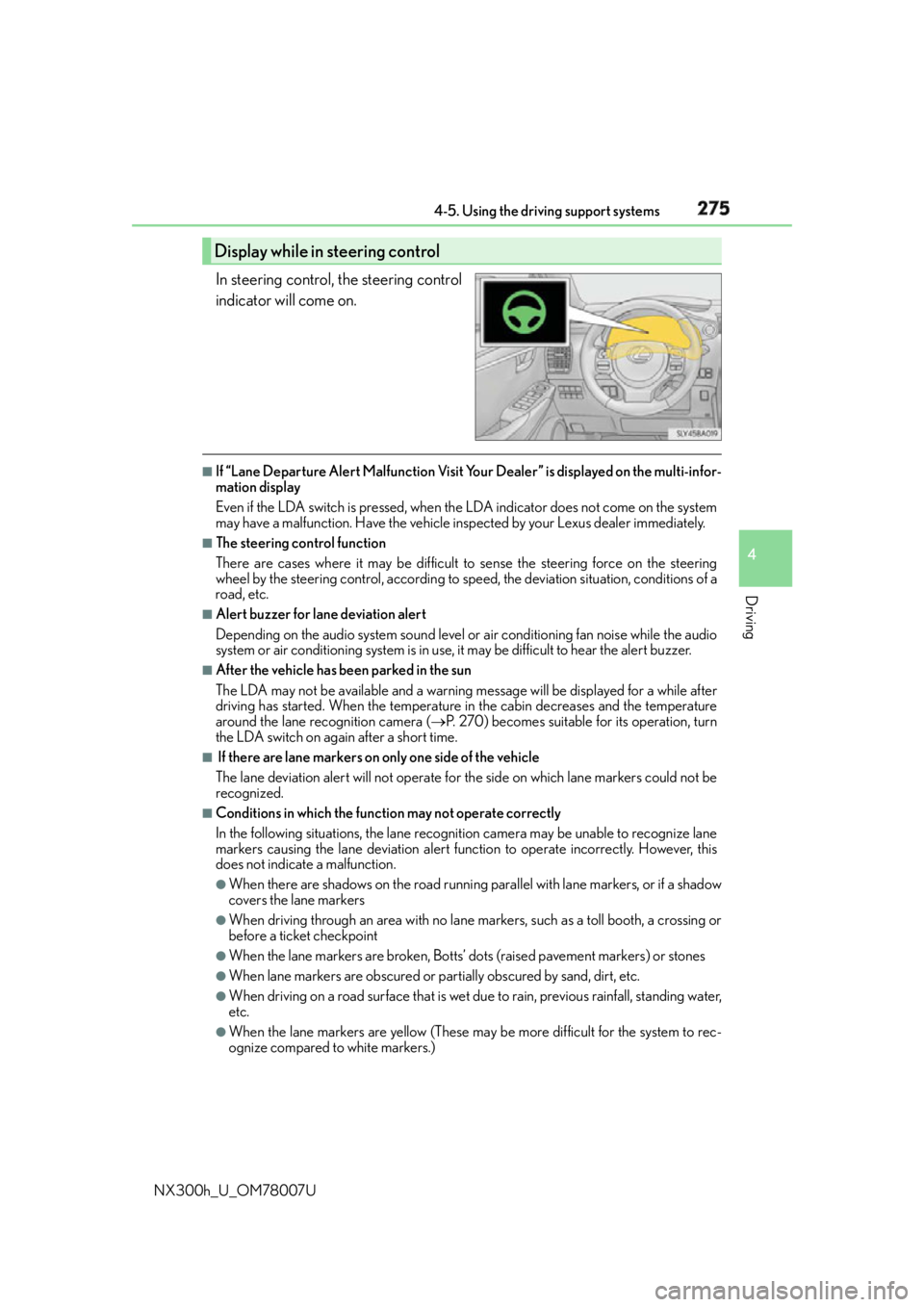
NX300h_U_OM78007U In steering control, the steering control
indicator will come on. ■
If “Lane Departure Alert Malfunction Visit Yo ur Dealer” is displaye d on the multi-infor-
mation display
Even if the LDA switch is pressed, when th e LDA indicator does not come on the system
may have a malfunction. Have the vehicle in spected by your Lexus dealer immediately.■
The steering control function
There are cases where it may be difficult to sense the steering force on the steering
wheel by the steering control, according to speed, the deviatio n situation, conditions of a
road, etc. ■
Alert buzzer for lane deviation alert
Depending on the audio system sound level or air conditioning fan noise while the audio
system or air conditioning system is in use, it may be difficult to hear the alert buzzer.■
After the vehicle has been parked in the sun
The LDA may not be available and a warning message will be displayed for a while after
driving has started. When the temperature in the cabin decreases and the temperature
around the lane recognition camera ( P. 270) becomes suitable for its operation, turn
the LDA switch on again after a short time. ■
If there are lane markers on only one side of the vehicle
The lane deviation alert will not operate for the side on which lane markers could not be
recognized. ■
Conditions in which the functi on may not operate correctly
In the following situations, the lane recognition camera may be unable to recognize lane
markers causing the lane deviation alert function to operate incorrectly. However, this
does not indicate a malfunction. ●
When there are shadows on the road running parallel with lane mark ers, or if a shadow
covers the lane markers ●
When driving through an area with no lane markers, such as a toll booth, a crossing or
before a ticket checkpoint ●
When the lane markers are broken, Botts’ dots (raised pavement markers) or stones ●
When lane markers are obscured or partially obscured by sand, dirt, etc. ●
When driving on a road surface that is wet du e to rain, previous rainfall, standing water,
etc. ●
When the lane markers are yellow (These may be more difficult for the system to rec-
ognize compared to white markers.)Display while in steering control
Page 276 of 681
276 4-5. Using the driving support systems
NX300h_U_OM78007U ●
When the lane markers are on a curb, etc. ●
When driving on a particularly brig ht road surface, such as concrete●
When driving on a road surface that is bright due to reflected light ●
When driving in a location wh ere the light level changes rapi dly, such as the entrance to
or exit from a tunnel ●
When sunlight or the headlights of oncoming vehicles are shining directly into the cam-
era lens ●
When driving on roads that are branching or merging ●
When driving on a hill ●
When driving on winding roads or roads that are uneven ●
When driving on rough or unpaved roads ●
When driving on a sharp curve ●
When lane markers are extremely narrow or extremely wide ●
When the vehicle leans to one side an unus ual amount due to a heavy load or improper
tire inflation pressure ●
When the following distance between your vehicle and the vehicle ahead is extremely
short ●
When the vehicle experiences strong up-and -down motion such as when driving on an
extremely rough road or on a seam in the pavement ●
When headlight brightness at nighttime is reduced due to dirt on the lenses, or when
the headlights are misaligned ●
When receiving a side wind ■
When changing the tires
Depending on the tires used, sufficient performance may not be maintainable.■
Warning messages for the LDA
Warning messages are used to indicate a syst em malfunction or to inform the driver of
the need for caution while driving. If a wa rning message is shown on the multi-informa-
tion display, read the message and follow the instructions.
Also, even if a warning message is displayed, it will not impede normal driving. ■
When turning on/off the steering control function
From “Settings display” ( P. 103) of the multi-information display, the steering
control function can be turned on/off.
Pressing the or meter control switches ( P. 103), selects
With each press of meter control switch es, the control switches between “On” and
“Off” ■
Sensitivity adjustment for th e lane deviation alert buzzer
From
“Settings display” ( P. 103) of the multi-inform ation display, the alert sen-
sitivity for the alert buzzer when deviating from the lane can be adjusted.
Pressing the or meter control switches ( P. 103), selects
With each press of meter control switches, the control switches between “High”
and “Standard” 1
2
1
2
Page 277 of 681
2774-5. Using the driving support systems
4
Driving
NX300h_U_OM78007U WA R N I N G ■
Before using the LDA
Do not over rely on the LDA. The LDA does not drive the vehicle automatically, nor
does it reduce the amount of care you need to take. As such, the driver must always
assume full responsibility for understandin g his/her surroundings, for operating the
steering wheel to correct the driving line, and for driving safely. Also, take occasional
rests from fatigue due to driving over long periods of time, etc.
Inappropriate or negligent driving co uld lead to an unexpected accident.■
Do not drive without holding the steering wheel
While the steering control function is operating, when the system judges that the vehi-
cle is being driven without holding the steering wheel, a warning message is displayed.
( P. 2 7 1 )
Inappropriate steering wheel operations and/or negligent driving could lead to an
unexpected accident. When driving, firmly ho ld the steering wheel and keep safe driv-
ing in mind. ■
To avoid operating the LDA by mistake
Switch the LDA off using the LDA switch when not in use. ( P. 2 7 2 )■
Situations unsuitable for LDA
Do not use the LDA in any of the following situations.
Otherwise, the system may not function correctly and could result in an accident. ●
When driving with snow tires, tire ch ains, a spare tire, or similar equipment●
When a tire with a different structure, maker, brand, or tread pattern is used. ●
When remain tread of the tire or the air pressure is insufficient●
When restructuring the suspension ●
When there are objects or structures along the roadside that might be misinterpreted
as lane markers (such as guardrails, a curb, reflector posts, etc.) ●
When driving on snowy roads ●
When pavement lane markers are difficult to see due to rain, snow, fog, sand, dust,
etc. ●
When there are visible lines on the pavement from road repairs, or if the remains of
old lane markers are still visible on the road ●
When driving on a road with lane closures due to maintenance, or when driving in a
temporary lane ●
When driving on road surfaces that are slippery from rain, snow, etc.●
When driving in traffic lanes other than highways and freeway ●
When driving through construction areas
Page 310 of 681
310 4-5. Using the driving support systems
NX300h_U_OM78007UPCS (Pre-Collision System)
◆ Pre-collision warning
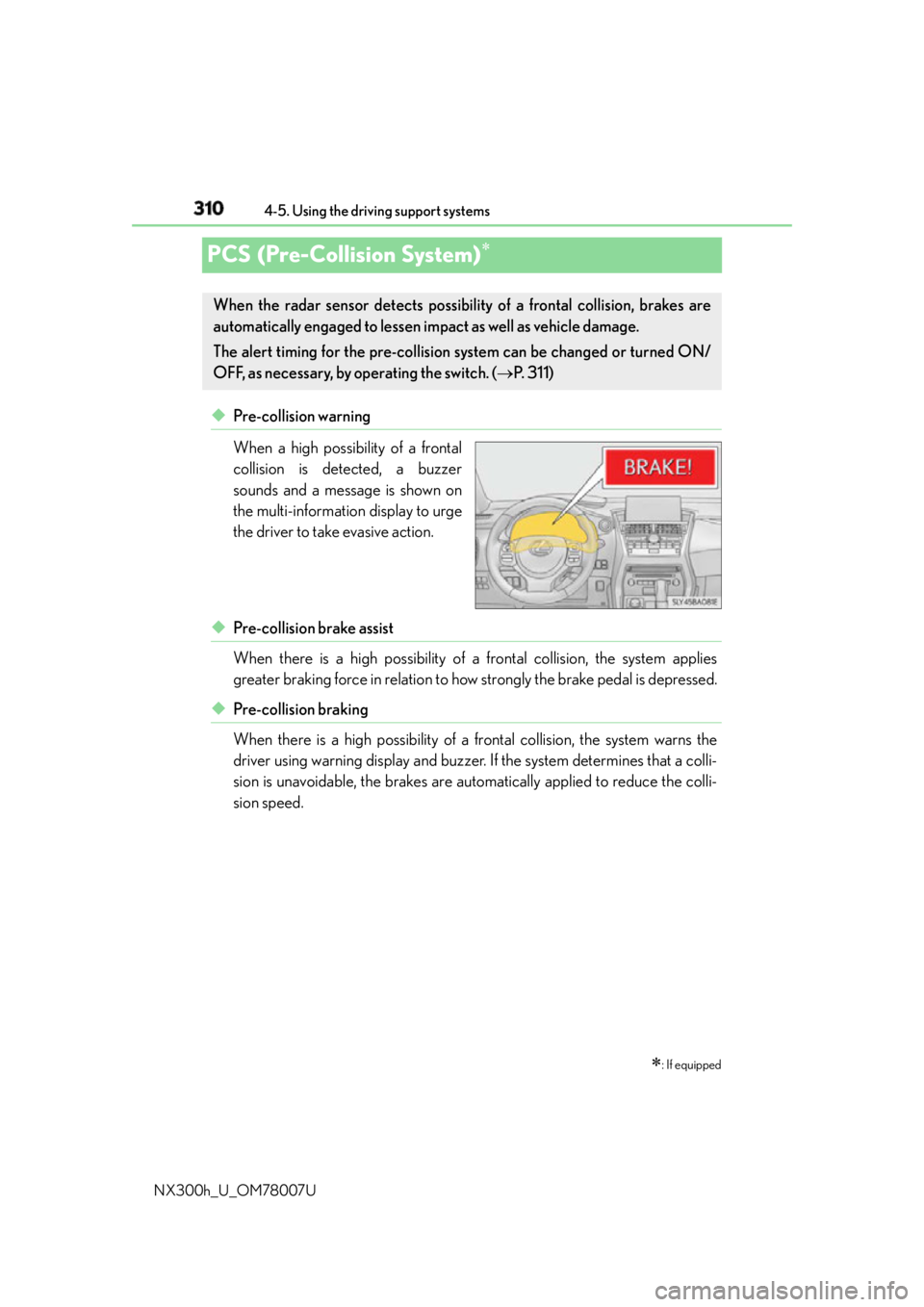
When a high possibility of a frontal
collision is detected, a buzzer
sounds and a message is shown on
the multi-information display to urge
the driver to take evasive action.
◆ Pre-collision brake assist
When there is a high possibility of a frontal collision, the system applies
greater braking force in relation to ho w strongly the brake pedal is depressed.
◆ Pre-collision braking
When there is a high possibility of a frontal collision, the system warns the
driver using warning display and buzzer. If the system determines that a colli-
sion is unavoidable, the brakes are automatically applied to reduce the colli-
sion speed.
: If equippedWhen the radar sensor detects possibilit y of a frontal collision, brakes are
automatically engaged to lessen im pact as well as vehicle damage.
The alert timing for the pre-collision system can be changed or turned ON/
OFF, as necessary, by operating the switch. ( P. 311)
Page 311 of 681
3114-5. Using the driving support systems
4
Driving
NX300h_U_OM78007U ■
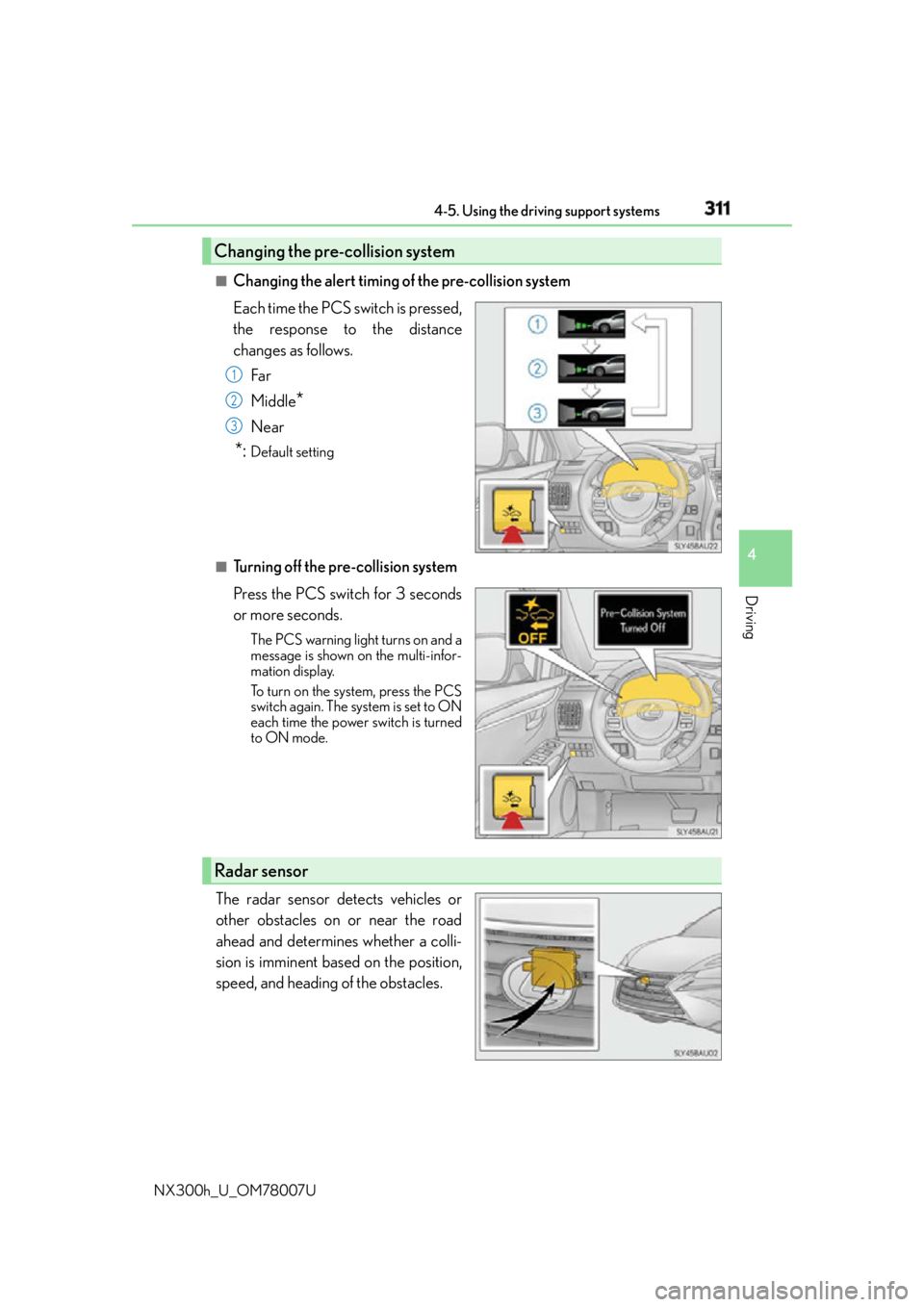
Changing the alert timing of the pre-collision system
Each time the PCS switch is pressed,
the response to the distance
changes as follows.
Far
Middle
* Near
*: Default setting
■
Turning off the pre-collision system
Press the PCS switch for 3 seconds
or more seconds. The PCS warning light turns on and a
message is shown on the multi-infor-
mation display.
To turn on the system, press the PCS
switch again. The system is set to ON
each time the power switch is turned
to ON mode.
The radar sensor detects vehicles or
other obstacles on or near the road
ahead and determines whether a colli-
sion is imminent based on the position,
speed, and heading of the obstacles.Changing the pre-collision system 1
2
3
Radar sensor
Page 312 of 681

312 4-5. Using the driving support systems
NX300h_U_OM78007U ■
The pre-collision system is operational when
The pre-collision system is on ( P. 311) and the following conditions are met:●
Pre-collision warning:
• Vehicle speed is greater th an about 10 mph (15 km/h).
• The speed at which your vehicle is approaching the obstacle or the vehicle running
ahead of you is greater than about 7 mph (10 km/h). ●
Pre-collision brake assist:
• The VSC is not turned off.
• Vehicle speed is greater than about 19 mph (30 km/h).
• The speed at which your vehicle is approaching the obstacle or the vehicle running
ahead of you is greater than about 19 mph (30 km/h).
• The brake pedal is depressed. ●
Pre-collision braking:
• The VSC is not turned off.
• Vehicle speed is greater th an about 10 mph (15 km/h).
• The speed at which your vehicle is approaching the obstacle or the vehicle running
ahead of you is greater than about 7 mph (10 km/h).■
Conditions that may trigger the system even if there is no possibility of a collision
If the following obstructs the front of the sens or, the system judges that a collision may be
possible and operates. ●
When passing by a vehicle while making left or right turns or passing a vehicle in an
opposite lane. ●
When the vehicle rapidly approaches an object in front of it (such as another vehicle,
toll gate, etc.) ●
When climbing a steep hill, etc., and there are structures in the upper region of the road
(billboards, low ceilings , street lamps, etc.)●
When driving through narrow passages or places with low ceilings (bridges, tunnels,
overhead passes, etc.) ●
When driving on an uneven road surface ●
When metal objects are on the road surface causing level differences or protrusions in
the road ●
When an extreme change in vehicle height occurs ●
When the radar sensor moves off position du e to its surrounding area being subjected
to a strong impact. ●
When there is an obstacle on the side of an entrance of a curb for road (guardrails, etc.) ●
When your vehicle is tilted upwards (due to towing a trailer or during emergency tow-
ing, heavy loads in the lu ggage compartment, etc.).
When the system is activated in the situations described above, ther e is also a possibility
that the brakes will be applied wi th a force greater than normal.■
Obstacles not detected
The sensor cannot detect plasti c obstacles such as traffic co nes. There may also be occa-
sions when the sensor cannot detect pedestrians, animals, bicycles, motorcycles, trees,
or snowdrifts.
Page 313 of 681
3134-5. Using the driving support systems
4
Driving
NX300h_U_OM78007U ■
Situations in which the pre-collision system does not function properly
The system may not function effectively in situations such as the following:●
On roads with sharp bends or uneven surfaces ●
If a vehicle suddenly moves in front of your vehicle, such as at an intersection ●
If a vehicle suddenly cuts in front of your vehicle, such as when overtaking ●
In inclement weather such as heav y rain, fog, snow or sand storms●
When your vehicle is skidding with the VSC system off ●
When an extreme change in vehicle height occurs ●
When the radar sensor moves off position du e to its surrounding area being subjected
to a strong impact ●
Due to greatly turning the wheel when an obstacle suddenly appears ahead ■
Automatic cancelation of the pre-collision system
When a malfunction occurs due to sensor contamination, etc., that results in the sensors
being unable to detect obstacles, the pre-collision syst em will be automatically disabled.
In this case, the system will not activate even if there is a collision possibility.■
When there is a malfunction in the system, or if the system is temporarily unavailable
The PCS warning light flashes and a warning message is shown on the multi-information
display. If a warning message is shown on th e multi-information display, read the message
and follow the instructions. ■
When the TRAC and VSC are turned off ●
When the TRAC and VSC operations are turned off ( P. 307), the pre-collision brake
assist and pre-collision braking are also turned off. However, the alert function oper-
ates. ●
The PCS warning light turns on and the “V SC Turned Off Pre-Collision Brake System
Unavailable” is shown on the multi-information display. ■
Certification
For vehicles sold in the U.S.A.
FCC ID: HYQDNMWR007
This device complies with part 15 of the FC C Rules. Operation is subject to the following
two conditions: (1) This device may not caus e harmful interference, and (2) this device
must accept any interference received, incl uding interference that may cause undesired
operation.
FCC WARNING
Changes or modifications not expressly approved by the party responsible for compli-
ance could void the user’s authority to operate the equipment.
Radio frequency radiation exposure Information:
This equipment complies with FCC radiation exposure limits set forth for an uncontrolled
environment.
This equipment should be installed and operated with minimum distance of 20 cm
between the radiator (antenna) and your body.
This transmitter must not be co-located or operating in conjunction with any other
antenna or transmitter.
For vehicles sold in Canada
This device complies with Industry Canada licence-exempt RSS standard(s).
Operation is subject to the following two co nditions: (1) this device may not cause inter-
ference, and (2) this device must accept any interference, including interference that
may cause undesired operation of the device.
Page 317 of 681

3174-5. Using the driving support systems
4
Driving
NX300h_U_OM78007U ■
The BSM outside rear view mirror indicators visibility
When under strong sunlight, the BSM outside rear view mirror indicator may be difficult
to see. ■
Rear Cross Traffic Alert buzzer hearing
Rear Cross Traffic Alert function may be difficult to hear over loud noises such as high
audio volume. ■
When “Blind Spot Monitor Unavailable” is shown on the multi-information display
Water, snow mud, etc., may be built up in the vicinity of the sensor area of bumper.
( P. 318) Removing the water, snow, mud, etc., from the vicinity of the sensor area
bumper should return it to normal. Also, the sensor may not function normally when used
in extremely hot or cold weather. ■
When “Blind Spot Monitor System Malfunct ion” is shown on the multi-information
display
There may be a sensor malfunction or voltag e abnormality. Have the vehicle inspected at
a Lexus dealer. ■
Certification for the Blind Spot Monitor system
For vehicles sold in the U.S.A.
FCC ID: OAYSRR2A
This device complies with part 15 of the FC C Rules. Operation is subject to the following
two conditions:
(1) This device may not cause harmful interference, and
(2) this device must accept any interference received, including interference that may
cause undesired operation.
FCC Warning
Changes or modifications not expressly approved by the party responsible for compli-
ance could void the user’s authority to operate the equipment.
For vehicles sold in Canada
Applicable law: Canada 310
This device complies with Industry Canada licence-exempt RSS st andard(s). Operation
is subject to the following two conditions: (1) this device may not cause interference, and
(2) this device must accept any interference, including interference that may cause
undesired operation of the device.
Frequency bands: 24.05-24.25 GHz
Output power: less than 20 milliwatts
Page 329 of 681

3294-6. Driving tips
4
Driving
NX300h_U_OM78007U NOTICE ■
Repairing or replacing snow tires
Request repairs or replacement of snow tires from Lexus dealers or legitimate tire
retailers.
This is because the removal and attachment of snow tires affects the operation of the
tire pressure warning valves and transmitters. ■
Fitting tire chains
The tire pressure warning valves and transmitters may not function correctly when tire
chains are fitted.
Page 365 of 681

3655-4. Using the radio
5
Lexus Display Audio system
NX300h_U_OM78007U ■
XM Radio Services — Descriptions ●
Radio and Entertainment
XM offers more than 170 satellite radio channels of commercial-free music and pre-
mier sports, news, talk, and entertainment. XM is broadcast via satellites to millions of
listeners across the continental United States . XM subscribers listen to XM on satellite
radio receivers for the car, home, and port able use. More information about XM is
available online at www.siriusxm.com
(U.S.A.) or www.xmradio.ca (Canada).●
Satellite tuner
The tuner supports only Audio Services (M usic and Talk) and the accompanying Text
Information of XM ®
Satellite Radio.■
XM Radio Services — Subscription Instructions
For XM Services requiring a subscription (s uch as XM Radio), the following paragraph
shall be included.
Required XM Radio monthly subscriptions sold separately after tr ial period. Subscrip-
tion fee is consumer only. All fees and prog ramming subject to change. Subscriptions are
subject to the Customer Agreement available at www.siriusxm.com
(U.S.A.) or
www.xmradio.ca (Canada) XM service only availa ble in the 48 contiguous United
States and 10 Canadian provinces. © 2011 Sirius XM Radio Inc. Sirius, XM and all
related marks and logos are trademarks of Sirius XM Radio Inc. All other marks, channel
names and logos are the property of their respective owners.
For more information, program schedules, and to subscribe or extend subscription after
complimentary trial period; more information is available at:
U.S.A. Customers:
Visit w w w.siriusxm.com or call 1-877-515-3987
Canadian Customers:
Visit w w w.xmradio.ca or call 1-877-438-9677●
Radio ID
You will need the radio ID when activating XM service or reporting a problem. If
“Ch000” is selected using the “TUNE•SCRO LL” knob, the ID code, which is 8 alpha-
numeric characters, will be displayed. If anot her channel is selected , the ID code will no
longer be displayed. The channel (000) alte rnates between displaying the radio ID and
the specific radio code. ■
XM Radio Services — Legal Disclaimers and Warnings ●
Fees and Taxes — Subscription fee, taxes, on e time activation fee, and other fees may
apply. Subscription fee is consumer only. All fees and programming subject to change.
Subscriptions subject to Customer Agreement available at www.siriusxm.com (U.S.A.)
or www.xmradio.ca (Canada) XM service only availa ble in the 48 contiguous United
States and Canada
* .
* : Canada — some deterioration of service may occur in extreme northern latitudes.
This is beyond the control of XM Satellite Radio.
Explicit Language Notice — Channels with frequent explicit la nguage are indicated
with an “XL” preceding the channel name. Channel blocking is available for XM Satel-
lite Radio receivers by notifying XM at;
U.S.A. Customers:
Visit www.siriusxm.com or calling 1-877-515-3987
Canadian Customers:
Visit w w w.xmradio.ca or calling 1-877-438-9677