tow LEXUS NX300H 2016 User Guide
[x] Cancel search | Manufacturer: LEXUS, Model Year: 2016, Model line: NX300H, Model: LEXUS NX300H 2016Pages: 680, PDF Size: 10.23 MB
Page 148 of 680
1483-3. Adjusting the seats
NX300h_OM_USA_OM78082U
■Before folding down the rear seatbacks Stow the rear center seat be lt and seat belt buckles. (P. 3 4 )
Lower the head restraint of the rear seat. ( P. 1 5 8 )
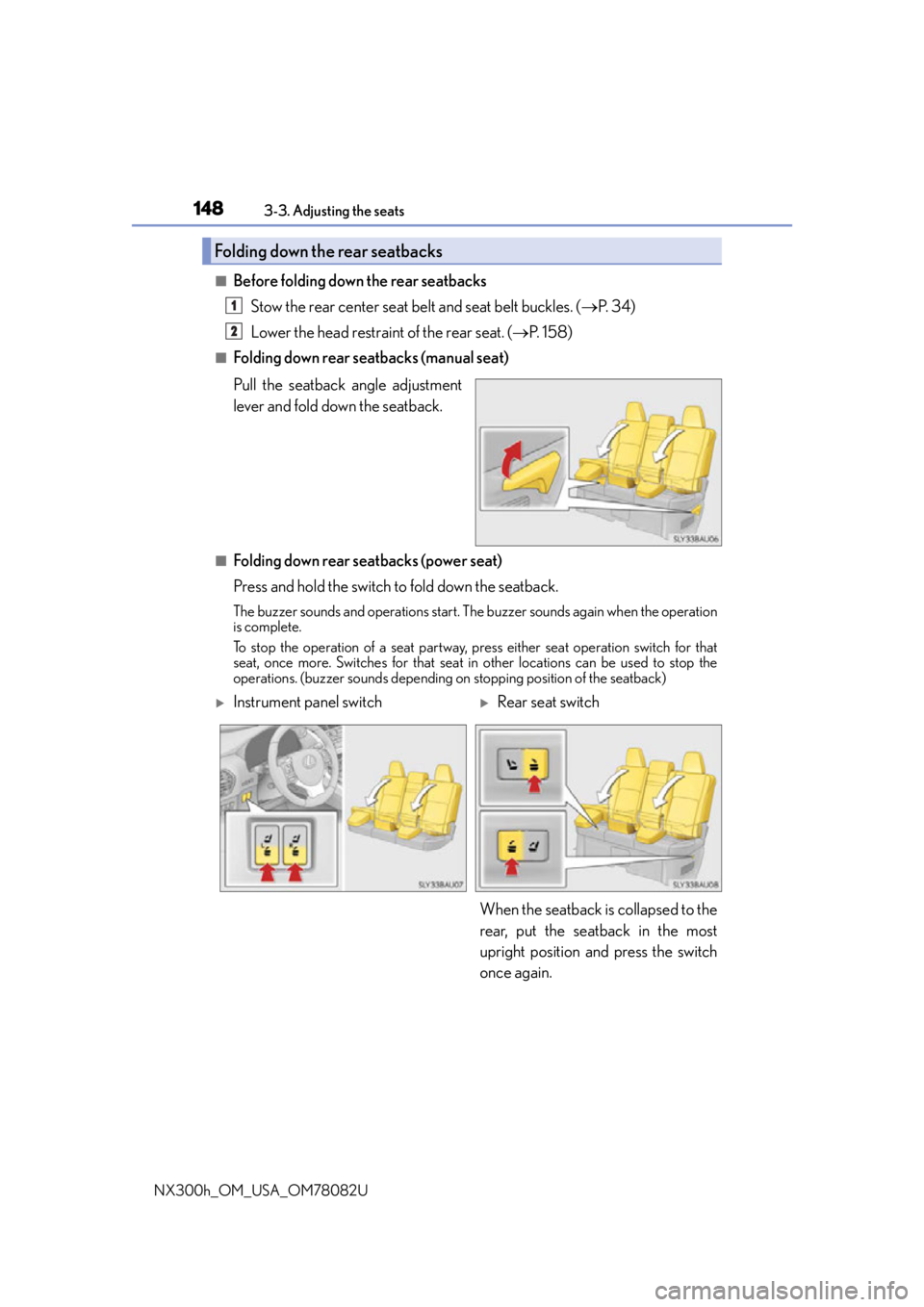
■Folding down rear seatbacks (manual seat)
Pull the seatback angle adjustment
lever and fold down the seatback.
■Folding down rear seatbacks (power seat)
Press and hold the switch to fold down the seatback.
The buzzer sounds and operations start. Th e buzzer sounds again when the operation
is complete.
To stop the operation of a se at partway, press either seat operation switch for that
seat, once more. Switches for that seat in other locations can be used to stop the
operations. (buzzer sounds depending on stopping position of the seatback)
Folding down the rear seatbacks
1
2
Instrument panel switchRear seat switch
When the seatback is collapsed to the
rear, put the seatback in the most
upright position and press the switch
once again.
Page 153 of 680
1533-3. Adjusting the seats
3
Operation of each component
NX300h_OM_USA_OM78082U
WA R N I N G
■Seat adjustment
To reduce the risk of sliding under the lap belt during a collision, do not recline the seat
more than necessary.
If the seat is too rec lined, the lap belt may slide past the hips and apply restraint forces
directly to the abdomen, or your neck may contact the shoulder belt, increasing the risk
of death or serious injury in the event of an accident.
Adjustments should not be ma de while driving as the seat may unexpectedly move and
cause the driver to lose control of the vehicle.
■After returning the rear seatback to the upright position
Observe the following precautions.
Failure to do so may result in death or serious injury.
●Make sure that the seatback is securely locked in position by lightly pushing it back
and forth.
●Check that the seat belts are not twisted or caught in the seatback.
■Jam protection function (vehicles with a power seat)
Observe the following precautions.
Failure to do so may cause death or serious injury.
●Never use any part of your body to intentio nally activate the jam protection function.
●The jam protection function may not work if something gets caught just before the
seatback is fully folded forward. Be careful not to get fingers caught or anything else.
●The jam protection function may not work depending on the shape of the object that
is caught. Be careful not to catch fingers or anything else.
NOTICE
■Stowing the seat belts
The seat belts and the buckles for the rear ce nter seat, as well as the armrest, must be
stowed before you fold down the rear seatbacks. ( P. 3 4 , 4 6 5 )
Page 159 of 680
1593-3. Adjusting the seats
3
Operation of each component
NX300h_OM_USA_OM78082U
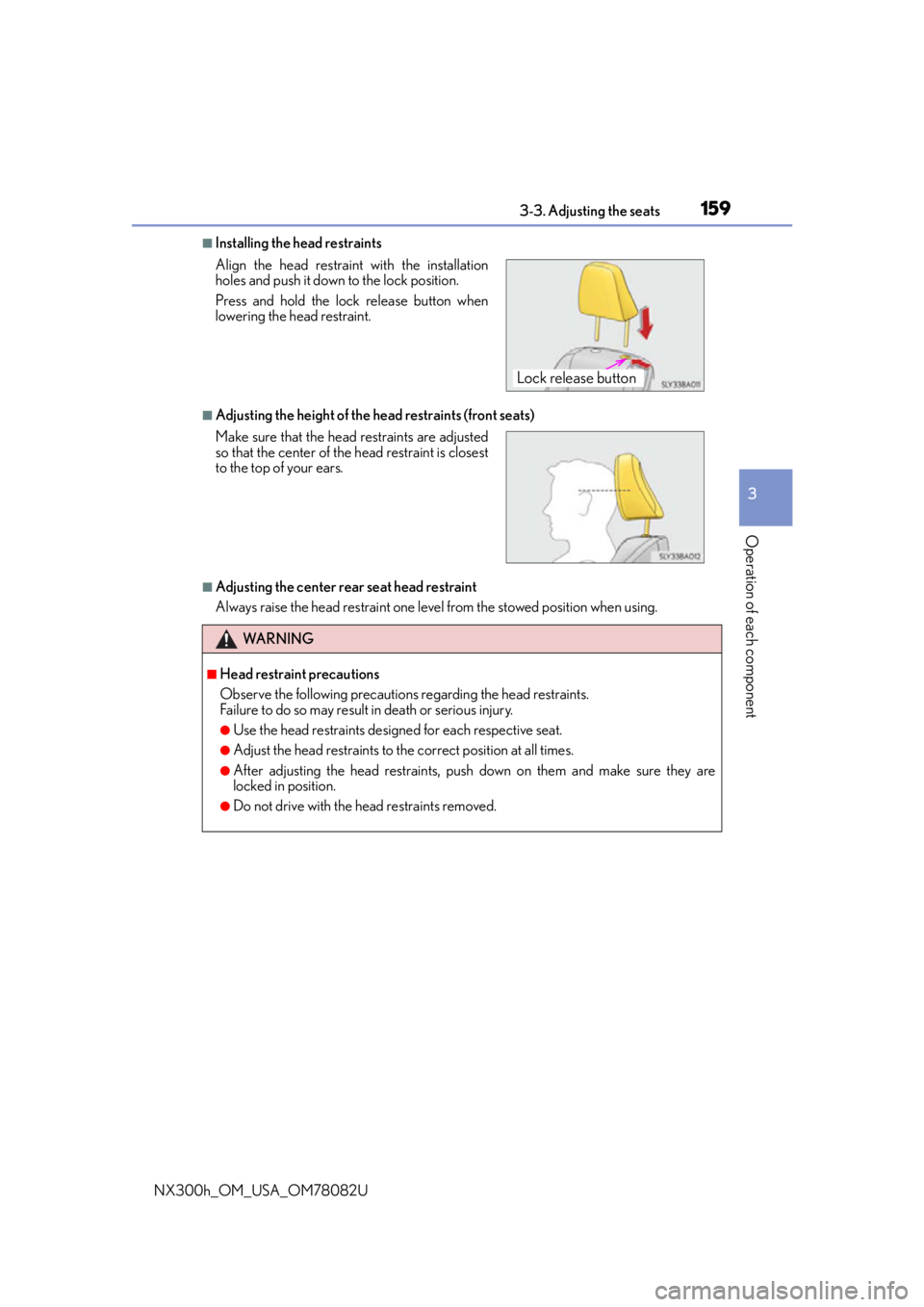
■Installing the head restraints
■Adjusting the height of the head restraints (front seats)
■Adjusting the center rear seat head restraint
Always raise the head restraint one level from the stowed position when using. Align the head restraint with the installation
holes and push it down to the lock position.
Press and hold the lock release button when
lowering the head restraint.
Make sure that the head restraints are adjusted
so that the center of the head restraint is closest
to the top of your ears.
WA R N I N G
■Head restraint precautions
Observe the following precautions regarding the head restraints.
Failure to do so may result in death or serious injury.
●Use the head restraints designed for each respective seat.
●Adjust the head restraints to the correct position at all times.
●After adjusting the head restraints, push down on them and make sure they are
locked in position.
●Do not drive with the head restraints removed.
Lock release button
Page 160 of 680
1603-4. Adjusting the steering wheel and mirrors
NX300h_OM_USA_OM78082U
Steering wheel
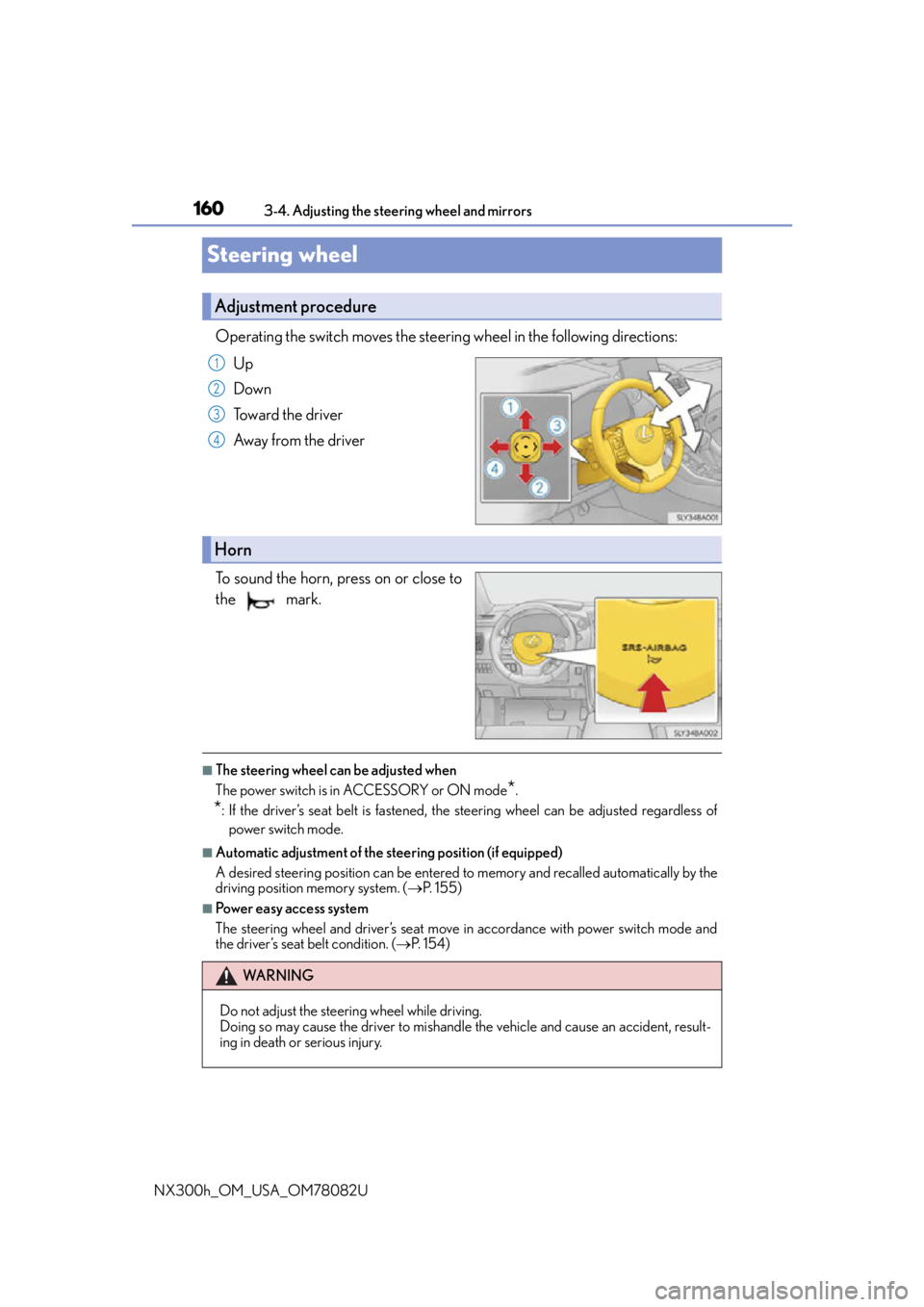
Operating the switch moves the steering wheel in the following directions: Up
Down
Toward the driver
Away from the driver
To sound the horn, press on or close to
the mark.
■The steering wheel can be adjusted when
The power switch is in ACCESSORY or ON mode
*.
*: If the driver’s seat belt is fastened, the steering wheel can be adjusted regardless of
power switch mode.
■Automatic adjustment of the steering position (if equipped)
A desired steering position can be entered to memory and recalled automatically by the
driving position memory system. ( P. 1 5 5 )
■Power easy access system
The steering wheel and driver’s seat move in accordance with power switch mode and
the driver’s seat belt condition. ( P. 1 5 4 )
Adjustment procedure
1
2
3
4
Horn
WA R N I N G
Do not adjust the steering wheel while driving.
Doing so may cause the driver to mishandle the vehicle and cause an accident, result-
ing in death or serious injury.
Page 173 of 680

173
4Driving
NX300h_OM_USA_OM78082U
4-1. Before drivingDriving the vehicle ....................... 174
Cargo and luggage .................... 182
Vehicle load limits ....................... 186
Trailer towing (vehicles with towing package) ....................... 187
Trailer towing (vehicles without towing package) ...... 199
Dinghy towing............................. 200
4-2. Driving procedures Power (ignition) switch.............. 201
EV drive mode ........................... 206
Hybrid transmission ................. 208
Turn signal lever ........................... 212
Parking brake ................................ 213
Brake Hold ..................................... 216
ASC (Active Sound Control) ......... 218
4-3. Operating the lights and wipers
Headlight switch .......................... 219
Automatic High Beam .............223
Fog light switch............................ 227
Windshield wipers and washer..........................................228
Rear window wiper and washer..........................................234 4-4. Refueling
Opening the fuel tank cap ..... 236
4-5. Using the driving support systems
Dynamic radar cruise control ......................................... 240
Dynamic radar cruise control with full-speed
range ............................................ 253
Cruise control ..............................267
LDA (Lane Departure Alert with steering control) ............ 270
Intuitive parking assist .............. 279
Lexus parking assist monitor ........................................ 287
Driving mode select switch ...........................................303
Driving assist systems...............305
PCS (Pre-Collision System)........... 310
BSM (Blind Spot Monitor) ...... 316
4-6. Driving tips Hybrid vehicle driving tips ................................................. 324
Winter driving tips ..................... 326
Utility vehicle precautions ......330
Page 176 of 680
1764-1. Before driving
NX300h_OM_USA_OM78082U
■Breaking in your new Lexus
To extend the life of the ve hicle, observing the followin g precautions is recommended:
●For the first 200 miles (300 km):
Avoid sudden stops.
●For the first 1000 miles (1600 km):
• Do not drive at extremely high speeds.
• Avoid sudden acceleration.
• Do not drive continuously in low gears.
• Do not drive at a constant speed for extended periods.
Vehicles with towing package
●For the first 500miles (800 km):
Do not tow a trailer.
■Operating your vehicle in a foreign country
Comply with the relevant vehi cle registration laws and confirm the availability of the cor-
rect fuel. ( P. 6 1 6 )
■Eco-friendly driving
P. 1 0 0
WA R N I N G
Observe the following precautions.
Failure to do so may result in death or serious injury.
■When starting the vehicle
Always keep your foot on the brake pedal while stopped with the “READY” indicator is
illuminated. This prevents the vehicle from creeping.
■When driving the vehicle
●Do not drive if you are unfamiliar with the location of the brake and accelerator ped-
als to avoid depressing the wrong pedal.
• Accidentally depressing th e accelerator pedal instead of the brake pedal will
result in sudden acceleration that may lead to an accident.
• When backing up, you may twist your body around, leading to difficulty in operat-
ing the pedals. Make sure to operate the pedals properly.
• Make sure to keep a correct driving posture even when moving the vehicle only slightly. This allows you to depress th e brake and accelerator pedals properly.
• Depress the brake pedal using your righ t foot. Depressing the brake pedal using
your left foot may delay response in an emergency, resulting in an accident.
●The driver should pay extra attention to pedestrians when the vehicle is powered only
by the electric motor (traction motor). As there is no engine noise, the pedestrians
may misjudge the vehicle’s movement.
●Do not drive the vehicle over or stop the vehicle near flammable materials.
The exhaust system and exhaust gases can be extremely hot. These hot parts may
cause a fire if there is any flammable material nearby.
Page 182 of 680
1824-1. Before driving
NX300h_OM_USA_OM78082U
Cargo and luggage
Cargo capacity depends on the to tal weight of the occupants.
(Cargo capacity) = (Total load capacity) — (Total weight of occupants)
Steps for Determining Correct Load Limit
(1) Locate the statement “The combined weight of occupants and cargo should never exceed XXX kg or XXX lbs.” on your vehicle’s placard.
(2) Determine the combined weight of the driver and passengers that will be
riding in your vehicle.
(3) Subtract the combined weight of the driver and passengers from XXX kg or
XXX lbs.
(4) The resulting figure equals the ava ilable amount of cargo and luggage load
capacity.
For example, if the “XXX” amount equals 1400 lbs. and there will be five
150 lb passengers in your vehicle, the amount of available cargo and luggage
load capacity is 650 lbs. (1400 750 (5 150) = 650 lbs.)
(5) Determine the combined weight of luggage and cargo being loaded on the
vehicle. That weight may not safely exceed the available cargo and luggage
load capacity calculated in Step 4.
(6) If your vehicle will be towing a trailer, load from your trailer will be transferred
to your vehicle. Consult this manual to determine how this reduces the avail-
able cargo and luggage load capacity of your vehicle. (P. 1 8 6 )
Vehicles without towing package: Lexus does not recommend towing a trailer with
your vehicle. Your vehicle is not designed for trailer towing.
Take notice of the following information about storage precautions, cargo
capacity and load.
Capacity and distribution
Page 184 of 680
1844-1. Before driving
NX300h_OM_USA_OM78082U
WA R N I N G
■Things that must not be carri ed in the luggage compartment
The following things may cause a fire if loaded in the luggage compartment:
●Receptacles containing gasoline
●Aerosol cans
■Storage precautions
Observe the following precautions.
Failure to do so may prevent the pedals from being depressed properly, may block the
driver’s vision, or may result in items hittin g the driver or passengers, possibly causing
an accident.
●Stow cargo and luggage in the luggage compartment whenever possible.
●Do not stack cargo and luggage in the luggage compartment higher than the seat-
backs.
●When you fold down the rear seats, long items should not be placed directly behind
the front seats.
●Never allow anyone to ride in the luggage compartment. It is not designed for pas-
sengers. They should ride in their seats with their seat belts properly fastened.
●Do not place cargo or luggage in or on the following locations.
• At the feet of the driver
• On the front passenger or re ar seats (when stacking items)
•On the luggage cover
• On the instrument panel
•On the dashboard
●Secure all items in th e occupant compartment.
■Capacity and distribution
●Do not exceed the maximum axle weight ra ting or the total vehicle weight rating.
●Even if the total load of occupant’s weight and the cargo load is less than the total load
capacity, do not apply the load unevenly. Improper loading may cause deterioration
of steering or braking control which may cause death or serious injury.
■When using a roof luggage carrier (vehicles with roof rails)
Observe the following precautions:
●Place the cargo so that its weight is distributed evenly between the front and rear
axles.
●If loading long or wide cargo, never exce ed the vehicle overall length or width.
( P. 606)
●Before driving, make sure the cargo is securely fastened on the roof luggage carrier.
●Loading cargo on the roof luggage carrier will make the center of gravity of the vehi-
cle higher. Avoid high speeds, sudden starts, sharp turns, sudden braking or abrupt
maneuvers, otherwise it may result in loss of control or vehicle rollover due to failure
to operate this vehicle correctly and result in death or serious injury.
●If driving for a long distance, on rough roads, or at high speeds, stop the vehicle now
and then during the trip to make sure the cargo remains in its place.
●Do not exceed 176.3 lb. (80 kg) cargo weight on the roof luggage carrier.
Page 186 of 680
1864-1. Before driving
NX300h_OM_USA_OM78082U
Vehicle load limits
◆Total load capacity (vehicle capacity weight): P. 6 0 6
Total load capacity means the combined weight of occupants, cargo and lug-
gage.
◆Seating capacity: 5 occupants (Front 2, Rear 3)
Seating capacity means the maximum number of occupants whose estimated
average weight is 150 lb. (68 kg) per person.
◆TWR (Trailer Weight Rating) (Vehicles with towing package):
P. 1 9 0 , 6 0 6
TWR means the maximum gross trailer weight (trailer weight plus its cargo
weight) that your vehicle is able to tow.
◆TWR (Trailer Weight Rating) (Vehicles without towing package)
Lexus does not recommend towing a trailer with your vehicle.
◆Cargo capacity
Cargo capacity may increase or decrea se depending on the weight and the
number of occupants.
■Total load capacity and seating capacity
These details are also described on the tire and loading information label. (P. 5 2 5 )
Vehicle load limits include total load capacity, seating capacity, towing capac-
ity and cargo capacity.
WA R N I N G
■Overloading the vehicle
Do not overload the vehicle.
It may not only cause damage to the tires, but also degrade steering and braking ability,
resulting in an accident.
Page 187 of 680
1874-1. Before driving
4
Driving
NX300h_OM_USA_OM78082U
Trailer towing (vehicles with towing package)
Contact your Lexus dealer for further information about additional requirements
such as a towing kit, etc.
Your vehicle is designed primarily as a passenger-and-load-carrying vehicle.
Towing a trailer can have an adverse impact on handling, performance, brak-
ing, durability, and fuel consumption. Fo r your safety and the safety of others,
you must not overload your vehicle or trailer. You must also ensure that you
are using appropriate towing equipment, that the towing equipment has been
installed correctly and used properly, and that you employ the requisite driv-
ing habits.
Vehicle-trailer stability and braking pe rformance are affected by trailer sta-
bility, brake performance and setting, tr ailer brakes, the hitch and hitch sys-
tems (if equipped).
To tow a trailer safely, use extreme ca re and drive the vehicle in accordance
with your trailer’s characteristics and operating conditions.
Lexus warranties do not apply to damage or malfunction caused by towing a
trailer for commer cial purposes.