engine LEXUS NX300H 2016 Owner's Manual
[x] Cancel search | Manufacturer: LEXUS, Model Year: 2016, Model line: NX300H, Model: LEXUS NX300H 2016Pages: 680, PDF Size: 10.23 MB
Page 181 of 680

1814-1. Before driving
4
Driving
NX300h_OM_USA_OM78082U
NOTICE
■When driving the vehicle
●Do not depress the accelerator and brake pedals at the same time during driving, the
hybrid system output may be restrained.
●Do not use the accelerator pedal or depress the accelerator and brake pedals at the
same time to hold the vehicle on a hill.
■When parking the vehicle
Always shift the shift lever to P, set the parking brake. Failure to do so may cause the
vehicle to move or the vehicle may accelerate suddenly if the accelerator pedal is acci-
dentally depressed.
■Avoiding damage to vehicle parts
●Do not turn the steering wheel fully in either direction and hold it there for an
extended period of time.
Doing so may damage the power steering motor.
●When driving over bumps in the road, drive as slowly as possible to avoid damaging
the wheels, underside of the vehicle, etc.
■If you get a flat tire while driving
A flat or damaged tire may cause the follo wing situations. Hold the steering wheel
firmly and gradually depress the brak e pedal to slow down the vehicle.
●It may be difficult to control your vehicle.
●The vehicle will make abnormal sounds or vibrations.
●The vehicle will lean abnormally.
Information on what to do in case of a flat tire ( P. 5 7 5 )
■When encountering flooded roads
Do not drive on a road that has flooded after heavy rain, etc. Doing so may cause the
following serious damage to the vehicle:
●Engine stalling
●Short in electrical components
●Engine damage caused by water immersion
In the event that you drive on a flooded road and the vehicle is flooded, be sure to have
your Lexus dealer check the following:
●Brake function
●Changes in quantity and quality of oil and fluid used for the engine, hybrid transmis-
sion, etc.
●Lubricant condition for the bearings and susp ension joints (where possible), and the
function of all joints, bearings, etc.
Page 193 of 680

1934-1. Before driving
4
Driving
NX300h_OM_USA_OM78082U
●Reversing with a trailer attached is difficult and requires practice. Grip the
bottom of the steering wheel and move your hand to the left to move the
trailer to the left. Move your hand to the right to move the trailer to right. (This
is generally opposite to reversing without a trailer attached.) Avoid sharp or
prolonged turning. Have someone guid e you when reversing to reduce the
risk of an accident.
●As stopping distance is increased when towing a trailer, vehicle-to vehicle dis-
tance should be increased. For each 10 mph (16 km/h) of speed, allow at least
one vehicle and trailer length.
●Avoid sudden braking as you may skid, re sulting in the trailer jackknifing and a
loss of vehicle control. This is especially true on wet or slippery surfaces.
●Avoid jerky starts or sudden acceleration.
●Avoid jerky steering and sharp turns, and slow down before making turn.
●Note that when making a turn, the traile r wheels will be closer than the vehicle
wheels to the inside of the turn. Comp ensate by making a wider than normal
turning radius.
●Slow down before making a turn, in cross winds, on wet or slippery surfaces,
etc.
Increasing vehicle speed can destabilize the trailer.
●Take care when passing other vehicles. Passing requires considerable dis-
tance. After passing a vehicle, do not forget the length of your trailer, and be
sure you have plenty of room before changing lanes.
●To maintain engine braking efficiency and charging system performance
when using engine braking, do no t put the transmission in D. (P. 2 0 8 )
●Instability happens more frequently when descending steep or long downhill
grades. Before descending, slow down and downshift. Do not make sudden
downshifts while descending steep or long downhill grades.
●Avoid holding the brake pedal down too long or applying the brakes too fre-
quently. This could cause the brakes to overheat and result in reduced braking
efficiency.
●Due to the added load of the trailer, yo ur vehicle’s engine may overheat on hot
days (at temperatures over 85 F [30 C]) when driving up a long or steep
grade. If the engine coolant temperat ure gauge indicates overheating, imme-
diately turn off the air cond itioning (if in use), pull your vehicle off the road and
stop in a safe spot. ( P. 5 9 9 )
Page 196 of 680

1964-1. Before driving
NX300h_OM_USA_OM78082U
■Break-in schedule
If your vehicle is new or equipped with any new power train components (such as an
engine, transmission, differential or wheel bearing), Lexus recommends that you do not
tow a trailer until the vehicle has been driven for over 500 miles (800 km).
After the vehicle has been driven for over 500 miles (800 km), you can start towing.
However, for the next 500 miles (800 km), drive the vehicle at a speed of less than
50 mph (80 km/h) when towing a trailer, and avoid full throttle acceleration.
■Maintenance
●If you tow a trailer, your vehicle will require more frequent maintenance due to the addi-
tional load. (See “Warranty and Services Guide”, “Owner’s Manual Supplement” or
“Scheduled Maintenance”.)
●Retighten the fixing bolts of the towing ba ll and bracket after approximately 600 miles
(1000 km) of trailer towing.
■If trailer sway occurs
One or more factors (crosswinds, passing vehicles, rough roads, etc.) can adversely
affect handling of your vehicle and trailer, causing instability.
●If trailer swaying occurs:
• Firmly grip the steering wheel. Steer straight ahead.
Do not try to control trailer sway ing by turning the steering wheel.
• Begin releasing the accelerator pedal i mmediately but very gradually to reduce
speed.
Do not increase speed. Do not apply vehicle brakes.
If you make no extreme correction with the steering or brakes, your vehicle and trailer
should stabilize.
●After the trailer sw aying has stopped:
• Stop in a safe place. Get all occupants out of the vehicle.
• Check the tires of the vehicle and the trailer.
• Check the load in the trailer. Make sure the load has not shifted.
Make sure the tongue weight is appropriate, if possible.
• Check the load in the vehicle. Make sure the vehicle is not overloaded after occupants get in.
If you cannot find any problems, the speed at which trailer swaying occurred is beyond
the limit of your particular vehicle-trailer combination. Drive at a lower speed to pre-
vent instability. Remember that swaying of the towing vehicle-trailer increases as
speed increases.
Page 206 of 680
2064-2. Driving procedures
NX300h_OM_USA_OM78082U
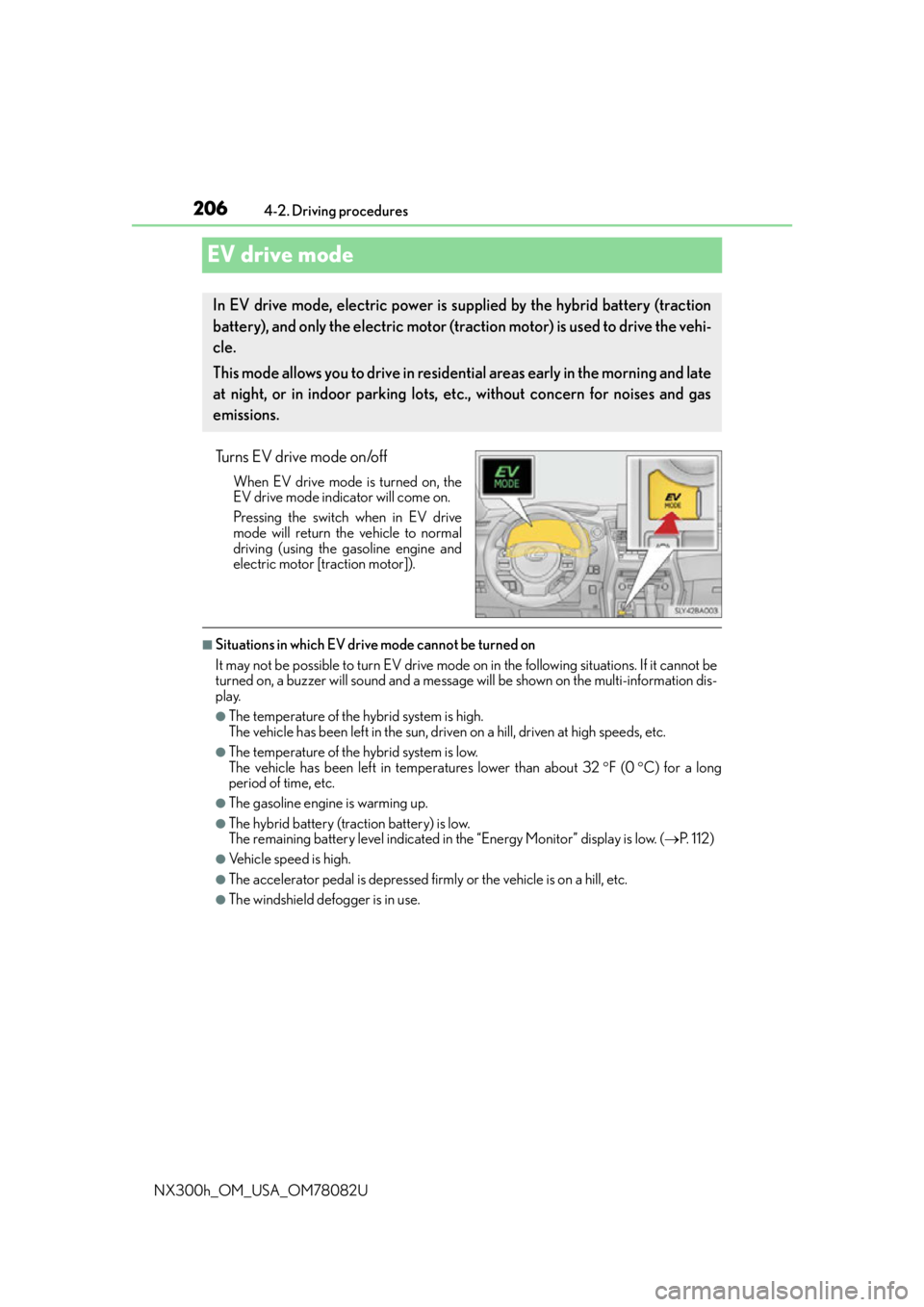
EV drive mode
Turns EV drive mode on/off
When EV drive mode is turned on, the
EV drive mode indicator will come on.
Pressing the switch when in EV drive
mode will return the vehicle to normal
driving (using the gasoline engine and
electric motor [traction motor]).
■Situations in which EV drive mode cannot be turned on
It may not be possible to turn EV drive mode on in the following situations. If it cannot be
turned on, a buzzer will sound and a message will be shown on the multi-information dis-
play.
●The temperature of the hybrid system is high.
The vehicle has been left in the sun, driven on a hill, driven at high speeds, etc.
●The temperature of the hybrid system is low.
The vehicle has been left in temperatures lower than about 32 F (0 C) for a long
period of time, etc.
●The gasoline engine is warming up.
●The hybrid battery (traction battery) is low.
The remaining battery level indicated in the “Energy Monitor” display is low. ( P. 112)
●Vehicle speed is high.
●The accelerator pedal is depressed firm ly or the vehicle is on a hill, etc.
●The windshield defogger is in use.
In EV drive mode, electric power is su pplied by the hybrid battery (traction
battery), and only the electric motor (tra ction motor) is used to drive the vehi-
cle.
This mode allows you to drive in residential areas early in the morning and late
at night, or in indoor parking lots, etc., without concern for noises and gas
emissions.
Page 207 of 680

2074-2. Driving procedures
4
Driving
NX300h_OM_USA_OM78082U
■Switching to EV drive mode when the gasoline engine is cold
If the hybrid system is started while the gasoline engine is cold, the gasoline engine will
start automatically after a short period of time in order to warm up. In this case, you will
become unable to switch to EV drive mode.
After the hybrid system has started and the “READY” indicator has illuminated, press the
EV drive mode switch before the gasoline en gine starts to switch to EV drive mode.
■Automatic cancelation of EV drive mode
When driving in EV drive mode, the gasoline engine may automatically restart in the fol-
lowing situations. When EV drive mode is canceled, a buzzer will sound, the EV drive
mode indicator will go off after flashing, an d a message is displayed on the multi-informa-
tion display.
●The hybrid battery (traction battery) becomes low.
The remaining battery level indicated in the “Energy Monitor” display is low. ( P. 112)
●Vehicle speed is high.
●The accelerator pedal is depressed firm ly or the vehicle is on a hill, etc.
■Possible driving distance when driving in EV drive mode
EV drive mode’s possible driving distance ra nges from a few hundred meters to approxi-
mately 0.6 mile (1 km). However, dependin g on vehicle conditions, there are situations
when EV drive mode cannot be used. (The distance that is possible depends on the
hybrid battery [traction battery] level and driving conditions.)
■Fuel economy
The hybrid system is designed to achieve the best possible fuel economy during normal
driving (using the gasoline engine and electric motor [traction motor]). Driving in EV
drive mode more than necessary may lower fuel economy.
WA R N I N G
■Caution while driving
When driving in EV drive mode, pay special attention to the area around the vehicle.
Because there is no engine noise, pedestrians, people riding bicycles or other people
and vehicles in the area may not be aware of the vehicle starting off or approaching
them, so take extra care while driving.
Page 208 of 680
2084-2. Driving procedures
NX300h_OM_USA_OM78082U
Hybrid transmission
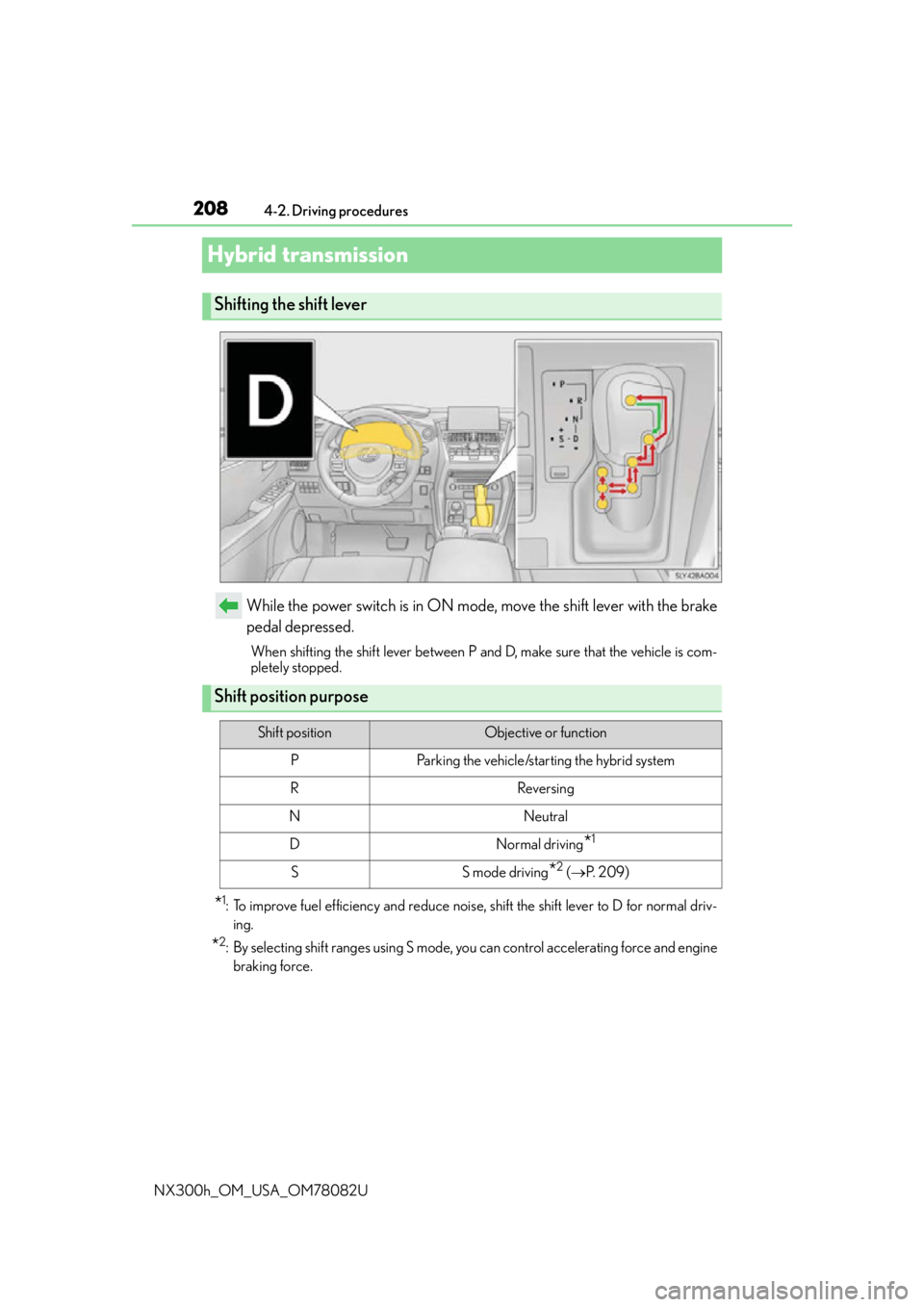
While the power switch is in ON mode, move the shift lever with the brake
pedal depressed.
When shifting the shift lever between P and D, make sure that the vehicle is com-
pletely stopped.
*1: To improve fuel efficiency and reduce noise, shift the shift lever to D for normal driv-
ing.
*2: By selecting shift ranges using S mode, yo u can control accelerating force and engine
braking force.
Shifting the shift lever
Shift position purpose
Shift positionObjective or function
PParking the vehicle/starting the hybrid system
RReversing
NNeutral
DNormal driving*1
SS mode driving*2 ( P. 2 0 9 )
Page 209 of 680
2094-2. Driving procedures
4
Driving
NX300h_OM_USA_OM78082U
P. 3 0 3
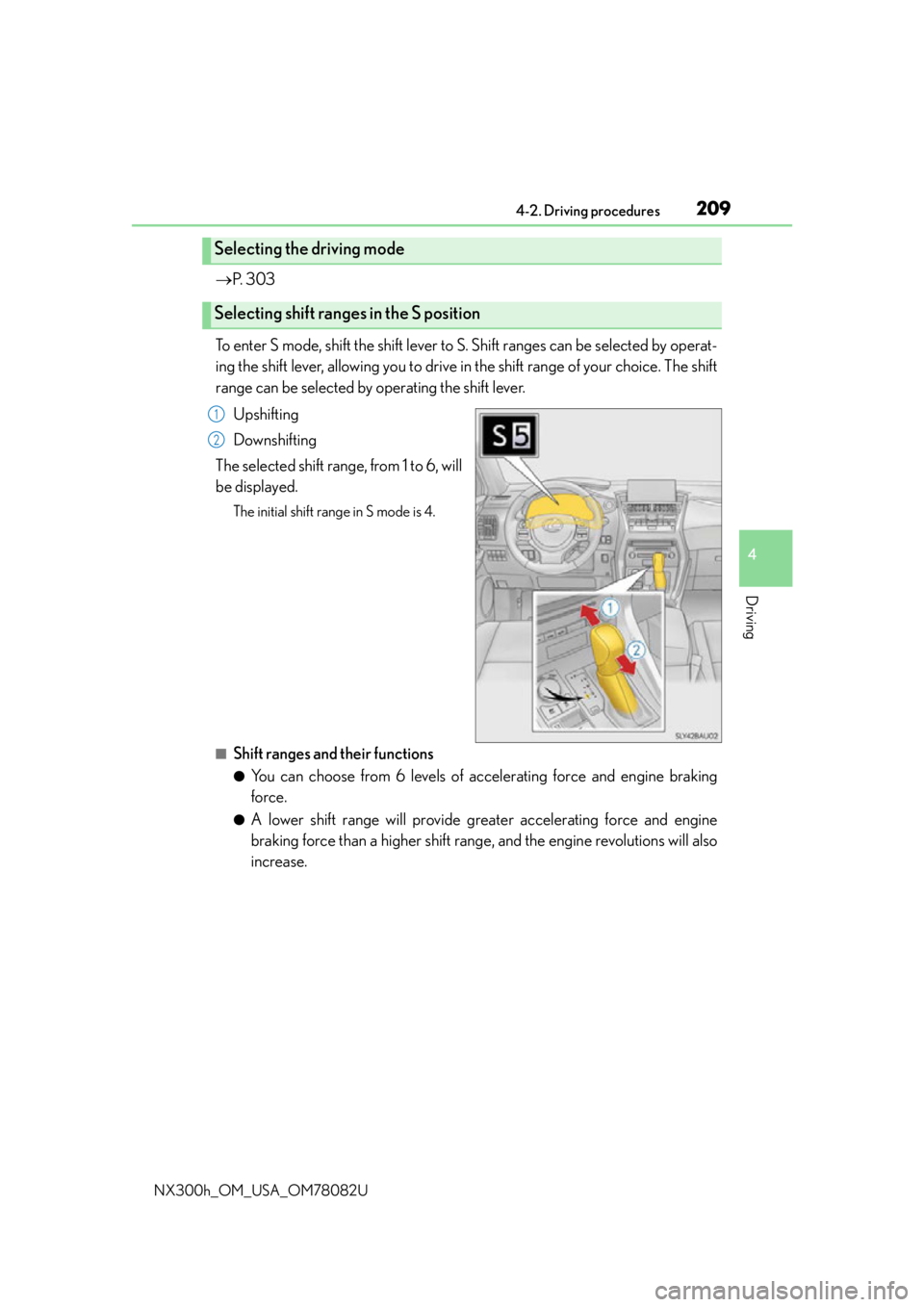
To enter S mode, shift the shift lever to S. Shift ranges can be selected by operat-
ing the shift lever, allowing you to drive in the shift range of your choice. The shift
range can be selected by operating the shift lever. Upshifting
Downshifting
The selected shift range, from 1 to 6, will
be displayed.
The initial shift range in S mode is 4.
■Shift ranges and their functions
●You can choose from 6 levels of acce lerating force and engine braking
force.
●A lower shift range will provide greater accelerating force and engine
braking force than a higher shift rang e, and the engine revolutions will also
increase.
Selecting the driving mode
Selecting shift ranges in the S position
1
2
Page 210 of 680

2104-2. Driving procedures
NX300h_OM_USA_OM78082U
■S mode
●When the shift range is 4 or lower, holding th e shift lever toward “+” sets the shift range
to 6.
●Automatically selects a higher shift range before the engine speed becomes too high.
■Downshifting restriction warning buzzer
To help ensure safety and driving performa nce, downshifting operation may sometimes
be restricted. In some circumstances, downshifting may not be possible even when the
shift lever is operated. (A buzzer will sound twice.)
■When driving with cruise control (if equipped), dynamic radar cruise control (if
equipped) or dynamic radar cruise control with full-speed range (if equipped) acti-
vated
Even when performing the following actions with the intent of enabling engine braking,
engine braking will not activate because cruise control, dynamic radar cruise control or
dynamic radar cruise control with full-speed range will not be canceled.
●While driving in S mode, downshifting to 5 or 4. ( P. 2 0 9 )
●When switching the driving mode to sp ort mode while driving in D position.
( P. 303)
■Restraining sudden start (Drive-Start Control)
When the following unusual operation is pe rformed, the hybrid system output may be
restrained.
●When the shift lever is shifted from R to D, D to R, N to R, P to D, or P to R (D includes S)
with the accelerator pedal depressed, a wa rning message appears on the multi-infor-
mation display. If a warning message is show n on the multi-information display, read the
message and follow the instructions.
●When the accelerator pedal is depresse d too while the vehicle is in reverse.
■If the shift lever cannot be shifted from P
P. 5 9 0
Page 211 of 680

2114-2. Driving procedures
4
Driving
NX300h_OM_USA_OM78082U
WA R N I N G
■When driving on slippery road surfaces
Be careful of downshifting and sudden acceleration, as this could result in the vehicle
skidding to the side or spinning.
NOTICE
■Hybrid battery (traction battery) charge
If the shift lever is in N, the hybrid battery (traction battery) will not be charging, even
when the engine is running. Therefore, if the ve hicle is left with the shift lever in N for a
long period of time, the hybrid battery (tr action battery) will discharge, and this may
result in the vehicle not being able to start.
Page 218 of 680
2184-2. Driving procedures
NX300h_OM_USA_OM78082U
ASC (Active Sound Control)
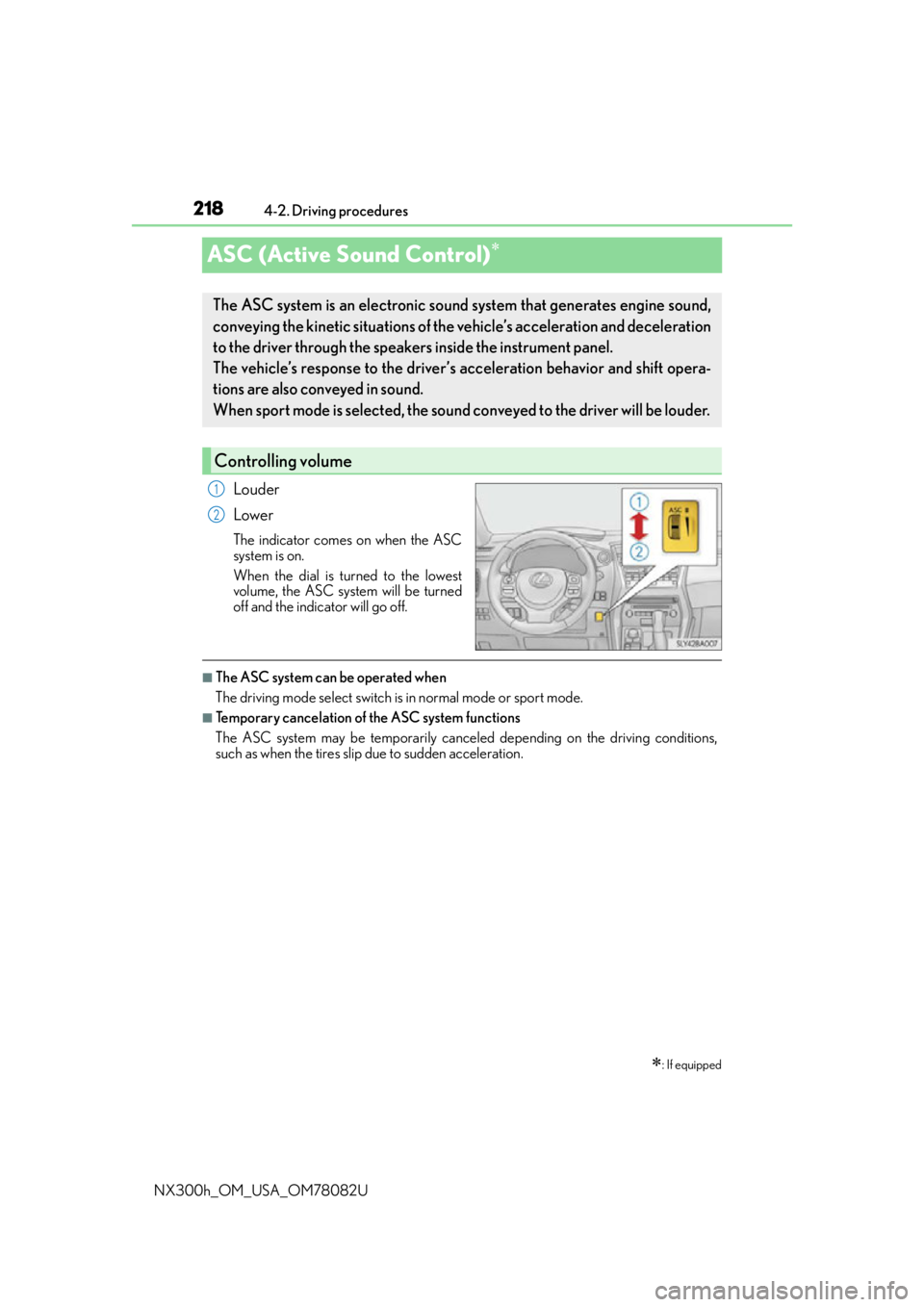
Louder
Lower
The indicator comes on when the ASC
system is on.
When the dial is turned to the lowest
volume, the ASC system will be turned
off and the indicator will go off.
■The ASC system can be operated when
The driving mode select switch is in normal mode or sport mode.
■Temporary cancelation of the ASC system functions
The ASC system may be temporarily cancele d depending on the driving conditions,
such as when the tires slip due to sudden acceleration.
: If equipped
The ASC system is an electronic sound system that generates engine sound,
conveying the kinetic situations of the vehicle’s acceleration and deceleration
to the driver through the speake rs inside the instrument panel.
The vehicle’s response to the driver’s acceleration behavior and shift opera-
tions are also conveyed in sound.
When sport mode is selected, the sound co nveyed to the driver will be louder.
Controlling volume
1
2