light LEXUS RC F 2017 Owners Manual
[x] Cancel search | Manufacturer: LEXUS, Model Year: 2017, Model line: RC F, Model: LEXUS RC F 2017Pages: 724, PDF Size: 15.76 MB
Page 601 of 724
6018-2. Steps to take in an emergency
8
When trouble arises
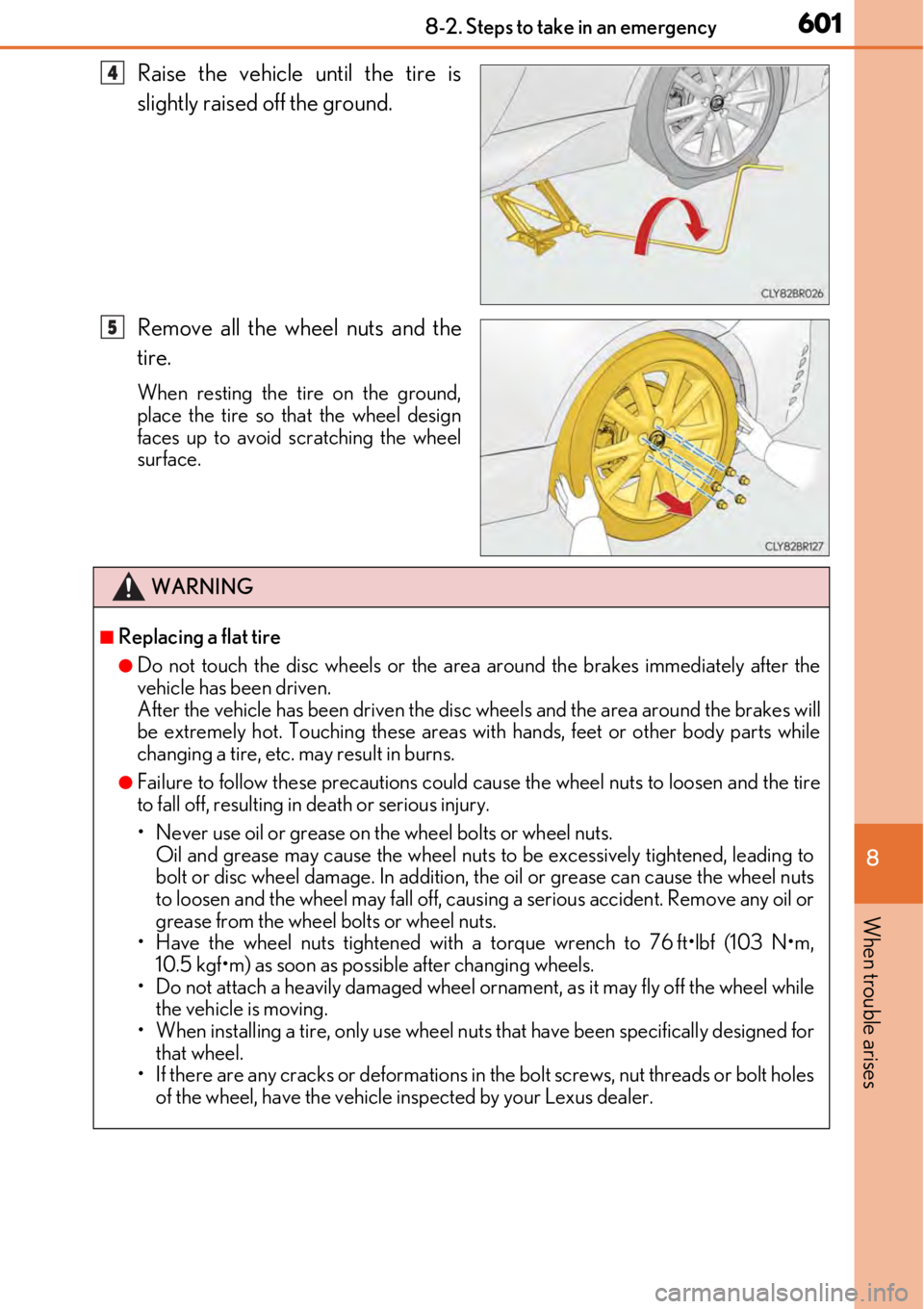
Raise the vehicle until the tire is
slightly raised off the ground.
Remove all the wheel nuts and the
tire.
When resting the tire on the ground,
place the tire so that the wheel design
faces up to avoid scratching the wheel
surface.
4
5
WARNING
■Replacing a flat tire
●Do not touch the disc wheels or the area around the brakes immediately after the
vehicle has been driven.
After the vehicle has been driven the disc wheels and the area around the brakes will
be extremely hot. Touching these areas with hands, feet or other body parts while
changing a tire, etc. may result in burns.
●Failure to follow these precautions could cau se the wheel nuts to loosen and the tire
to fall off, resulting in death or serious injury.
• Never use oil or grease on the wheel bolts or wheel nuts. Oil and grease may cause the wheel nuts to be excessively tightened, leading to
bolt or disc wheel damage. In addition, the oil or grease can cause the wheel nuts
to loosen and the wheel may fall off, causing a serious accident. Remove any oil or
grease from the wheel bolts or wheel nuts.
• Have the wheel nuts tightened with a torque wrench to 76 ft•lbf (103 N•m,
10.5 kgf•m) as soon as possible after changing wheels.
• Do not attach a heavily damaged wheel or nament, as it may fly off the wheel while
the vehicle is moving.
• When installing a tire, only use wheel nuts that have been specifically designed for
that wheel.
• If there are any cracks or deformations in the bolt screws, nut threads or bolt holes
of the wheel, have the vehicle inspected by your Lexus dealer.
Page 603 of 724

6038-2. Steps to take in an emergency
8
When trouble arises
Firmly tighten each wheel nut two or
three times in the order shown in the
illustration.
Tightening torque:
76 ft•lbf (103 N•m, 10.5 kgf•m)
Stow the flat tire, tire jack and all tools.
■The spare tire
●RC350/RC300/RC200t:
The spare tire is identified by the label “TEMPORARY USE ONLY” on the tire sidewall.
●Use the spare tire temporarily, and only in an emergency.
●Make sure to check the tire inflation pressure of the spare tire.
(→ P. 652)
■When using the spare tire
As the spare tire is not equipped with a tire pressure warning valve and transmitter, low
inflation pressure of the spare tire will not be indicated by the tire pressure warning sys-
tem. Also, if you replace the spare tire after the tire pressure warning light comes on, the
light remains on.
■When the spare tire is equipped
The vehicle becomes lower when driving with the spare tire compared to when driving
with standard tires.
■If you have a flat rear tire on a road covered with snow or ice (vehicles with front and
rear tires of the same size except fo r vehicles with LDH and 19-inch tires)
Install the spare tire on one of the front whee ls of the vehicle. Perform the following steps
and fit tire chains to the rear tires:
Replace a front tire with the spare tire.
Replace the flat rear tire with the tire removed from the front of the vehicle.
Fit tire chains to the rear tires.
4
5
1
2
3
Page 617 of 724
6178-2. Steps to take in an emergency
8
When trouble arises
■If the tire is inflated to more than the recommended level
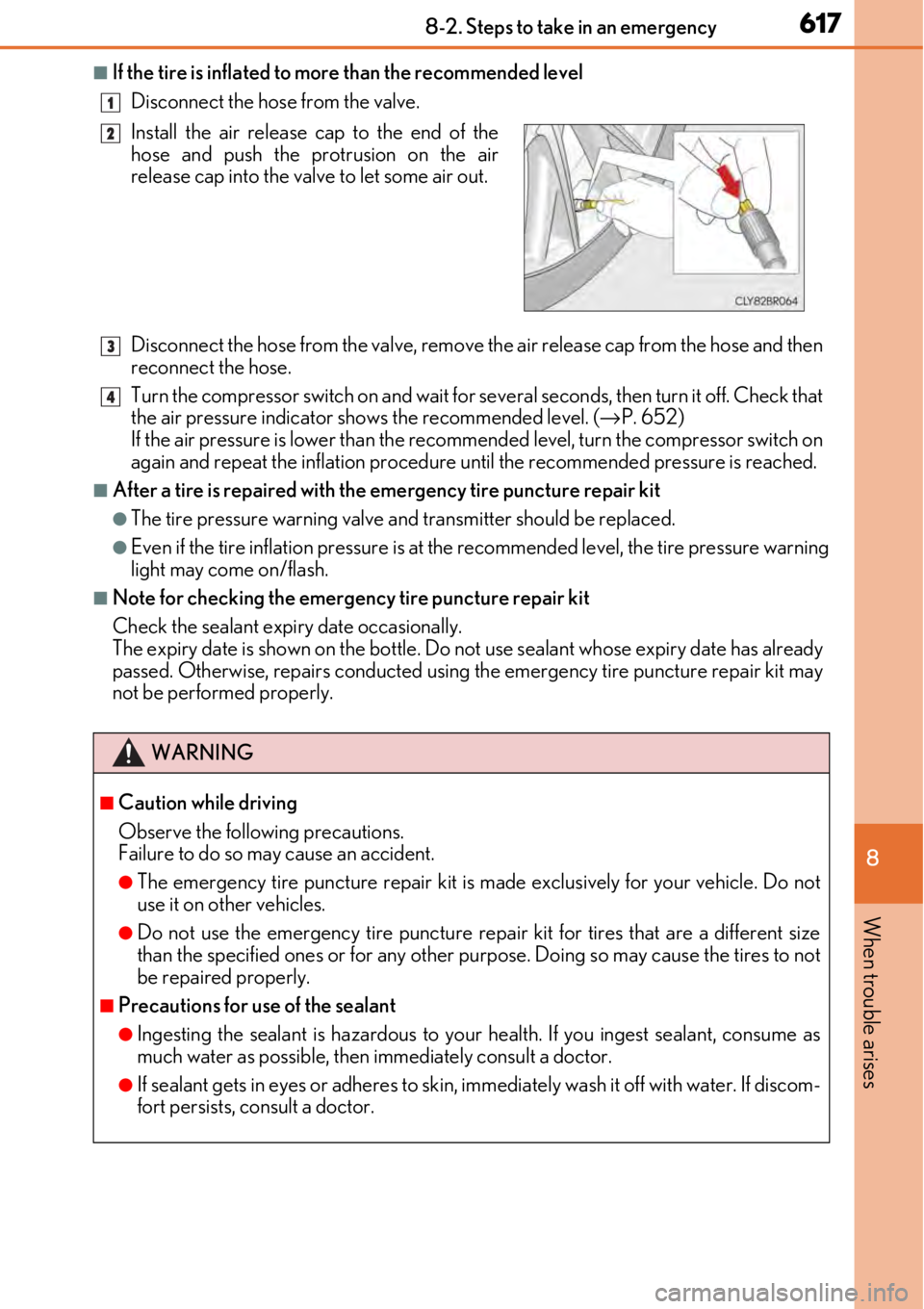
Disconnect the hose from the valve.
Disconnect the hose from the valve, remove the air releas e cap from the hose and then
reconnect the hose.
Turn the compressor switch on and wait for se veral seconds, then turn it off. Check that
the air pressure indicator sh ows the recommended level. ( →P. 652)
If the air pressure is lower than the reco mmended level, turn the compressor switch on
again and repeat the inflation procedure un til the recommended pressure is reached.
■After a tire is repaired with the emergency tire puncture repair kit
●The tire pressure warning valve an d transmitter should be replaced.
●Even if the tire inflation pressure is at the recommended leve l, the tire pressure warning
light may come on/flash.
■Note for checking the emergency tire puncture repair kit
Check the sealant expi ry date occasionally.
The expiry date is shown on the bottle. Do not use sealant whose expiry date has already
passed. Otherwise, repairs co nducted using the emergency ti re puncture repair kit may
not be performed properly. Install the air release cap to the end of the
hose and push the protrusion on the air
release cap into the valve to let some air out.
WARNING
■Caution while driving
Observe the following precautions.
Failure to do so may cause an accident.
●The emergency tire puncture repair kit is
made exclusively for your vehicle. Do not
use it on other vehicles.
●Do not use the emergency tire puncture repa ir kit for tires that are a different size
than the specified ones or for any other pu rpose. Doing so may cause the tires to not
be repaired properly.
■Precautions for use of the sealant
●Ingesting the sealant is hazardous to your health. If you ingest sealant, consume as
much water as possible, then immediately consult a doctor.
●If sealant gets in eyes or adheres to skin, immediately wash it off with water. If discom-
fort persists, consult a doctor.
1
2
3
4
Page 620 of 724
6208-2. Steps to take in an emergency
One of the following may be the cause of the problem:
●There may not be sufficient fuel in the vehicle’s tank.
Refuel the vehicle.
●The engine may be flooded.
Try to restart the engine again following correct starting procedures.
(→ P. 207)
●There may be a malfunction in th e engine immobilizer system. (→P. 79)
One of the following may be the cause of the problem:
●The battery may be discharged. ( →P. 626)
●The battery terminal connections may be loose or corroded.
The engine starting system may be malfun ctioning due to an electrical problem
such as electronic key battery depletio n or a blown fuse. However, an interim
measure is available to start the engine. ( →P. 621)
If the engine will not start
If the engine will not start even though correct starting procedures are being
followed ( →P. 207), consider each of the following points:
The engine will not start even thoug h the starter motor operates nor-
mally.
The starter motor turns over slowly , the interior lights and headlights
are dim, or the horn does not sound or sounds at a low volume.
The starter motor does not turn over
Page 621 of 724
6218-2. Steps to take in an emergency
8
When trouble arises
One of the following may be the cause of the problem:
●One or both of the battery terminals may be disconnected.
●The battery may be discharged. (→P. 626)
●There may be a malfunction in the steering lock system.
Contact your Lexus dealer if the problem cannot be repaired, or if repair procedures
are unknown.
When the engine does not start, the follo wing steps can be used as an interim
measure to start the engine if the engine switch is functioning normally:
Set the parking brake.
Shift the shift lever to P.
Turn the engine switch to ACCESSORY mode.
Press and hold the engine switch for about 15 seconds while depressing the
brake pedal firmly.
Even if the engine can be started using the above steps, the system may be mal-
functioning. Have the vehicle in spected by your Lexus dealer.
The starter motor does not turn over, the interior lights and headlights
do not turn on, or the horn does not sound.
Emergency start function
1
2
3
4
Page 628 of 724

6288-2. Steps to take in an emergency
Start the engine of the second vehicle. Increase the engine speed slightly and
maintain at that level for approximatel y 5 minutes to recharge the battery of
your vehicle.
Open and close any of the door of your vehicle with the engine switch off.
Maintain the engine speed of the second vehicle and start the engine of your
vehicle by turning the engine switch to IGNITION ON mode.
Once the vehicle’s engine has started, remove the jumper cables in the exact
reverse order from which they were connected.
Once the engine starts, have the vehicle inspected at your Lexus dealer as soon
as possible.
■Starting the engine when the battery is discharged
The engine cannot be started by push-starting.
■To prevent battery discharge
●Turn off the headlights and the audio system while the engine is off.
●Turn off any unnecessary electrical components when the vehicle is running at a low
speed for an extended period , such as in heavy traffic.
■Charging the battery
The electricity stored in the battery will disc harge gradually even when the vehicle is not
in use, due to natural discharge and the draini ng effects of certain electrical appliances. If
the vehicle is left for a long time, the battery may discharge, and the engine may be
unable to start. (The battery recharges automatically during driving.)
■When recharging or replacing the battery
●In some cases, it may not be possible to un lock the doors using the smart access system
with push-button start when the battery is discharged. Use the wireless remote control
or the mechanical key to lock or unlock the doors.
●The engine may not start on the first attempt after the battery has recharged but will
start normally after the second attempt. This is not a malfunction.
●The engine switch mode is memorized by the vehicle. When the battery is recon-
nected, the system will return to the mode it was in before the battery was discharged.
Before disconnecting the battery, turn the engine switch off.
If you are unsure what mode the engine switch was in before the battery discharged, be
especially careful when reconnecting the battery.
5
6
7
8
Page 629 of 724
6298-2. Steps to take in an emergency
8
When trouble arises
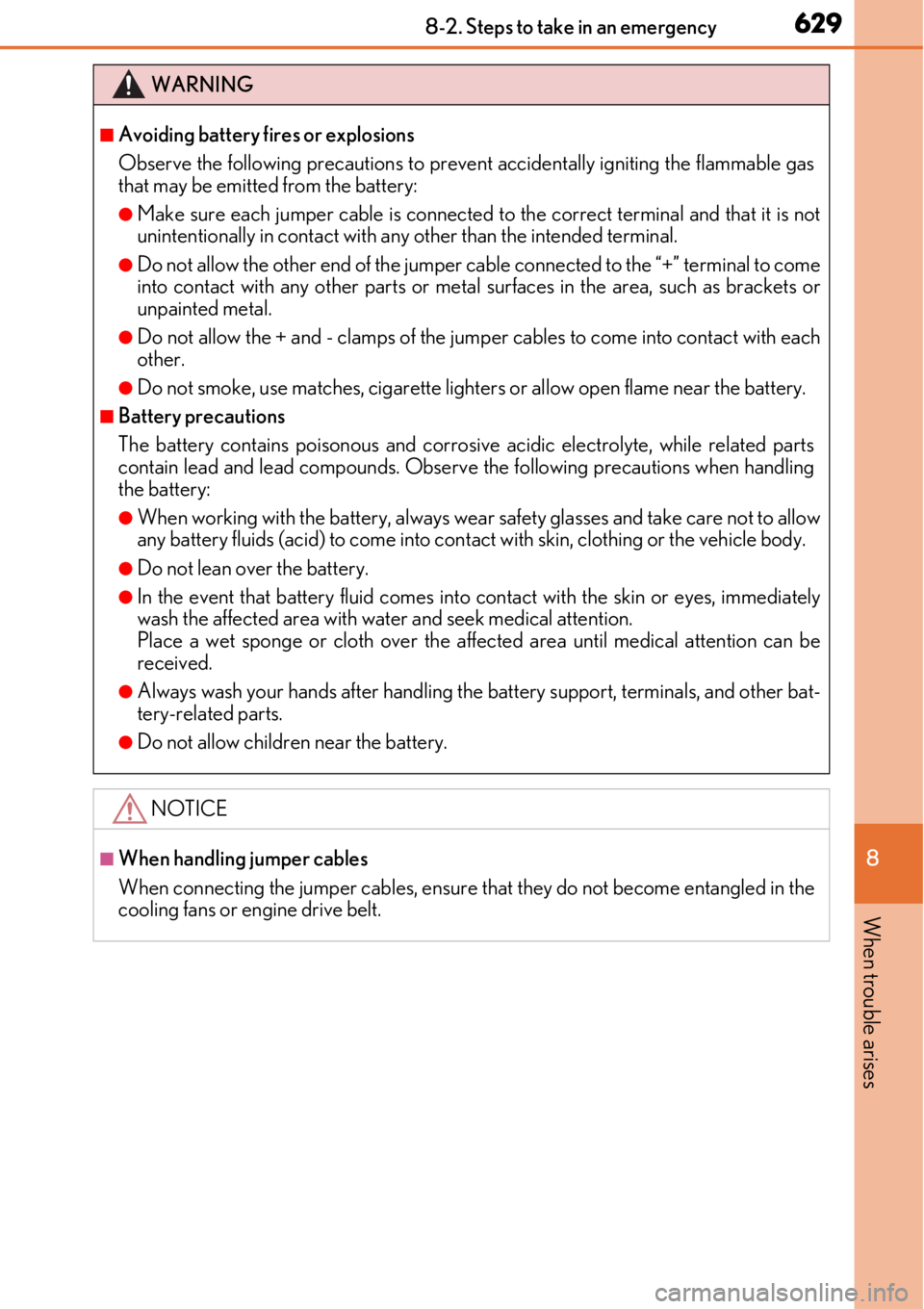
WARNING
■Avoiding battery fires or explosions
Observe the following precautions to prevent accidentally igniting the flammable gas
that may be emitted from the battery:
●Make sure each jumper cable is connected to the correct terminal and that it is not
unintentionally in contact with any other than the intended terminal.
●Do not allow the other end of the jumper cab le connected to the “+” terminal to come
into contact with any other parts or metal surfaces in the area, such as brackets or
unpainted metal.
●Do not allow the + and - clamps of the jump er cables to come into contact with each
other.
●Do not smoke, use matches, cigarette lighters or allow open flame near the battery.
■Battery precautions
The battery contains poisonous and corrosive acidic electrolyte, while related parts
contain lead and lead compounds. Observ e the following precautions when handling
the battery:
●When working with the battery, always wear safety glasses and take care not to allow
any battery fluids (acid) to come into cont act with skin, clothing or the vehicle body.
●Do not lean over the battery.
●In the event that battery fluid comes into contact with the skin or eyes, immediately
wash the affected area with water and seek medical attention.
Place a wet sponge or cloth over the affected area until medical attention can be
received.
●Always wash your hands afte r handling the battery support, terminals, and other bat-
tery-related parts.
●Do not allow children near the battery.
NOTICE
■When handling jumper cables
When connecting the jumper cables, ensure that they do not become entangled in the
cooling fans or engine drive belt.
Page 648 of 724

6489-1. Specifications
■Spark plug
Cooling system
Capacity
RC350/
RC30010.1 qt. (9.6 L, 8.4 Imp. qt.)
RC200t
Gasoline engine
8.5 qt. (8.0 L, 7.0 Imp. qt.)
Intercooler
3.3 qt. (3.1 L, 2.7 Imp. qt.)
RC F12.3 qt. (11.6 L, 10.2 Imp. qt.)
Coolant type
Use either of the following:
• “Toyota Super Long Life Coolant”
• Similar high-quality ethylene glycol-based non-sili-
cate, non-amine, non-nitrite, and non-borate coolant
with long-life hybrid organic acid technology
Do not use plain water alone.
Ignition system
RC350/RC300RC200tRC F
MakeDENSO
FK20HBR11NGK DILFR7K9GDENSO
FK20HBR-J8
Gap0.043 in. (1.1 mm)0.035 in. (0.9 mm)0.031 in. (0.8 mm)
NOTICE
■Iridium-tipped spark plugs
Use only iridium-tipped spark plugs. Do not adjust the spark plug gap.
Electrical system
Battery
Open voltage at 68°F
(20° C):12.3 V or higher
If the voltage is lower than the standard value, charge
the battery.
(Voltage is checked 20 minutes after the engine and all
lights are turned off.)
Charging rates5 A max.
Page 657 of 724
6579-1. Specifications
9
Vehicle specifications
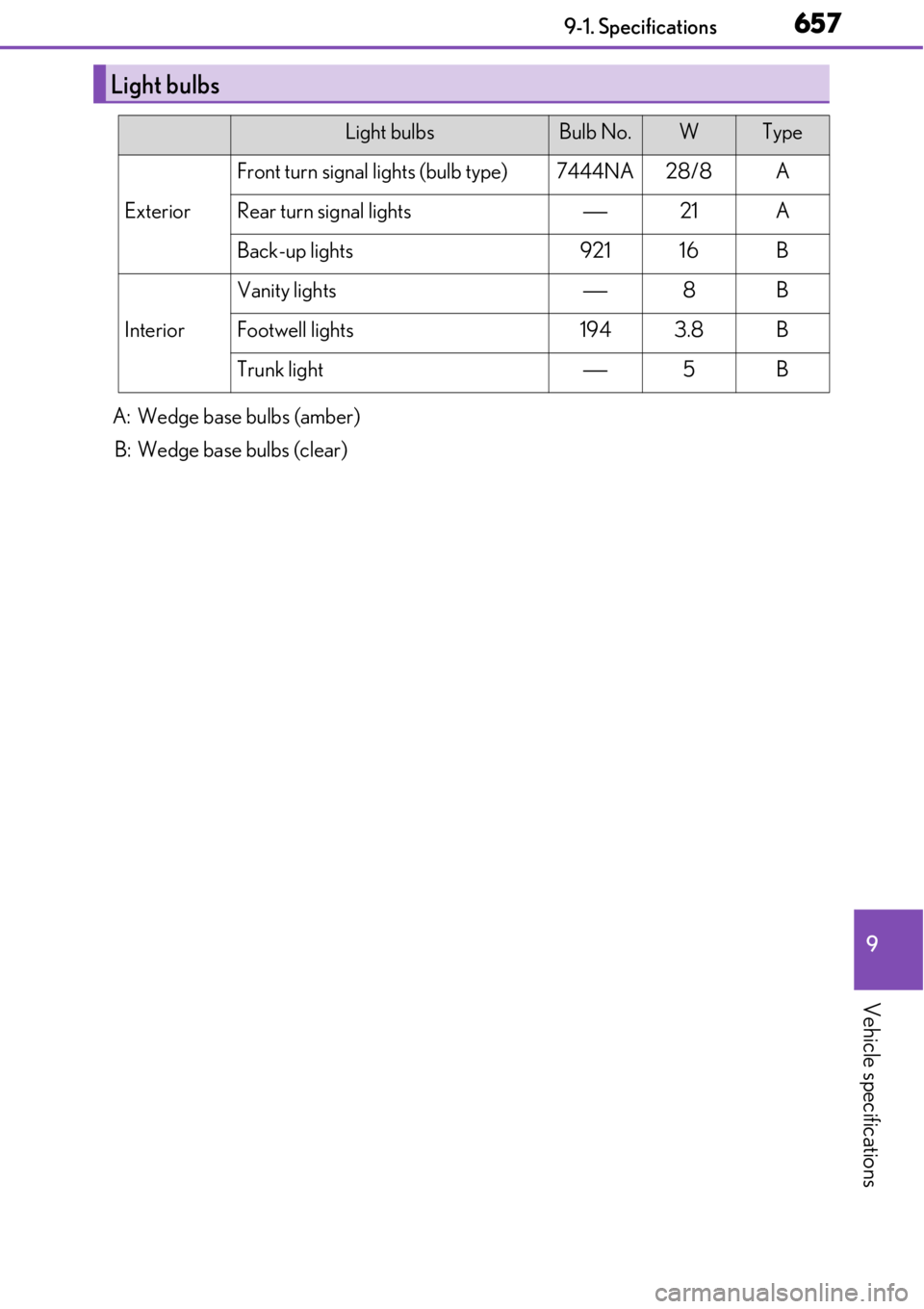
Light bulbs
Light bulbsBulb No.WType
Exterior
Front turn signal lights (bulb type)7444NA28/8A
Rear turn signal lights⎯21A
Back-up lights92116B
Interior
Vanity lights⎯8B
Footwell lights1943.8B
Trunk light⎯5B
A: Wedge base bulbs (amber)B: Wedge base bulbs (clear)
Page 659 of 724
6599-1. Specifications
9
Vehicle specifications
■Recommendation of the use of gasoline containing detergent additives
●Lexus recommends the use of gasoline that contains detergent additives to avoid the
build-up of engine deposits.
●All gasoline sold in the U.S.A. contains minimum detergent additives to clean and/or
keep clean intake systems, per EPA’s lowest additives concentration program.
●Lexus strongly recommends the use of Top Tier Detergent Gasoline. For more informa-
tion on Top Tier Detergent Gasoline and a lis t of marketers, please go to the official
website www.toptiergas.com.
■Recommendation of the use of low emissions gasoline
Gasolines containing oxygenates such as et hers and ethanol, as well as reformulated
gasolines, are available in some cities. Thes e fuels are typically acceptable for use, pro-
viding they meet other fuel requirements.
Lexus recommends these fuels, since the form ulations allow for reduced vehicle emis-
sions.
■Non-recommendation of the use of blended gasoline
●If you use gasohol in your vehicle, be sure that it has an octane ra ting no lower than 91.
●Lexus does not recommend the use of gasoline containing methanol.
■Non-recommendation of the use of gasoline containing MMT
Some gasoline contains an octane enhancing additive called MMT (Methylcyclopenta-
dienyl Manganese Tricarbonyl).
Lexus does not recommend the use of gasoline that contains MMT. If fuel containing
MMT is used, your emission control system may be adversely affected.
The malfunction indicator lamp on the instru ment cluster may come on. If this happens,
contact your Lexus dealer for service.
■If your engine knocks
●Consult your Lexus dealer.
●You may occasionally notice light knocking for a short time while accelerating or driv-
ing uphill. This is normal and there is no need for concern.
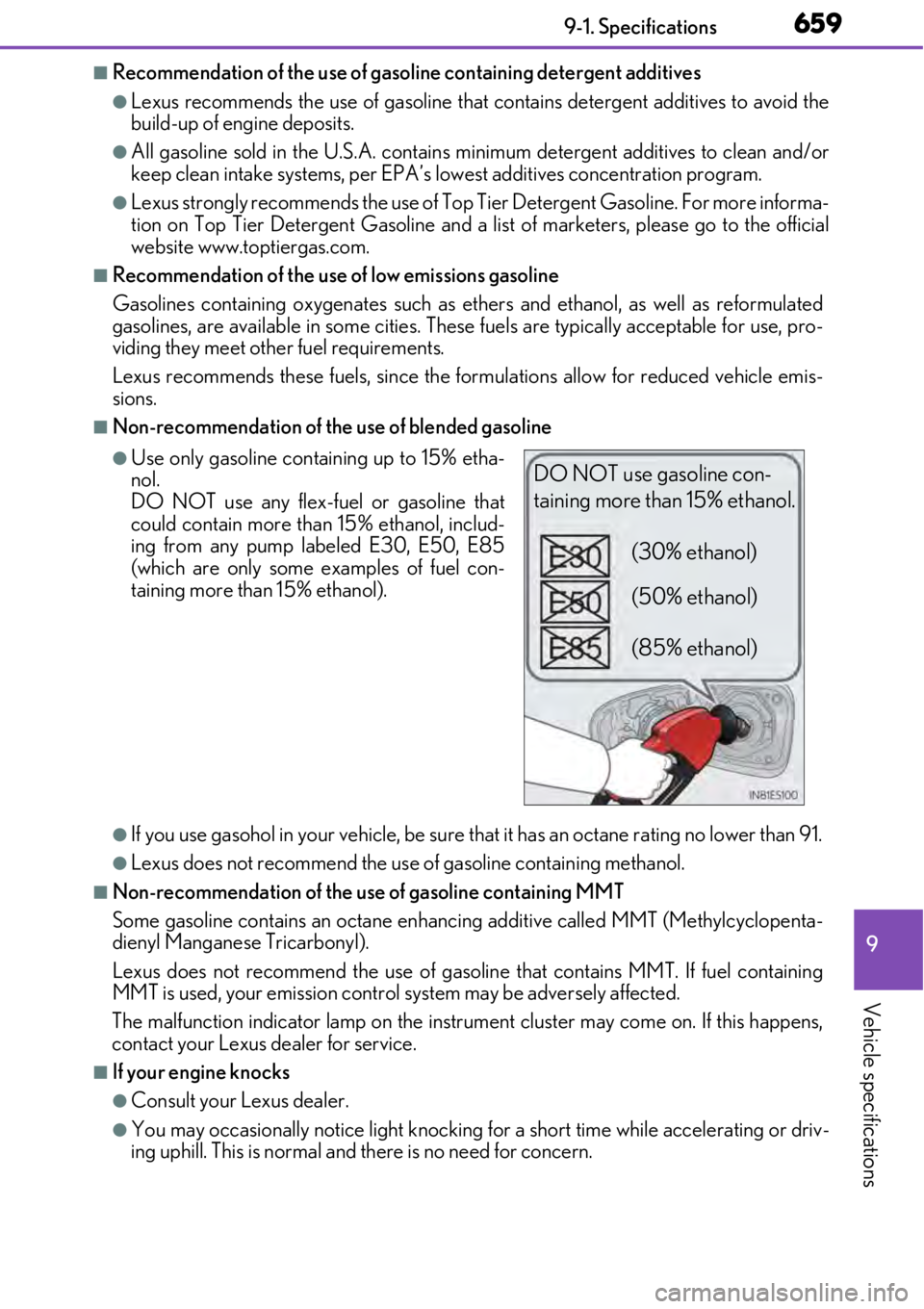
●Use only gasoline containing up to 15% etha-
nol.
DO NOT use any flex-fuel or gasoline that
could contain more than 15% ethanol, includ-
ing from any pump labeled E30, E50, E85
(which are only some examples of fuel con-
taining more than 15% ethanol).DO NOT use gasoline con-
taining more than 15% ethanol.
(30% ethanol)
(50% ethanol)
(85% ethanol)