inflation pressure LEXUS RC200T 2017 Owner's Manual
[x] Cancel search | Manufacturer: LEXUS, Model Year: 2017, Model line: RC200T, Model: LEXUS RC200T 2017Pages: 724, PDF Size: 42.04 MB
Page 595 of 724
5958-2. Steps to take in an emergency
8
When trouble arises
RC200t_RC F_EE(OM24728E)
■If the tire pressure warning light frequently comes on after blinking for 1 minute
If the tire pressure warning light frequently comes on after blinking for 1 minute when the engine switch is turned to IGNITION ON mode, have it checked by any authorized
Lexus dealer or repairer, or another duly qualified and equipped professional.
■Warning buzzer
In some cases, the buzzer may not be heard due to being in a noisy location or audio
sound.
WARNING
■If both the ABS and the brake system warning lights remain on
Stop your vehicle in a safe place immediately and contact any authorized Lexus dealer or repairer, or another duly qualified and equipped professional. The vehicle will
become extremely unstable during braking, and the ABS system may fail, which could cause an accident resulting in death or serious injury.
■When the electric power steering system warning light comes on
The steering wheel may become extremely heavy. If the steering wheel becomes heavier than us ual when operating, hold firmly and oper- ate using more force than usual.
■If the tire pressure warning light comes on
Be sure to observe the following precautions. Failure to do so could cause a loss of vehicle control and result in death or serious injury.
Vehicles with a spare tire
●Stop your vehicle in a safe place as soon as possible. Adjust the tire inflation pressureimmediately.
●If the tire pressure warning light comes on even after tire inflation pressure adjust- ment, it is probable that you have a flat tire. Check the tires. If a tire is flat, change itwith the spare tire and have the flat tire repaired by the nearest authorized Lexus
dealer or repairer, or another duly qualified and equipped professional.
●Avoid abrupt maneuvering and braking. If th e vehicle tires deteriorate, you could lose control of the steering wheel or the brakes.
Vehicles with an emergency tire puncture repair kit
●Stop your vehicle in a safe place as soon as possible. Adjust the tire inflation pressureimmediately.
●If the tire pressure warning light comes on even after tire inflation pressure adjust- ment, it is probable that you have a flat tire. Check the tires. If a tire is flat, repair theflat tire by using emergency tire puncture repair kit.
●Avoid abrupt maneuvering and braking. If th e vehicle tires deteriorate, you could lose control of the steering wheel or the brakes.
■If a blowout or sudden air leakage should occur
The tire pressure warning system may not activate immediately.
Page 609 of 724
6098-2. Steps to take in an emergency
8
When trouble arises
RC200t_RC F_EE(OM24728E)
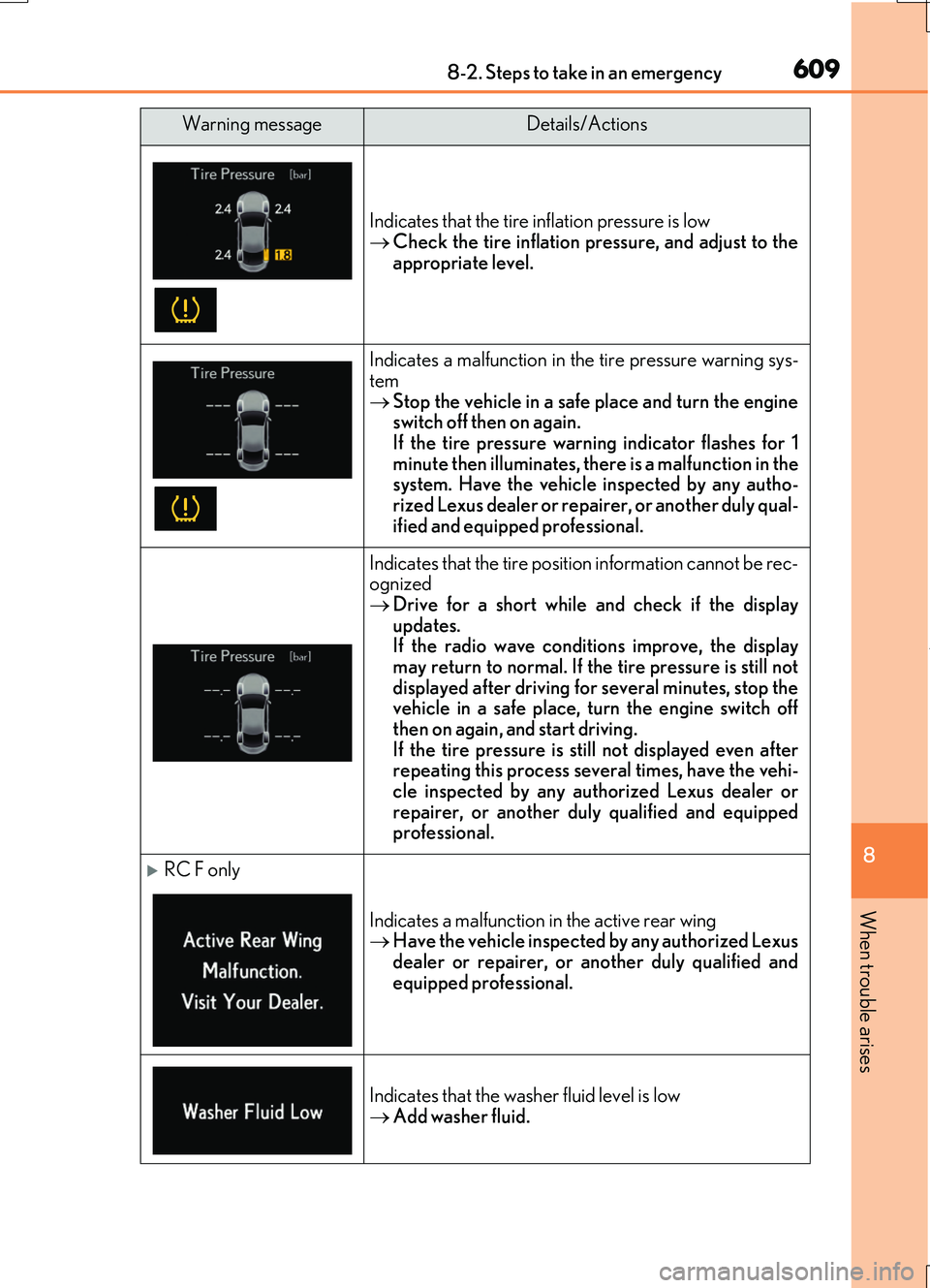
Indicates that the tire inflation pressure is low
Check the tire inflation pressure, and adjust to the appropriate level.
Indicates a malfunction in th e tire pressure warning sys- tem
Stop the vehicle in a safe place and turn the engine switch off then on again.If the tire pressure warning indicator flashes for 1
minute then illuminates, th ere is a malfunction in the system. Have the vehicle inspected by any autho-rized Lexus dealer or repairer, or another duly qual-
ified and equipped professional.
Indicates that the tire position information cannot be rec- ognized Drive for a short while and check if the display
updates. If the radio wave conditions improve, the displaymay return to normal. If the tire pressure is still not
displayed after driving for several minutes, stop the vehicle in a safe place, turn the engine switch offthen on again, and start driving.
If the tire pressure is still not displayed even after repeating this process several times, have the vehi-cle inspected by any authorized Lexus dealer or
repairer, or another duly qualified and equipped professional.
RC F only
Indicates a malfunction in the active rear wing Have the vehicle inspected by any authorized Lexus
dealer or repairer, or another duly qualified and equipped professional.
Indicates that the washer fluid level is low Add washer fluid.
Warning messageDetails/Actions
Page 630 of 724
6308-2. Steps to take in an emergency
RC200t_RC F_EE(OM24728E)
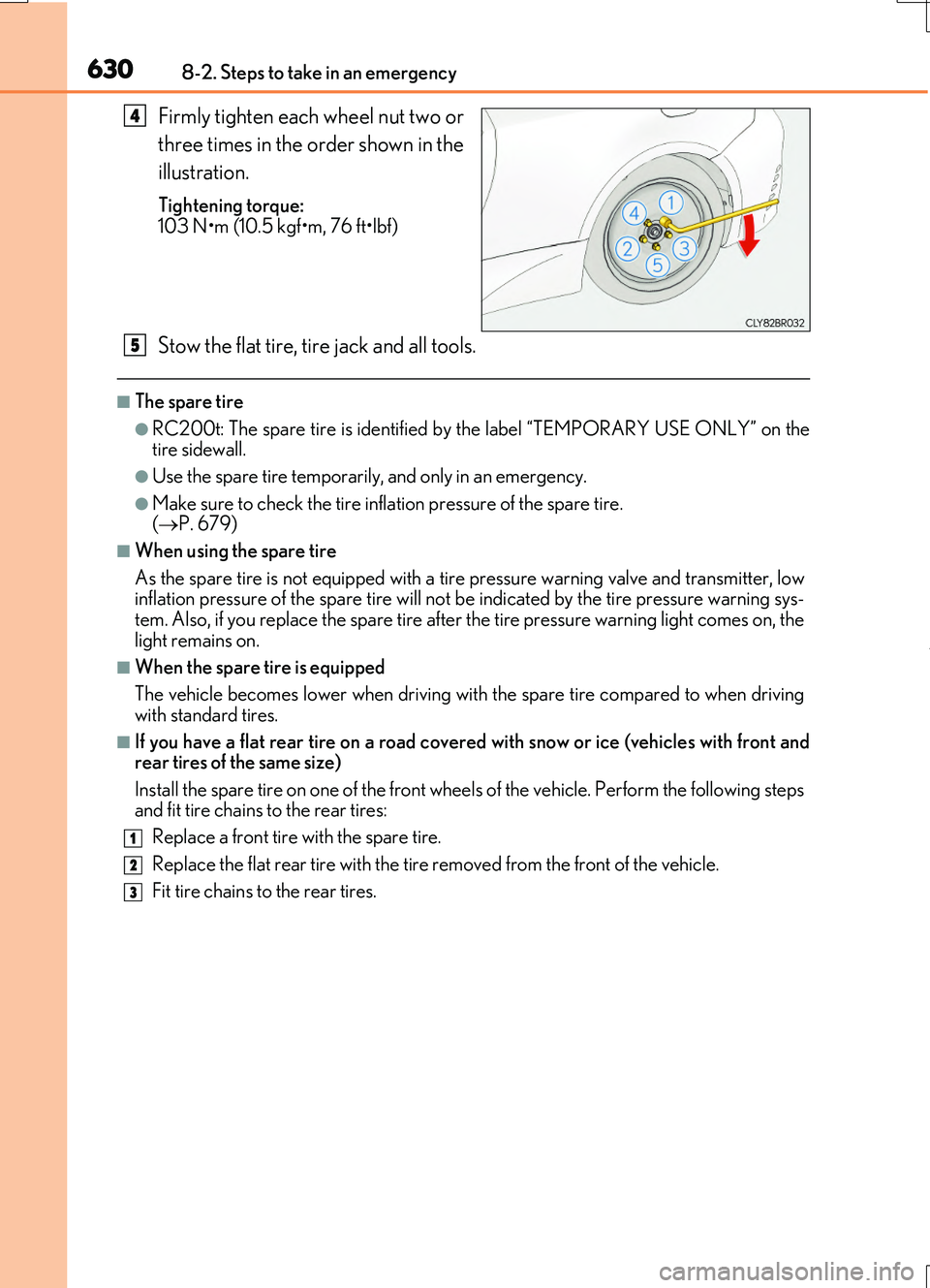
Firmly tighten each wheel nut two or
three times in the order shown in the
illustration.
Tightening torque:
103 N•m (10.5 kgf•m, 76 ft•lbf)
Stow the flat tire, tire jack and all tools.
■The spare tire
●RC200t: The spare tire is identified by the label “TEMPORARY USE ONLY” on the tire sidewall.
●Use the spare tire temporarily, and only in an emergency.
●Make sure to check the tire inflation pressure of the spare tire. ( P. 679)
■When using the spare tire
As the spare tire is not equipped with a tire pressure warning valve and transmitter, low inflation pressure of the spare tire will not be indicated by the tire pressure warning sys- tem. Also, if you replace the spare tire after the tire pressure warning light comes on, the
light remains on.
■When the spare tire is equipped
The vehicle becomes lower when driving with the spare tire compared to when driving
with standard tires.
■If you have a flat rear tire on a road covered with snow or ice (vehicles with front and rear tires of the same size)
Install the spare tire on one of the front wheels of the vehicle. Perform the following steps and fit tire chains to the rear tires:
Replace a front tire with the spare tire.
Replace the flat rear tire with the tire removed from the front of the vehicle.
Fit tire chains to the rear tires.
4
5
1
2
3
Page 641 of 724
6418-2. Steps to take in an emergency
8
When trouble arises
RC200t_RC F_EE(OM24728E)
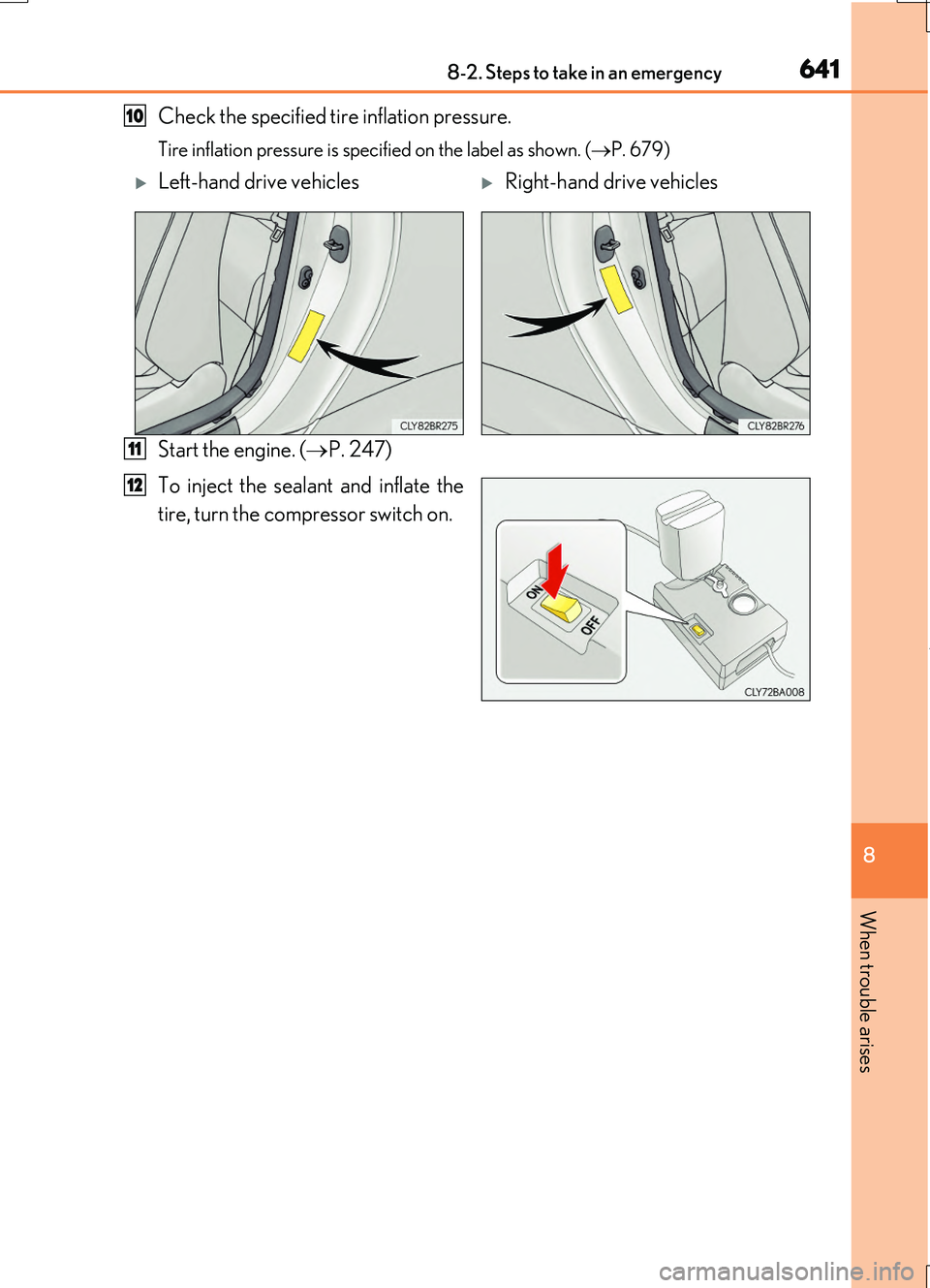
Check the specified tire inflation pressure.
Tire inflation pressure is specified on the label as shown. (P. 679)
Start the engine. (P. 247)
To inject the sealant and inflate the
tire, turn the compressor switch on.
10
Left-hand drive vehiclesRight-hand drive vehicles
11
12
Page 642 of 724
6428-2. Steps to take in an emergency
RC200t_RC F_EE(OM24728E)
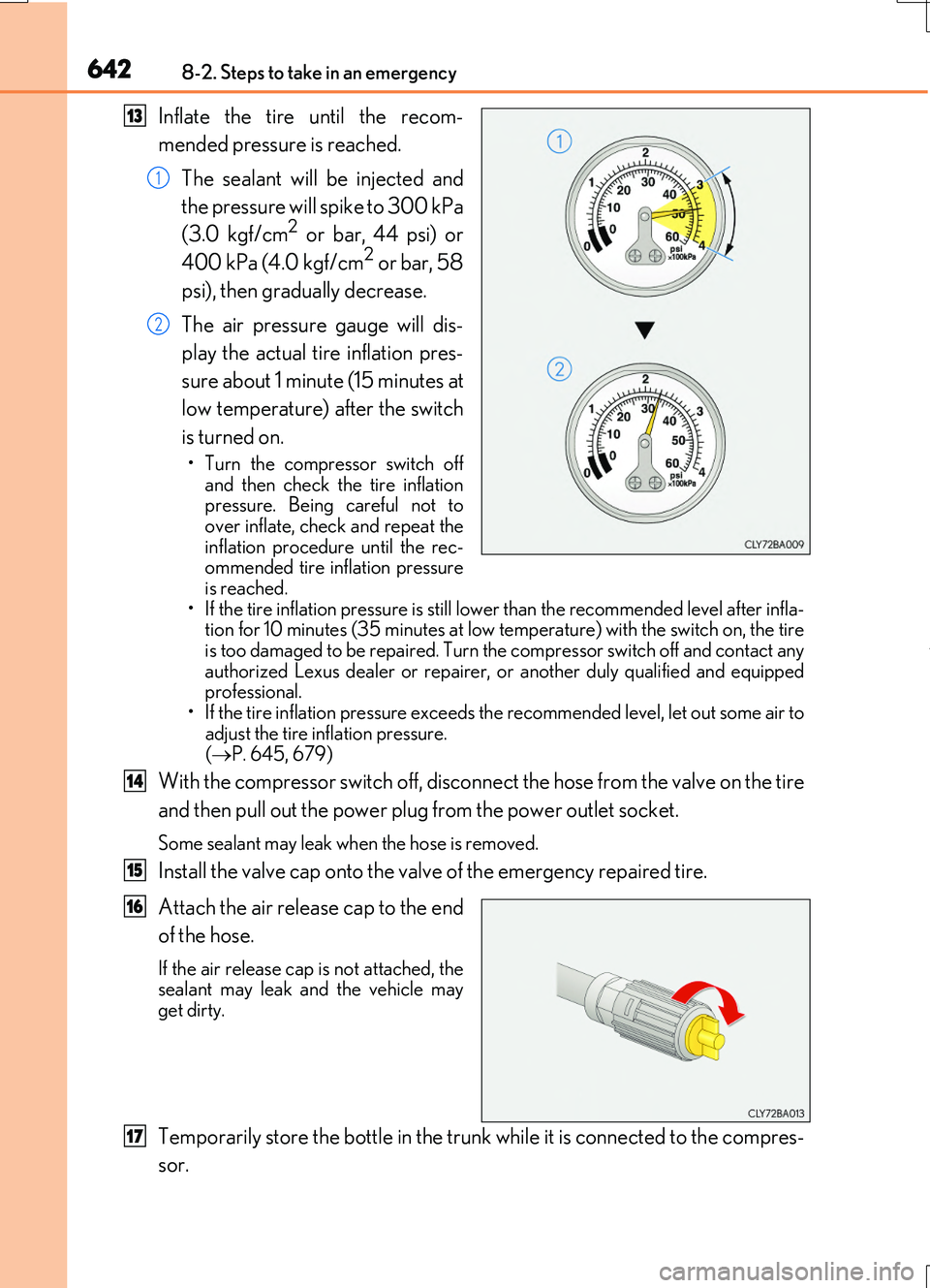
Inflate the tire until the recom-
mended pressure is reached.
The sealant will be injected and
the pressure will spike to 300 kPa
(3.0 kgf/cm2 or bar, 44 psi) or
400 kPa (4.0 kgf/cm2 or bar, 58
psi), then gradually decrease.
The air pressure gauge will dis-
play the actual tire inflation pres-
sure about 1 minute (15 minutes at
low temperature) after the switch
is turned on.
• Turn the compressor switch off and then check the tire inflationpressure. Being careful not to
over inflate, check and repeat the inflation procedure until the rec-ommended tire inflation pressure
is reached. • If the tire inflation pressure is still lo wer than the recommended level after infla- tion for 10 minutes (35 minutes at low temperature) with the switch on, the tire
is too damaged to be repaired. Turn the compressor switch off and contact any authorized Lexus dealer or repairer, or another duly qualified and equipped professional.
• If the tire inflation pressure exceeds th e recommended level, let out some air to adjust the tire inflation pressure.
( P. 645, 679)
With the compressor switch off, disconnect the hose from the valve on the tire
and then pull out the power plug from the power outlet socket.
Some sealant may leak wh en the hose is removed.
Install the valve cap onto the valve of the emergency repaired tire.
Attach the air release cap to the end
of the hose.
If the air release cap is not attached, the sealant may leak and the vehicle may
get dirty.
Temporarily store the bottle in the trunk while it is connected to the compres-
sor.
13
1
2
14
15
16
17
Page 643 of 724
6438-2. Steps to take in an emergency
8
When trouble arises
RC200t_RC F_EE(OM24728E)
To spread the liquid sealant evenly within the tire, immediately drive safely for
about 5 km (3 miles) below 80 km/h (50 mph).
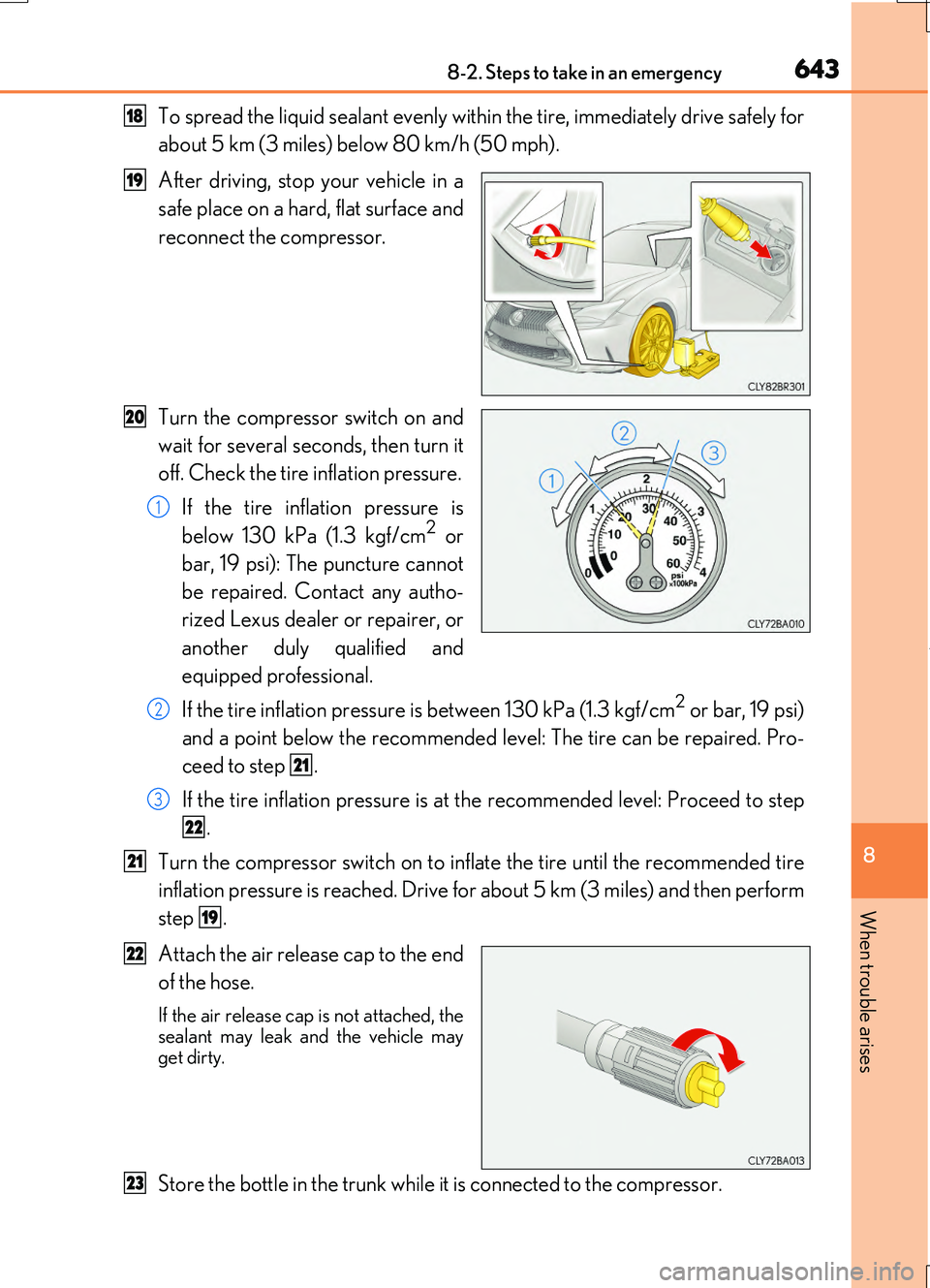
After driving, stop your vehicle in a
safe place on a hard, flat surface and
reconnect the compressor.
Turn the compressor switch on and
wait for several seconds, then turn it
off. Check the tire inflation pressure.
If the tire inflation pressure is
below 130 kPa (1.3 kgf/cm
2 or
bar, 19 psi): The puncture cannot
be repaired. Contact any autho-
rized Lexus dealer or repairer, or
another duly qualified and
equipped professional.
If the tire inflation pressure is between 130 kPa (1.3 kgf/cm
2 or bar, 19 psi)
and a point below the recommended level: The tire can be repaired. Pro-
ceed to step .
If the tire inflation pressure is at the recommended level: Proceed to step .
Turn the compressor switch on to infl ate the tire until the recommended tire
inflation pressure is reached. Drive for about 5 km (3 miles) and then perform
step .
Attach the air release cap to the end
of the hose.
If the air release cap is not attached, the
sealant may leak and the vehicle may
get dirty.
Store the bottle in the trunk while it is connected to the compressor.
18
19
20
1
2
21
3
1322
21
19
22
23
Page 645 of 724
6458-2. Steps to take in an emergency
8
When trouble arises
RC200t_RC F_EE(OM24728E)
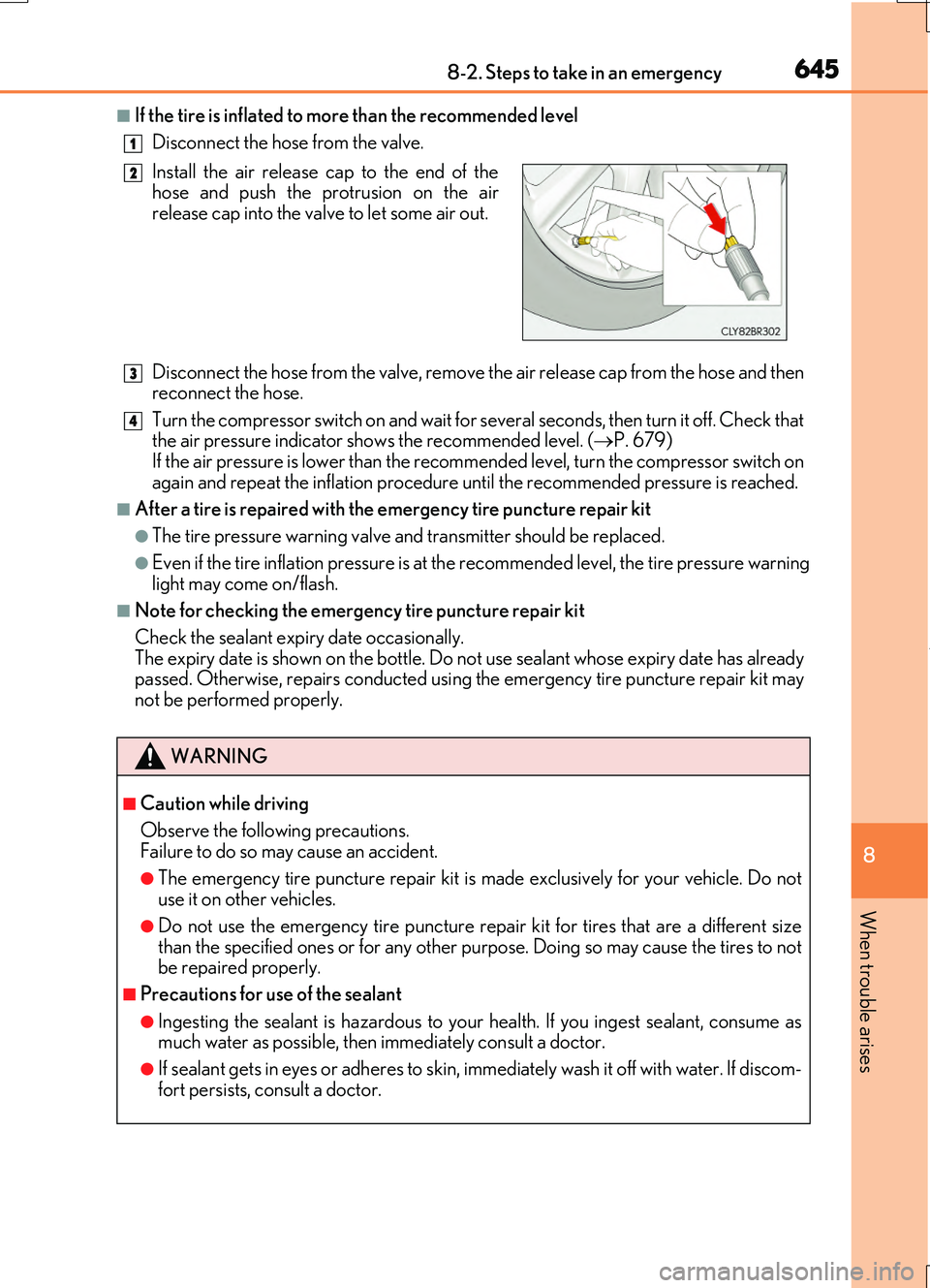
■If the tire is inflated to more than the recommended level
Disconnect the hose from the valve.
Disconnect the hose from the valve, remove the air release cap from the hose and then reconnect the hose.
Turn the compressor switch on and wait for several seconds, then turn it off. Check that the air pressure indicator sh ows the recommended level. (P. 679) If the air pressure is lower than the reco mmended level, turn the compressor switch on
again and repeat the inflation procedure un til the recommended pressure is reached.
■After a tire is repaired with the emergency tire puncture repair kit
●The tire pressure warning valve and transmitter should be replaced.
●Even if the tire inflation pressure is at the recommended level, the tire pressure warning light may come on/flash.
■Note for checking the emergency tire puncture repair kit
Check the sealant expiry date occasionally. The expiry date is shown on the bottle. Do not use sealant whose expiry date has alreadypassed. Otherwise, repairs conducted using th e emergency tire puncture repair kit may
not be performed properly.
Install the air release cap to the end of the hose and push the protrusion on the airrelease cap into the valve to let some air out.
WARNING
■Caution while driving
Observe the following precautions. Failure to do so may cause an accident.
●The emergency tire puncture repair kit is made exclusively for your vehicle. Do notuse it on other vehicles.
●Do not use the emergency tire puncture repa ir kit for tires that are a different size
than the specified ones or fo r any other purpose. Doing so may cause the tires to not be repaired properly.
■Precautions for use of the sealant
●Ingesting the sealant is hazardous to your health. If you ingest sealant, consume asmuch water as possible, then immediately consult a doctor.
●If sealant gets in eyes or adheres to skin, immediately wash it off with water. If discom-
fort persists, consult a doctor.
1
2
3
4
Page 646 of 724
6468-2. Steps to take in an emergency
RC200t_RC F_EE(OM24728E)
WARNING
■When fixing the flat tire
Observe the following precautions. Failure to do so may result in death or serious injury.
●Stop your vehicle in a safe and flat area.
●Do not touch the wheels or the area around the brakes immediately after the vehicle has been driven.
After the vehicle has been driven, the wheels and the area around the brakes may be extremely hot. Touching these areas with hands, feet or other body parts may result inburns.
●Connect the valve and hose securely with the tire installed on the vehicle.
• If the hose is not properly connected to the valve, air leakage may occur or sealant may be sprayed out.
• If the hose comes off the valve while inflating the tire, there is a risk that the hose will move abruptly due to air pressure.• After inflation of the tire has completed, the sealant may splatter when the hose is
disconnected or some air is let out of the tire.
●Follow the operation procedure to repair the tire. If the procedure is not followed, the
sealant may spray out.
●Keep back from the tire while it is being repaired, as there is a chance of it bursting while the repair operation is being performe d. If you notice any cracks or deforma-
tion of the tire, turn off the compressor sw itch and stop the repair operation immedi- ately.
●The kit may overheat if operated for a long period of time. Do not operate the com-
pressor continuously for more than 35 minutes.
●Parts of the kit become hot during operatio n. Be careful handling the kit during and after operation. Do not touch the metal part around the connecting area between the
bottle and compressor. It will be extremely hot.
●Do not attach the vehicle speed warning sticker to an area other than the one indi- cated. If the sticker is attached to an area where an SRS airbag is located, such as the
pad of the steering wheel, it may preven t the SRS airbag from operating properly.
■Driving to spread the liquid sealant evenly
●Drive the vehicle carefully at a low speed. Be especially careful when turning and cor-
nering.
●If the vehicle does not drive straight or you feel a pull through the steering wheel, stop the vehicle and check the following:
• Tire condition. The tire may have separated from the wheel. • Tire inflation pressure. If tire inflation pressure is 130 kPa (1.3 kgf/cm2 or b ar, 1 9 p si)or below, this may indica te severe tire damage.
Page 679 of 724
679
9
9-1. Specifications
Vehicle specifications
RC200t_RC F_EE(OM24728E)
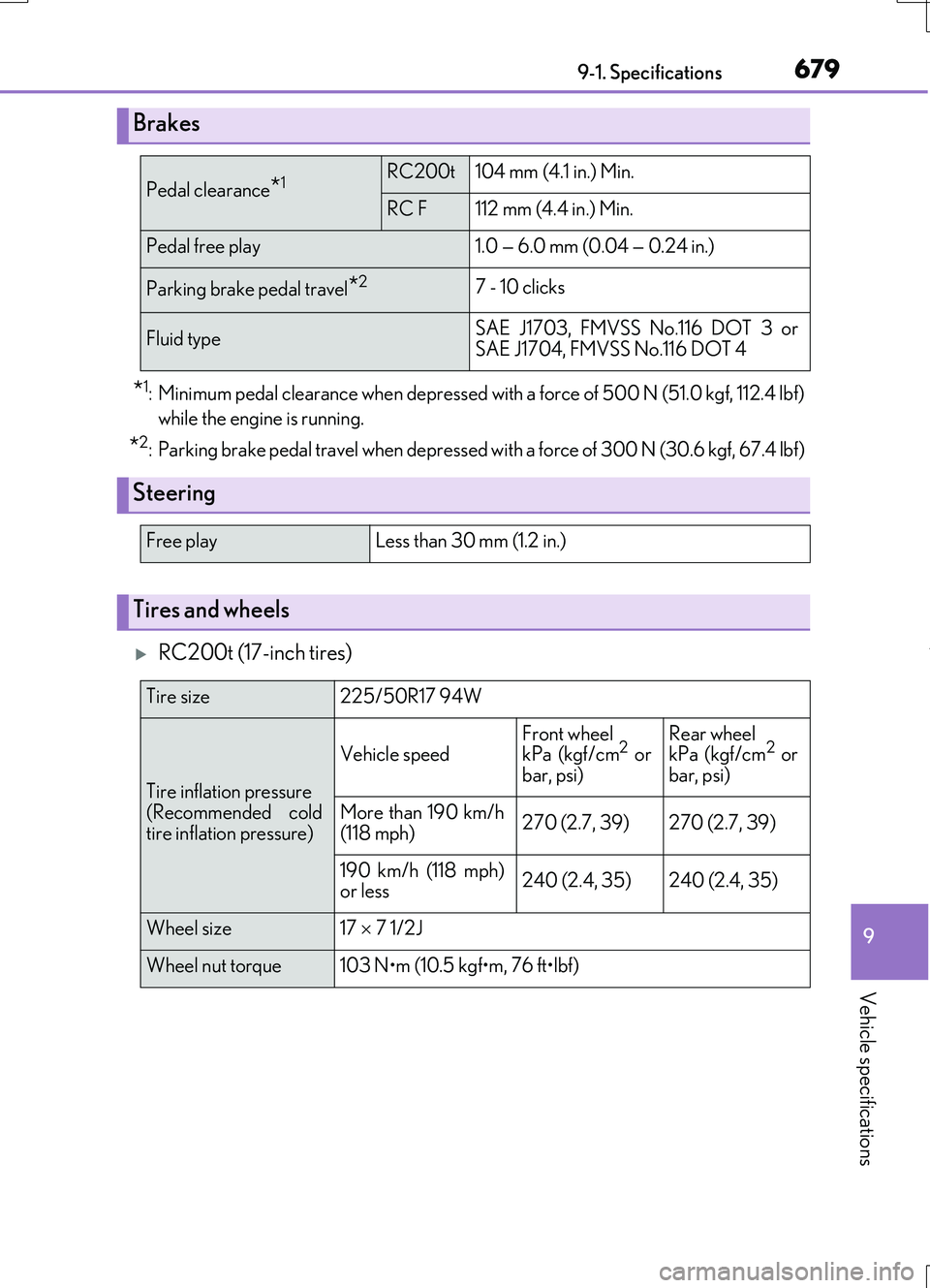
*1: Minimum pedal clearance when depressed with a force of 500 N (51.0 kgf, 112.4 lbf)
while the engine is running.
*2: Parking brake pedal travel when depressed with a force of 300 N (30.6 kgf, 67.4 lbf)
RC200t (17-inch tires)
Brakes
Pedal clearance*1RC200t104 mm (4.1 in.) Min.
RC F112 mm (4.4 in.) Min.
Pedal free play1.0 — 6.0 mm (0.04 — 0.24 in.)
Parking brake pedal travel*27 - 10 clicks
Fluid typeSAE J1703, FMVSS No.116 DOT 3 or
SAE J1704, FMVSS No.116 DOT 4
Steering
Free playLess than 30 mm (1.2 in.)
Tires and wheels
Tire size225/50R17 94W
Tire inflation pressure (Recommended cold
tire inflation pressure)
Vehicle speedFront wheel kPa (kgf/cm2 orbar, psi)
Rear wheelkPa (kgf/cm2 orbar, psi)
More than 190 km/h
(118 mph)270 (2.7, 39)270 (2.7, 39)
190 km/h (118 mph) or less240 (2.4, 35)240 (2.4, 35)
Wheel size17 7 1/2J
Wheel nut torque103 N•m (10.5 kgf•m, 76 ft•lbf)
Page 680 of 724
6809-1. Specifications
RC200t_RC F_EE(OM24728E)
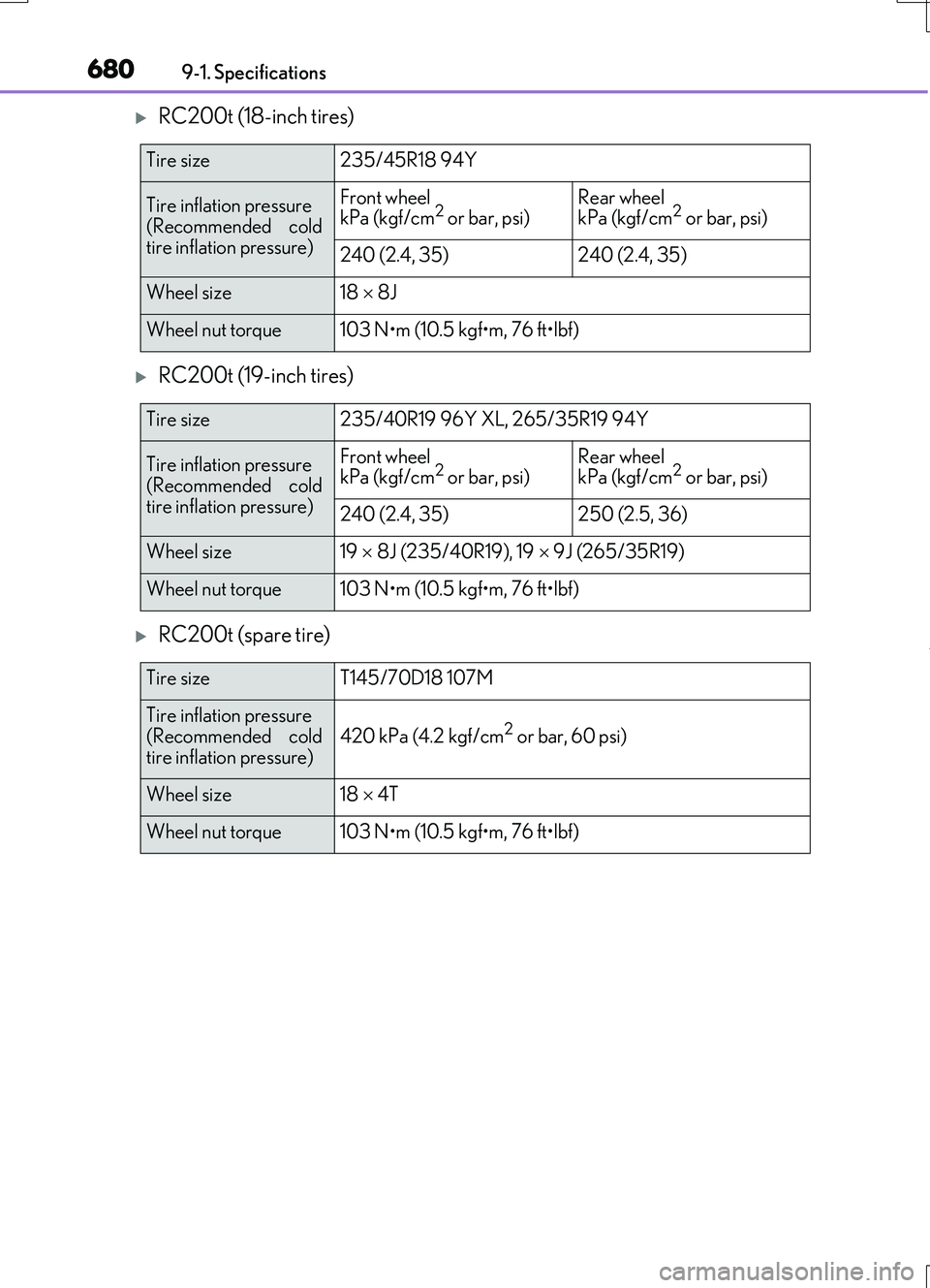
RC200t (18-inch tires)
RC200t (19-inch tires)
RC200t (spare tire)
Tire size235/45R18 94Y
Tire inflation pressure
(Recommended cold tire inflation pressure)
Front wheelkPa (kgf/cm2 or bar, psi)Rear wheelkPa (kgf/cm2 or bar, psi)
240 (2.4, 35)240 (2.4, 35)
Wheel size18 8J
Wheel nut torque103 N•m (10.5 kgf•m, 76 ft•lbf)
Tire size235/40R19 96Y XL, 265/35R19 94Y
Tire inflation pressure (Recommended cold
tire inflation pressure)
Front wheel kPa (kgf/cm2 or bar, psi)Rear wheelkPa (kgf/cm2 or bar, psi)
240 (2.4, 35)250 (2.5, 36)
Wheel size19 8J (235/40R19), 19 9J (265/35R19)
Wheel nut torque103 N•m (10.5 kgf•m, 76 ft•lbf)
Tire sizeT145/70D18 107M
Tire inflation pressure
(Recommended cold tire inflation pressure)420 kPa (4.2 kgf/cm2 or bar, 60 psi)
Wheel size18 4T
Wheel nut torque103 N•m (10.5 kgf•m, 76 ft•lbf)