wheel LEXUS RC300 2017 Owners Manual
[x] Cancel search | Manufacturer: LEXUS, Model Year: 2017, Model line: RC300, Model: LEXUS RC300 2017Pages: 724, PDF Size: 15.76 MB
Page 616 of 724

6168-2. Steps to take in an emergency
■Emergency tire puncture repair kit
●The sealant has a limited lifespan. The expiry date is marked on the bottle. The sealant
should be replaced before the expiry date. Contact your Lexus dealer for replacement.
●The sealant stored in the emergency tire puncture repair kit can be used only once to
temporarily repair a single tire. If the sealant has been used and needs to be purchased,
contact your Lexus dealer. The compressor is reusable.
●The sealant can be used when the outside temperature is from -40 °F (-40 °C) to
140 °F (60 °C).
●The kit is exclusively designed for size and type of tires originally installed on your vehi-
cle. Do not use it for tires that a different size than the original ones, or for any other
purposes.
●If the sealant gets on yo ur clothes, it may stain.
●If the sealant adheres to a wheel or the surface of the vehicle body, the stain may not be
removable if it is not cleaned at once. Immediately wipe away the sealant with a wet
cloth.
●During operation of the kit, a loud operation noise is produc ed. This does not indicate a
malfunction.
●Do not use the emergency tire puncture repair kit to check or to adjust the tire pres-
sure.
Page 618 of 724

6188-2. Steps to take in an emergency
WARNING
■When fixing the flat tire
Observe the following precautions.
Failure to do so may result in death or serious injury.
●Stop your vehicle in a safe and flat area.
●Do not touch the wheels or the area around the brakes immediately after the vehicle
has been driven.
After the vehicle has been driven, the wheels and the area around the brakes may be
extremely hot. Touching these areas with hands, feet or other body parts may result in
burns.
●Connect the valve and hose securely with the tire installed on the vehicle.
• If the hose is not properly connected to the valve, air leakage may occur or sealant
may be sprayed out.
• If the hose comes off the valve while inflating the tire, there is a risk that the hose will move abruptly due to air pressure.
• After inflation of the tire has completed, the sealant may splatter when the hose is disconnected or some air is let out of the tire.
●Follow the operation procedure to repair the tire. If the procedure is not followed, the
sealant may spray out.
●Keep back from the tire while it is being re paired, as there is a chance of it bursting
while the repair operation is being performe d. If you notice any cracks or deforma-
tion of the tire, turn off the compressor sw itch and stop the repair operation immedi-
ately.
●The kit may overheat if operated for a long period of time. Do not operate the com-
pressor continuously for more than 35 minutes.
●Parts of the kit become hot during operation. Be careful handling the kit during and
after operation. Do not touch the metal part around the connecting area between the
bottle and compressor. It will be extremely hot.
●Do not attach the vehicle speed warning sticker to an area other than the one indi-
cated. If the sticker is attached to an area where an SRS airbag is located, such as the
pad of the steering wheel, it may preven t the SRS airbag from operating properly.
■Driving to spread the liquid sealant evenly
●Drive the vehicle carefully at a low speed. Be especially careful when turning and cor-
nering.
●If the vehicle does not drive straight or you feel a pull through the steering wheel, stop
the vehicle and check the following:
• Tire condition. The tire may have separated from the wheel.
• Tire inflation pressure. If tire inflation pressure is 19 psi (130 kPa, 1.3 kgf/cm
2 or
bar) or below, this may in dicate severe tire damage.
Page 636 of 724
6368-2. Steps to take in an emergency
Stop the engine. Set the parking brake and shift the shift lever to P.
Remove the mud, snow or sand from around the rear wheels.
Place wood, stones or some other materi al under the rear wheels to help pro-
vide traction.
Restart the engine.
Shift the shift lever to D or R and rele ase the parking brake. Then, while exer-
cising caution, depress the accelerator pedal.
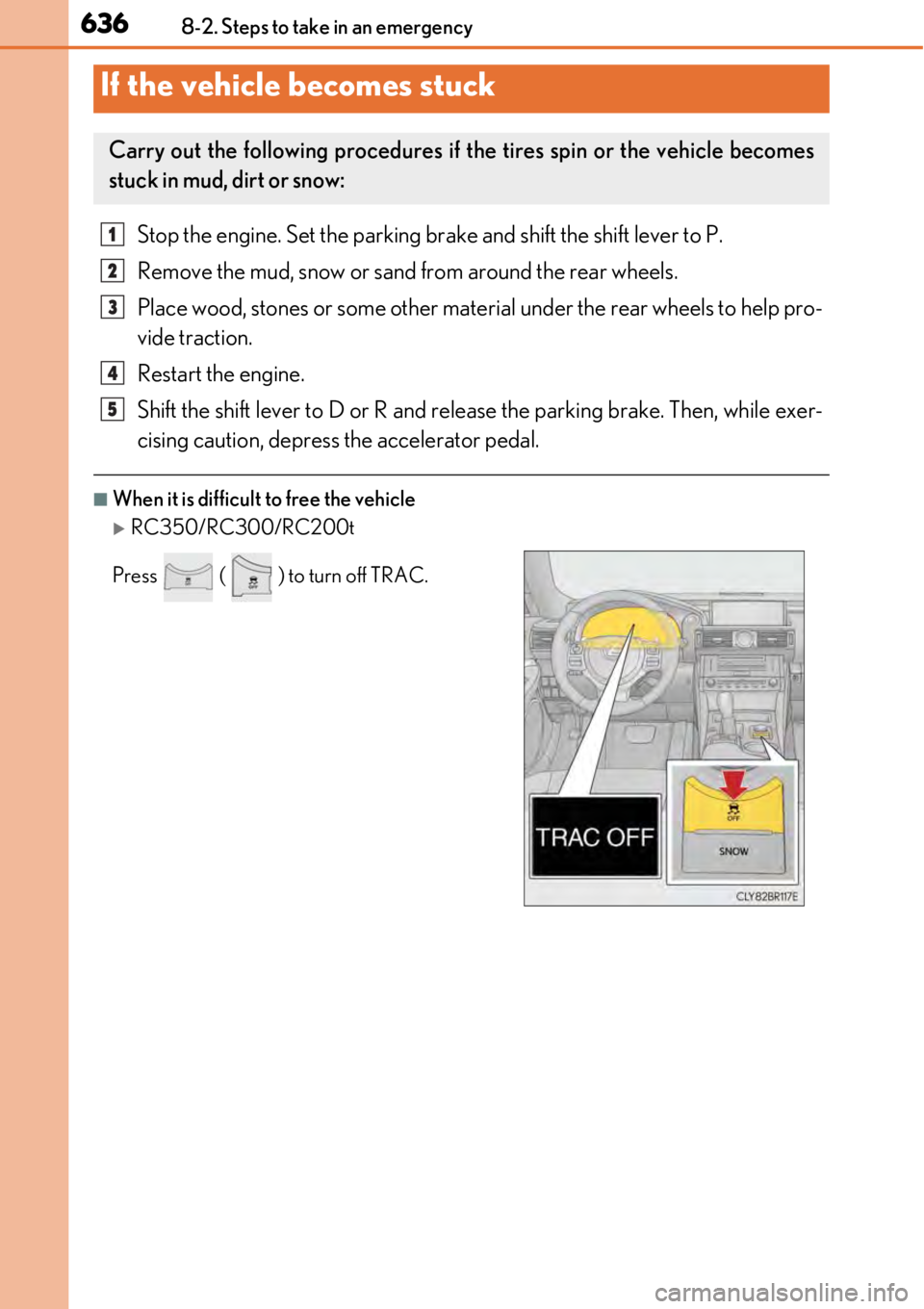
■When it is difficult to free the vehicle
RC350/RC300/RC200t
If the vehicle becomes stuck
Carry out the following procedures if the tires spin or the vehicle becomes
stuck in mud, dirt or snow:
Press ( ) to turn off TRAC.
1
2
3
4
5
Page 637 of 724
6378-2. Steps to take in an emergency
8
When trouble arises
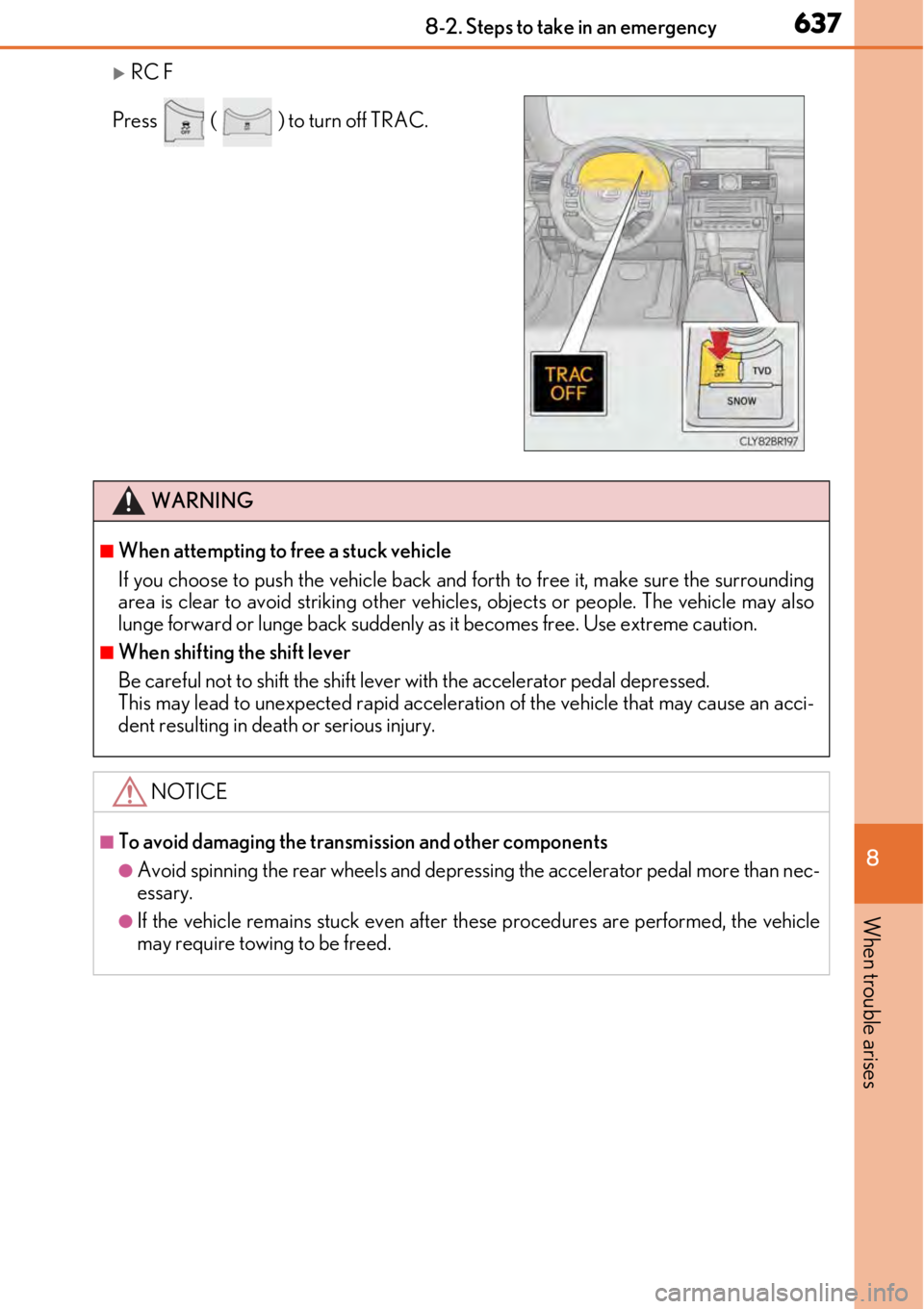
RC F
Press ( ) to turn off TRAC.
WARNING
■When attempting to free a stuck vehicle
If you choose to push the vehicle back and forth to free it, make sure the surrounding
area is clear to avoid striking other vehicl es, objects or people. The vehicle may also
lunge forward or lunge back suddenly as it becomes free. Use extreme caution.
■When shifting the shift lever
Be careful not to shift the shift lever with the accelerator pedal depressed.
This may lead to unexpected rapid acceleration of the vehicle that may cause an acci-
dent resulting in deat h or serious injury.
NOTICE
■To avoid damaging the transmission and other components
●Avoid spinning the rear wheels and depressing the accelerator pedal more than nec-
essary.
●If the vehicle remains stuck even after th ese procedures are performed, the vehicle
may require towing to be freed.
Page 640 of 724
6409-1. Specifications
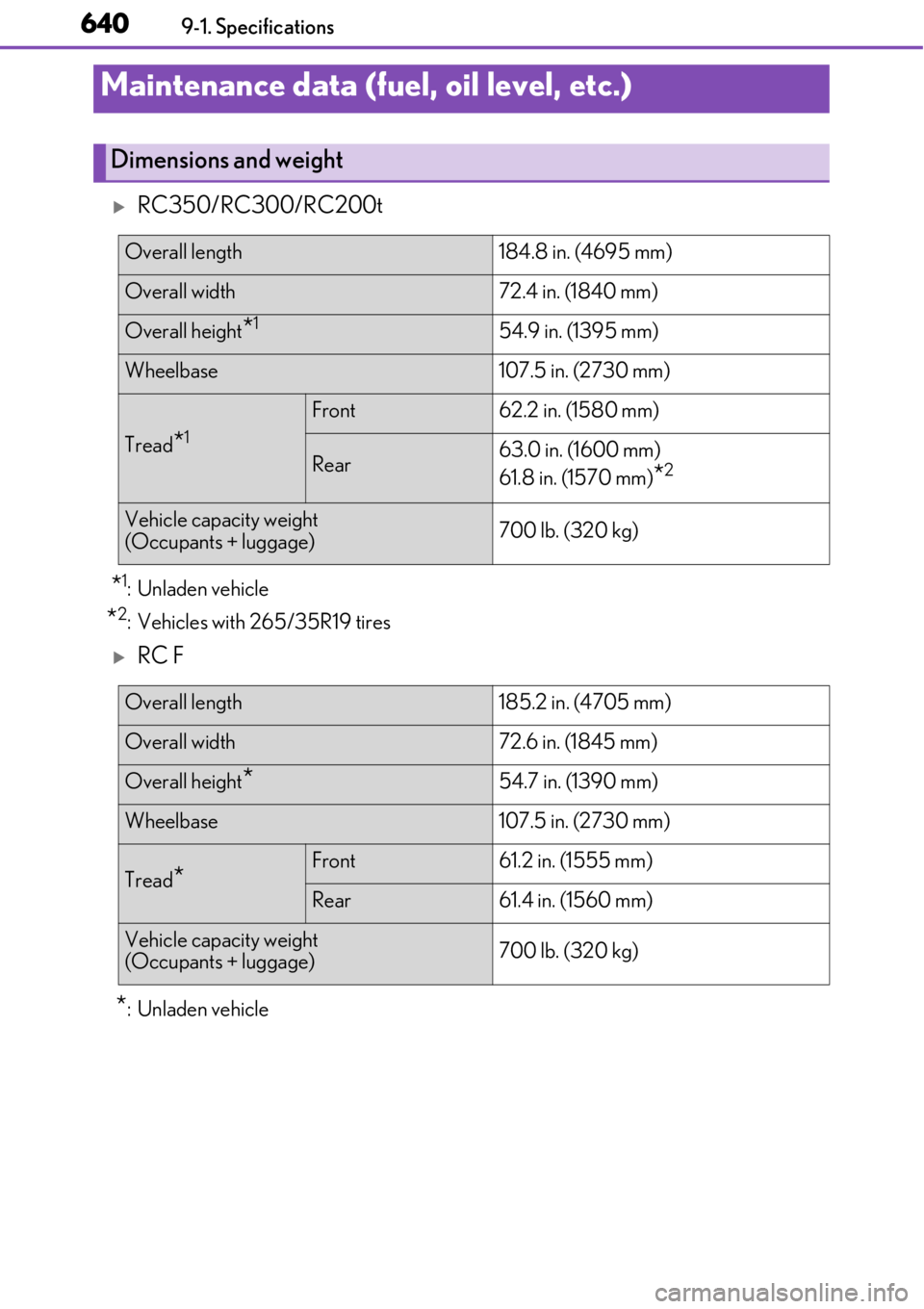
RC350/RC300/RC200t
*1:Unladen vehicle
*2: Vehicles with 265/35R19 tires
RC F
*:Unladen vehicle
Maintenance data (fuel, oil level, etc.)
Dimensions and weight
Overall length184.8 in. (4695 mm)
Overall width72.4 in. (1840 mm)
Overall height*154.9 in. (1395 mm)
Wheelbase107.5 in. (2730 mm)
Tread*1
Front62.2 in. (1580 mm)
Rear63.0 in. (1600 mm)
61.8 in. (1570 mm)
*2
Vehicle capacity weight
(Occupants + luggage)700 lb. (320 kg)
Overall length185.2 in. (4705 mm)
Overall width72.6 in. (1845 mm)
Overall height*54.7 in. (1390 mm)
Wheelbase107.5 in. (2730 mm)
Tread*Front61.2 in. (1555 mm)
Rear61.4 in. (1560 mm)
Vehicle capacity weight
(Occupants + luggage)700 lb. (320 kg)
Page 652 of 724
6529-1. Specifications
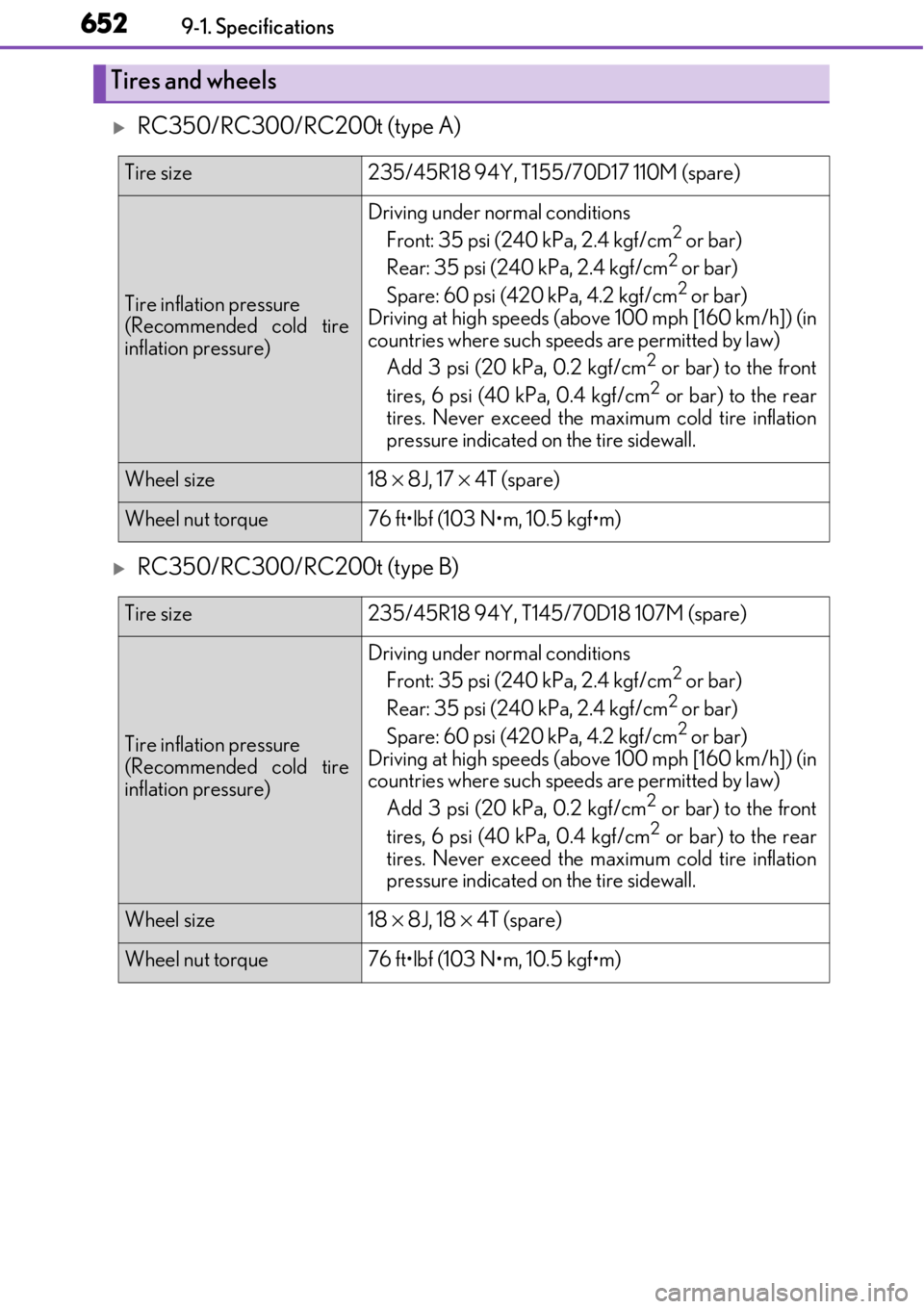
RC350/RC300/RC200t (type A)
RC350/RC300/RC200t (type B)
Tires and wheels
Tire size235/45R18 94Y, T155/70D17 110M (spare)
Tire inflation pressure
(Recommended cold tire
inflation pressure)
Driving under normal conditionsFront: 35 psi (240 kPa, 2.4 kgf/cm2 or bar)
Rear: 35 psi (240 kPa, 2.4 kgf/cm2 or bar)
Spare: 60 psi (420 kPa, 4.2 kgf/cm2 or bar)
Driving at high speeds (above 100 mph [160 km/h]) (in
countries where such speeds are permitted by law)
Add 3 psi (20 kPa, 0.2 kgf/cm
2 or bar) to the front
tires, 6 psi (40 kPa, 0.4 kgf/cm2 or bar) to the rear
tires. Never exceed the maximum cold tire inflation
pressure indicated on the tire sidewall.
Wheel size18 × 8J, 17 × 4T (spare)
Wheel nut torque76 ft•lbf (103 N•m, 10.5 kgf•m)
Tire size235/45R18 94Y, T145/70D18 107M (spare)
Tire inflation pressure
(Recommended cold tire
inflation pressure)
Driving under normal conditions
Front: 35 psi (240 kPa, 2.4 kgf/cm2 or bar)
Rear: 35 psi (240 kPa, 2.4 kgf/cm2 or bar)
Spare: 60 psi (420 kPa, 4.2 kgf/cm2 or bar)
Driving at high speeds (above 100 mph [160 km/h]) (in
countries where such speeds are permitted by law)
Add 3 psi (20 kPa, 0.2 kgf/cm
2 or bar) to the front
tires, 6 psi (40 kPa, 0.4 kgf/cm2 or bar) to the rear
tires. Never exceed the maximum cold tire inflation
pressure indicated on the tire sidewall.
Wheel size18 × 8J, 18 × 4T (spare)
Wheel nut torque76 ft•lbf (103 N•m, 10.5 kgf•m)
Page 653 of 724
6539-1. Specifications
9
Vehicle specifications
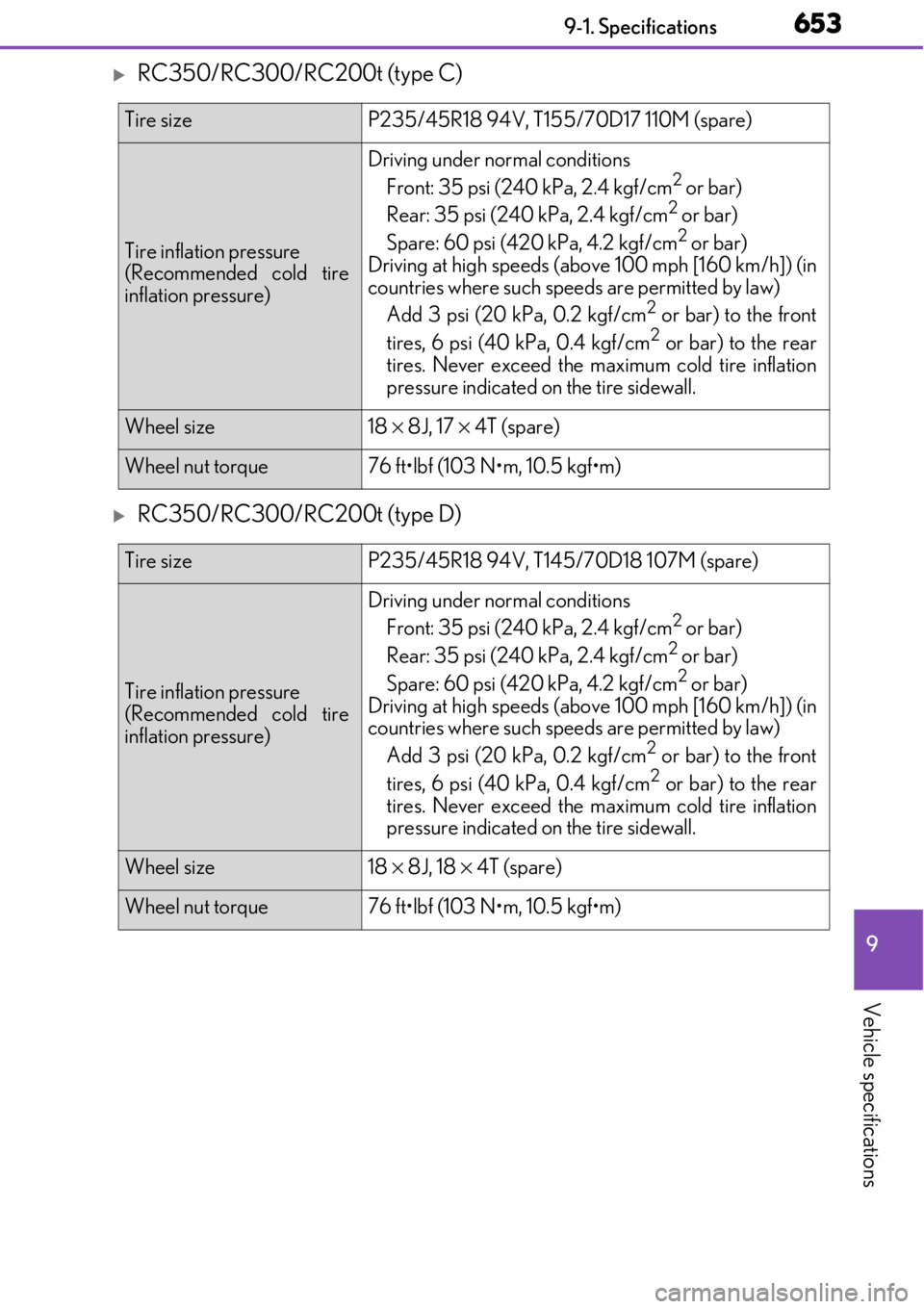
RC350/RC300/RC200t (type C)
RC350/RC300/RC200t (type D)
Tire sizeP235/45R18 94V, T155/70D17 110M (spare)
Tire inflation pressure
(Recommended cold tire
inflation pressure)
Driving under normal conditionsFront: 35 psi (240 kPa, 2.4 kgf/cm2 or bar)
Rear: 35 psi (240 kPa, 2.4 kgf/cm2 or bar)
Spare: 60 psi (420 kPa, 4.2 kgf/cm2 or bar)
Driving at high speeds (above 100 mph [160 km/h]) (in
countries where such speeds are permitted by law)
Add 3 psi (20 kPa, 0.2 kgf/cm
2 or bar) to the front
tires, 6 psi (40 kPa, 0.4 kgf/cm2 or bar) to the rear
tires. Never exceed the maximum cold tire inflation
pressure indicated on the tire sidewall.
Wheel size18 × 8J, 17 × 4T (spare)
Wheel nut torque76 ft•lbf (103 N•m, 10.5 kgf•m)
Tire sizeP235/45R18 94V, T145/70D18 107M (spare)
Tire inflation pressure
(Recommended cold tire
inflation pressure)
Driving under normal conditions
Front: 35 psi (240 kPa, 2.4 kgf/cm2 or bar)
Rear: 35 psi (240 kPa, 2.4 kgf/cm2 or bar)
Spare: 60 psi (420 kPa, 4.2 kgf/cm2 or bar)
Driving at high speeds (above 100 mph [160 km/h]) (in
countries where such speeds are permitted by law)
Add 3 psi (20 kPa, 0.2 kgf/cm
2 or bar) to the front
tires, 6 psi (40 kPa, 0.4 kgf/cm2 or bar) to the rear
tires. Never exceed the maximum cold tire inflation
pressure indicated on the tire sidewall.
Wheel size18 × 8J, 18 × 4T (spare)
Wheel nut torque76 ft•lbf (103 N•m, 10.5 kgf•m)
Page 654 of 724
6549-1. Specifications
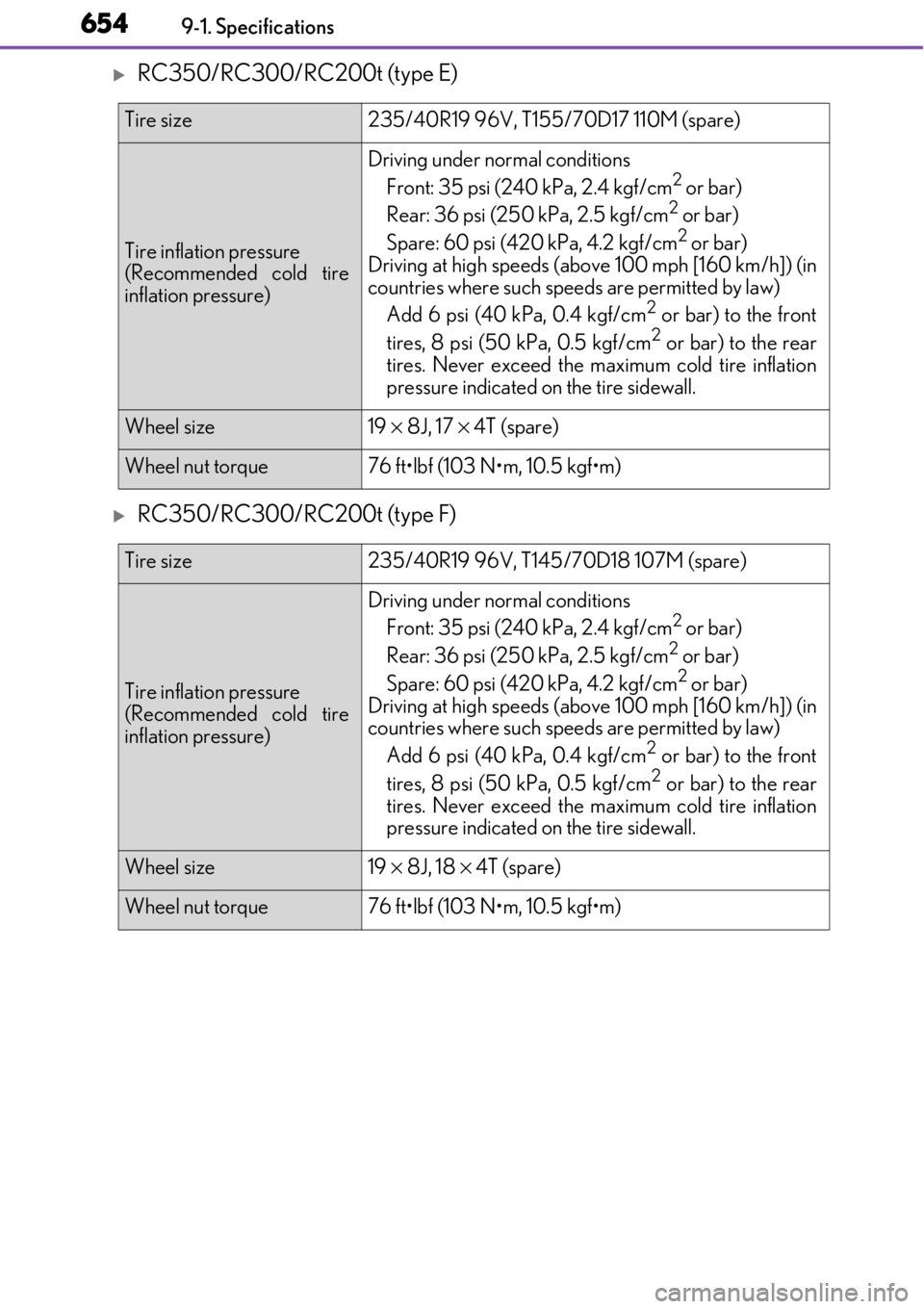
RC350/RC300/RC200t (type E)
RC350/RC300/RC200t (type F)
Tire size235/40R19 96V, T155/70D17 110M (spare)
Tire inflation pressure
(Recommended cold tire
inflation pressure)
Driving under normal conditionsFront: 35 psi (240 kPa, 2.4 kgf/cm2 or bar)
Rear: 36 psi (250 kPa, 2.5 kgf/cm2 or bar)
Spare: 60 psi (420 kPa, 4.2 kgf/cm2 or bar)
Driving at high speeds (above 100 mph [160 km/h]) (in
countries where such speeds are permitted by law)
Add 6 psi (40 kPa, 0.4 kgf/cm
2 or bar) to the front
tires, 8 psi (50 kPa, 0.5 kgf/cm2 or bar) to the rear
tires. Never exceed the maximum cold tire inflation
pressure indicated on the tire sidewall.
Wheel size19 × 8J, 17 × 4T (spare)
Wheel nut torque76 ft•lbf (103 N•m, 10.5 kgf•m)
Tire size235/40R19 96V, T145/70D18 107M (spare)
Tire inflation pressure
(Recommended cold tire
inflation pressure)
Driving under normal conditions
Front: 35 psi (240 kPa, 2.4 kgf/cm2 or bar)
Rear: 36 psi (250 kPa, 2.5 kgf/cm2 or bar)
Spare: 60 psi (420 kPa, 4.2 kgf/cm2 or bar)
Driving at high speeds (above 100 mph [160 km/h]) (in
countries where such speeds are permitted by law)
Add 6 psi (40 kPa, 0.4 kgf/cm
2 or bar) to the front
tires, 8 psi (50 kPa, 0.5 kgf/cm2 or bar) to the rear
tires. Never exceed the maximum cold tire inflation
pressure indicated on the tire sidewall.
Wheel size19 × 8J, 18 × 4T (spare)
Wheel nut torque76 ft•lbf (103 N•m, 10.5 kgf•m)
Page 655 of 724
6559-1. Specifications
9
Vehicle specifications
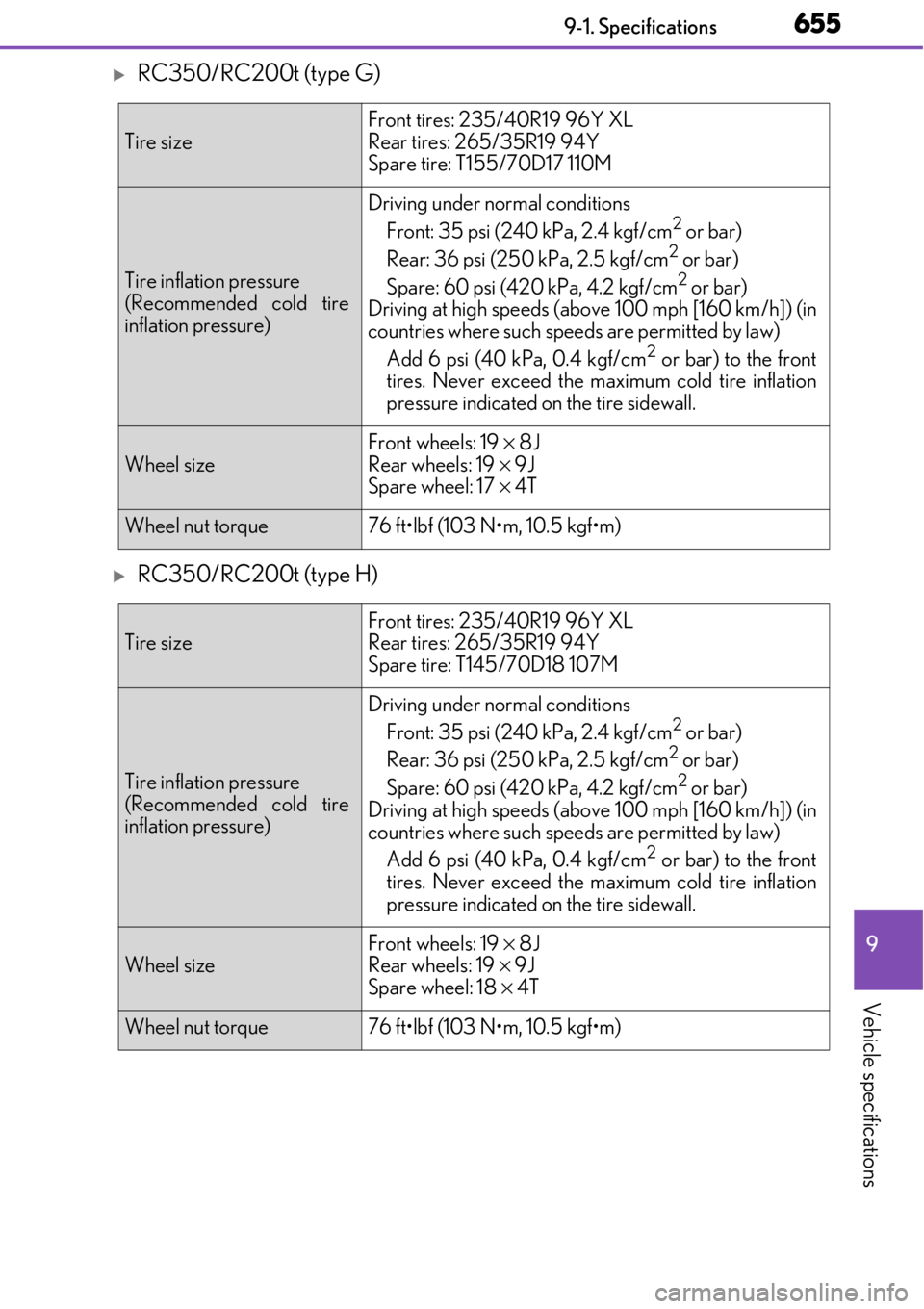
RC350/RC200t (type G)
RC350/RC200t (type H)
Tire size
Front tires: 235/40R19 96Y XL
Rear tires: 265/35R19 94Y
Spare tire: T155/70D17 110M
Tire inflation pressure
(Recommended cold tire
inflation pressure)
Driving under normal conditionsFront: 35 psi (240 kPa, 2.4 kgf/cm2 or bar)
Rear: 36 psi (250 kPa, 2.5 kgf/cm2 or bar)
Spare: 60 psi (420 kPa, 4.2 kgf/cm2 or bar)
Driving at high speeds (above 100 mph [160 km/h]) (in
countries where such speeds are permitted by law)
Add 6 psi (40 kPa, 0.4 kgf/cm
2 or bar) to the front
tires. Never exceed the maximum cold tire inflation
pressure indicated on the tire sidewall.
Wheel sizeFront wheels: 19 × 8J
Rear wheels: 19 × 9J
Spare wheel: 17 × 4T
Wheel nut torque76 ft•lbf (103 N•m, 10.5 kgf•m)
Tire sizeFront tires: 235/40R19 96Y XL
Rear tires: 265/35R19 94Y
Spare tire: T145/70D18 107M
Tire inflation pressure
(Recommended cold tire
inflation pressure)
Driving under normal conditions
Front: 35 psi (240 kPa, 2.4 kgf/cm2 or bar)
Rear: 36 psi (250 kPa, 2.5 kgf/cm2 or bar)
Spare: 60 psi (420 kPa, 4.2 kgf/cm2 or bar)
Driving at high speeds (above 100 mph [160 km/h]) (in
countries where such speeds are permitted by law)
Add 6 psi (40 kPa, 0.4 kgf/cm
2 or bar) to the front
tires. Never exceed the maximum cold tire inflation
pressure indicated on the tire sidewall.
Wheel size
Front wheels: 19 × 8J
Rear wheels: 19 × 9J
Spare wheel: 18 × 4T
Wheel nut torque76 ft•lbf (103 N•m, 10.5 kgf•m)
Page 656 of 724
6569-1. Specifications
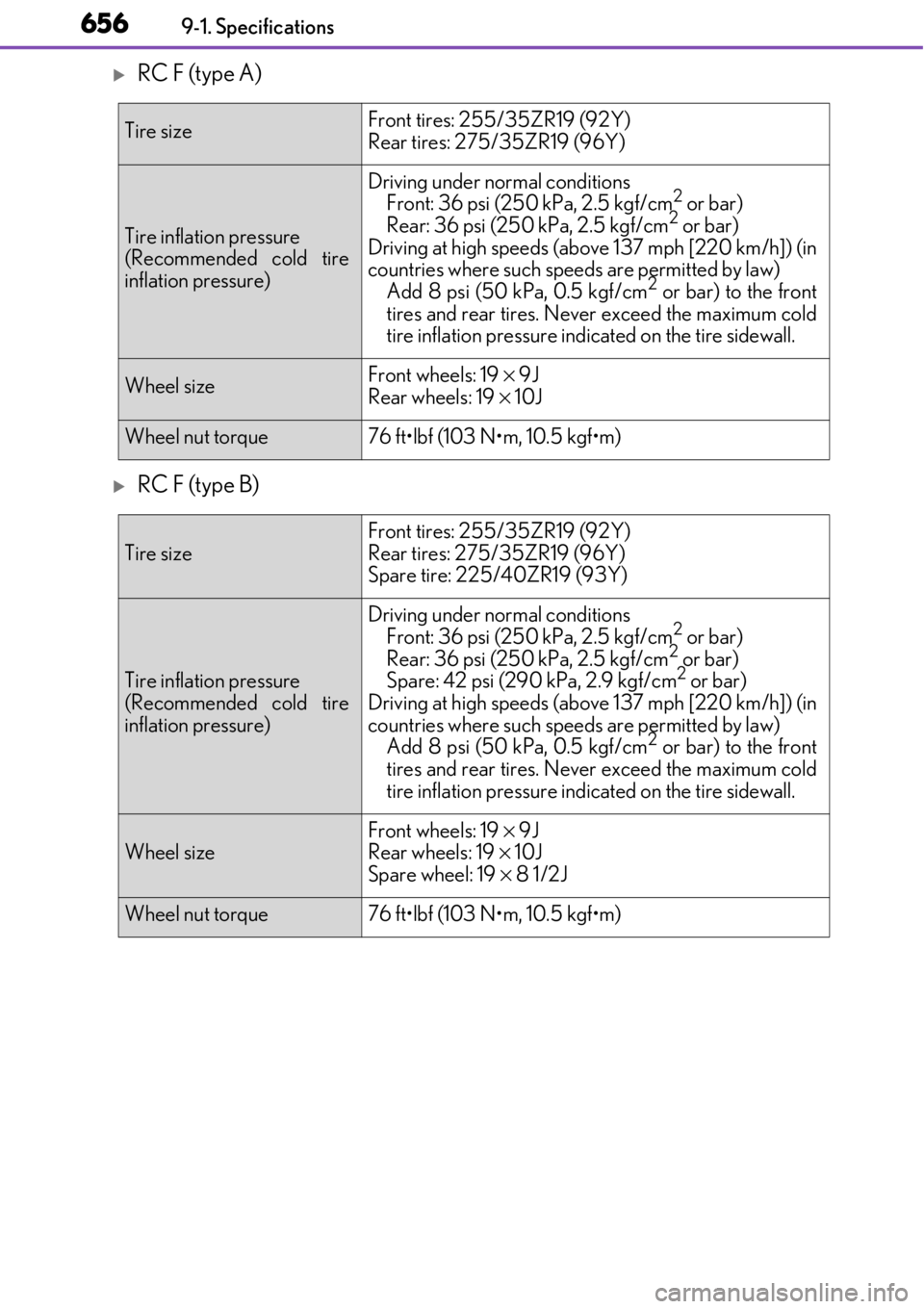
RC F (type A)
RC F (type B)
Tire sizeFront tires: 255/35ZR19 (92Y)
Rear tires: 275/35ZR19 (96Y)
Tire inflation pressure
(Recommended cold tire
inflation pressure)
Driving under normal conditionsFront: 36 psi (250 kPa, 2.5 kgf/cm2 or bar)
Rear: 36 psi (250 kPa, 2.5 kgf/cm2 or bar)
Driving at high speeds (above 137 mph [220 km/h]) (in
countries where such speeds are permitted by law) Add 8 psi (50 kPa, 0.5 kgf/cm
2 or bar) to the front
tires and rear tires. Never exceed the maximum cold
tire inflation pressure indi cated on the tire sidewall.
Wheel sizeFront wheels: 19 × 9J
Rear wheels: 19 × 10J
Wheel nut torque76 ft•lbf (103 N•m, 10.5 kgf•m)
Tire size
Front tires: 255/35ZR19 (92Y)
Rear tires: 275/35ZR19 (96Y)
Spare tire: 225/40ZR19 (93Y)
Tire inflation pressure
(Recommended cold tire
inflation pressure)
Driving under normal conditions
Front: 36 psi (250 kPa, 2.5 kgf/cm2 or bar)
Rear: 36 psi (250 kPa, 2.5 kgf/cm2 or bar)
Spare: 42 psi (290 kPa, 2.9 kgf/cm2 or bar)
Driving at high speeds (above 137 mph [220 km/h]) (in
countries where such speeds are permitted by law) Add 8 psi (50 kPa, 0.5 kgf/cm
2 or bar) to the front
tires and rear tires. Never exceed the maximum cold
tire inflation pressure indi cated on the tire sidewall.
Wheel sizeFront wheels: 19 × 9J
Rear wheels: 19 × 10J
Spare wheel: 19 × 8 1/2J
Wheel nut torque76 ft•lbf (103 N•m, 10.5 kgf•m)