seats LEXUS RC300 2017 User Guide
[x] Cancel search | Manufacturer: LEXUS, Model Year: 2017, Model line: RC300, Model: LEXUS RC300 2017Pages: 724, PDF Size: 15.76 MB
Page 56 of 724

561-1. For safe use
WARNING
■Front passenger occupant classification system precautions
●Do not recline the front passenger seatback so far that it touches a rear seat. This may
cause the “AIR BAG OFF” indicator light to be illuminated, which indicates that the
SRS airbags for th e front passenger will no t activate in the event of a severe accident.
If the seatback touches the rear seat, return the seatback to a position where it does
not touch the rear seat. Keep the front passenger seatback as upright as possible
when the vehicle is moving. Reclining the seatback excessively may lessen the effec-
tiveness of the seat belt system.
●If an adult sits in the fron t passenger seat, the “AIR BAG ON” indicator light is illumi-
nated. If the “AIR BAG OFF” indicator is illuminated, ask the passenger to sit up
straight, well back in the seat, feet on the floor, and with the seat belt worn correctly. If
the “AIR BAG OFF” indicator still remain s illuminated, either ask the passenger to
move to the rear seat, or if that is not possible, move the front passenger seat fully
rearward.
●When it is unavoidable to in stall a forward-facing child re straint system on the front
passenger seat, install the ch ild restraint system on the front passenger seat in the
proper order. ( →P. 60)
●Do not modify or remove the front seats.
●Do not kick the front passenger seat or subject it to severe impact. Otherwise, the
SRS warning light may come on to indica te a malfunction of the front passenger
occupant classification system. In this cas e, contact your Lexus dealer immediately.
●Child restraint systems installed on the rear se at should not contact the front seat-
backs.
●Do not use a seat accessory, such as a cushion and seat cover, that covers the seat
cushion surface.
●Do not modify or replace the upholstery of the front seat.
●Do not place anything between the cons ole box and front passenger seat. Other-
wise, the system may not de tect the front passenger properly, leading to improper
operation of the airbags.
●Adjust the front passenger seat so that the head restraint does not touch the ceiling. If
the head restraint is left in contact with the ceiling, the system may not detect the front
passenger properly, leading to improper operation of the airbags.
Page 57 of 724

571-1. For safe use
1
For safety and security
●It is recommended that children sit in the rear seats to avoid accidental con-
tact with the shift lever, wiper switch, etc.
●Use the window lock switch to avoid children operating the power window
accidentally.
●Do not let small children operate equipment which may catch or pinch body
parts, such as the power window, hood, trunk, seats etc.
Safety information for children
Observe the following precautions wh en children are in the vehicle.
Use a child restraint system appropriate for the child, until the child becomes
large enough to properly wear the vehicle’s seat belt.
WARNING
Never leave children unattended in the vehicl e, and never allow children to have or use
the key.
Children may be able to start the vehicle or sh ift the vehicle into neutral. There is also a
danger that children may injure themselves by playing with the windows, the moon roof
or other features of the vehi cle. In addition, heat build-up or extremely cold tempera-
tures inside the vehicle can be fatal to children.
Page 71 of 724
711-1. For safe use
1
For safety and security
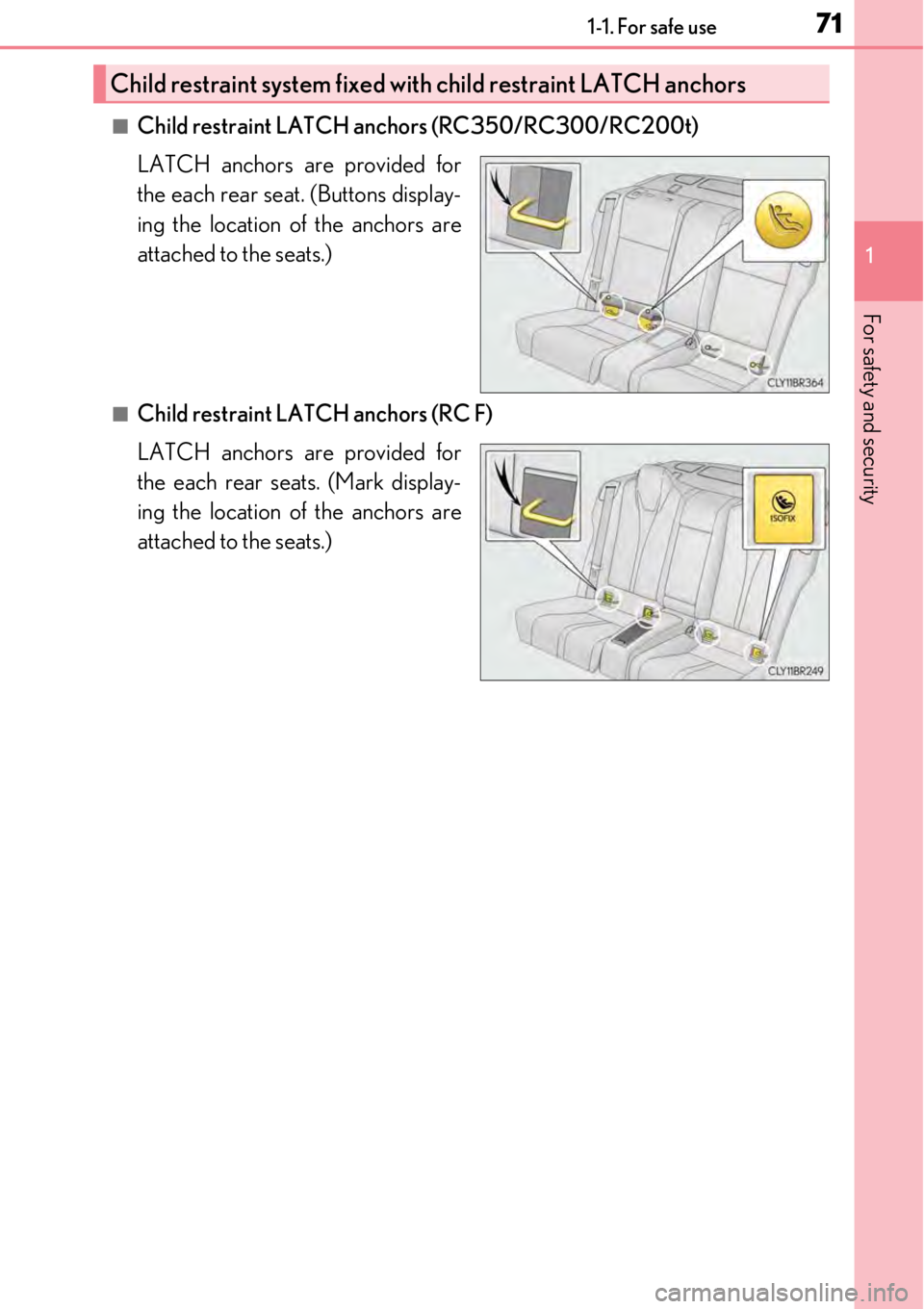
■Child restraint LATCH anchors (RC350/RC300/RC200t)
LATCH anchors are provided for
the each rear seat. (Buttons display-
ing the location of the anchors are
attached to the seats.)
■Child restraint LATCH anchors (RC F)
LATCH anchors are provided for
the each rear seats. (Mark display-
ing the location of the anchors are
attached to the seats.)
Child restraint system fixed with child restraint LATCH anchors
Page 135 of 724

135
Operation of
each component
3
3-1. Key information
Keys .................................................. 136
3-2. Opening, closing and locking the doors and trunk
Doors ................................................. 141
Trunk .................................................147
Smart access system with push-button start ...................... 152
3-3. Adjusting the seats Front seats...................................... 164
Rear seats........................................167
Driving position memory ......... 169
Head restraints .............................173
3-4. Adjusting the steering wheel and mirrors
Steering wheel ..............................176
Inside rear view mirror ............. 178
Outside rear view mirrors....... 180
3-5. Opening, closing the windows and moon roof
Power windows ........................... 183
Moon roof ...................................... 187
Page 164 of 724
1643-3. Adjusting the seats
■Before entering/exiting the rear seats
Remove the seat belt from the seat belt guide. (→P. 35)
■Entering/exiting the rear seat
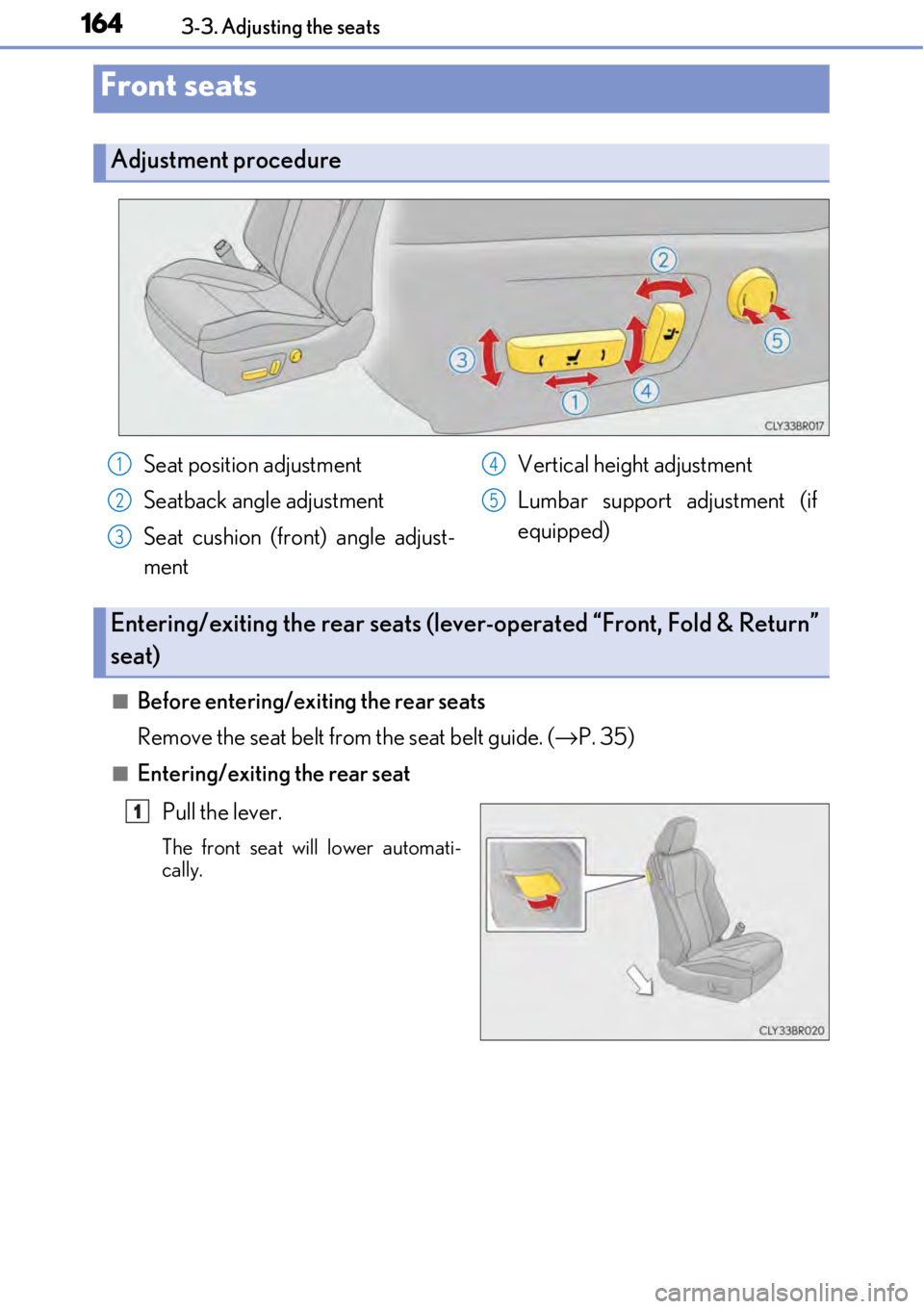
Pull the lever.
The front seat will lower automati-
cally.
Front seats
Adjustment procedure
Seat position adjustment
Seatback angle adjustment
Seat cushion (front) angle adjust-
ment Vertical height adjustment
Lumbar support adjustment (if
equipped)
Entering/exiting the rear seats (lever-operated “Front, Fold & Retur\
n”
seat)
1
2
3
4
5
1
Page 165 of 724
1653-3. Adjusting the seats
3
Operation of each component
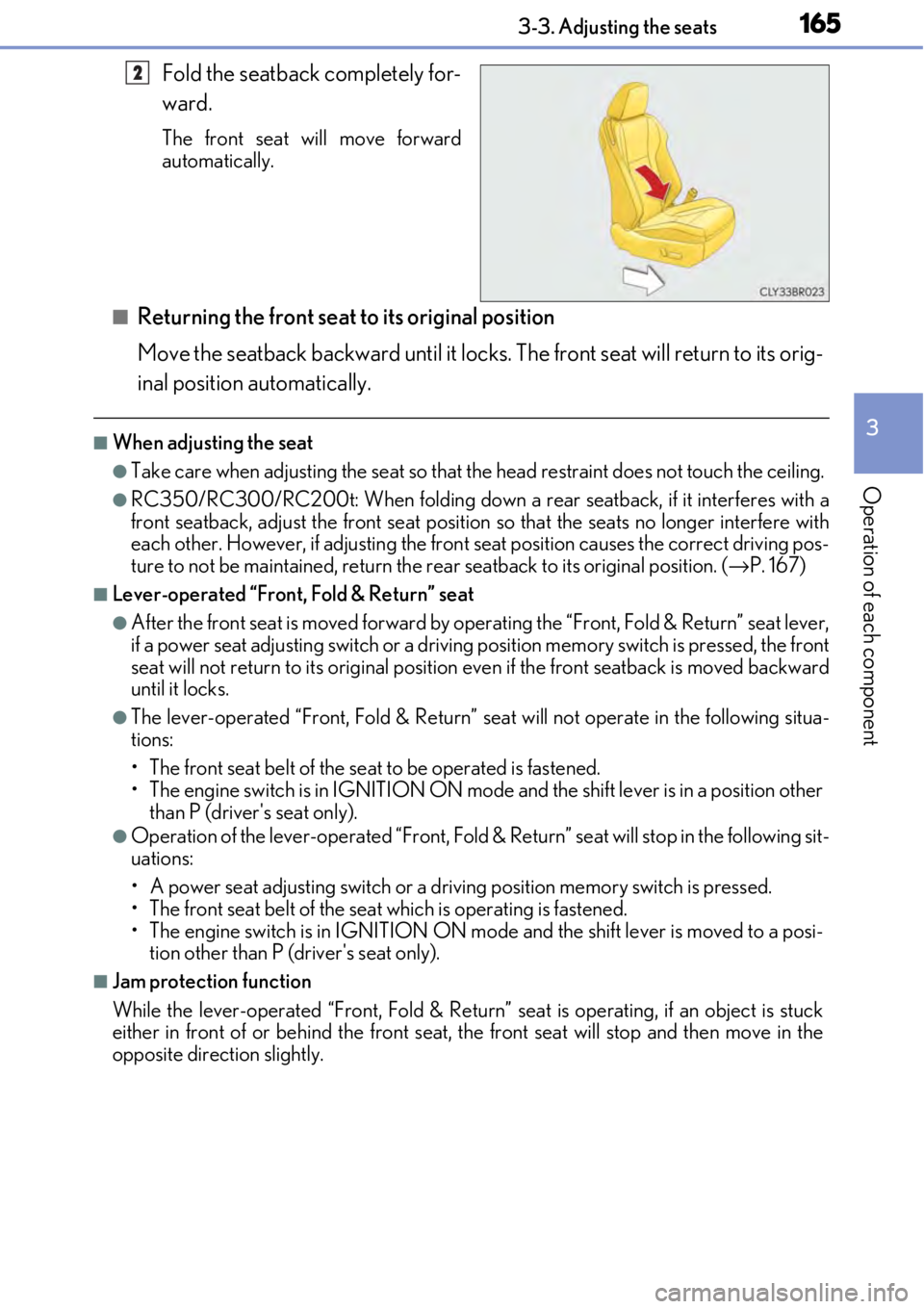
Fold the seatback completely for-
ward.
The front seat will move forward
automatically.
■Returning the front seat to its original position
Move the seatback backward until it locks. The front seat will return to its orig-
inal position automatically.
■When adjusting the seat
●Take care when adjusting the seat so that the head restraint does not touch the ceiling.
●RC350/RC300/RC200t: When folding down a rear seatback, if it interferes with a
front seatback, adjust the front seat position so that the seats no longer interfere with
each other. However, if adjusting the front seat position causes the correct driving pos-
ture to not be maintained, return the rear seatback to its original position. ( →P. 167)
■Lever-operated “Front, Fold & Return” seat
●After the front seat is moved forward by oper ating the “Front, Fold & Return” seat lever,
if a power seat adjustin g switch or a driving position memo ry switch is pressed, the front
seat will not return to its original position even if the front seatback is moved backward
until it locks.
●The lever-operated “Front, Fold & Return” seat will not operate in the following situa-
tions:
• The front seat belt of the seat to be operated is fastened.
• The engine switch is in IGNITION ON mode and the shift lever is in a position other
than P (driver's seat only).
●Operation of the lever-operated “Front, Fold & Return” seat will stop in the following sit-
uations:
• A power seat adjusting switch or a driv ing position memory switch is pressed.
• The front seat belt of the seat which is operating is fastened.
• The engine switch is in IGNITION ON mo de and the shift lever is moved to a posi-
tion other than P (driver's seat only).
■Jam protection function
While the lever-operated “Front, Fold & Return” seat is operating, if an object is stuck
either in front of or behind the front seat, the front seat will stop and then move in the
opposite direction slightly.
2
Page 166 of 724
1663-3. Adjusting the seats
WARNING
■When adjusting the seat position
●Take care when adjusting the seat position to ensure that other passengers are not
injured by the moving seat.
●Do not put your hands under the seat or near the moving parts to avoid injury.
Fingers or hands may become jammed in the seat mechanism.
●Make sure to leave enough space around the feet so they do not get stuck.
■Seat adjustment
To reduce the risk of sliding under the lap be lt during a collision, do not recline the seat
more than necessary.
If the seat is too reclined, the lap belt may slide past the hips and apply restraint forces
directly to the abdomen, or your neck may contact the shou lder belt, increasing the risk
of death or serious injury in the event of an accident.
Adjustments should not be made while drivin g as the seat may unexpectedly move and
cause the driver to lose control of the vehicle.
■Lever-operated “Front, Fold & Return” seat
●Before operating the lever-operated “Front, Fold & Return” seat, ensure that any sur-
rounding passengers or objects will not contact the seat.
●Make sure the seatback is locked securely before driving.
●Never operate the lever-operated “Front, Fold & Return” seat while the vehicle is
moving.
■Jam protection function
Do not use a hand, foot, or an y other part of your body to intentionally activate the jam
protection function.
Page 167 of 724
1673-3. Adjusting the seats
3
Operation of each component
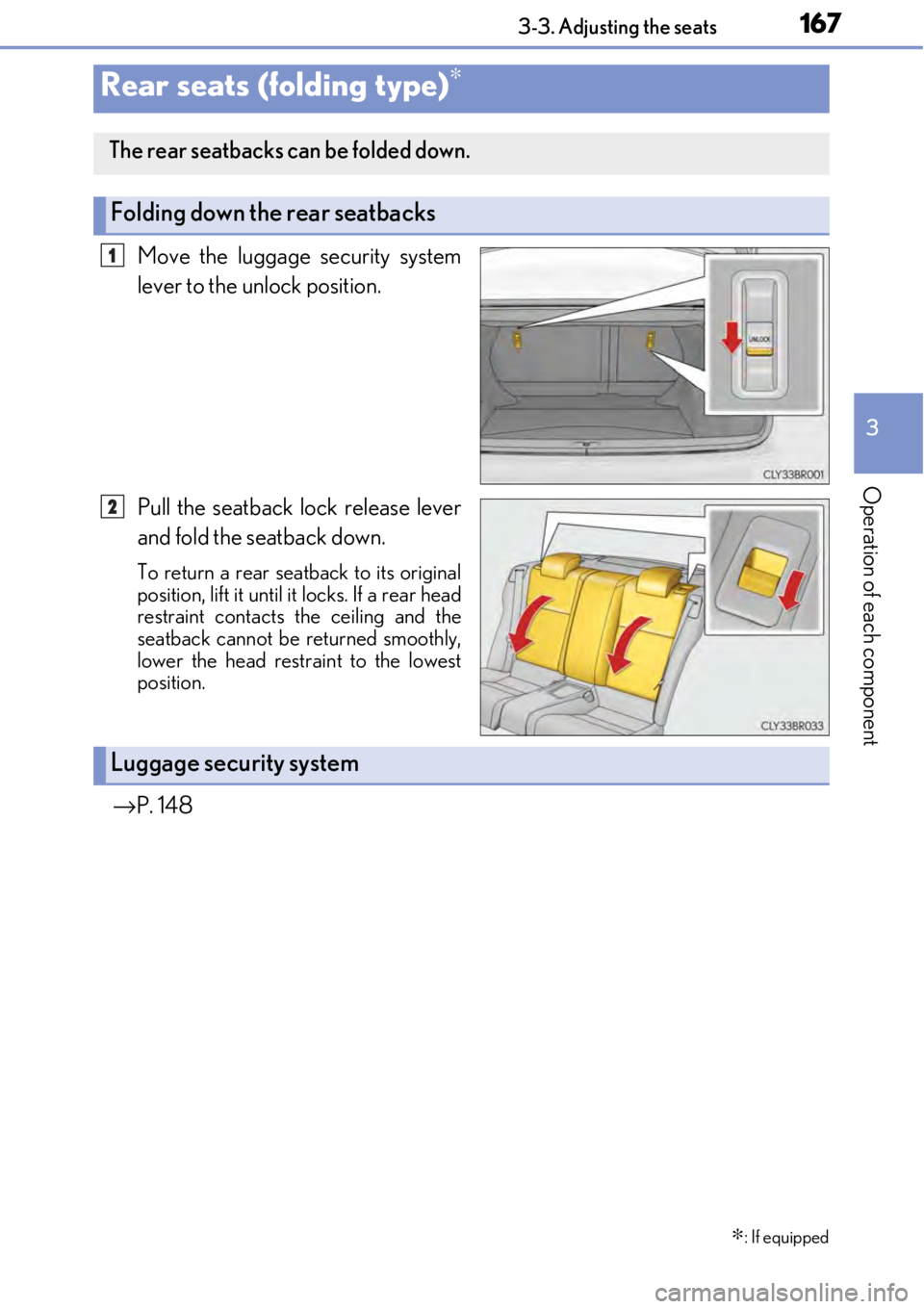
Move the luggage security system
lever to the unlock position.
Pull the seatback lock release lever
and fold the seatback down.
To return a rear seatback to its original
position, lift it until it locks. If a rear head
restraint contacts the ceiling and the
seatback cannot be returned smoothly,
lower the head rest raint to the lowest
position.
→ P. 148
Rear seats (folding type)∗
∗
: If equipped
The rear seatbacks can be folded down.
Folding down the rear seatbacks
1
2
Luggage security system
Page 168 of 724
1683-3. Adjusting the seats
WARNING
Observe the following precautions. Failure to do so may result in death or serious injury.
■When folding the rear seatbacks down
●Do not fold the seatbacks down while driving.
●Stop the vehicle on level ground, set the pa rking brake and shift the shift lever to P.
●Do not allow anyone to sit on a folded seatback or in the trunk while driving.
●Do not allow children to enter the trunk.
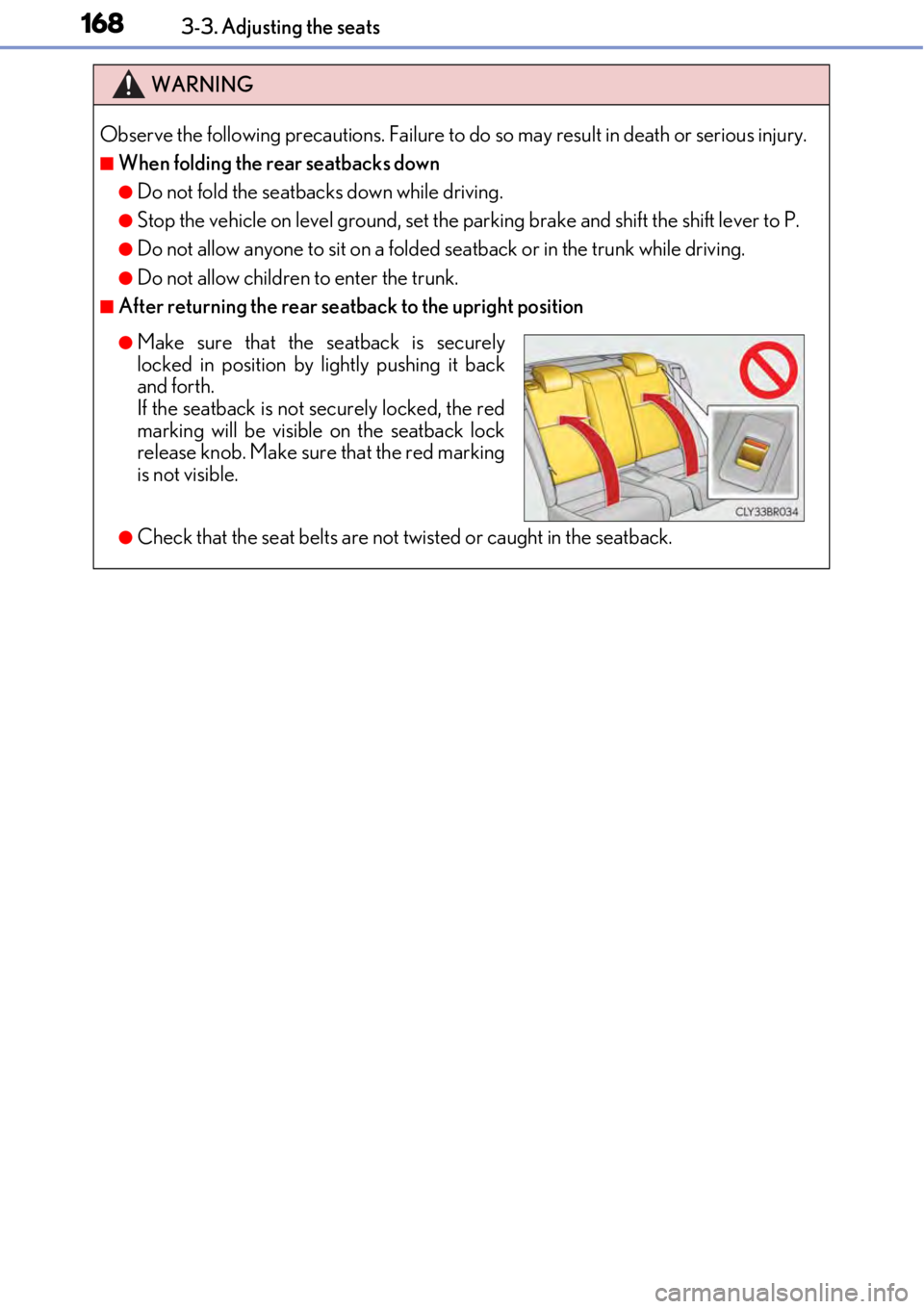
■After returning the rear seatback to the upright position
●Check that the seat belts are not twisted or caught in the seatback.
●Make sure that the seatback is securely
locked in position by lightly pushing it back
and forth.
If the seatback is not securely locked, the red
marking will be visible on the seatback lock
release knob. Make sure that the red marking
is not visible.
Page 169 of 724
1693-3. Adjusting the seats
3
Operation of each component
Your preferred driving position (the position of the driver's seat, steering wheel
and outside rear view mirrors) can be recorded and recalled by pressing a but-
ton.
Three different driving positions can be recorded into memory.
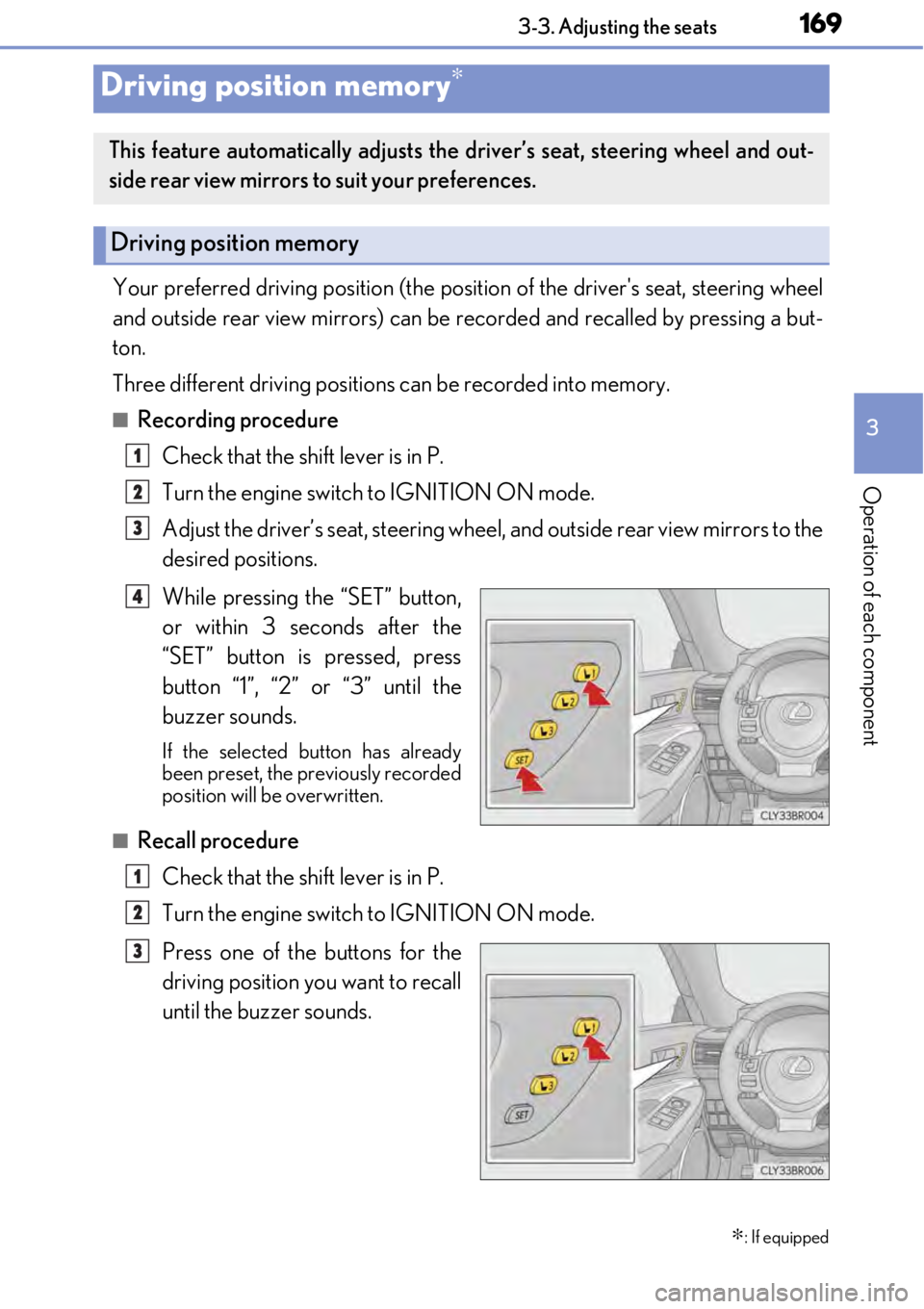
■Recording procedure
Check that the shift lever is in P.
Turn the engine switch to IGNITION ON mode.
Adjust the driver’s seat, steering wheel, and outside rear view mirrors to the
desired positions.
While pressing the “SET” button,
or within 3 seconds after the
“SET” button is pressed, press
button “1”, “2” or “3” until the
buzzer sounds.
If the selected button has already
been preset, the previously recorded
position will be overwritten.
■Recall procedureCheck that the shift lever is in P.
Turn the engine switch to IGNITION ON mode.
Press one of the buttons for the
driving position you want to recall
until the buzzer sounds.
Driving position memory∗
∗
: If equipped
This feature automatically adjusts the driver’s seat, steering wheel and out-
side rear view mirrors to suit your preferences.
Driving position memory
1
2
3
4
1
2
3