torque LEXUS RC300 2017 User Guide
[x] Cancel search | Manufacturer: LEXUS, Model Year: 2017, Model line: RC300, Model: LEXUS RC300 2017Pages: 724, PDF Size: 15.76 MB
Page 500 of 724
![LEXUS RC300 2017 User Guide 5007-3. Do-it-yourself maintenance
RC F (vehicles with TVD [Torque Vectoring Differential])
*: Do not place the floor jack under either torque transfer module.
Torque transfer modules*
Jack point](/img/36/58019/w960_58019-499.png "LEXUS RC300 2017 User Guide 5007-3. Do-it-yourself maintenance
RC F (vehicles with TVD [Torque Vectoring Differential])
*: Do not place the floor jack under either torque transfer module.
Torque transfer modules*
Jack point")
5007-3. Do-it-yourself maintenance
RC F (vehicles with TVD [Torque Vectoring Differential])
*: Do not place the floor jack under either torque transfer module.
Torque transfer modules*
Jack point
Page 580 of 724
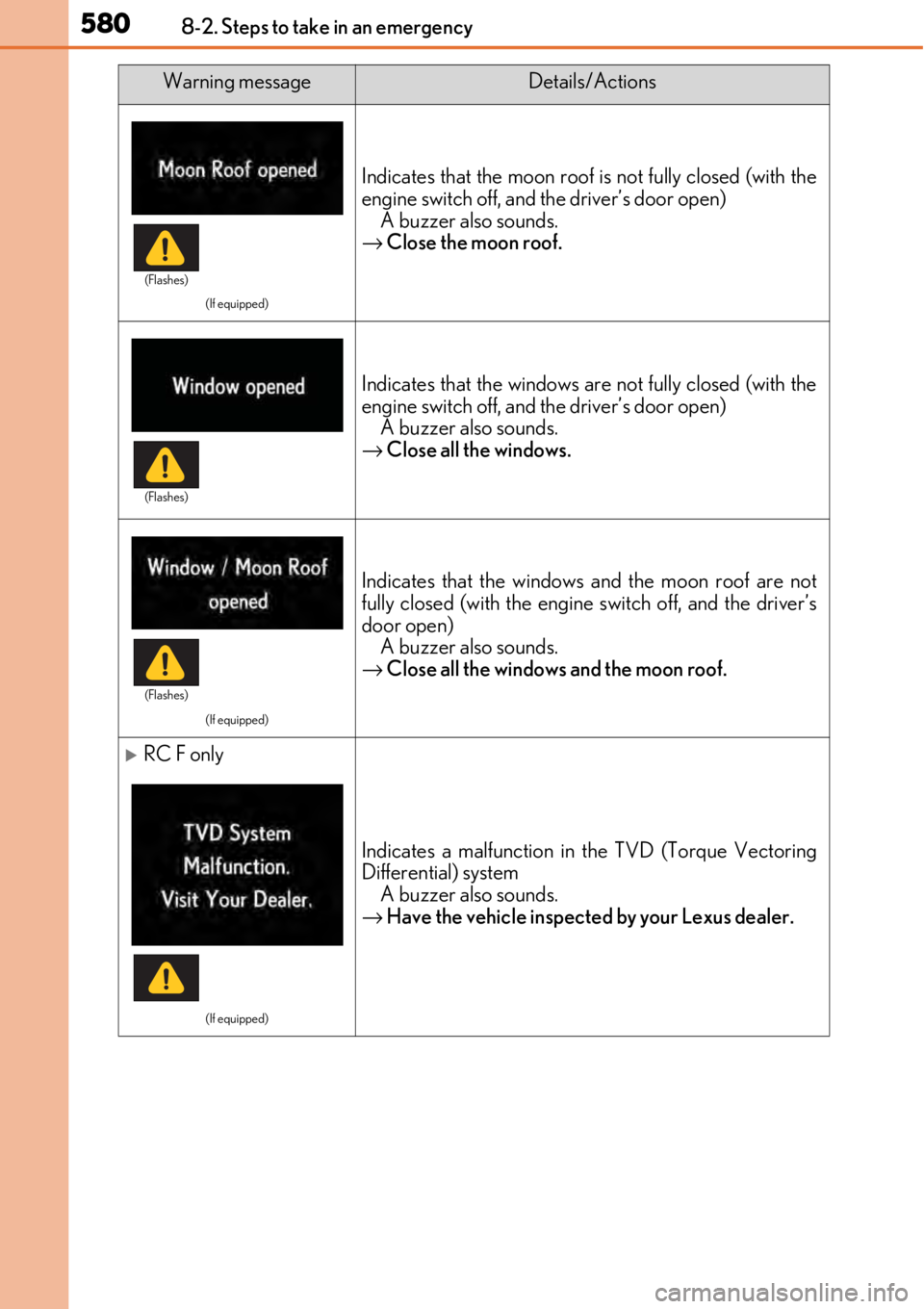
5808-2. Steps to take in an emergency
(If equipped)
Indicates that the moon roof is not fully closed (with the
engine switch off, and the driver’s door open)A buzzer also sounds.
→ Close the moon roof.
Indicates that the windows are not fully closed (with the
engine switch off, and the driver’s door open)
A buzzer also sounds.
→ Close all the windows.
(If equipped)
Indicates that the windows and the moon roof are not
fully closed (with the engine switch off, and the driver’s
door open)
A buzzer also sounds.
→ Close all the windows and the moon roof.
RC F only
(If equipped)
Indicates a malfunction in the TVD (Torque Vectoring
Differential) system
A buzzer also sounds.
→ Have the vehicle inspected by your Lexus dealer.
Warning messageDetails/Actions
(Flashes)
(Flashes)
(Flashes)
Page 581 of 724
5818-2. Steps to take in an emergency
8
When trouble arises
RC F only
(If equipped)
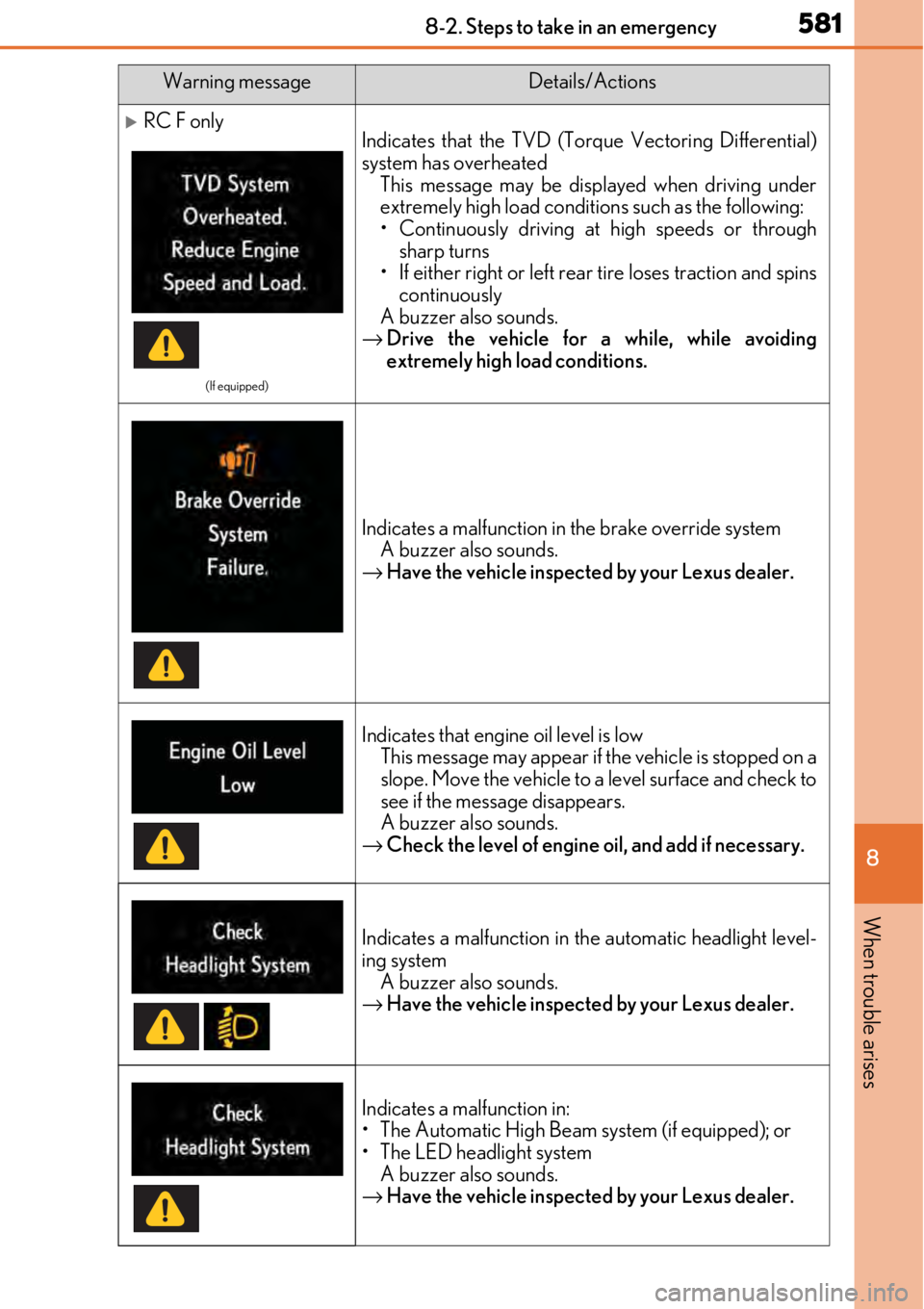
Indicates that the TVD (Torque Vectoring Differential)
system has overheatedThis message may be disp layed when driving under
extremely high load conditions such as the following:
• Continuously driving at high speeds or through
sharp turns
• If either right or left rear tire loses traction and spins
continuously
A buzzer also sounds.
→ Drive the vehicle for a while, while avoiding
extremely high load conditions.
Indicates a malfunction in the brake override system
A buzzer also sounds.
→ Have the vehicle inspected by your Lexus dealer.
Indicates that engine oil level is low
This message may ap pear if the vehicle is stopped on a
slope. Move the vehicle to a level surface and check to
see if the message disappears.
A buzzer also sounds.
→ Check the level of engine oil, and add if necessary.
Indicates a malfunction in th e automatic headlight level-
ing system
A buzzer also sounds.
→ Have the vehicle inspected by your Lexus dealer.
Indicates a malfunction in:
• The Automatic High Beam system (if equipped); or
• The LED headlight system
A buzzer also sounds.
→ Have the vehicle inspected by your Lexus dealer.
Warning messageDetails/Actions
Page 601 of 724
6018-2. Steps to take in an emergency
8
When trouble arises
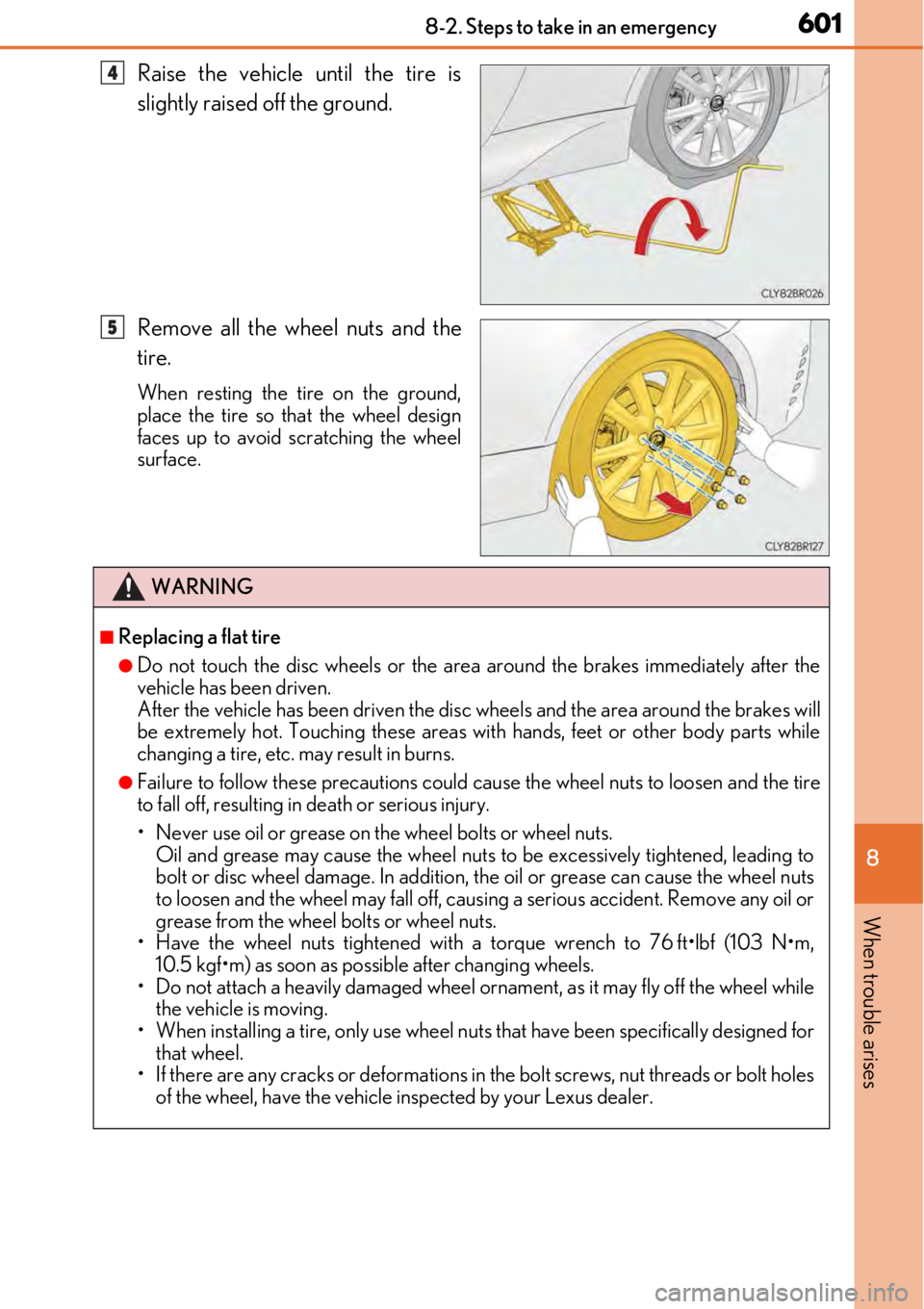
Raise the vehicle until the tire is
slightly raised off the ground.
Remove all the wheel nuts and the
tire.
When resting the tire on the ground,
place the tire so that the wheel design
faces up to avoid scratching the wheel
surface.
4
5
WARNING
■Replacing a flat tire
●Do not touch the disc wheels or the area around the brakes immediately after the
vehicle has been driven.
After the vehicle has been driven the disc wheels and the area around the brakes will
be extremely hot. Touching these areas with hands, feet or other body parts while
changing a tire, etc. may result in burns.
●Failure to follow these precautions could cau se the wheel nuts to loosen and the tire
to fall off, resulting in death or serious injury.
• Never use oil or grease on the wheel bolts or wheel nuts. Oil and grease may cause the wheel nuts to be excessively tightened, leading to
bolt or disc wheel damage. In addition, the oil or grease can cause the wheel nuts
to loosen and the wheel may fall off, causing a serious accident. Remove any oil or
grease from the wheel bolts or wheel nuts.
• Have the wheel nuts tightened with a torque wrench to 76 ft•lbf (103 N•m,
10.5 kgf•m) as soon as possible after changing wheels.
• Do not attach a heavily damaged wheel or nament, as it may fly off the wheel while
the vehicle is moving.
• When installing a tire, only use wheel nuts that have been specifically designed for
that wheel.
• If there are any cracks or deformations in the bolt screws, nut threads or bolt holes
of the wheel, have the vehicle inspected by your Lexus dealer.
Page 603 of 724
6038-2. Steps to take in an emergency
8
When trouble arises
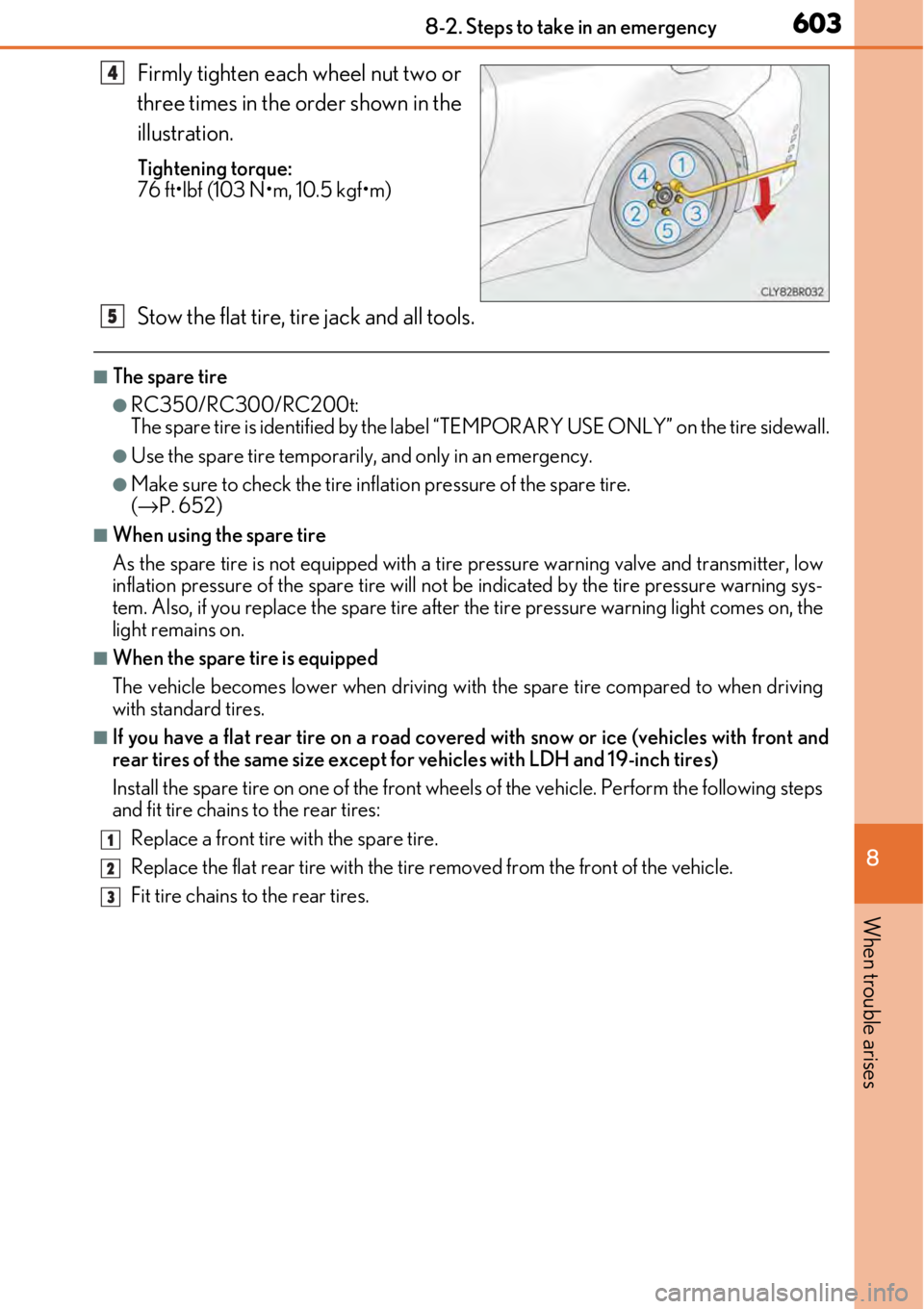
Firmly tighten each wheel nut two or
three times in the order shown in the
illustration.
Tightening torque:
76 ft•lbf (103 N•m, 10.5 kgf•m)
Stow the flat tire, tire jack and all tools.
■The spare tire
●RC350/RC300/RC200t:
The spare tire is identified by the label “TEMPORARY USE ONLY” on the tire sidewall.
●Use the spare tire temporarily, and only in an emergency.
●Make sure to check the tire inflation pressure of the spare tire.
(→ P. 652)
■When using the spare tire
As the spare tire is not equipped with a tire pressure warning valve and transmitter, low
inflation pressure of the spare tire will not be indicated by the tire pressure warning sys-
tem. Also, if you replace the spare tire after the tire pressure warning light comes on, the
light remains on.
■When the spare tire is equipped
The vehicle becomes lower when driving with the spare tire compared to when driving
with standard tires.
■If you have a flat rear tire on a road covered with snow or ice (vehicles with front and
rear tires of the same size except fo r vehicles with LDH and 19-inch tires)
Install the spare tire on one of the front whee ls of the vehicle. Perform the following steps
and fit tire chains to the rear tires:
Replace a front tire with the spare tire.
Replace the flat rear tire with the tire removed from the front of the vehicle.
Fit tire chains to the rear tires.
4
5
1
2
3
Page 650 of 724
![LEXUS RC300 2017 User Guide 6509-1. Specifications
RC350/RC300/RC200t (vehicles without LSD [Limited Slip Differential])
RC350/RC200t/RC F (vehicles with LSD [Limited Slip Differential])
RC F (vehicles with TVD [Torque](/img/36/58019/w960_58019-649.png "LEXUS RC300 2017 User Guide 6509-1. Specifications
RC350/RC300/RC200t (vehicles without LSD [Limited Slip Differential])
RC350/RC200t/RC F (vehicles with LSD [Limited Slip Differential])
RC F (vehicles with TVD [Torque")
6509-1. Specifications
RC350/RC300/RC200t (vehicles without LSD [Limited Slip Differential])
RC350/RC200t/RC F (vehicles with LSD [Limited Slip Differential])
RC F (vehicles with TVD [Torque Vectoring Differential])
*1: Your Lexus vehicle is filled with “Toyota Genuine Differential Gear Oil” at the factory.
Use Lexus approved “Toyota Genuine Differ ential Gear Oil” or an equivalent of
matching quality to satisfy the above specification. Please contact your Lexus dealer
for further details.
*2: Torque transfer modules are located on the ri ght and left sides of the rear differential
unit.
*3: Using torque transfer module fluid other than “Toyota Genuine ATF WS” may cause deterioration of performance, vibration, or ultimately damage the TVD system of your
vehicle.
Rear differential
Oil capacity1.42 qt. (1.35 L, 1.19 Imp. qt.)
Oil type and viscosityToyota Genuine Differential gear oil LT
75W-85 GL-5 or equivalent
*1
Oil capacity1.42 qt. (1.35 L, 1.19 Imp. qt.)
Oil type and viscosityToyota Genuine Differential gear oil LX
75W-85 GL-5 or equivalent*1
DifferentialTorque transfer module*2
Oil capacity1.42 qt. (1.35 L, 1.19 Imp. qt.)
Left-hand side:
0.74 qt. (0.70 L, 0.62 Imp. qt.)
Right-hand side:
0.74 qt. (0.70 L, 0.62 Imp. qt.)
Oil type and viscos-
ity
Toyota Genuine Differential
gear oil LT
75W-85 GL-5 or equiva-
lent
*1
Toyota Genuine ATF WS*3
Page 652 of 724
6529-1. Specifications
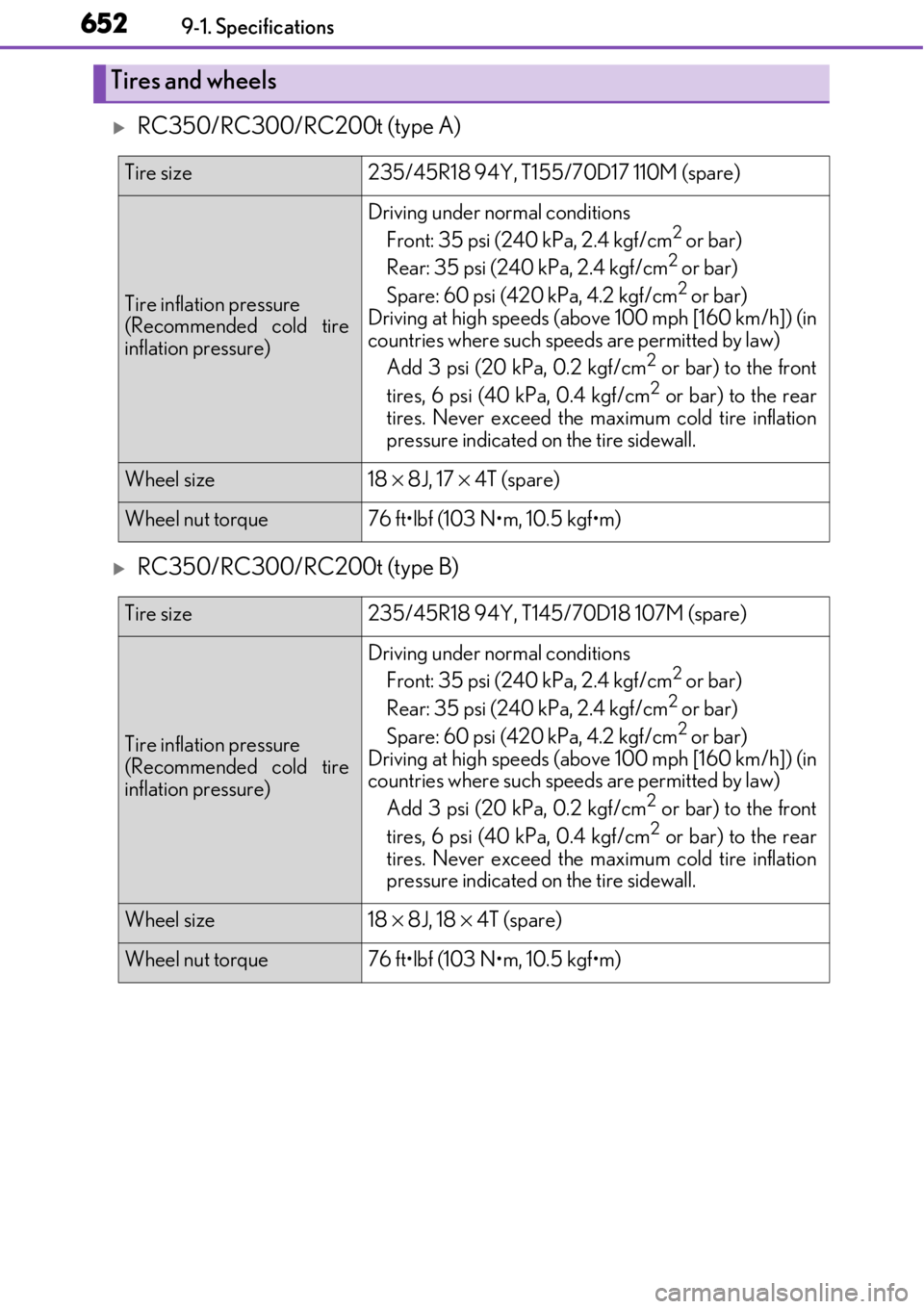
RC350/RC300/RC200t (type A)
RC350/RC300/RC200t (type B)
Tires and wheels
Tire size235/45R18 94Y, T155/70D17 110M (spare)
Tire inflation pressure
(Recommended cold tire
inflation pressure)
Driving under normal conditionsFront: 35 psi (240 kPa, 2.4 kgf/cm2 or bar)
Rear: 35 psi (240 kPa, 2.4 kgf/cm2 or bar)
Spare: 60 psi (420 kPa, 4.2 kgf/cm2 or bar)
Driving at high speeds (above 100 mph [160 km/h]) (in
countries where such speeds are permitted by law)
Add 3 psi (20 kPa, 0.2 kgf/cm
2 or bar) to the front
tires, 6 psi (40 kPa, 0.4 kgf/cm2 or bar) to the rear
tires. Never exceed the maximum cold tire inflation
pressure indicated on the tire sidewall.
Wheel size18 × 8J, 17 × 4T (spare)
Wheel nut torque76 ft•lbf (103 N•m, 10.5 kgf•m)
Tire size235/45R18 94Y, T145/70D18 107M (spare)
Tire inflation pressure
(Recommended cold tire
inflation pressure)
Driving under normal conditions
Front: 35 psi (240 kPa, 2.4 kgf/cm2 or bar)
Rear: 35 psi (240 kPa, 2.4 kgf/cm2 or bar)
Spare: 60 psi (420 kPa, 4.2 kgf/cm2 or bar)
Driving at high speeds (above 100 mph [160 km/h]) (in
countries where such speeds are permitted by law)
Add 3 psi (20 kPa, 0.2 kgf/cm
2 or bar) to the front
tires, 6 psi (40 kPa, 0.4 kgf/cm2 or bar) to the rear
tires. Never exceed the maximum cold tire inflation
pressure indicated on the tire sidewall.
Wheel size18 × 8J, 18 × 4T (spare)
Wheel nut torque76 ft•lbf (103 N•m, 10.5 kgf•m)
Page 653 of 724
6539-1. Specifications
9
Vehicle specifications
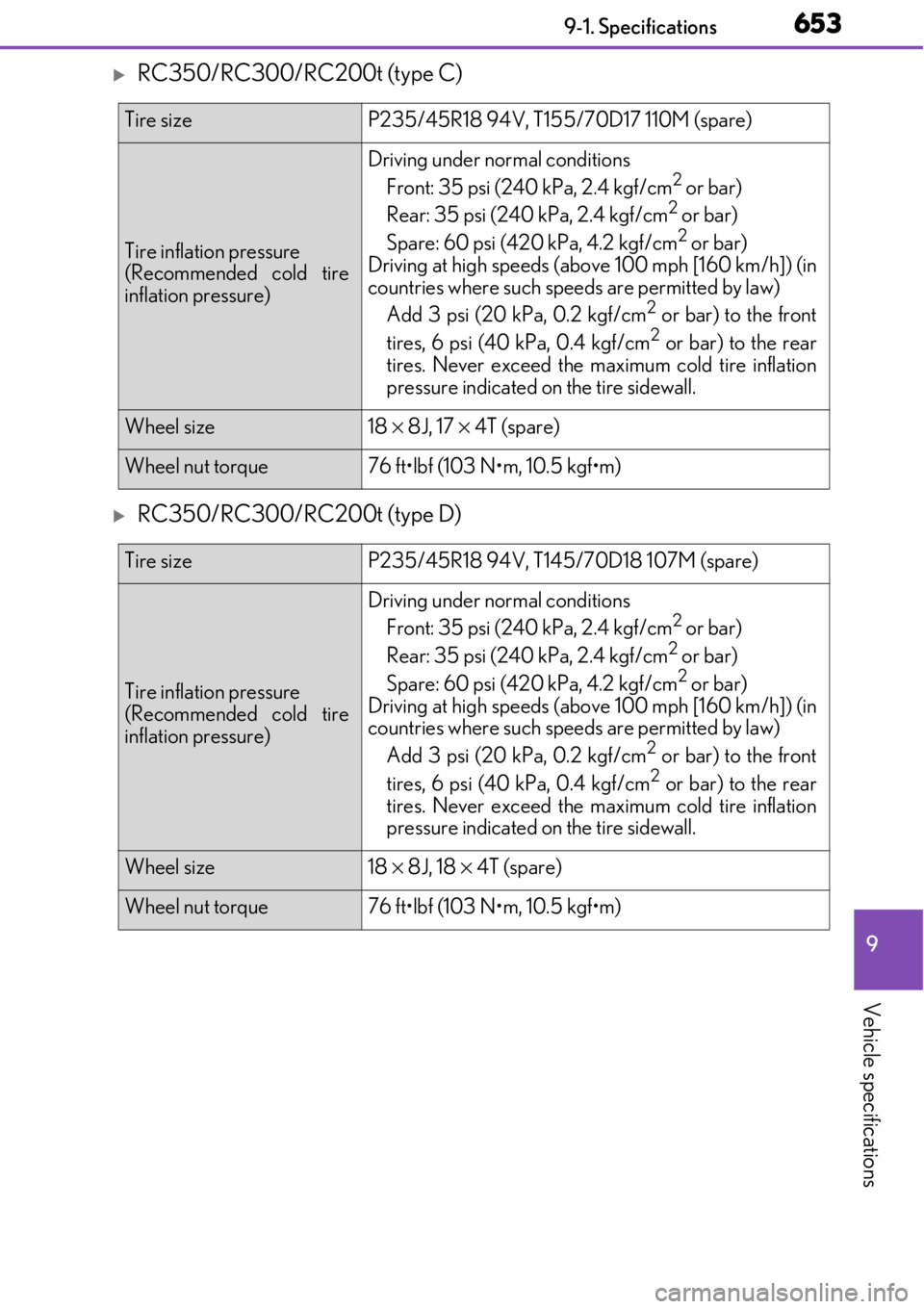
RC350/RC300/RC200t (type C)
RC350/RC300/RC200t (type D)
Tire sizeP235/45R18 94V, T155/70D17 110M (spare)
Tire inflation pressure
(Recommended cold tire
inflation pressure)
Driving under normal conditionsFront: 35 psi (240 kPa, 2.4 kgf/cm2 or bar)
Rear: 35 psi (240 kPa, 2.4 kgf/cm2 or bar)
Spare: 60 psi (420 kPa, 4.2 kgf/cm2 or bar)
Driving at high speeds (above 100 mph [160 km/h]) (in
countries where such speeds are permitted by law)
Add 3 psi (20 kPa, 0.2 kgf/cm
2 or bar) to the front
tires, 6 psi (40 kPa, 0.4 kgf/cm2 or bar) to the rear
tires. Never exceed the maximum cold tire inflation
pressure indicated on the tire sidewall.
Wheel size18 × 8J, 17 × 4T (spare)
Wheel nut torque76 ft•lbf (103 N•m, 10.5 kgf•m)
Tire sizeP235/45R18 94V, T145/70D18 107M (spare)
Tire inflation pressure
(Recommended cold tire
inflation pressure)
Driving under normal conditions
Front: 35 psi (240 kPa, 2.4 kgf/cm2 or bar)
Rear: 35 psi (240 kPa, 2.4 kgf/cm2 or bar)
Spare: 60 psi (420 kPa, 4.2 kgf/cm2 or bar)
Driving at high speeds (above 100 mph [160 km/h]) (in
countries where such speeds are permitted by law)
Add 3 psi (20 kPa, 0.2 kgf/cm
2 or bar) to the front
tires, 6 psi (40 kPa, 0.4 kgf/cm2 or bar) to the rear
tires. Never exceed the maximum cold tire inflation
pressure indicated on the tire sidewall.
Wheel size18 × 8J, 18 × 4T (spare)
Wheel nut torque76 ft•lbf (103 N•m, 10.5 kgf•m)
Page 654 of 724
6549-1. Specifications
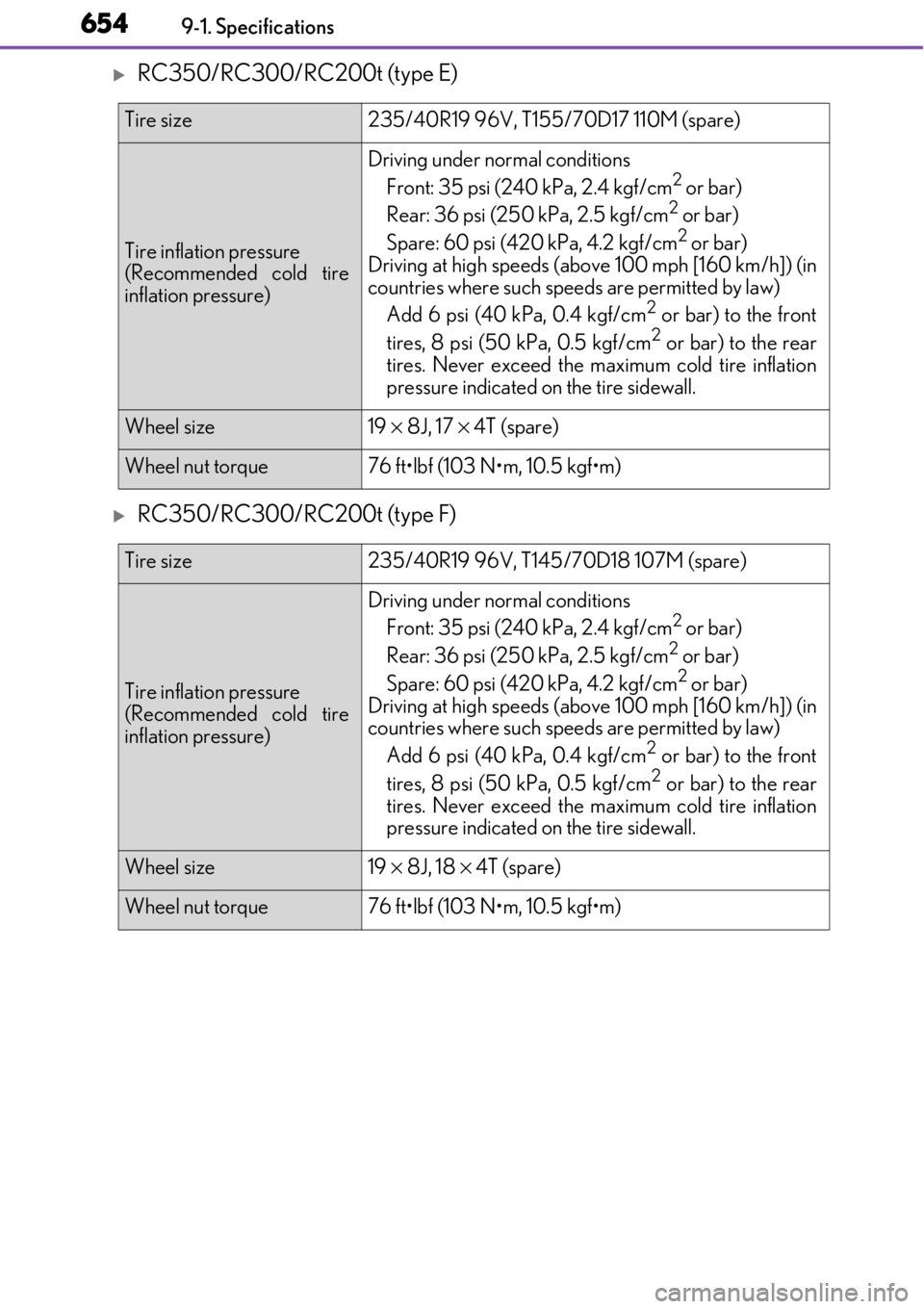
RC350/RC300/RC200t (type E)
RC350/RC300/RC200t (type F)
Tire size235/40R19 96V, T155/70D17 110M (spare)
Tire inflation pressure
(Recommended cold tire
inflation pressure)
Driving under normal conditionsFront: 35 psi (240 kPa, 2.4 kgf/cm2 or bar)
Rear: 36 psi (250 kPa, 2.5 kgf/cm2 or bar)
Spare: 60 psi (420 kPa, 4.2 kgf/cm2 or bar)
Driving at high speeds (above 100 mph [160 km/h]) (in
countries where such speeds are permitted by law)
Add 6 psi (40 kPa, 0.4 kgf/cm
2 or bar) to the front
tires, 8 psi (50 kPa, 0.5 kgf/cm2 or bar) to the rear
tires. Never exceed the maximum cold tire inflation
pressure indicated on the tire sidewall.
Wheel size19 × 8J, 17 × 4T (spare)
Wheel nut torque76 ft•lbf (103 N•m, 10.5 kgf•m)
Tire size235/40R19 96V, T145/70D18 107M (spare)
Tire inflation pressure
(Recommended cold tire
inflation pressure)
Driving under normal conditions
Front: 35 psi (240 kPa, 2.4 kgf/cm2 or bar)
Rear: 36 psi (250 kPa, 2.5 kgf/cm2 or bar)
Spare: 60 psi (420 kPa, 4.2 kgf/cm2 or bar)
Driving at high speeds (above 100 mph [160 km/h]) (in
countries where such speeds are permitted by law)
Add 6 psi (40 kPa, 0.4 kgf/cm
2 or bar) to the front
tires, 8 psi (50 kPa, 0.5 kgf/cm2 or bar) to the rear
tires. Never exceed the maximum cold tire inflation
pressure indicated on the tire sidewall.
Wheel size19 × 8J, 18 × 4T (spare)
Wheel nut torque76 ft•lbf (103 N•m, 10.5 kgf•m)
Page 655 of 724
6559-1. Specifications
9
Vehicle specifications
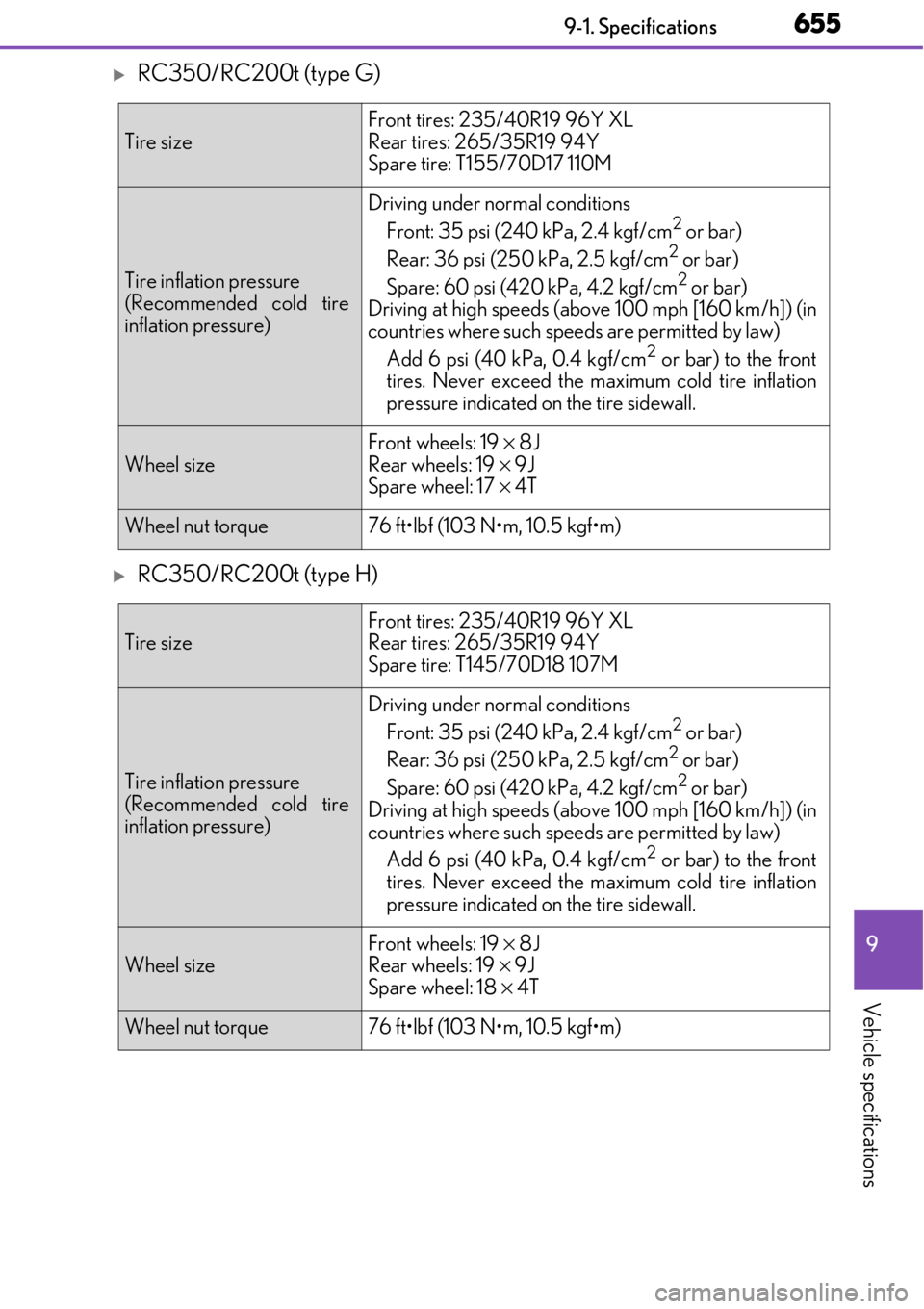
RC350/RC200t (type G)
RC350/RC200t (type H)
Tire size
Front tires: 235/40R19 96Y XL
Rear tires: 265/35R19 94Y
Spare tire: T155/70D17 110M
Tire inflation pressure
(Recommended cold tire
inflation pressure)
Driving under normal conditionsFront: 35 psi (240 kPa, 2.4 kgf/cm2 or bar)
Rear: 36 psi (250 kPa, 2.5 kgf/cm2 or bar)
Spare: 60 psi (420 kPa, 4.2 kgf/cm2 or bar)
Driving at high speeds (above 100 mph [160 km/h]) (in
countries where such speeds are permitted by law)
Add 6 psi (40 kPa, 0.4 kgf/cm
2 or bar) to the front
tires. Never exceed the maximum cold tire inflation
pressure indicated on the tire sidewall.
Wheel sizeFront wheels: 19 × 8J
Rear wheels: 19 × 9J
Spare wheel: 17 × 4T
Wheel nut torque76 ft•lbf (103 N•m, 10.5 kgf•m)
Tire sizeFront tires: 235/40R19 96Y XL
Rear tires: 265/35R19 94Y
Spare tire: T145/70D18 107M
Tire inflation pressure
(Recommended cold tire
inflation pressure)
Driving under normal conditions
Front: 35 psi (240 kPa, 2.4 kgf/cm2 or bar)
Rear: 36 psi (250 kPa, 2.5 kgf/cm2 or bar)
Spare: 60 psi (420 kPa, 4.2 kgf/cm2 or bar)
Driving at high speeds (above 100 mph [160 km/h]) (in
countries where such speeds are permitted by law)
Add 6 psi (40 kPa, 0.4 kgf/cm
2 or bar) to the front
tires. Never exceed the maximum cold tire inflation
pressure indicated on the tire sidewall.
Wheel size
Front wheels: 19 × 8J
Rear wheels: 19 × 9J
Spare wheel: 18 × 4T
Wheel nut torque76 ft•lbf (103 N•m, 10.5 kgf•m)