brakes LEXUS RC300 2017 Owner's Manual
[x] Cancel search | Manufacturer: LEXUS, Model Year: 2017, Model line: RC300, Model: LEXUS RC300 2017Pages: 724, PDF Size: 15.76 MB
Page 572 of 724
5728-2. Steps to take in an emergency
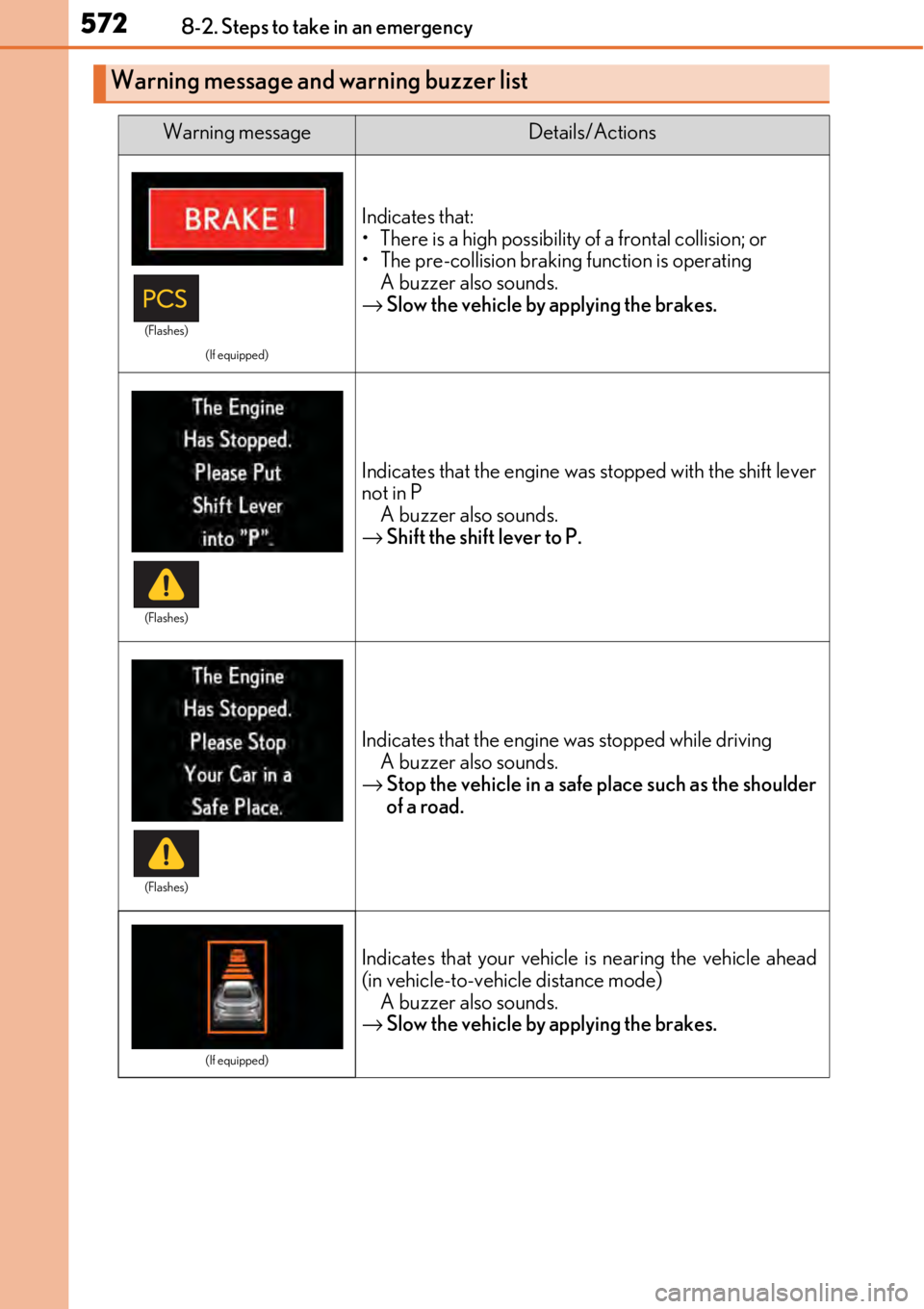
Warning message and warning buzzer list
Warning messageDetails/Actions
(If equipped)
Indicates that:
• There is a high possibility of a frontal collision; or
• The pre-collision braking function is operatingA buzzer also sounds.
→ Slow the vehicle by applying the brakes.
Indicates that the engine was stopped with the shift lever
not in P
A buzzer also sounds.
→ Shift the shift lever to P.
Indicates that the engine was stopped while driving
A buzzer also sounds.
→ Stop the vehicle in a safe place such as the shoulder
of a road.
(If equipped)
Indicates that your vehicle is nearing the vehicle ahead
(in vehicle-to-vehicle distance mode)
A buzzer also sounds.
→ Slow the vehicle by applying the brakes.
(Flashes)
(Flashes)
(Flashes)
Page 601 of 724
6018-2. Steps to take in an emergency
8
When trouble arises
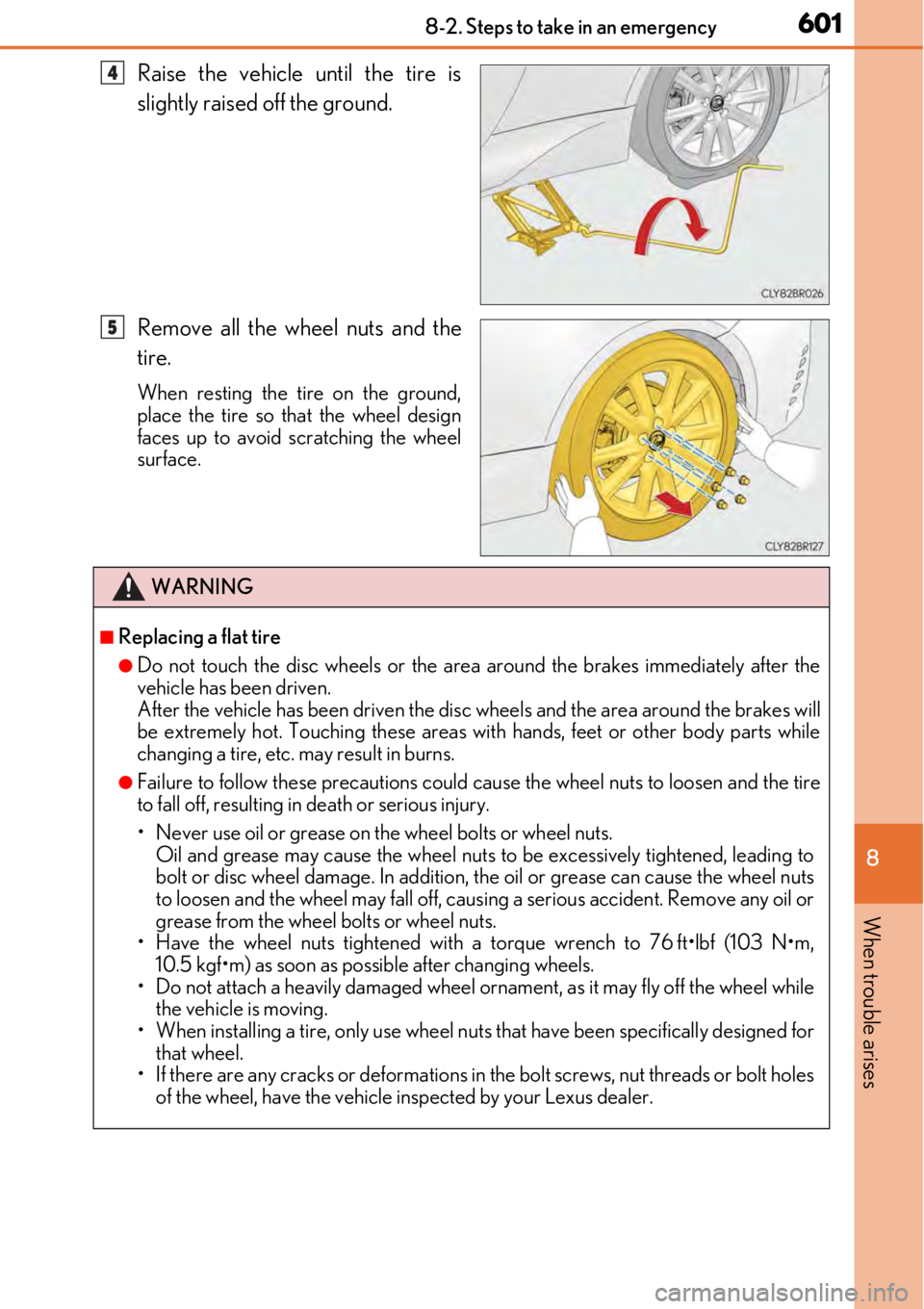
Raise the vehicle until the tire is
slightly raised off the ground.
Remove all the wheel nuts and the
tire.
When resting the tire on the ground,
place the tire so that the wheel design
faces up to avoid scratching the wheel
surface.
4
5
WARNING
■Replacing a flat tire
●Do not touch the disc wheels or the area around the brakes immediately after the
vehicle has been driven.
After the vehicle has been driven the disc wheels and the area around the brakes will
be extremely hot. Touching these areas with hands, feet or other body parts while
changing a tire, etc. may result in burns.
●Failure to follow these precautions could cau se the wheel nuts to loosen and the tire
to fall off, resulting in death or serious injury.
• Never use oil or grease on the wheel bolts or wheel nuts. Oil and grease may cause the wheel nuts to be excessively tightened, leading to
bolt or disc wheel damage. In addition, the oil or grease can cause the wheel nuts
to loosen and the wheel may fall off, causing a serious accident. Remove any oil or
grease from the wheel bolts or wheel nuts.
• Have the wheel nuts tightened with a torque wrench to 76 ft•lbf (103 N•m,
10.5 kgf•m) as soon as possible after changing wheels.
• Do not attach a heavily damaged wheel or nament, as it may fly off the wheel while
the vehicle is moving.
• When installing a tire, only use wheel nuts that have been specifically designed for
that wheel.
• If there are any cracks or deformations in the bolt screws, nut threads or bolt holes
of the wheel, have the vehicle inspected by your Lexus dealer.
Page 618 of 724

6188-2. Steps to take in an emergency
WARNING
■When fixing the flat tire
Observe the following precautions.
Failure to do so may result in death or serious injury.
●Stop your vehicle in a safe and flat area.
●Do not touch the wheels or the area around the brakes immediately after the vehicle
has been driven.
After the vehicle has been driven, the wheels and the area around the brakes may be
extremely hot. Touching these areas with hands, feet or other body parts may result in
burns.
●Connect the valve and hose securely with the tire installed on the vehicle.
• If the hose is not properly connected to the valve, air leakage may occur or sealant
may be sprayed out.
• If the hose comes off the valve while inflating the tire, there is a risk that the hose will move abruptly due to air pressure.
• After inflation of the tire has completed, the sealant may splatter when the hose is disconnected or some air is let out of the tire.
●Follow the operation procedure to repair the tire. If the procedure is not followed, the
sealant may spray out.
●Keep back from the tire while it is being re paired, as there is a chance of it bursting
while the repair operation is being performe d. If you notice any cracks or deforma-
tion of the tire, turn off the compressor sw itch and stop the repair operation immedi-
ately.
●The kit may overheat if operated for a long period of time. Do not operate the com-
pressor continuously for more than 35 minutes.
●Parts of the kit become hot during operation. Be careful handling the kit during and
after operation. Do not touch the metal part around the connecting area between the
bottle and compressor. It will be extremely hot.
●Do not attach the vehicle speed warning sticker to an area other than the one indi-
cated. If the sticker is attached to an area where an SRS airbag is located, such as the
pad of the steering wheel, it may preven t the SRS airbag from operating properly.
■Driving to spread the liquid sealant evenly
●Drive the vehicle carefully at a low speed. Be especially careful when turning and cor-
nering.
●If the vehicle does not drive straight or you feel a pull through the steering wheel, stop
the vehicle and check the following:
• Tire condition. The tire may have separated from the wheel.
• Tire inflation pressure. If tire inflation pressure is 19 psi (130 kPa, 1.3 kgf/cm
2 or
bar) or below, this may in dicate severe tire damage.
Page 651 of 724
6519-1. Specifications
9
Vehicle specifications
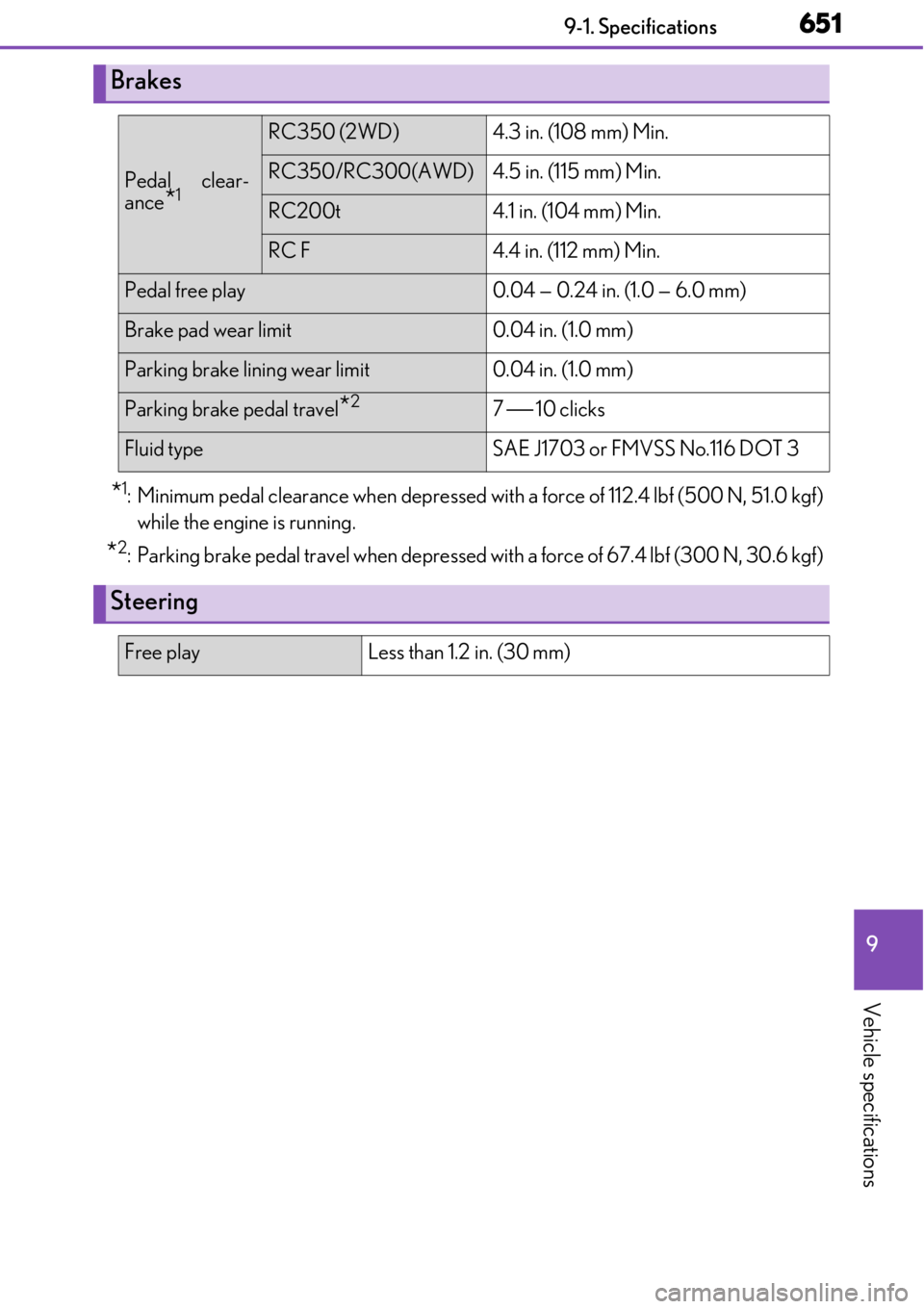
*1: Minimum pedal clearance when depressed with a force of 112.4 lbf (500 N, 51.0 kgf)
while the engine is running.
*2: Parking brake pedal travel when depressed with a force of 67.4 lbf (300 N, 30.6 kgf)
Brakes
Pedal clear-
ance*1
RC350 (2WD)4.3 in. (108 mm) Min.
RC350/RC300 (AWD)4.5 in. (115 mm) Min.
RC200t4.1 in. (104 mm) Min.
RC F4.4 in. (112 mm) Min.
Pedal free play0.04 — 0.24 in. (1.0 — 6.0 mm)
Brake pad wear limit0.04 in. (1.0 mm)
Parking brake lining wear limit0.04 in. (1.0 mm)
Parking brake pedal travel*27 ⎯ 10 clicks
Fluid typeSAE J1703 or FMVSS No.116 DOT 3
Steering
Free playLess than 1.2 in. (30 mm)
Page 668 of 724
6689-1. Specifications
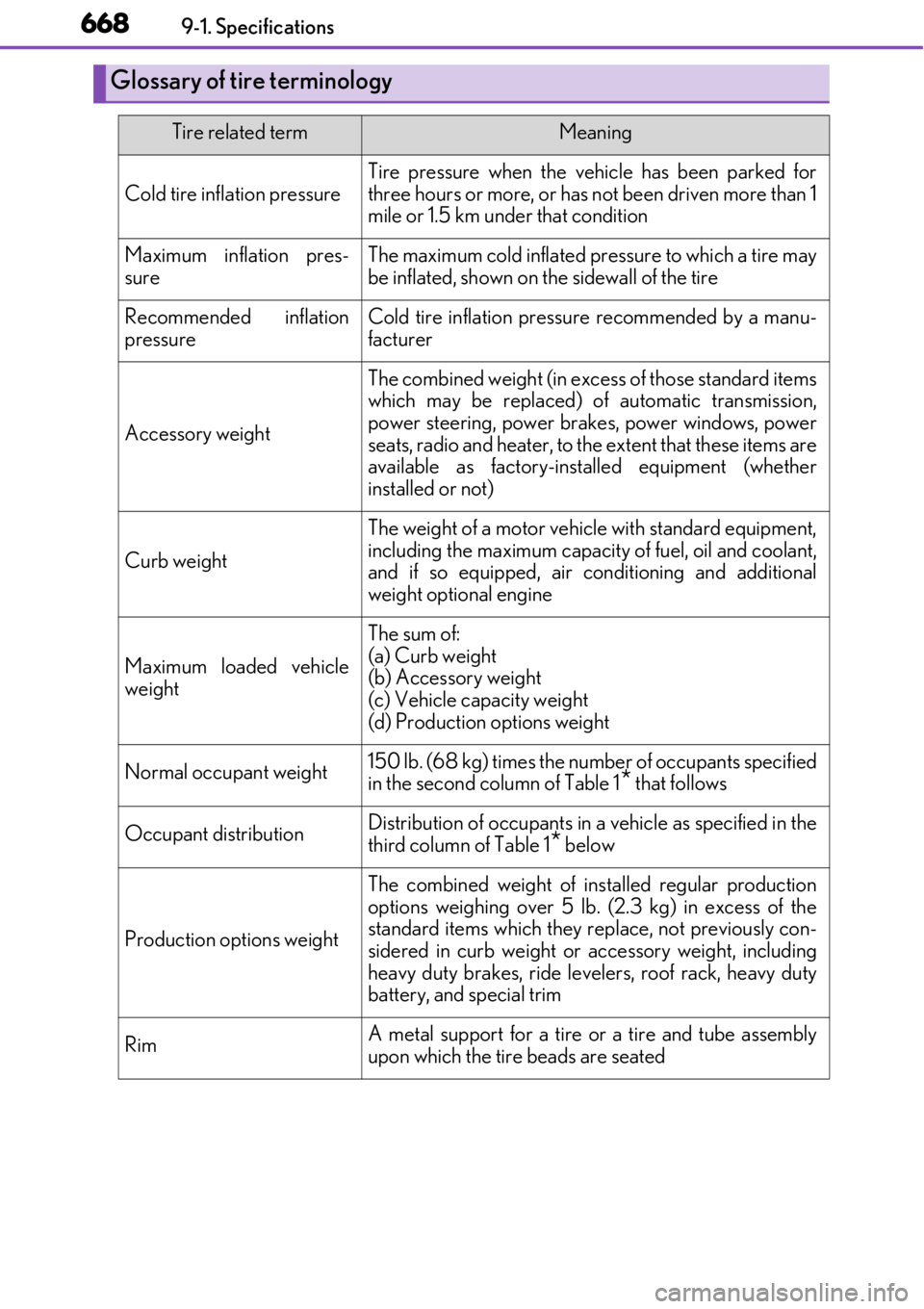
Glossary of tire terminology
Tire related termMeaning
Cold tire inflation pressure
Tire pressure when the vehicle has been parked for
three hours or more, or has not been driven more than 1
mile or 1.5 km un der that condition
Maximum inflation pres-
sureThe maximum cold inflated pr essure to which a tire may
be inflated, shown on the sidewall of the tire
Recommended inflation
pressureCold tire inflation pressure recommended by a manu-
facturer
Accessory weight
The combined weight (in exce ss of those standard items
which may be replaced) of automatic transmission,
power steering, power brakes, power windows, power
seats, radio and heater, to the extent that these items are
available as factory-installed equipment (whether
installed or not)
Curb weight
The weight of a motor vehicle with standard equipment,
including the maximum capacity of fuel, oil and coolant,
and if so equipped, air co nditioning and additional
weight optional engine
Maximum loaded vehicle
weight
The sum of:
(a) Curb weight
(b) Accessory weight
(c) Vehicle capacity weight
(d) Production options weight
Normal occupant weight150 lb. (68 kg) times the numb er of occupants specified
in the second column of Table 1* that follows
Occupant distributionDistribution of occupants in a vehicle as specified in the
third column of Table 1
* below
Production options weight
The combined weight of in stalled regular production
options weighing over 5 lb. (2.3 kg) in excess of the
standard items which they re place, not previously con-
sidered in curb weight or accessory weight, including
heavy duty brakes, ride levelers, roof rack, heavy duty
battery, and special trim
RimA metal support for a tire or a tire and tube assembly
upon which the tire beads are seated