tires LEXUS RC300 2017 Service Manual
[x] Cancel search | Manufacturer: LEXUS, Model Year: 2017, Model line: RC300, Model: LEXUS RC300 2017Pages: 724, PDF Size: 15.76 MB
Page 636 of 724
6368-2. Steps to take in an emergency
Stop the engine. Set the parking brake and shift the shift lever to P.
Remove the mud, snow or sand from around the rear wheels.
Place wood, stones or some other materi al under the rear wheels to help pro-
vide traction.
Restart the engine.
Shift the shift lever to D or R and rele ase the parking brake. Then, while exer-
cising caution, depress the accelerator pedal.
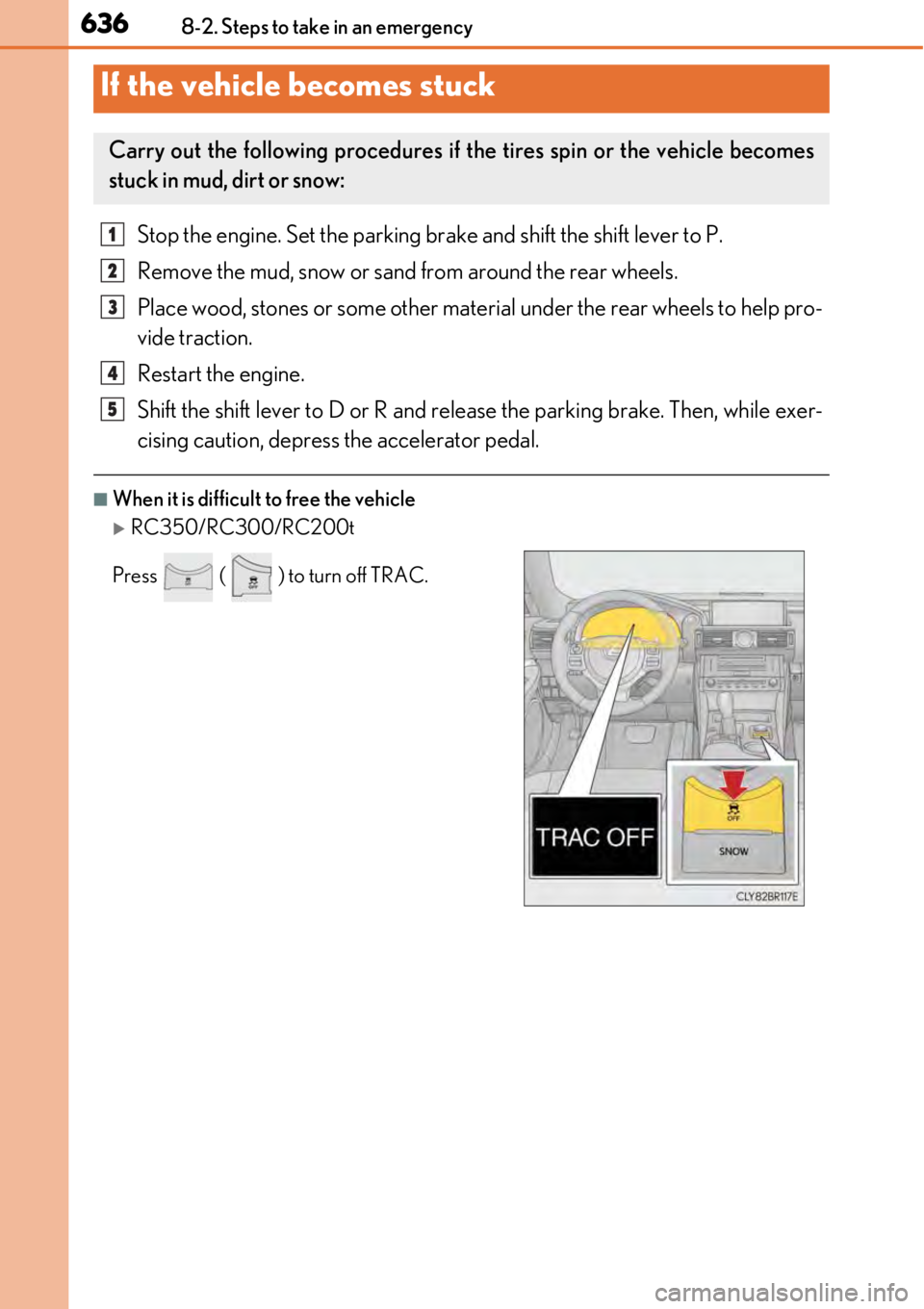
■When it is difficult to free the vehicle
RC350/RC300/RC200t
If the vehicle becomes stuck
Carry out the following procedures if the tires spin or the vehicle becomes
stuck in mud, dirt or snow:
Press ( ) to turn off TRAC.
1
2
3
4
5
Page 640 of 724
6409-1. Specifications
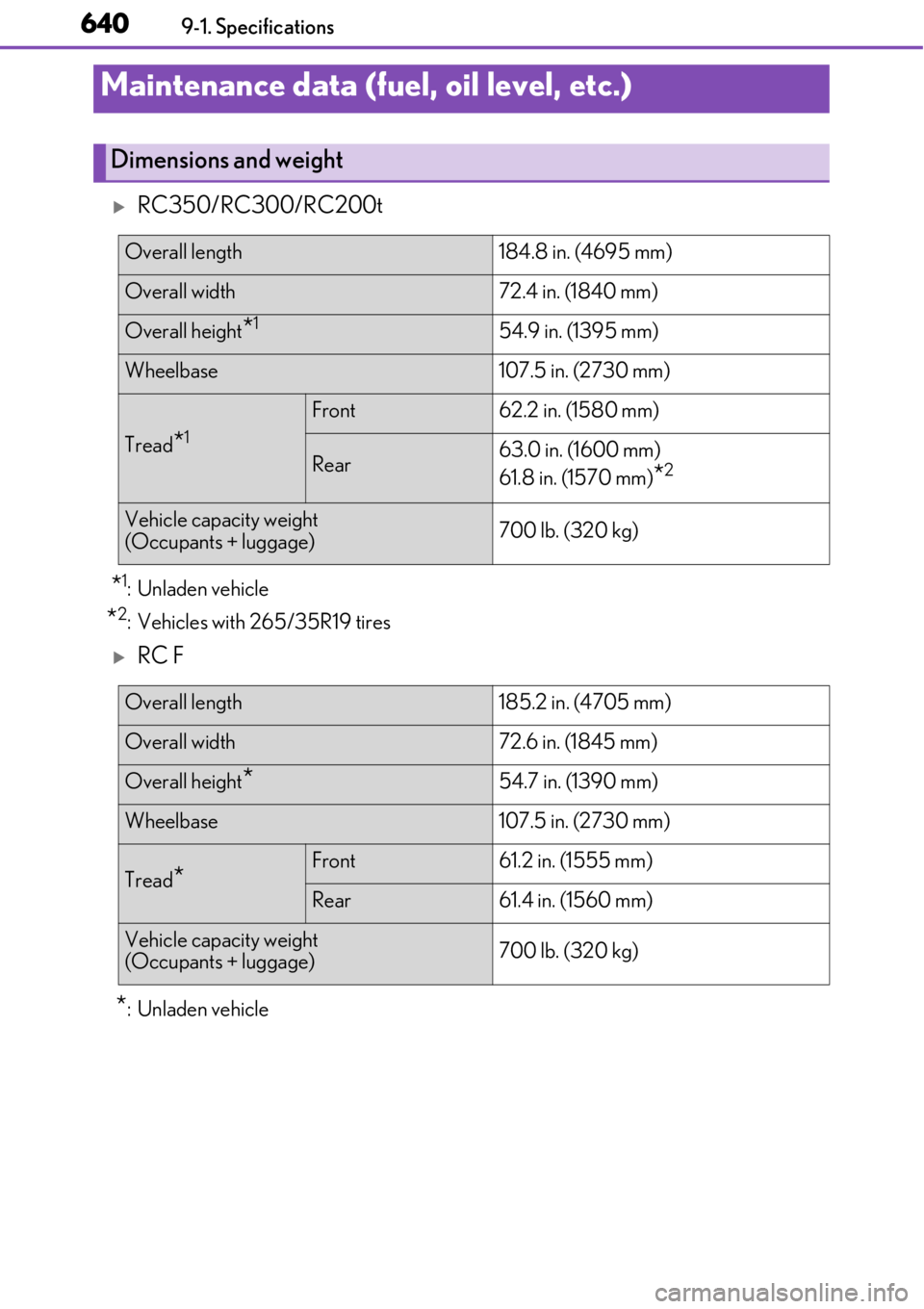
RC350/RC300/RC200t
*1:Unladen vehicle
*2: Vehicles with 265/35R19 tires
RC F
*:Unladen vehicle
Maintenance data (fuel, oil level, etc.)
Dimensions and weight
Overall length184.8 in. (4695 mm)
Overall width72.4 in. (1840 mm)
Overall height*154.9 in. (1395 mm)
Wheelbase107.5 in. (2730 mm)
Tread*1
Front62.2 in. (1580 mm)
Rear63.0 in. (1600 mm)
61.8 in. (1570 mm)
*2
Vehicle capacity weight
(Occupants + luggage)700 lb. (320 kg)
Overall length185.2 in. (4705 mm)
Overall width72.6 in. (1845 mm)
Overall height*54.7 in. (1390 mm)
Wheelbase107.5 in. (2730 mm)
Tread*Front61.2 in. (1555 mm)
Rear61.4 in. (1560 mm)
Vehicle capacity weight
(Occupants + luggage)700 lb. (320 kg)
Page 652 of 724
6529-1. Specifications
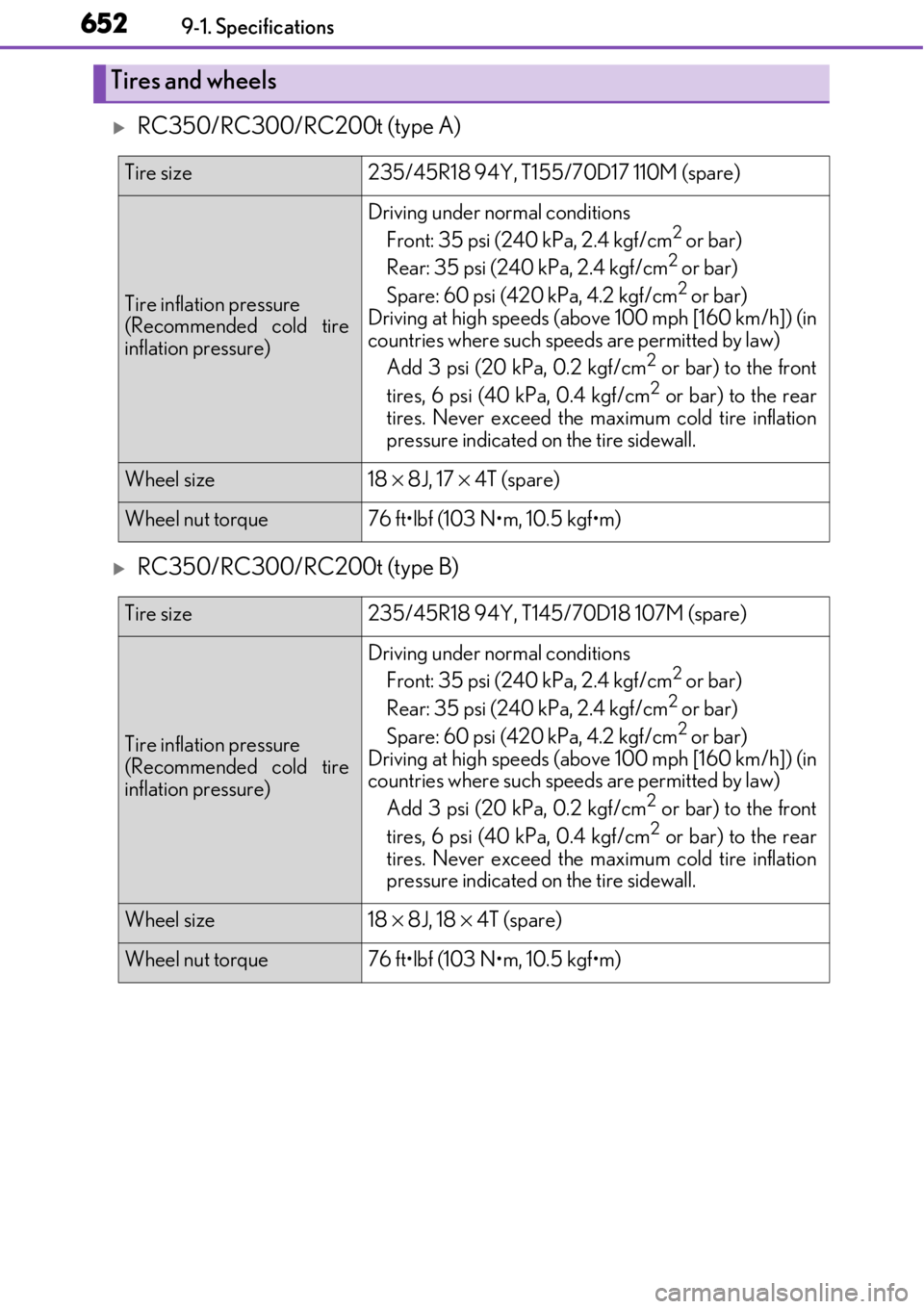
RC350/RC300/RC200t (type A)
RC350/RC300/RC200t (type B)
Tires and wheels
Tire size235/45R18 94Y, T155/70D17 110M (spare)
Tire inflation pressure
(Recommended cold tire
inflation pressure)
Driving under normal conditionsFront: 35 psi (240 kPa, 2.4 kgf/cm2 or bar)
Rear: 35 psi (240 kPa, 2.4 kgf/cm2 or bar)
Spare: 60 psi (420 kPa, 4.2 kgf/cm2 or bar)
Driving at high speeds (above 100 mph [160 km/h]) (in
countries where such speeds are permitted by law)
Add 3 psi (20 kPa, 0.2 kgf/cm
2 or bar) to the front
tires, 6 psi (40 kPa, 0.4 kgf/cm2 or bar) to the rear
tires. Never exceed the maximum cold tire inflation
pressure indicated on the tire sidewall.
Wheel size18 × 8J, 17 × 4T (spare)
Wheel nut torque76 ft•lbf (103 N•m, 10.5 kgf•m)
Tire size235/45R18 94Y, T145/70D18 107M (spare)
Tire inflation pressure
(Recommended cold tire
inflation pressure)
Driving under normal conditions
Front: 35 psi (240 kPa, 2.4 kgf/cm2 or bar)
Rear: 35 psi (240 kPa, 2.4 kgf/cm2 or bar)
Spare: 60 psi (420 kPa, 4.2 kgf/cm2 or bar)
Driving at high speeds (above 100 mph [160 km/h]) (in
countries where such speeds are permitted by law)
Add 3 psi (20 kPa, 0.2 kgf/cm
2 or bar) to the front
tires, 6 psi (40 kPa, 0.4 kgf/cm2 or bar) to the rear
tires. Never exceed the maximum cold tire inflation
pressure indicated on the tire sidewall.
Wheel size18 × 8J, 18 × 4T (spare)
Wheel nut torque76 ft•lbf (103 N•m, 10.5 kgf•m)
Page 653 of 724
6539-1. Specifications
9
Vehicle specifications
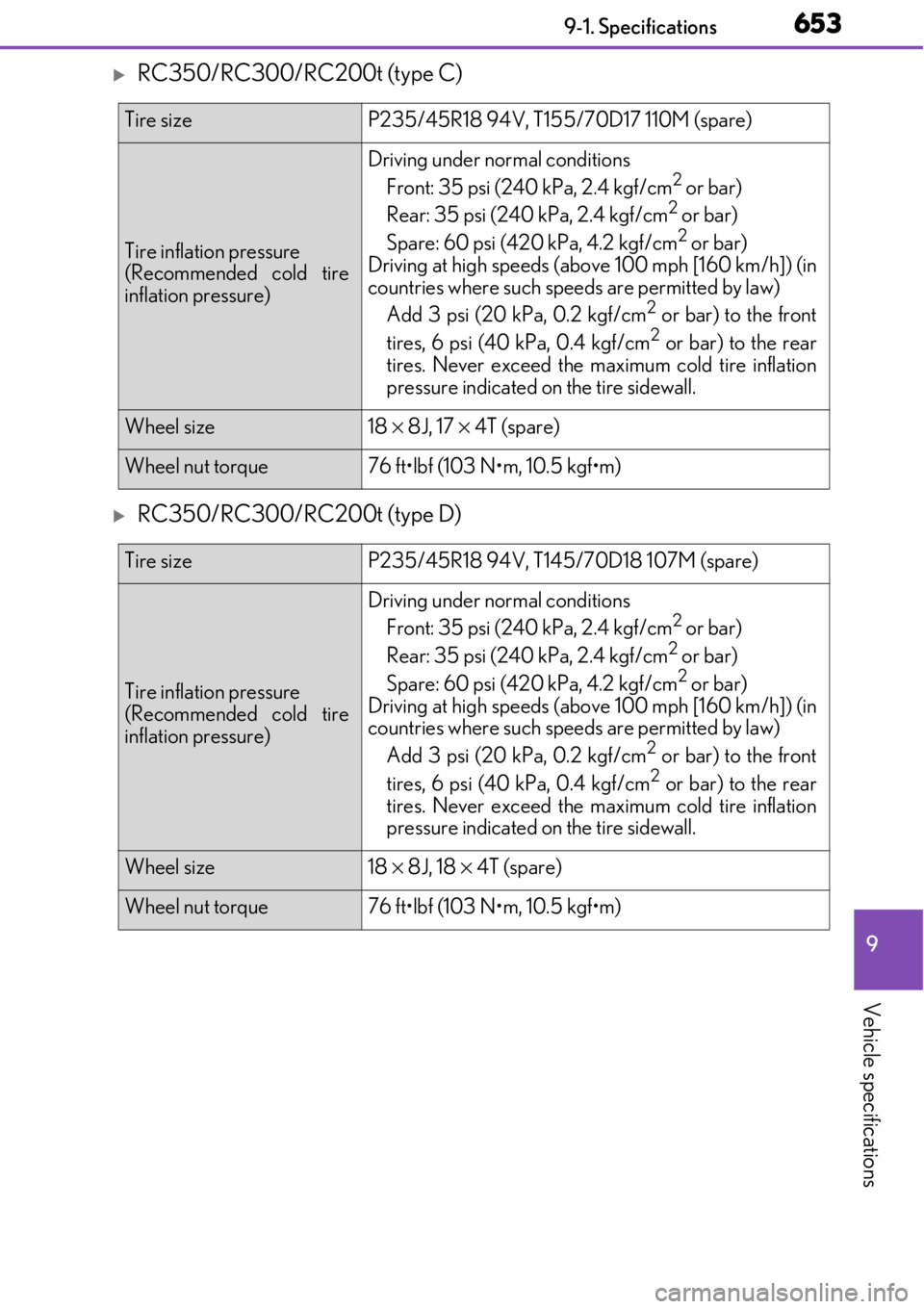
RC350/RC300/RC200t (type C)
RC350/RC300/RC200t (type D)
Tire sizeP235/45R18 94V, T155/70D17 110M (spare)
Tire inflation pressure
(Recommended cold tire
inflation pressure)
Driving under normal conditionsFront: 35 psi (240 kPa, 2.4 kgf/cm2 or bar)
Rear: 35 psi (240 kPa, 2.4 kgf/cm2 or bar)
Spare: 60 psi (420 kPa, 4.2 kgf/cm2 or bar)
Driving at high speeds (above 100 mph [160 km/h]) (in
countries where such speeds are permitted by law)
Add 3 psi (20 kPa, 0.2 kgf/cm
2 or bar) to the front
tires, 6 psi (40 kPa, 0.4 kgf/cm2 or bar) to the rear
tires. Never exceed the maximum cold tire inflation
pressure indicated on the tire sidewall.
Wheel size18 × 8J, 17 × 4T (spare)
Wheel nut torque76 ft•lbf (103 N•m, 10.5 kgf•m)
Tire sizeP235/45R18 94V, T145/70D18 107M (spare)
Tire inflation pressure
(Recommended cold tire
inflation pressure)
Driving under normal conditions
Front: 35 psi (240 kPa, 2.4 kgf/cm2 or bar)
Rear: 35 psi (240 kPa, 2.4 kgf/cm2 or bar)
Spare: 60 psi (420 kPa, 4.2 kgf/cm2 or bar)
Driving at high speeds (above 100 mph [160 km/h]) (in
countries where such speeds are permitted by law)
Add 3 psi (20 kPa, 0.2 kgf/cm
2 or bar) to the front
tires, 6 psi (40 kPa, 0.4 kgf/cm2 or bar) to the rear
tires. Never exceed the maximum cold tire inflation
pressure indicated on the tire sidewall.
Wheel size18 × 8J, 18 × 4T (spare)
Wheel nut torque76 ft•lbf (103 N•m, 10.5 kgf•m)
Page 654 of 724
6549-1. Specifications
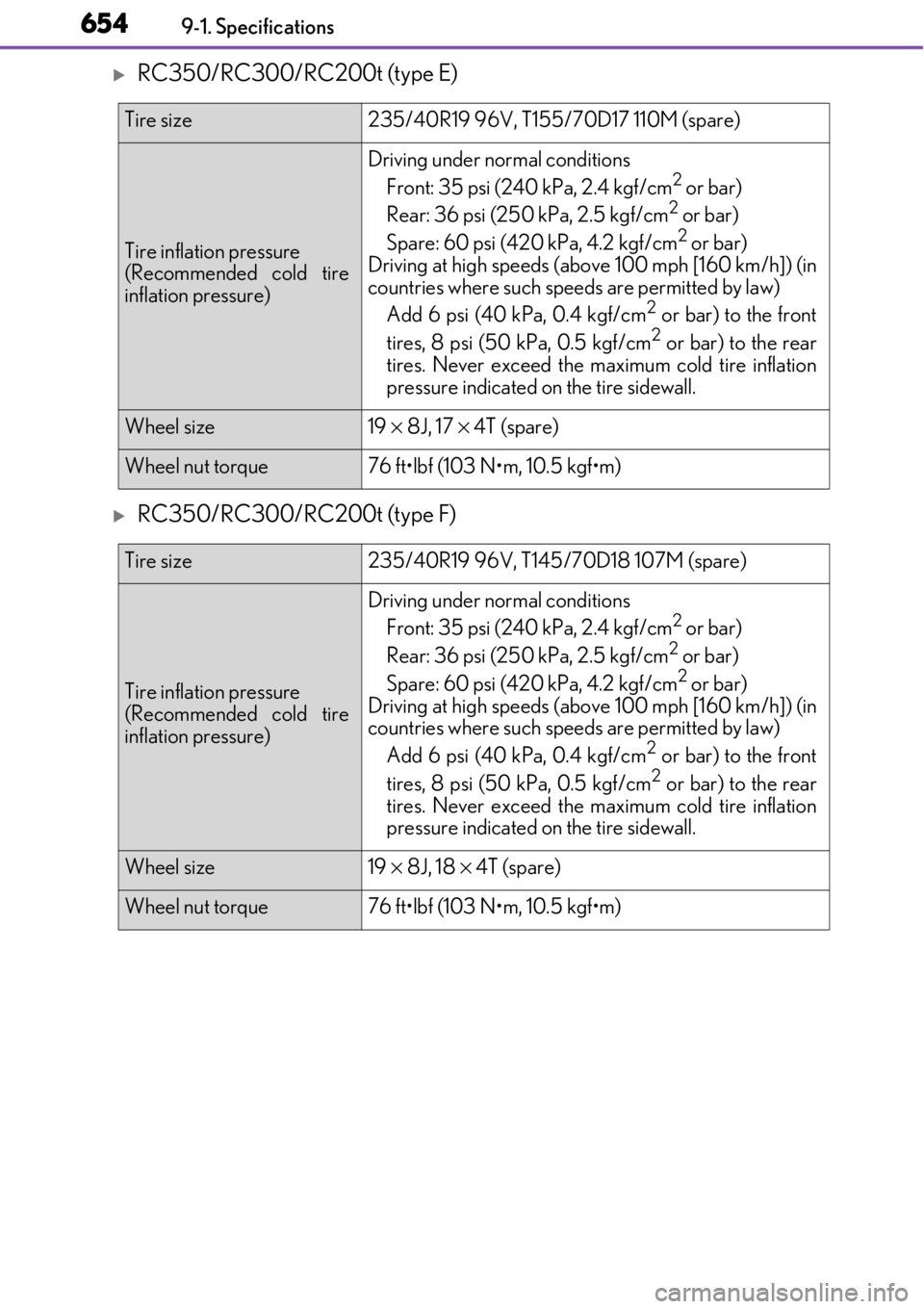
RC350/RC300/RC200t (type E)
RC350/RC300/RC200t (type F)
Tire size235/40R19 96V, T155/70D17 110M (spare)
Tire inflation pressure
(Recommended cold tire
inflation pressure)
Driving under normal conditionsFront: 35 psi (240 kPa, 2.4 kgf/cm2 or bar)
Rear: 36 psi (250 kPa, 2.5 kgf/cm2 or bar)
Spare: 60 psi (420 kPa, 4.2 kgf/cm2 or bar)
Driving at high speeds (above 100 mph [160 km/h]) (in
countries where such speeds are permitted by law)
Add 6 psi (40 kPa, 0.4 kgf/cm
2 or bar) to the front
tires, 8 psi (50 kPa, 0.5 kgf/cm2 or bar) to the rear
tires. Never exceed the maximum cold tire inflation
pressure indicated on the tire sidewall.
Wheel size19 × 8J, 17 × 4T (spare)
Wheel nut torque76 ft•lbf (103 N•m, 10.5 kgf•m)
Tire size235/40R19 96V, T145/70D18 107M (spare)
Tire inflation pressure
(Recommended cold tire
inflation pressure)
Driving under normal conditions
Front: 35 psi (240 kPa, 2.4 kgf/cm2 or bar)
Rear: 36 psi (250 kPa, 2.5 kgf/cm2 or bar)
Spare: 60 psi (420 kPa, 4.2 kgf/cm2 or bar)
Driving at high speeds (above 100 mph [160 km/h]) (in
countries where such speeds are permitted by law)
Add 6 psi (40 kPa, 0.4 kgf/cm
2 or bar) to the front
tires, 8 psi (50 kPa, 0.5 kgf/cm2 or bar) to the rear
tires. Never exceed the maximum cold tire inflation
pressure indicated on the tire sidewall.
Wheel size19 × 8J, 18 × 4T (spare)
Wheel nut torque76 ft•lbf (103 N•m, 10.5 kgf•m)
Page 655 of 724
6559-1. Specifications
9
Vehicle specifications
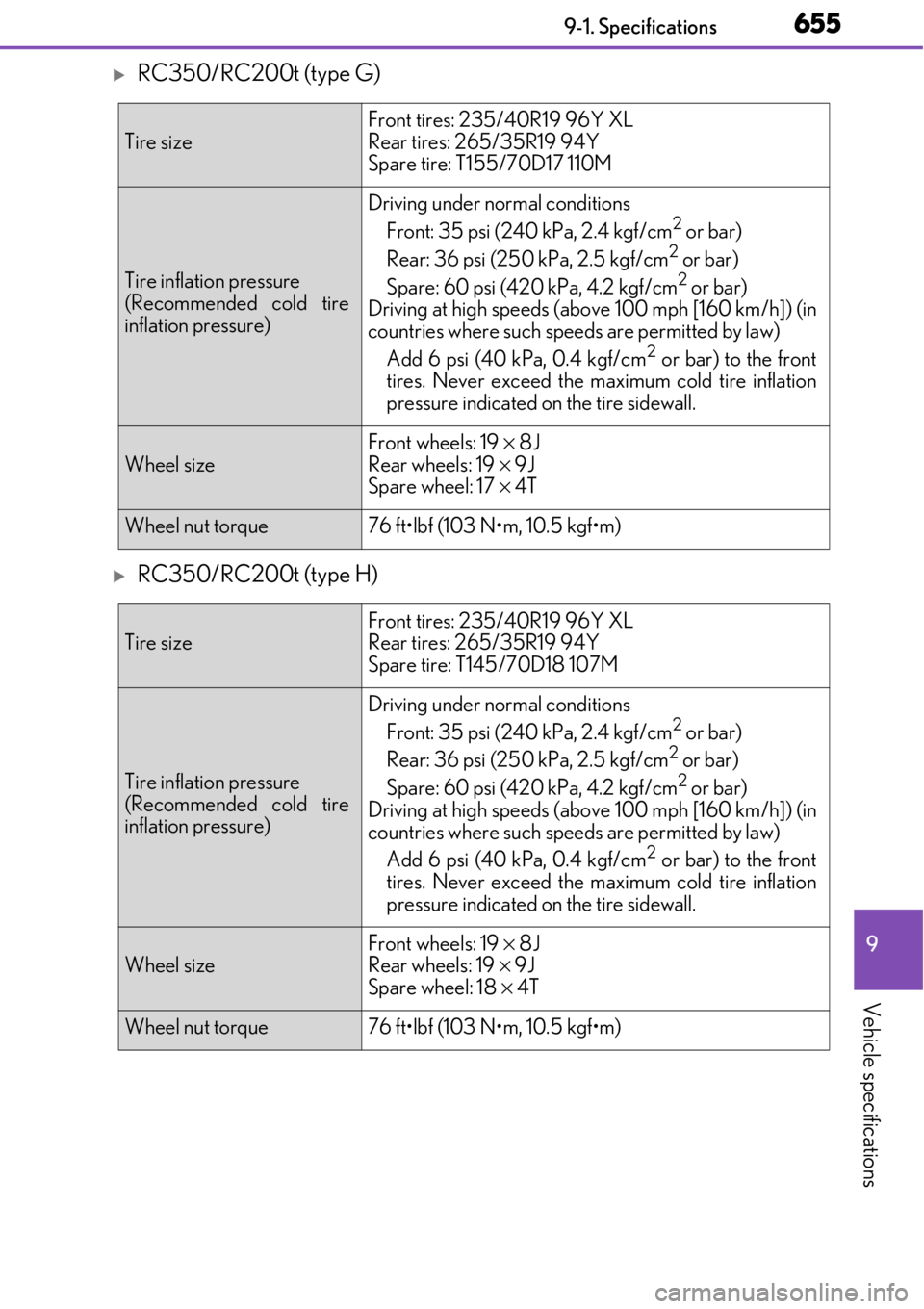
RC350/RC200t (type G)
RC350/RC200t (type H)
Tire size
Front tires: 235/40R19 96Y XL
Rear tires: 265/35R19 94Y
Spare tire: T155/70D17 110M
Tire inflation pressure
(Recommended cold tire
inflation pressure)
Driving under normal conditionsFront: 35 psi (240 kPa, 2.4 kgf/cm2 or bar)
Rear: 36 psi (250 kPa, 2.5 kgf/cm2 or bar)
Spare: 60 psi (420 kPa, 4.2 kgf/cm2 or bar)
Driving at high speeds (above 100 mph [160 km/h]) (in
countries where such speeds are permitted by law)
Add 6 psi (40 kPa, 0.4 kgf/cm
2 or bar) to the front
tires. Never exceed the maximum cold tire inflation
pressure indicated on the tire sidewall.
Wheel sizeFront wheels: 19 × 8J
Rear wheels: 19 × 9J
Spare wheel: 17 × 4T
Wheel nut torque76 ft•lbf (103 N•m, 10.5 kgf•m)
Tire sizeFront tires: 235/40R19 96Y XL
Rear tires: 265/35R19 94Y
Spare tire: T145/70D18 107M
Tire inflation pressure
(Recommended cold tire
inflation pressure)
Driving under normal conditions
Front: 35 psi (240 kPa, 2.4 kgf/cm2 or bar)
Rear: 36 psi (250 kPa, 2.5 kgf/cm2 or bar)
Spare: 60 psi (420 kPa, 4.2 kgf/cm2 or bar)
Driving at high speeds (above 100 mph [160 km/h]) (in
countries where such speeds are permitted by law)
Add 6 psi (40 kPa, 0.4 kgf/cm
2 or bar) to the front
tires. Never exceed the maximum cold tire inflation
pressure indicated on the tire sidewall.
Wheel size
Front wheels: 19 × 8J
Rear wheels: 19 × 9J
Spare wheel: 18 × 4T
Wheel nut torque76 ft•lbf (103 N•m, 10.5 kgf•m)
Page 656 of 724
6569-1. Specifications
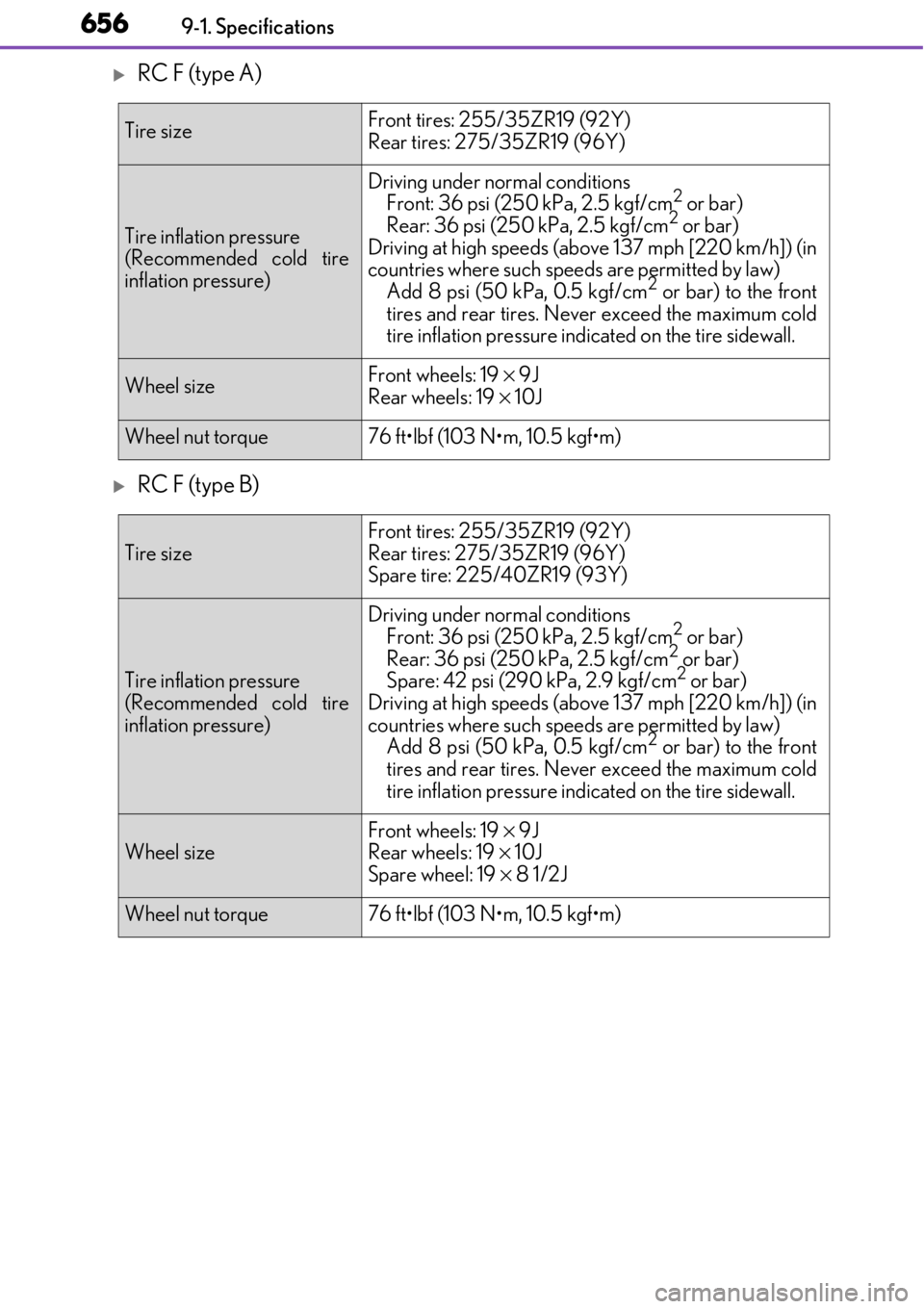
RC F (type A)
RC F (type B)
Tire sizeFront tires: 255/35ZR19 (92Y)
Rear tires: 275/35ZR19 (96Y)
Tire inflation pressure
(Recommended cold tire
inflation pressure)
Driving under normal conditionsFront: 36 psi (250 kPa, 2.5 kgf/cm2 or bar)
Rear: 36 psi (250 kPa, 2.5 kgf/cm2 or bar)
Driving at high speeds (above 137 mph [220 km/h]) (in
countries where such speeds are permitted by law) Add 8 psi (50 kPa, 0.5 kgf/cm
2 or bar) to the front
tires and rear tires. Never exceed the maximum cold
tire inflation pressure indi cated on the tire sidewall.
Wheel sizeFront wheels: 19 × 9J
Rear wheels: 19 × 10J
Wheel nut torque76 ft•lbf (103 N•m, 10.5 kgf•m)
Tire size
Front tires: 255/35ZR19 (92Y)
Rear tires: 275/35ZR19 (96Y)
Spare tire: 225/40ZR19 (93Y)
Tire inflation pressure
(Recommended cold tire
inflation pressure)
Driving under normal conditions
Front: 36 psi (250 kPa, 2.5 kgf/cm2 or bar)
Rear: 36 psi (250 kPa, 2.5 kgf/cm2 or bar)
Spare: 42 psi (290 kPa, 2.9 kgf/cm2 or bar)
Driving at high speeds (above 137 mph [220 km/h]) (in
countries where such speeds are permitted by law) Add 8 psi (50 kPa, 0.5 kgf/cm
2 or bar) to the front
tires and rear tires. Never exceed the maximum cold
tire inflation pressure indi cated on the tire sidewall.
Wheel sizeFront wheels: 19 × 9J
Rear wheels: 19 × 10J
Spare wheel: 19 × 8 1/2J
Wheel nut torque76 ft•lbf (103 N•m, 10.5 kgf•m)
Page 662 of 724

6629-1. Specifications
Tire size (→ P. 664)
DOT and Tire Identification Number (TIN) (→ P. 663)
Location of trea dwear indicators (→ P. 517)
Tire ply composition and materials
Plies are layers of rubber-c oated parallel cords. Cords are the strands which form the
plies in a tire.
Radial tires or bias-ply tires
A radial tire has “RADIAL” on the sidewall. A tire not marked “RADIAL” is a bias-ply
tire.
TUBELESS or TUBE TYPE
A tubeless tire does not have a tube and air is directly put into the tire. A tube type tire
has a tube inside the tire and the tube maintains the air pressure.
Load limit at maximum cold tire inflation pressure (→ P. 668)
Maximum cold tire inflation pressure (→ P. 668)
This means the pressure to which a tire may be inflated.
Uniform tire quality grading
For details, see “Uniform Tire Quality Grading” that follows.
Summer tires or all season tires (→ P. 521)
An all season tire has “M+S” on the side wall. A tire not marked “M+S” is a summer
tire.
“TEMPORARY USE ONLY”
A compact spare tire is identified by the phrase “TEMPORARY USE ONLY” molded
on its sidewall. This tire is designed for temporary emergency use only.
1
2
3
4
5
6
7
8
9
10
11
Page 666 of 724

6669-1. Specifications
This information has been prepared in accordance with regulations issued by the
National Highway Traffic Safety Administra tion of the U.S. Department of Trans-
portation.
It provides the purchasers and/or prospe ctive purchasers of Lexus vehicles with
information on uniform tire quality grading.
Your Lexus dealer will help answer any ques tions you may have as you read this infor-
mation.
■DOT quality grades
All passenger vehicle tires must conform to Federal Safety Requirements in
addition to these grades. Quality grades can be found where applicable on
the tire sidewall between tread shoulder and maximum section width.
For example: Treadwear 200 Traction AA Temperature A
■Treadwear
The treadwear grade is a comparative rati ng based on the wear rate of the tire
when tested under controlled conditio ns on a specified government test
course.
For example, a tire graded 150 would wear one and a half (1 - 1/2) times as well on
the government course as a tire graded 100.
The relative performance of tires depends upon the actual conditions of their use.
Performance may differ significantly from the norm due to variations in driving
habits, service practices and difference s in road characteristics and climate.
■Traction AA, A, B, C
The traction grades, from highest to lowest, are AA, A, B and C, and they rep-
resent the tire’s ability to stop on wet pavement as measured under controlled
conditions on specified government test surfaces of asphalt and concrete.
A tire marked C may have poor traction performance.
Warning: The traction grade assigned to this tire is based on braking (straight
ahead) traction tests and does not include cornering (turning) traction.
Uniform Tire Quality Grading
Page 667 of 724

6679-1. Specifications
9
Vehicle specifications
■Temperature A, B, C
The temperature grades are A (the highest), B, and C, representing the tire’s
resistance to the generation of heat and its ability to dissipate heat when
tested under controlled conditions on a specified indoor laboratory test
wheel.
Sustained high temperature can cause the ma terial of the tire to degenerate and
reduce tire life, and excessive temperat ure can lead to sudden tire failure.
Grade C corresponds to a level of perfor mance which all passenger car tires must
meet under the Federal Motor Vehicle Safety Standard No. 109.
Grades B and A represent higher levels of performance on the laboratory test
wheel than the minimum required by law.
Warning: The temperature grades of a tire assume that it is properly inflated and
not overloaded.
Excessive speed, underi nflation, or excessive loading, either separately or in com-
bination, can cause heat buildup and possible tire failure.