air conditioning LEXUS RC300 2022 Owner's Manual
[x] Cancel search | Manufacturer: LEXUS, Model Year: 2022, Model line: RC300, Model: LEXUS RC300 2022Pages: 400, PDF Size: 27.73 MB
Page 224 of 400
2225-2. Using the air conditioning system
RC350/RC300 Owner's Manual
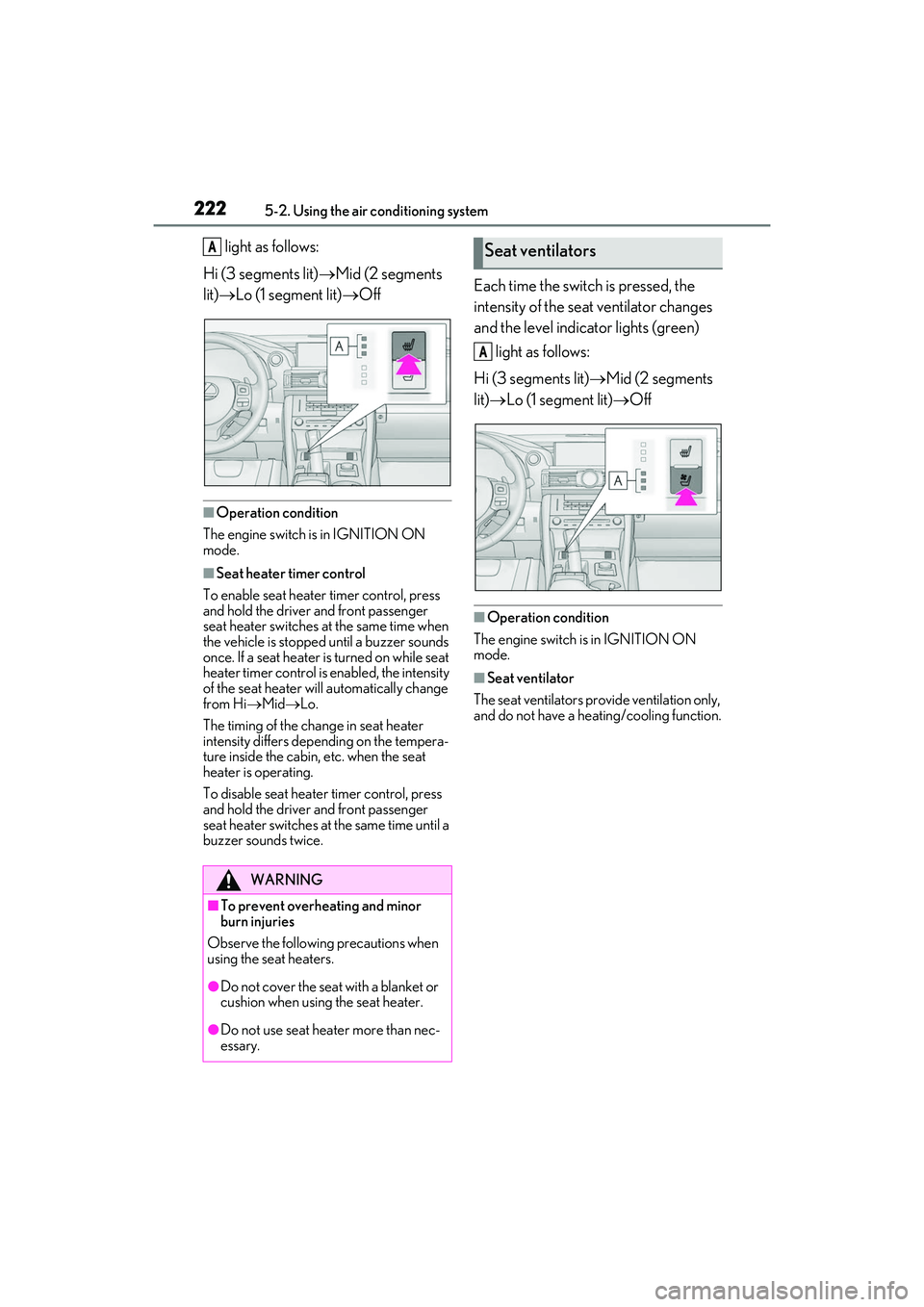
light as follows:
Hi (3 segments lit) Mid (2 segments
lit) Lo (1 segment lit) Off
■Operation condition
The engine switch is in IGNITION ON
mode.
■Seat heater timer control
To enable seat heater timer control, press
and hold the driver and front passenger
seat heater switches at the same time when
the vehicle is stopped until a buzzer sounds
once. If a seat heater is turned on while seat
heater timer control is enabled, the intensity
of the seat heater will automatically change
from Hi Mid Lo.
The timing of the chan ge in seat heater
intensity differs depending on the tempera-
ture inside the cabin, etc. when the seat
heater is operating.
To disable seat heater timer control, press
and hold the driver and front passenger
seat heater switches at the same time until a
buzzer sounds twice.
Each time the switch is pressed, the
intensity of the seat ventilator changes
and the level indicator lights (green)
light as follows:
Hi (3 segments lit) Mid (2 segments
lit) Lo (1 segment lit) Off
■Operation condition
The engine switch is in IGNITION ON
mode.
■Seat ventilator
The seat ventilators provide ventilation only,
and do not have a heating/cooling function.
WARNING
■To prevent overheating and minor
burn injuries
Observe the following precautions when
using the seat heaters.
●Do not cover the seat with a blanket or
cushion when using the seat heater.
●Do not use seat heater more than nec-
essary.
ASeat ventilators
A
Page 241 of 400
239
RC350/RC300 Owner's Manual
6
6
Maintenance and care
Maintenance and care
.6-1. Maintenance and careCleaning and protecting the vehi-cle exterior ................................ 240
Cleaning and protecting the vehi- cle interior ................................. 243
6-2. Maintenance Maintenance requirements .. 246
General maintenance ............. 247
Emission inspection and mainte- nance (I/M) programs ......... 250
6-3. Do-it-yourself maintenance Do-it-yourself service precautions......................................................... 251
Hood............................................... 253
Positioning a floor jack............ 253
Engine compartment............... 255
Tires ................................................ 263
Tire inflation pressure............... 271
Wheels........................................... 272
Air conditioning filter...............273
Electronic key battery ............. 275
Checking and replacing fuses ........................................................ 276
Headlight aim.............................. 278
Light bulbs .................................... 279
Page 245 of 400
2436-1. Maintenance and care
RC350/RC300 Owner's Manual
6
Maintenance and care
Remove dirt and dust using a vac-
uum cleaner. Wipe dirty surfaces
with a cloth dampened with luke-
warm water.
If dirt cannot be removed, wipe it off
with a soft cloth dampened with
neutral detergent diluted to approx-
imately 1%.
Wring out any excess water from the cloth
and thoroughly wipe off remaining traces
of detergent and water.
■Shampooing the carpets
There are several commercial foaming-type
cleaners available. Use a sponge or brush
to apply the foam. Rub in overlapping cir-
cles. Do not use water. Wipe dirty surfaces
and let them dry. Excellent results are
obtained by keeping the carpet as dry as
possible.
■Handling the seat belts
Clean with mild soap and lukewarm water
using a cloth or spon ge. Also check the
belts periodically for excessive wear, fraying
or cuts.
■When cleaning the carpeted portions of
the glove box, console box, etc.
If a strong adhesive tape is used, there is a
possibility that the su rface of the carpet
could be damaged.
NOTICE
●Do not bring the nozzle tip close to
boots (rubber or re sin manufactured
cover), connectors or the following
parts. The parts may be damaged if
they come into contact with high-pres-
sure water.
• Traction related parts
•Suspension parts
•Steering parts
• Brake parts
●Keep the cleaning nozzle at least 11.9
in. (30 cm) away from the vehicle
body. Otherwise resin section, such as
moldings and bumpers, may be
deformed and damaged.
Also, do not continuously hold the nozzle
in the same place.
●Do not spray the lower part of the
windshield continuously.
If water enters the air conditioning sys-
tem intake located near the lower part of
the windshield, the air conditioning sys-
tem may not oper ate correctly.
●Do not wash the underside of the vehi-
cle using a high pressure car washer.
Cleaning and protecting the
vehicle interior
Perform cleaning in a manner
appropriate to each component
and its material.
Protecting the vehicle interior
Page 275 of 400
2736-3. Do-it-yourself maintenance
RC350/RC300 Owner's Manual
6
Maintenance and careUse only Lexus wheel nuts and
wrenches designed for use with
your aluminum wheels.
When rotating, repairing or chang-
ing your tires, check that the wheel
nuts are still tight after driving 1000
miles (1600 km).
Be careful not to damage the alumi-
num wheels when using tire chains.
Use only Lexus genuine balance
weights or equivalent and a plastic
or rubber hammer when balancing
your wheels. 1
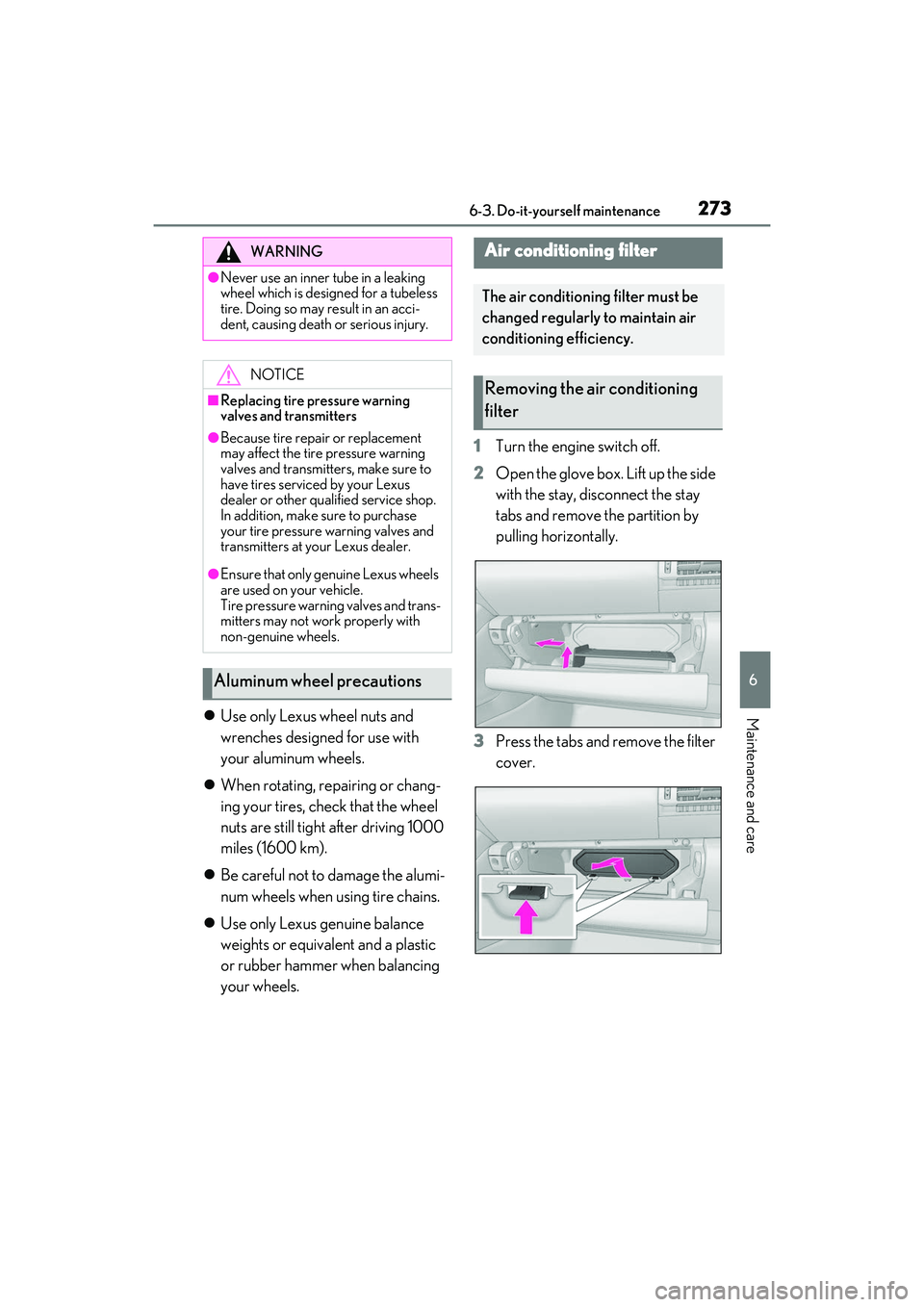
Turn the engine switch off.
2 Open the glove box. Lift up the side
with the stay, disconnect the stay
tabs and remove the partition by
pulling horizontally.
3 Press the tabs and remove the filter
cover.
WARNING
●Never use an inner tube in a leaking
wheel which is designed for a tubeless
tire. Doing so may result in an acci-
dent, causing death or serious injury.
NOTICE
■Replacing tire pressure warning
valves and transmitters
●Because tire repair or replacement
may affect the tire pressure warning
valves and transmitters, make sure to
have tires serviced by your Lexus
dealer or other qual ified service shop.
In addition, make sure to purchase
your tire pressure warning valves and
transmitters at your Lexus dealer.
●Ensure that only ge nuine Lexus wheels
are used on your vehicle.
Tire pressure warning valves and trans-
mitters may not work properly with
non-genuine wheels.
Aluminum wheel precautions
Air conditioning filter
The air conditioning filter must be
changed regularly to maintain air
conditioning efficiency.
Removing the air conditioning
filter
Page 276 of 400
2746-3. Do-it-yourself maintenance
RC350/RC300 Owner's Manual
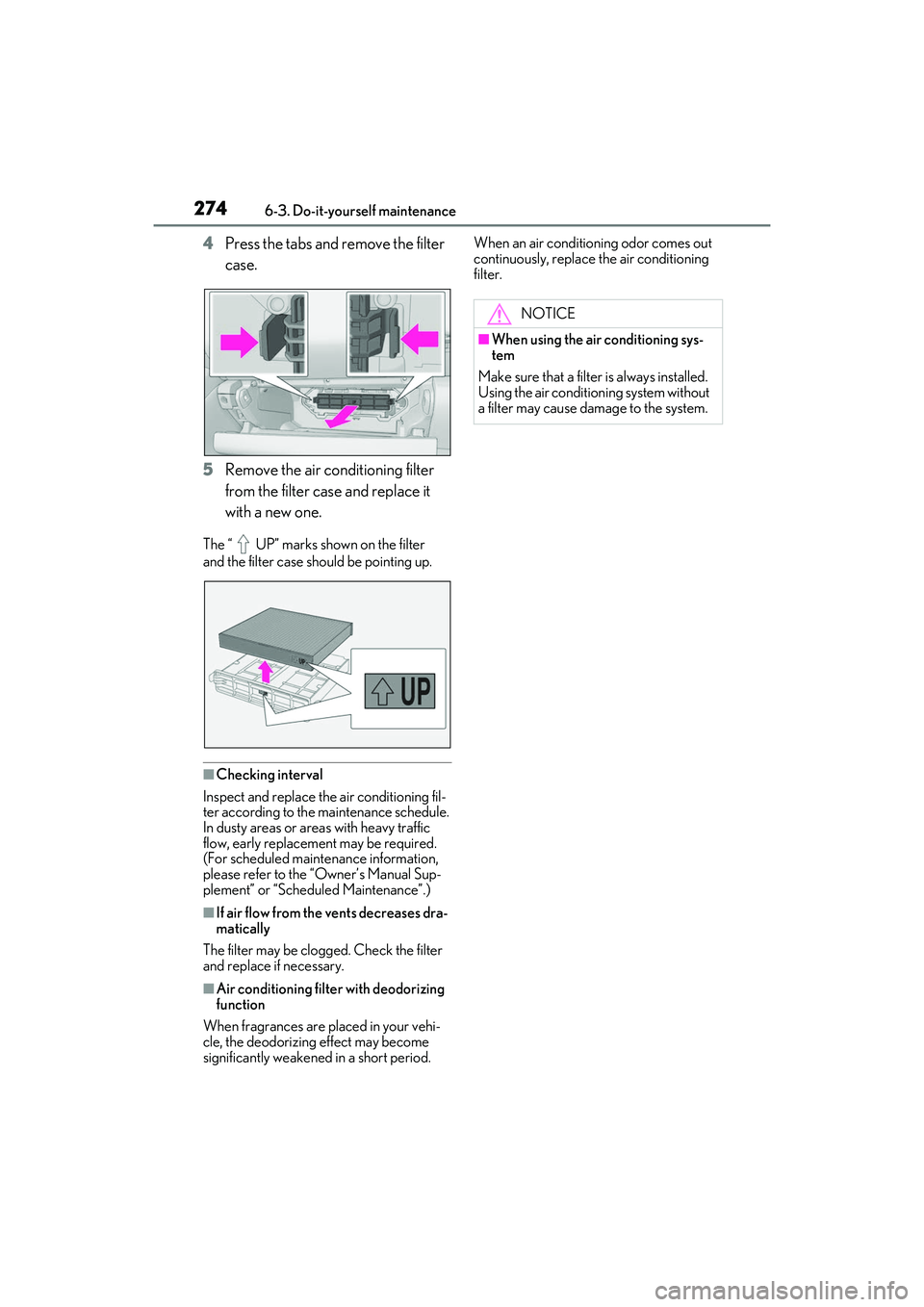
4Press the tabs and remove the filter
case.
5 Remove the air conditioning filter
from the filter case and replace it
with a new one.
The “ UP” marks shown on the filter
and the filter case should be pointing up.
■Checking interval
Inspect and replace the air conditioning fil-
ter according to the maintenance schedule.
In dusty areas or area s with heavy traffic
flow, early replacement may be required.
(For scheduled mainte nance information,
please refer to the “Owner’s Manual Sup-
plement” or “Scheduled Maintenance”.)
■If air flow from th e vents decreases dra-
matically
The filter may be clogged. Check the filter
and replace if necessary.
■Air conditioning filter with deodorizing
function
When fragrances are placed in your vehi-
cle, the deodorizing effect may become
significantly weakened in a short period. When an air conditioning odor comes out
continuously, replace the air conditioning
filter.
NOTICE
■When using the air conditioning sys-
tem
Make sure that a filter is always installed.
Using the air conditioning system without
a filter may cause damage to the system.
Page 322 of 400
3207-2. Steps to take in an emergency
RC350/RC300 Owner's Manual
1Stop the vehicle in a safe place and
turn off the air conditioning system,
and then stop the engine.
2 If you see steam:
Carefully lift the hood after the
steam subsides.
If you do not see steam:
Carefully lift the hood.
3 After the engine has cooled down
sufficiently, inspect the hoses and
radiator core (radiator) for any
leaks.
RC350/RC300 AWD
WARNING
●When working with the battery, always
wear safety glasses and take care not
to allow any battery fluids (acid) to
come into contact with skin, clothing
or the vehicle body.
●Do not lean over the battery.
●In the event that battery fluid comes
into contact with the skin or eyes,
immediately wash the affected area
with water and seek medical attention.
Place a wet sponge or cloth over the
affected area until medical attention
can be received.
●Always wash your hands after handling
the battery support, terminals, and
other battery-related parts.
●Do not allow children near the battery.
NOTICE
■When handling jumper cables
When connecting the jumper cables,
ensure that they do not become entan-
gled in the cooling fans or engine drive
belt.
If your vehicle overheats
The following may indicate that
your vehicle is overheating.
The engine coolant temperature
gauge ( P.66) is in the red zone
or a loss of engine power is expe-
rienced. (For example, the vehicle
speed does not increase.)
“Engine Coolant Temp High Stop
in a Safe Place See Owner’s
Manual” is shown on the
multi-information display.
Steam comes out from under the
hood.
Correction procedures
Page 324 of 400
3227-2. Steps to take in an emergency
RC350/RC300 Owner's Manual
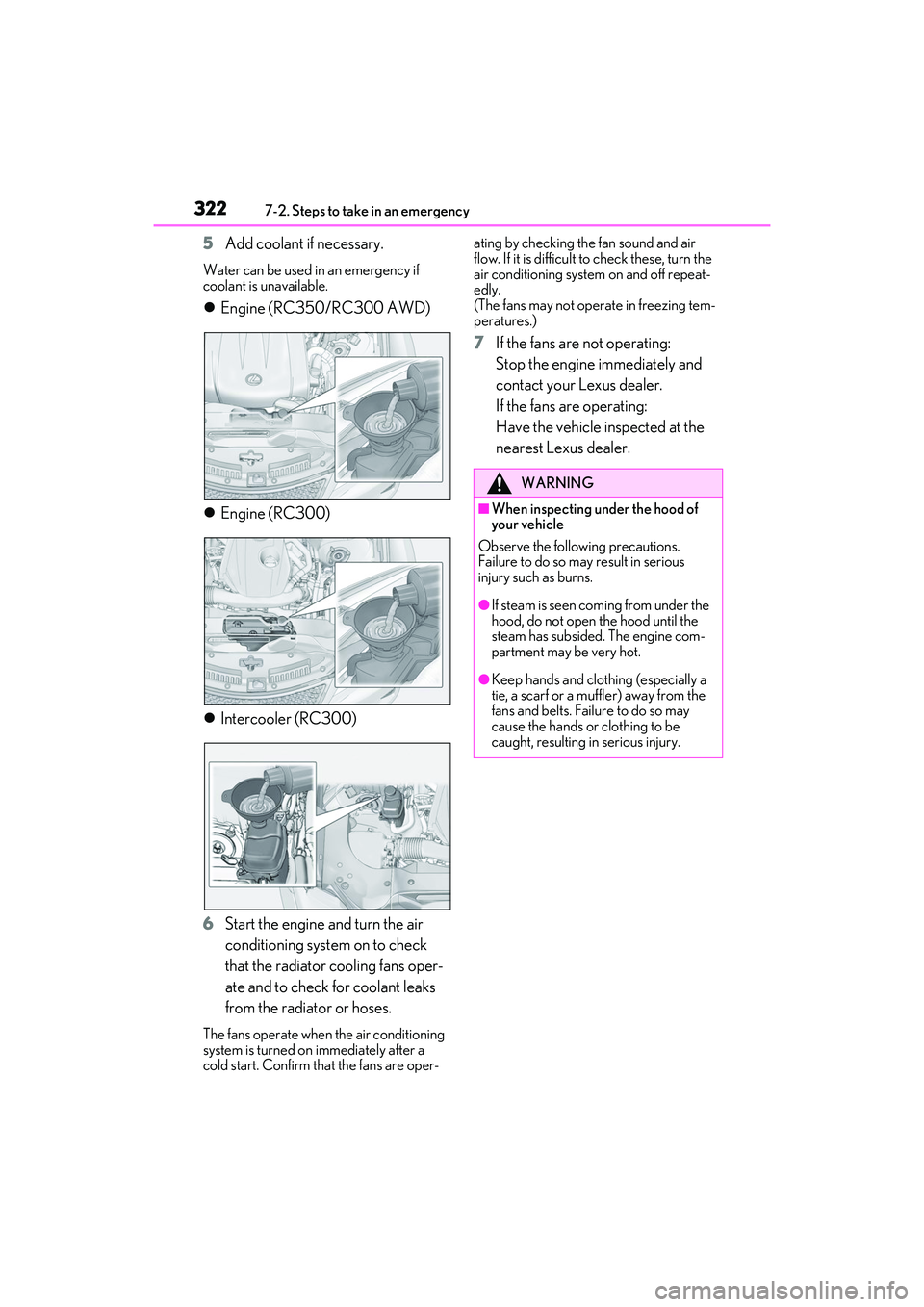
5Add coolant if necessary.
Water can be used in an emergency if
coolant is unavailable.
Engine (RC350/RC300 AWD)
Engine (RC300)
Intercooler (RC300)
6 Start the engine and turn the air
conditioning system on to check
that the radiator cooling fans oper-
ate and to check for coolant leaks
from the radiator or hoses.
The fans operate when the air conditioning
system is turned on immediately after a
cold start. Confirm that the fans are oper- ating by checking the fan sound and air
flow. If it is difficult to check these, turn the
air conditioning system
on and off repeat-
edly.
(The fans may not operate in freezing tem-
peratures.)
7 If the fans are not operating:
Stop the engine immediately and
contact your Lexus dealer.
If the fans are operating:
Have the vehicle inspected at the
nearest Lexus dealer.
WARNING
■When inspecting under the hood of
your vehicle
Observe the following precautions.
Failure to do so may result in serious
injury such as burns.
●If steam is seen coming from under the
hood, do not open the hood until the
steam has subsided. The engine com-
partment may be very hot.
●Keep hands and clothing (especially a
tie, a scarf or a muff ler) away from the
fans and belts. Failure to do so may
cause the hands or clothing to be
caught, resulting in serious injury.
Page 345 of 400
3438-1. Specifications
RC350/RC300 Owner's Manual
8
Vehicle specifications
cornering (turning) traction.
■Temperature A, B, C
The temperature grades are A (the
highest), B, and C, representing the
tire’s resistance to the generation of
heat and its ability to dissipate heat
when tested under controlled condi-
tions on a specified indoor laboratory
test wheel.
Sustained high temperature can cause the
material of the tire to degenerate and
reduce tire life, and excessive temperature
can lead to sudden tire failure. Grade C corresponds to
a level of perfor-
mance which all passenger car tires must
meet under the Federal Motor Vehicle
Safety Standard No. 109.
Grades B and A represent higher levels of
performance on the laboratory test wheel
than the minimum required by law.
Warning: The temperatur e grades of a tire
assume that it is properly inflated and not
overloaded.
Excessive speed, unde rinflation, or exces-
sive loading, either separately or in combi-
nation, can cause heat buildup and
possible tire failure.
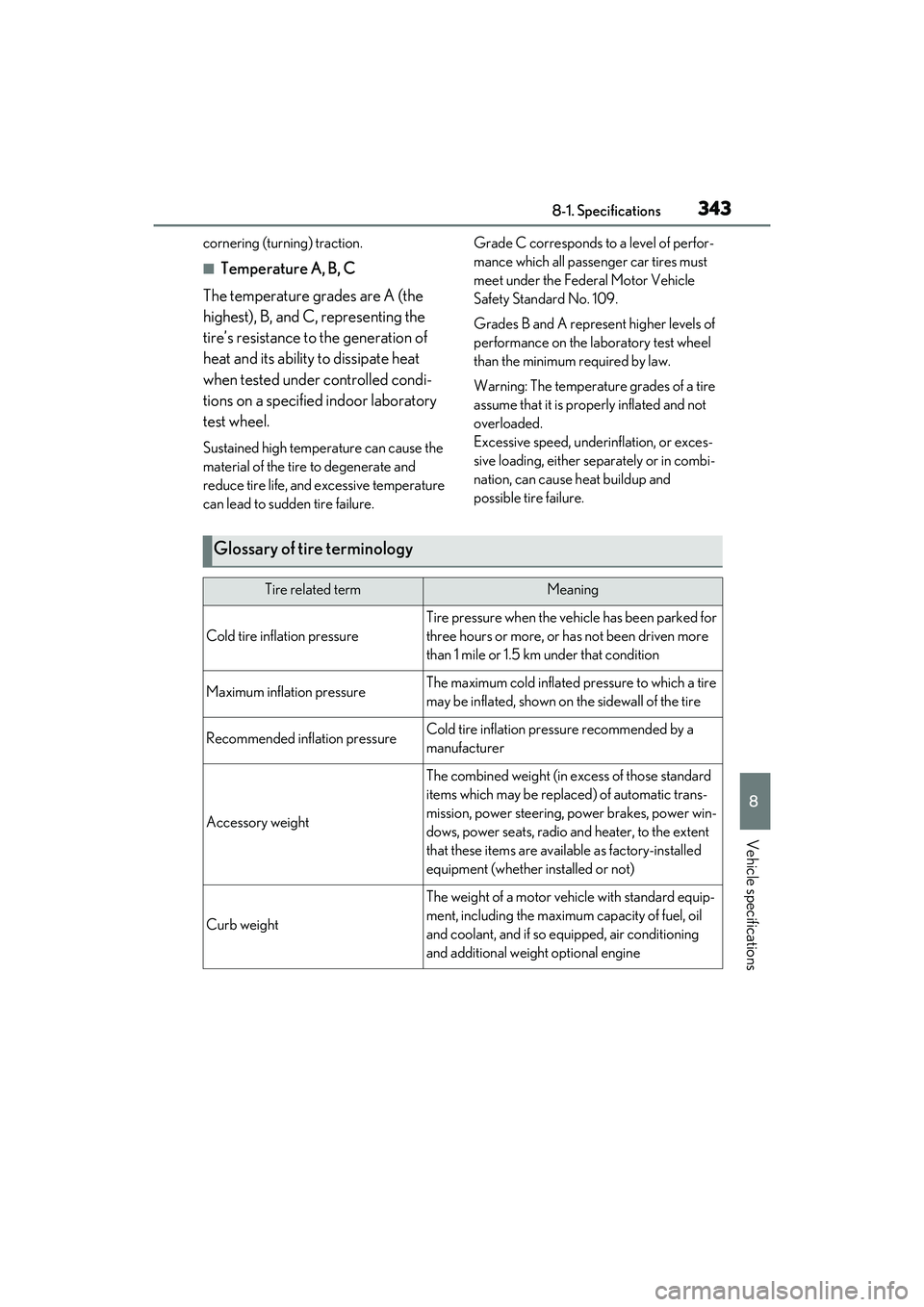
Glossary of tire terminology
Tire related termMeaning
Cold tire inflation pressure
Tire pressure when the vehicle has been parked for
three hours or more, or has not been driven more
than 1 mile or 1.5 km under that condition
Maximum inflation pressureThe maximum cold inflated pressure to which a tire
may be inflated, shown on the sidewall of the tire
Recommended inflation pressureCold tire inflation pressure recommended by a
manufacturer
Accessory weight
The combined weight (in excess of those standard
items which may be replaced) of automatic trans-
mission, power steering, power brakes, power win-
dows, power seats, radio and heater, to the extent
that these items are available as factory-installed
equipment (whether installed or not)
Curb weight
The weight of a motor vehicle with standard equip-
ment, including the maximum capacity of fuel, oil
and coolant, and if so equipped, air conditioning
and additional weight optional engine
Page 357 of 400
3558-2. Customization
RC350/RC300 Owner's Manual
8
Vehicle specifications
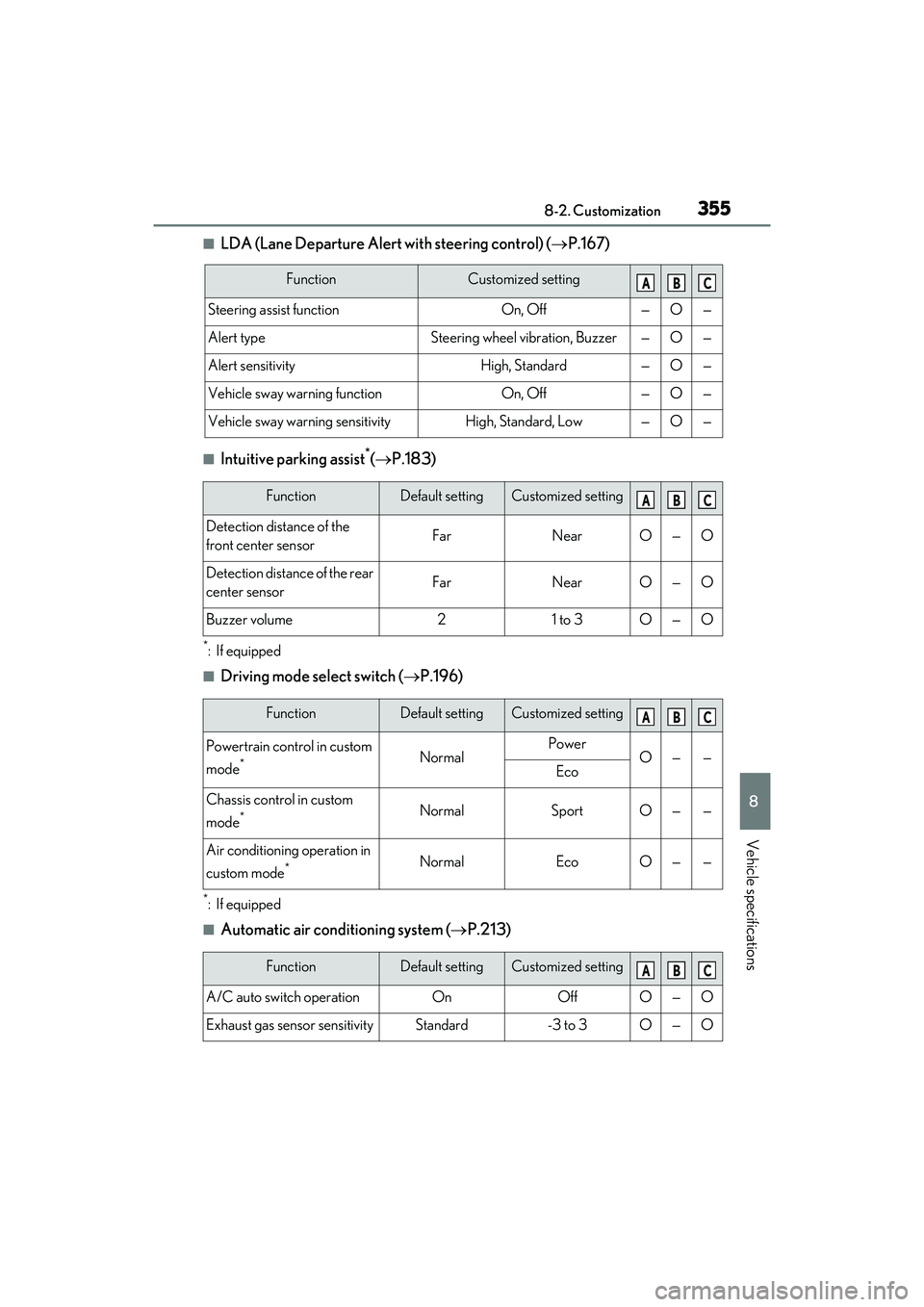
■LDA (Lane Departure Alert with steering control) (P.167)
■Intuitive parking assist*( P.183)
*:If equipped
■Driving mode select switch ( P.196)
*:If equipped
■Automatic air conditioning system ( P.213)
FunctionCustomized setting
Steering assist functionOn, Off—O—
Alert typeSteering wheel vibration, Buzzer—O—
Alert sensitivityHigh, Standard—O—
Vehicle sway warning functionOn, Off—O—
Vehicle sway warning sensitivityHigh, Standard, Low—O—
ABC
FunctionDefault settingCustomized setting
Detection distance of the
front center sensorFarNearO—O
Detection distance of the rear
center sensorFarNearO—O
Buzzer volume21 to 3O—O
ABC
FunctionDefault settingCustomized setting
Powertrain control in custom
mode
*NormalPowerO——Eco
Chassis control in custom
mode
*NormalSportO——
Air conditioning operation in
custom mode
*NormalEcoO——
ABC
FunctionDefault settingCustomized setting
A/C auto switch operationOnOffO—O
Exhaust gas sensor sensitivityStandard-3 to 3O—O
ABC
Page 386 of 400
384Alphabetical Index
RC350/RC300 Owner's Manual
Alphabetical Index
A
A/CAir conditioning filter ............................... 273
Automatic air conditioning system ..... 213
Micro dust and pollen filter..................... 217
ABS (Anti-lock Brake System)............... 198 Warning light ............................................... 295
Active Sound Control (ASC) ..................139
Adaptive Variable Suspension System 199
Air conditioning filter ................................. 273
Air conditioning system Air conditioning filter ............................... 273
Automatic air conditioning system ..... 213
Micro dust and pollen filter..................... 217
Airbags Airbag operating conditions................... 30
Airbag precautions for your child .........32
Correct driving posture .............................23
Curtain shield airbag operating condi-tions .................................................................. 30
Curtain shield airbag precautions ........32
Front passenger occupa nt classification
system ............................................................. 36
General airbag precautions ....................32
Locations of airbags.................................... 28
Modification and disposal of airbags . 35
Side airbag operating conditions ......... 30
Side airbag precautions .............................32
Side and curtain shield airbags operating conditions ...................................................... 30
Side and curtain shield airbags precau- tions ...................................................................32
SRS airbags ..................................................... 28
SRS warning light ...................................... 294
Alarm ....................................................................57 Warning buzzer ......................................... 293
Anchor brackets .......................................41, 49
Antennas (smart access system with push-button start)........................................ 93
Anti-lock Brake System (ABS)............... 198 Warning light ............................................... 295 Approach warning........................................ 179
ASC (Active Sound Control) ..................139
Assist grips ..................................................... 228
Audio system-linked display .......................76
Automatic air conditioning system ........213
Automatic headlight leveling system ..... 141
Automatic High Beam ................................ 142
Automatic light control system............... 140
Automatic transmission ..............................129
M mode ............................................................132
Paddle shift switches ......................... 131, 132
Snow mode...................................................... 131
Average fuel economy..................................73
Average vehicle speed .................................73
B
Back-up light Replacing light bulbs............................... 280
Wattage ..........................................................336
Battery Battery checking ..........................................261
If the battery is discharged ......................317
Preparing and checking before winter..........................................................................203
Warning light ............................................... 294
Blind Spot Monitor (BSM)........................ 189
Boost gauge.......................................................74
Brake Brake hold .......................................................137
Fluid................................................................... 332
Parking brake ............................................... 135
Warning light ...............................................293
Brake assist ..................................................... 198
Break-in tips...................................................... 117
Brightness control Instrument panel light control................. 70
BSM (Blind Spot Monitor)........................ 189
C
Card key ............................................................ 82