towing LEXUS RC350 2015 User Guide
[x] Cancel search | Manufacturer: LEXUS, Model Year: 2015, Model line: RC350, Model: LEXUS RC350 2015Pages: 684, PDF Size: 9.31 MB
Page 261 of 684

2614-5. Using the driving support systems
4
Driving
RC350/RCF_U (OM24636U)
■Sensor detection information
●RC350: The sensor’s detection areas are limited to the areas around the vehicle’s front
and rear bumpers.
●RC F: The sensor’s detection areas are limited to the areas around the vehicle’s front
corner and rear bumpers.
●Certain vehicle conditions and the surround ing environment may affect the ability of
the sensor to correctly detect obstacles. Particular instances where this may occur are
listed below.
• There is dirt, snow or ice on the sensor . (Wiping the sensors will resolve this prob-
lem.)
• The sensor is frozen. (Thawing th e area will resolve this problem.)
In especially cold weather, if a sensor is frozen the screen may show an abnormal
display, or obstacles may not be detected.
• The sensor is covered in any way.
• The vehicle is leaning co nsiderably to one side.
• On an extremely bumpy road, on an incline, on gravel, or on grass.
• The vicinity of the vehicle is noisy due to vehicle horns, motorcycle engines, air brakes of large vehicles, or other loud noises producing ultrasonic waves.
• There is another vehicle equipped with parking assist sensor in the vicinity.
• The sensor is coated with a sheet of spray or heavy rain.
• The vehicle is equipped with a fender pole or wireless antenna.
• Towing eyelets are installed.
• The bumper or sensor receives a strong impact.
• The vehicle is approaching a tall or curved curb.
• In harsh sunlight or intense cold weather.
• The area directly under the bumpers is not detected.
• If obstacles draw too close to the sensor.
• A non-genuine Lexus suspension (low ered suspension etc.) is installed.
• People may not be detected if they are wearing certain types of clothing.
In addition to the examples above, there are instances in which, because of their shape,
signs and other objects may be judged by the sensor to be closer than they are.
●The shape of the obstacle may prevent the sensor from detecting it. Pay particular
attention to the following obstacles:
• Wires, fences, ropes, etc.
• Cotton, snow and other materials that absorb sound waves
• Sharply-angled objects
•Low obstacles
• Tall obstacles with upper sections projecting outwards in the direction of your vehi-
cle
●The following situations may occur during use.
• Depending on the shape of the obstacle and other factors, the detection distance
may shorten, or detect ion may be impossible.
• Obstacles may not be detected if they are too close to the sensor.
• There will be a short delay between obst acle detection and display. Even at slow
speeds, there is a possibility that the obstacle will come within the sensor’s detection
areas before the display is shown and the warning beep sounds.
• Thin posts or objects lower than the sensor may not be detected when approached, even if they have been detected once.
• It might be difficult to hear beeps due to the volume of the audio system or air flow noise of the air conditioning system.
Page 293 of 684
2934-5. Using the driving support systems
4
Driving
RC350/RCF_U (OM24636U)
■Conditions that may trigger the system even if there is no danger of a collision
In the following situations, the front of the sensor may be obstructed causing the system
to determine that there is a poss ibility of a collision and operate:
●When passing an oncoming vehicle on a cu rb or while making a left or right turn
●When rapidly closing on an obstruction in front of the vehicle, such as a vehicle or toll
gate
●When climbing a hill, and an overhead structure (billboard, low ceiling, street lamps,
etc.) appears in the vehicle’s line of travel
●When driving through a narrow passage or a place with a low ceiling (bridges, tunnels,
overhead passes, etc.)
●When driving on an uneven road surface
●When there is a metal object on the road surf ace, or a gap or protrusion in the road sur-
face
●When there is an extreme change in the vehicle height
●When the sensor is misaligned due to a stro ng impact to the surrounding area of the
sensor
●When there is an object on the side of the road at the entrance to a curve, such as
guardrails
●When the front of your vehicle is inclined (during emergency towing, carrying a heavy
load in the trunk, etc.)
When the system is activated in the situations described above, there is also a possibility
that the brakes will be applied with a force greater than normal.
■Obstacles not detected
The sensor cannot detect plasti c obstacles such as traffic cones. There may also be occa-
sions when the sensor cannot detect pedestrians, animals, bicycles, motorcycles, trees,
or snowdrifts.
■Situations in which the pre-collision system does not function properly
The system may not function effectively in situations such as the following:
●On roads with sharp bends or uneven surfaces
●If a vehicle suddenly moves in front of your vehicle, such as at an intersection
●If a vehicle suddenly cuts in front of your vehicle, such as when overtaking
●In inclement weather such as heavy rain, fog, snow or sand storms
●If the vehicle is skidding when VSC is not operating
●When your vehicle is steeply inclined
●When the radar sensor moves off position due to its surrounding area being subjected
to a strong impact
●When an obstacle suddenly appears in front of the vehicle due to the steering wheel
being turned sharply or another cause
■Automatic cancelation of the pre-collision system
When a malfunction occurs due to sensor cont amination, etc. that results in the sensors
being unable to detect obstacles, the pre-collision syst em will be automatically disabled.
In this case, the system will not activate even if there is a collision possibility.
■When there is a malfunction in the system or if the system is temporarily unusable
The pre-collision system warning light will flash or illuminate and warning messages will
be displayed. ( P. 5 3 4 , 5 4 5 )
Page 454 of 684

4546-4. Using the other interior features
RC350/RCF_U (OM24636U)
■Stolen Vehicle Location
If your vehicle is stolen, Safety Connect can work with local authorities to
assist them in locating and recovering the vehicle. After filing a police report,
call the Safety Connect response center at 1-800-25-LEXUS (1-800-255-
3987) and follow the prompts for Safety Connect to initiate this service.
In addition to assisting law enforcement with recovery of a stolen vehicle,
Safety-Connect-equipped vehicle location data may, under certain circum-
stances, be shared with third parties to locate your vehicle. Further informa-
tion is available at Lexus.com.
■Emergency Assistance Button (“SOS”)
In the event of an emergency on the ro ad, push the “SOS” button to reach the
Safety Connect response center. Th e answering agent will determine your
vehicle’s location, assess the emergency, and dispatch the necessary assis-
tance required.
If you accidentally press the “SOS” button, tell the response-center agent that you
are not experiencing an emergency.
■Enhanced Roadside Assistance
Enhanced Roadside Assistance adds GP S data to the already included war-
ranty-based Lexus roadside service.
Subscribers can press the “SOS” button to reach a Safety Connect response-
center agent, who can help with a wide range of needs, such as: towing, flat
tire, fuel delivery, etc. For a description of the Roadside Assistance services
and their limitations, please see the Safety Connect Terms and Conditions,
which are available at Lexus.com.
Page 524 of 684
524
RC350/RCF_U (OM24636U)8-2. Steps to take in an emergency
The following may indicate a problem with your transmission. Contact your
Lexus dealer or commercial towing service before towing.
●The engine is running but the vehicle will not move.
●The vehicle makes an abnormal sound.
If your vehicle needs to be towed
If towing is necessary, we recommend having your vehicle towed by your
Lexus dealer or commercial towing service, using a lift-type truck or flatbed
truck.
Use a safety chain system for all towing, and abide by all state/provincial and
local laws.
Situations needs to contact dealers before towing
Page 525 of 684
5258-2. Steps to take in an emergency
8
When trouble arises
RC350/RCF_U (OM24636U)
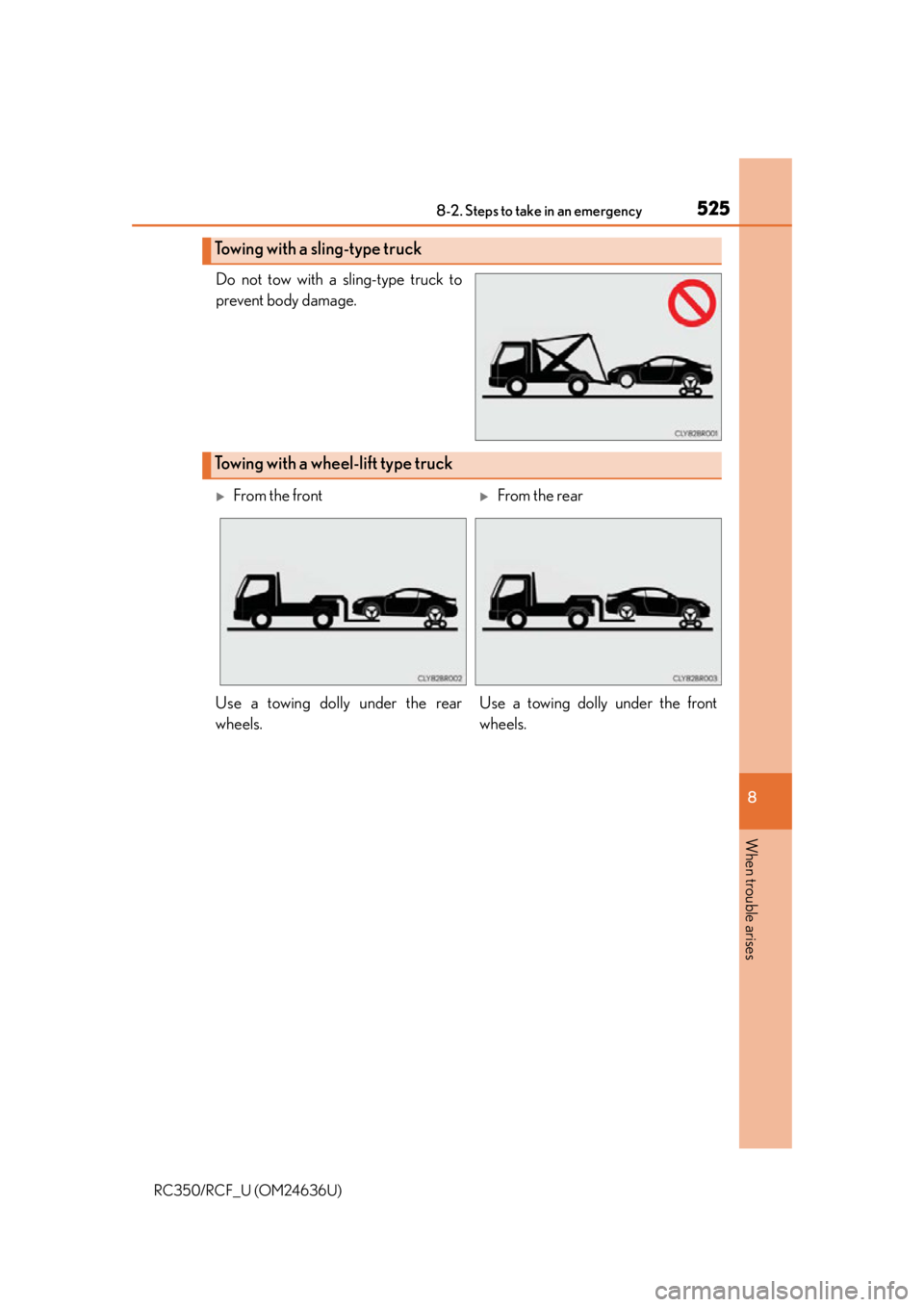
Do not tow with a sling-type truck to
prevent body damage.
Towing with a sling-type truck
Towing with a wheel-lift type truck
From the frontFrom the rear
Use a towing dolly under the rear
wheels. Use a towing dolly under the front
wheels.
Page 526 of 684
5268-2. Steps to take in an emergency
RC350/RCF_U (OM24636U)
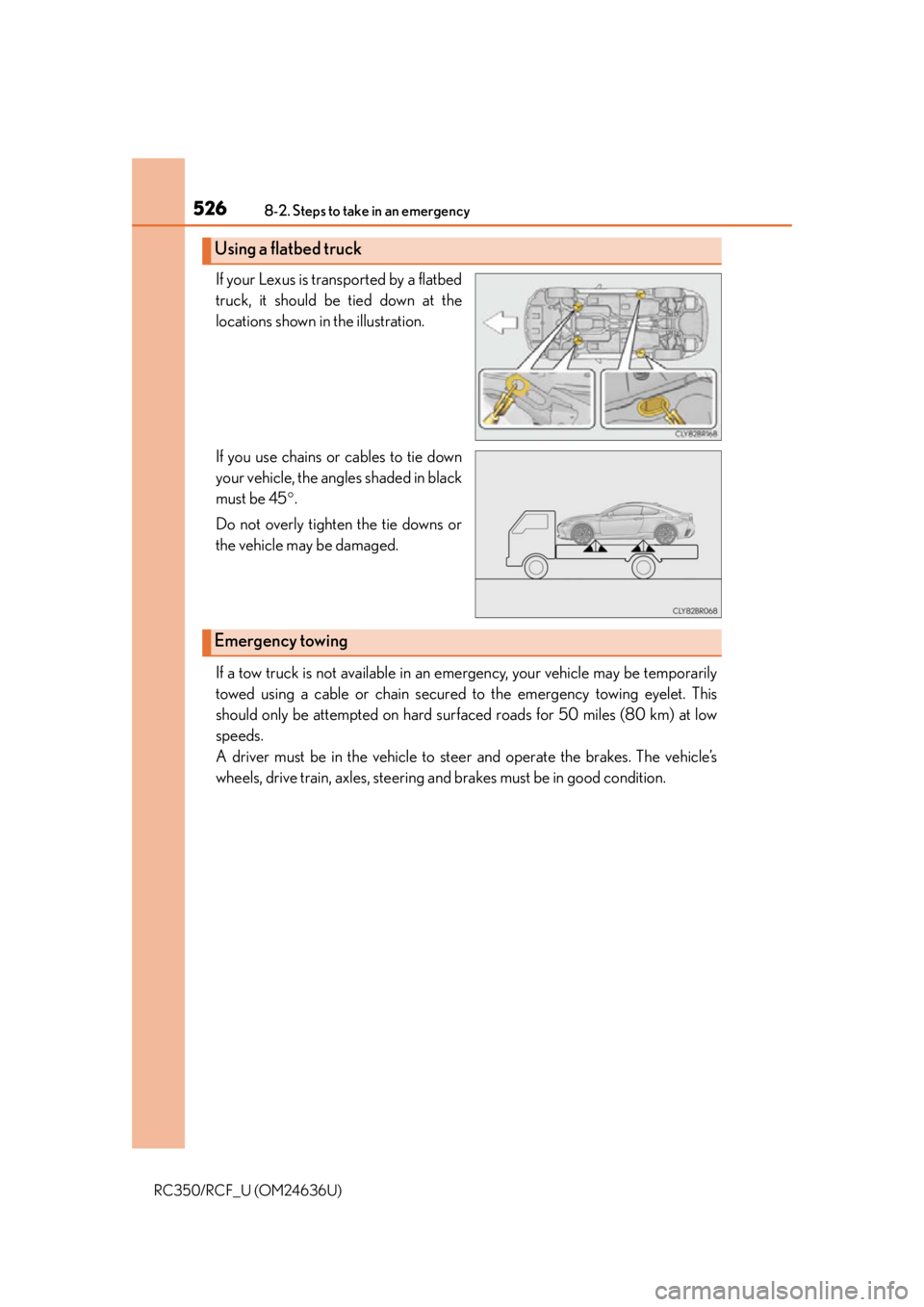
If your Lexus is transported by a flatbed
truck, it should be tied down at the
locations shown in the illustration.
If you use chains or cables to tie down
your vehicle, the angles shaded in black
must be 45.
Do not overly tighten the tie downs or
the vehicle may be damaged.
If a tow truck is not available in an emergency, your vehicle may be temporarily
towed using a cable or chain secured to the emergency towing eyelet. This
should only be attempted on hard surfaced roads for 50 miles (80 km) at low
speeds.
A driver must be in the vehicle to steer and operate the brakes. The vehicle’s
wheels, drive train, axles, steering an d brakes must be in good condition.
Using a flatbed truck
Emergency towing
Page 527 of 684
5278-2. Steps to take in an emergency
8
When trouble arises
RC350/RCF_U (OM24636U)
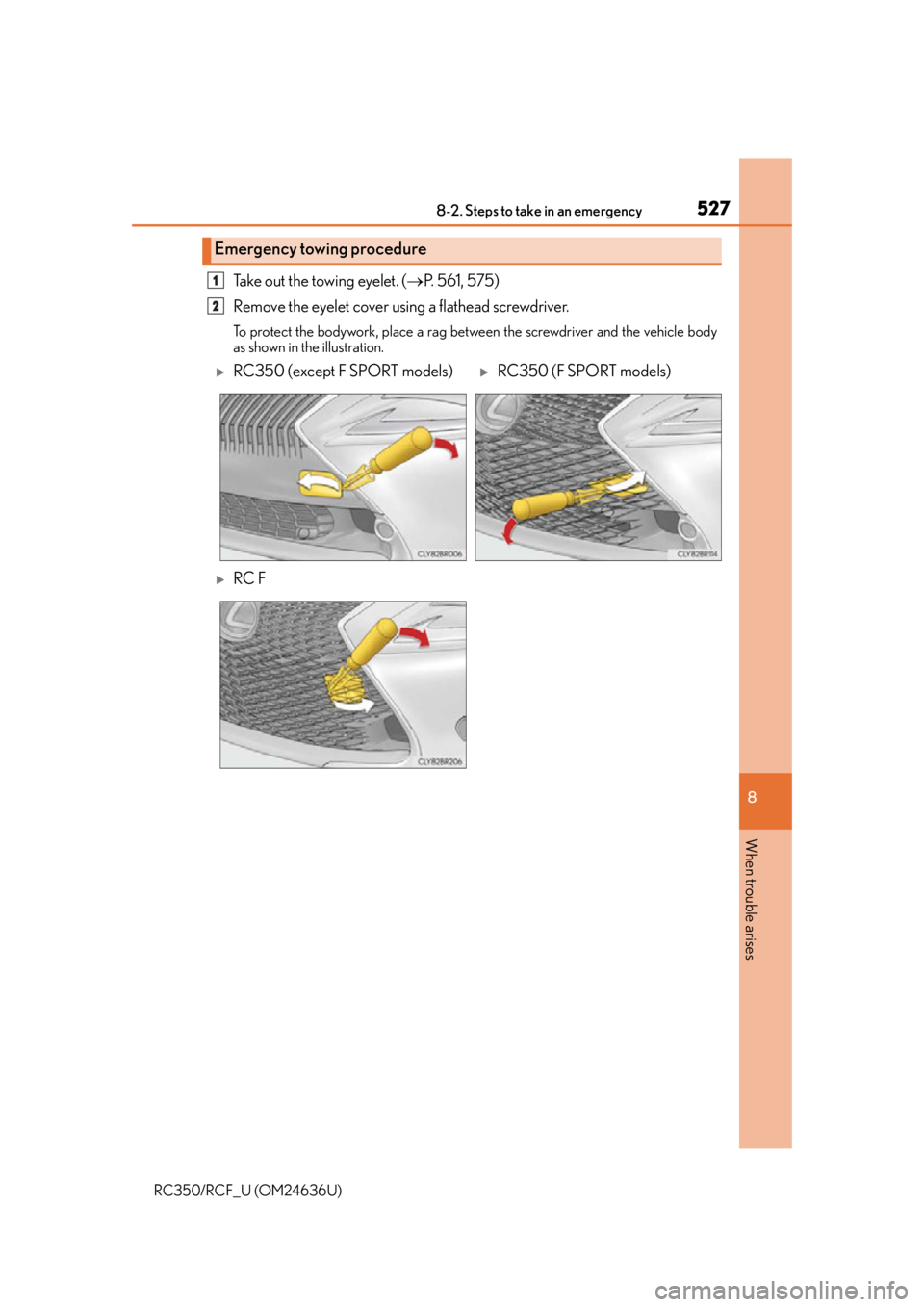
Take out the towing eyelet. (P. 561, 575)
Remove the eyelet cover using a flathead screwdriver.
To protect the bodywork, place a rag between the screwdriver and the vehicle body
as shown in the illustration.
Emergency towing procedure
1
2
RC350 (except F SPORT models)RC350 (F SPORT models)
RC F
Page 528 of 684
5288-2. Steps to take in an emergency
RC350/RCF_U (OM24636U)
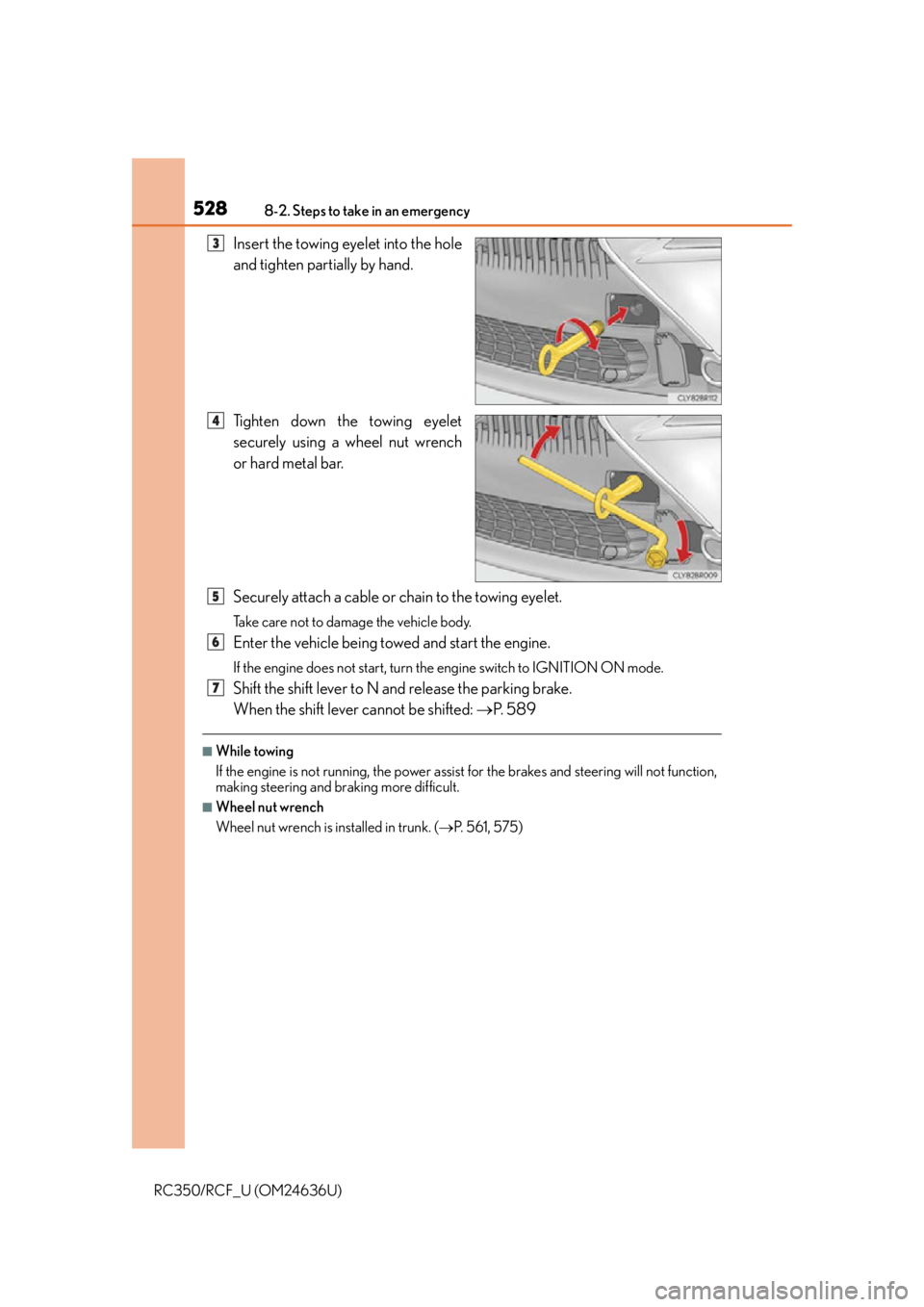
Insert the towing eyelet into the hole
and tighten partially by hand.
Tighten down the towing eyelet
securely using a wheel nut wrench
or hard metal bar.
Securely attach a cable or chain to the towing eyelet.
Take care not to damage the vehicle body.
Enter the vehicle being towed and start the engine.
If the engine does not start, turn the engine switch to IGNITION ON mode.
Shift the shift lever to N and release the parking brake.
When the shift lever cannot be shifted: P. 5 8 9
■While towing
If the engine is not running, the power assist for the brakes and steering will not function,
making steering and br aking more difficult.
■Wheel nut wrench
Wheel nut wrench is installed in trunk. ( P. 561, 575)
3
4
5
6
7
Page 529 of 684
5298-2. Steps to take in an emergency
8
When trouble arises
RC350/RCF_U (OM24636U)
WA R N I N G
Observe the following precautions.
Failure to do so may result in death or serious injury.
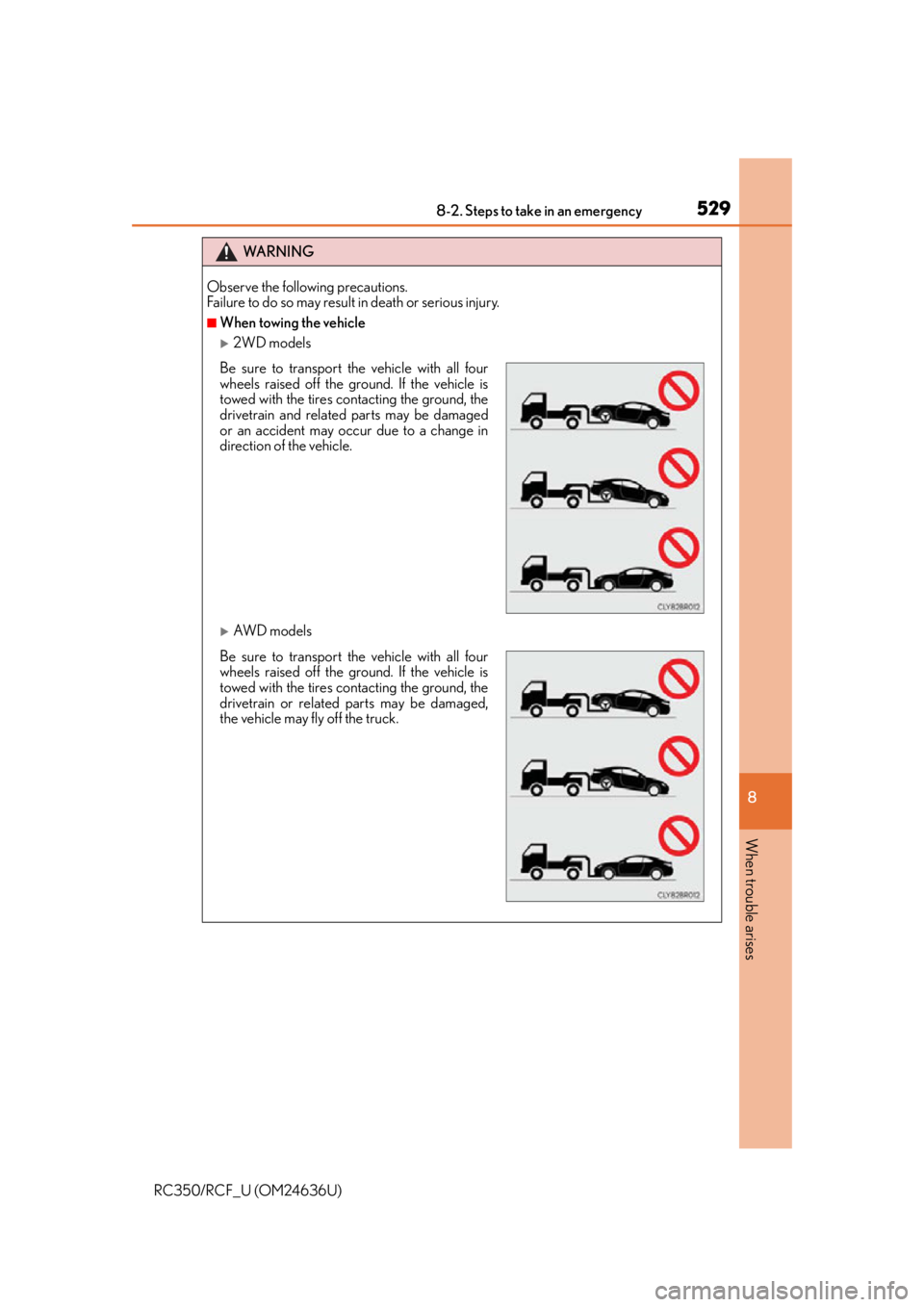
■When towing the vehicle
2WD models
AW D m o d e l s
Be sure to transport the vehicle with all four
wheels raised off the ground. If the vehicle is
towed with the tires contacting the ground, the
drivetrain and related parts may be damaged
or an accident may occur due to a change in
direction of the vehicle.
Be sure to transport the vehicle with all four
wheels raised off the ground. If the vehicle is
towed with the tires contacting the ground, the
drivetrain or related parts may be damaged,
the vehicle may fly off the truck.
Page 530 of 684
5308-2. Steps to take in an emergency
RC350/RCF_U (OM24636U)
WA R N I N G
■While towing
●When towing using a cables or chains, avoid sudden starts, etc. which place excessive
stress on the towing eyelets, cables or chains. The towing eyelets, cables or chains
may become damaged, broken debris ma y hit people and cause serious damage.
●Do not turn the engine switch off.
There is a possibility that the steering wheel is locked and cannot be operated.
■Installing towing eyelet to the vehicle
Make sure that towing eyelet is installed securely.
If not securely installed, towing ey elet may come loose during towing.
NOTICE
■To prevent damage to the vehicle when towing using a wheel-lift type truck (2WD
models)
●Do not tow the vehicle from the rear when the engine switch is off. The steering lock
mechanism is not strong enough to hold the front wheels straight.
●When raising the vehicle from the rear, en sure adequate ground clearance for towing
at the opposite end of the raised vehicle. Without adequate clearance, the vehicle
could be damaged while being towed from the rear.
■To prevent damage to the vehicle when towing using a wheel-lift type truck (AWD
models)
When raising the vehicle, ensure adequate ground clearance for towing at the oppo-
site end of the raised vehicle. Without adequate clearance, the vehicle could be dam-
aged while being towed.
■To prevent body damage when to wing with a sling-type truck
Do not tow with a sling-type truck, either from the front or rear.
■To prevent damage to the drivetrain, susp ension and related parts when performing
emergency towing
When securing a cable or chai n to the vehicle, do not wrap the cable or chain around
drivetrain or suspension co mponents and related parts.