suspension LEXUS RC350 2016 User Guide
[x] Cancel search | Manufacturer: LEXUS, Model Year: 2016, Model line: RC350, Model: LEXUS RC350 2016Pages: 700, PDF Size: 14.12 MB
Page 295 of 700
2954-5. Using the driving support systems
4
Driving
RC350_RC300_RC200t_RC F_U (OM24671U)
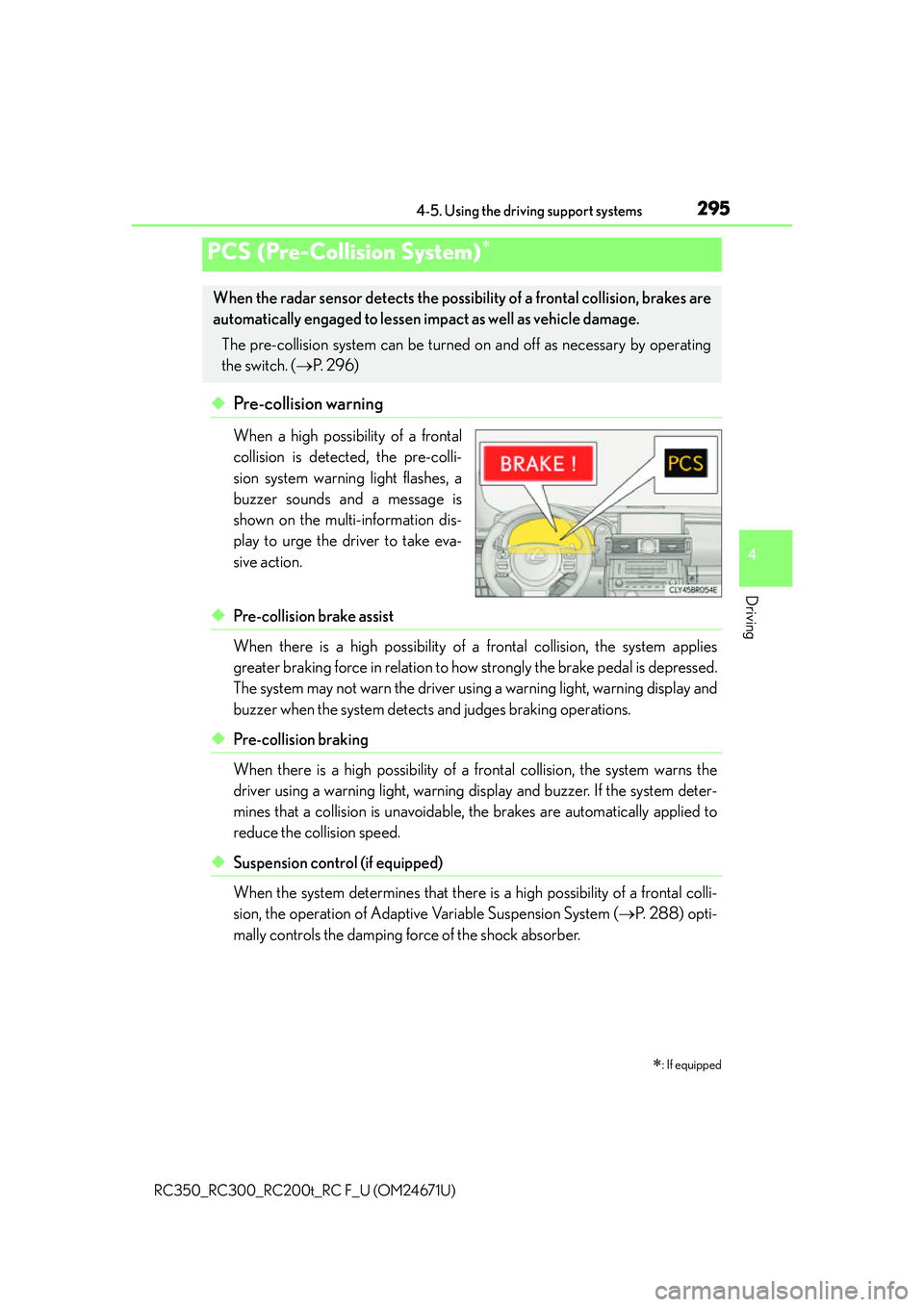
◆Pre-collision warning
When a high possibility of a frontal
collision is detected, the pre-colli-
sion system warning light flashes, a
buzzer sounds and a message is
shown on the multi-information dis-
play to urge the driver to take eva-
sive action.
◆Pre-collision brake assist
When there is a high possibility of a frontal collision, the system applies
greater braking force in relation to ho w strongly the brake pedal is depressed.
The system may not warn the driver using a warning light, warning display and
buzzer when the system detects and judges braking operations.
◆Pre-collision braking
When there is a high possibility of a frontal collision, the system warns the
driver using a warning light, warning di splay and buzzer. If the system deter-
mines that a collision is unavoidable, the brakes are automatically applied to
reduce the collision speed.
◆Suspension control (if equipped)
When the system determines that there is a high possibility of a frontal colli-
sion, the operation of Adaptive Variable Suspension System ( P. 288) opti-
mally controls the damping force of the shock absorber.
PCS (Pre-Collision System)
: If equipped
When the radar sensor detects the possibility of a frontal collision, brakes are
automatically engaged to lessen im pact as well as vehicle damage.
The pre-collision system can be turned on and off as necessary by operating
the switch. ( P. 2 9 6 )
Page 297 of 700
2974-5. Using the driving support systems
4
Driving
RC350_RC300_RC200t_RC F_U (OM24671U)
■The pre-collision system is operational when
The pre-collision system is enabled and the following conditions are met:
●Pre-collision warning:
• Vehicle speed is greater than about 10 mph (15 km/h).
• The speed at which your vehicle is approaching the obstacle or the vehicle running ahead of you is greater than about 10 mph (15 km/h).
●Pre-collision brake assist:
• The VSC system is not disabled.
• Vehicle speed is greater than about 19 mph (30 km/h).
• The speed at which your vehicle is approaching the obstacle or the vehicle running
ahead of you is greater than about 19 mph (30 km/h).
• The brake pedal is depressed.
●Pre-collision braking:
• The VSC system is not disabled.
• Vehicle speed is greater th an about 10 mph (15 km/h).
• The speed at which your vehicle is approaching the obstacle or the vehicle running ahead of you is greater than about 10 mph (15 km/h).
●Suspension control:
• Vehicle speed is greater than about 4 mph (5 km/h).
• The speed at which your vehicle is approaching the obstacle or the vehicle running ahead of you is greater than about 19 mph (30 km/h).
●Steering control:
• The VSC system is not disabled.
• Vehicle speed is greater than about 19 mph (30 km/h).
• The speed at which your vehicle is approaching the obstacle or the vehicle runningahead of you is greater than about 19 mph (30 km/h).
Page 468 of 700
4687-1. Maintenance and care
RC350_RC300_RC200t_RC F_U (OM24671U)
NOTICE
■When using a high pressure car wash
●When washing the vehicle, do not spray the camera or its surrounding area directly
with a high pressure washer. Shock applie d from high pressure water may cause the
device to not operate normally.
●Do not bring the nozzle tip close to boots (rubber or resin manufactured cover), con-
nectors or the following parts. The parts may be damaged if they come into contact
with high-pressure water.
■Hood vent (RC F)
• Traction related parts
• Steering parts • Suspension parts
•Brake parts
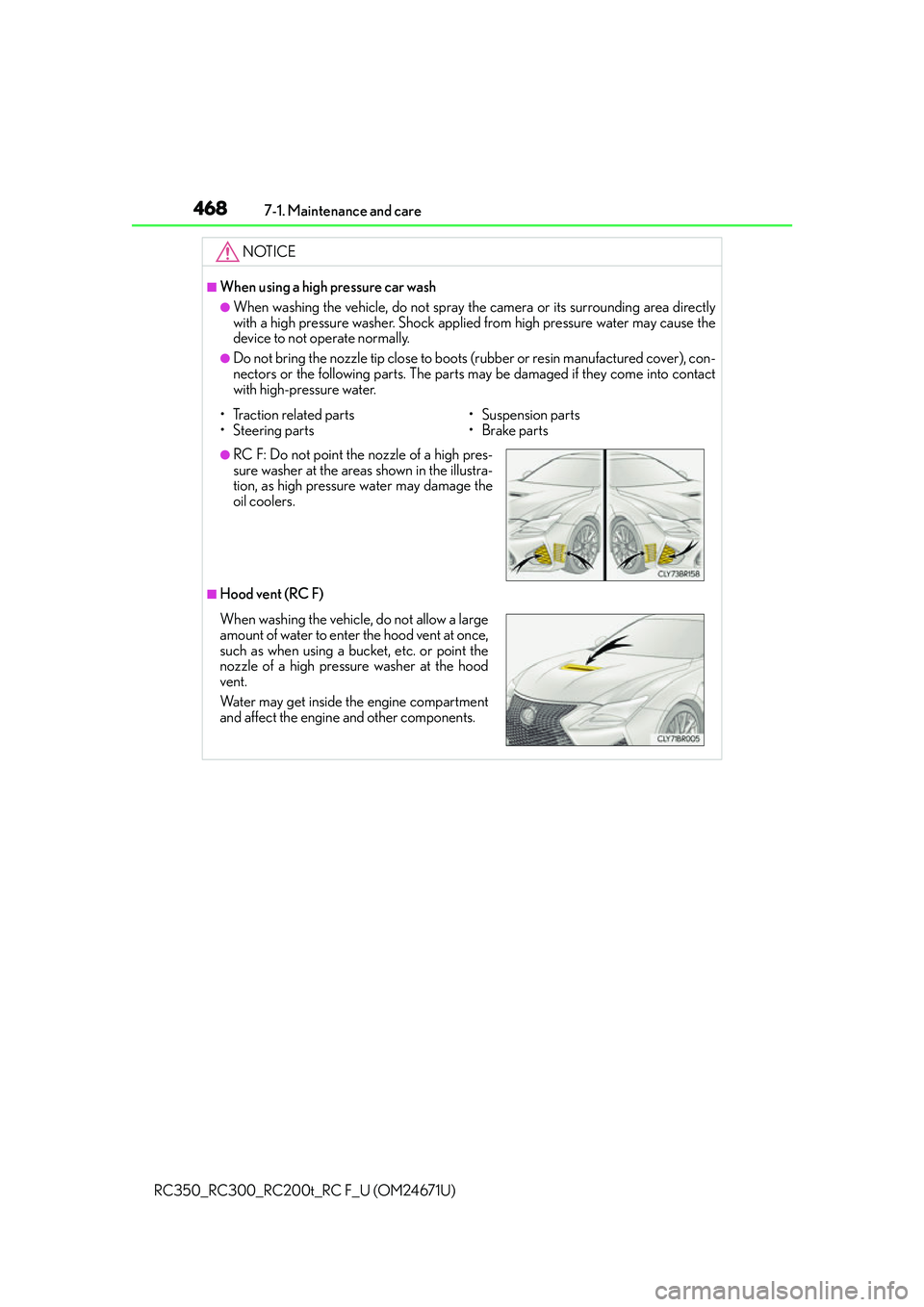
●RC F: Do not point the nozzle of a high pres-
sure washer at the areas shown in the illustra-
tion, as high pressure water may damage the
oil coolers.
When washing the vehicle, do not allow a large
amount of water to enter
the hood vent at once,
such as when using a bucket, etc. or point the
nozzle of a high pressure washer at the hood
vent.
Water may get inside the engine compartment
and affect the engine and other components.
Page 540 of 700
5408-2. Steps to take in an emergency
RC350_RC300_RC200t_RC F_U (OM24671U)
WA R N I N G
■While towing
●When towing using cables or chains, avoid sudden starts, etc. which place excessive
stress on the towing eyelets, cables or chains. The towing eyelets, cables or chains
may become damaged, broken debris may hit people, and cause serious damage.
●Do not turn the engine switch off.
There is a possibility that the steering wheel is locked and cannot be operated.
■Installing towing eyelets to the vehicle
Make sure that towing eyelets are installed securely.
If not securely installed, towing eyelets may come loose during towing.
NOTICE
■To prevent damage to the vehicle when towing using a wheel-lift type truck
●Do not tow the vehicle from the rear when the engine switch is off. The steering lock
mechanism is not strong enough to hold the front wheels straight.
●When raising the vehicle, ensure adequate ground clearance for towing at the oppo-
site end of the raised vehicle. Without adequate clearance, the vehicle could be dam-
aged while being towed.
■To prevent damage to the vehicle when towing with a sling-type truck
Do not tow with a sling-type truck, either from the front or rear.
■To prevent damage to the vehicle during emergency towing
Do not secure cables or chains to the suspension components.
Page 541 of 700
5418-2. Steps to take in an emergency
8
When trouble arises
RC350_RC300_RC200t_RC F_U (OM24671U)
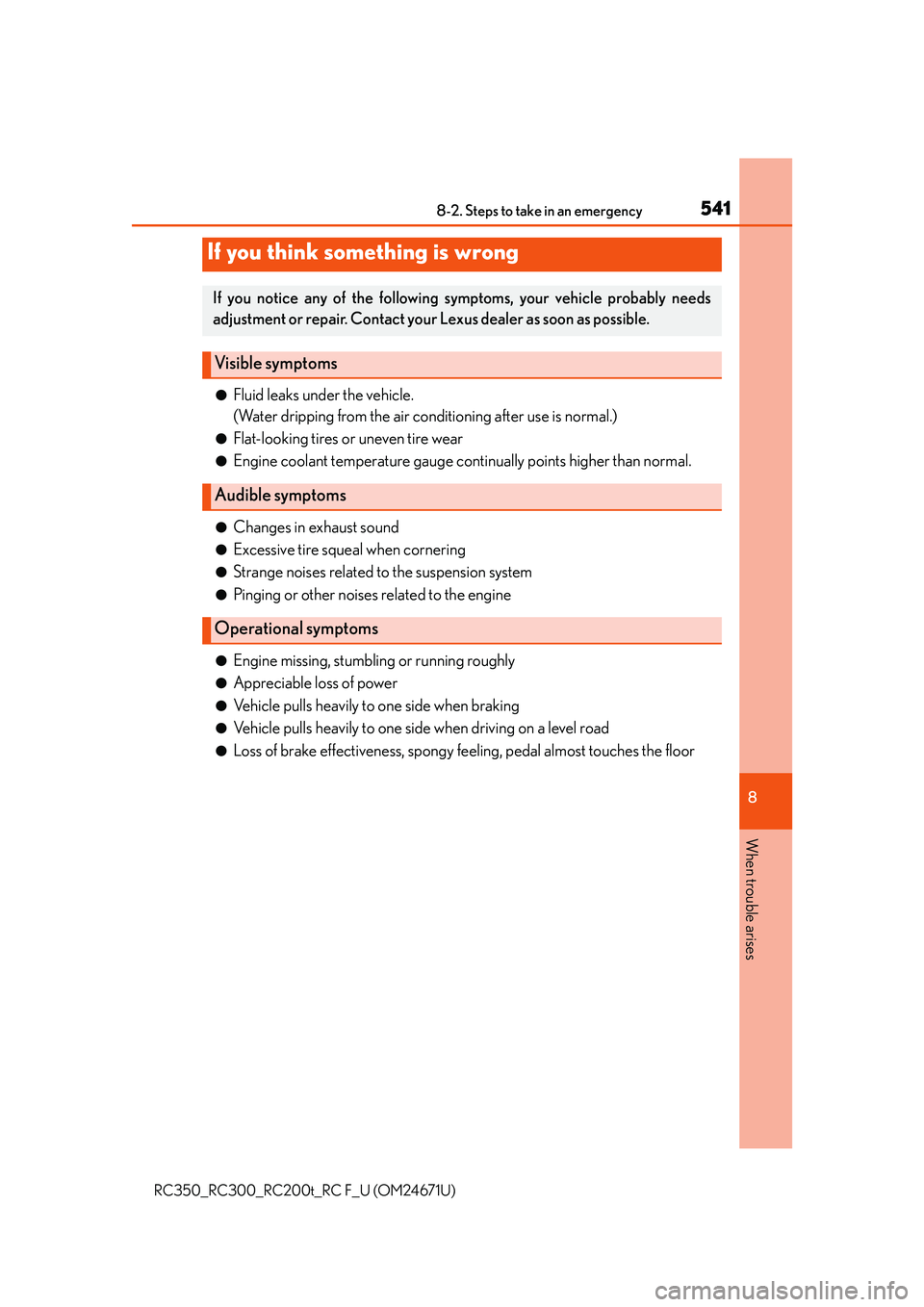
●Fluid leaks under the vehicle.
(Water dripping from the air conditioning after use is normal.)
●Flat-looking tires or uneven tire wear
●Engine coolant temperature gauge cont inually points higher than normal.
●Changes in exhaust sound
●Excessive tire squeal when cornering
●Strange noises related to the suspension system
●Pinging or other noises related to the engine
●Engine missing, stumbling or running roughly
●Appreciable loss of power
●Vehicle pulls heavily to one side when braking
●Vehicle pulls heavily to one side when driving on a level road
●Loss of brake effectiveness, spongy feeling, pedal almost touches the floor
If you think something is wrong
If you notice any of the following symptoms, your vehicle probably needs
adjustment or repair. Contact your Lexus dealer as soon as possible.
Visible symptoms
Audible symptoms
Operational symptoms
Page 582 of 700
5828-2. Steps to take in an emergency
RC350_RC300_RC200t_RC F_U (OM24671U)
WA R N I N G
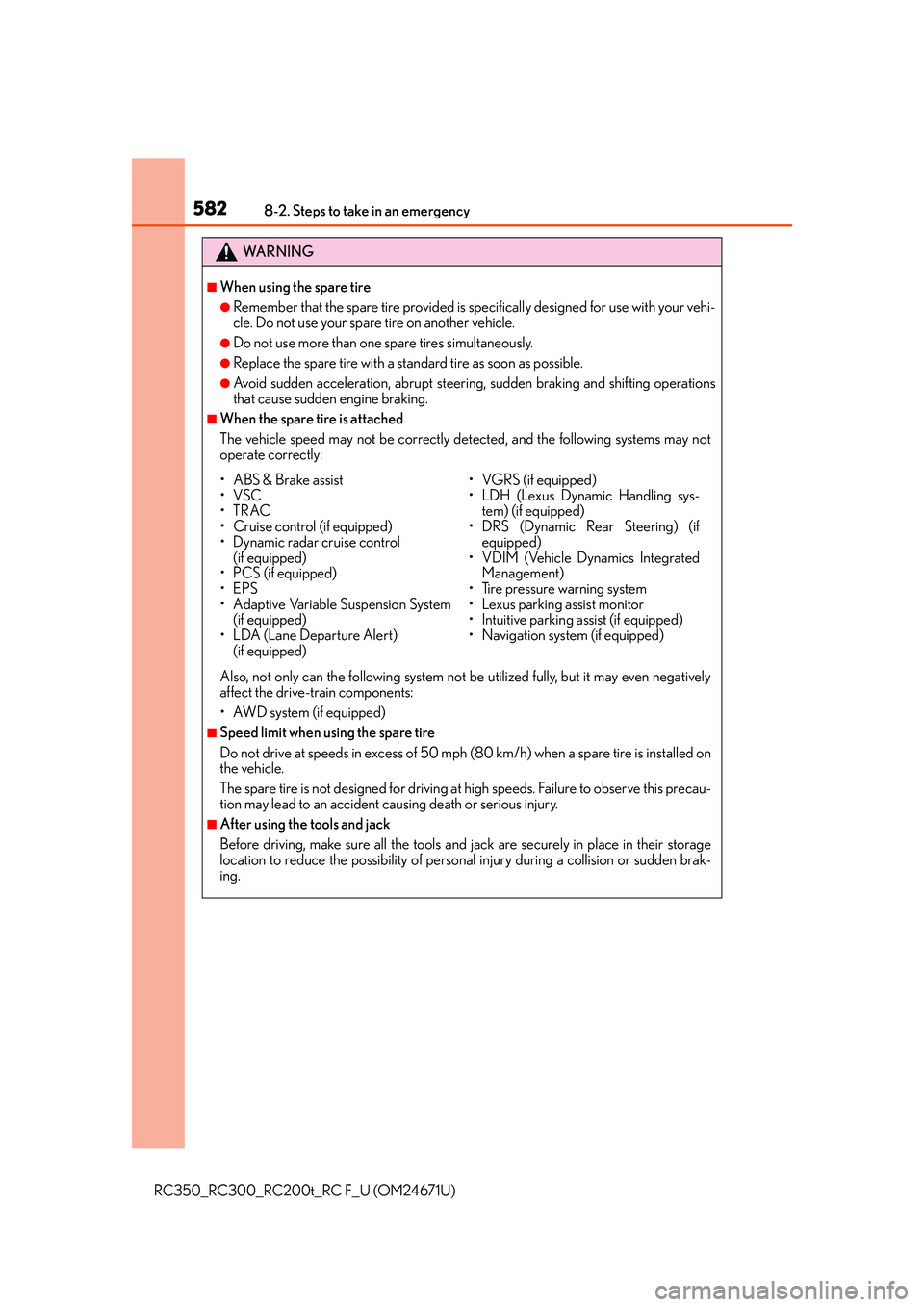
■When using the spare tire
●Remember that the spare tire provided is specifically designed for use with your vehi-
cle. Do not use your spare tire on another vehicle.
●Do not use more than one spare tires simultaneously.
●Replace the spare tire with a standard tire as soon as possible.
●Avoid sudden acceleration, abrupt steering, sudden braking and shifting operations
that cause sudden engine braking.
■When the spare tire is attached
The vehicle speed may not be correctly detected, and the following systems may not
operate correctly:
Also, not only can the following system not be utilized fully, but it may even negatively
affect the drive-train components:
• AWD system (if equipped)
■Speed limit when using the spare tire
Do not drive at speeds in excess of 50 mp h (80 km/h) when a spare tire is installed on
the vehicle.
The spare tire is not designed for driving at high speeds. Failure to observe this precau-
tion may lead to an accident causing death or serious injury.
■After using the tools and jack
Before driving, make sure all the tools and jack are securely in place in their storage
location to reduce the possibility of personal injury during a collision or sudden brak-
ing.
• ABS & Brake assist
•VSC
•TRAC
• Cruise control (if equipped)
• Dynamic radar cruise control (if equipped)
• PCS (if equipped)
•EPS
• Adaptive Variable Suspension System (if equipped)
• LDA (Lane Departure Alert) (if equipped) • VGRS (if equipped)
• LDH (Lexus Dynamic Handling sys-
tem) (if equipped)
• DRS (Dynamic Rear Steering) (if equipped)
• VDIM (Vehicle Dy namics Integrated
Management)
• Tire pressure warning system
• Lexus parking assist monitor
• Intuitive parking assist (if equipped)
• Navigation system (if equipped)
Page 673 of 700
673
For owners
RC350_RC300_RC200t_RC F_U (OM24671U)
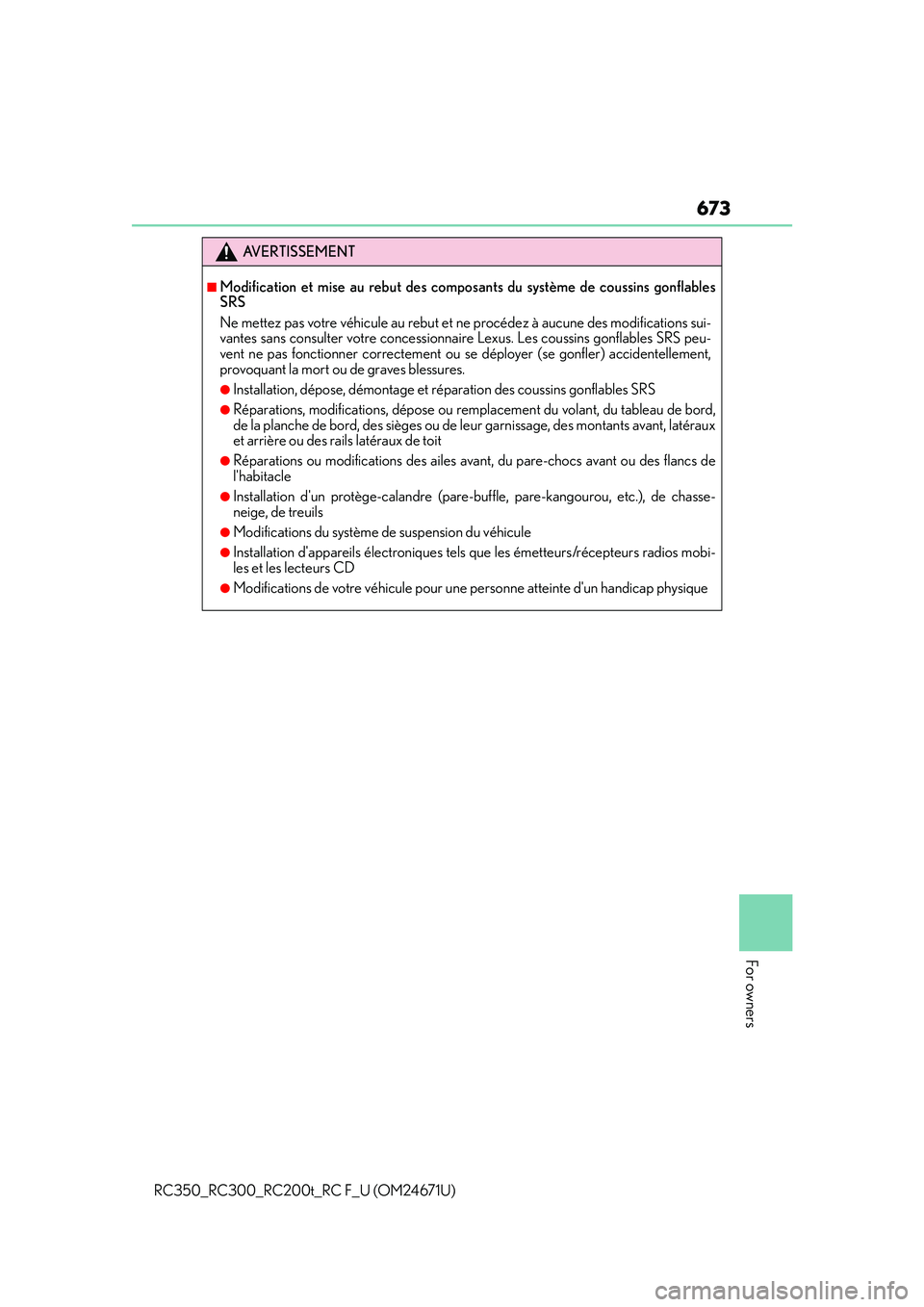
AVERTISSEMENT
■Modification et mise au rebut des composants du système de coussins gonflables
SRS
Ne mettez pas votre véhicule au rebut et ne procédez à aucune des modifications sui-
vantes sans consulter votre concessionnaire Lexus. Les coussins gonflables SRS peu-
vent ne pas fonctionner correctement ou se déployer (se gonfler) accidentellement,
provoquant la mort ou de graves blessures.
●Installation, dépose, démontage et réparation des coussins gonflables SRS
●Réparations, modifications, dépose ou remplacement du volant, du tableau de bord,
de la planche de bord, des sièges ou de leur garnissage, des montants avant, latéraux
et arrière ou des rails latéraux de toit
●Réparations ou modifications des ailes avant, du pare-chocs avant ou des flancs de
l'habitacle
●Installation d'un protège-ca landre (pare-buffle, pare-kangourou, etc.), de chasse-
neige, de treuils
●Modifications du système de suspension du véhicule
●Installation d'appareils électroniques tels que les émetteurs/récepteurs radios mobi-
les et les lecteurs CD
●Modifications de votre véhicule pour une personne atteinte d'un handicap physique
Page 680 of 700
680
RC350_RC300_RC200t_RC F_U (OM24671U)Alphabetical index
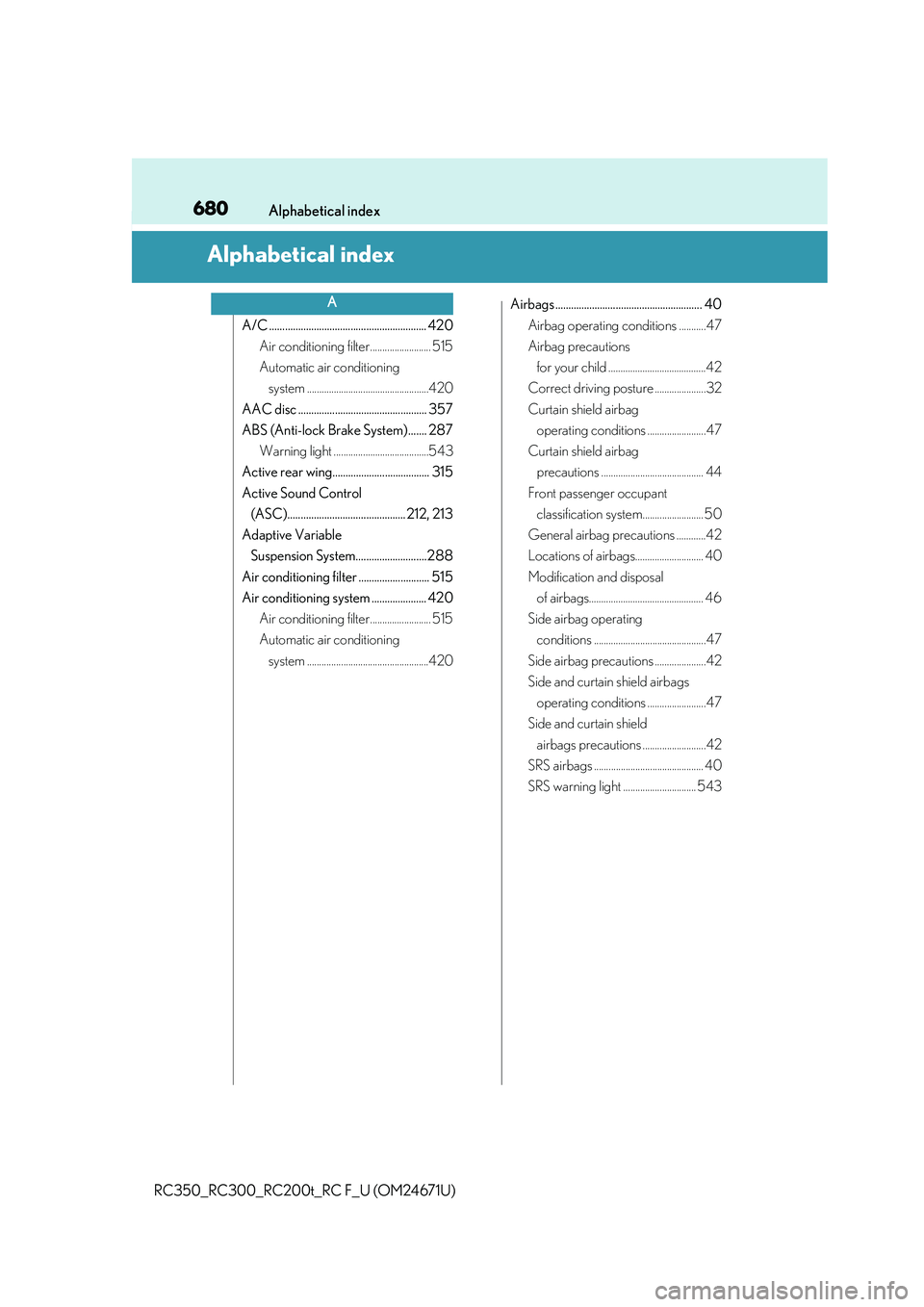
Alphabetical index
A/C ............................................................ 420
Air conditioning filter......................... 515
Automatic air conditioning system ..................................................420
AAC disc ................................................. 357
ABS (Anti-lock Brake System)....... 287 Warning light .......................................543
Active rear wing..................................... 315
Active Sound Control (ASC)............................................. 212, 213
Adaptive Variable Suspension System...........................288
Air conditioning filter ........................... 515
Air conditioning system ..................... 420 Air conditioning filter......................... 515
Automatic air conditioning system ..................................................420 Airbags ........................................................ 40
Airbag operating conditions ...........47
Airbag precautions for your child ........................................42
Correct driving posture .....................32
Curtain shield airbag operating conditions ........................47
Curtain shield airbag precautions .......................................... 44
Front passenger occupant classification system......................... 50
General airbag precautions ............42
Locations of airbags............................ 40
Modification and disposal of airbags............................................... 46
Side airbag operating conditions ..............................................47
Side airbag precautions .....................42
Side and curtain shield airbags operating conditions ........................47
Side and curtain shield airbags precautions ..........................42
SRS airbags ............................................. 40
SRS warning light .............................. 543
A