brake LEXUS RC350 2016 Workshop Manual
[x] Cancel search | Manufacturer: LEXUS, Model Year: 2016, Model line: RC350, Model: LEXUS RC350 2016Pages: 700, PDF Size: 14.12 MB
Page 476 of 700
4767-2. Maintenance
RC350_RC300_RC200t_RC F_U (OM24671U)
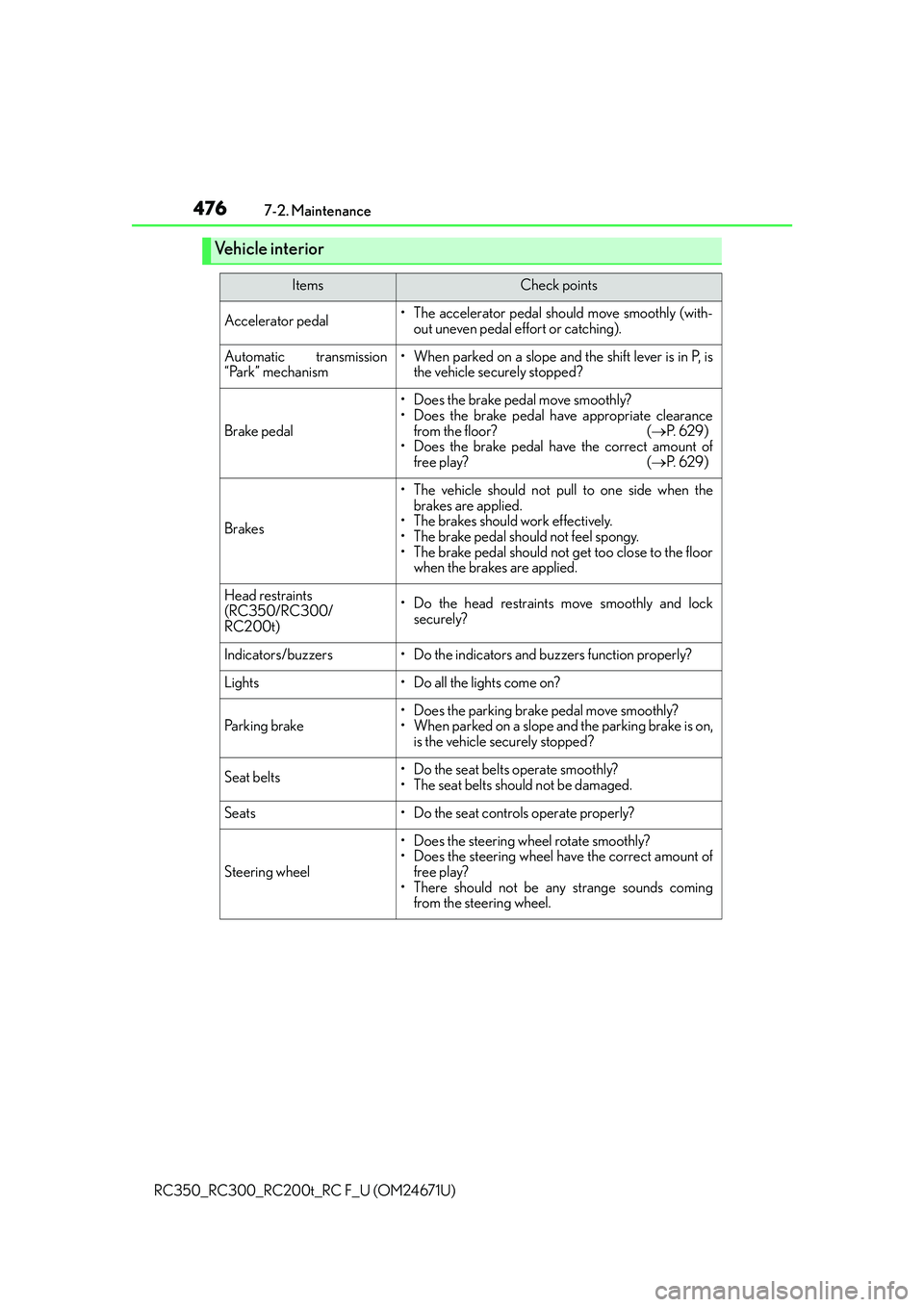
Vehicle interior
ItemsCheck points
Accelerator pedal• The accelerator pedal should move smoothly (with- out uneven pedal effort or catching).
Automatic transmission
“Park” mechanism• When parked on a slope and the shift lever is in P, isthe vehicle securely stopped?
Brake pedal
• Does the brake pedal move smoothly?
• Does the brake pedal have appropriate clearance
from the floor? ( P. 6 2 9 )
• Does the brake pedal have the correct amount of
free play? ( P. 6 2 9 )
Brakes
• The vehicle should not pull to one side when the
brakes are applied.
• The brakes should work effectively.
• The brake pedal should not feel spongy.
• The brake pedal should not get too close to the floor when the brakes are applied.
Head restraints
(RC350/RC300/
RC200t)• Do the head restraints move smoothly and locksecurely?
Indicators/buzzers• Do the indicators and buzzers function properly?
Lights• Do all the lights come on?
Parking brake• Does the parking brake pedal move smoothly?
• When parked on a slope and the parking brake is on,
is the vehicle securely stopped?
Seat belts•Do the seat belt s operate smoothly?
• The seat belts should not be damaged.
Seats• Do the seat controls operate properly?
Steering wheel
• Does the steering wheel rotate smoothly?
• Does the steering wheel have the correct amount of free play?
• There should not be an y strange sounds coming
from the steering wheel.
Page 479 of 700
479
RC350_RC300_RC200t_RC F_U (OM24671U)
7
Maintenance and care
7-3. Do-it-yourself maintenance
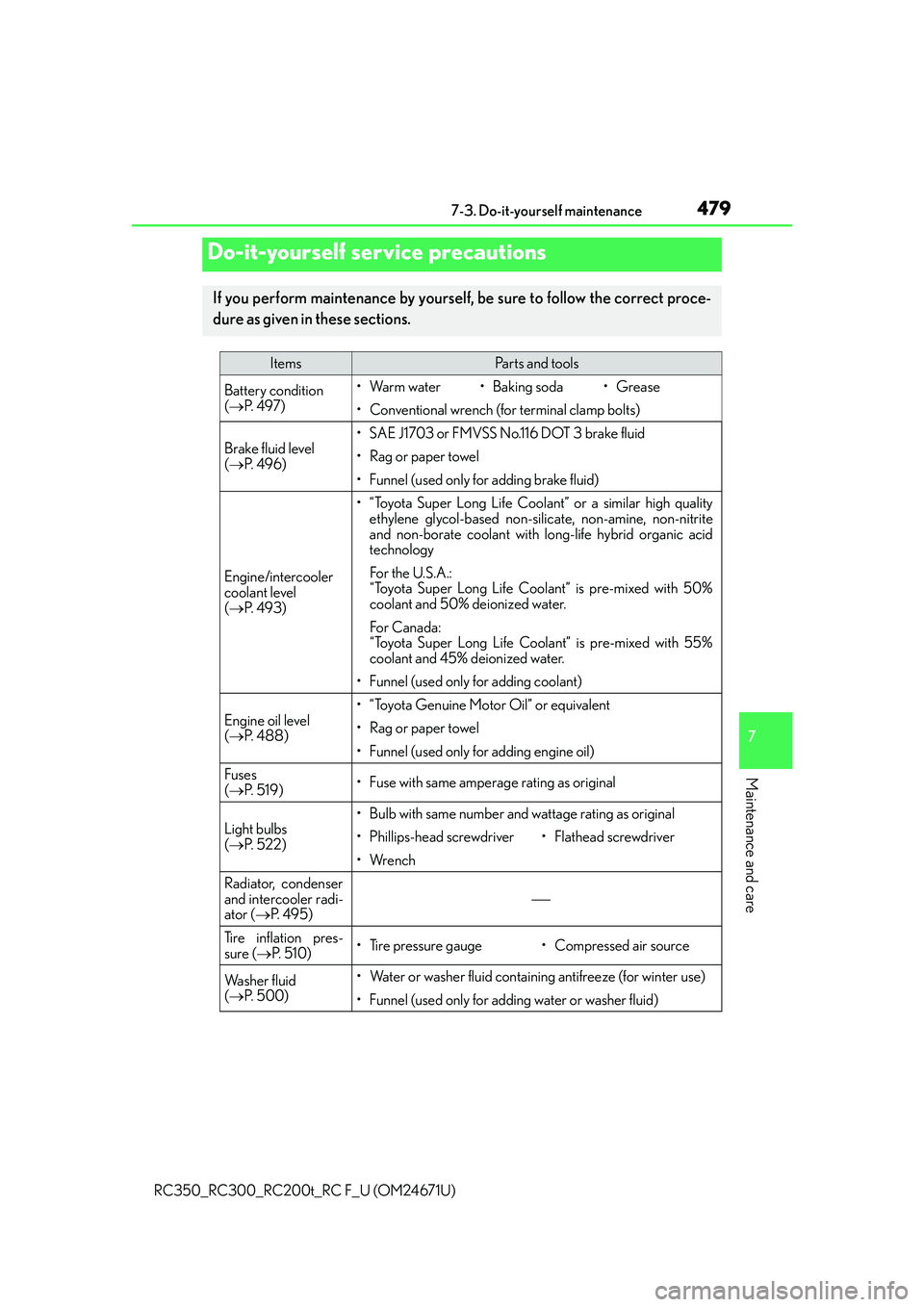
Do-it-yourself service precautions
If you perform maintenance by yourself, be sure to follow the correct proce-
dure as given in these sections.
ItemsPa r t s a n d t o o l s
Battery condition
( P. 4 9 7 )•Warm water• Baking soda•Grease
• Conventional wrench (for terminal clamp bolts)
Brake fluid level
( P. 4 9 6 )• SAE J1703 or FMVSS No.116 DOT 3 brake fluid
• Rag or paper towel
• Funnel (used only for adding brake fluid)
Engine/intercooler
coolant level
( P. 4 9 3 )
• “Toyota Super Long Life Coolant” or a similar high quality
ethylene glycol-based non-silicate, non-amine, non-nitrite
and non-borate coolant with long-life hybrid organic acid
technology
For the U.S.A.:
“Toyota Super Long Life Coolant” is pre-mixed with 50%
coolant and 50% deionized water.
For Canada:
“Toyota Super Long Life Coolant” is pre-mixed with 55%
coolant and 45% deionized water.
• Funnel (used only for adding coolant)
Engine oil level
( P. 4 8 8 )
• “Toyota Genuine Motor Oil” or equivalent
• Rag or paper towel
• Funnel (used only for adding engine oil)
Fuses
( P. 5 1 9 )• Fuse with same amperage rating as original
Light bulbs
( P. 522)
• Bulb with same number and wattage rating as original
• Phillips-head screwdriver•Flathead screwdriver
•Wrench
Radiator, condenser
and intercooler radi-
ator ( P. 4 9 5 )
Tire inflation pres-
sure ( P. 5 1 0 )• Tire pressure gauge• Compressed air source
Wa s h e r f l u i d
( P. 500)• Water or washer fluid containi ng antifreeze (for winter use)
• Funnel (used only for adding water or washer fluid)
Page 485 of 700
4857-3. Do-it-yourself maintenance
7
Maintenance and care
RC350_RC300_RC200t_RC F_U (OM24671U)
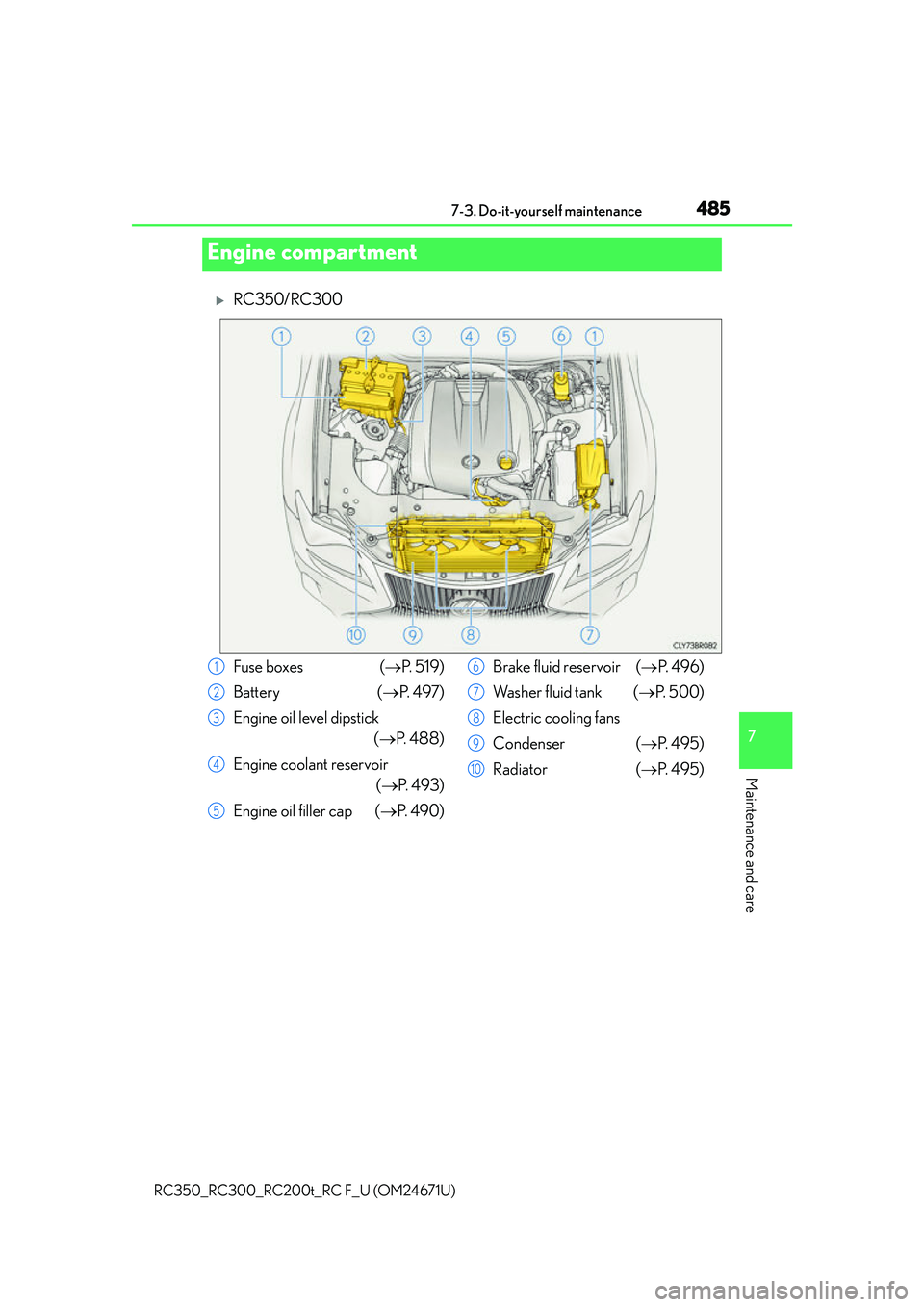
RC350/RC300
Engine compartment
Fuse boxes (P. 5 1 9 )
Battery ( P. 4 9 7 )
Engine oil level dipstick (P. 4 8 8 )
Engine coolant reservoir (P. 4 9 3 )
Engine oil filler cap ( P. 4 9 0 ) Brake fluid reservoir (
P. 4 9 6 )
Wa s h e r f l u i d t a n k ( P. 5 0 0 )
Electric cooling fans
Condenser ( P. 4 9 5 )
Radiator ( P. 4 9 5 )1
2
3
4
5
6
7
8
9
10
Page 486 of 700
4867-3. Do-it-yourself maintenance
RC350_RC300_RC200t_RC F_U (OM24671U)
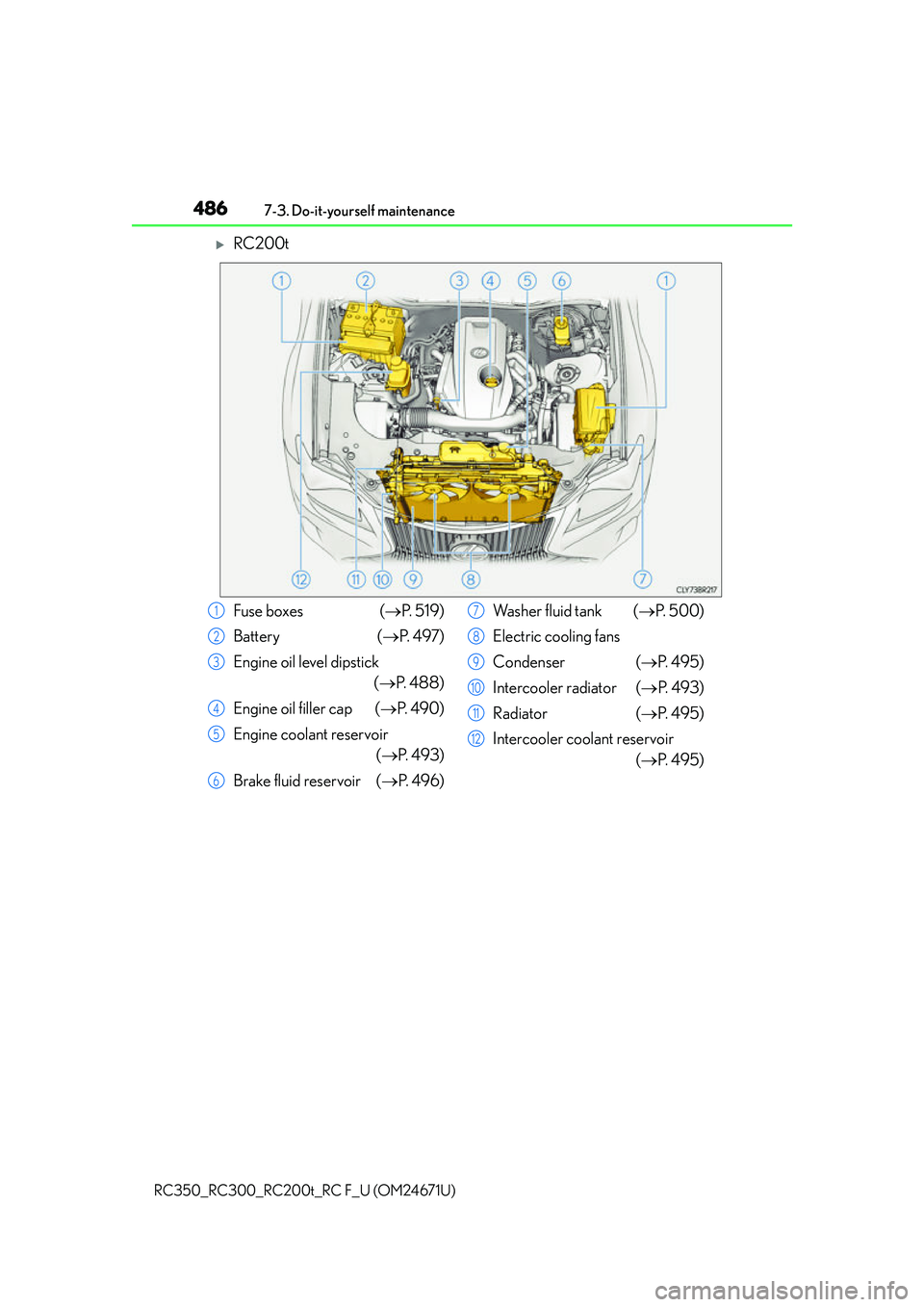
RC200t
Fuse boxes ( P. 5 1 9 )
Battery ( P. 4 9 7 )
Engine oil level dipstick (P. 4 8 8 )
Engine oil filler cap ( P. 4 9 0 )
Engine coolant reservoir (P. 4 9 3 )
Brake fluid reservoir ( P. 4 9 6 ) Wa s h e r f l u i d t a n k (
P. 5 0 0 )
Electric cooling fans
Condenser ( P. 4 9 5 )
Intercooler radiator ( P. 4 9 3 )
Radiator ( P. 4 9 5 )
Intercooler coolant reservoir (P. 4 9 5 )1
2
3
4
5
6
7
8
9
10
11
12
Page 487 of 700
4877-3. Do-it-yourself maintenance
7
Maintenance and care
RC350_RC300_RC200t_RC F_U (OM24671U)
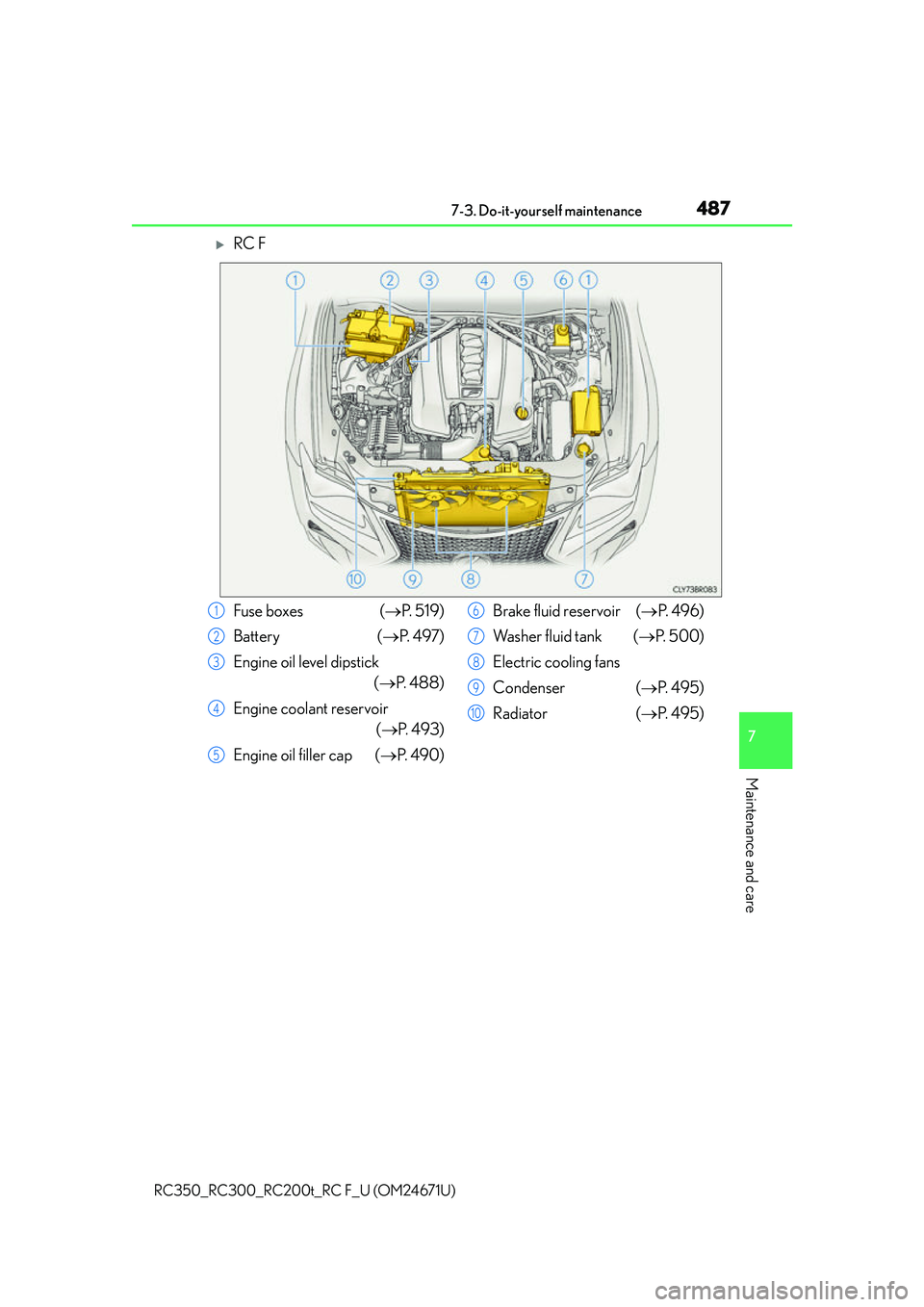
RC F
Fuse boxes (P. 5 1 9 )
Battery ( P. 4 9 7 )
Engine oil level dipstick (P. 4 8 8 )
Engine coolant reservoir (P. 4 9 3 )
Engine oil filler cap ( P. 4 9 0 ) Brake fluid reservoir (
P. 4 9 6 )
Wa s h e r f l u i d t a n k ( P. 5 0 0 )
Electric cooling fans
Condenser ( P. 4 9 5 )
Radiator ( P. 4 9 5 )1
2
3
4
5
6
7
8
9
10
Page 496 of 700
4967-3. Do-it-yourself maintenance
RC350_RC300_RC200t_RC F_U (OM24671U)
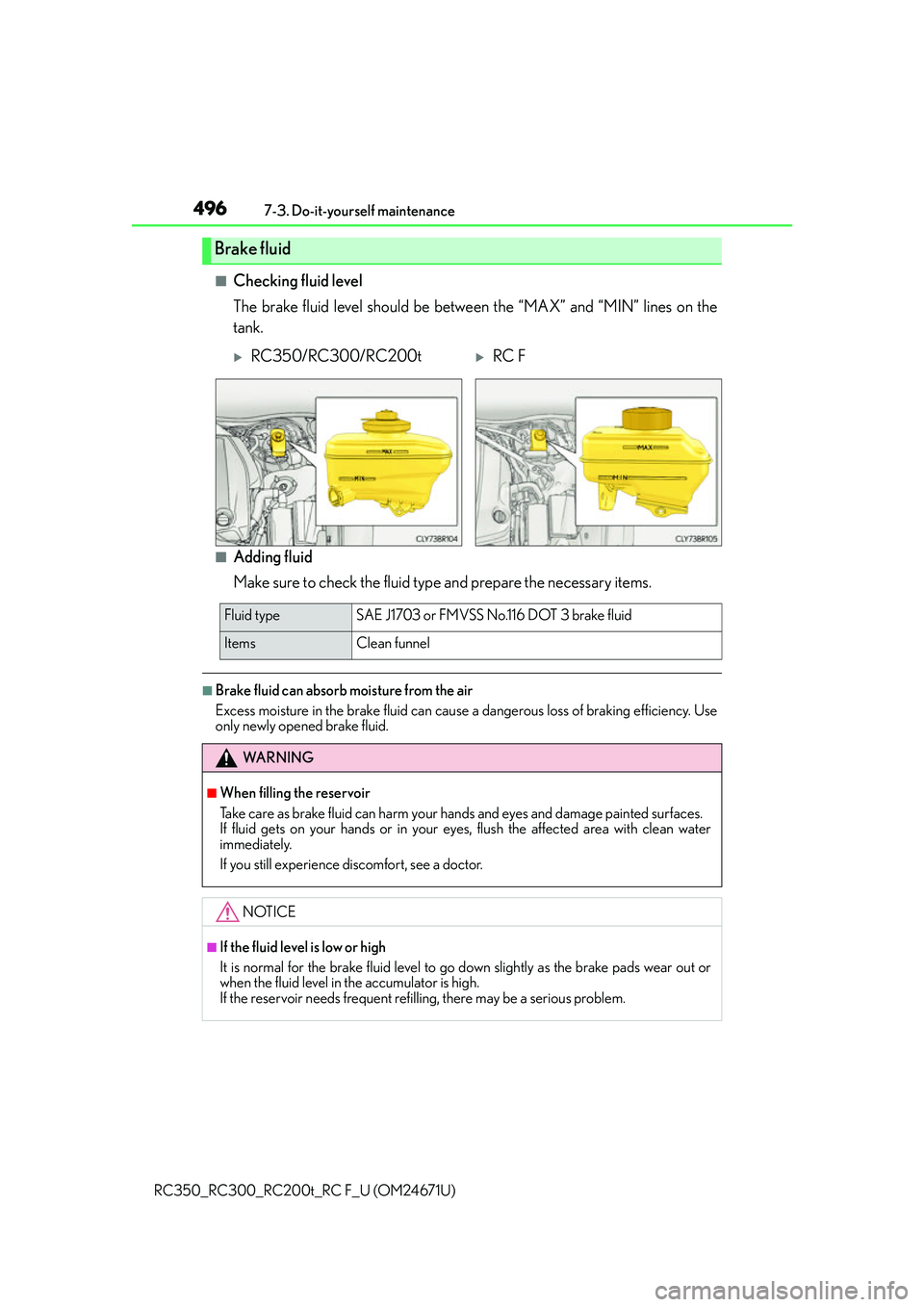
■Checking fluid level
The brake fluid level should be between the “MAX” and “MIN” lines on the
tank.
■Adding fluid
Make sure to check the fluid type and prepare the necessary items.
■Brake fluid can absorb moisture from the air
Excess moisture in the brake fluid can cause a dangerous loss of braking efficiency. Use
only newly opened brake fluid.
Brake fluid
RC350/RC300/RC200tRC F
Fluid type SAE J1703 or FMVSS No.116 DOT 3 brake fluid
Items Clean funnel
WA R N I N G
■When filling the reservoir
Take care as brake fluid can harm your hands and eyes and damage painted surfaces.
If fluid gets on your hands or in your eyes, flush the affected area with clean water
immediately.
If you still experience discomfort, see a doctor.
NOTICE
■If the fluid level is low or high
It is normal for the brake fluid level to go down slightly as the brake pads wear out or
when the fluid level in the accumulator is high.
If the reservoir needs frequent refil ling, there may be a serious problem.
Page 533 of 700
5338-1. Essential information
8
When trouble arises
RC350_RC300_RC200t_RC F_U (OM24671U)
Steadily step on the brake pedal with both feet and firmly depress it.
Do not pump the brake pedal repeatedly as this will increase the effort required to
slow the vehicle.
Shift the shift lever to N.
If the shift lever is shifted to N
After slowing down, stop the vehicle in a safe place by the road.
Stop the engine.
If the shift lever cannot be shifted to N
Keep depressing the brake pedal with both feet to reduce vehicle speed as
much as possible.
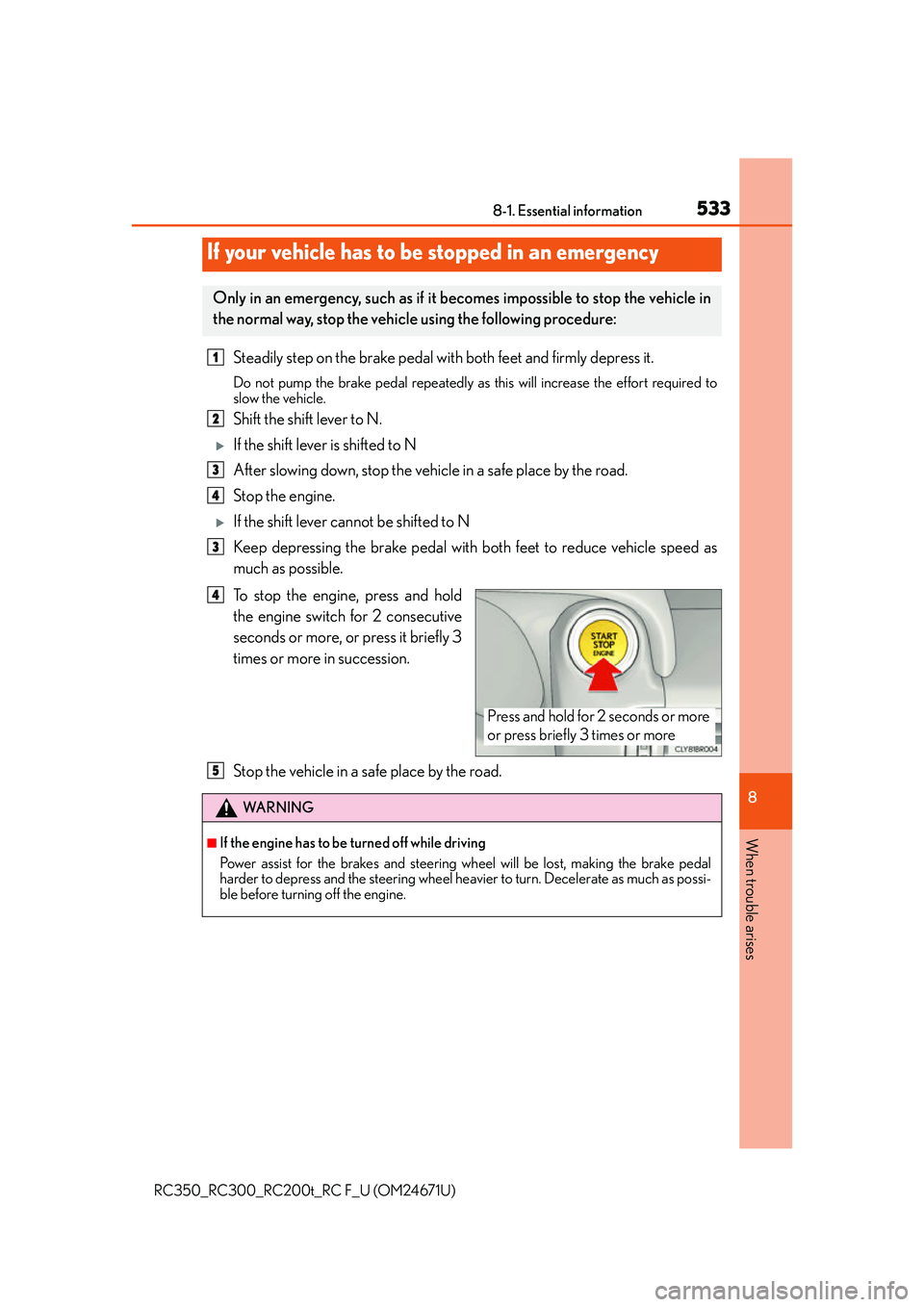
To stop the engine, press and hold
the engine switch for 2 consecutive
seconds or more, or press it briefly 3
times or more in succession.
Stop the vehicle in a safe place by the road.
If your vehicle has to be stopped in an emergency
Only in an emergency, such as if it becomes impossible to stop the vehicle in
the normal way, stop the vehicle using the following procedure:
1
2
3
4
3
Press and hold for 2 seconds or more
or press briefly 3 times or more
4
WA R N I N G
■If the engine has to be turned off while driving
Power assist for the brakes and steering wheel will be lost, making the brake pedal
harder to depress and the steering wheel heavier to turn. Decelerate as much as possi-
ble before turning off the engine.
5
Page 536 of 700
5368-2. Steps to take in an emergency
RC350_RC300_RC200t_RC F_U (OM24671U)
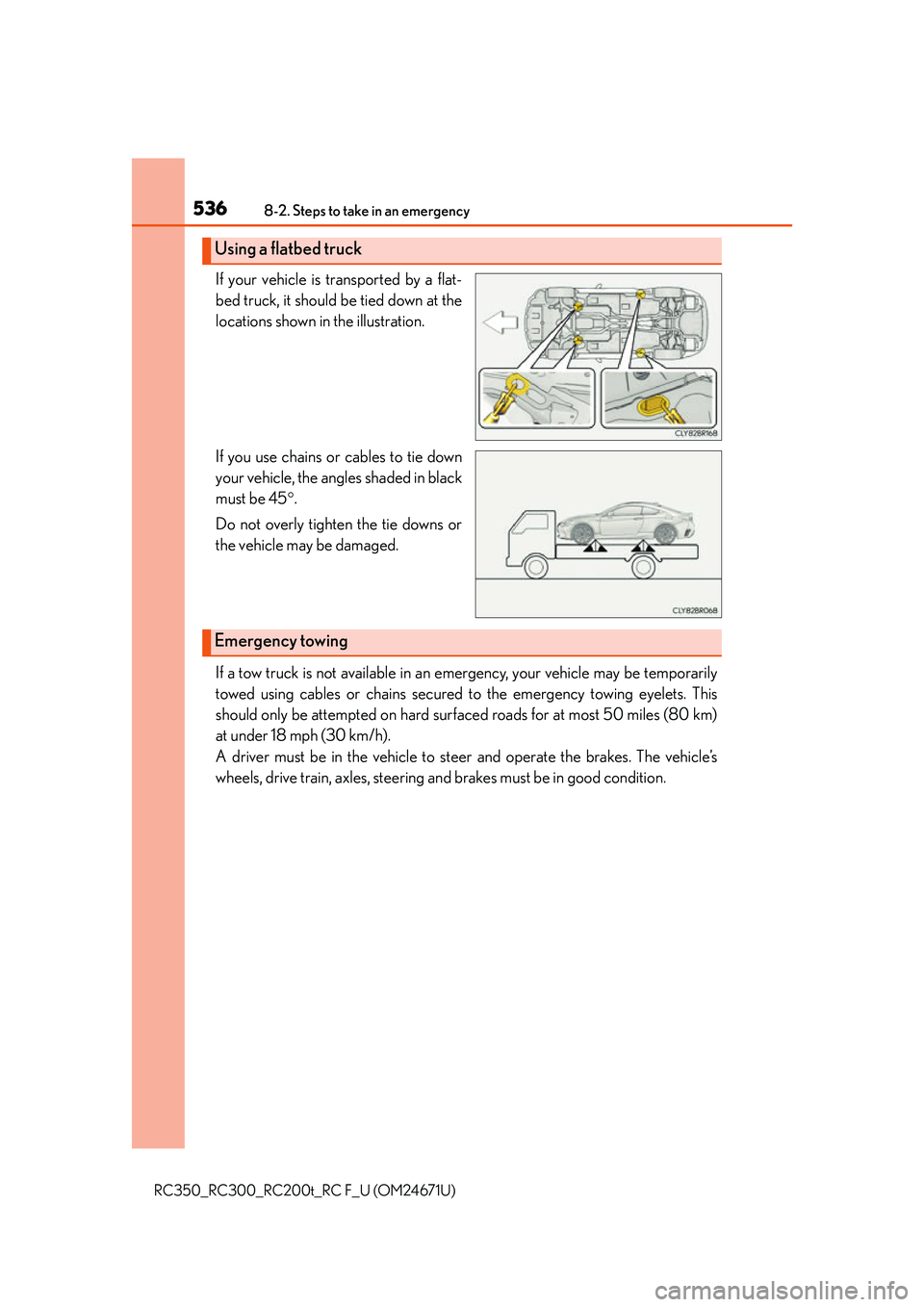
If your vehicle is transported by a flat-
bed truck, it should be tied down at the
locations shown in the illustration.
If you use chains or cables to tie down
your vehicle, the angles shaded in black
must be 45.
Do not overly tighten the tie downs or
the vehicle may be damaged.
If a tow truck is not available in an emergency, your vehicle may be temporarily
towed using cables or chains secured to the emergency towing eyelets. This
should only be attempted on hard surf aced roads for at most 50 miles (80 km)
at under 18 mph (30 km/h).
A driver must be in the vehicle to steer and operate the brakes. The vehicle’s
wheels, drive train, axles, steering an d brakes must be in good condition.
Using a flatbed truck
Emergency towing
Page 538 of 700
5388-2. Steps to take in an emergency
RC350_RC300_RC200t_RC F_U (OM24671U)
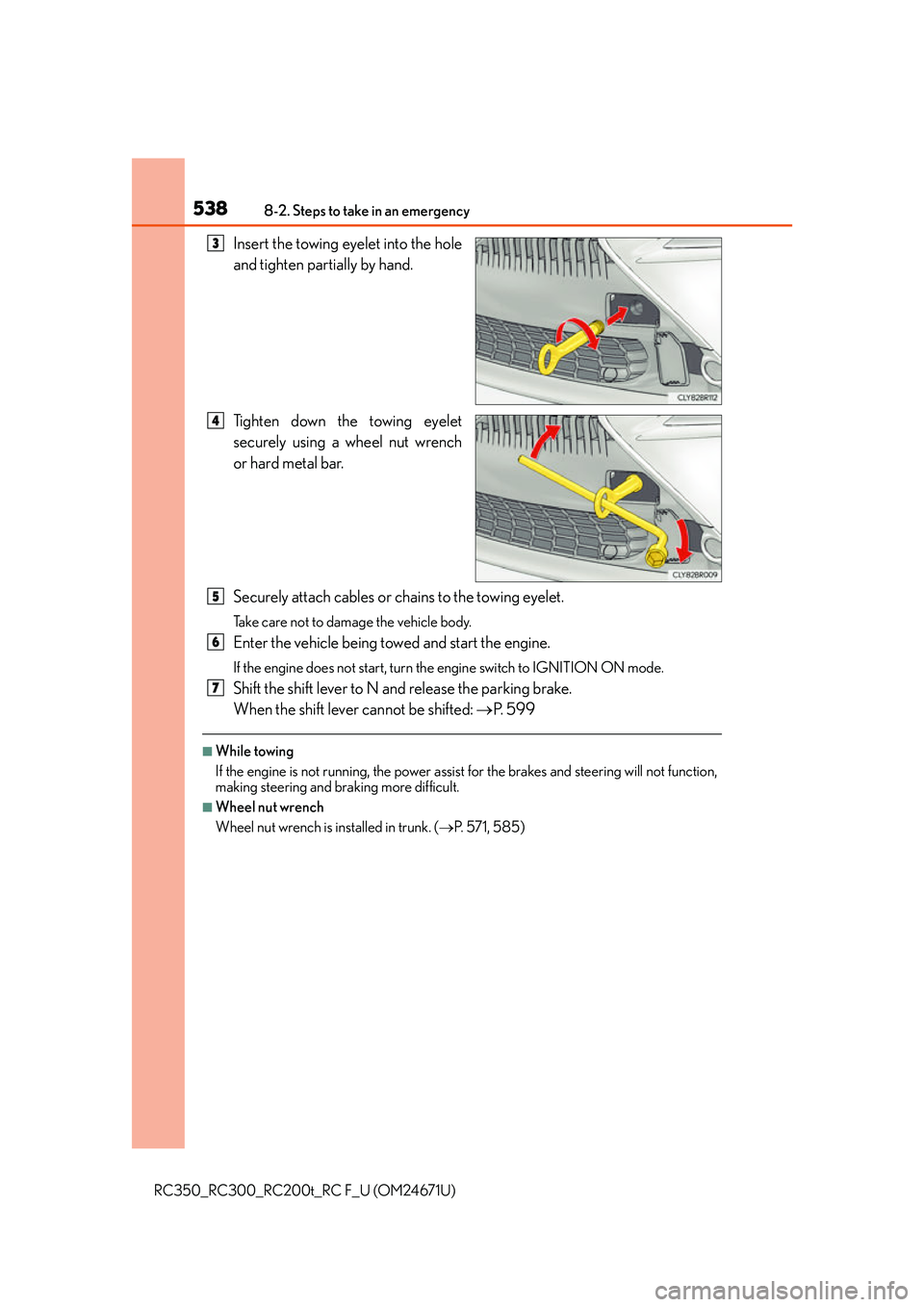
Insert the towing eyelet into the hole
and tighten partially by hand.
Tighten down the towing eyelet
securely using a wheel nut wrench
or hard metal bar.
Securely attach cables or chains to the towing eyelet.
Take care not to damage the vehicle body.
Enter the vehicle being towed and start the engine.
If the engine does not start, turn the engine switch to IGNITION ON mode.
Shift the shift lever to N and release the parking brake.
When the shift lever cannot be shifted: P. 5 9 9
■While towing
If the engine is not running, the power assist for the brakes and steering will not function,
making steering and br aking more difficult.
■Wheel nut wrench
Wheel nut wrench is installed in trunk. ( P. 571, 585)
3
4
5
6
7
Page 541 of 700
5418-2. Steps to take in an emergency
8
When trouble arises
RC350_RC300_RC200t_RC F_U (OM24671U)
●Fluid leaks under the vehicle.
(Water dripping from the air conditioning after use is normal.)
●Flat-looking tires or uneven tire wear
●Engine coolant temperature gauge cont inually points higher than normal.
●Changes in exhaust sound
●Excessive tire squeal when cornering
●Strange noises related to the suspension system
●Pinging or other noises related to the engine
●Engine missing, stumbling or running roughly
●Appreciable loss of power
●Vehicle pulls heavily to one side when braking
●Vehicle pulls heavily to one side when driving on a level road
●Loss of brake effectiveness, spongy feeling, pedal almost touches the floor
If you think something is wrong
If you notice any of the following symptoms, your vehicle probably needs
adjustment or repair. Contact your Lexus dealer as soon as possible.
Visible symptoms
Audible symptoms
Operational symptoms