wheel size LEXUS RC350 2017 User Guide
[x] Cancel search | Manufacturer: LEXUS, Model Year: 2017, Model line: RC350, Model: LEXUS RC350 2017Pages: 724, PDF Size: 15.76 MB
Page 570 of 724

5708-2. Steps to take in an emergency
WARNING
■Maintenance of the tires
Each tire, including the spare (if provided), should be checked monthly when cold and
inflated to the inflation pressure recomm ended by the vehicle manufacturer on the
vehicle placard or tire inflation pressure label (tire and load information label). (If your
vehicle has tires of a different size than the size indicated on the vehicle placard or tire
inflation pressure label [tire and load in formation label], you should determine the
proper tire inflation pressure for those tires.)
As an added safety feature, your vehicle ha s been equipped with a tire pressure moni-
toring system (TPMS-tire pressure warning system) that illuminates a low tire pressure
telltale (tire pressure warning light) when on e or more of your tires is significantly
under-inflated. Accordingly, when the low ti re pressure telltale (tire pressure warning
light) illuminates, you should stop and check your tires as soon as possible, and inflate
them to the proper pressure. Driving on a si gnificantly under-inflated tire causes the
tire to overheat and can lead to tire failure . Under-inflation also reduces fuel efficiency
and tire tread life, and may affect the vehicle’s handling and stopping ability.
Please note that the TPMS (tire pressure wa rning system) is not a substitute for proper
tire maintenance, and it is th e driver’s responsibility to ma intain correct tire pressure,
even if under-inflation has not reached the le vel to trigger illumination of the TPMS low
tire pressure telltale (tir e pressure warning light).
Your vehicle has also been equipped with a TPMS (tire pressure warning system) mal-
function indicator to indicate when the system is not operating properly. The TPMS
(tire pressure warning system) malfunction indi cator is combined with the low tire pres-
sure telltale (tire pressure warning light). When the system detects a malfunction, the
telltale will flash for approximately one mi nute and then remain continuously illumi-
nated. This sequence will cont inue upon subsequent vehicle start-ups as long as the
malfunction exists. When the malfunction in dicator is illuminated, the system may not
be able to detect or signal low tire pressure as intended.
TPMS (tire pressure warning system) malfun ctions may occur for a variety of reasons,
including the installation of replacement or alternate tires or wheels on the vehicle that
prevent the TPMS (tire pressure warning system) from functioning properly. Always
check the TPMS (tire pressure warning system) malfunction telltale after replacing one
or more tires or wheels on your vehicle to ensure that the replacement or alternate
tires and wheels allow the TPMS (tire pressu re warning system) to continue to function
properly.
NOTICE
■To ensure the tire pressure warning system operates properly
Do not install tires with different specifications or makers, as the tire pressure warning
system may not operate properly.
Page 603 of 724
6038-2. Steps to take in an emergency
8
When trouble arises
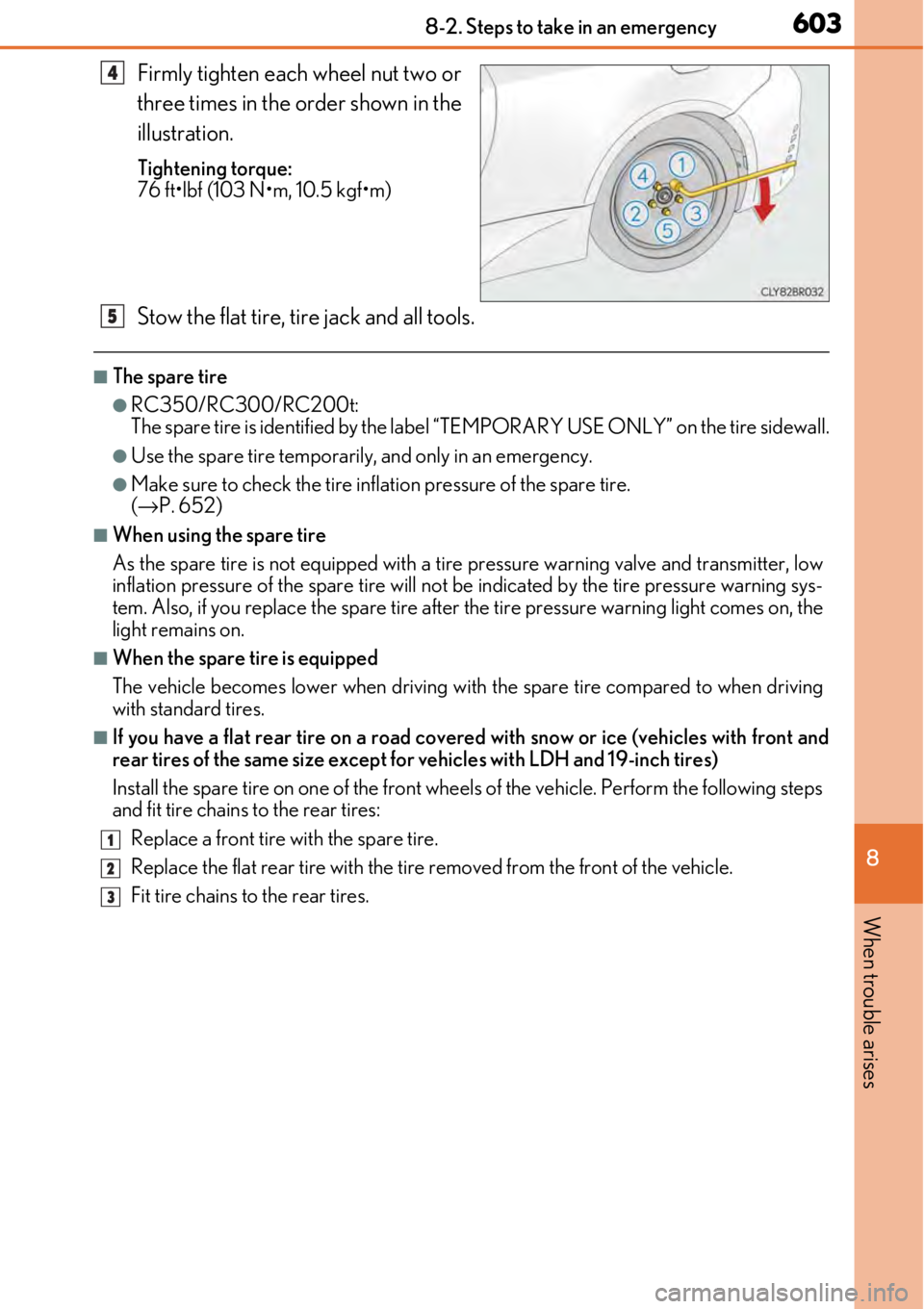
Firmly tighten each wheel nut two or
three times in the order shown in the
illustration.
Tightening torque:
76 ft•lbf (103 N•m, 10.5 kgf•m)
Stow the flat tire, tire jack and all tools.
■The spare tire
●RC350/RC300/RC200t:
The spare tire is identified by the label “TEMPORARY USE ONLY” on the tire sidewall.
●Use the spare tire temporarily, and only in an emergency.
●Make sure to check the tire inflation pressure of the spare tire.
(→ P. 652)
■When using the spare tire
As the spare tire is not equipped with a tire pressure warning valve and transmitter, low
inflation pressure of the spare tire will not be indicated by the tire pressure warning sys-
tem. Also, if you replace the spare tire after the tire pressure warning light comes on, the
light remains on.
■When the spare tire is equipped
The vehicle becomes lower when driving with the spare tire compared to when driving
with standard tires.
■If you have a flat rear tire on a road covered with snow or ice (vehicles with front and
rear tires of the same size except fo r vehicles with LDH and 19-inch tires)
Install the spare tire on one of the front whee ls of the vehicle. Perform the following steps
and fit tire chains to the rear tires:
Replace a front tire with the spare tire.
Replace the flat rear tire with the tire removed from the front of the vehicle.
Fit tire chains to the rear tires.
4
5
1
2
3
Page 616 of 724

6168-2. Steps to take in an emergency
■Emergency tire puncture repair kit
●The sealant has a limited lifespan. The expiry date is marked on the bottle. The sealant
should be replaced before the expiry date. Contact your Lexus dealer for replacement.
●The sealant stored in the emergency tire puncture repair kit can be used only once to
temporarily repair a single tire. If the sealant has been used and needs to be purchased,
contact your Lexus dealer. The compressor is reusable.
●The sealant can be used when the outside temperature is from -40 °F (-40 °C) to
140 °F (60 °C).
●The kit is exclusively designed for size and type of tires originally installed on your vehi-
cle. Do not use it for tires that a different size than the original ones, or for any other
purposes.
●If the sealant gets on yo ur clothes, it may stain.
●If the sealant adheres to a wheel or the surface of the vehicle body, the stain may not be
removable if it is not cleaned at once. Immediately wipe away the sealant with a wet
cloth.
●During operation of the kit, a loud operation noise is produc ed. This does not indicate a
malfunction.
●Do not use the emergency tire puncture repair kit to check or to adjust the tire pres-
sure.
Page 652 of 724
6529-1. Specifications
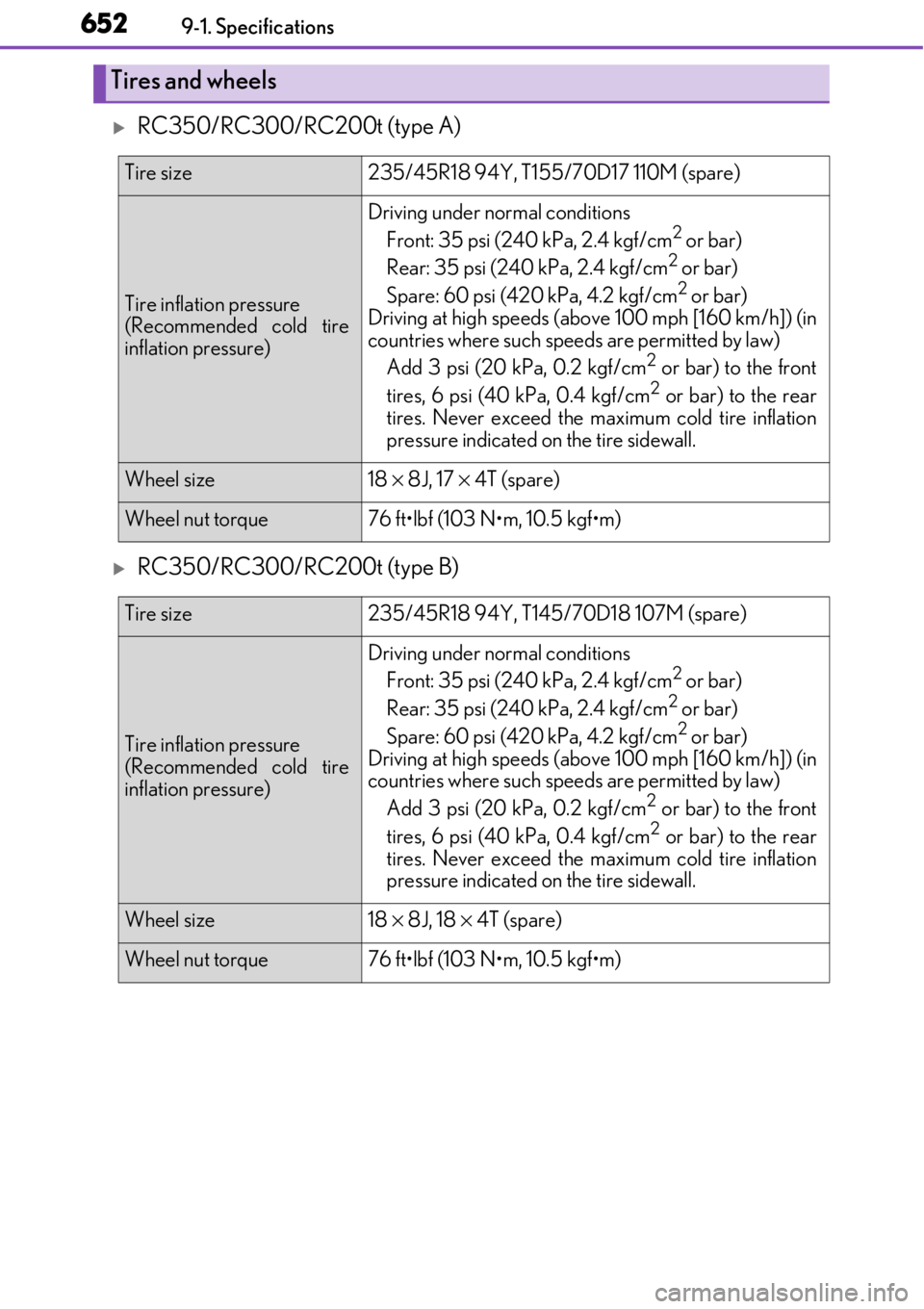
RC350/RC300/RC200t (type A)
RC350/RC300/RC200t (type B)
Tires and wheels
Tire size235/45R18 94Y, T155/70D17 110M (spare)
Tire inflation pressure
(Recommended cold tire
inflation pressure)
Driving under normal conditionsFront: 35 psi (240 kPa, 2.4 kgf/cm2 or bar)
Rear: 35 psi (240 kPa, 2.4 kgf/cm2 or bar)
Spare: 60 psi (420 kPa, 4.2 kgf/cm2 or bar)
Driving at high speeds (above 100 mph [160 km/h]) (in
countries where such speeds are permitted by law)
Add 3 psi (20 kPa, 0.2 kgf/cm
2 or bar) to the front
tires, 6 psi (40 kPa, 0.4 kgf/cm2 or bar) to the rear
tires. Never exceed the maximum cold tire inflation
pressure indicated on the tire sidewall.
Wheel size18 × 8J, 17 × 4T (spare)
Wheel nut torque76 ft•lbf (103 N•m, 10.5 kgf•m)
Tire size235/45R18 94Y, T145/70D18 107M (spare)
Tire inflation pressure
(Recommended cold tire
inflation pressure)
Driving under normal conditions
Front: 35 psi (240 kPa, 2.4 kgf/cm2 or bar)
Rear: 35 psi (240 kPa, 2.4 kgf/cm2 or bar)
Spare: 60 psi (420 kPa, 4.2 kgf/cm2 or bar)
Driving at high speeds (above 100 mph [160 km/h]) (in
countries where such speeds are permitted by law)
Add 3 psi (20 kPa, 0.2 kgf/cm
2 or bar) to the front
tires, 6 psi (40 kPa, 0.4 kgf/cm2 or bar) to the rear
tires. Never exceed the maximum cold tire inflation
pressure indicated on the tire sidewall.
Wheel size18 × 8J, 18 × 4T (spare)
Wheel nut torque76 ft•lbf (103 N•m, 10.5 kgf•m)
Page 653 of 724
6539-1. Specifications
9
Vehicle specifications
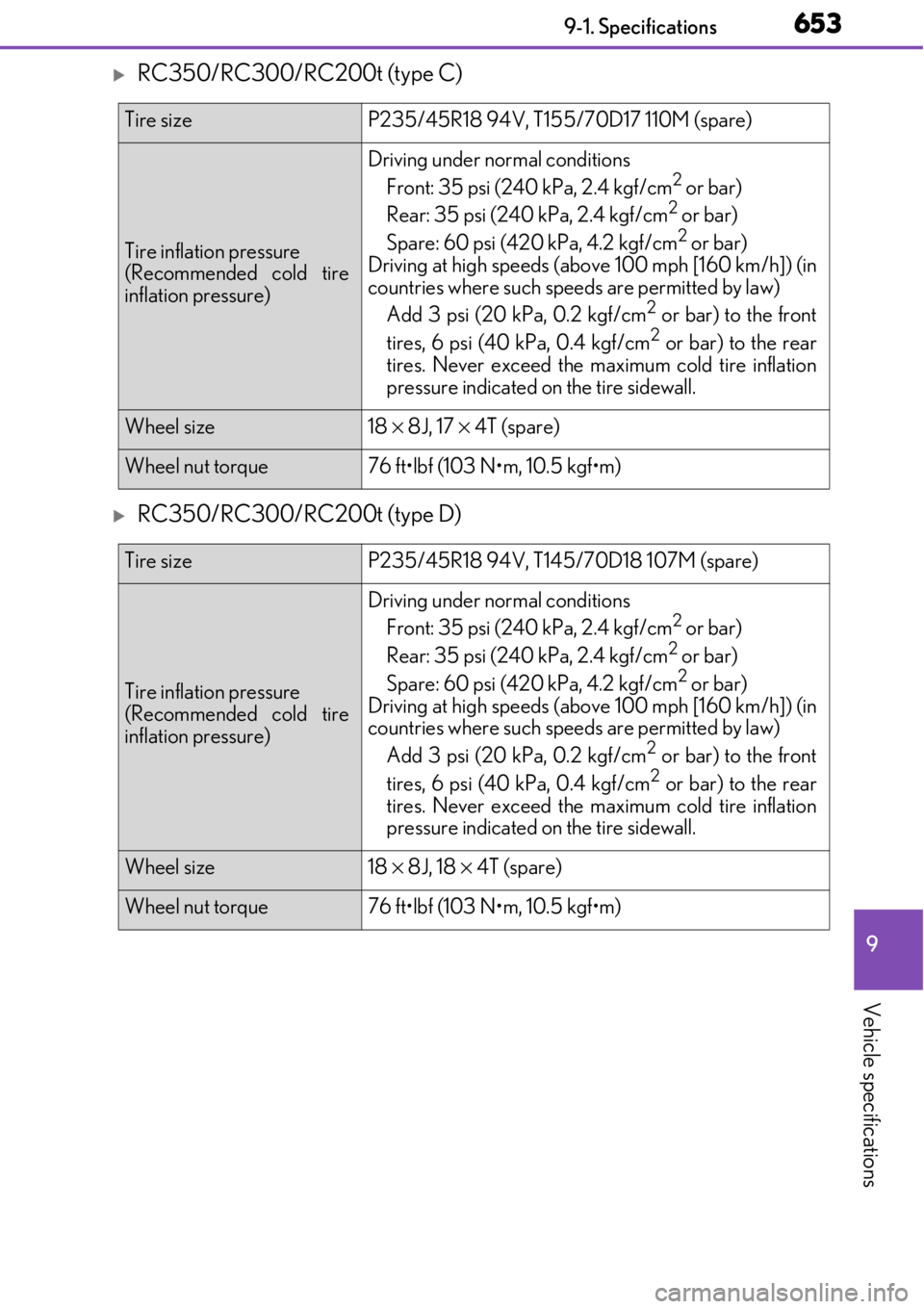
RC350/RC300/RC200t (type C)
RC350/RC300/RC200t (type D)
Tire sizeP235/45R18 94V, T155/70D17 110M (spare)
Tire inflation pressure
(Recommended cold tire
inflation pressure)
Driving under normal conditionsFront: 35 psi (240 kPa, 2.4 kgf/cm2 or bar)
Rear: 35 psi (240 kPa, 2.4 kgf/cm2 or bar)
Spare: 60 psi (420 kPa, 4.2 kgf/cm2 or bar)
Driving at high speeds (above 100 mph [160 km/h]) (in
countries where such speeds are permitted by law)
Add 3 psi (20 kPa, 0.2 kgf/cm
2 or bar) to the front
tires, 6 psi (40 kPa, 0.4 kgf/cm2 or bar) to the rear
tires. Never exceed the maximum cold tire inflation
pressure indicated on the tire sidewall.
Wheel size18 × 8J, 17 × 4T (spare)
Wheel nut torque76 ft•lbf (103 N•m, 10.5 kgf•m)
Tire sizeP235/45R18 94V, T145/70D18 107M (spare)
Tire inflation pressure
(Recommended cold tire
inflation pressure)
Driving under normal conditions
Front: 35 psi (240 kPa, 2.4 kgf/cm2 or bar)
Rear: 35 psi (240 kPa, 2.4 kgf/cm2 or bar)
Spare: 60 psi (420 kPa, 4.2 kgf/cm2 or bar)
Driving at high speeds (above 100 mph [160 km/h]) (in
countries where such speeds are permitted by law)
Add 3 psi (20 kPa, 0.2 kgf/cm
2 or bar) to the front
tires, 6 psi (40 kPa, 0.4 kgf/cm2 or bar) to the rear
tires. Never exceed the maximum cold tire inflation
pressure indicated on the tire sidewall.
Wheel size18 × 8J, 18 × 4T (spare)
Wheel nut torque76 ft•lbf (103 N•m, 10.5 kgf•m)
Page 654 of 724
6549-1. Specifications
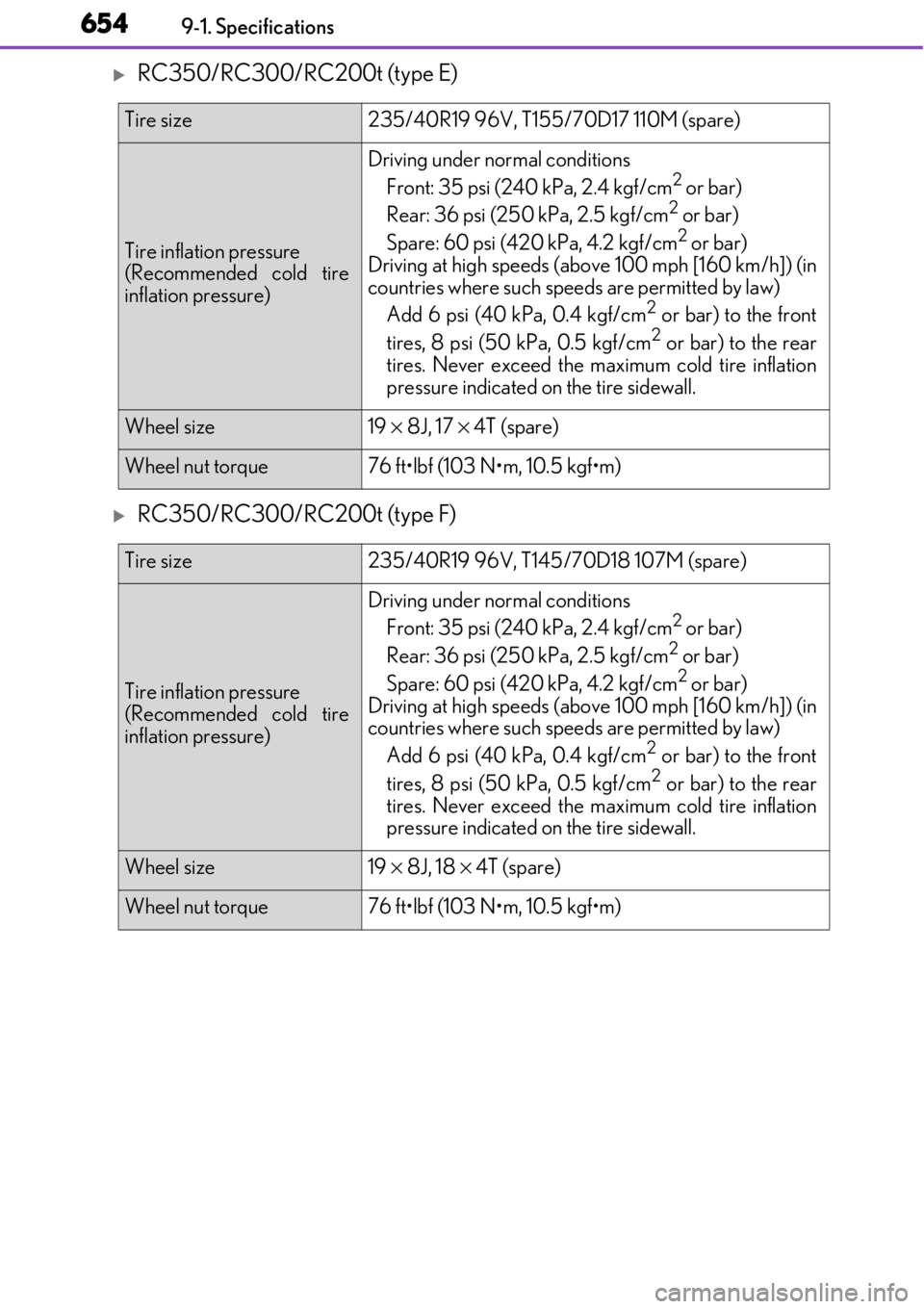
RC350/RC300/RC200t (type E)
RC350/RC300/RC200t (type F)
Tire size235/40R19 96V, T155/70D17 110M (spare)
Tire inflation pressure
(Recommended cold tire
inflation pressure)
Driving under normal conditionsFront: 35 psi (240 kPa, 2.4 kgf/cm2 or bar)
Rear: 36 psi (250 kPa, 2.5 kgf/cm2 or bar)
Spare: 60 psi (420 kPa, 4.2 kgf/cm2 or bar)
Driving at high speeds (above 100 mph [160 km/h]) (in
countries where such speeds are permitted by law)
Add 6 psi (40 kPa, 0.4 kgf/cm
2 or bar) to the front
tires, 8 psi (50 kPa, 0.5 kgf/cm2 or bar) to the rear
tires. Never exceed the maximum cold tire inflation
pressure indicated on the tire sidewall.
Wheel size19 × 8J, 17 × 4T (spare)
Wheel nut torque76 ft•lbf (103 N•m, 10.5 kgf•m)
Tire size235/40R19 96V, T145/70D18 107M (spare)
Tire inflation pressure
(Recommended cold tire
inflation pressure)
Driving under normal conditions
Front: 35 psi (240 kPa, 2.4 kgf/cm2 or bar)
Rear: 36 psi (250 kPa, 2.5 kgf/cm2 or bar)
Spare: 60 psi (420 kPa, 4.2 kgf/cm2 or bar)
Driving at high speeds (above 100 mph [160 km/h]) (in
countries where such speeds are permitted by law)
Add 6 psi (40 kPa, 0.4 kgf/cm
2 or bar) to the front
tires, 8 psi (50 kPa, 0.5 kgf/cm2 or bar) to the rear
tires. Never exceed the maximum cold tire inflation
pressure indicated on the tire sidewall.
Wheel size19 × 8J, 18 × 4T (spare)
Wheel nut torque76 ft•lbf (103 N•m, 10.5 kgf•m)
Page 655 of 724
6559-1. Specifications
9
Vehicle specifications
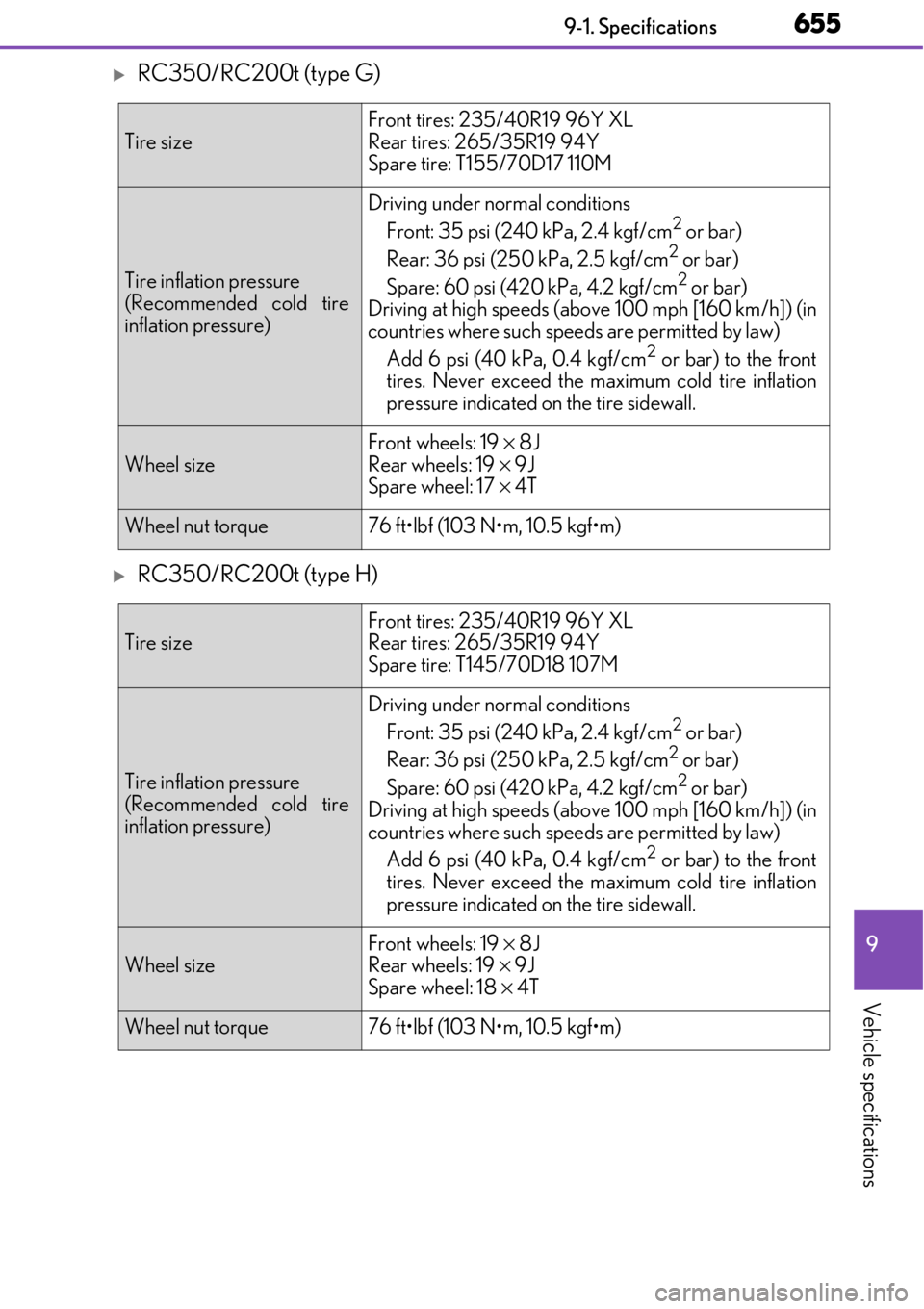
RC350/RC200t (type G)
RC350/RC200t (type H)
Tire size
Front tires: 235/40R19 96Y XL
Rear tires: 265/35R19 94Y
Spare tire: T155/70D17 110M
Tire inflation pressure
(Recommended cold tire
inflation pressure)
Driving under normal conditionsFront: 35 psi (240 kPa, 2.4 kgf/cm2 or bar)
Rear: 36 psi (250 kPa, 2.5 kgf/cm2 or bar)
Spare: 60 psi (420 kPa, 4.2 kgf/cm2 or bar)
Driving at high speeds (above 100 mph [160 km/h]) (in
countries where such speeds are permitted by law)
Add 6 psi (40 kPa, 0.4 kgf/cm
2 or bar) to the front
tires. Never exceed the maximum cold tire inflation
pressure indicated on the tire sidewall.
Wheel sizeFront wheels: 19 × 8J
Rear wheels: 19 × 9J
Spare wheel: 17 × 4T
Wheel nut torque76 ft•lbf (103 N•m, 10.5 kgf•m)
Tire sizeFront tires: 235/40R19 96Y XL
Rear tires: 265/35R19 94Y
Spare tire: T145/70D18 107M
Tire inflation pressure
(Recommended cold tire
inflation pressure)
Driving under normal conditions
Front: 35 psi (240 kPa, 2.4 kgf/cm2 or bar)
Rear: 36 psi (250 kPa, 2.5 kgf/cm2 or bar)
Spare: 60 psi (420 kPa, 4.2 kgf/cm2 or bar)
Driving at high speeds (above 100 mph [160 km/h]) (in
countries where such speeds are permitted by law)
Add 6 psi (40 kPa, 0.4 kgf/cm
2 or bar) to the front
tires. Never exceed the maximum cold tire inflation
pressure indicated on the tire sidewall.
Wheel size
Front wheels: 19 × 8J
Rear wheels: 19 × 9J
Spare wheel: 18 × 4T
Wheel nut torque76 ft•lbf (103 N•m, 10.5 kgf•m)
Page 656 of 724
6569-1. Specifications
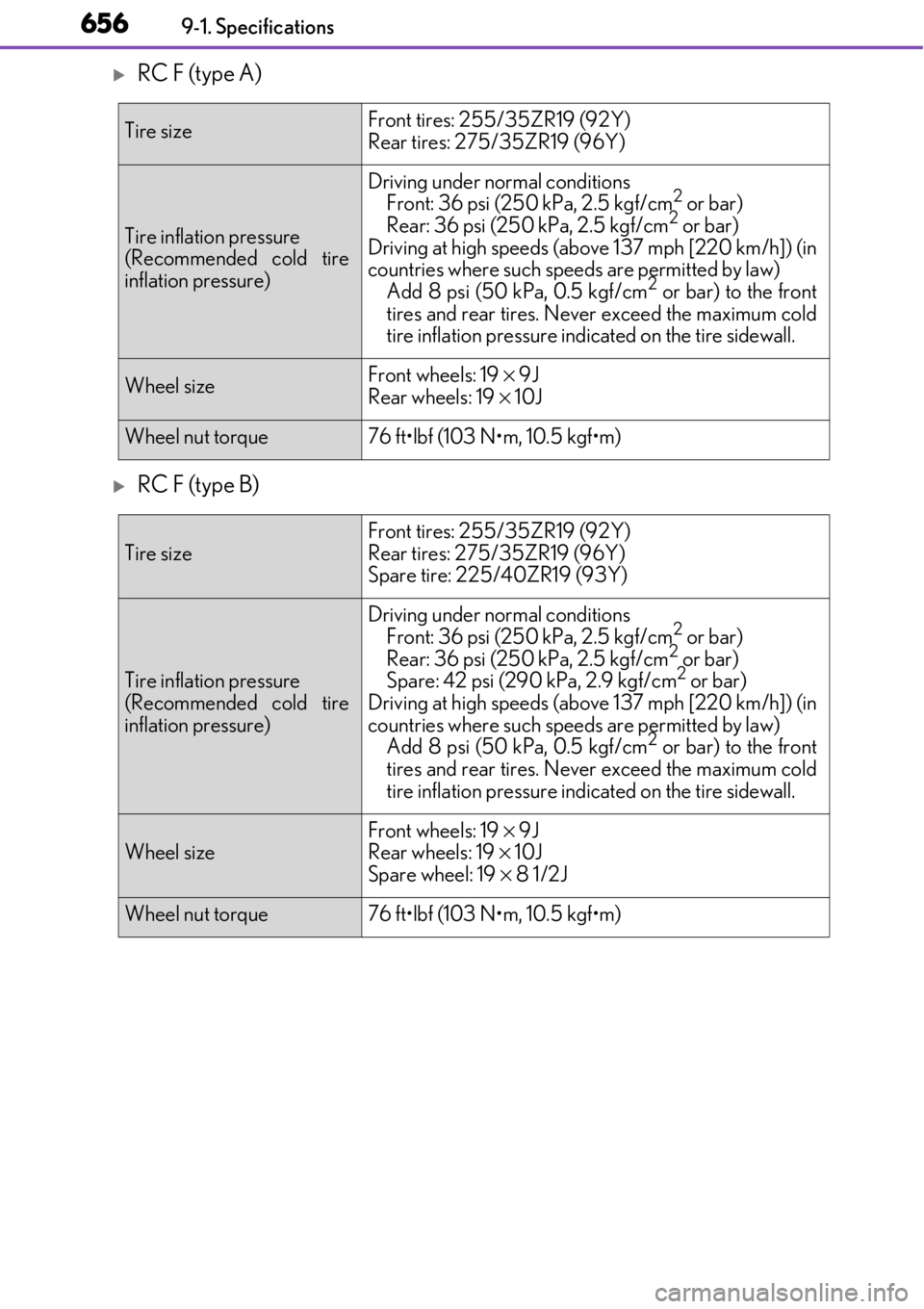
RC F (type A)
RC F (type B)
Tire sizeFront tires: 255/35ZR19 (92Y)
Rear tires: 275/35ZR19 (96Y)
Tire inflation pressure
(Recommended cold tire
inflation pressure)
Driving under normal conditionsFront: 36 psi (250 kPa, 2.5 kgf/cm2 or bar)
Rear: 36 psi (250 kPa, 2.5 kgf/cm2 or bar)
Driving at high speeds (above 137 mph [220 km/h]) (in
countries where such speeds are permitted by law) Add 8 psi (50 kPa, 0.5 kgf/cm
2 or bar) to the front
tires and rear tires. Never exceed the maximum cold
tire inflation pressure indi cated on the tire sidewall.
Wheel sizeFront wheels: 19 × 9J
Rear wheels: 19 × 10J
Wheel nut torque76 ft•lbf (103 N•m, 10.5 kgf•m)
Tire size
Front tires: 255/35ZR19 (92Y)
Rear tires: 275/35ZR19 (96Y)
Spare tire: 225/40ZR19 (93Y)
Tire inflation pressure
(Recommended cold tire
inflation pressure)
Driving under normal conditions
Front: 36 psi (250 kPa, 2.5 kgf/cm2 or bar)
Rear: 36 psi (250 kPa, 2.5 kgf/cm2 or bar)
Spare: 42 psi (290 kPa, 2.9 kgf/cm2 or bar)
Driving at high speeds (above 137 mph [220 km/h]) (in
countries where such speeds are permitted by law) Add 8 psi (50 kPa, 0.5 kgf/cm
2 or bar) to the front
tires and rear tires. Never exceed the maximum cold
tire inflation pressure indi cated on the tire sidewall.
Wheel sizeFront wheels: 19 × 9J
Rear wheels: 19 × 10J
Spare wheel: 19 × 8 1/2J
Wheel nut torque76 ft•lbf (103 N•m, 10.5 kgf•m)
Page 664 of 724
6649-1. Specifications
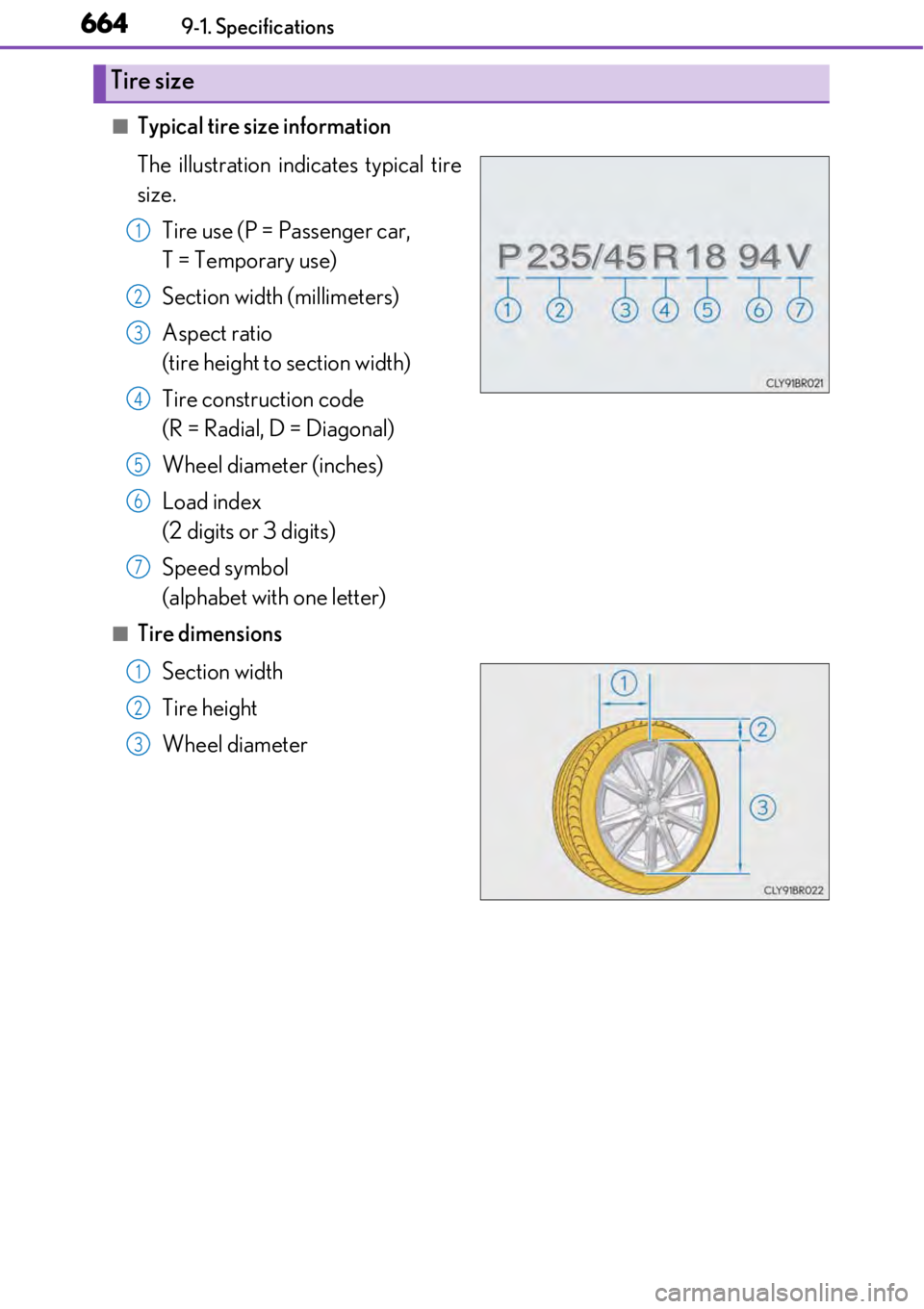
■Typical tire size information
The illustration indicates typical tire
size.Tire use (P = Passenger car,
T = Temporary use)
Section width (millimeters)
Aspect ratio
(tire height to section width)
Tire construction code
(R = Radial, D = Diagonal)
Wheel diameter (inches)
Load index
(2 digits or 3 digits)
Speed symbol
(alphabet with one letter)
■Tire dimensions
Section width
Tire height
Wheel diameter
Tire size
1
2
3
4
5
6
7
1
2
3
Page 669 of 724
6699-1. Specifications
9
Vehicle specifications
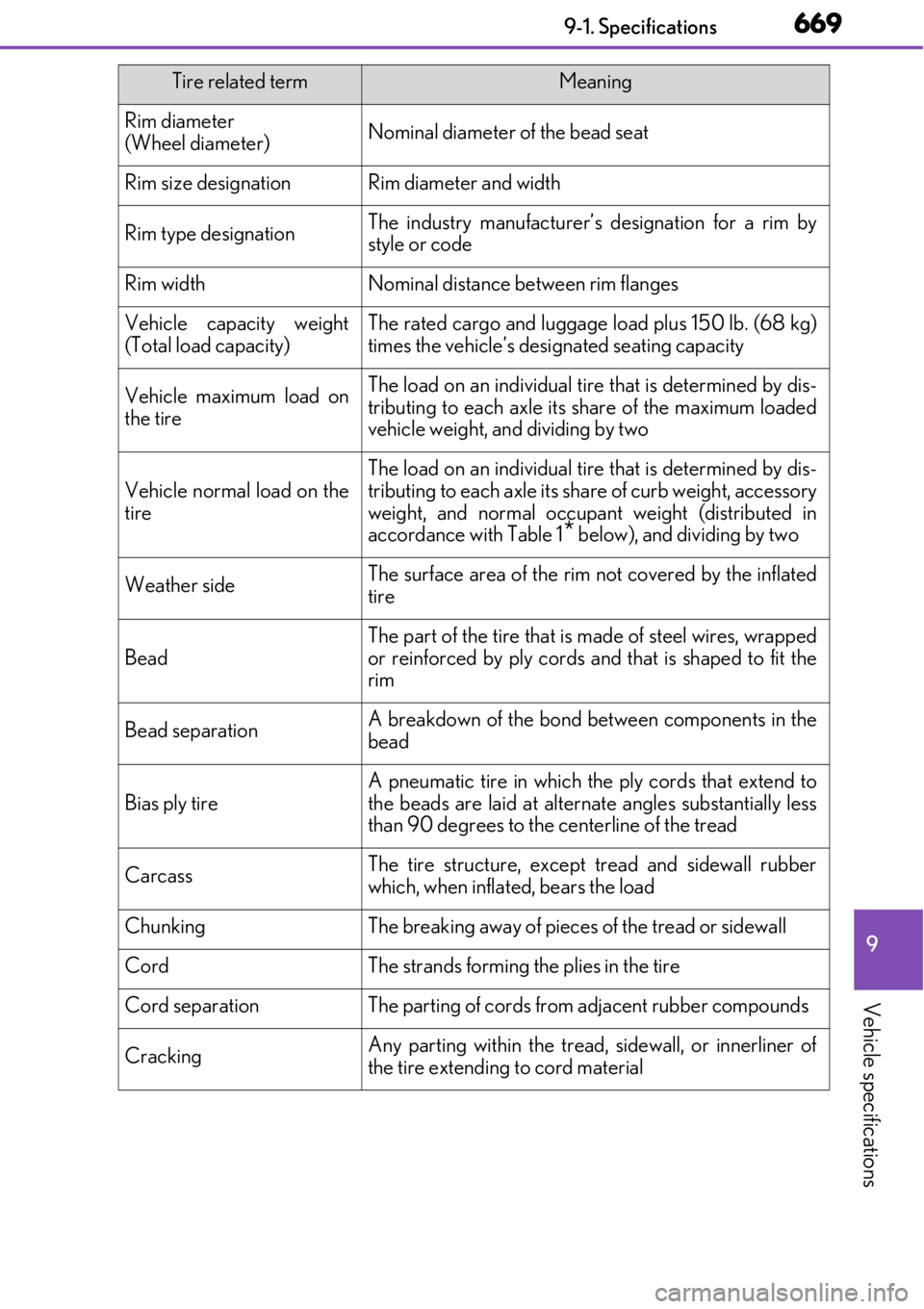
Rim diameter
(Wheel diameter)Nominal diameter of the bead seat
Rim size designationRim diameter and width
Rim type designationThe industry manufacturer’s designation for a rim by
style or code
Rim widthNominal distance between rim flanges
Vehicle capacity weight
(Total load capacity)The rated cargo and luggage load plus 150 lb. (68 kg)
times the vehicle’s desi gnated seating capacity
Vehicle maximum load on
the tireThe load on an individual tire that is determined by dis-
tributing to each axle its share of the maximum loaded
vehicle weight, and dividing by two
Vehicle normal load on the
tire
The load on an individual tire that is determined by dis-
tributing to each axle its sh are of curb weight, accessory
weight, and normal occupant weight (distributed in
accordance with Table 1
* below), and dividing by two
Weather sideThe surface area of the rim not covered by the inflated
tire
BeadThe part of the tire that is made of steel wires, wrapped
or reinforced by ply cords an d that is shaped to fit the
rim
Bead separationA breakdown of the bond between components in the
bead
Bias ply tireA pneumatic tire in which the ply cords that extend to
the beads are laid at alternate angles substantially less
than 90 degrees to the centerline of the tread
CarcassThe tire structure, except tread and sidewall rubber
which, when inflated, bears the load
ChunkingThe breaking away of pieces of the tread or sidewall
CordThe strands forming th e plies in the tire
Cord separationThe parting of cords from adjacent rubber compounds
CrackingAny parting within the tread, sidewall, or innerliner of
the tire extending to cord material
Tire related termMeaning