flat tire LEXUS RC350 2017 Owner's Manual
[x] Cancel search | Manufacturer: LEXUS, Model Year: 2017, Model line: RC350, Model: LEXUS RC350 2017Pages: 724, PDF Size: 15.76 MB
Page 529 of 724
5297-3. Do-it-yourself maintenance
7
Maintenance and care
WARNING
■When inspecting or replacing tires
Observe the following precautions to prevent accidents.
Failure to do so may cause damage to parts of the drivetrain as well as dangerous han-
dling characteristics, which may lead to an accident resulting in death or serious injury.
●Do not mix tires of different makes, models or tread patterns.
Also, do not mix tires of remarkably different treadwear.
●Do not use tire sizes other than those recommended by Lexus.
●Do not mix differently constructed tires (radial, bias-belted or bias-ply tires).
●Do not mix summer, all season and snow tires.
●Do not use tires that have be en used on another vehicle.
Do not use tires if you do not know how they were used previously.
●Vehicles with a compact spare tire: Do no t tow if your vehicle has a compact spare
tire installed.
●Vehicles with an emergency tire puncture repair kit: Do not tow anything if a tire that
has been repaired using the emergency tire puncture repair kit is installed. The load
on the tire may cause unexpected damage to the tire.
■When initializing the tire pressure warning system
Do not operate the tire pressure warning reset switch without first adjusting the tire
inflation pressure to the spec ified level. Otherwise, the tire pressure warning light may
not come on even if the tire inflation pressu re is low, or it may come on when the tire
inflation pressure is actually normal.
■Caution regarding interference with electronic devices
●Users of any electrical medical device ot her than implantable cardiac pacemakers,
cardiac resynchronization th erapy-pacemakers or implantable cardioverter defibril-
lators should consult the manufacturer of the device for information about its opera-
tion under the influence of radio waves.
Radio waves could have unexpected effects on the operation of such medical
devices.
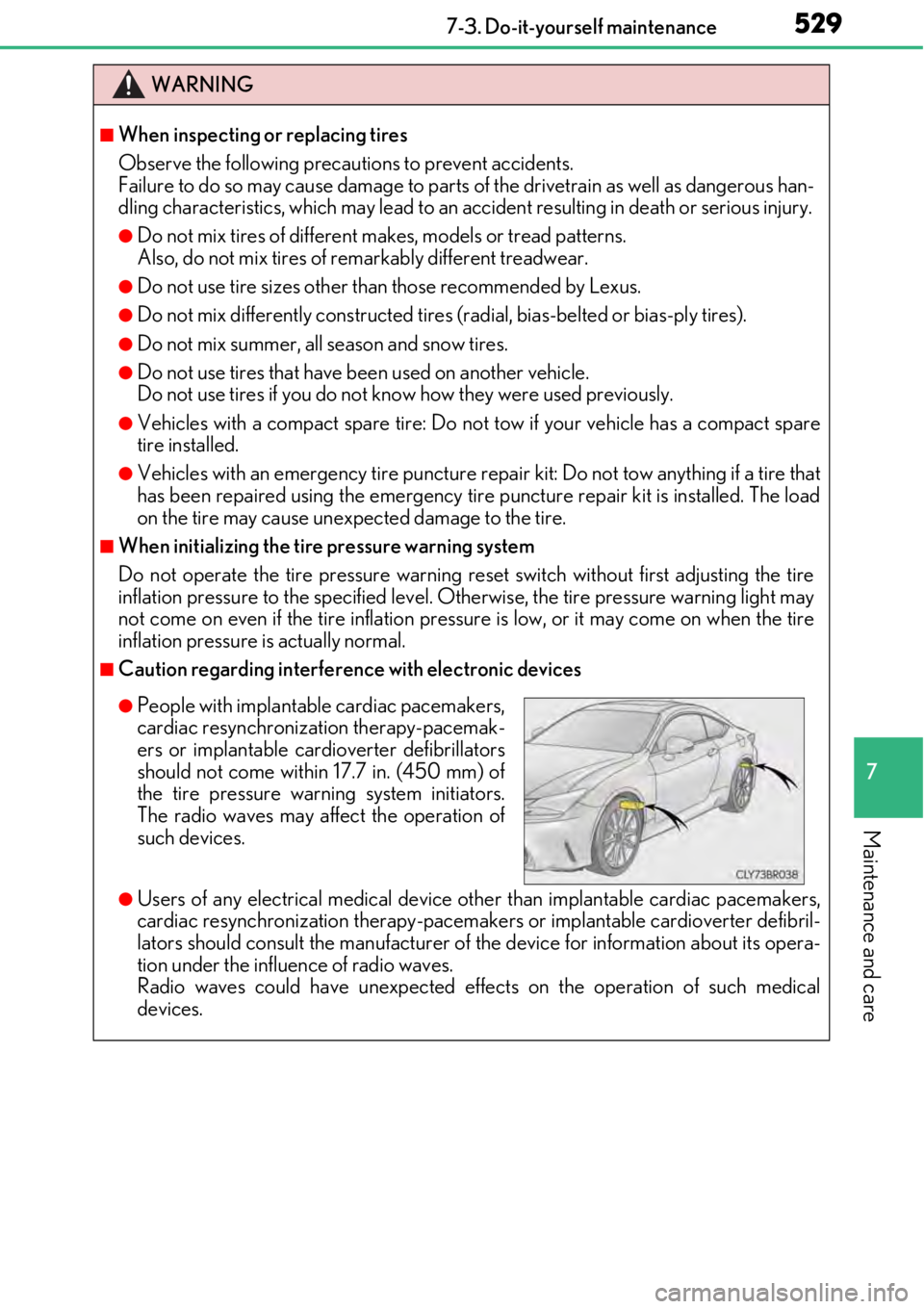
●People with implantabl e cardiac pacemakers,
cardiac resynchronization therapy-pacemak-
ers or implantable cardioverter defibrillators
should not come within 17.7 in. (450 mm) of
the tire pressure warn ing system initiators.
The radio waves may affect the operation of
such devices.
Page 530 of 724

5307-3. Do-it-yourself maintenance
NOTICE
■Repairing or replacing tires, wheels, tire pressure warning valves, transmitters and
tire valve caps
●When removing or fitting the wheels, tires or the tire pressure warning valves and
transmitters, contact your Lexus dealer as the tire pressure warning valves and trans-
mitters may be damaged if not handled correctly.
●Make sure to install the tire valve caps. If the tire valve caps are not installed, water
could enter the tire pressure warning valv es and the tire pressure warning valves
could be bound.
●When replacing tire valve caps, do not use tire valve caps other than those specified.
The cap may become stuck.
■To avoid damage to the tire pressu re warning valves and transmitters
When a tire is repaired with liquid sealants, the tire pressure warning valve and trans-
mitter may not operate properly. If a liquid sealant is used, contact your Lexus dealer or
other qualified service shop as soon as possi ble. After use of liquid sealant, make sure
to replace the tire pressure warning valve and transmitter when repairing or replacing
the tire. (→ P. 518)
■Driving on rough roads
Take particular care when driving on roads with loose surfaces or potholes.
These conditions may cause lo sses in tire inflation pressure, reducing the cushioning
ability of the tires. In addition, driving on rough roads may cause damage to the tires
themselves, as well as the vehicle’s wheels and body.
■Low profile tires
Low profile tires may cause greater damage than usual to the tire wheel when sustain-
ing impact from the road surface. Ther efore, pay attention to the following:
●Be sure to use proper tire inflation pressure. If tires ar e under-inflated, they may be
damaged more severely.
●Avoid potholes, uneven pavement, curbs an d other road hazards. Failure to do so
may lead to severe tire and wheel damage.
■If tire inflation pressure of ea ch tire becomes low while driving
Do not continue driving, or your tires and/or wheels may be ruined.
Page 531 of 724
5317-3. Do-it-yourself maintenance
7
Maintenance and care
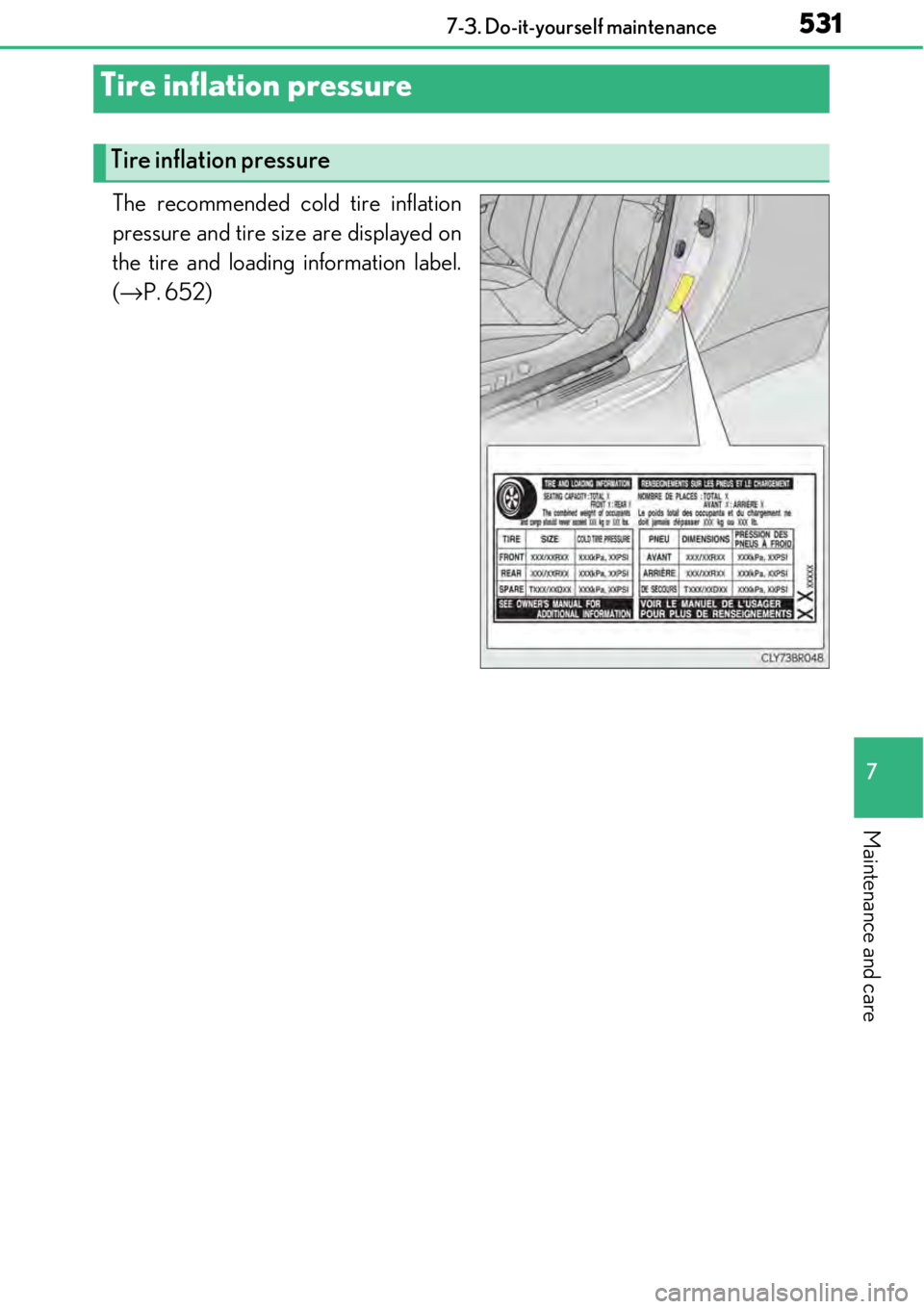
The recommended cold tire inflation
pressure and tire size are displayed on
the tire and loading information label.
(→P. 652)
Tire inflation pressure
Tire inflation pressure
Page 532 of 724
5327-3. Do-it-yourself maintenance
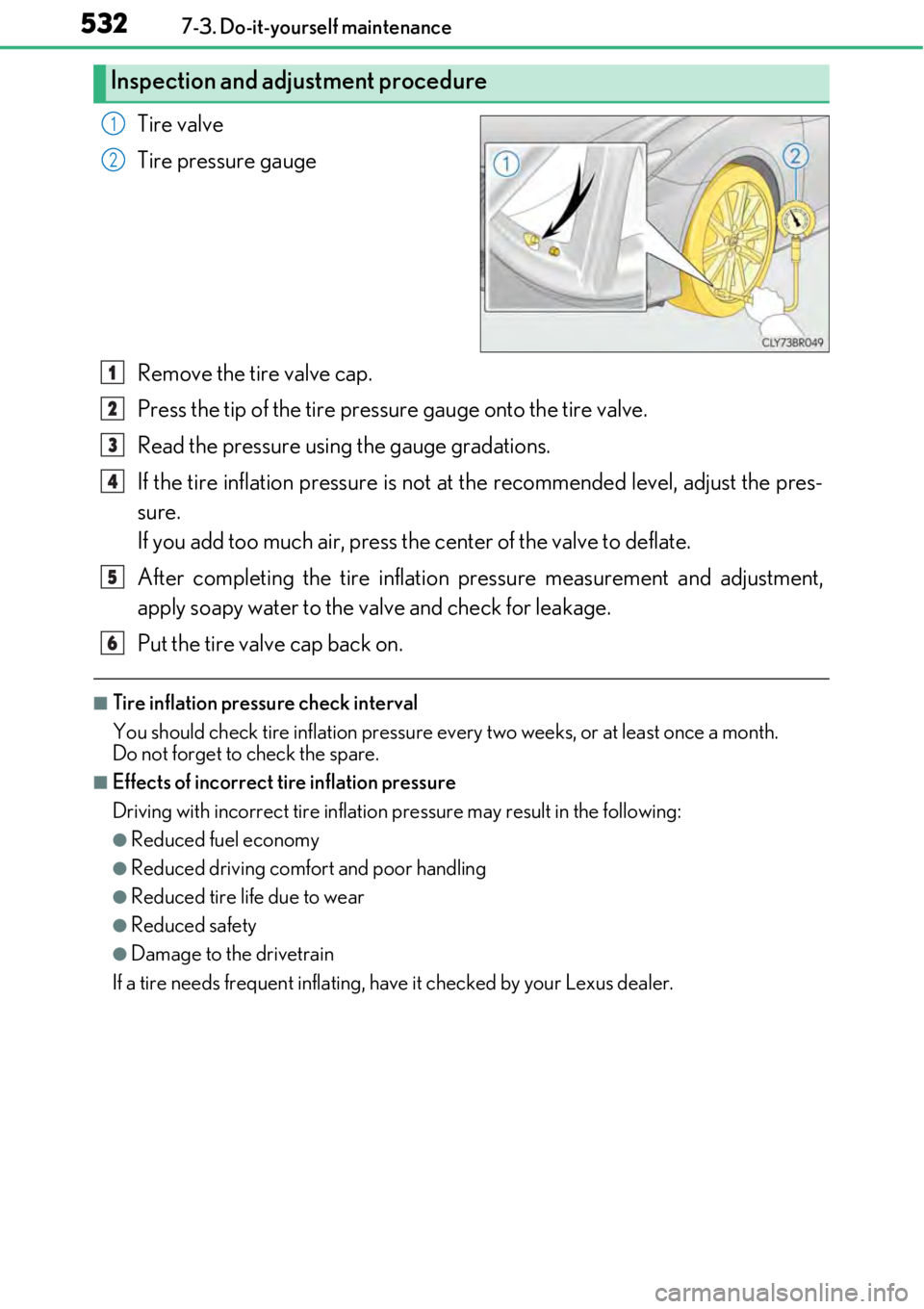
Tire valve
Tire pressure gauge
Remove the tire valve cap.
Press the tip of the tire pressure gauge onto the tire valve.
Read the pressure using the gauge gradations.
If the tire inflation pressure is not at the recommended level, adjust the pres-
sure.
If you add too much air, press the center of the valve to deflate.
After completing the tire inflation pressure measurement and adjustment,
apply soapy water to the valve and check for leakage.
Put the tire valve cap back on.
■Tire inflation pressure check interval
You should check tire inflation pressure ev ery two weeks, or at least once a month.
Do not forget to check the spare.
■Effects of incorrect tire inflation pressure
Driving with incorrect tire inflation pressure may result in the following:
●Reduced fuel economy
●Reduced driving comfort and poor handling
●Reduced tire life due to wear
●Reduced safety
●Damage to the drivetrain
If a tire needs frequent inflating, ha ve it checked by your Lexus dealer.
Inspection and adjustment procedure
1
2
1
2
3
4
5
6
Page 533 of 724
5337-3. Do-it-yourself maintenance
7
Maintenance and care
■Instructions for checking tire inflation pressure
When checking tire inflation pressure, observe the following:
●Check only when the tires are cold.
If your vehicle has been parked for at least 3 hours or has not been driven for more than
1 mile or 1.5 km, you will get an accurate cold tire inflation pressure reading.
●Always use a tire pressure gauge.
It is difficult to judge if a tire is properly inflated based only on its appearance.
●It is normal for the tire inflat ion pressure to be higher after driving as heat is generated
in the tire. Do not reduce tire inflation pressure after driving.
●Never exceed the vehicle capacity weight.
Passengers and luggage weight should be placed so that the vehicle is balanced.
WARNING
■Proper inflation is critical to save tire performance
Keep your tires properly inflated.
If the tires are not properly inflated, the following conditions may occur which could
lead to an accident resulting in death or serious injury:
●Excessive wear
●Uneven wear
●Poor handling
●Possibility of blowouts resu lting from overheated tires
●Air leaking from between tire and wheel
●Wheel deformation and/or tire damage
●Greater possibility of tire damage while driving (due to road hazards, expansion
joints, sharp edges in the road, etc.)
NOTICE
■When inspecting and adjust ing tire inflation pressure
Be sure to put the tire valve caps back on.
If a valve cap is not installed, dirt or moisture may get into the valve and cause an air
leak, resulting in decreased tire inflation pressure.
Page 534 of 724
5347-3. Do-it-yourself maintenance
When replacing wheels, care should be taken to ensure that they are equivalent
to those removed in load capacity, diameter, rim width and inset
*.
Replacement wheels are available at your Lexus dealer.
*: Conventionally referred to as “offset”.
Lexus does not recommend using the following:
●Wheels of different sizes or types
●Used wheels
●Bent wheels that have been straightened
●Use only Lexus wheel nuts and wrenches designed for use with your alumi-
num wheels.
●When rotating, repairing or changing your tires, check that the wheel nuts are
still tight after driving 1000 miles (1600 km).
●Be careful not to damage the aluminum wheels when using tire chains.
●Use only Lexus genuine balance weights or equivalent and a plastic or rubber
hammer when balancing your wheels.
■When replacing wheels
The wheels of your vehicle are equipped with tire pressure warning valves and transmit-
ters that allow the tire pressure warning system to provide advance warning in the event
of a loss in tire inflation pressure. Whenever wheels are replaced, tire pressure warning
valves and transmitters must be installed. (→P. 518)
Wheels
If a wheel is bent, cracked or heavily corroded, it should be replaced. Other-
wise, the tire may separate from the wheel or cause a loss of handling control.
Wheel selection
Aluminum wheel precautions
Page 553 of 724

553
When trouble arises8
8-1. Essential informationEmergency flashers.................. 554
If your vehicle has to be stopped in an
emergency ................................ 555 8-2. Steps to take in an emergency
If your vehicle needs to be towed ...........................................556
If you think something is wrong ........................................... 563
Fuel pump shut off system ...... 564
If a warning light turns on or a warning buzzer
sounds..........................................565
If a warning message is displayed.......................................571
If you have a flat tire (vehicles with a spare
tire)................................................ 592
If you have a flat tire (vehicles with an
emergency tire puncture
repair kit) ....................................606
If the engine will not start ........ 620
If the electronic key does not operate properly ............. 622
If the vehicle battery is discharged ................................. 626
If your vehicle overheats .........630
If the vehicle becomes stuck ............................................. 636
Page 563 of 724
5638-2. Steps to take in an emergency
8
When trouble arises
●Fluid leaks under the vehicle.
(Water dripping from the air conditioning after use is normal.)
●Flat-looking tires or uneven tire wear
●Engine coolant temperature gauge continually points higher than normal.
●Changes in exhaust sound
●Excessive tire squeal when cornering
●Strange noises related to the suspension system
●Pinging or other noises related to the engine
●Engine missing, stumbling or running roughly
●Appreciable loss of power
●Vehicle pulls heavily to one side when braking
●Vehicle pulls heavily to one side when driving on a level road
●Loss of brake effectiveness, spongy feeling, pedal almost touches the floor
If you think something is wrong
If you notice any of the following symptoms, your vehicle probably needs
adjustment or repair. Contact your Lexus dealer as soon as possible.
Visible symptoms
Audible symptoms
Operational symptoms
Page 567 of 724
5678-2. Steps to take in an emergency
8
When trouble arises
*1: Parking brake engaged warning buzzer (RC350/RC300/RC200t):→ P. 575
*2: Open door warning buzzer:
→ P. 573
*3: Driver’s seat belt buzzer:
The driver’s seat belt buzzer sounds to alert the driver that his or her seat belt is not
fastened. Once the engine switch is turned to IGNITION ON mode, the buzzer
sounds for 6 seconds. If the vehicle reaches a speed of 12 mph (20 km/h), the buzzer
sounds once. If the seat belt is still unfast ened after 24 seconds, the buzzer will sound
intermittently for 10 seconds. Then, if the se at belt is still unfastened, the buzzer will
sound in a different tone for 20 more seconds.
Front passenger’s seat belt buzzer:
The front passenger’s seat belt buzzer soun ds to alert the front passenger that his or
her seat belt is not fastened. The buzzer so unds once if the vehicle reaches a speed of
12 mph (20 km/h). If the seat belt is still unfastened after 24 se conds, the buzzer will
sound intermittently for 10 se conds. Then, if the seat belt is still unfastened, the buzzer
will sound in a different to ne for 20 more seconds.
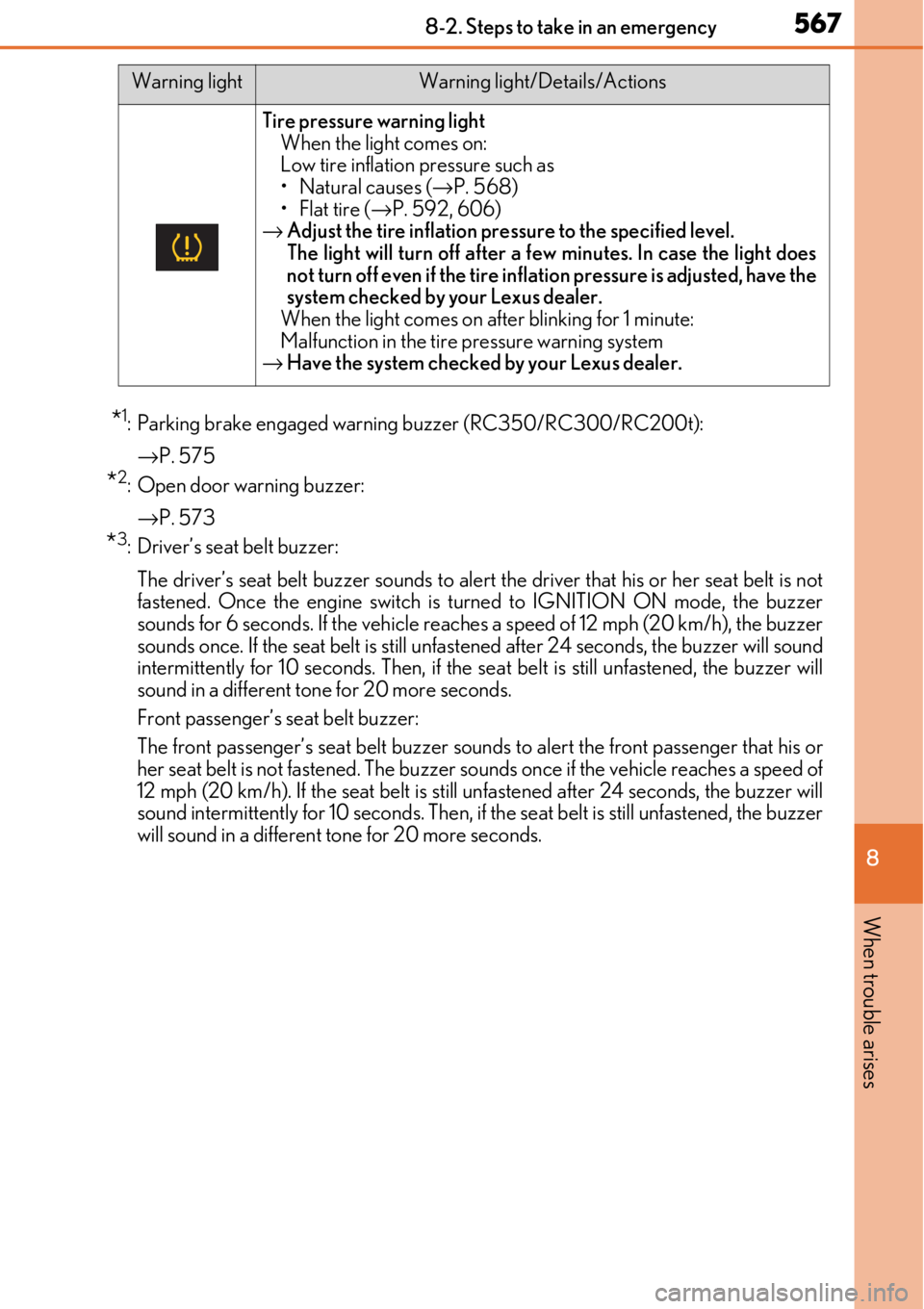
Tire pressure warning light
When the light comes on:
Low tire inflation pressure such as
• Natural causes ( →P. 568)
•Flat tire ( →P. 592, 606)
→ Adjust the tire inflation pres sure to the specified level.
The light will turn off after a few minutes. In case the light does
not turn off even if the tire inflation pressure is adjusted, have the
system checked by your Lexus dealer.
When the light comes on af ter blinking for 1 minute:
Malfunction in the tire pressure warning system
→ Have the system checked by your Lexus dealer.
Warning lightWarning light/Details/Actions
Page 568 of 724

5688-2. Steps to take in an emergency
■SRS warning light
This warning light system monitors the airbag sensor assembly, front impact sensors, side
impact sensors (door), side impact sensors (front), side impact sensors (rear), driver’s
seat position sensor, driver’s seat belt buckle switch, front passenger occupant classifica-
tion system, “AIR BAG ON” indicator light, “A IR BAG OFF” indicator light, front passen-
ger’s seat belt buckle switch, seat belt pretensioners, airbags, interconnecting wiring and
power sources. (→ P. 41)
■Front passenger detection sensor, seat belt reminder and warning buzzer
If luggage is placed on the front passenger seat, the front passenger detection sensor
may cause the warning light to flash and the warning buzzer to sound even if a passenger
is not sitting in the seat.
■If the malfunction indicator lamp comes on while driving
First check the following:
●Is the fuel tank empty?
If it is, fill the fu el tank immediately.
●Is the fuel tank cap loose?
If it is, tighten it securely.
The light will go off after several driving trips.
If the light does not go off even after severa l trips, contact your Lexus dealer as soon as
possible.
■Electric power steering system warning light (warning buzzer)
When the battery charge becomes insufficien t or the voltage temporarily drops, the
electric power steering system warning li ght may come on and the warning buzzer may
sound.
■When the tire pressure warning light comes on
Check the tire inflation pressu re and adjust to the appropriate level. Pushing the tire
pressure warning reset switch will not tu rn off the tire pressure warning light.
■The tire pressure warning light may come on due to natural causes
The tire pressure warning light may come on due to natural causes such as natural air
leaks and tire inflation pressure changes caus ed by temperature. In this case, adjusting
the tire inflation pressure will turn off the warning light (after a few minutes).
■When a tire is replaced with the spare tire (if equipped)
The spare tire is not equipped with a tire pr essure warning valve and transmitter. If a tire
goes flat, the tire pressure warning light will not turn off even though the flat tire has been
replaced with the spare tire.
■Conditions that the tire pressure wa rning system may not function properly
→ P. 522
■If the tire pressure warning light freque ntly comes on after blinking for 1 minute
If the tire pressure warning light frequently comes on after blinking for 1 minute when the
engine switch is turned to IGNITION ON mo de, have it checked by your Lexus dealer.
■Warning buzzer
In some cases, the buzzer may not be heard due to being in a noisy location or audio
sound.