parking brake LEXUS RC350 2017 Owner's Manual
[x] Cancel search | Manufacturer: LEXUS, Model Year: 2017, Model line: RC350, Model: LEXUS RC350 2017Pages: 724, PDF Size: 15.76 MB
Page 332 of 724
3324-6. Driving tips
Perform the following according to the driving conditions:
●Do not try to forcibly open a window or move a wiper that is frozen. Pour
warm water over the frozen area to me lt the ice. Wipe away the water imme-
diately to prevent it from freezing.
●To ensure proper operation of the c limate control system fan, remove any
snow that has accumulated on the air inlet vents in front of the windshield.
●Check for and remove any excess ice or snow that may have accumulated on
the exterior lights, vehicle’s roof, chassi s, around the tires or on the brakes.
●Remove any snow or mud from the bottom of your shoes before getting in the
vehicle.
Accelerate the vehicle slowly, keep a sa fe distance between you and the vehicle
ahead, and drive at a reduced spee d suitable to road conditions.
●Park the vehicle and move the shift lever to P without setting the parking
brake. The parking brake may freeze up, preventing it from being released. If
the vehicle is parked without setting the parking brake, make sure to block the
wheels.
Failure to do so may be dangerous because it may cause the vehicle to move
unexpectedly, possibly leading to an accident.
●If the vehicle is parked without setting the parking brake, confirm that the shift
lever cannot be moved out of P
*.
*: The shift lever will be locked if it is atte mpted to be shifted from P to any other posi-
tion without depressing the brake pedal. If the shift lever can be shifted from P, there
may be a problem with the shift lock sy stem. Have the vehicle inspected by your
Lexus dealer immediately.
Before driving the vehicle
When driving the vehicle
When parking the vehicle
Page 481 of 724

4817-1. Maintenance and care
7
Maintenance and care
■Automatic car washes (vehicles with CFRP parts)
Do not use automatic car washes as they may scratch the CFRP parts and damage the
paint.
■High pressure car washes
●Do not allow the nozzles of the car wash to come within close proximity of the windows.
●Before using the car wash, check that the fuel filler door on your vehicle is closed prop-
erly.
■When using a car wash
If the door handle becomes wet while the electronic key is within the effective range, the
door may lock and unlock repeatedly. In that case, follow the following correction proce-
dures to wash the vehicle:
●Place the key in a position 6 ft. (2 m) or more separate from the vehicle while the vehi-
cle is being washed. (Take care to ensure that the key is not stolen.)
●Set the electronic key to battery-saving mode to disable the sm art access system with
push-button start. ( →P. 154)
■Aluminum wheels
●Remove any dirt immediately by using a neut ral detergent. Do not use hard brushes or
abrasive cleaners. Do not use stro ng or harsh chemical cleaners.
Use the same mild detergent and wax as used on the paint.
●Do not use detergent on the wheels when they are hot, for example after driving a long
distance in hot weather.
●Wash detergent from the wheels immediately after use.
■Brake
●Painted brake calipers (if equipped)
• When using detergent, use ne utral detergent. Do not use hard brushes or abrasive
cleaners, as they will damage the paint.
• Do not use detergent on the brake calipers when they are hot.
• Wash detergent off immediately after use.
●RC F: Rust may form if the vehicle is parked with wet brake pads or disc rotors, causing
them to stick. Before parking the vehicle after it is washed, drive slowly and apply the
brakes several times to dry the parts.
■Bumpers
Do not scrub with abrasive cleaners.
■Side windows water-repelle nt coating (if equipped)
●The following precautions can extend the effectiveness of the water-repellent coating.
• Remove any dirt, etc. from the side windows regularly.
• Do not allow dirt and dust to accumulate on the windows for a long period.
Clean the windows with a soft, damp cloth as soon as possible.
• Do not use wax or glass cleaners that co ntain abrasives when cleaning the windows.
• Do not use any metallic objects to remove condensation build up.
●When the water-repellent performance has become insufficient, the coating can be
repaired. Contact your Lexus dealer.
Page 492 of 724
4927-2. Maintenance
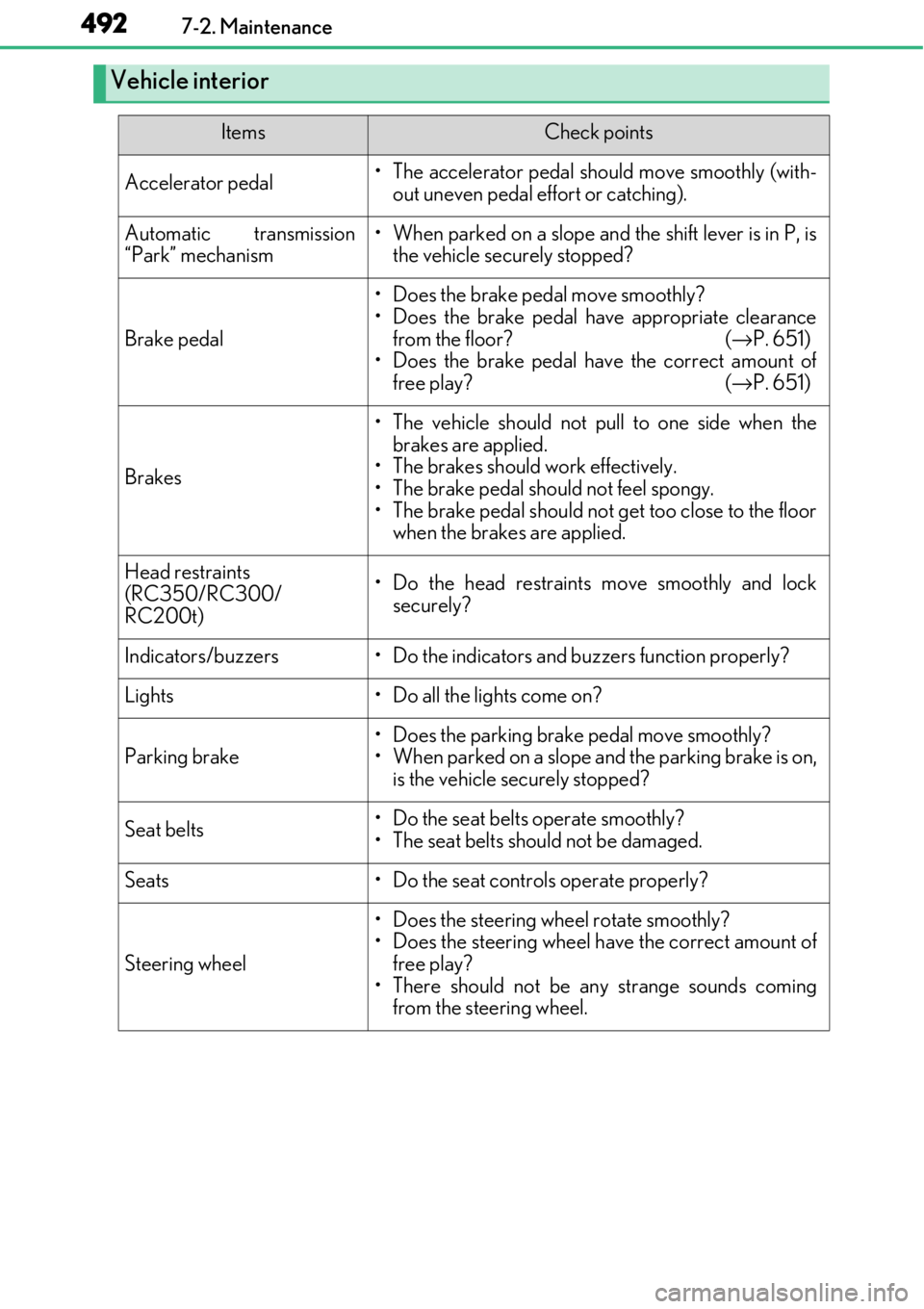
Vehicle interior
ItemsCheck points
Accelerator pedal• The accelerator pedal should move smoothly (with-
out uneven pedal effort or catching).
Automatic transmission
“Park” mechanism• When parked on a slope and the shift lever is in P, is the vehicle securely stopped?
Brake pedal
• Does the brake pedal move smoothly?
• Does the brake pedal have appropriate clearance
from the floor? ( →P. 651)
• Does the brake pedal have the correct amount of
free play? ( →P. 651)
Brakes
• The vehicle should not pull to one side when the
brakes are applied.
• The brakes should work effectively.
• The brake pedal should not feel spongy.
• The brake pedal should no t get too close to the floor
when the brakes are applied.
Head restraints
(RC350/RC300/
RC200t)• Do the head restraints move smoothly and lock securely?
Indicators/buzzers• Do the indicators and buzzers function properly?
Lights• Do all the lights come on?
Parking brake• Does the parking brake pedal move smoothly?
• When parked on a slope and the parking brake is on,
is the vehicle securely stopped?
Seat belts• Do the seat belts operate smoothly?
• The seat belts should not be damaged.
Seats• Do the seat controls operate properly?
Steering wheel
• Does the steering wheel rotate smoothly?
• Does the steering wheel have the correct amount offree play?
• There should not be any strange sounds coming from the steering wheel.
Page 560 of 724
5608-2. Steps to take in an emergency
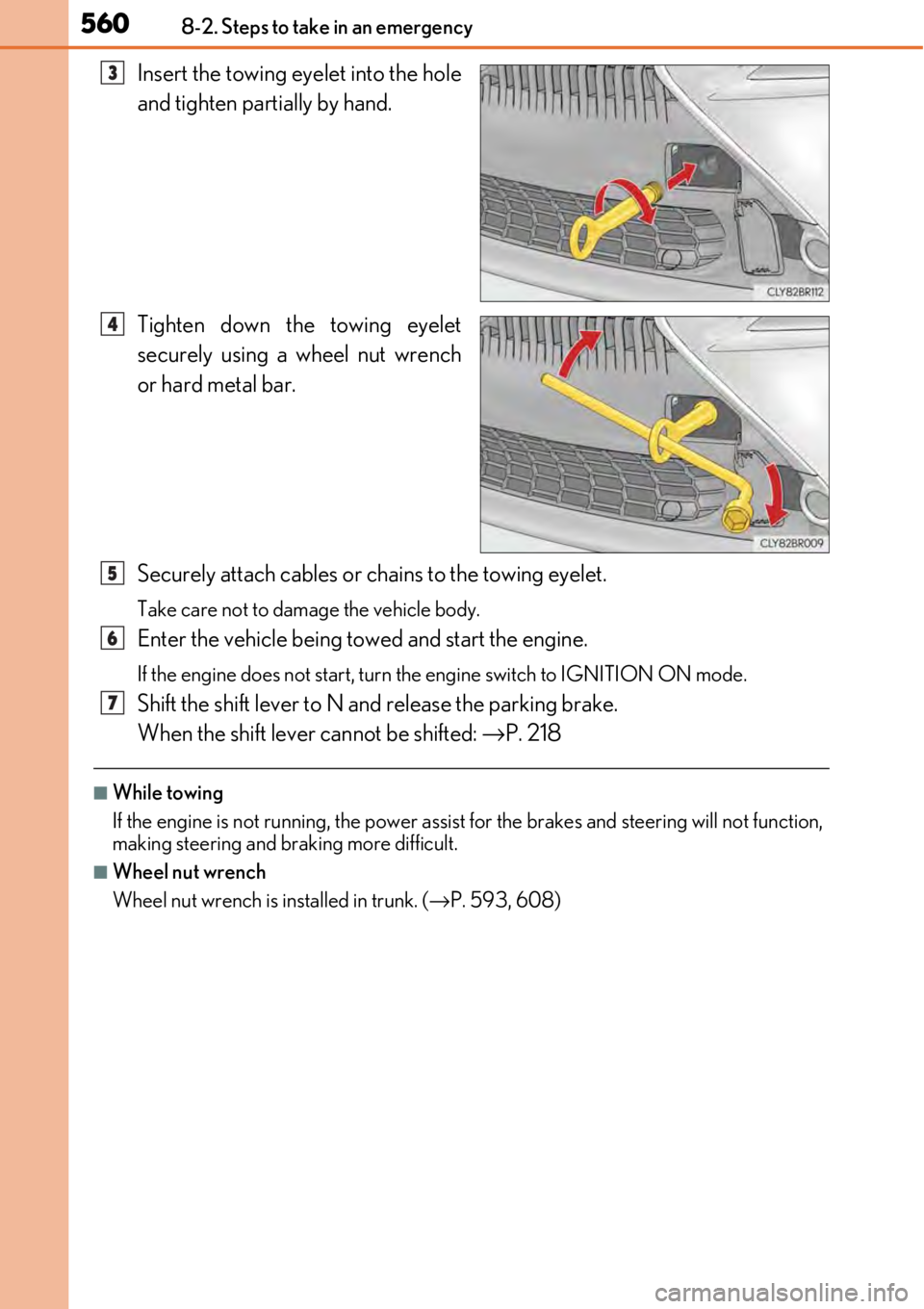
Insert the towing eyelet into the hole
and tighten partially by hand.
Tighten down the towing eyelet
securely using a wheel nut wrench
or hard metal bar.
Securely attach cables or chains to the towing eyelet.
Take care not to damage the vehicle body.
Enter the vehicle being towed and start the engine.
If the engine does not start, turn the engine switch to IGNITION ON mode.
Shift the shift lever to N and release the parking brake.
When the shift lever cannot be shifted: →P. 218
■While towing
If the engine is not running, the power assist for the brakes and steering will not function,
making steering and br aking more difficult.
■Wheel nut wrench
Wheel nut wrench is installed in trunk. ( →P. 593, 608)
3
4
5
6
7
Page 565 of 724
5658-2. Steps to take in an emergency
8
When trouble arises
If a warning light turns on or a warning buzzer
sounds
Calmly perform the following actions if any of the warning lights comes on or
flashes. If a light comes on or flashes, but then goes off, this does not necessar-
ily indicate a malfunction in the system. However, if this continues to occur,
have the vehicle inspecte d by your Lexus dealer.
Warning light and warning buzzer list
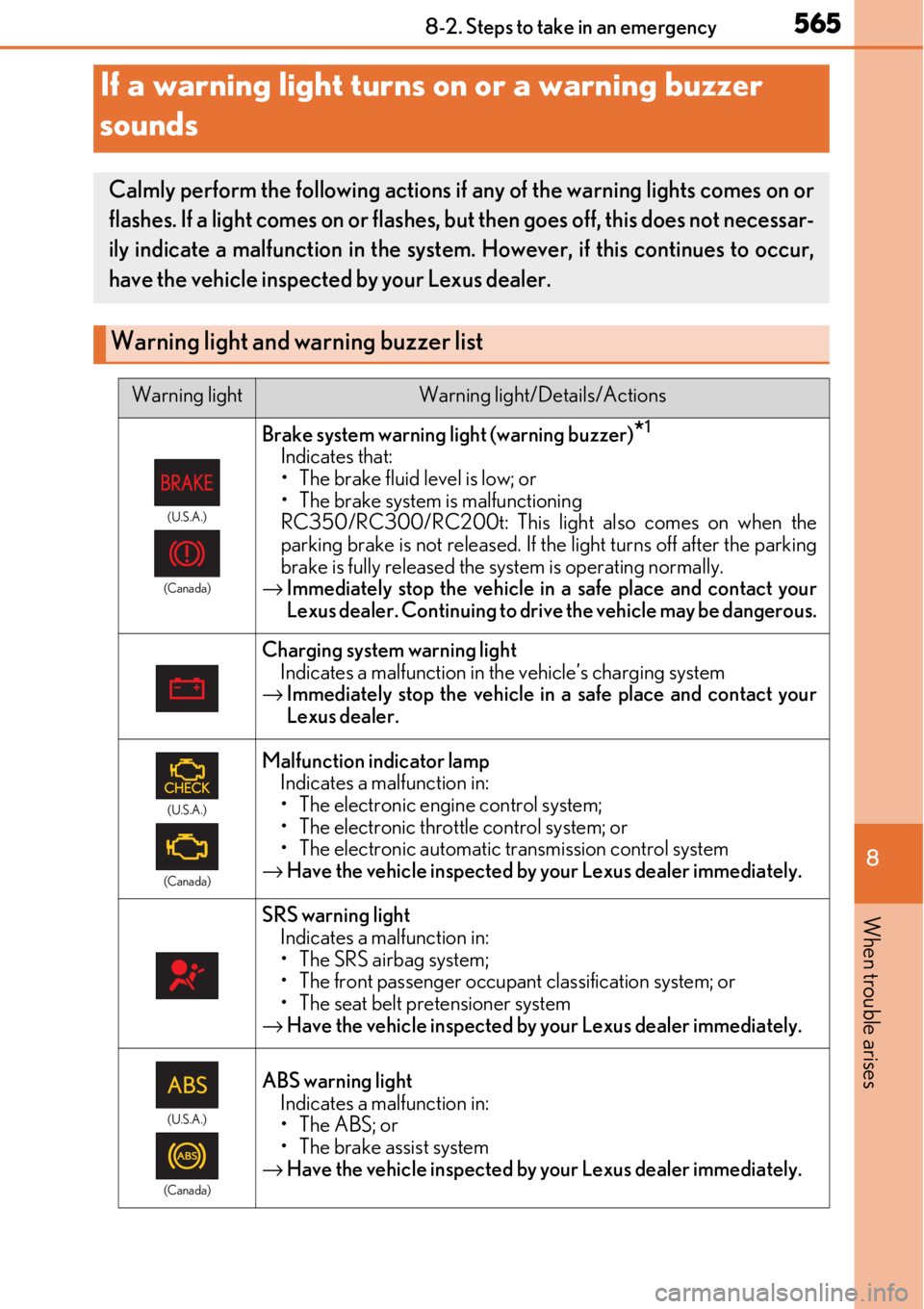
Warning lightWarning light/Details/Actions
(U.S.A.)
(Canada)
Brake system warning light (warning buzzer)*1
Indicates that:
• The brake fluid level is low; or
• The brake system is malfunctioning
RC350/RC300/RC200t: This light also comes on when the
parking brake is not released. If th e light turns off after the parking
brake is fully released the system is operating normally.
→ Immediately stop the vehicle in a safe place and contact your
Lexus dealer. Continuing to drive the vehicle may be dangerous.
Charging system warning light
Indicates a malfunction in the vehicle’s charging system
→ Immediately stop the vehicle in a safe place and contact your
Lexus dealer.
(U.S.A.)
(Canada)
Malfunction indicator lamp Indicates a malfunction in:
• The electronic engine control system;
• The electronic throttle control system; or
• The electronic automatic transmission control system
→ Have the vehicle inspected by your Lexus dealer immediately.
SRS warning light
Indicates a malfunction in:
• The SRS airbag system;
• The front passenger occupant classification system; or
• The seat belt pretensioner system
→ Have the vehicle inspected by your Lexus dealer immediately.
(U.S.A.)
(Canada)
ABS warning light Indicates a malfunction in:
• The ABS; or
• The brake assist system
→ Have the vehicle inspected by your Lexus dealer immediately.
Page 567 of 724
5678-2. Steps to take in an emergency
8
When trouble arises
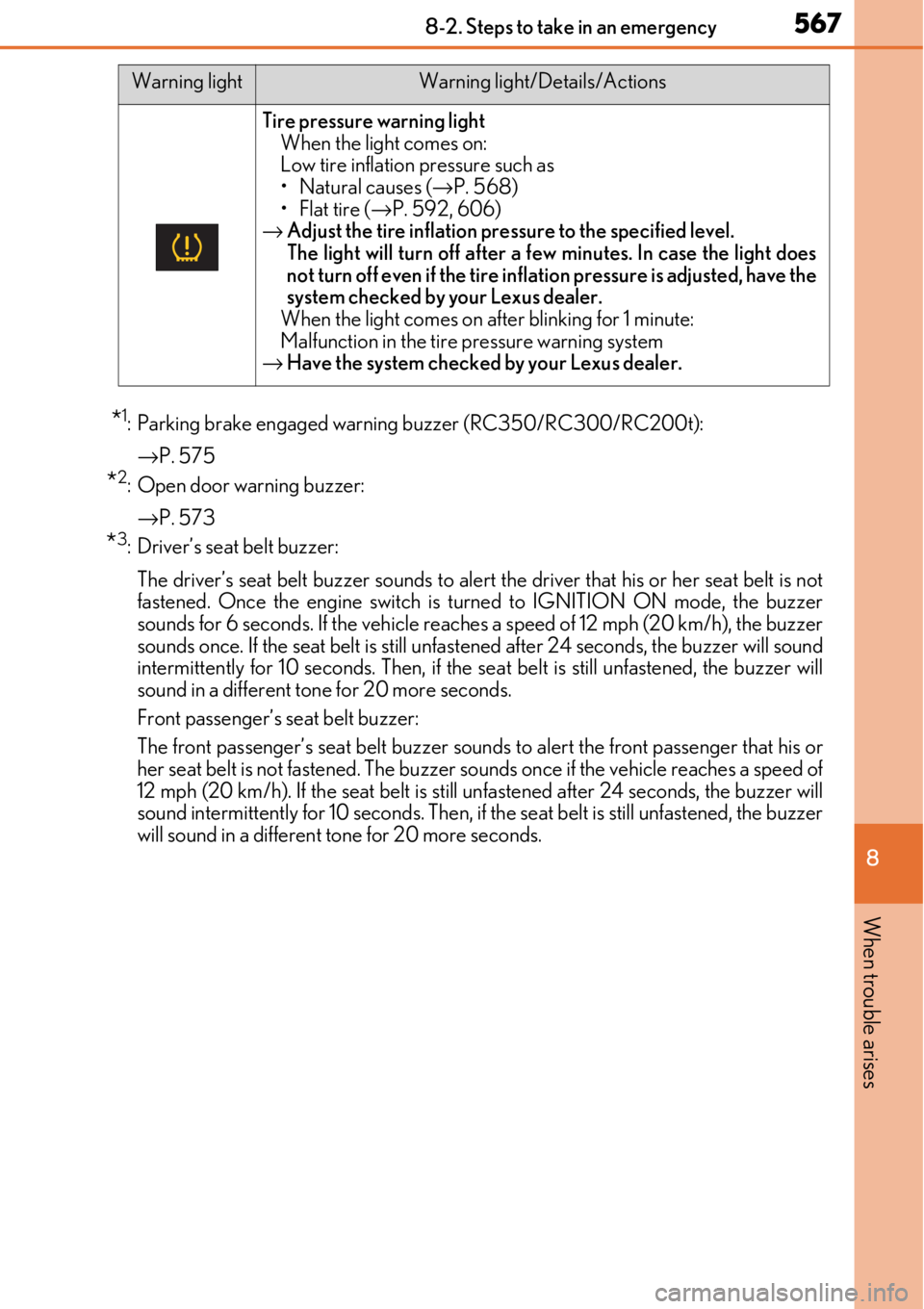
*1: Parking brake engaged warning buzzer (RC350/RC300/RC200t):→ P. 575
*2: Open door warning buzzer:
→ P. 573
*3: Driver’s seat belt buzzer:
The driver’s seat belt buzzer sounds to alert the driver that his or her seat belt is not
fastened. Once the engine switch is turned to IGNITION ON mode, the buzzer
sounds for 6 seconds. If the vehicle reaches a speed of 12 mph (20 km/h), the buzzer
sounds once. If the seat belt is still unfast ened after 24 seconds, the buzzer will sound
intermittently for 10 seconds. Then, if the se at belt is still unfastened, the buzzer will
sound in a different tone for 20 more seconds.
Front passenger’s seat belt buzzer:
The front passenger’s seat belt buzzer soun ds to alert the front passenger that his or
her seat belt is not fastened. The buzzer so unds once if the vehicle reaches a speed of
12 mph (20 km/h). If the seat belt is still unfastened after 24 se conds, the buzzer will
sound intermittently for 10 se conds. Then, if the seat belt is still unfastened, the buzzer
will sound in a different to ne for 20 more seconds.
Tire pressure warning light
When the light comes on:
Low tire inflation pressure such as
• Natural causes ( →P. 568)
•Flat tire ( →P. 592, 606)
→ Adjust the tire inflation pres sure to the specified level.
The light will turn off after a few minutes. In case the light does
not turn off even if the tire inflation pressure is adjusted, have the
system checked by your Lexus dealer.
When the light comes on af ter blinking for 1 minute:
Malfunction in the tire pressure warning system
→ Have the system checked by your Lexus dealer.
Warning lightWarning light/Details/Actions
Page 575 of 724
5758-2. Steps to take in an emergency
8
When trouble arises
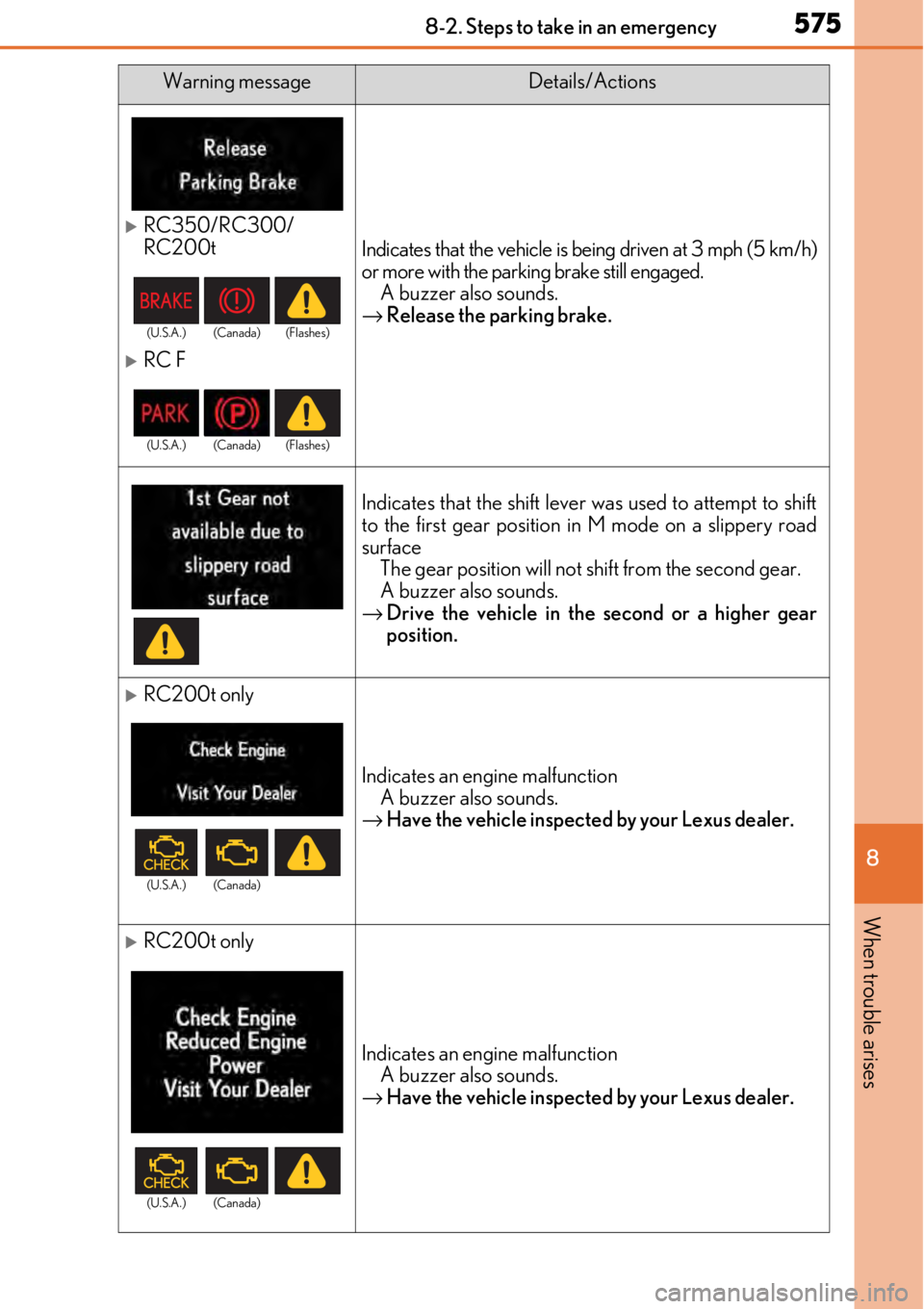
RC350/RC300/
RC200t
RC F
Indicates that the vehicle is being driven at 3 mph (5 km/h)
or more with the parking brake still engaged.A buzzer also sounds.
→ Release the parking brake.
Indicates that the shift lever was used to attempt to shift
to the first gear position in M mode on a slippery road
surface
The gear position will not shift from the second gear.
A buzzer also sounds.
→ Drive the vehicle in the second or a higher gear
position.
RC200t only
Indicates an engine malfunction
A buzzer also sounds.
→ Have the vehicle inspected by your Lexus dealer.
RC200t only
Indicates an engine malfunction
A buzzer also sounds.
→ Have the vehicle inspected by your Lexus dealer.
Warning messageDetails/Actions
(U.S.A.) (Canada) (Flashes)
(U.S.A.) (Canada) (Flashes)
(U.S.A.) (Canada)
(U.S.A.) (Canada)
Page 592 of 724
5928-2. Steps to take in an emergency
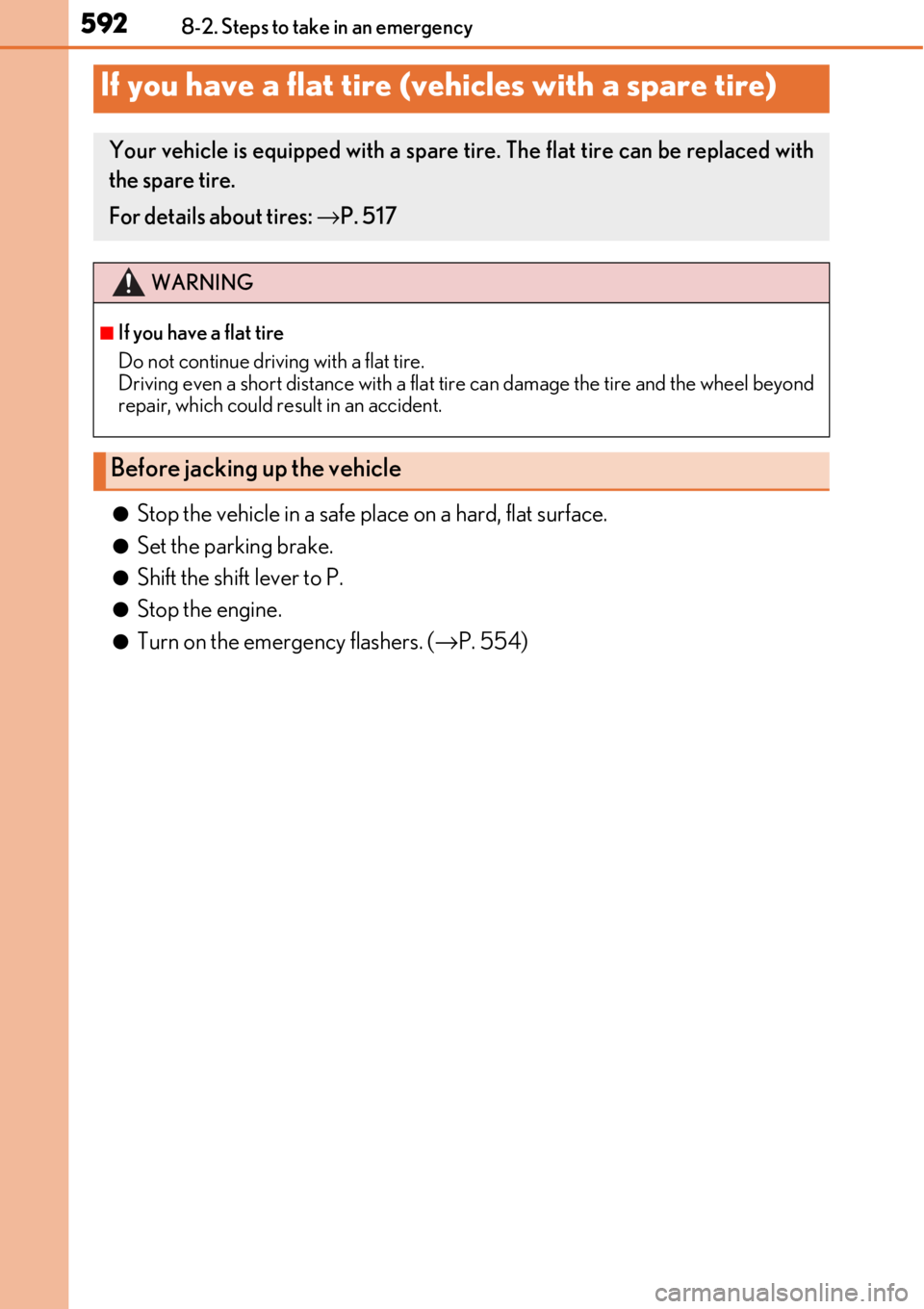
●Stop the vehicle in a safe place on a hard, flat surface.
●Set the parking brake.
●Shift the shift lever to P.
●Stop the engine.
●Turn on the emergency flashers. ( →P. 554)
If you have a flat tire (vehicles with a spare tire)
Your vehicle is equipped with a spare tire. The flat tire can be replaced with
the spare tire.
For details about tires: → P. 517
WARNING
■If you have a flat tire
Do not continue driving with a flat tire.
Driving even a short distance with a flat ti re can damage the tire and the wheel beyond
repair, which could re sult in an accident.
Before jacking up the vehicle
Page 604 of 724

6048-2. Steps to take in an emergency
WARNING
■When using the spare tire
●Remember that the spare tire provided is specifically designed for use with your vehi-
cle. Do not use your spare tire on another vehicle.
●Do not use more than one spare tires simultaneously.
●Replace the spare tire with a standard tire as soon as possible.
●Avoid sudden acceleration, abrupt steering, sudden braking and shifting operations
that cause sudden engine braking.
■When the spare tire is attached
The vehicle speed may not be correctly detected, and the following systems may not
operate correctly:
Also, not only can the following system not be utilized fully, but it may even negatively
affect the drive-train components:
• AWD system (if equipped)
■Speed limit when using the spare tire
Do not drive at speeds in excess of 50 mp h (80 km/h) when a spare tire is installed on
the vehicle.
The spare tire is not designed for driving at high speeds. Failure to observe this precau-
tion may lead to an accident causing death or serious injury.
■After using the tools and jack
Before driving, make sure all the tools and jack are securely in place in their storage
location to reduce the possibilit y of personal injury during a collision or sudden brak-
ing.
• ABS & Brake assist
•VSC
•TRAC
• Cruise control (if equipped)
• Dynamic radar cruise control (if equipped)
• PCS (if equipped)
•EPS
• Adaptive Variable Suspension System (if equipped)
• LDA (Lane Departure Alert) (if equipped) • VGRS (if equipped)
• LDH (Lexus Dynamic Handling sys-
tem) (if equipped)
• DRS (Dynamic Rear Steering) (if equipped)
• VDIM (Vehicle Dynamics Integrated Management)
• Tire pressure warning system
• Lexus parking assist monitor
• Intuitive parking assist (if equipped)
• Navigation system (if equipped)
Page 607 of 724
6078-2. Steps to take in an emergency
8
When trouble arises
●Stop the vehicle in a safe place on a hard, flat surface.
●Set the parking brake.
●Shift the shift lever to P.
●Stop the engine.
●Turn on the emergency flashers. ( →P. 554)
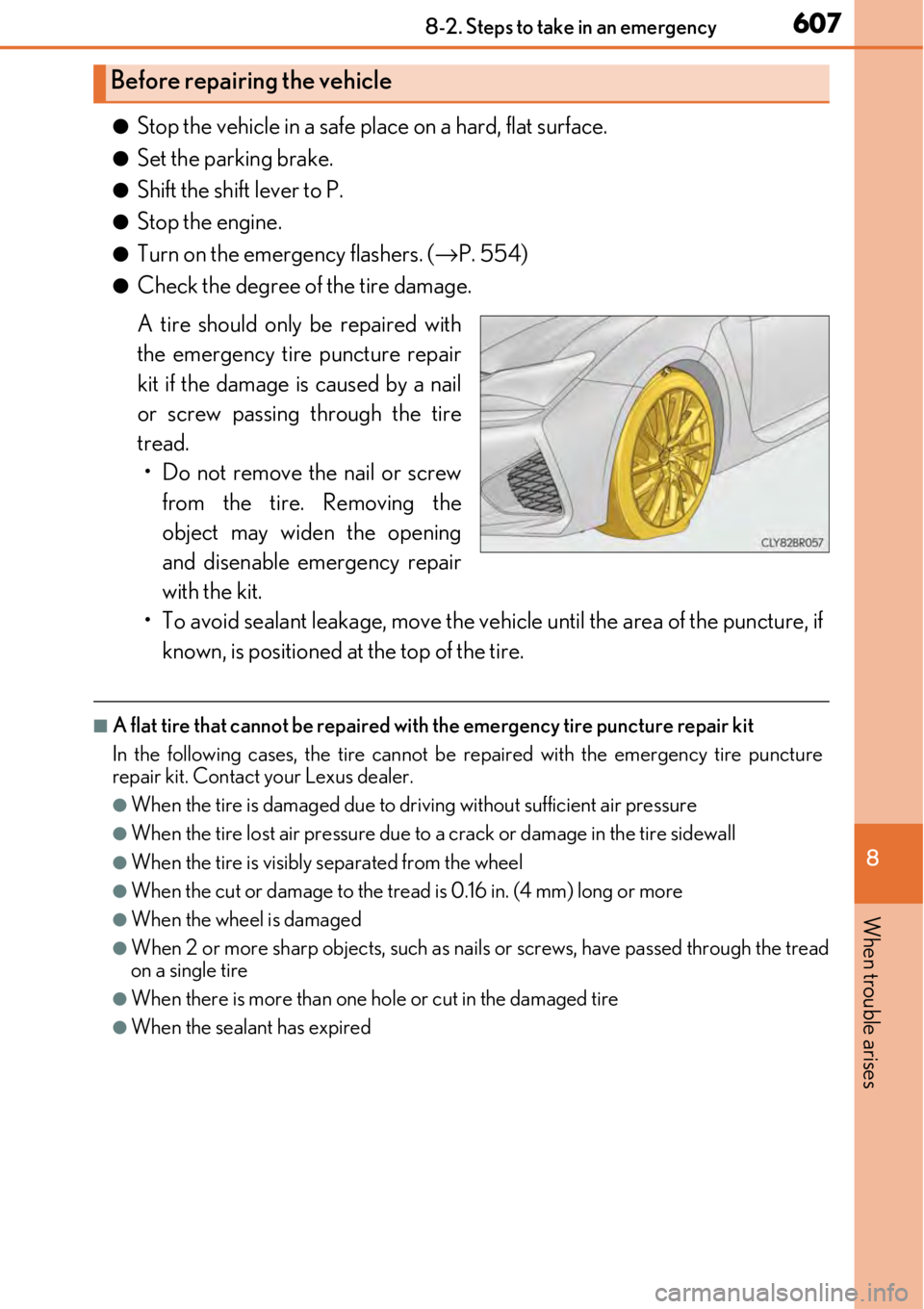
●Check the degree of the tire damage.
A tire should only be repaired with
the emergency tire puncture repair
kit if the damage is caused by a nail
or screw passing through the tire
tread.
• Do not remove the nail or screw from the tire. Removing the
object may widen the opening
and disenable emergency repair
with the kit.
• To avoid sealant leakage, move the vehi cle until the area of the puncture, if
known, is positioned at the top of the tire.
■A flat tire that cannot be repaired with the emergenc y tire puncture repair kit
In the following cases, the tire cannot be repaired with the emergency tire puncture
repair kit. Contact your Lexus dealer.
●When the tire is damaged due to driving without sufficient air pressure
●When the tire lost air pressure due to a crack or damage in the tire sidewall
●When the tire is visibly separated from the wheel
●When the cut or damage to the tread is 0.16 in. (4 mm) long or more
●When the wheel is damaged
●When 2 or more sharp objects, such as nails or screws, have passed through the tread
on a single tire
●When there is more than one hole or cut in the damaged tire
●When the sealant has expired
Before repairing the vehicle