steering wheel LEXUS RC350 2017 Repair Manual
[x] Cancel search | Manufacturer: LEXUS, Model Year: 2017, Model line: RC350, Model: LEXUS RC350 2017Pages: 724, PDF Size: 15.76 MB
Page 507 of 724
5077-3. Do-it-yourself maintenance
7
Maintenance and care
■Engine oil consumption
A certain amount of engine oil will be consumed while driving. In the following situations,
oil consumption may increase, and engine oil may need to be refilled in between oil
maintenance intervals.
●When the engine is new, for example directly after purchasing the vehicle or after
replacing the engine
●If low quality oil or oil of an inappropriate viscosity is used
●When driving at high engine speeds or with a heavy load, or when driving while accel-
erating or decelerating frequently
●When leaving the engine idling for a long time, or when driving frequently through
heavy traffic
■After changing the engine oil (RC200t only)
The engine oil maintenance data should be reset. Perform the following procedures:
While the vehicle is stopped, press the meter control switch on the steering wheel.
Press the < or > meter control switch on the st eering wheel, select, and then
press the meter control switch.
Press ∧ or ∨ meter control switch on the steering wheel to select “Oil Maintenance”
and then press .
Select “Yes” an d then press .
A message will be displayed on the multi-information display.
WARNING
■Used engine oil
●Used engine oil contains potentially harm ful contaminants which may cause skin dis-
orders such as inflammation and skin cance r, so care should be taken to avoid pro-
longed and repeated contact. To remove used engine oil from your skin, wash
thoroughly with soap and water.
●Dispose of used oil and filters only in a sa fe and acceptable manner. Do not dispose of
used oil and filters in household tras h, in sewers or onto the ground.
Call your Lexus dealer, service station or auto parts store for information concerning
recycling or disposal.
●Do not leave used engine oil within the reach of children.
1
2
3
4
Page 545 of 724
5457-3. Do-it-yourself maintenance
7
Maintenance and care
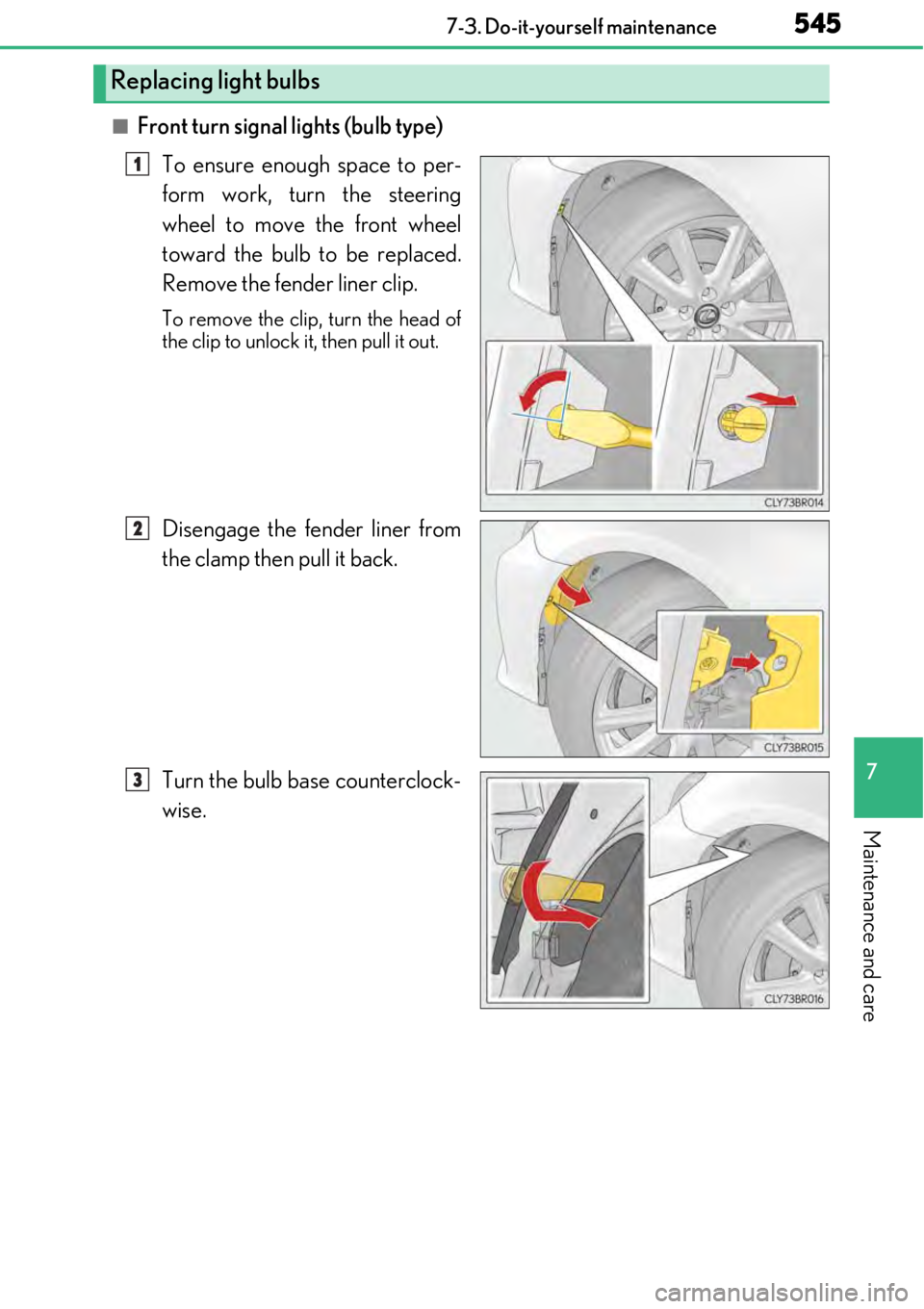
■Front turn signal lights (bulb type)To ensure enough space to per-
form work, turn the steering
wheel to move the front wheel
toward the bulb to be replaced.
Remove the fender liner clip.
To remove the clip , turn the head of
the clip to unlock it, then pull it out.
Disengage the fender liner from
the clamp then pull it back.
Turn the bulb base counterclock-
wise.
Replacing light bulbs
1
2
3
Page 555 of 724
5558-1. Essential information
8
When trouble arises
Steadily step on the brake pedal with both feet and firmly depress it.
Do not pump the brake pedal repeatedly as this will increase the effort required to
slow the vehicle.
Shift the shift lever to N.
If the shift lever is shifted to N
After slowing down, stop the vehicle in a safe place by the road.
Stop the engine.
If the shift lever cannot be shifted to N
Keep depressing the brake pedal with both feet to reduce vehicle speed as
much as possible.
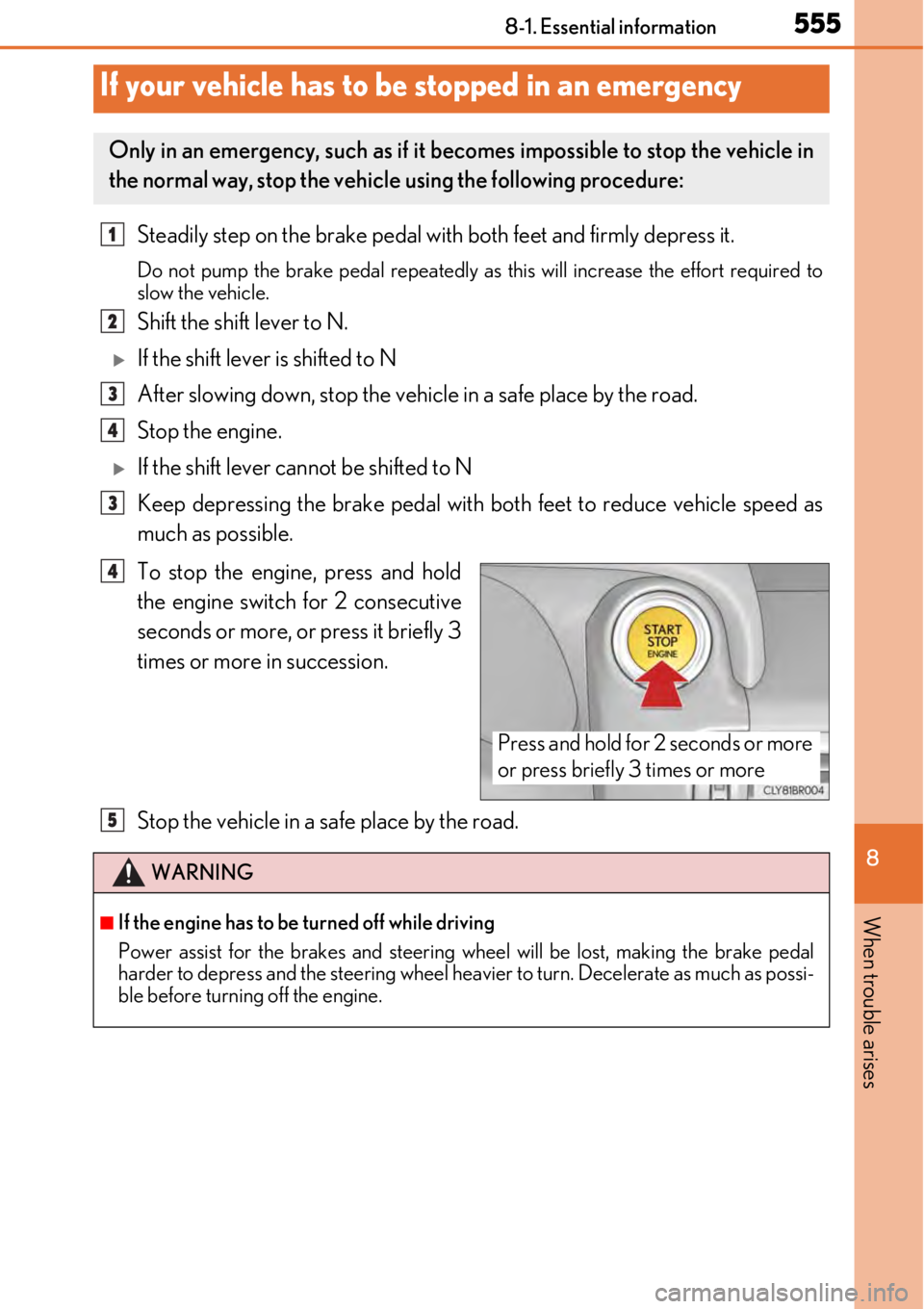
To stop the engine, press and hold
the engine switch for 2 consecutive
seconds or more, or press it briefly 3
times or more in succession.
Stop the vehicle in a safe place by the road.
If your vehicle has to be stopped in an emergency
Only in an emergency, such as if it becomes impossible to stop the vehicle in
the normal way, stop the vehicl e using the following procedure:
1
2
3
4
3
Press and hold for 2 seconds or more
or press briefly 3 times or more
4
WARNING
■If the engine has to be turned off while driving
Power assist for the brakes and steering wheel will be lost, making the brake pedal
harder to depress and the steering wheel heav ier to turn. Decelerate as much as possi-
ble before turning off the engine.
5
Page 558 of 724
5588-2. Steps to take in an emergency
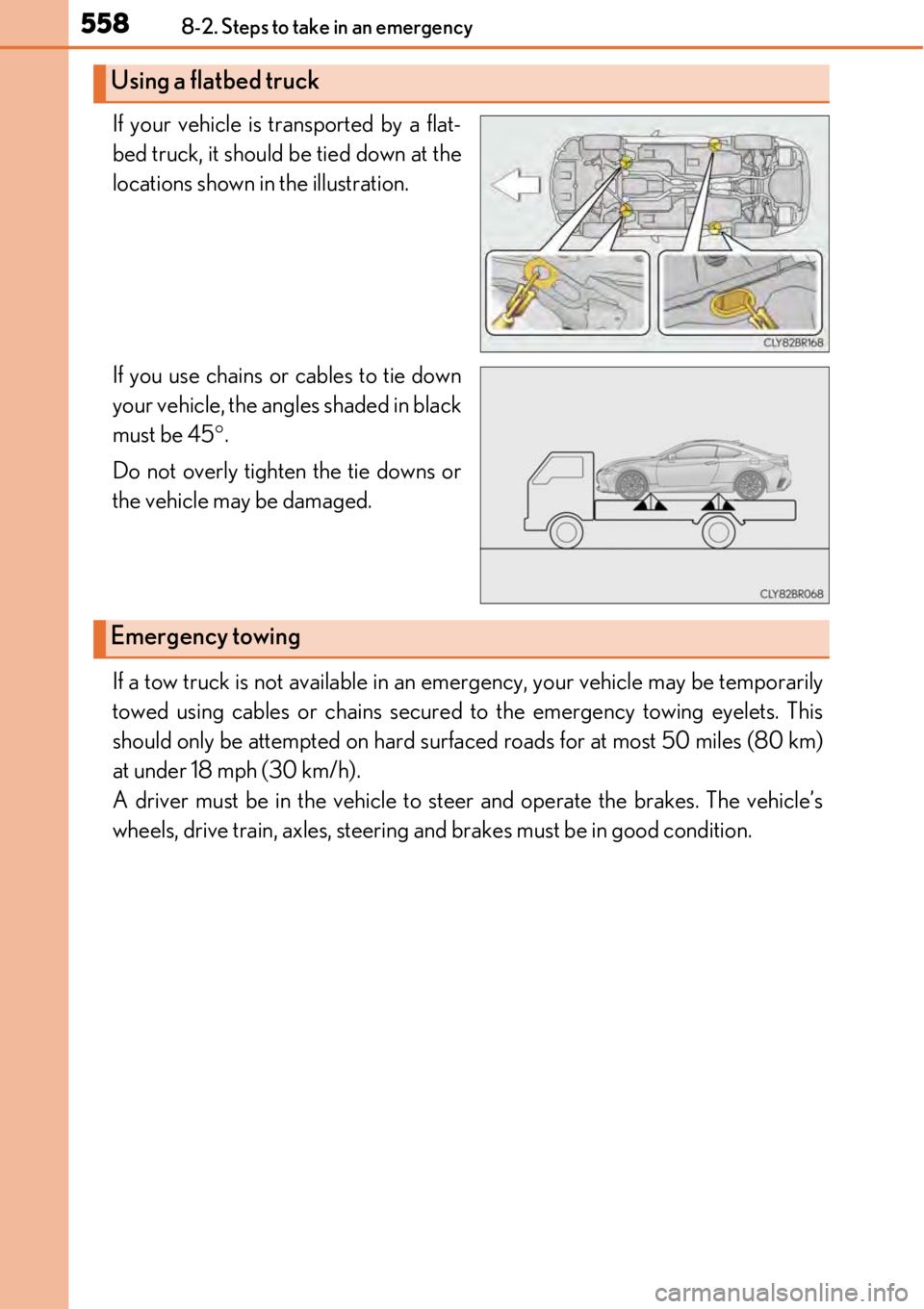
If your vehicle is transported by a flat-
bed truck, it should be tied down at the
locations shown in the illustration.
If you use chains or cables to tie down
your vehicle, the angles shaded in black
must be 45°.
Do not overly tighten the tie downs or
the vehicle may be damaged.
If a tow truck is not available in an em ergency, your vehicle may be temporarily
towed using cables or chains secured to the emergency towing eyelets. This
should only be attempted on hard surf aced roads for at most 50 miles (80 km)
at under 18 mph (30 km/h).
A driver must be in the vehicle to st eer and operate the brakes. The vehicle’s
wheels, drive train, axles, steering an d brakes must be in good condition.
Using a flatbed truck
Emergency towing
Page 560 of 724
5608-2. Steps to take in an emergency
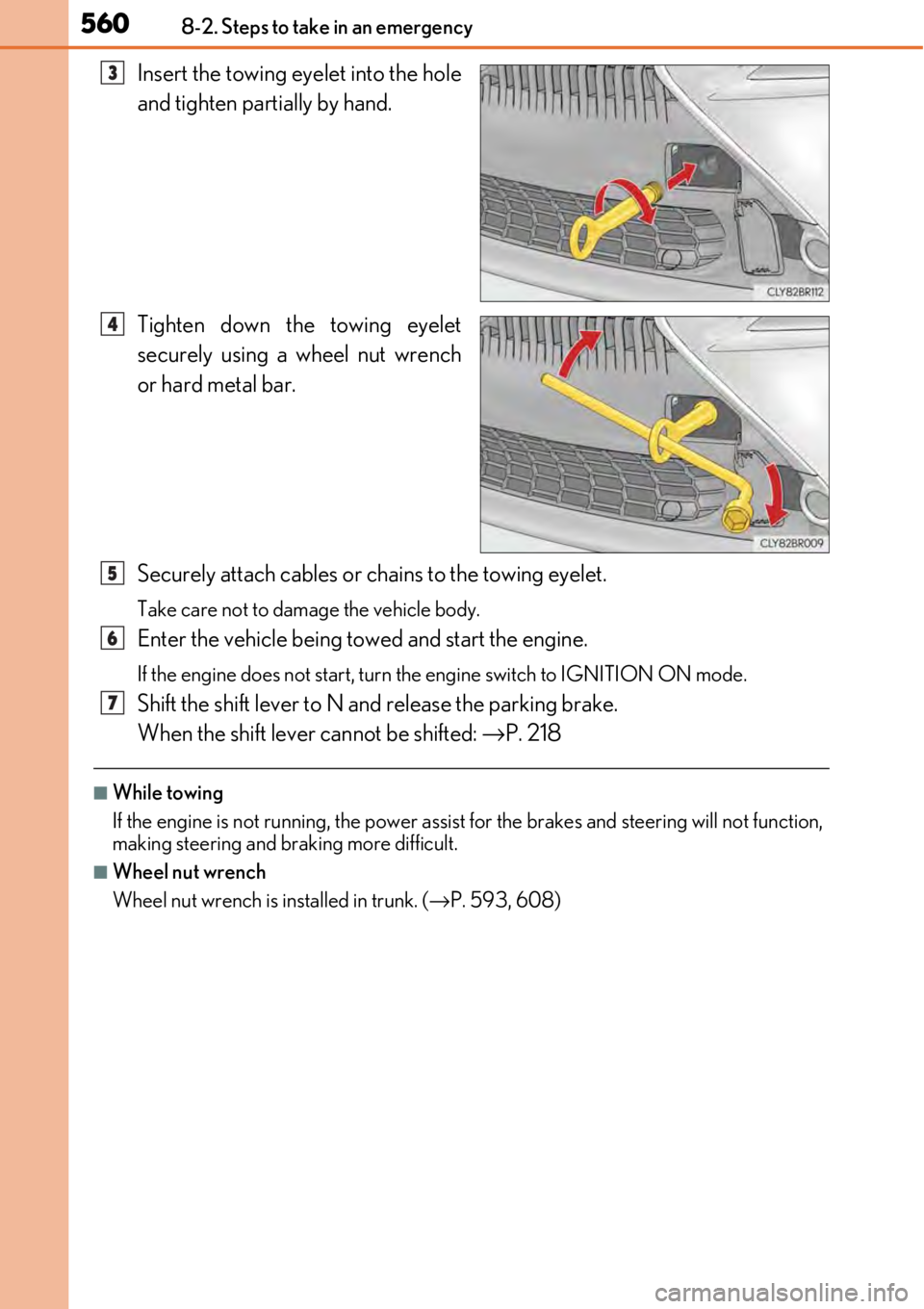
Insert the towing eyelet into the hole
and tighten partially by hand.
Tighten down the towing eyelet
securely using a wheel nut wrench
or hard metal bar.
Securely attach cables or chains to the towing eyelet.
Take care not to damage the vehicle body.
Enter the vehicle being towed and start the engine.
If the engine does not start, turn the engine switch to IGNITION ON mode.
Shift the shift lever to N and release the parking brake.
When the shift lever cannot be shifted: →P. 218
■While towing
If the engine is not running, the power assist for the brakes and steering will not function,
making steering and br aking more difficult.
■Wheel nut wrench
Wheel nut wrench is installed in trunk. ( →P. 593, 608)
3
4
5
6
7
Page 562 of 724
5628-2. Steps to take in an emergency
WARNING
■While towing
●When towing using cables or chains, avoid sudden starts, etc. which place excessive
stress on the towing eyelets, cables or chains. The towing eyelets, cables or chains
may become damaged, broken debris ma y hit people, and cause serious damage.
●Do not turn the engine switch off.
There is a possibility that the steering wheel is locked and cannot be operated.
■Installing towing eyelets to the vehicle
Make sure that towing eyel ets are installed securely.
If not securely installed, towing ey elets may come loose during towing.
NOTICE
■To prevent damage to the vehicle when towing using a wheel-lift type truck
●Do not tow the vehicle from the rear when the engine switch is off. The steering lock
mechanism is not strong enough to hold the front wheels straight.
●When raising the vehicle, ensure adequate ground cleara nce for towing at the oppo-
site end of the raised vehicle. Without ad equate clearance, the vehicle could be dam-
aged while being towed.
■To prevent damage to the vehicle when towing with a sling-type truck
Do not tow with a sling-type truck, either from the front or rear.
■To prevent damage to the ve hicle during emergency towing
Do not secure cables or chains to the suspension components.
Page 569 of 724

5698-2. Steps to take in an emergency
8
When trouble arises
WARNING
■If both the ABS and the brake system warning lights remain on
Stop your vehicle in a safe place immediat ely and contact your Lexus dealer. The vehi-
cle will become extremely unstable during br aking, and the ABS system may fail, which
could cause an accident resultin g in death or serious injury.
■When the electric power steering system warning light comes on
The steering wheel may become extremely heavy.
If the steering wheel becomes heavier than usual when operating, hold firmly and oper-
ate using more force than usual.
■If the tire pressure warning light comes on
Be sure to observe the following precaution s. Failure to do so could cause a loss of
vehicle control and result in death or serious injury.
Vehicles with a spare tire
●Stop your vehicle in a safe place as soon as possible. Adjust the tire inflation pressure
immediately.
●If the tire pressure warning light comes on even after tire inflation pressure adjust-
ment, it is probable that you have a flat tire . Check the tires. If a tire is flat, change it
with the spare tire and have the flat tire repaired by the nearest Lexus dealer.
●Avoid abrupt maneuvering and braking. If the vehicle tires deteriorate, you could lose
control of the steering wheel or the brakes.
Vehicles with an emergency tire puncture repair kit
●Stop your vehicle in a safe place as soon as possible. Adjust the tire inflation pressure
immediately.
●If the tire pressure warning light comes on even after tire inflation pressure adjust-
ment, it is probable that you ha ve a flat tire. Check the tires. If a tire is flat, repair the
flat tire by using emergency tire puncture repair kit.
●Avoid abrupt maneuvering and braking. If the vehicle tires deteriorate, you could lose
control of the steering wheel or the brakes.
■If a blowout or sudden air leakage should occur
The tire pressure warning system may not activate immediately.
Page 579 of 724
5798-2. Steps to take in an emergency
8
When trouble arises
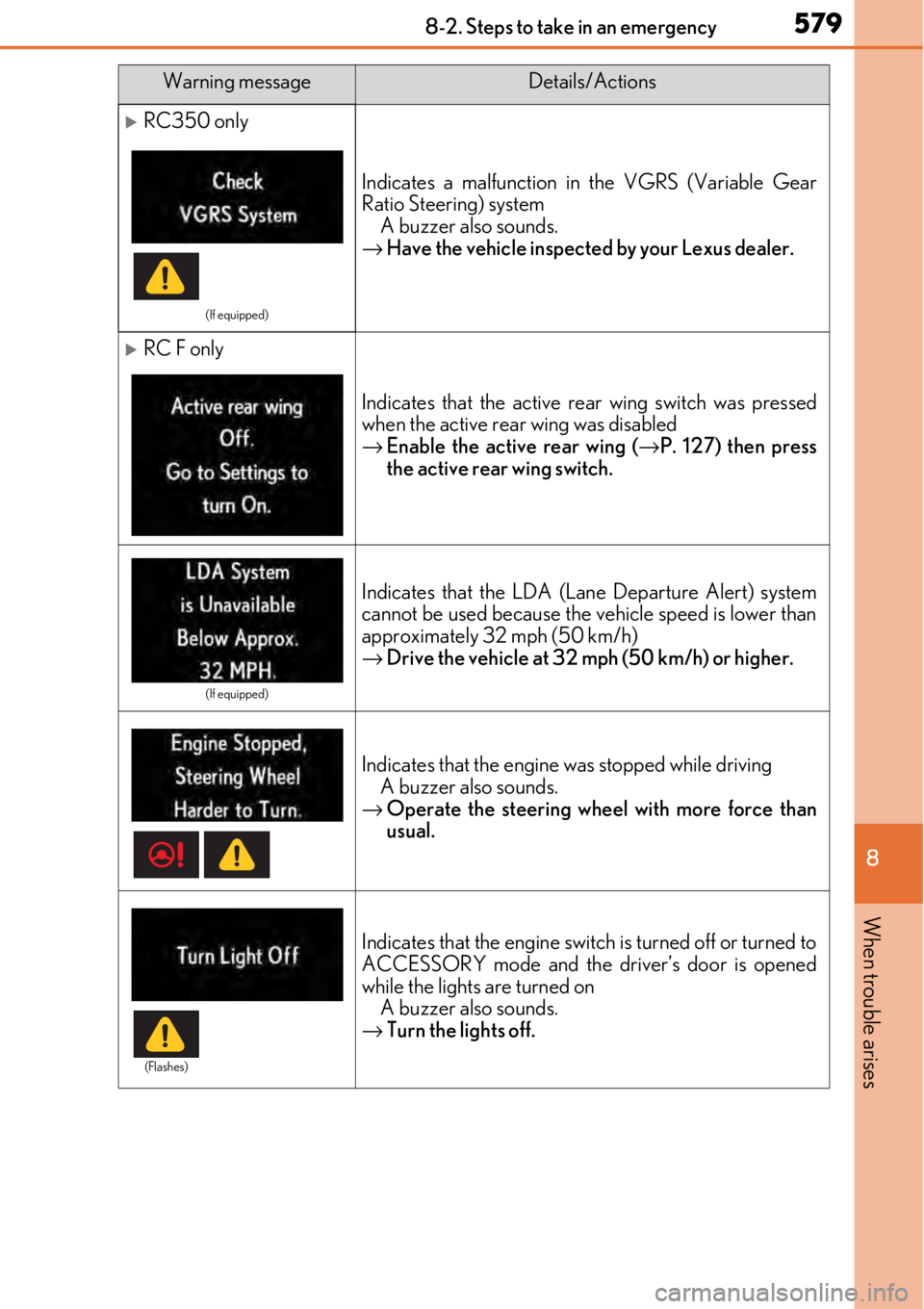
RC350 only
(If equipped)
Indicates a malfunction in the VGRS (Variable Gear
Ratio Steering) system
A buzzer also sounds.
→ Have the vehicle inspected by your Lexus dealer.
RC F only
Indicates that the active re ar wing switch was pressed
when the active rear wing was disabled
→ Enable the active rear wing ( →P. 127) then press
the active rear wing switch.
(If equipped)
Indicates that the LDA (Lan e Departure Alert) system
cannot be used because the vehicle speed is lower than
approximately 32 mph (50 km/h)
→ Drive the vehicle at 32 mph (50 km/h) or higher.
Indicates that the engine was stopped while driving
A buzzer also sounds.
→ Operate the steering wheel with more force than
usual.
Indicates that the engine switch is turned off or turned to
ACCESSORY mode and the driver’s door is opened
while the lights are turned on
A buzzer also sounds.
→ Turn the lights off.
Warning messageDetails/Actions
(Flashes)
Page 589 of 724
5898-2. Steps to take in an emergency
8
When trouble arises
OnceCon-
tinuous
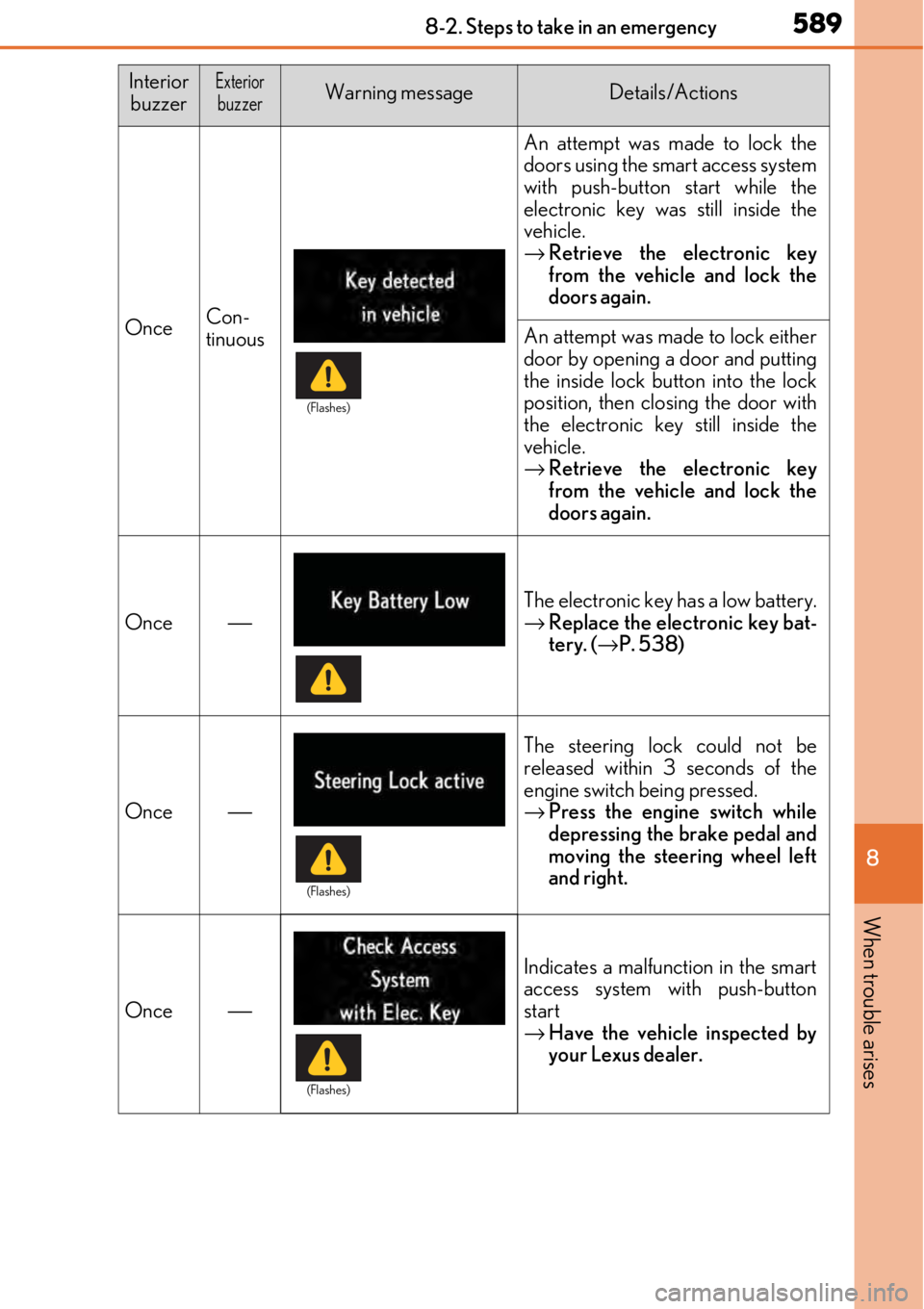
An attempt was made to lock the
doors using the smart access system
with push-button start while the
electronic key was still inside the
vehicle.
→Retrieve the electronic key
from the vehicle and lock the
doors again.
An attempt was made to lock either
door by opening a door and putting
the inside lock bu tton into the lock
position, then closing the door with
the electronic key still inside the
vehicle.
→ Retrieve the electronic key
from the vehicle and lock the
doors again.
Once⎯
The electronic key has a low battery.
→Replace the electronic key bat-
tery. ( →P. 538)
Once⎯
The steering lock could not be
released within 3 seconds of the
engine switch being pressed.
→ Press the engine switch while
depressing the brake pedal and
moving the steering wheel left
and right.
Once⎯
Indicates a malfunction in the smart
access system with push-button
start
→Have the vehicle inspected by
your Lexus dealer.
Interior
buzzerExteriorbuzzerWarning messageDetails/Actions
(Flashes)
(Flashes)
(Flashes)
Page 618 of 724

6188-2. Steps to take in an emergency
WARNING
■When fixing the flat tire
Observe the following precautions.
Failure to do so may result in death or serious injury.
●Stop your vehicle in a safe and flat area.
●Do not touch the wheels or the area around the brakes immediately after the vehicle
has been driven.
After the vehicle has been driven, the wheels and the area around the brakes may be
extremely hot. Touching these areas with hands, feet or other body parts may result in
burns.
●Connect the valve and hose securely with the tire installed on the vehicle.
• If the hose is not properly connected to the valve, air leakage may occur or sealant
may be sprayed out.
• If the hose comes off the valve while inflating the tire, there is a risk that the hose will move abruptly due to air pressure.
• After inflation of the tire has completed, the sealant may splatter when the hose is disconnected or some air is let out of the tire.
●Follow the operation procedure to repair the tire. If the procedure is not followed, the
sealant may spray out.
●Keep back from the tire while it is being re paired, as there is a chance of it bursting
while the repair operation is being performe d. If you notice any cracks or deforma-
tion of the tire, turn off the compressor sw itch and stop the repair operation immedi-
ately.
●The kit may overheat if operated for a long period of time. Do not operate the com-
pressor continuously for more than 35 minutes.
●Parts of the kit become hot during operation. Be careful handling the kit during and
after operation. Do not touch the metal part around the connecting area between the
bottle and compressor. It will be extremely hot.
●Do not attach the vehicle speed warning sticker to an area other than the one indi-
cated. If the sticker is attached to an area where an SRS airbag is located, such as the
pad of the steering wheel, it may preven t the SRS airbag from operating properly.
■Driving to spread the liquid sealant evenly
●Drive the vehicle carefully at a low speed. Be especially careful when turning and cor-
nering.
●If the vehicle does not drive straight or you feel a pull through the steering wheel, stop
the vehicle and check the following:
• Tire condition. The tire may have separated from the wheel.
• Tire inflation pressure. If tire inflation pressure is 19 psi (130 kPa, 1.3 kgf/cm
2 or
bar) or below, this may in dicate severe tire damage.