wheel LEXUS RC350 2018 Owners Manual
[x] Cancel search | Manufacturer: LEXUS, Model Year: 2018, Model line: RC350, Model: LEXUS RC350 2018Pages: 636, PDF Size: 6.92 MB
Page 551 of 636
5518-1. Specifications
8
Vehicle specifications
RC350_RC300 AWD_RC300_RC F_U(OM24748U)
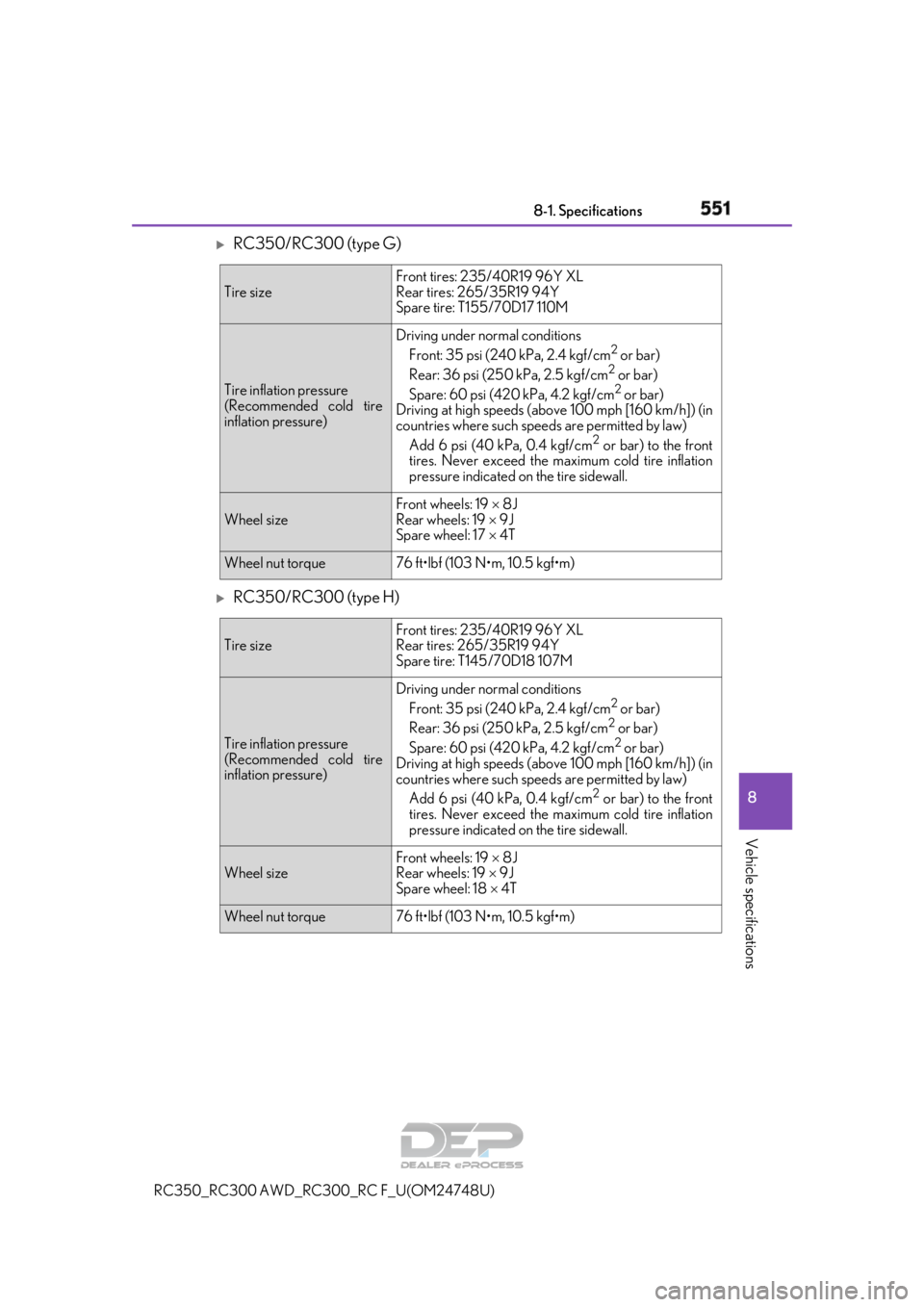
RC350/RC300 (type G)
RC350/RC300 (type H)
Tire size
Front tires: 235/40R19 96Y XL
Rear tires: 265/35R19 94Y
Spare tire: T155/70D17 110M
Tire inflation pressure
(Recommended cold tire
inflation pressure)
Driving under normal conditions
Front: 35 psi (240 kPa, 2.4 kgf/cm2 or bar)
Rear: 36 psi (250 kPa, 2.5 kgf/cm2 or bar)
Spare: 60 psi (420 kPa, 4.2 kgf/cm2 or bar)
Driving at high speeds (above 100 mph [160 km/h]) (in
countries where such speeds are permitted by law)
Add 6 psi (40 kPa, 0.4 kgf/cm
2 or bar) to the front
tires. Never exceed the maximum cold tire inflation
pressure indicated on the tire sidewall.
Wheel sizeFront wheels: 19 8J
Rear wheels: 19 9J
Spare wheel: 17 4T
Wheel nut torque76 ft•lbf (103 N•m, 10.5 kgf•m)
Tire sizeFront tires: 235/40R19 96Y XL
Rear tires: 265/35R19 94Y
Spare tire: T145/70D18 107M
Tire inflation pressure
(Recommended cold tire
inflation pressure)
Driving under normal conditions
Front: 35 psi (240 kPa, 2.4 kgf/cm2 or bar)
Rear: 36 psi (250 kPa, 2.5 kgf/cm2 or bar)
Spare: 60 psi (420 kPa, 4.2 kgf/cm2 or bar)
Driving at high speeds (above 100 mph [160 km/h]) (in
countries where such speeds are permitted by law)
Add 6 psi (40 kPa, 0.4 kgf/cm
2 or bar) to the front
tires. Never exceed the maximum cold tire inflation
pressure indicated on the tire sidewall.
Wheel size
Front wheels: 19 8J
Rear wheels: 19 9J
Spare wheel: 18 4T
Wheel nut torque76 ft•lbf (103 N•m, 10.5 kgf•m)
Page 552 of 636
5528-1. Specifications
RC350_RC300 AWD_RC3 00_RC F_U(OM24748U)
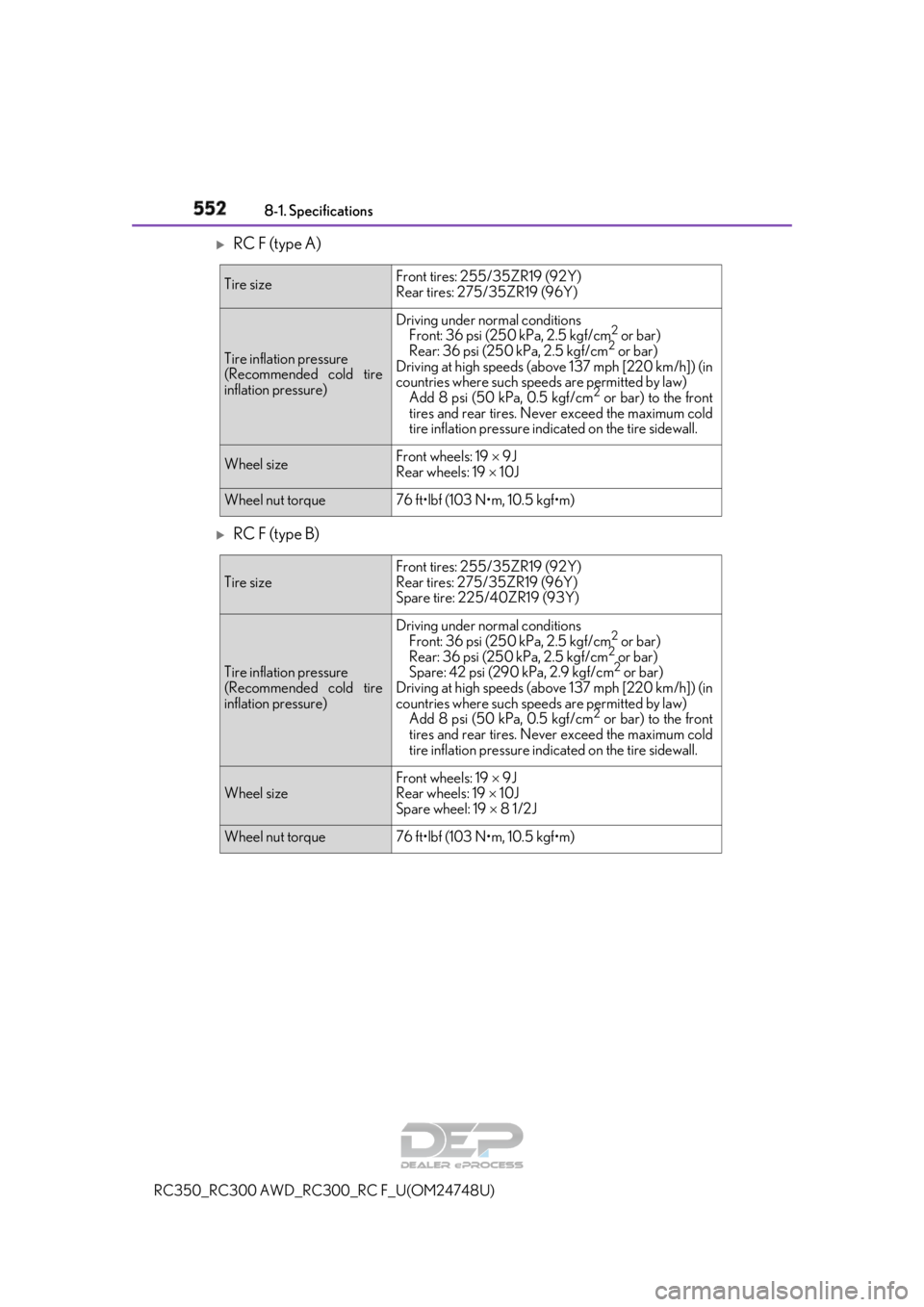
RC F (type A)
RC F (type B)
Tire sizeFront tires: 255/35ZR19 (92Y)
Rear tires: 275/35ZR19 (96Y)
Tire inflation pressure
(Recommended cold tire
inflation pressure)
Driving under normal conditions
Front: 36 psi (250 kPa, 2.5 kgf/cm2 or bar)
Rear: 36 psi (250 kPa, 2.5 kgf/cm2 or bar)
Driving at high speeds (above 137 mph [220 km/h]) (in
countries where such speeds are permitted by law) Add 8 psi (50 kPa, 0.5 kgf/cm
2 or bar) to the front
tires and rear tires. Never exceed the maximum cold
tire inflation pressure indi cated on the tire sidewall.
Wheel sizeFront wheels: 19 9J
Rear wheels: 19 10J
Wheel nut torque76 ft•lbf (103 N•m, 10.5 kgf•m)
Tire size
Front tires: 255/35ZR19 (92Y)
Rear tires: 275/35ZR19 (96Y)
Spare tire: 225/40ZR19 (93Y)
Tire inflation pressure
(Recommended cold tire
inflation pressure)
Driving under normal conditions
Front: 36 psi (250 kPa, 2.5 kgf/cm2 or bar)
Rear: 36 psi (250 kPa, 2.5 kgf/cm2 or bar)
Spare: 42 psi (290 kPa, 2.9 kgf/cm2 or bar)
Driving at high speeds (above 137 mph [220 km/h]) (in
countries where such speeds are permitted by law) Add 8 psi (50 kPa, 0.5 kgf/cm
2 or bar) to the front
tires and rear tires. Never exceed the maximum cold
tire inflation pressure indi cated on the tire sidewall.
Wheel sizeFront wheels: 19 9J
Rear wheels: 19 10J
Spare wheel: 19 8 1/2J
Wheel nut torque76 ft•lbf (103 N•m, 10.5 kgf•m)
Page 560 of 636
5608-1. Specifications
RC350_RC300 AWD_RC3 00_RC F_U(OM24748U)
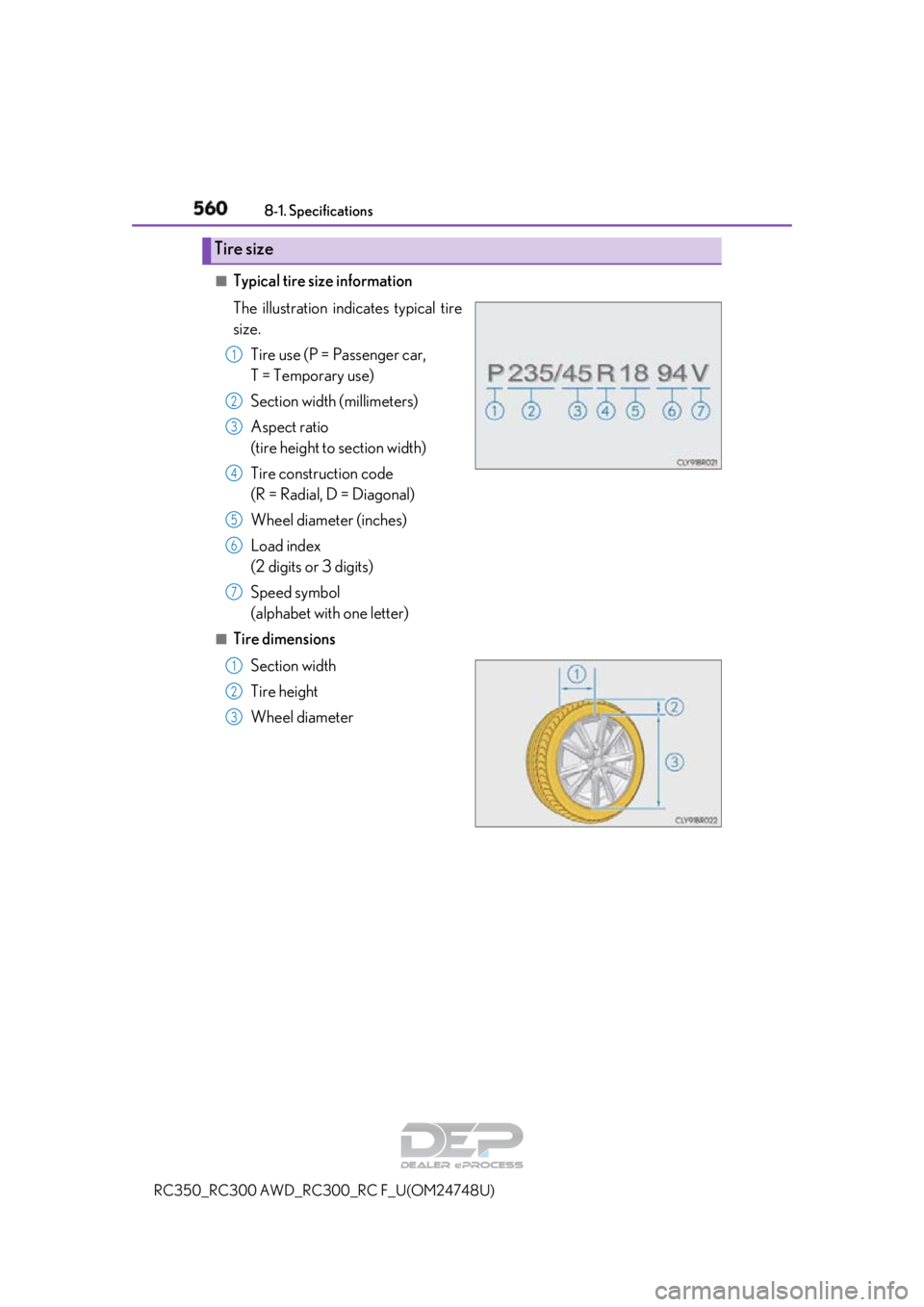
■Typical tire size information
The illustration indicates typical tire
size.
Tire use (P = Passenger car,
T = Temporary use)
Section width (millimeters)
Aspect ratio
(tire height to section width)
Tire construction code
(R = Radial, D = Diagonal)
Wheel diameter (inches)
Load index
(2 digits or 3 digits)
Speed symbol
(alphabet with one letter)
■Tire dimensions
Section width
Tire height
Wheel diameter
Tire size
1
2
3
4
5
6
7
1
2
3
Page 563 of 636

5638-1. Specifications
8
Vehicle specifications
RC350_RC300 AWD_RC300_RC F_U(OM24748U)
■Temperature A, B, C
The temperature grades are A (the highes t), B, and C, representing the tire’s
resistance to the generation of heat and its ability to dissipate heat when
tested under controlled conditions on a specified indoor laboratory test
wheel.
Sustained high temperature can cause the ma terial of the tire to degenerate and
reduce tire life, and excessive temperature can lead to sudden tire failure.
Grade C corresponds to a level of perfor mance which all passenger car tires must
meet under the Federal Motor Vehicle Safety Standard No. 109.
Grades B and A represent higher levels of performance on the laboratory test
wheel than the minimum required by law.
Warning: The temperature grades of a tire assume that it is properly inflated and
not overloaded.
Excessive speed, underi nflation, or excessive loading, either separately or in com-
bination, can cause heat buildup and possible tire failure.
Page 565 of 636
5658-1. Specifications
8
Vehicle specifications
RC350_RC300 AWD_RC300_RC F_U(OM24748U)
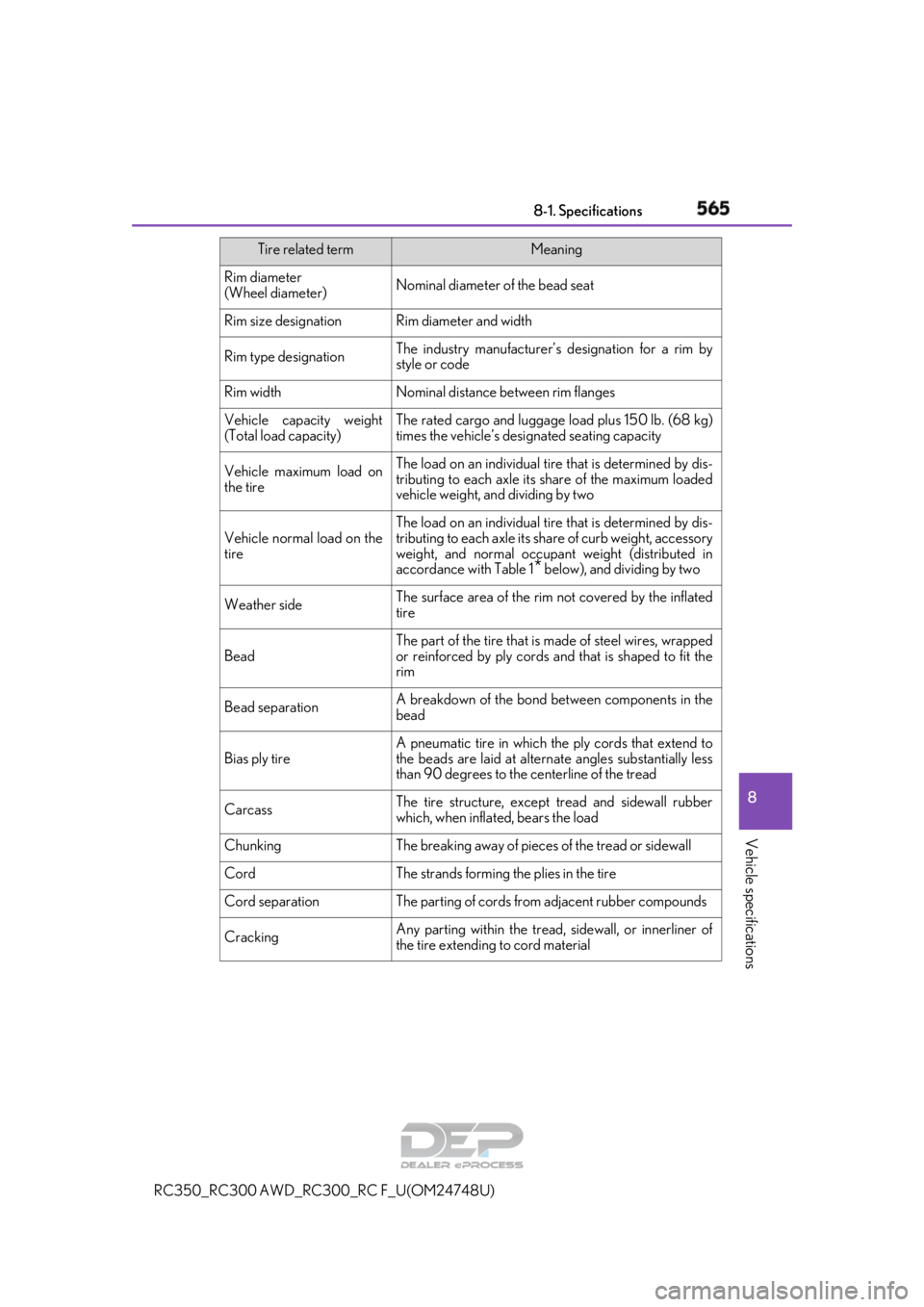
Rim diameter
(Wheel diameter)Nominal diameter of the bead seat
Rim size designationRim diameter and width
Rim type designationThe industry manufacturer’s designation for a rim by
style or code
Rim widthNominal distance between rim flanges
Vehicle capacity weight
(Total load capacity)The rated cargo and luggage load plus 150 lb. (68 kg)
times the vehicle’s desi gnated seating capacity
Vehicle maximum load on
the tireThe load on an individual tire that is determined by dis-
tributing to each axle its share of the maximum loaded
vehicle weight, and dividing by two
Vehicle normal load on the
tire
The load on an individual tire that is determined by dis-
tributing to each axle its sh are of curb weight, accessory
weight, and normal occupant weight (distributed in
accordance with Table 1
* below), and dividing by two
Weather sideThe surface area of the rim not covered by the inflated
tire
BeadThe part of the tire that is made of steel wires, wrapped
or reinforced by ply cords and that is shaped to fit the
rim
Bead separationA breakdown of the bond between components in the
bead
Bias ply tireA pneumatic tire in which the ply cords that extend to
the beads are laid at altern ate angles substantially less
than 90 degrees to the centerline of the tread
CarcassThe tire structure, except tread and sidewall rubber
which, when inflated, bears the load
ChunkingThe breaking away of pieces of the tread or sidewall
CordThe strands forming th e plies in the tire
Cord separationThe parting of cords from adjacent rubber compounds
CrackingAny parting within the tread, sidewall, or innerliner of
the tire extending to cord material
Tire related termMeaning
Page 567 of 636
5678-1. Specifications
8
Vehicle specifications
RC350_RC300 AWD_RC300_RC F_U(OM24748U)
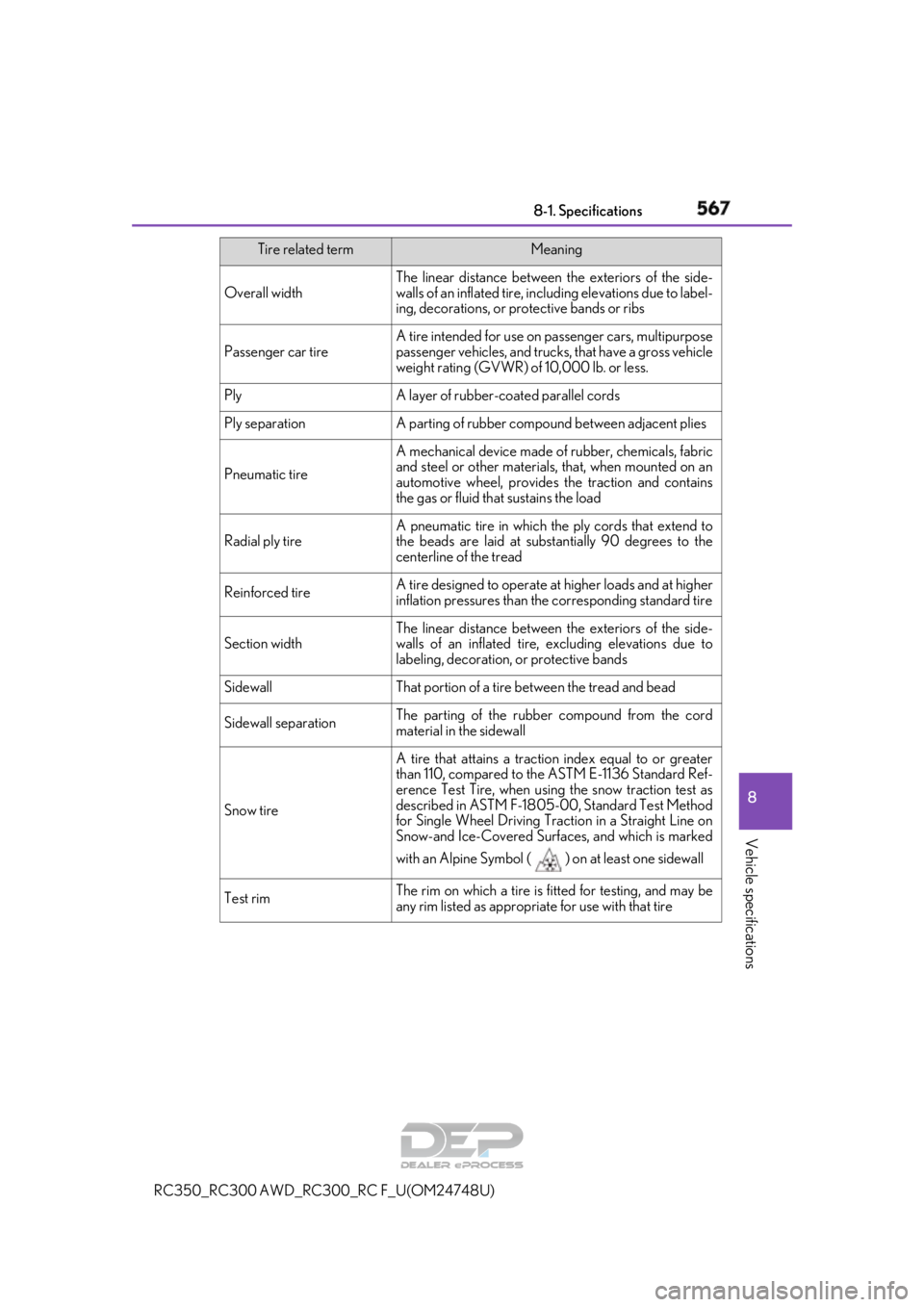
Overall widthThe linear distance between the exteriors of the side-
walls of an inflated tire, including elev ations due to label-
ing, decorations, or protective bands or ribs
Passenger car tire
A tire intended for use on passenger cars, multipurpose
passenger vehicles, and trucks, that have a gross vehicle
weight rating (GVWR) of 10,000 lb. or less.
PlyA layer of rubber-coat ed parallel cords
Ply separationA parting of rubber compou nd between adjacent plies
Pneumatic tire
A mechanical device made of rubber, chemicals, fabric
and steel or other materials, that, when mounted on an
automotive wheel, provides the traction and contains
the gas or fluid that sustains the load
Radial ply tire
A pneumatic tire in which the ply cords that extend to
the beads are laid at substantially 90 degrees to the
centerline of the tread
Reinforced tire A tire designed to operate at higher loads and at higher
inflation pressures than the corresponding standard tire
Section width
The linear distance between the exteriors of the side-
walls of an inflated tire, excluding elevations due to
labeling, decoration, or protective bands
SidewallThat portion of a tire between the tread and bead
Sidewall separationThe parting of the rubber compound from the cord
material in the sidewall
Snow tire
A tire that attains a traction index equal to or greater
than 110, compared to the ASTM E-1136 Standard Ref-
erence Test Tire, when using the snow traction test as
described in ASTM F-1805-00, Standard Test Method
for Single Wheel Driving Traction in a Straight Line on
Snow-and Ice-Covered Surfaces, and which is marked
with an Alpine Symbol ( ) on at least one sidewall
Test rimThe rim on which a tire is fitted for testing, and may be
any rim listed as appropriate for use with that tire
Tire related termMeaning
Page 568 of 636
5688-1. Specifications
RC350_RC300 AWD_RC3 00_RC F_U(OM24748U)
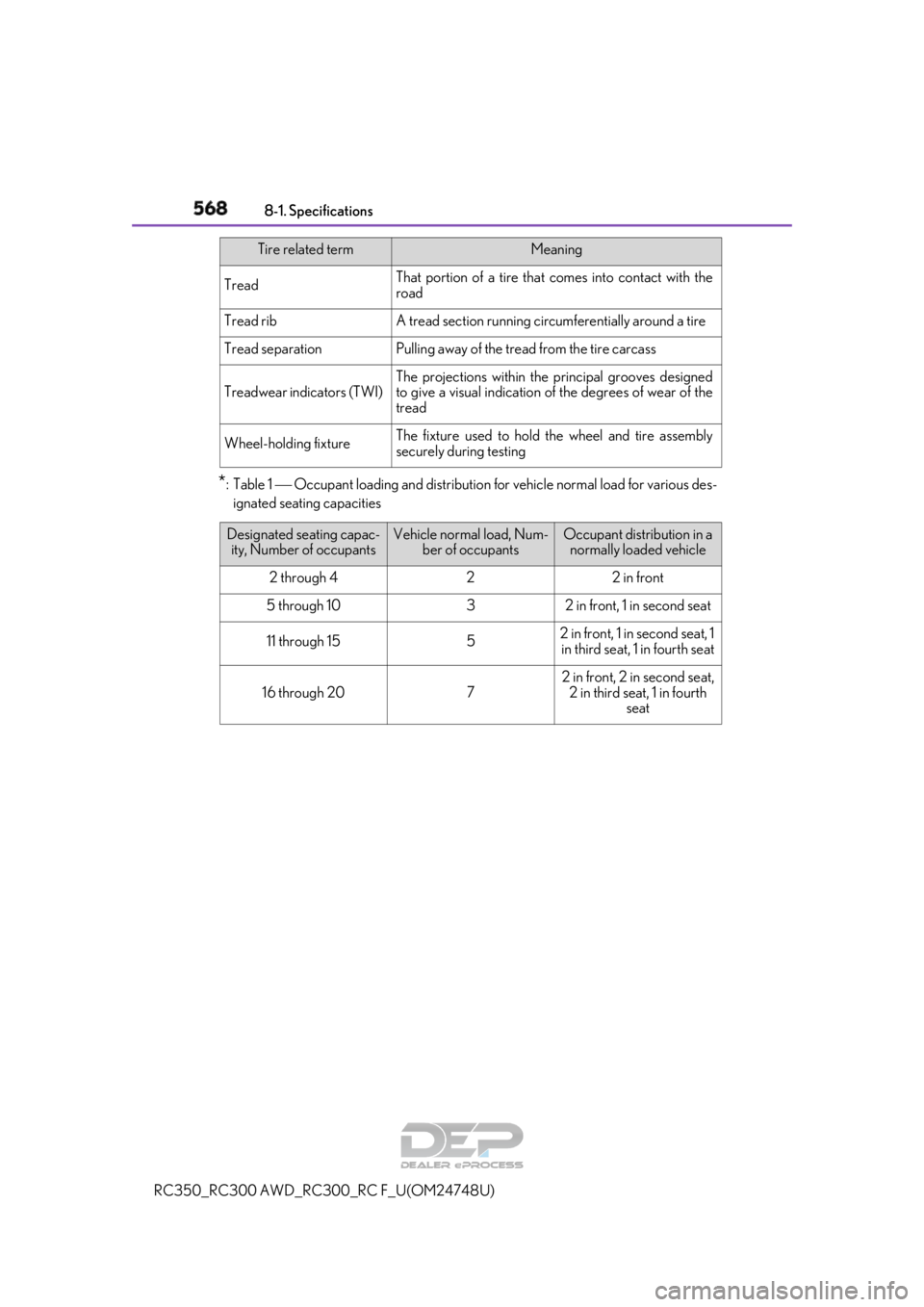
*:Table 1 Occupant loading and distribution fo r vehicle normal load for various des-
ignated seating capacities
TreadThat portion of a tire that comes into contact with the
road
Tread ribA tread section running circ umferentially around a tire
Tread separationPulling away of the tread from the tire carcass
Treadwear indicators (TWI)
The projections within the principal grooves designed
to give a visual indication of the degrees of wear of the
tread
Wheel-holding fixtureThe fixture used to hold the wheel and tire assembly
securely during testing
Tire related termMeaning
Designated seating capac- ity, Number of occupantsVehicle normal load, Num- ber of occupantsOccupant distribution in a normally loaded vehicle
2 through 422 in front
5 through 1032 in front, 1 in second seat
11 through 1552 in front, 1 in second seat, 1 in third seat, 1 in fourth seat
16 through 207
2 in front, 2 in second seat,
2 in third seat, 1 in fourth seat
Page 573 of 636
5738-2. Customization
RC350_RC300 AWD_RC3 00_RC F_U(OM24748U)
8
Vehicle specifications
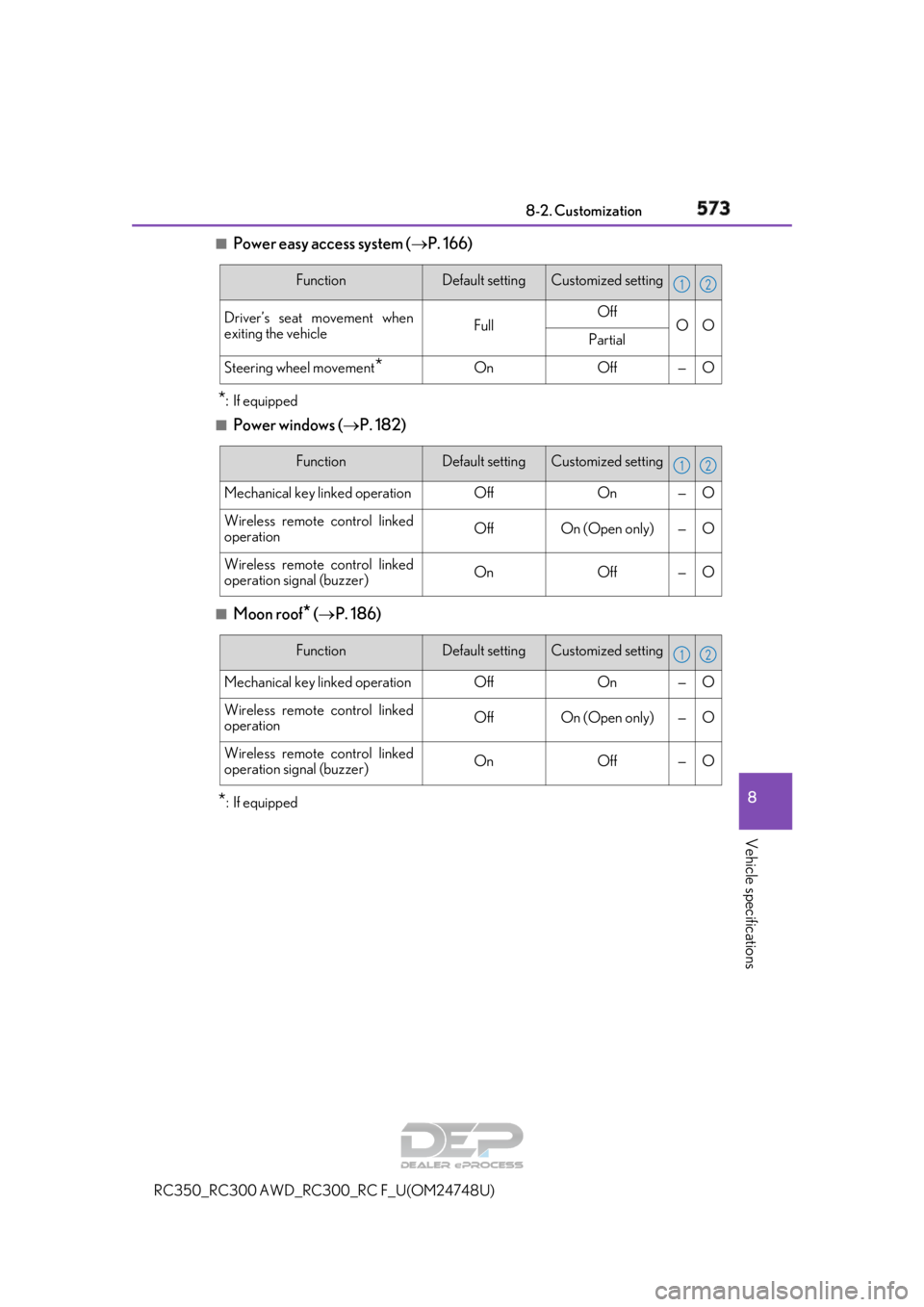
■Power easy access system (P. 166)
*:If equipped
■Power windows ( P. 182)
■Moon roof* ( P. 186)
*: If equipped
FunctionDefault settingCustomized setting
Driver’s seat movement when
exiting the vehicleFullOffOOPartial
Steering wheel movement*OnOff—O
12
FunctionDefault settingCustomized setting
Mechanical key linked operationOffOn—O
Wireless remote control linked
operationOffOn (Open only)—O
Wireless remote control linked
operation signal (buzzer)OnOff—O
12
FunctionDefault settingCustomized setting
Mechanical key linked operationOffOn—O
Wireless remote control linked
operationOffOn (Open only)—O
Wireless remote control linked
operation signal (buzzer)OnOff—O
12
Page 613 of 636
613What to do if... (Troubleshooting)
RC350_RC300 AWD_RC300_RC F_U(OM24748U)
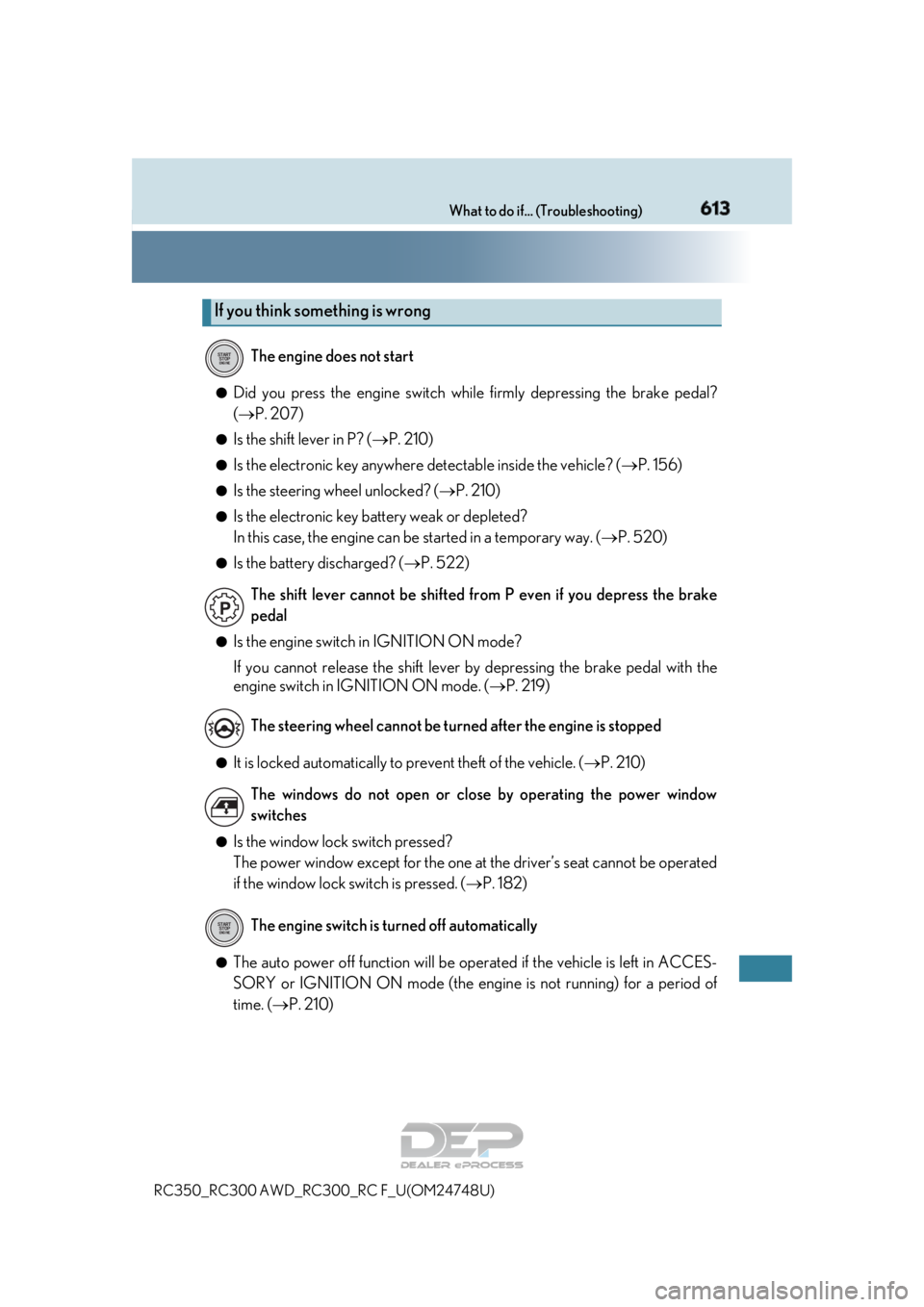
●Did you press the engine switch while firmly depressing the brake pedal?
( P. 207)
●Is the shift lever in P? ( P. 210)
●Is the electronic key anywhere detectable inside the vehicle? ( P. 156)
●Is the steering wheel unlocked? ( P. 210)
●Is the electronic key battery weak or depleted?
In this case, the engine can be started in a temporary way. (P. 520)
●Is the battery discharged? ( P. 522)
●Is the engine switch in IGNITION ON mode?
If you cannot release the shift lever by depressing the brake pedal with the
engine switch in IGNITION ON mode. ( P. 219)
●It is locked automatically to prevent theft of the vehicle. ( P. 210)
●Is the window lock switch pressed?
The power window except for the one at the driver’s seat cannot be operated
if the window lock switch is pressed. ( P. 182)
●The auto power off function will be operated if the vehicle is left in ACCES-
SORY or IGNITION ON mode (the engine is not running) for a period of
time. (P. 210)
If you think something is wrong
The engine does not start
The shift lever cannot be shifted from P even if you depress the brake
pedal
The steering wheel cannot be turned after the engine is stopped
The windows do not open or close by operating the power window
switches
The engine switch is turned off automatically
Page 618 of 636

618Alphabetical index
RC350_RC300 AWD_RC300_RC F_U(OM24748U)
Card key ................................................... 140
Care ................................................. 376, 381
Aluminum wheels .............................. 377
Exterior....................................................376
Interior ...................................................... 381
Seat belts ............................................... 382
Cargo capacity...................................... 204
Cargo hooks .......................................... 353
Chains ............................................ 322, 322
Child restraint system............................ 58 Child seats definition .......................... 58
Child seats installation ................. 65, 71
Front passenger occupant classification system ...........................51
Installing a CRS to the passenger seat............................ 62
Installing a CRS to the rear seat............................................................ 64
Installing CRS with LATCH anchors ..................... 72
Installing CRS with seat belts ..........65
Installing CRS with top tether strap ......................... 76 Child safety ................................................. 57
Airbag precautions...............................42
Battery precautions ............... 410, 525
Child restraint system......................... 58
How your child should wear the seat belt .......................................... 36
Installing child restraints .................... 58
Moon roof precautions ................... 189
Power window lock switch.............182
Power window precautions .......... 185
Removed electronic key battery precautions .............. 428
Seat belt extender precautions .......................................... 39
Seat belt precautions .......................... 38
Seat heater precautions ................. 344
Trunk precautions ...............................154
C