tire pressure LEXUS RCF 2018 User Guide
[x] Cancel search | Manufacturer: LEXUS, Model Year: 2018, Model line: RCF, Model: LEXUS RCF 2018Pages: 636, PDF Size: 6.88 MB
Page 259 of 636

2594-5. Using the driving support systems
4
Driving
RC350_RC300 AWD_RC3 00_RC F_U(OM24748U)• After the engine has started the vehicle has not been driven for a certain amount of
time
• While making a left/right turn and for a few seconds after making a left/right turn
• While driving on a curve and for a few seconds after driving on a curve
• If your vehicle is skidding
• If the wheels are misaligned
• If a wiper blade is blocking the camera sensor
• The vehicle is wobbling.
• The vehicle is being driven at extremely high speeds.
• When driving on a hill
• If the radar sensor or ca mera sensor is misaligned●
In some situations such as the following, sufficient braking forc e may not be obtained,
preventing the system from performing properly:
• If the braking functions cannot operate to their full extent, such as when the brake
parts are extremely cold, extremely hot, or wet
• If the vehicle is not properly maintained (brakes or tires are excessively worn,
improper tire inflation pressure, etc.)
• When the vehicle is being driven on a gravel road or other slippery surface●
Some pedestrians such as the following may not be detected by the radar sensor and
camera sensor, preventing the system from operating properly:
• Pedestrians shorter than approximately 3.2 ft. (1 m) or taller than approximately 6.5
ft. (2 m)
• Pedestrians wearing oversized clothing (a ra in coat, long skirt, etc.), making their sil-
houette obscure
• Pedestrians who are carrying large baggage, holding an umbrella, etc., hiding part
of their body
• Pedestrians who are bending forward or squatting
• Pedestrians who are pushing a stroller , wheelchair, bicycle or other vehicle
• Groups of pedestrians which are close together
• Pedestrians who are wearing white and look extremely bright
• Pedestrians in the dark, such as at night or while in a tunnel
• Pedestrians whose clothing appears to be nearly the same color or brightness as
their surroundings
• Pedestrians near walls, fences , guardrails, or large objects
• Pedestrians who are on a metal object (manhole cover, steel plate, etc.) on the road
• Pedestrians who are walking fast
• Pedestrians who are changing speed abruptly
• Pedestrians running out from be hind a vehicle or a large object
• Pedestrians who are extremely close to the side of the vehicle (outside rear view
mirror, etc.)• If the front of the vehicle is raised or low-
ered
Page 263 of 636

2634-5. Using the driving support systems
4
Driving
RC350_RC300 AWD_RC3 00_RC F_U(OM24748U)WARNING ■
Before using LDA system
Do not rely solely upon the LDA system. The LDA system does not automatically drive
the vehicle or reduce the amount of attention that must be paid to the area in front of
the vehicle. The driver must always assume full responsibility for driving safely by pay-
ing careful attention to the surrounding cond itions and operating the steering wheel to
correct the path of the vehicle. Also, the driver must take adequate breaks when
fatigued, such as from driving for a long period of time.
Failure to perform appropriate driving operat ions and pay careful attention may lead to
an accident, resulting in death or serious injury. ■
To avoid operating LDA system by mistake
When not using the LDA system, use the LDA switch to turn the system off.■
Situations unsuitable for LDA system
Do not use the LDA system in the following situations.
The system may not operate properly and lead to an accident, resulting in death or
serious injury. ●
A spare tire, tire chains, etc. are equipped. ●
When the tires have been excessively worn, or when the tire inflation pressure is low. ●
Tires which differ by structure, manufacturer, brand or tread pattern are used. ●
Objects or patterns that could be mistaken for white (yellow) lines are present on the
side of the road (guardrails, cu rbs, reflective poles, etc.).●
Vehicle is driven on a snow-covered road. ●
White (yellow) lines are difficult to see due to rain, snow, fog, dust, etc.●
Asphalt repair marks, white (y ellow) line marks, etc. are present due to road repair.●
Vehicle is driven in a temporary lane or restricted lane due to construction work.●
Vehicle is driven on a road surface which is slippery due to rainy weather, fallen snow,
freezing, etc. ●
Vehicle is driven in traffic lanes ot her than on highways and freeways.●
Vehicle is driven in a construction zone. ●
During emergency towing ■
Preventing LDA system malfunctions and operations performed by mistake ●
Do not modify the headlights or place stickers, etc. on the surface of the lights.●
Do not modify the suspension etc. If the suspension etc. needs to be replaced, con-
tact your Lexus dealer. ●
Do not install or place anything on the hood or grille. Also, do not install a grille guard
(bull bars, kangaroo bar, etc.). ●
If your windshield needs repair s, contact your Lexus dealer.
Page 267 of 636

2674-5. Using the driving support systems
4
Driving
RC350_RC300 AWD_RC3 00_RC F_U(OM24748U)■
White (yellow) lines are only on one side of road
The LDA system will not operate for the side on which white (yellow) lines could not be
recognized. ■
Conditions in which functions may not operate properly
In the following situations, the camera sensor may not detect white (yellow) lines and var-
ious functions may not operate normally. ●
There are shadows on the road that run parallel with, or cover, the white (yellow) lines. ●
The vehicle is driven in an ar ea without white (yellow) lines, such as in front of a tollgate
or checkpoint, or at an intersection, etc.●
The white (yellow) lines are cracked, “Botts ’ dots”, “Raised pavement marker” or stones
are present. ●
The white (yellow) lines cannot be seen or are difficult to see due to sand, etc. ●
The vehicle is driven on a road surface that is wet due to rain, puddles, etc. ●
The traffic lines are yellow (which may be more difficult to recognize than lines that are
white). ●
The white (yellow) lines cross over a curb, etc. ●
The vehicle is driven on a bright surface, such as concrete. ●
The vehicle is driven on a surface that is bright due to reflected light, etc. ●
The vehicle is driven in an area where the brightness changes suddenly, such as at the
entrances and exits of tunnels, etc.●
Light from the headlights of an oncoming vehicle, the sun, etc. enters the camera.●
The vehicle is driven where the road diverges, merges, etc. ●
The vehicle is driven on a slope. ●
The vehicle is driven on a road which t ilts left or right, or a winding road.●
The vehicle is driven on an unpaved or rough road. ●
The vehicle is driven around a sharp curve. ●
The traffic lane is excessively narrow or wide. ●
The vehicle is extremely tilted due to carry ing heavy luggage or having improper tire
pressure. ●
The distance to the preceding vehicle is extremely short. ●
The vehicle is moving up and down a large am ount due to road conditions during driv-
ing (poor roads or road seams). ●
The headlight lenses are dirty and emit a faint amount of light at night, or the beam axis
has deviated. ●
The vehicle is struck by a crosswind. ●
The vehicle has just changed lane s or crossed an intersection.●
Snow tires, etc. are equipped. ■
Warning message
Warning messages are used to indicate a syst em malfunction or to inform the driver of
the need for caution while driving. ( P. 460)■
Customization
Some functions can be customized ( P. 111)
Page 319 of 636

3194-5. Using the driving support systems
4
Driving
RC350_RC300 AWD_RC3 00_RC F_U(OM24748U)WARNING ■
When the TRAC/VSC systems are turned off
Be especially careful and drive at a speed appropriate to the road conditions. As these
are the systems to help ensure vehicle stab ility and driving force, do not turn the
TRAC/VSC systems off unless necessary. ■
Expert mode precautions ●
Do not use on public roads. ●
Use only when the road co nditions and safety of the surrounding area can be
ensured. ●
Proper use of expert mode requires a professional level of driving skill. When using
expert mode, always check the road condit ions and surrounding area and drive more
carefully than usual. ■
Replacing tires
Make sure that all tires are of the specified size, brand, tread pattern and total load
capacity. In addition, make sure that the tire s are inflated to the recommended tire infla-
tion pressure level.
The ABS, TRAC and VSC systems will not function correctly if different tires are
installed on the vehicle.
Contact your Lexus dealer for further in formation when replacing tires or wheels.■
Handling of tires and the suspension
Using tires with any kind of problem or modi fying the suspension w ill affect the driving
assist systems, and may cause a system to malfunction.
Page 323 of 636

3234-6. Driving tips
4
Driving
RC350_RC300 AWD_RC3 00_RC F_U(OM24748U)WARNING ■
Driving with snow tires
Observe the following precautions to reduce the risk of accidents.
Failure to do so may result in a loss of vehi cle control and cause death or serious injury.●
Use tires of the specified size. ●
Maintain the recommended level of air pressure.●
Do not drive in excess of 75 mph (120 km/h ), regardless of the type of snow tires
being used. ●
Use snow tires on all, not just some wheels. ■
Driving with tire chains
Observe the following precautions to reduce the risk of accidents.
Failure to do so may result in the vehicle being unable to be dr iven safely, and may
cause death or serious injury. ●
Do not drive in excess of the speed limit specified for the ti re chains being used, or 30
mph (50 km/h), whichever is lower. ●
Avoid driving on bumpy road surfaces or over potholes.●
Avoid sudden acceleration, abrupt steering, sudden braking and shifting operations
that cause sudden engine braking. ●
Slow down sufficiently before entering a cu rve to ensure that vehicle control is main-
tained. ●
Do not use LDA (Lane Departure Alert with steering control) system.
NOTICE ■
Repairing or replacing snow tires
Request repairs or replacement of snow ti res from Lexus dealers or legitimate tire
retailers.
This is because the removal an d attachment of snow tires affects the operation of the
tire pressure warning va lves and transmitters.■
Fitting tire chains
The tire pressure warning valv es and transmitters may not function correctly when tire
chains are fitted.
Page 375 of 636

375
Maintenance and care
6
RC350_RC300 AWD_RC3 00_RC F_U(OM24748U) 6-1. Maintenance and care
Cleaning and protecting
the vehicle exterior ................ 376
Cleaning and protecting
the vehicle interior................... 381
6-2. Maintenance
Maintenance
requirements ............................384
General maintenance.............. 387
Emission inspection and
maintenance (I/M)
programs ....................................390
6-3. Do-it-yourself
maintenance
Do-it-yourself service
precautions................................. 391
Hood ............................................... 393
Positioning a floor jack ............ 394
Engine compartment ............... 397
Tires ...................................................412
Tire inflation pressure............... 420
Wheels ........................................... 423
Air conditioning filter ............... 425
Electronic key battery .............. 427
Checking and replacing
fuses .............................................. 429
Light bulbs..................................... 432
Page 389 of 636
3896-2. Maintenance
RC350_RC300 AWD_RC3 00_RC F_U(OM24748U) 6
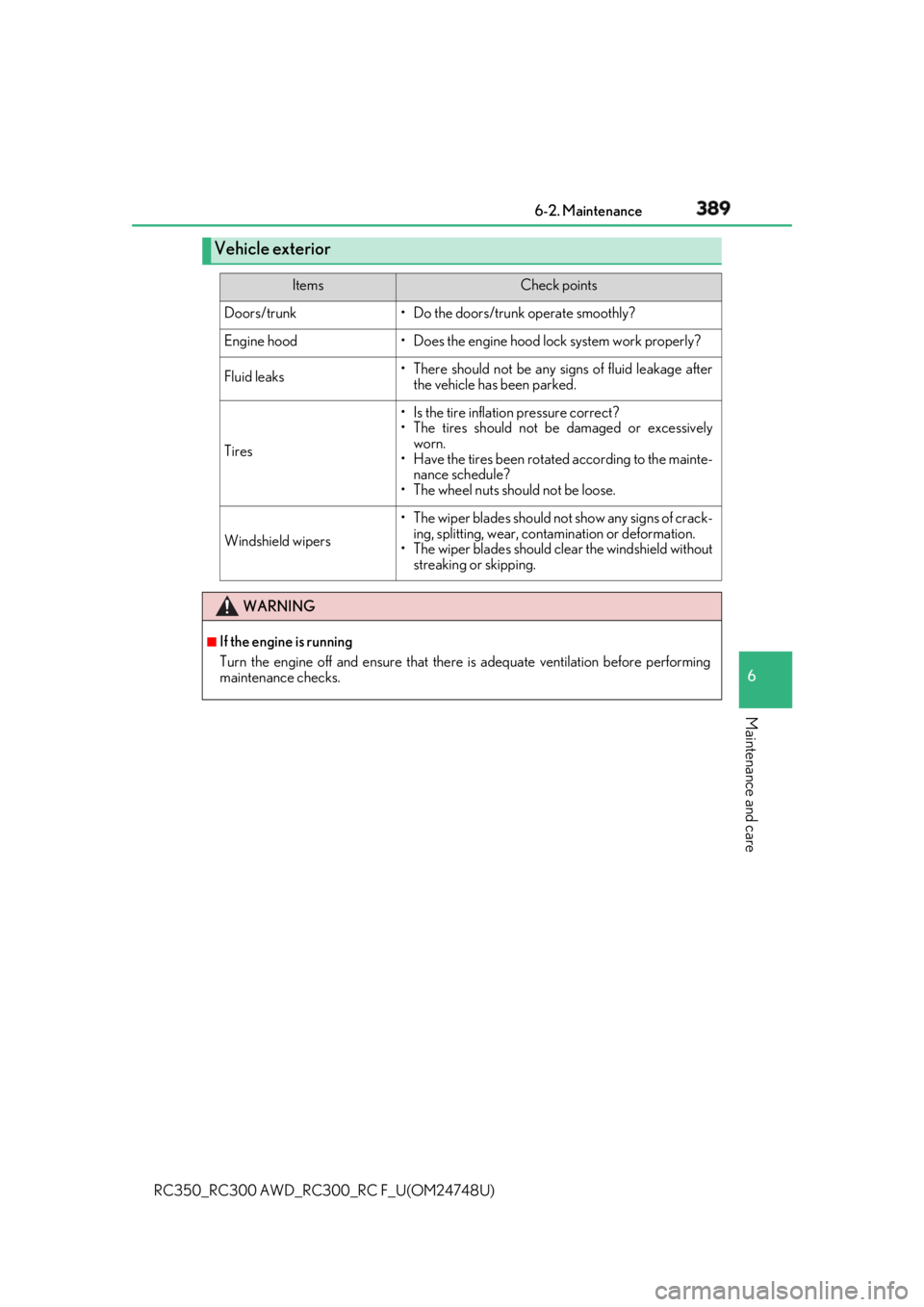
Maintenance and care Vehicle exterior Items Check points
Doors/trunk • Do the doors/trunk operate smoothly?
Engine hood • Does the engine hood lock system work properly?
Fluid leaks • There should not be any si gns of fluid leakage after
the vehicle has been parked.
Tires • Is the tire inflation pressure correct?
• The tires should not be damaged or excessively
worn.
• Have the tires been rotated according to the mainte-
nance schedule?
• The wheel nuts should not be loose.
Windshield wipers •The wiper blades should no t show any signs of crack-
ing, splitting, wear, contamination or deformation.
• The wiper blades should clear the windshield without
streaking or skipping.
WARNING ■
If the engine is running
Turn the engine off and ensure that there is adequate ventilation before performing
maintenance checks.
Page 391 of 636
391
RC350_RC300 AWD_RC3 00_RC F_U(OM24748U) 6
Maintenance and care 6-3. Do-it-yourself maintenance
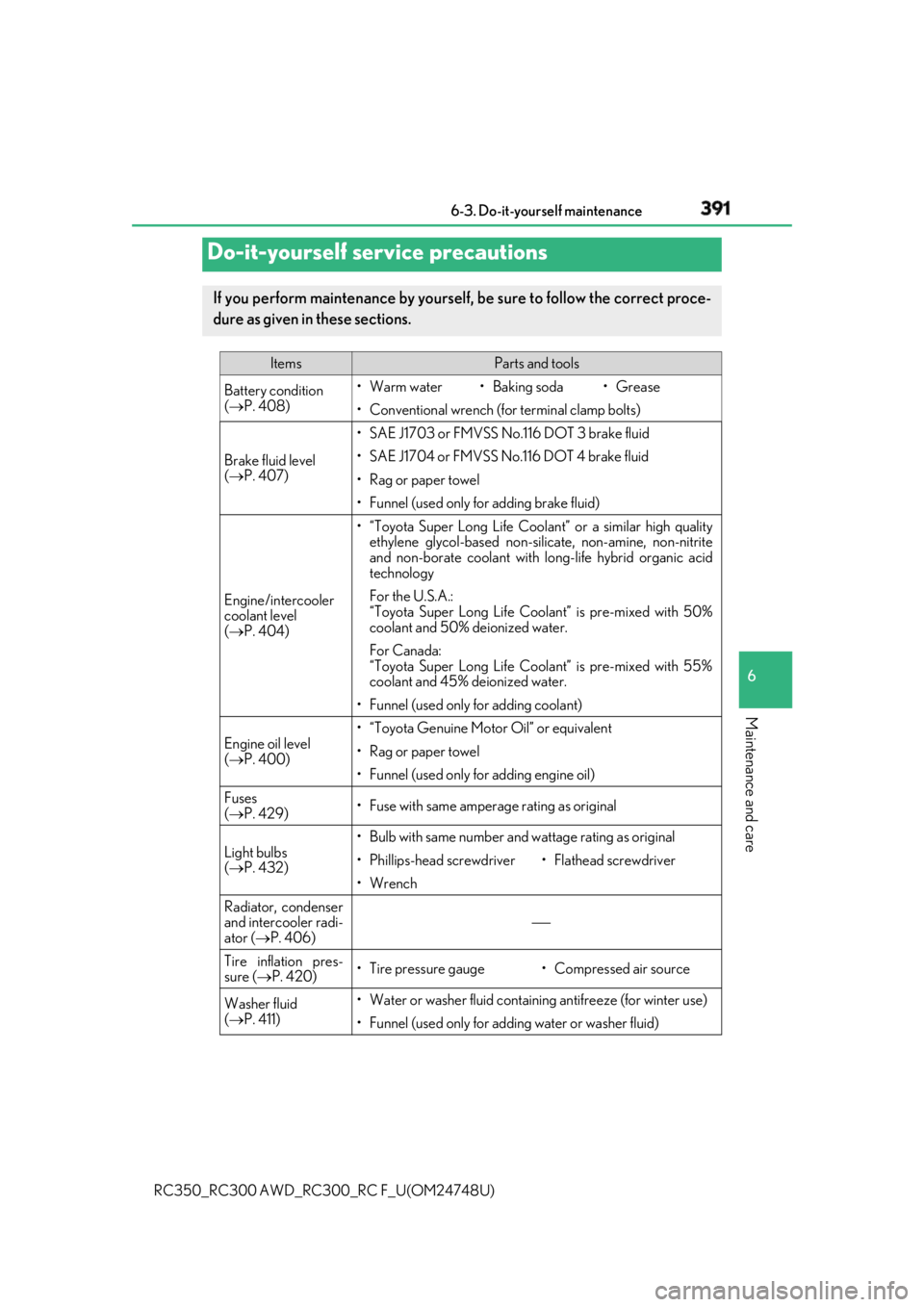
Do-it-yourself service precautions If you perform maintenance by yourself, be sure to follow the correct proce-
dure as given in these sections. Items Parts and tools
Battery condition
( P. 408) •Warm water • Baking soda •Grease
• Conventional wrench (for terminal clamp bolts)
Brake fluid level
( P. 407) • SAE J1703 or FMVSS No.116 DOT 3 brake fluid
• SAE J1704 or FMVSS No.116 DOT 4 brake fluid
• Rag or paper towel
• Funnel (used only for adding brake fluid)
Engine/intercooler
coolant level
( P. 404) • “Toyota Super Long Life Coolan t” or a similar high quality
ethylene glycol-based non-silicate, non-amine, non-nitrite
and non-borate coolant with long-life hybrid organic acid
technology
For the U.S.A.:
“Toyota Super Long Life Coolant” is pre-mixed with 50%
coolant and 50% deionized water.
For Canada:
“Toyota Super Long Life Cool ant” is pre-mixed with 55%
coolant and 45% deionized water.
• Funnel (used only for adding coolant)
Engine oil level
( P. 400) • “Toyota Genuine Motor Oil” or equivalent
• Rag or paper towel
• Funnel (used only for adding engine oil)
Fuses
( P. 429) • Fuse with same amperage rating as original
Light bulbs
( P. 432) • Bulb with same number and wattage rating as original
• Phillips-head screwdriver •Flathead sc rewdriver
•Wrench
Radiator, condenser
and intercooler radi-
ator ( P. 406)
Tire inflation pres-
sure ( P. 420) • Tire pressure gauge • Compressed air source
Washer fluid
( P. 411) • Water or washer fluid containing antifreeze (for winter use)
• Funnel (used only for adding water or washer fluid)
Page 412 of 636
412 6-3. Do-it-yourself maintenance
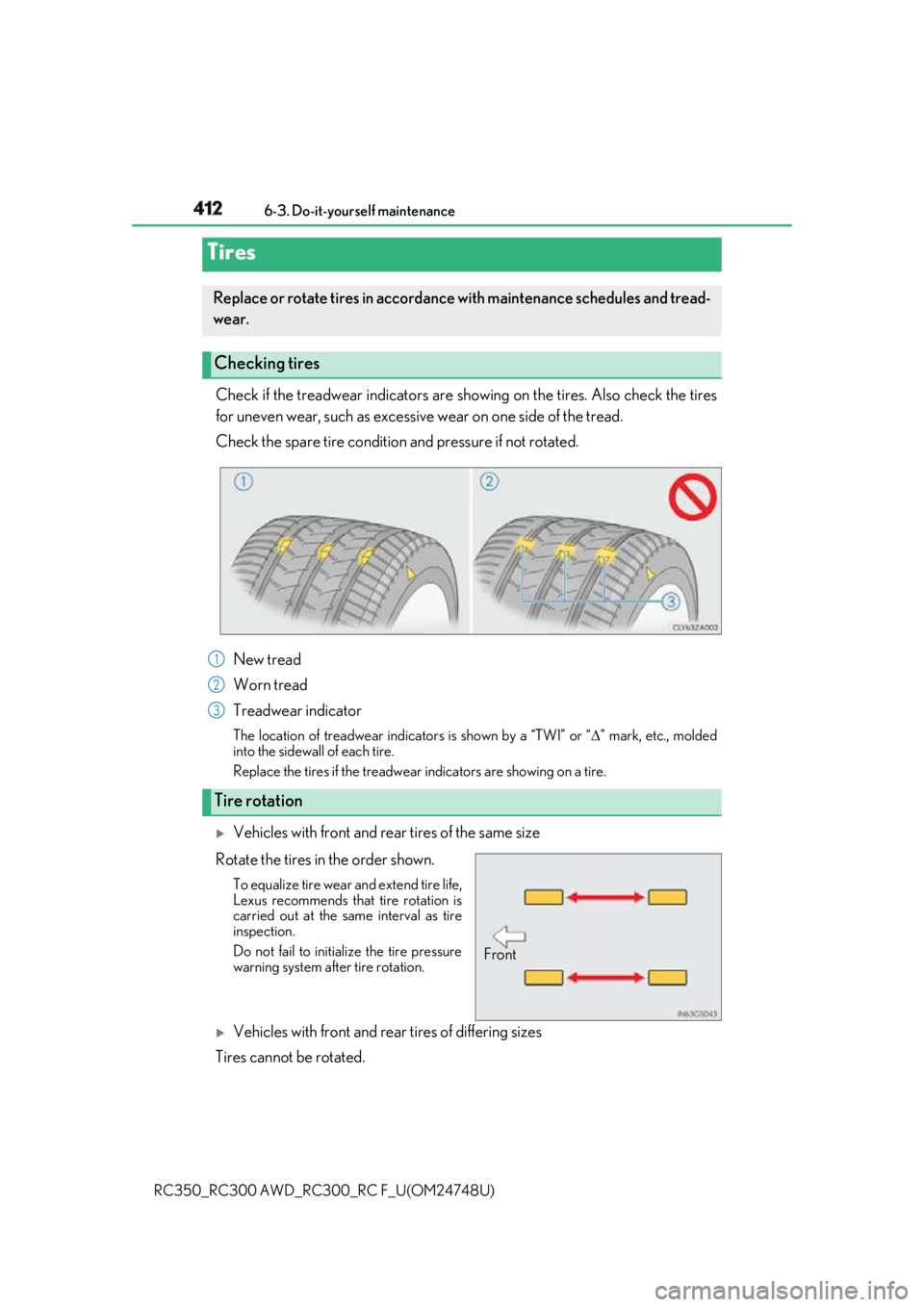
RC350_RC300 AWD_RC3 00_RC F_U(OM24748U)Check if the treadwear indicators are showing on the tires. Also check the tires
for uneven wear, such as excessive wear on one side of the tread.
Check the spare tire condition and pressure if not rotated.
New tread
Worn tread
Treadwear indicator The location of treadwear indicato rs is shown by a “TWI” or “ ” mark, etc., molded
into the sidewall of each tire.
Replace the tires if the treadwear indicators are showing on a tire.
Vehicles with front and rear tires of the same size
Rotate the tires in the order shown. To equalize tire wear and extend tire life,
Lexus recommends that tire rotation is
carried out at the same interval as tire
inspection.
Do not fail to initialize the tire pressure
warning system after tire rotation.
Vehicles with front and rear tires of differing sizes
Tires cannot be rotated.Tires Replace or rotate tires in accordance with maintenance schedules and tread-
wear.
Checking tires
Tire rotation 1
2
3
Front
Page 413 of 636
4136-3. Do-it-yourself maintenance
RC350_RC300 AWD_RC3 00_RC F_U(OM24748U) 6
Maintenance and care Your vehicle is equipped with a tire pressure warning system that uses tire pres-
sure warning valves and transmitters to detect low tire inflation pressure before
serious problems arise. ●
If the tire pressure drops below a predet ermined level, the driver is warned by
a screen display and a warning light. ( P. 455, 477)●
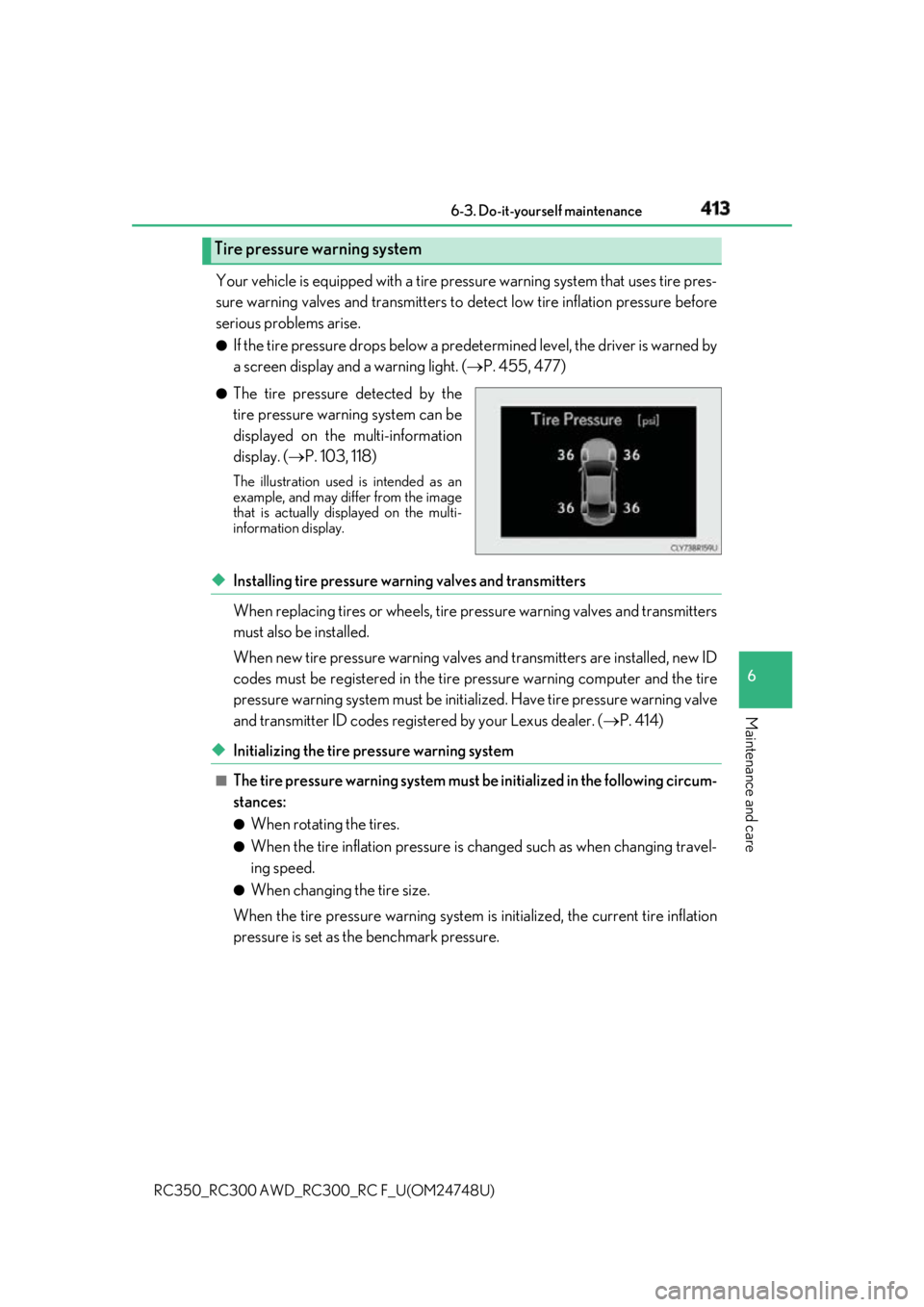
The tire pressure detected by the
tire pressure warning system can be
displayed on the multi-information
display. ( P. 103, 118)The illustration used is intended as an
example, and may differ from the image
that is actually disp layed on the multi-
information display.
◆ Installing tire pressure warning valves and transmitters
When replacing tires or wheels, tire pr essure warning valv es and transmitters
must also be installed.
When new tire pressure wa rning valves and transmitters are installed, new ID
codes must be registered in the tire pressure warning computer and the tire
pressure warning system must be initia lized. Have tire pressure warning valve
and transmitter ID codes registered by your Lexus dealer. ( P. 414)
◆ Initializing the tire pressure warning system ■
The tire pressure warning system must be initialized in the following circum-
stances: ●
When rotating the tires. ●
When the tire inflation pressure is changed such as when changing travel-
ing speed. ●
When changing the tire size.
When the tire pressure warning system is initialized, the current tire inflation
pressure is set as the benchmark pressure.Tire pressure warning system