engine oil LEXUS RCF 2019 User Guide
[x] Cancel search | Manufacturer: LEXUS, Model Year: 2019, Model line: RCF, Model: LEXUS RCF 2019Pages: 636, PDF Size: 12.48 MB
Page 200 of 636

200 4-1. Before driving
RC F_U NOTICE ■
When driving the vehicle ●
Do not depress the accelerator and brake pedals at the same time while driving, as
this may restrain the engine output.●
Do not use the accelerator pedal or depre ss the accelerator and brake pedals at the
same time to hold the vehicle on a hill. ■
When parking the vehicle
Always set the parking brake, and shift the sh ift lever to P. Failure to do so may cause
the vehicle to move or the vehicle may acce lerate suddenly if th e accelerator pedal is
accidentally depressed. ■
Avoiding damage to vehicle parts ●
Do not turn the steering wheel fully in either direction and hold it there for an
extended period of time.
Doing so may damage the power steering motor. ●
When driving over bumps in the road, drive as slowly as possible to avoid damaging
the wheels, underside of the vehicle, etc. ●
RC300: Make sure to idle the engine immediately after high-load driving. Stop the
engine only after the turb ocharger has cooled down.
Failure to do so may cause damage to the turbocharger. ■
If you get a flat tire while driving
A flat or damaged tire may cause the following situations . Hold the steering wheel
firmly and gradually depress the brake pedal to slow down the vehicle. ●
It may be difficult to control your vehicle. ●
The vehicle will make abnormal sounds or vibrations. ●
The vehicle will lean abnormally.
Information on what to do in case of a flat tire ( P. 489, 502)■
When encountering flooded roads
Do not drive on a road that has flooded af ter heavy rain etc. Doing so may cause the
following serious damage to the vehicle: ●
Engine stalling ●
Short in electrical components ●
Engine damage caused by water immersion
In the event that you drive on a flooded road and the vehicle is flooded, be sure to have
your Lexus dealer check the following: ●
Brake function ●
Changes in quantity and quality of oil and fluid used for the engine, transmission,
transfer (AWD models), differential, etc. ●
Lubricant condition for the propeller shaft, bearings and suspension joints (where
possible), and the function of all joints, bearings, etc.
Page 320 of 636
320
RC F_U 4-6. Driving tips
●
Use fluids that are appropriate to the prevailing outside temperatures.
•Engine oil
• Engine coolant
• Washer fluid ●
Have a service technician inspect the condition of the battery. ●
Have the vehicle fitted with four snow tires or purchase a set of tire chains for
the rear tires.
* Ensure that all tires are the specified size and brand, and that chains match the size
of the tires.
* : Tire chains cannot be mounted on vehicles with front and rear tires of differing sizes
and vehicles with LDH and 19-inch tires.
●
Use fluids that are appropriate to the prevailing outside temperatures.
•Engine oil
• Engine coolant
• Washer fluid ●
Have a service technician inspect the condition of the battery. ●
Have the vehicle fitted with four snow tires. Ensure that all tires are th e specified size and brand.Winter driving tips Carry out the necessary preparations an d inspections before driving the vehi-
cle in winter. Always drive the vehicle in a manner appropriate to the prevail-
ing weather conditions.
Preparation for winter (RC350/RC300)
Preparation for winter (RC F)
Page 379 of 636
3796-1. Maintenance and care
6
Maintenance and care
RC F_U WARNING ■
Precautions regarding the exhaust pipes
As exhaust gases cause the exhaust pipes to become quite hot, do not touch the
exhaust pipes while the engine is running or immediately after the engine is turned off.
When washing the vehicle, be careful not to touch the exhaust pipes until they have
cooled sufficiently, as touching hot exhaust pipes can cause burns. ■
Precaution regarding the rear bumper with Blind Spot Monitor (if equipped)
If the paint of the rear bumper is chipped or scratched, the syst em may malfunction. If
this occurs, consult your Lexus dealer.
NOTICE ■
Application of coatings to the vehi cle body (vehicles with CFRP parts)
Do not apply any kind of coating to the vehicle body as doing so may damage the paint
or reduce its durability. ■
To prevent paint deterioration and corrosion on the body and components (aluminum
wheels etc.) ●
Wash the vehicle immediatel y in the following cases:
• After driving near the sea coast
• After driving on salted roads
• If coal tar or tree sap is present on the paint surface
• If dead insects, insect droppings or bird droppings are present on the paint surface
• After driving in an area contaminated wi th soot, oily smoke, mine dust, iron pow-
der or chemical substances
• If the vehicle becomes heavily soiled with dust or mud
• If liquids such as benzene and gasoli ne are spilled on the paint surface●
If the paint is chipped or scratched, have it repaired immediately. ●
To prevent the wheels from corroding, remove any dirt and store in a place with low
humidity when storing the wheels. ■
Cleaning the exterior lights ●
Wash carefully. Do not use organic subs tances or scrub with a hard brush.
This may damage the surfaces of the lights.●
Do not apply wax to the surfaces of the lights.
Wax may cause damage to the lenses. ■
To prevent damage to the windshield wiper arms
When lifting the wiper arms away from the windshield, pull the driver side wiper arm
upward first, and repeat for the passenger side. When returning the wipers to their
original position, do so from the passenger side first. ■
When using an automatic car wash (vehicle s with rain-sensing windshield wipers)
Set the wipers to the intermittent windshield wipers. ( P. 236)
If AUTO mode is selected, the wipers may operate and the wiper blades may be dam-
aged.
Page 380 of 636
380 6-1. Maintenance and care
RC F_U NOTICE ■
When using a high pressure car wash ●
When washing the vehicle, do not spray the camera or its surrounding area directly
with a high pressure washer. Shock appli ed from high pressure water may cause the
device to not operate normally. ●
Do not bring the nozzle tip close to boots (rubber or resin manufactured cover), con-
nectors or the following parts. The parts may be damaged if they come into contact
with high-pressure water.
■
Hood vent (RC F)• Traction related parts
• Steering parts • Suspension parts
• Brake parts●
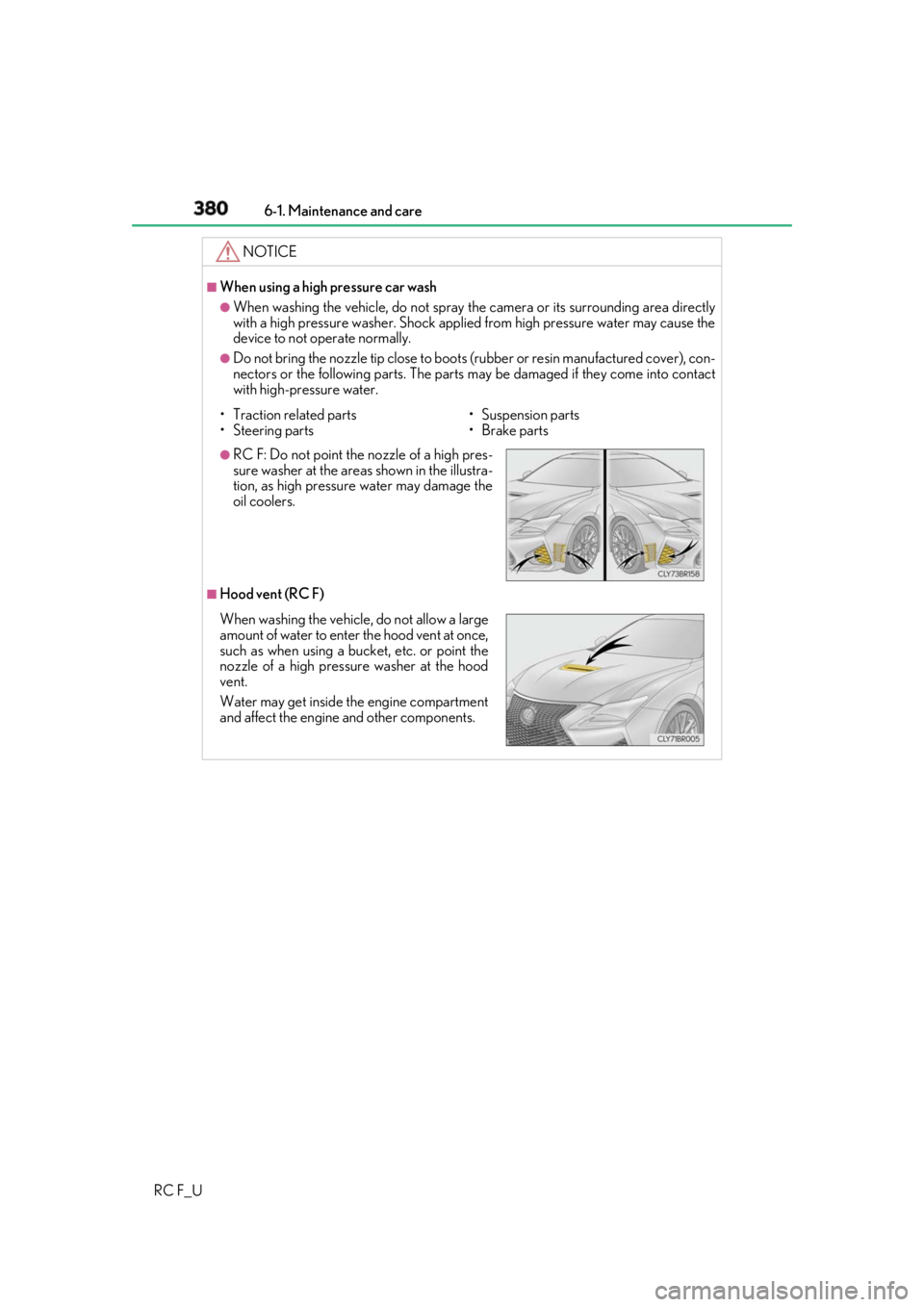
RC F: Do not point the nozzle of a high pres-
sure washer at the areas shown in the illustra-
tion, as high pressure water may damage the
oil coolers.
When washing the vehicle, do not allow a large
amount of water to enter the hood vent at once,
such as when using a bucket, etc. or point the
nozzle of a high pressure washer at the hood
vent.
Water may get inside the engine compartment
and affect the engine and other components.
Page 386 of 636

386 6-2. Maintenance
RC F_U WARNING ■
If your vehicle is not properly maintained
Improper maintenance could result in se rious damage to the vehicle and possible
death or serious injury. ■
Handling of the battery ●
Engine exhaust, some of its constituents, and a wide variety of automobile compo-
nents contain or emit chemicals known to th e State of California to cause cancer and
birth defects and other reproductive ha rm. Work in a well ventilated area.●
Oils, fuels and fluids contained in vehicles as well as waste produced by component
wear contain or emit chemicals known to the State of California to cause cancer and
birth defects or other reproductive harm. Avoid exposure and wash any affected area
immediately. ●
Battery posts, terminals and related acce ssories contain lead and lead compounds
which are known to cause brain damage . Wash your hands after handling. ( P. 408)
Page 387 of 636
3876-2. Maintenance
RC F_U 6
Maintenance and care
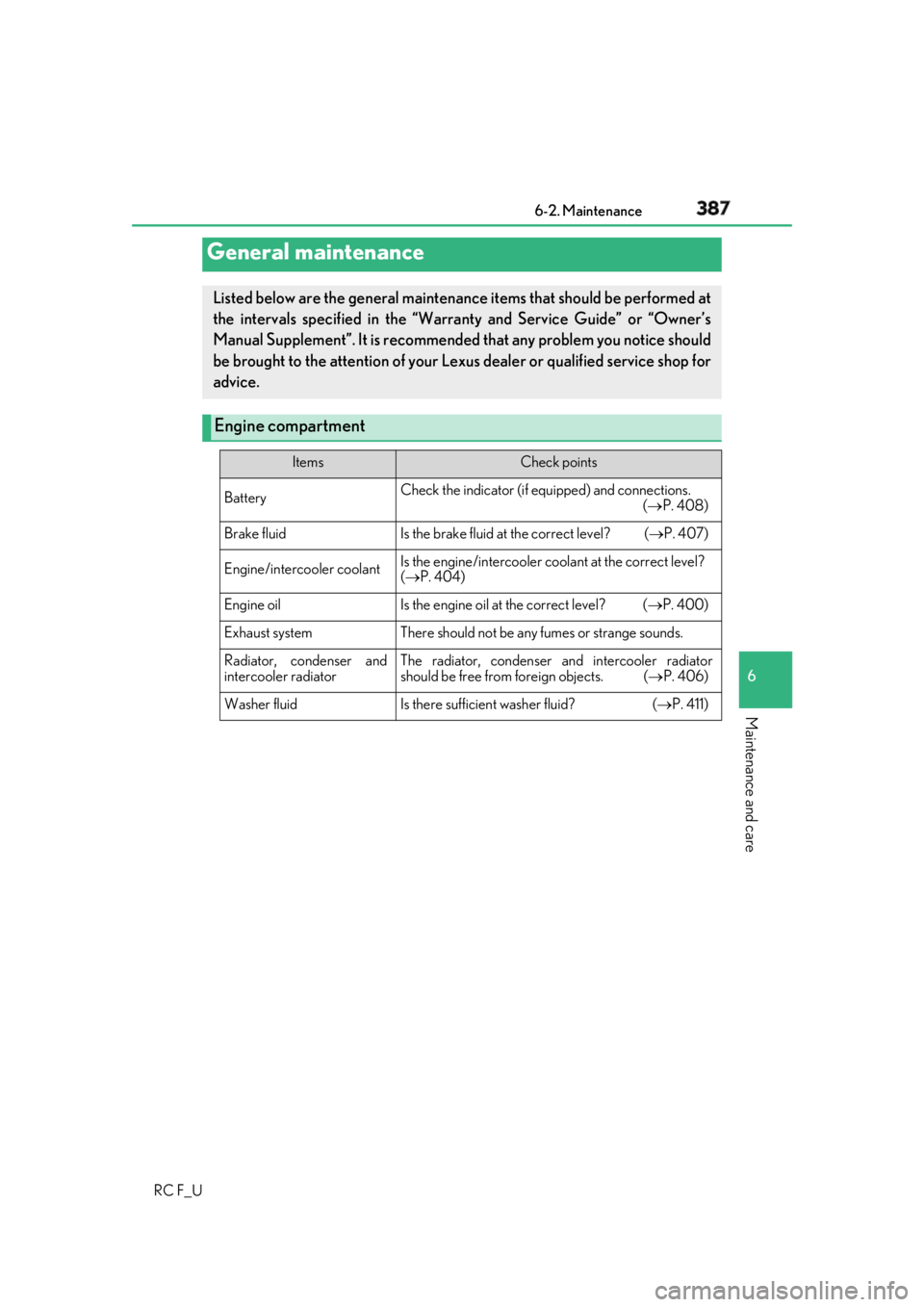
General maintenance Listed below are the general maintenanc e items that should be performed at
the intervals specified in the “Warranty and Service Guide” or “Owner’s
Manual Supplement”. It is recommende d that any problem you notice should
be brought to the attention of your Lexu s dealer or qualified service shop for
advice.
Engine compartment Items Check points
Battery Check the indicator (if equipped) and connections.
( P. 408)
Brake fluid Is the brake fluid at the correct level? ( P. 407)
Engine/intercooler coolant Is the engine/intercooler c oolant at the correct level?
( P. 404)
Engine oil Is the engine oil at the correct level? ( P. 400)
Exhaust system There should not be any fumes or strange sounds.
Radiator, condenser and
intercooler radiator The radiator, condenser and intercooler radiator
should be free from foreign objects. ( P. 406)
Washer fluid Is there sufficient washer fluid? ( P. 411)
Page 391 of 636
391
RC F_U 6
Maintenance and care 6-3. Do-it-yourself maintenance
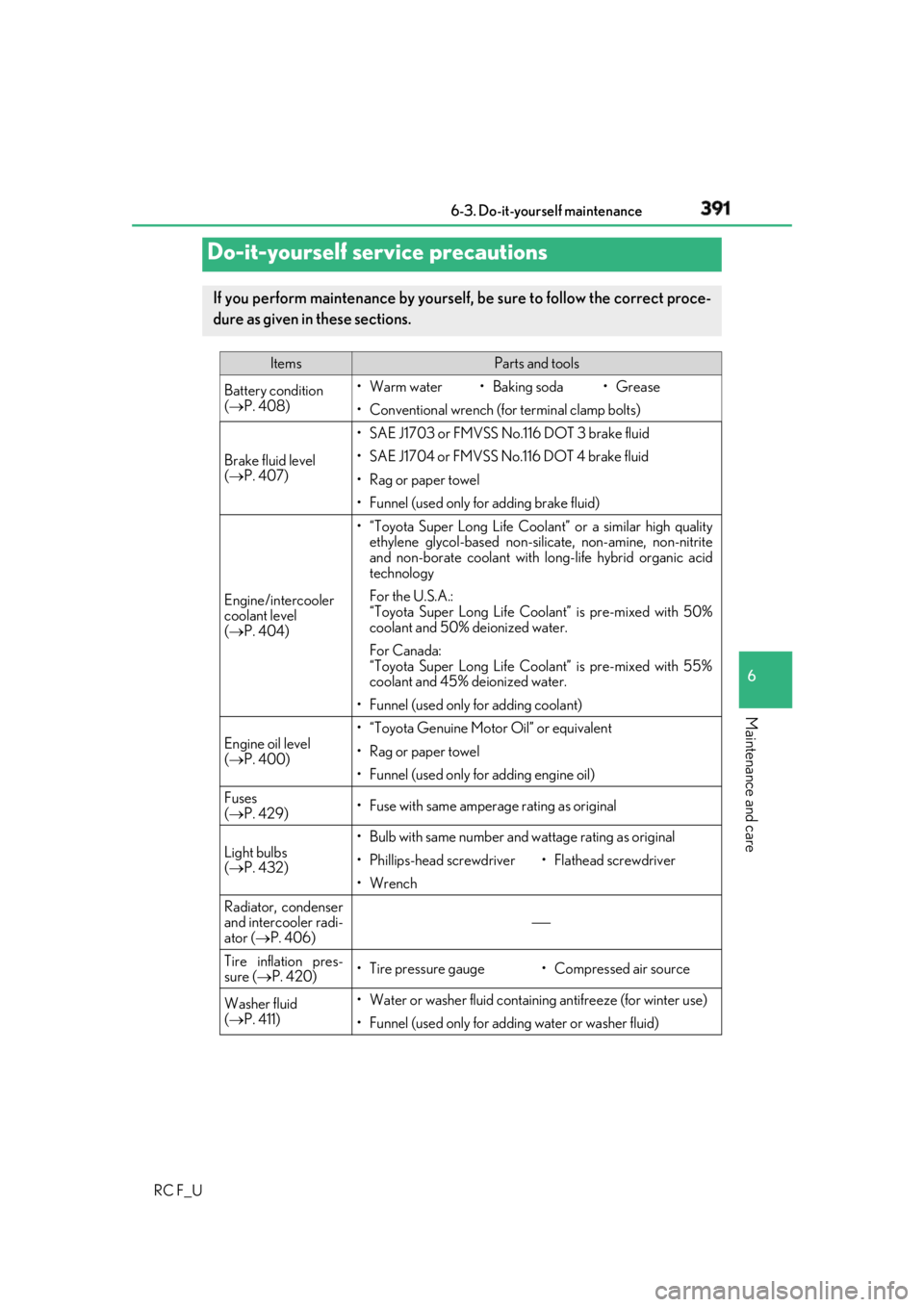
Do-it-yourself service precautions If you perform maintenance by yourself, be sure to follow the correct proce-
dure as given in these sections. Items Parts and tools
Battery condition
( P. 408) •Warm water • Baking soda •Grease
• Conventional wrench (for terminal clamp bolts)
Brake fluid level
( P. 407) • SAE J1703 or FMVSS No.116 DOT 3 brake fluid
• SAE J1704 or FMVSS No.116 DOT 4 brake fluid
• Rag or paper towel
• Funnel (used only for adding brake fluid)
Engine/intercooler
coolant level
( P. 404) • “Toyota Super Long Life Coolan t” or a similar high quality
ethylene glycol-based non-silicate, non-amine, non-nitrite
and non-borate coolant with long-life hybrid organic acid
technology
For the U.S.A.:
“Toyota Super Long Life Coolant” is pre-mixed with 50%
coolant and 50% deionized water.
For Canada:
“Toyota Super Long Life Cool ant” is pre-mixed with 55%
coolant and 45% deionized water.
• Funnel (used only for adding coolant)
Engine oil level
( P. 400) • “Toyota Genuine Motor Oil” or equivalent
• Rag or paper towel
• Funnel (used only for adding engine oil)
Fuses
( P. 429) • Fuse with same amperage rating as original
Light bulbs
( P. 432) • Bulb with same number and wattage rating as original
• Phillips-head screwdriver •Flathead sc rewdriver
•Wrench
Radiator, condenser
and intercooler radi-
ator ( P. 406)
Tire inflation pres-
sure ( P. 420) • Tire pressure gauge • Compressed air source
Washer fluid
( P. 411) • Water or washer fluid containing antifreeze (for winter use)
• Funnel (used only for adding water or washer fluid)
Page 392 of 636
392 6-3. Do-it-yourself maintenance
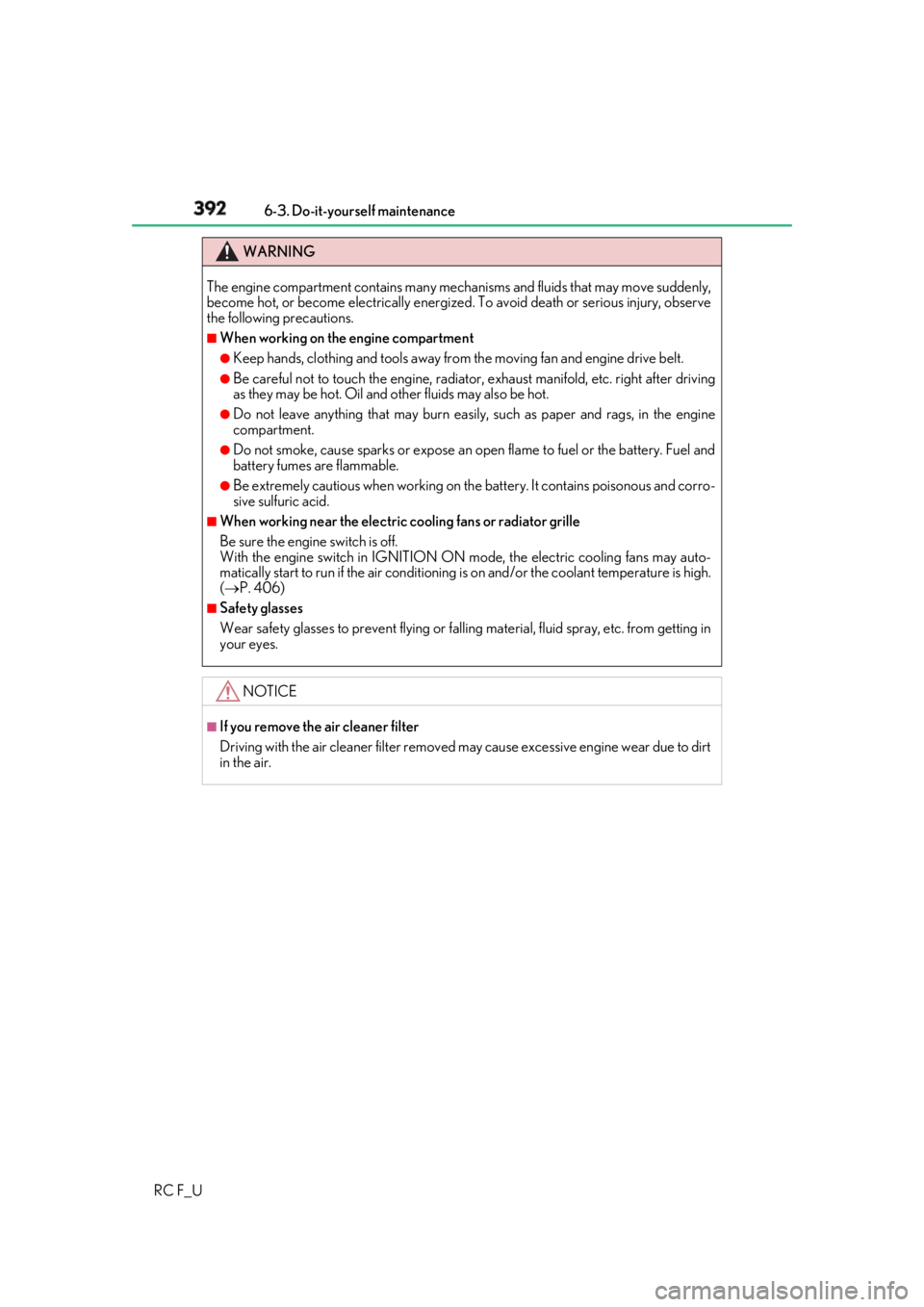
RC F_U WARNING
The engine compartment contains many mechan isms and fluids that may move suddenly,
become hot, or become electrically energize d. To avoid death or serious injury, observe
the following precautions. ■
When working on the engine compartment ●
Keep hands, clothing and tools away from the moving fan and engine drive belt.●
Be careful not to touch the engine, radiator, exhaust manifold, etc. right after driving
as they may be hot. Oil and other fluids may also be hot. ●
Do not leave anything that may burn easily, such as paper and rags, in the engine
compartment. ●
Do not smoke, cause sparks or expose an open flame to fuel or the battery. Fuel and
battery fumes are flammable. ●
Be extremely cautious when working on the battery. It contains poisonous and corro-
sive sulfuric acid. ■
When working near the electric cooling fans or radiator grille
Be sure the engine switch is off.
With the engine switch in IGNITION ON mode, the electric cooling fans may auto-
matically start to run if the air conditioning is on and/or the coolant temperature is high.
( P. 406) ■
Safety glasses
Wear safety glasses to prevent flying or falling material, flui d spray, etc. from getting in
your eyes.
NOTICE ■
If you remove the air cleaner filter
Driving with the air cleaner f ilter removed may cause excessive engine wear due to dirt
in the air.
Page 397 of 636
3976-3. Do-it-yourself maintenance
RC F_U 6
Maintenance and care
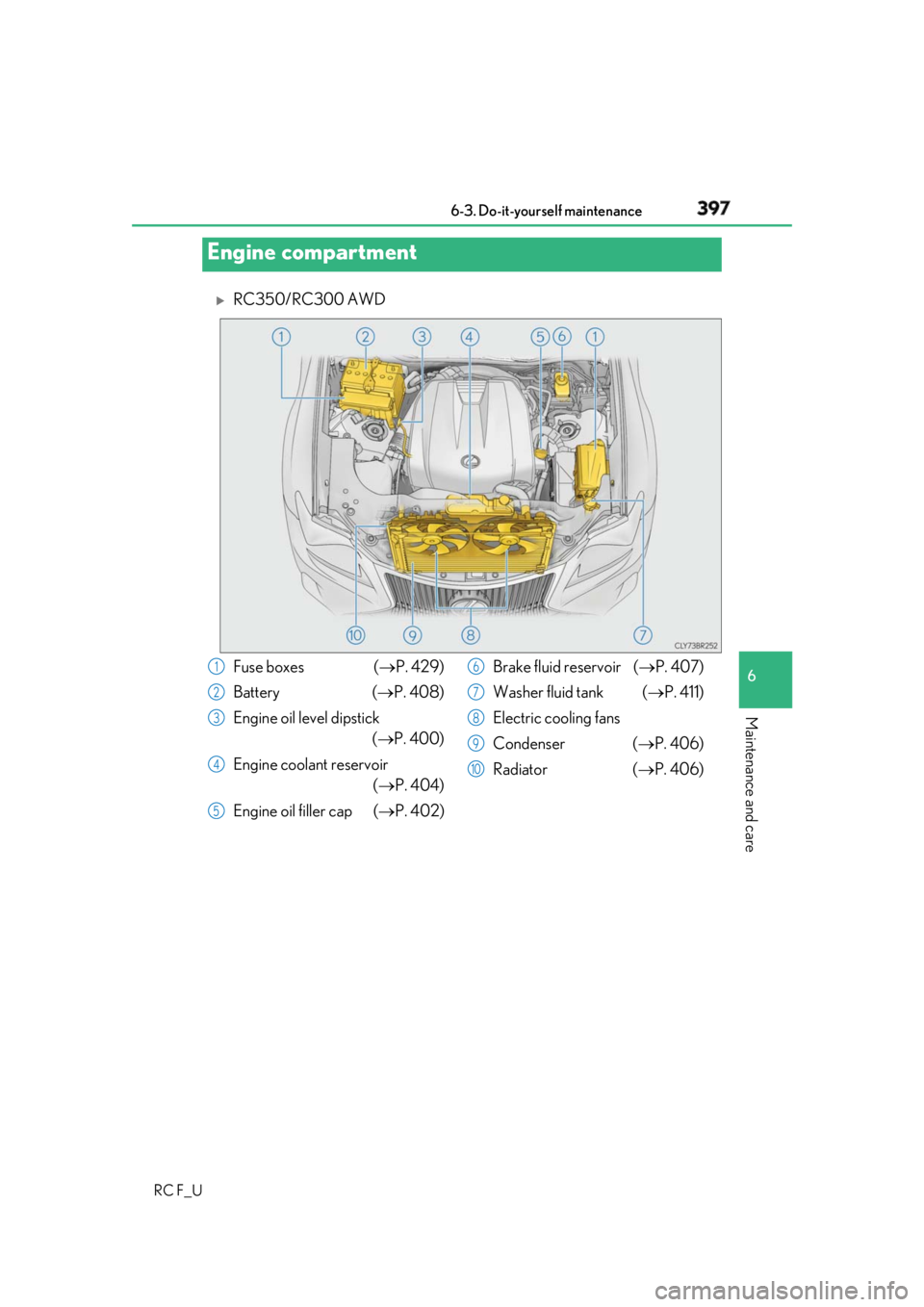
RC350/RC300 AWD
Engine compartment
Fuse boxes ( P. 429)
Battery ( P. 408)
Engine oil level dipstick
( P. 400)
Engine coolant reservoir
( P. 404)
Engine oil filler cap ( P. 402) Brake fluid reservoir ( P. 407)
Washer fluid tank ( P. 411)
Electric cooling fans
Condenser ( P. 406)
Radiator ( P. 406)1
2
3
4
5 6
7
8
9
10
Page 398 of 636
398 6-3. Do-it-yourself maintenance
RC F_U
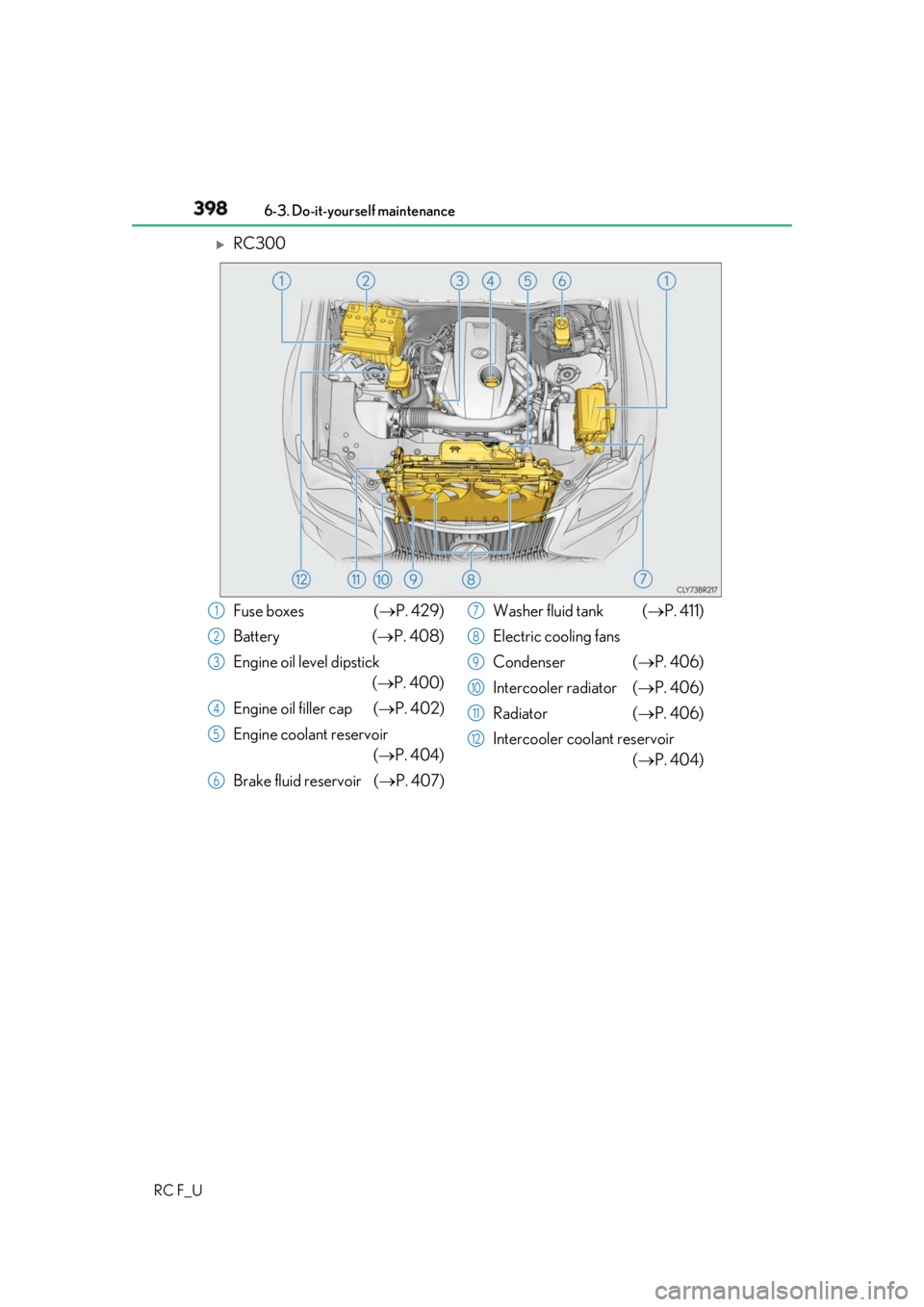
RC300
Fuse boxes ( P. 429)
Battery ( P. 408)
Engine oil level dipstick
( P. 400)
Engine oil filler cap ( P. 402)
Engine coolant reservoir
( P. 404)
Brake fluid reservoir ( P. 407) Washer fluid tank ( P. 411)
Electric cooling fans
Condenser ( P. 406)
Intercooler radiator ( P. 406)
Radiator ( P. 406)
Intercooler coolant reservoir
( P. 404)1
2
3
4
5
6 7
8
9
10
11
12