battery LEXUS RCF 2019 Workshop Manual
[x] Cancel search | Manufacturer: LEXUS, Model Year: 2019, Model line: RCF, Model: LEXUS RCF 2019Pages: 636, PDF Size: 12.48 MB
Page 516 of 636
516 7-2. Steps to take in an emergency
RC F_U One of the following may be the cause of the problem: ●
There may not be sufficient fuel in the vehicle’s tank.
Refuel the vehicle. ●
The engine may be flooded.
Try to restart the engine again follo wing correct starting procedures.
( P. 207)●
There may be a malfunction in th e engine immobilizer system. ( P. 79)
One of the following may be the cause of the problem: ●
The battery may be discharged. ( P. 522)●
The battery terminal connections may be loose or corroded.
The engine starting system may be malfun ctioning due to an electrical problem
such as electronic key battery depletio n or a blown fuse. However, an interim
measure is available to start the engine. ( P. 517)If the engine will not start If the engine will not start even though correct starting procedures are being
followed ( P. 207), consider each of the following points:
The engine will not start even thoug h the starter motor operates nor-
mally.
The starter motor turns over slowly , the interior lights and headlights
are dim, or the horn does not sound or sounds at a low volume.
The starter motor does not turn over
Page 517 of 636
5177-2. Steps to take in an emergency
RC F_U 7
When trouble arises One of the following may be the cause of the problem: ●
One or both of the battery terminals may be disconnected. ●
The battery may be discharged. ( P. 522)●
There may be a malfunction in the steering lock system.Contact your Lexus dealer if the problem cannot be repaired, or if repair procedures
are unknown.
When the engine does not start, the follo wing steps can be used as an interim
measure to start the engine if the engine switch is functioning normally:
Set the parking brake.
Shift the shift lever to P.
Turn the engine switch to ACCESSORY mode.
Press and hold the engine switch for about 15 seconds while depressing the
brake pedal firmly.
Even if the engine can be started using the above steps, the system may be mal-
functioning. Have the vehicle in spected by your Lexus dealer.The starter motor does not turn ove r, the interior lights and headlights
do not turn on, or the horn does not sound.
Emergency start function 1
2
3
4
Page 518 of 636
518 7-2. Steps to take in an emergency
RC F_U Use the mechanical key ( P. 141) in order to perfor m the following operations:■
Unlocking the door
Insert the mechanical key while
pulling on the driver’s door han-
dle.
Unlocking the door.
Remove the key, return the handle, and then pull the handle again.If the electronic key do es not operate properlyIf communication between the electron ic key and vehicle is interrupted ( P.
158) or the electronic key cannot be used because the battery is depleted,
the smart access system with push-butto n start and wireless remote control
cannot be used. In such cases, the doors and trunk can be opened and the
engine can be started by following the procedure below.
Locking and unlocking the doors and opening the trunk 1
2
3
Page 520 of 636
520 7-2. Steps to take in an emergency
RC F_U Ensure that the shift lever is in P and depress the brake pedal.
Touch the Lexus emblem side of the
electronic key to the engine switch. When the electronic key is detected, a
buzzer sounds and the engine switch
will turn to IGNITION ON mode.
When the smart access system with
push-button start is deactivated in cus-
tomization setting, the engine switch will
turn to ACCESSORY mode.
Firmly depress the brake pedal and check that is shown on the multi-
information display.
Press the engine switch.
In the event that the engine still cannot be started, contact your Lexus dealer.■
Stopping the engine
Shift the shift lever to P and press the engine switch as you normally do when stopping
the engine. ■
Replacing the key battery
As the above procedure is a temporary measure, it is recommended that the electronic
key battery be replaced immediately when the battery is depleted. ( P. 427)■
Changing engine switch modes
Release the brake pedal and press the engine switch in step above.
The engine does not start and modes will be changed each time the switch is pressed.
( P. 208) ■
When the electronic key does not work properly ●
Make sure that the smart access system wi th push-button start has not been deacti-
vated in the customization setting. If it is off, turn the function on.
(Customizable features: P. 569)●
Check if battery-saving mode is set. If it is set, cancel the function. ( P. 158)Starting the engine 1
2
3
4
3
Page 522 of 636
522 7-2. Steps to take in an emergency
RC F_U If you have a set of jumper (or booster) cables and a second vehicle with a 12-volt
battery, you can jump start your vehicle by following the steps below.
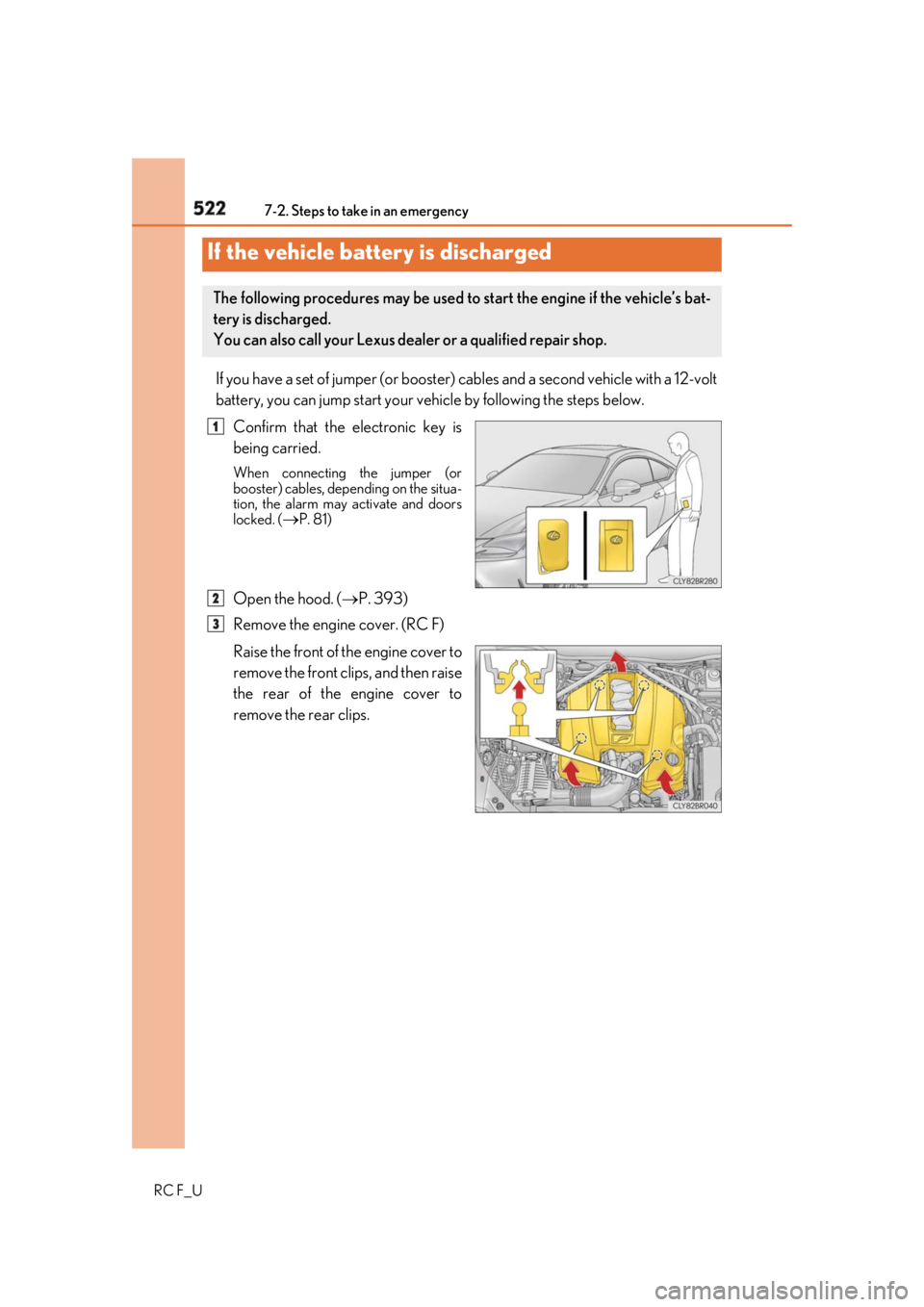
Confirm that the electronic key is
being carried. When connecting the jumper (or
booster) cables, depe nding on the situa-
tion, the alarm may activate and doors
locked. (
P. 81)
Open the hood. ( P. 393)
Remove the engine cover. (RC F)
Raise the front of the engine cover to
remove the front clips, and then raise
the rear of the engine cover to
remove the rear clips.If the vehicle battery is discharged The following procedures may be used to start the engine if the vehicle’s bat-
tery is discharged.
You can also call your Lexus deal er or a qualified repair shop.1
2
3
Page 523 of 636
5237-2. Steps to take in an emergency
RC F_U 7
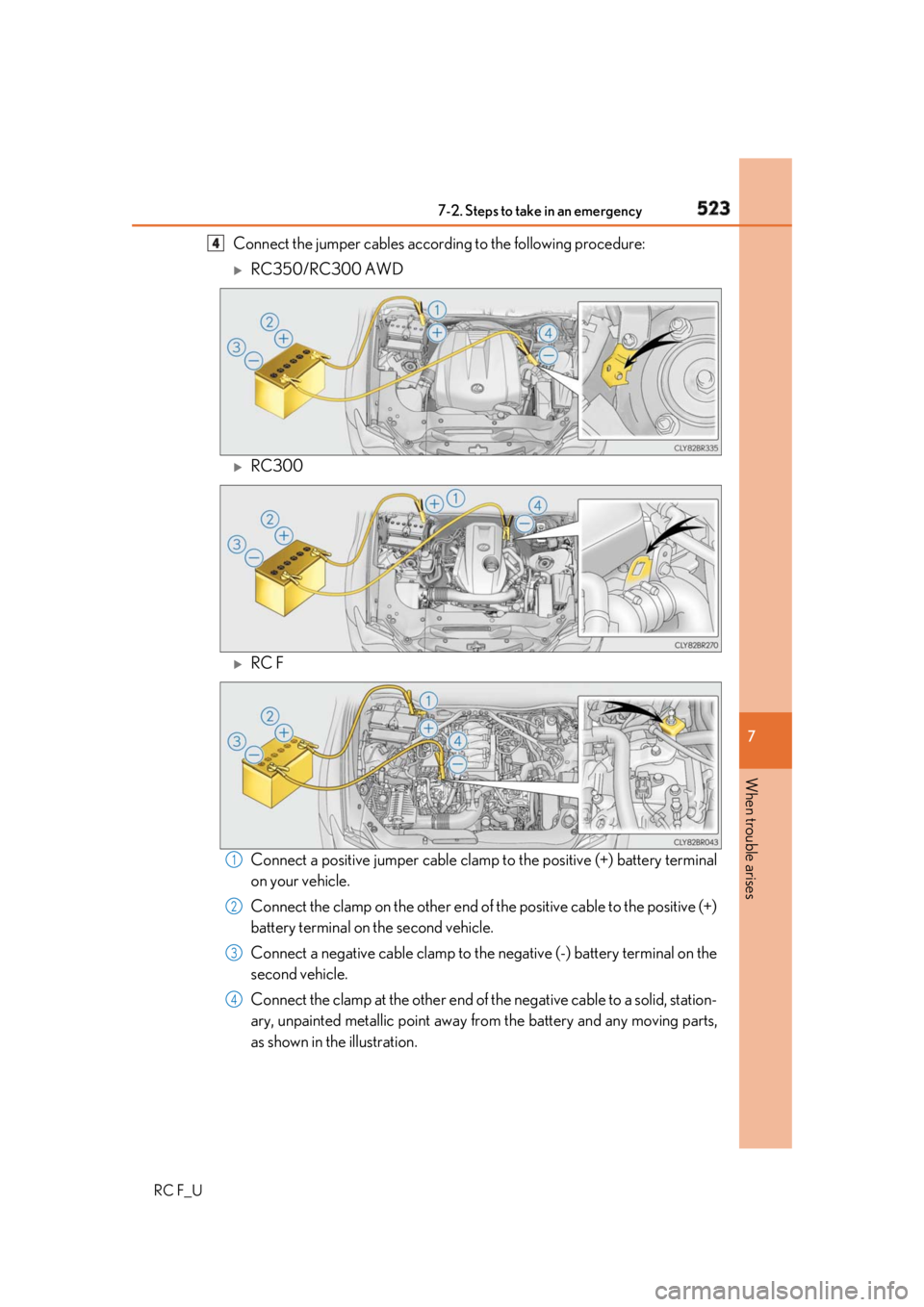
When trouble arises Connect the jumper cables accordin g to the following procedure:
RC350/RC300 AWD
RC300
RC F
Connect a positive jumper cable clamp to the positive (+) battery terminal
on your vehicle.
Connect the clamp on the other end of the positive cable to the positive (+)
battery terminal on the second vehicle.
Connect a negative cable clamp to the negative (-) battery terminal on the
second vehicle.
Connect the clamp at the other end of th e negative cable to a solid, station-
ary, unpainted metallic po int away from the battery and any moving parts,
as shown in the illustration. 4
1
2
3
4
Page 524 of 636
524 7-2. Steps to take in an emergency
RC F_U Start the engine of the second vehicle. Increase the engine speed slightly and
maintain at that level for approximatel y 5 minutes to recharge the battery of
your vehicle.
Open and close any of the door of your vehicle with the engine switch off.
Maintain the engine speed of the second vehicle and start the engine of your
vehicle by turning the engine switch to IGNITION ON mode.
Once the vehicle’s engine has started, remove the jumper cables in the exact
reverse order from which they were connected.
Once the engine starts, have the vehicle inspected at your Lexus dealer as soon
as possible. ■
Starting the engine when the battery is discharged
The engine cannot be started by push-starting. ■
To prevent battery discharge ●
Turn off the headlights and the audio system while the engine is off. ●
Turn off any unnecessary electrical componen ts when the vehicle is running at a low
speed for an extended period , such as in heavy traffic.■
Charging the battery
The electricity stored in the battery will disc harge gradually even when the vehicle is not
in use, due to natural discharge and the draini ng effects of certain electrical appliances. If
the vehicle is left for a long time, the battery may discharge, and the engine may be
unable to start. (The battery recharges automatically during driving.) ■
When recharging or replacing the battery ●
In some cases, it may not be possible to un lock the doors using the smart access system
with push-button start when the battery is discharged. Use the wireless remote control
or the mechanical key to lock or unlock the doors. ●
The engine may not start on the first attempt after the battery has recharged but will
start normally after the second attempt. This is not a malfunction. ●
The engine switch mode is memorized by the vehicle. When the battery is recon-
nected, the system will return to the mode it was in before the battery was discharged.
Before disconnecting the battery, turn the engine switch off.
If you are unsure what mode the engine switch was in before the battery discharged, be
especially careful when reconnecting the battery. 5
6
7
8
Page 525 of 636
5257-2. Steps to take in an emergency
RC F_U 7
When trouble arises WARNING ■
Avoiding battery fires or explosions
Observe the following precautions to preven t accidentally igniting the flammable gas
that may be emitted from the battery: ●
Make sure each jumper cable is connected to the correct terminal and that it is not
unintentionally in contact with any other than the intended terminal.●
Do not allow the other end of the jumper cab le connected to the “+” terminal to come
into contact with any other parts or metal surfaces in the area, such as brackets or
unpainted metal. ●
Do not allow the + and - clamps of the jump er cables to come in to contact with each
other. ●
Do not smoke, use matches, cigarette lighters or allow open flame near the battery. ■
Battery precautions
The battery contains poisonous and corrosive acidic electrolyte, while related parts
contain lead and lead compounds. Observ e the following precautions when handling
the battery: ●
When working with the battery, always wear safety glasses and take care not to allow
any battery fluids (acid) to come into cont act with skin, clothing or the vehicle body.●
Do not lean over the battery. ●
In the event that battery fluid comes into contact with the skin or eyes, immediately
wash the affected area with water and seek medical attention.
Place a wet sponge or cloth over the affected area until medical attention can be
received. ●
Always wash your hands afte r handling the battery support, terminals, and other bat-
tery-related parts. ●
Do not allow childre n near the battery.
NOTICE ■
When handling jumper cables
When connecting the jumper cables, ensure that they do not become entangled in the
cooling fans or engine drive belt.
Page 545 of 636
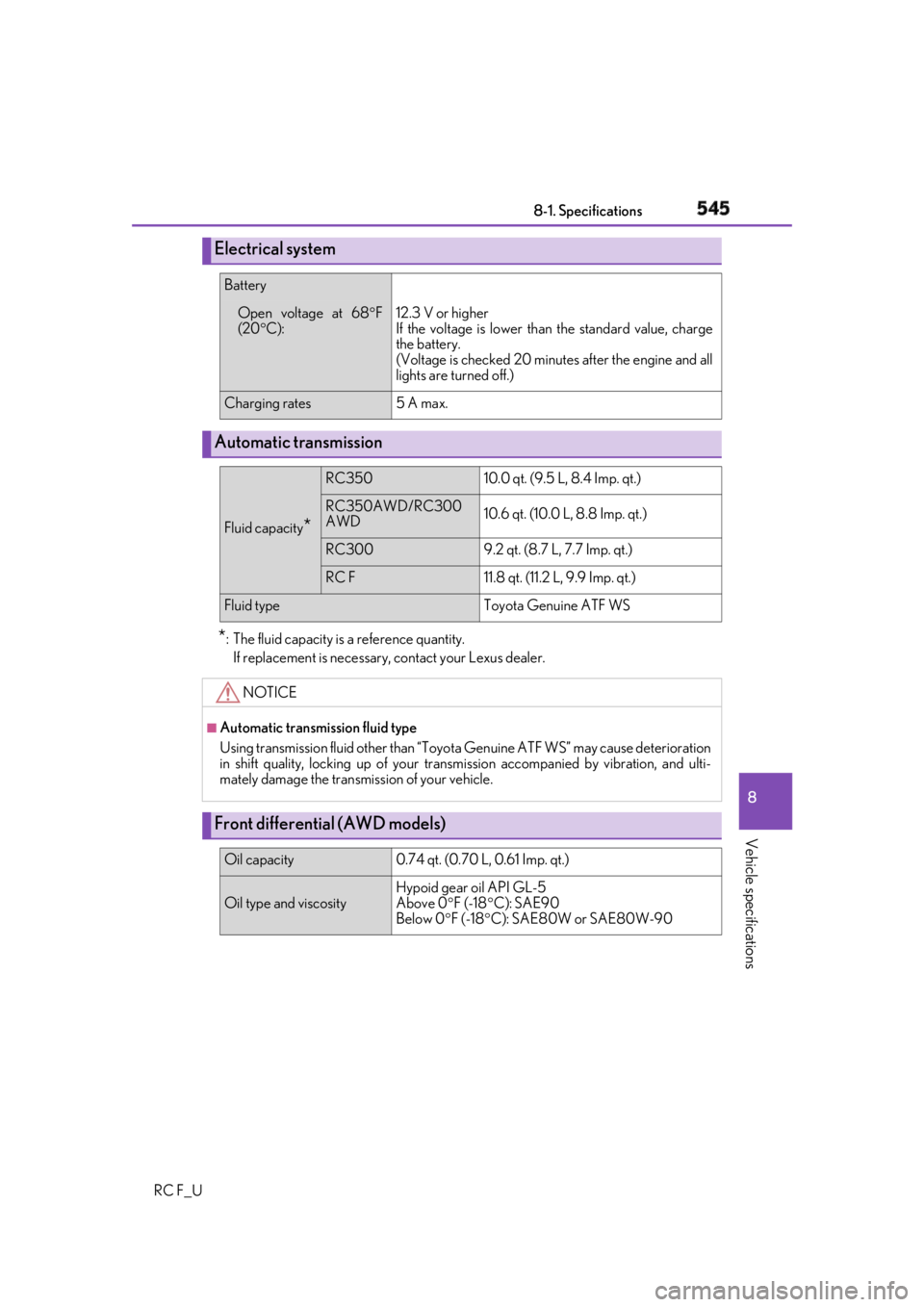
5458-1. Specifications
8
Vehicle specifications
RC F_U * : The fluid capacity is a reference quantity.
If replacement is necessary, contact your Lexus dealer.Electrical system Battery
Open voltage at 68 F
(20 C): 12.3 V or higher
If the voltage is lower than the standard value, charge
the battery.
(Voltage is checked 20 minutes after the engine and all
lights are turned off.)
Charging rates 5 A max.
Automatic transmission Fluid capacity
* RC350 10.0 qt. (9.5 L, 8.4 Imp. qt.)
RC350AWD/RC300
AWD 10.6 qt. (10.0 L, 8.8 Imp. qt.)
RC300 9.2 qt. (8.7 L, 7.7 Imp. qt.)
RC F 11.8 qt. (11.2 L, 9.9 Imp. qt.)
Fluid type Toyota Genuine ATF WS
NOTICE ■
Automatic transmission fluid type
Using transmission fluid other than “Toyota Genuine ATF WS” may cause deterioration
in shift quality, locking up of your transm ission accompanied by vibration, and ulti-
mately damage the transmission of your vehicle.
Front differential (AWD models) Oil capacity 0.74 qt. (0.70 L, 0.61 Imp. qt.)
Oil type and viscosity Hypoid gear oil API GL-5
Above 0 F (-18 C): SAE90
Below 0 F (-18 C): SAE80W or SAE80W-90
Page 564 of 636
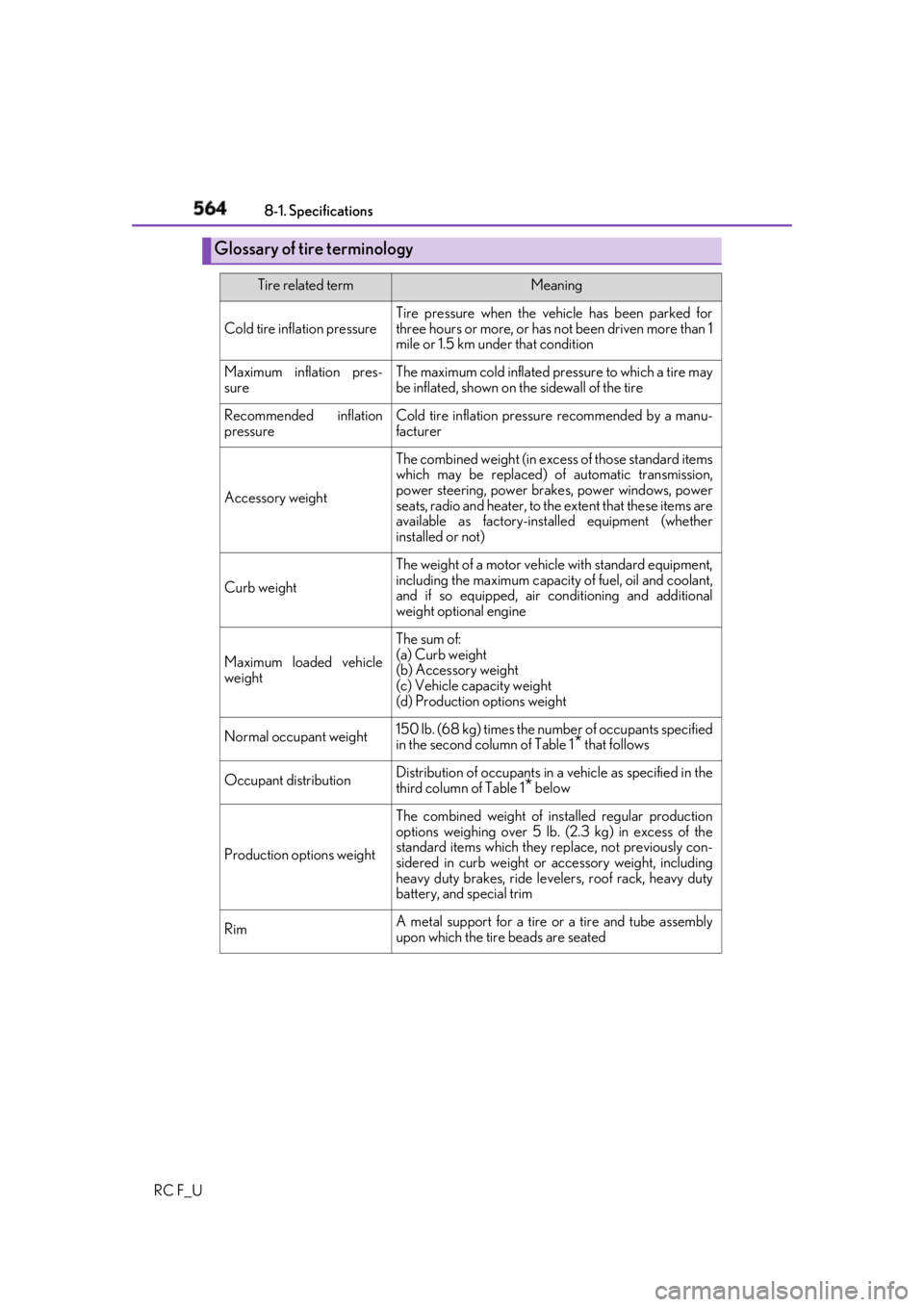
564 8-1. Specifications
RC F_U Glossary of tire terminology Tire related term Meaning
Cold tire inflation pressure Tire pressure when the vehicle has been parked for
three hours or more, or has no t been driven more than 1
mile or 1.5 km un der that condition
Maximum inflation pres-
sure The maximum cold inflated pr essure to which a tire may
be inflated, shown on the sidewall of the tire
Recommended inflation
pressure Cold tire inflation pressure recommended by a manu-
facturer
Accessory weight The combined weight (in exce ss of those standard items
which may be replaced) of automatic transmission,
power steering, power brakes, power windows, power
seats, radio and heater, to the extent that these items are
available as factory-installed equipment (whether
installed or not)
Curb weight The weight of a motor vehicle with standard equipment,
including the maximum capacity of fuel, oil and coolant,
and if so equipped, air co nditioning and additional
weight optional engine
Maximum loaded vehicle
weight The sum of:
(a) Curb weight
(b) Accessory weight
(c) Vehicle capacity weight
(d) Production options weight
Normal occupant weight 150 lb. (68 kg) times the numb er of occupants specified
in the second column of Table 1
* that follows
Occupant distribution Distribution of occupants in a vehicle as specified in the
third column of Table 1
* below
Production options weight The combined weight of in stalled regular production
options weighing over 5 lb. (2.3 kg) in excess of the
standard items which they re place, not previously con-
sidered in curb weight or accessory weight, including
heavy duty brakes, ride leve lers, roof rack, heavy duty
battery, and special trim
Rim A metal support for a tire or a tire and tube assembly
upon which the tire beads are seated