light LEXUS RCF 2021 Owners Manual
[x] Cancel search | Manufacturer: LEXUS, Model Year: 2021, Model line: RCF, Model: LEXUS RCF 2021Pages: 408, PDF Size: 8.25 MB
Page 330 of 408
3307-2. Steps to take in an emergency
The engine starting system may be
malfunctioning due to an electrical
problem such as electronic key battery
depletion or a blown fuse. However, an
interim measure is available to start the
engine. (P.330)
One of the following may be the cause
of the problem:
One or both of the battery terminals
may be disconnected. ( P.271)
The battery may be discharged.
( P.334)
There may be a malfunction in the
steering lock system.
Contact your Lexus dealer if the problem
cannot be repaired, or if repair procedures
are unknown.
When the engine does not start, the
following steps can be used as an
interim measure to start the engine if
the engine switch is functioning nor-
mally:
1 Set the parking brake.
2 Shift the shift lever to P.
3 Turn the engine switch to ACCES-
SORY mode. 4
Press and hold the engine switch
for about 15 seconds while
depressing the brake pedal firmly.
Even if the engine can be started using
the above steps, the system may be
malfunctioning. Have the vehicle
inspected by your Lexus dealer.
The starter motor does not turn
over
The starter motor does not turn
over, the interior lights and head-
lights do not turn on, or the horn
does not sound.
Emergency start function
Page 335 of 408
3357-2. Steps to take in an emergency
7
When trouble arises
raise the front of the engine cover
to remove the front clips.
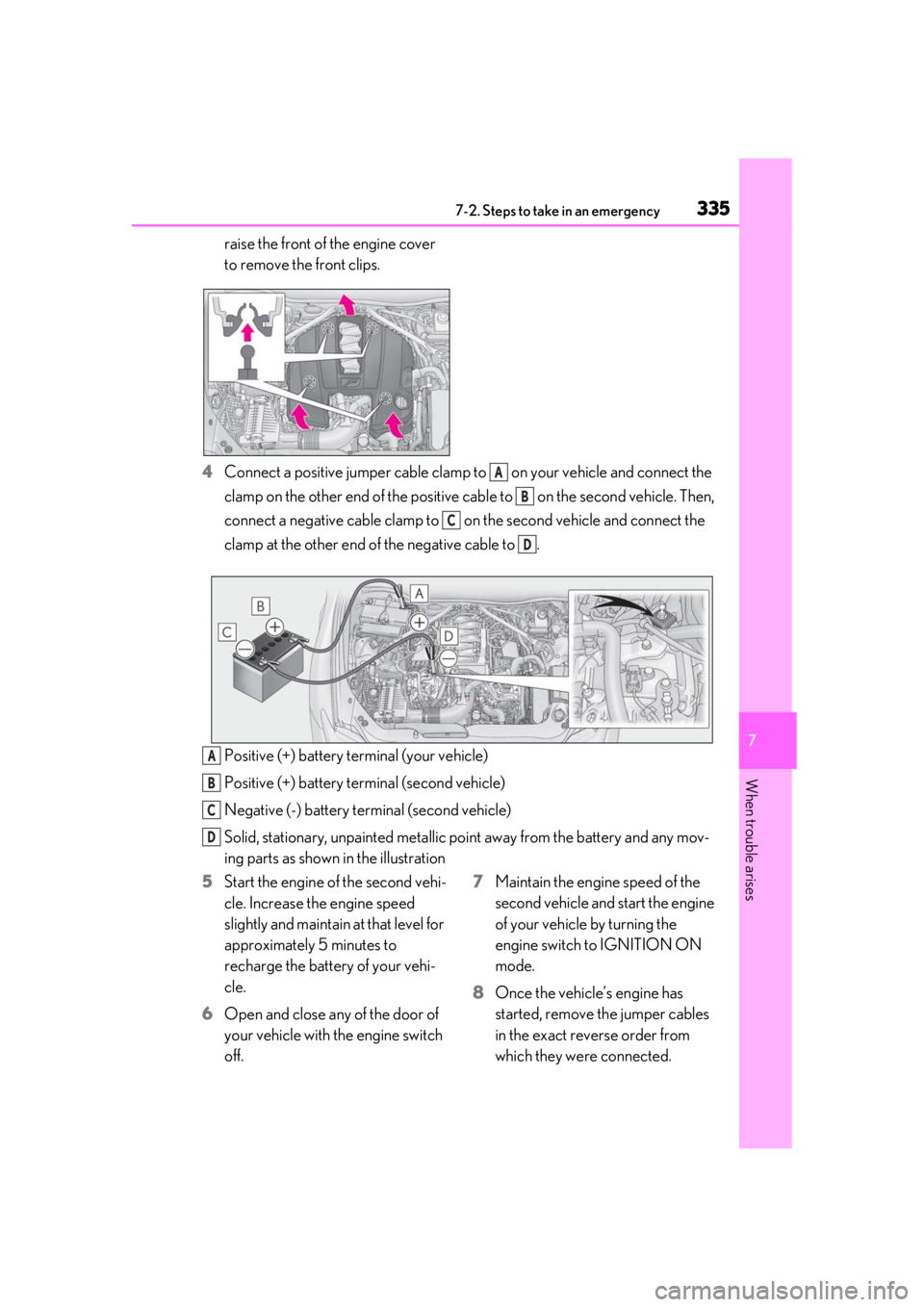
4 Connect a positive jumper cable clamp to on your vehicle and connect the
clamp on the other end of the positive cab le to on the second vehicle. Then,
connect a negative cable clamp to on the second vehicle and connect the
clamp at the other end of the negative cable to .
Positive (+) battery terminal (your vehicle)
Positive (+) battery terminal (second vehicle)
Negative (-) battery terminal (second vehicle)
Solid, stationary, unpainted metallic poin t away from the battery and any mov-
ing parts as shown in the illustration
5 Start the engine of the second vehi-
cle. Increase the engine speed
slightly and maintain at that level for
approximately 5 minutes to
recharge the battery of your vehi-
cle.
6 Open and close any of the door of
your vehicle with the engine switch
off. 7
Maintain the engine speed of the
second vehicle and start the engine
of your vehicle by turning the
engine switch to IGNITION ON
mode.
8 Once the vehicle’s engine has
started, remove the jumper cables
in the exact reverse order from
which they were connected.
A
B
C
D
A
B
C
D
Page 336 of 408
3367-2. Steps to take in an emergency
Once the engine starts, have the vehi-
cle inspected at your Lexus dealer as
soon as possible.
■Starting the engine when the battery is
discharged
The engine cannot be started by push-start-
ing.
■To prevent battery discharge
●Turn off the headlights and the audio sys-
tem while the engine is off.
●Turn off any unnecessary electrical com-
ponents when the vehicle is running at a
low speed for an extended period, such
as in heavy traffic.
■Charging the battery
The electricity stored in the battery will dis-
charge gradually even when the vehicle is
not in use, due to natural discharge and the
draining effects of certain electrical appli-
ances. If the vehicle is left for a long time,
the battery may discharge, and the engine
may be unable to start. (The battery
recharges automatically during driving.)
■When recharging or replacing the bat-
tery
●In some cases, it may not be possible to
unlock the doors using the smart access
system with push-button start when the
battery is discharged. Use the wireless
remote control or the mechanical key to
lock or unlock the doors.
●The engine may not start on the first
attempt after the battery has recharged
but will start normally after the second
attempt. This is not a malfunction.
●The engine switch mode is memorized by
the vehicle. When the battery is recon-
nected, the system will return to the
mode it was in before the battery was dis-
charged. Before di sconnecting the bat-
tery, turn the engine switch off.
If you are unsure what mode the engine
switch was in befo re the battery dis-
charged, be especially careful when
reconnecting the battery.
■When replacing the battery
●Use a battery that conforms to European
regulations.
●Use a battery that tha case size is same as
the previous one (LN3), 20 hour rate
capacity (20HR) is equivalent (70Ah) or
greater, and performance rating (CCA)
is equivalent (592A) or greater.
• If the sizes differ, the battery cannot be properly secured.
• If the 20 hour rate capacity is low, even if the time period where the vehicle is not
used is a short time, battery may dis-
charge and the engine may not be able to
start.
●For details, consult your Lexus dealer.
WARNING
■Avoiding battery fires or explosions
Observe the following precautions to
prevent accidentally igniting the flamma-
ble gas that may be emitted from the bat-
tery:
●Make sure each jumper cable is con-
nected to the correct terminal and that
it is not unintentionally in contact with
any other than the intended terminal.
●Do not allow the other end of the
jumper cable connected to the “+” ter-
minal to come into contact with any
other parts or meta l surfaces in the
area, such as brackets or unpainted
metal.
●Do not allow the + and - clamps of the
jumper cables to come into contact
with each other.
●Do not smoke, use matches, cigarette
lighters or allow open flame near the
battery.
■Battery precautions
The battery contains poisonous and cor-
rosive acidic electrol yte, while related
parts contain lead and lead compounds.
Observe the following precautions when
handling the battery:
Page 345 of 408
3458-1. Specifications
8
Vehicle specifications
If replacement is necessary, contact your Lexus dealer.
■Spark plug
*: The fluid capacity is a reference quantity.If replacement is necessary, contact your Lexus dealer.
Ignition system (spark plug)
MakeDENSO FK20HBR-J8
Gap0.031 in. (0.8 mm)
NOTICE
■Iridium-tipped spark plugs
Use only iridium-tipped spark plugs. Do not adjust the spark plug gap.
Electrical system (battery)
Open voltage at 68°F (20°C):
12.3 V or higher
If the voltage is lower than the standard value,
charge the battery.
(Voltage is checked 20 minutes after the engine
and all lights are turned off.)
Charging rates5 A max.
Automatic transmission
Fluid capacity*11.8 qt. (11.2 L, 9.9 Imp. qt.)
Fluid typeToyota Genuine ATF WS
NOTICE
■Automatic transmission fluid type
Using transmission fluid other than the above type may cause abnormal noise or vibra-
tion, or damage the transmission of your vehicle.
Page 348 of 408
3488-1. Specifications
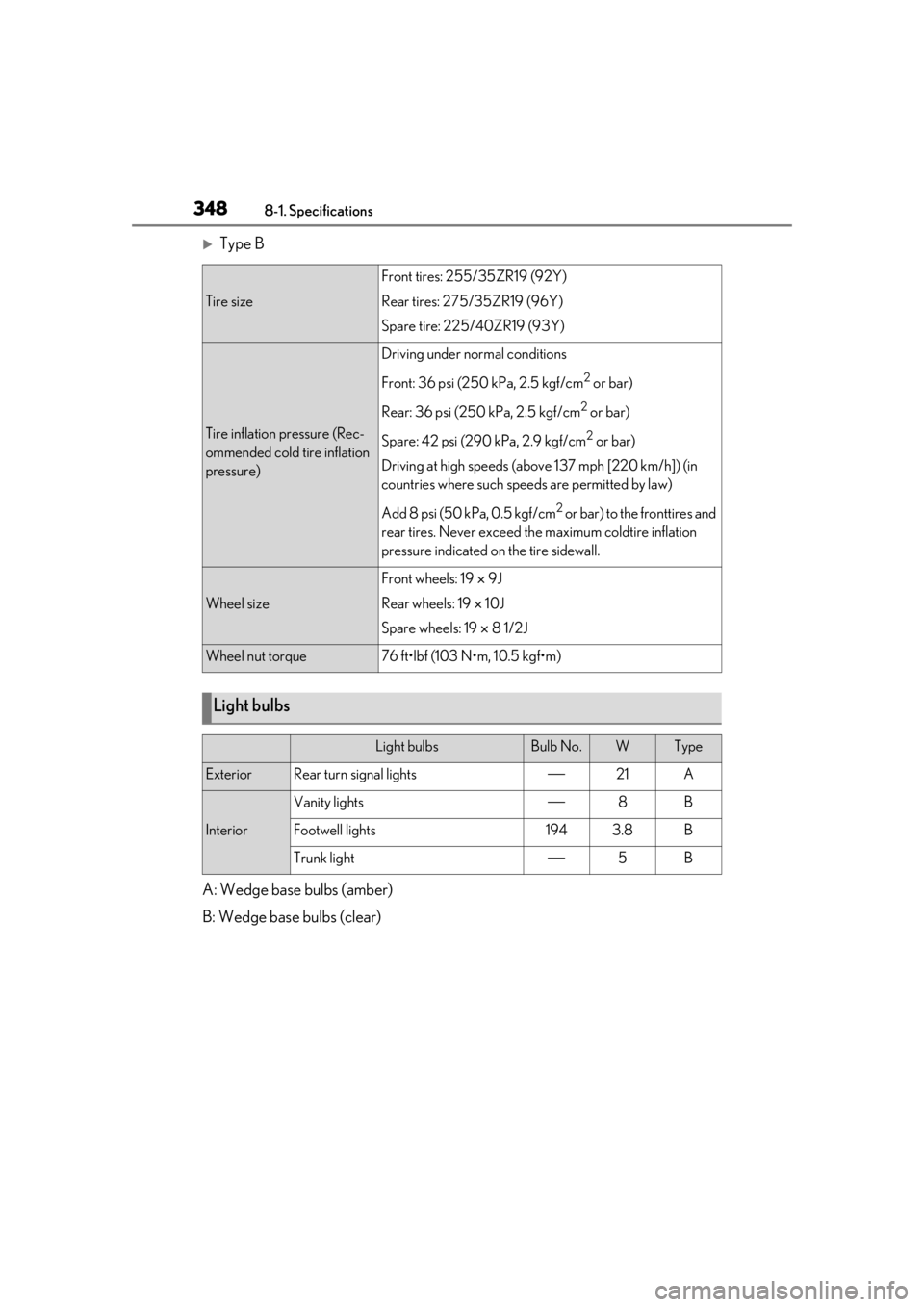
Type B
A: Wedge base bulbs (amber)
B: Wedge base bulbs (clear)
Tire size
Front tires: 255/35ZR19 (92Y)
Rear tires: 275/35ZR19 (96Y)
Spare tire: 225/40ZR19 (93Y)
Tire inflation pressure (Rec-
ommended cold tire inflation
pressure)
Driving under normal conditions
Front: 36 psi (250 kPa, 2.5 kgf/cm
2 or bar)
Rear: 36 psi (250 kPa, 2.5 kgf/cm
2 or bar)
Spare: 42 psi (290 kPa, 2.9 kgf/cm
2 or bar)
Driving at high speeds (above 137 mph [220 km/h]) (in
countries where such speeds are permitted by law)
Add 8 psi (50 kPa, 0.5 kgf/cm
2 or bar) to the fronttires and
rear tires. Never exceed th e maximum coldtire inflation
pressure indicated on the tire sidewall.
Wheel size
Front wheels: 19 9J
Rear wheels: 19 10J
Spare wheels: 19 8 1/2J
Wheel nut torque76 ft•lbf (103 N•m, 10.5 kgf•m)
Light bulbs
Light bulbsBulb No.WType
ExteriorRear turn signal lights21A
Interior
Vanity lights8B
Footwell lights1943.8B
Trunk light5B
Page 349 of 408
3498-1. Specifications
8
Vehicle specifications
■Gasoline quality
In very few cases, driveability problems may
be caused by the brand of gasoline you are
using. If driveability problems persist, try
changing the brand of gasoline. If this does
not correct the problem, consult your Lexus
dealer.
■Recommendation of the use of gasoline
containing detergent additives
●Lexus recommends the use of gasoline
that contains detergent additives to avoid
the build-up of engine deposits.
●All gasoline sold in the U.S.A. contains
minimum detergent additives to clean
and/or keep clean intake systems, per
EPA’s lowest additive s concentration pro-
gram.
●Lexus strongly recommends the use of
Top Tier Detergent Gasoline. For more
information on Top Tier Detergent Gaso-
line and a list of marketers, please go to
the official websit e www.toptiergas.com.
■Recommendation of the use of low
emissions gasoline
Gasolines containing oxygenates such as
ethers and ethanol, as well as reformulated gasolines, are available in some cities.
These fuels are typically acceptable for use,
providing they meet other fuel require-
ments.
Lexus recommends these fuels, since the
formulations allow for reduced vehicle
emissions.
■Non-recommendation of the use of
blended gasoline
●Use only gasoline containing up to 15%
ethanol.
DO NOT use any flex-fuel or gasoline
that could contain more than 15% etha-
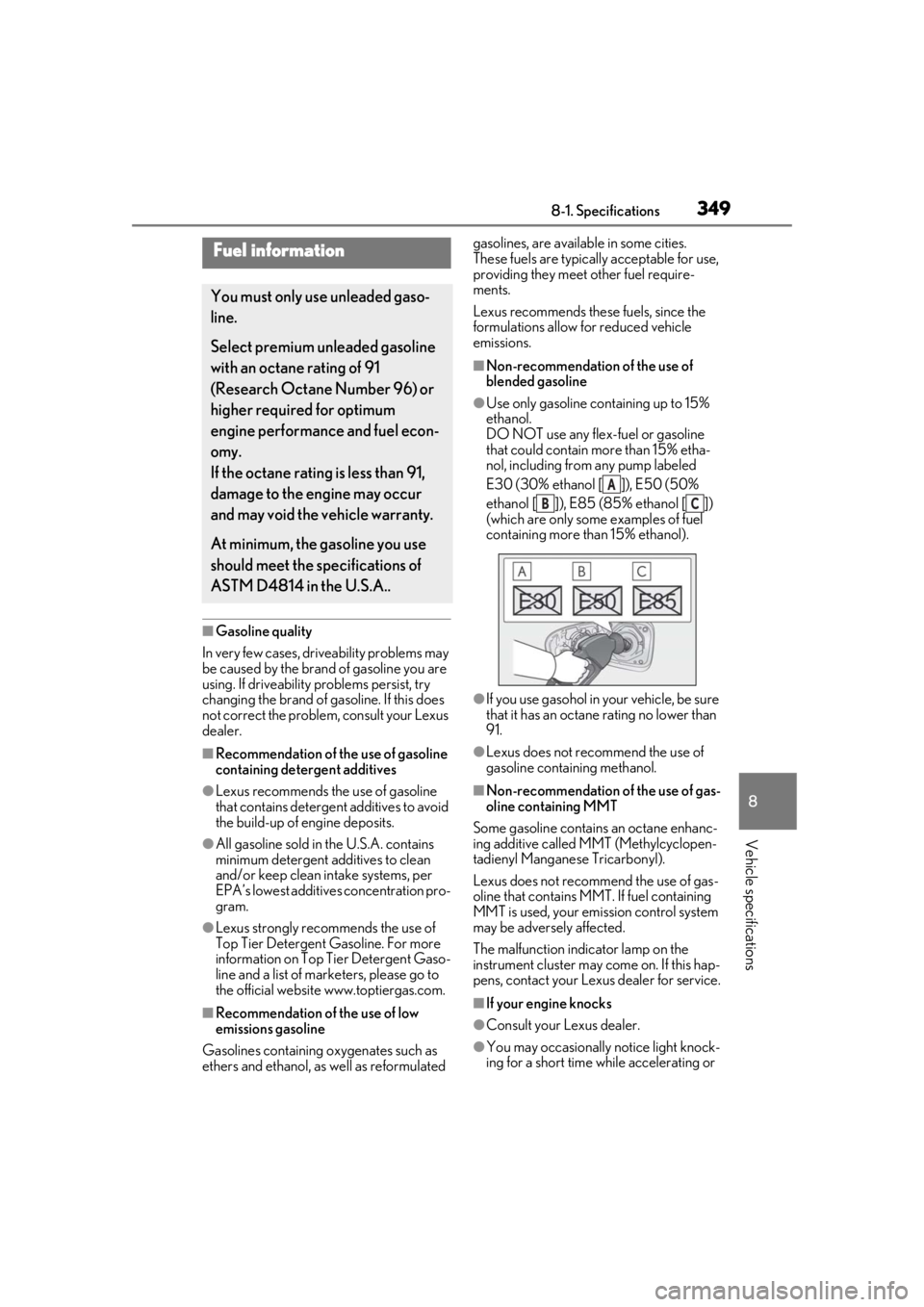
nol, including from
any pump labeled
E30 (30% ethanol [ ]), E50 (50%
ethanol [ ]), E85 (85% ethanol [ ])
(which are only some examples of fuel
containing more than 15% ethanol).
●If you use gasohol in your vehicle, be sure
that it has an octane rating no lower than
91.
●Lexus does not recommend the use of
gasoline containing methanol.
■Non-recommendation of the use of gas-
oline containing MMT
Some gasoline contains an octane enhanc-
ing additive called MMT (Methylcyclopen-
tadienyl Manganese Tricarbonyl).
Lexus does not recommend the use of gas-
oline that contains MMT. If fuel containing
MMT is used, your emission control system
may be adversely affected.
The malfunction indicator lamp on the
instrument cluster may come on. If this hap-
pens, contact your Lexus dealer for service.
■If your engine knocks
●Consult your Lexus dealer.
●You may occasionally notice light knock-
ing for a short time wh ile accelerating or
Fuel information
You must only use unleaded gaso-
line.
Select premium unleaded gasoline
with an octane rating of 91
(Research Octane Number 96) or
higher required for optimum
engine performance and fuel econ-
omy.
If the octane rating is less than 91,
damage to the engine may occur
and may void the vehicle warranty.
At minimum, the gasoline you use
should meet the specifications of
ASTM D4814 in the U.S.A..
A
BC
Page 357 of 408
3578-1. Specifications
8
Vehicle specifications
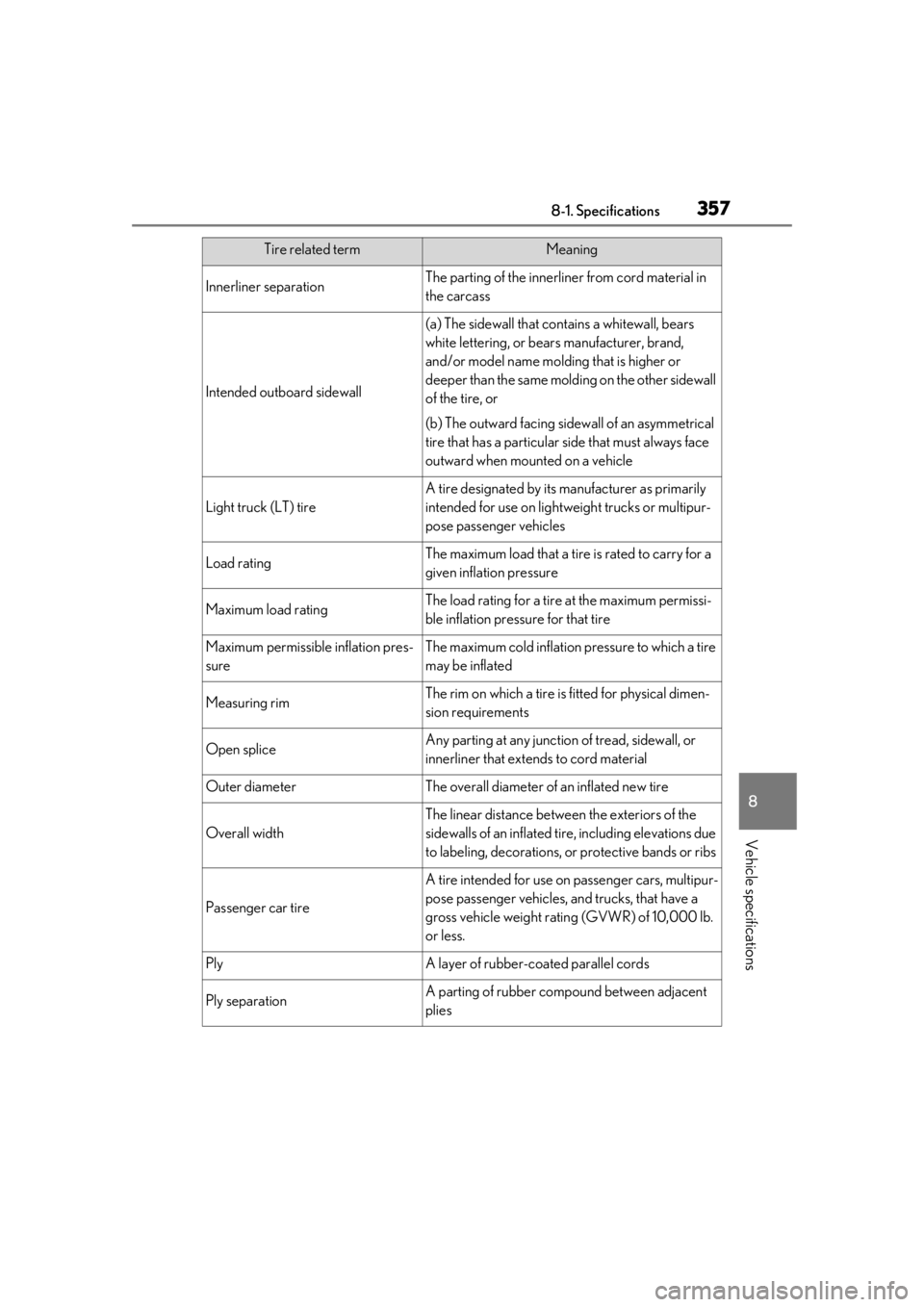
Innerliner separationThe parting of the innerliner from cord material in
the carcass
Intended outboard sidewall
(a) The sidewall that contains a whitewall, bears
white lettering, or bear s manufacturer, brand,
and/or model name molding that is higher or
deeper than the same molding on the other sidewall
of the tire, or
(b) The outward facing sidewall of an asymmetrical
tire that has a particular side that must always face
outward when mounted on a vehicle
Light truck (LT) tire
A tire designated by its manufacturer as primarily
intended for use on lightwe ight trucks or multipur-
pose passenger vehicles
Load ratingThe maximum load that a tire is rated to carry for a
given inflation pressure
Maximum load ratingThe load rating for a tire at the maximum permissi-
ble inflation pressure for that tire
Maximum permissible inflation pres-
sureThe maximum cold inflation pressure to which a tire
may be inflated
Measuring rimThe rim on which a tire is fitted for physical dimen-
sion requirements
Open spliceAny parting at any junction of tread, sidewall, or
innerliner that extends to cord material
Outer diameterThe overall diameter of an inflated new tire
Overall width
The linear distance between the exteriors of the
sidewalls of an inflated tire, including elevations due
to labeling, decorations, or protective bands or ribs
Passenger car tire
A tire intended for use on passenger cars, multipur-
pose passenger vehicles, and trucks, that have a
gross vehicle weight rating (GVWR) of 10,000 lb.
or less.
PlyA layer of rubber-c oated parallel cords
Ply separationA parting of rubber compound between adjacent
plies
Tire related termMeaning
Page 362 of 408

3628-2. Customization
*1: For details about each function: P.81
*2: The default setting varies according to country.
*3: Some status screens cannot be registered (i ndicated on the multi-information display)
*4: Always observe the legal speed limit when driving on public roads.
*5: On multi-information display
■Door lock (P.92, 95, 332)
Speed indicator settings75 mph (120 km/h)
30 mph to 100 mph
(50 km/h to 160
km/h)
*4—O—
Eco Driving Indicator LightOnOff—O—
Clock*512-hour display24-hour display—O—
Function*1Default settingCustomized settingABC
FunctionDefault settingCustomized setting
Unlocking using a mechani-
cal key
Driver’s door
unlocked in one
step, both side doors unlocked in two steps
Both side doors
unlocked in one step——O
Automatic door lock
Shifting the shift
lever to position other than P
Off
O—OVehicle speed is
approximately 12
mph (20 km/h) or higher
Automatic door unlockShifting the shift lever to POff
O—ODriver’s door is opened
Locking/unlocking of the
trunk when both side doors
are locked/unlocked
OnOff——O
ABC
Page 363 of 408
3638-2. Customization
8
Vehicle specifications
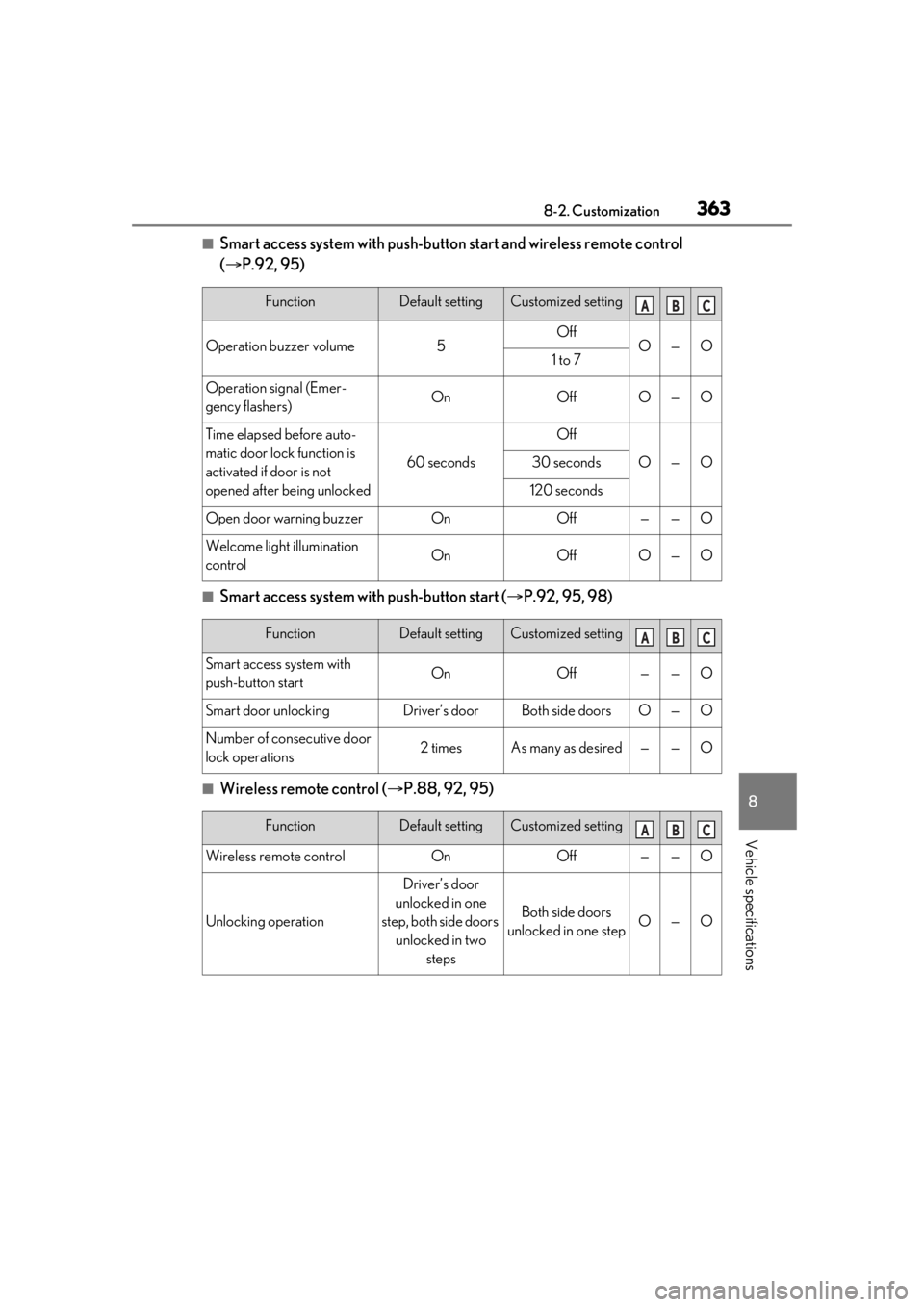
■Smart access system with push-button start and wireless remote control
( P.92, 95)
■Smart access system with push-button start ( P.92, 95, 98)
■Wireless remote control ( P.88, 92, 95)
FunctionDefault settingCustomized setting
Operation buzzer volume5OffO—O1 to 7
Operation signal (Emer-
gency flashers)OnOffO—O
Time elapsed before auto-
matic door lock function is
activated if door is not
opened after being unlocked
60 seconds
Off
O—O30 seconds
120 seconds
Open door warning buzzerOnOff——O
Welcome light illumination
controlOnOffO—O
ABC
FunctionDefault settingCustomized setting
Smart access system with
push-button startOnOff——O
Smart door unlockingDriver’s doorBoth side doorsO—O
Number of consecutive door
lock operations2 timesAs many as desired——O
ABC
FunctionDefault settingCustomized setting
Wireless remote controlOnOff——O
Unlocking operation
Driver’s door
unlocked in one
step, both side doors unlocked in two steps
Both side doors
unlocked in one stepO—O
ABC
Page 365 of 408
3658-2. Customization
8
Vehicle specifications
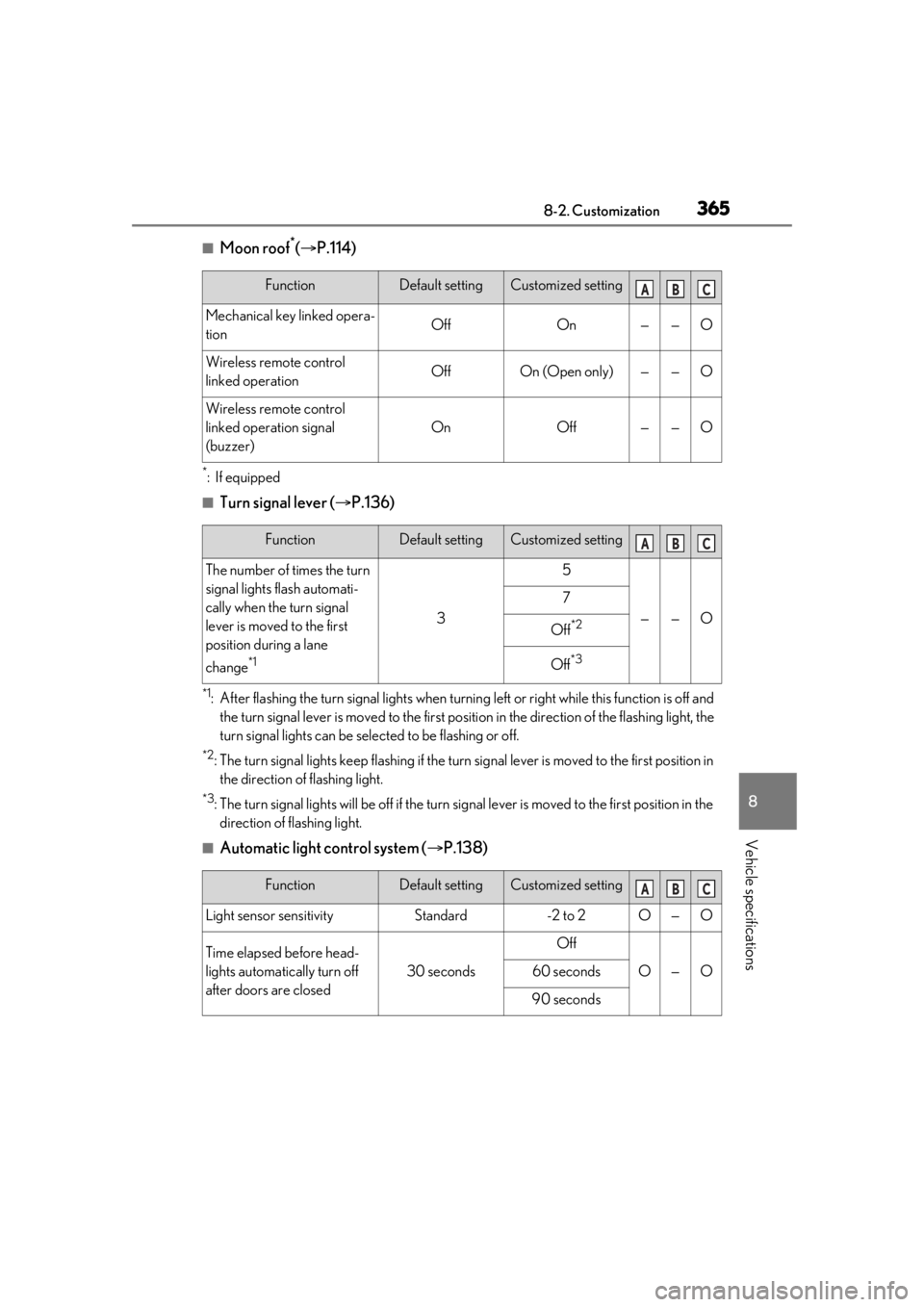
■Moon roof*( P.114)
*:If equipped
■Turn signal lever ( P.136)
*1: After flashing the turn signal lights when turnin g left or right while this function is off and
the turn signal lever is moved to the first positi on in the direction of the flashing light, the
turn signal lights can be sele cted to be flashing or off.
*2: The turn signal lights keep flashing if the turn signal lever is moved to the first position in
the direction of flashing light.
*3: The turn signal lights will be off if the turn si gnal lever is moved to the first position in the
direction of flashing light.
■Automatic light control system ( P.138)
FunctionDefault settingCustomized setting
Mechanical key linked opera-
tionOffOn——O
Wireless remote control
linked operationOffOn (Open only)——O
Wireless remote control
linked operation signal
(buzzer)
OnOff——O
ABC
FunctionDefault settingCustomized setting
The number of times the turn
signal lights flash automati-
cally when the turn signal
lever is moved to the first
position during a lane
change
*1
3
5
——O
7
Off*2
Off*3
ABC
FunctionDefault settingCustomized setting
Light sensor sensitivityStandard-2 to 2O—O
Time elapsed before head-
lights automatically turn off
after doors are closed
30 seconds
Off
O—O60 seconds
90 seconds
ABC