radio LEXUS RCF 2021 User Guide
[x] Cancel search | Manufacturer: LEXUS, Model Year: 2021, Model line: RCF, Model: LEXUS RCF 2021Pages: 408, PDF Size: 8.25 MB
Page 162 of 408
1624-5. Using the driving support systems
road or a wall that may be mistaken for a
vehicle or pedestrian
• When driving near an object that reflects
radio waves, such as a large truck or
guardrail
• When driving near a TV tower, broad-
casting station, electric power plant, or
other location where strong radio waves
or electrical noise may be present
■Situations in which the system may not
operate properly
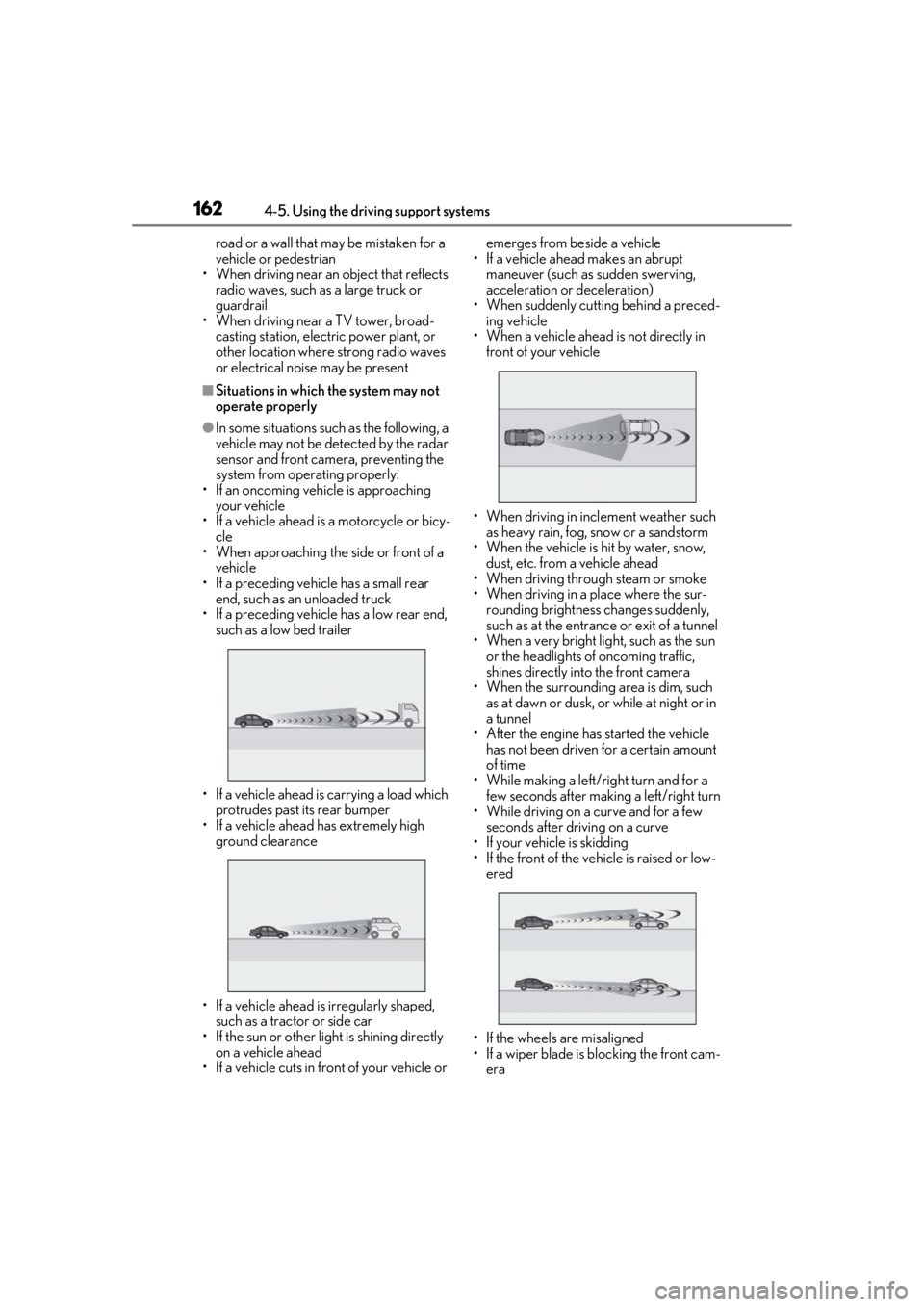
●In some situations such as the following, a
vehicle may not be detected by the radar
sensor and front camera, preventing the
system from operating properly:
• If an oncoming vehicle is approaching your vehicle
• If a vehicle ahead is a motorcycle or bicy-
cle
• When approaching the side or front of a vehicle
• If a preceding vehicle has a small rear end, such as an unloaded truck
• If a preceding vehicle has a low rear end,
such as a low bed trailer
• If a vehicle ahead is carrying a load which protrudes past its rear bumper
• If a vehicle ahead has extremely high ground clearance
• If a vehicle ahead is irregularly shaped, such as a tractor or side car
• If the sun or other light is shining directly
on a vehicle ahead
• If a vehicle cuts in front of your vehicle or emerges from beside a vehicle
• If a vehicle ahead makes an abrupt maneuver (such as sudden swerving,
acceleration or deceleration)
• When suddenly cutting behind a preced- ing vehicle
• When a vehicle ahead is not directly in front of your vehicle
• When driving in incl ement weather such
as heavy rain, fog, snow or a sandstorm
• When the vehicle is hit by water, snow,
dust, etc. from a vehicle ahead
• When driving through steam or smoke
• When driving in a place where the sur- rounding brightness changes suddenly,
such as at the entrance or exit of a tunnel
• When a very bright light, such as the sun
or the headlights of oncoming traffic,
shines directly into the front camera
• When the surrounding area is dim, such
as at dawn or dusk, or while at night or in
a tunnel
• After the engine has started the vehicle
has not been driven for a certain amount
of time
• While making a left/right turn and for a
few seconds after making a left/right turn
• While driving on a curve and for a few seconds after driving on a curve
• If your vehicle is skidding
• If the front of the vehicle is raised or low- ered
• If the wheels are misaligned
• If a wiper blade is blocking the front cam- era
Page 276 of 408
2766-4. Do-it-yourself maintenance
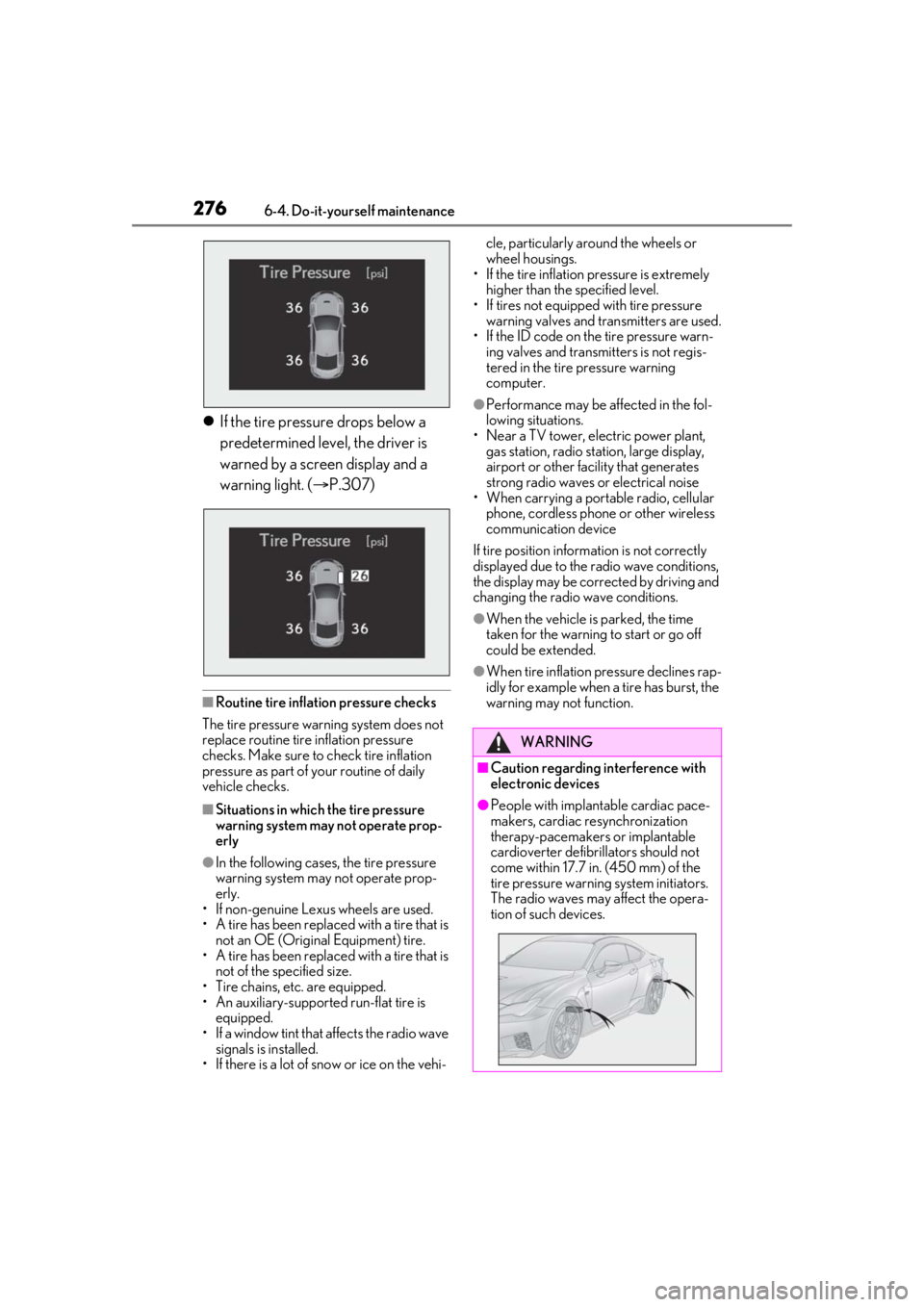
If the tire pressure drops below a
predetermined level, the driver is
warned by a screen display and a
warning light. ( P.307)
■Routine tire inflation pressure checks
The tire pressure warning system does not
replace routine tire inflation pressure
checks. Make sure to check tire inflation
pressure as part of your routine of daily
vehicle checks.
■Situations in which the tire pressure
warning system may not operate prop-
erly
●In the following cases, the tire pressure
warning system may not operate prop-
erly.
• If non-genuine Lexus wheels are used.
• A tire has been replaced with a tire that is
not an OE (Original Equipment) tire.
• A tire has been replaced with a tire that is
not of the specified size.
• Tire chains, etc. are equipped.
• An auxiliary-supported run-flat tire is
equipped.
• If a window tint that affects the radio wave
signals is installed.
• If there is a lot of snow or ice on the vehi- cle, particularly around the wheels or
wheel housings.
• If the tire inflation pressure is extremely
higher than the specified level.
• If tires not equipped with tire pressure warning valves and transmitters are used.
• If the ID code on the tire pressure warn- ing valves and transmitters is not regis-
tered in the tire pressure warning
computer.
●Performance may be af fected in the fol-
lowing situations.
• Near a TV tower, electric power plant, gas station, radio stat ion, large display,
airport or other fac ility that generates
strong radio waves or electrical noise
• When carrying a portable radio, cellular
phone, cordless phone or other wireless
communication device
If tire position information is not correctly
displayed due to the radio wave conditions,
the display may be corrected by driving and
changing the radio wave conditions.
●When the vehicle is parked, the time
taken for the warning to start or go off
could be extended.
●When tire inflation pr essure declines rap-
idly for example when a tire has burst, the
warning may not function.
WARNING
■Caution regarding interference with
electronic devices
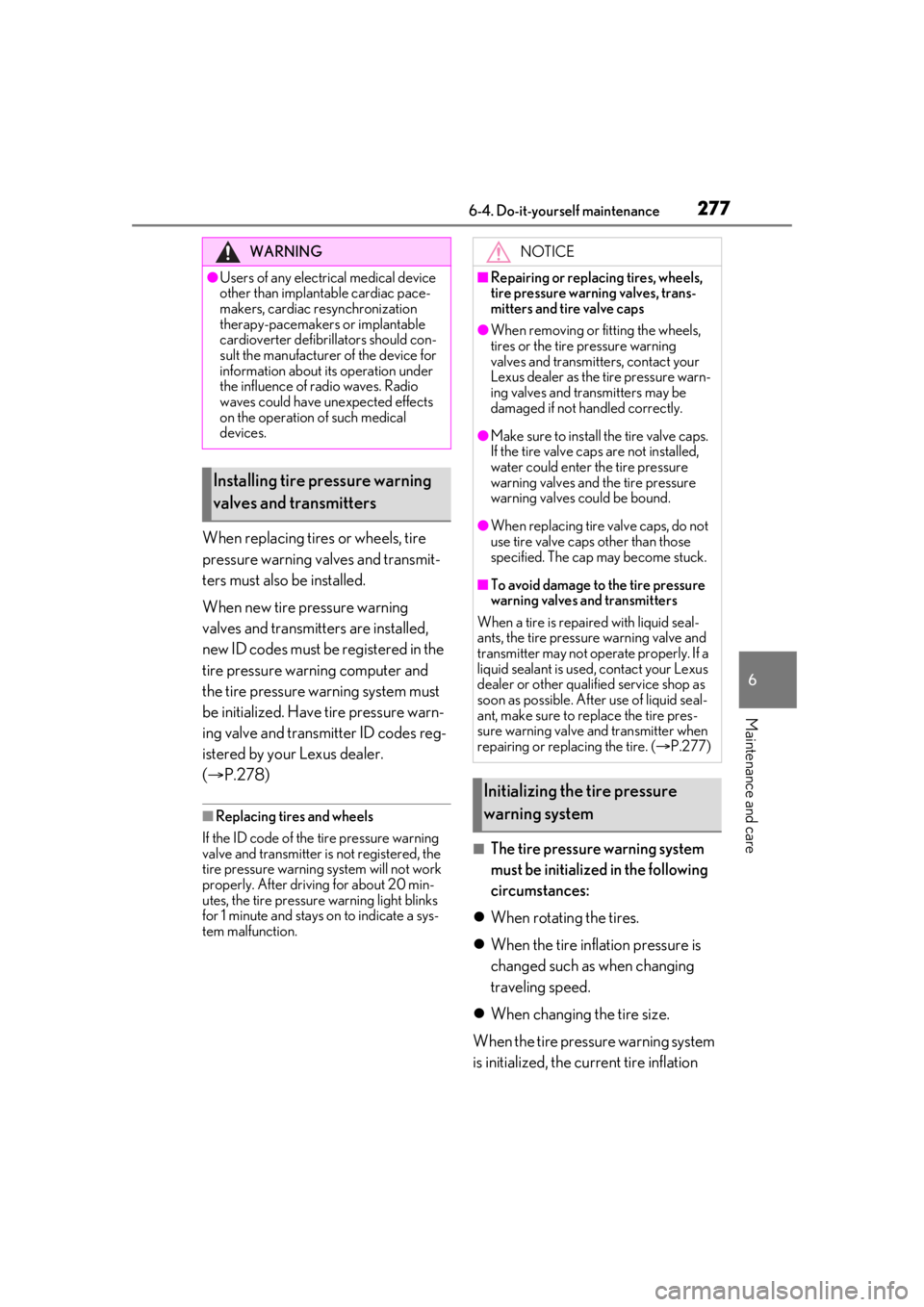
●People with implantable cardiac pace-
makers, cardiac resynchronization
therapy-pacemakers or implantable
cardioverter defibrillators should not
come within 17.7 in. (450 mm) of the
tire pressure warning system initiators.
The radio waves may affect the opera-
tion of such devices.
Page 277 of 408
2776-4. Do-it-yourself maintenance
6
Maintenance and care
When replacing tires or wheels, tire
pressure warning valves and transmit-
ters must also be installed.
When new tire pressure warning
valves and transmitters are installed,
new ID codes must be registered in the
tire pressure warning computer and
the tire pressure warning system must
be initialized. Have tire pressure warn-
ing valve and transmitter ID codes reg-
istered by your Lexus dealer.
( P.278)
■Replacing tires and wheels
If the ID code of the tire pressure warning
valve and transmitter is not registered, the
tire pressure warning system will not work
properly. After driving for about 20 min-
utes, the tire pressure warning light blinks
for 1 minute and stays on to indicate a sys-
tem malfunction.
■The tire pressure warning system
must be initialized in the following
circumstances:
When rotating the tires.
When the tire inflation pressure is
changed such as when changing
traveling speed.
When changing the tire size.
When the tire pressure warning system
is initialized, the current tire inflation
WARNING
●Users of any electrical medical device
other than implantable cardiac pace-
makers, cardiac resynchronization
therapy-pacemakers or implantable
cardioverter defibrillators should con-
sult the manufacturer of the device for
information about its operation under
the influence of radio waves. Radio
waves could have unexpected effects
on the operation of such medical
devices.
Installing tire pressure warning
valves and transmitters
NOTICE
■Repairing or replac ing tires, wheels,
tire pressure warning valves, trans-
mitters and tire valve caps
●When removing or fitting the wheels,
tires or the tire pressure warning
valves and transmitters, contact your
Lexus dealer as the tire pressure warn-
ing valves and transmitters may be
damaged if not handled correctly.
●Make sure to install the tire valve caps.
If the tire valve caps are not installed,
water could enter the tire pressure
warning valves and the tire pressure
warning valves could be bound.
●When replacing tire valve caps, do not
use tire valve caps other than those
specified. The cap may become stuck.
■To avoid damage to the tire pressure
warning valves and transmitters
When a tire is repaired with liquid seal-
ants, the tire pressure warning valve and
transmitter may not operate properly. If a
liquid sealant is used , contact your Lexus
dealer or other qualified service shop as
soon as possible. After use of liquid seal-
ant, make sure to re place the tire pres-
sure warning valve and transmitter when
repairing or replacing the tire. ( P.277)
Initializing the tire pressure
warning system
Page 354 of 408
3548-1. Specifications
■Traction AA, A, B, C
The traction grades, from highest to
lowest, are AA, A, B and C, and they
represent the tire’s ability to stop on
wet pavement as measured under con-
trolled conditions on specified govern-
ment test surfaces of asphalt and
concrete.
A tire marked C may have poor traction
performance.
Warning: The traction grade assigned to
this tire is based on braking (straight
ahead) traction tests and does not include
cornering (turning) traction.
■Temperature A, B, C
The temperature grades are A (the
highest), B, and C, representing the
tire’s resistance to the generation of
heat and its ability to dissipate heat when tested under controlled condi-
tions on a specified indoor laboratory
test wheel.
Sustained high temperature can cause the
material of the tire to degenerate and
reduce tire life, and excessive temperature
can lead to sudd
en tire failure.
Grade C corresponds to a level of perfor-
mance which all passenger car tires must
meet under the Fede ral Motor Vehicle
Safety Standard No. 109.
Grades B and A represent higher levels of
performance on the laboratory test wheel
than the minimum required by law.
Warning: The temperature grades of a tire
assume that it is properly inflated and not
overloaded.
Excessive speed, unde rinflation, or exces-
sive loading, either separately or in combi-
nation, can cause heat buildup and
possible tire failure.
Glossary of tire terminology
Tire related termMeaning
Cold tire inflation pressure
Tire pressure when the vehicle has been parked for
three hours or more, or has not been driven more
than 1 mile or 1.5 km under that condition
Maximum inflation pressureThe maximum cold inflated pressure to which a tire
may be inflated, shown on the sidewall of the tire
Recommended inflation pressureCold tire inflation pressure recommended by a
manufacturer
Accessory weight
The combined weight (in excess of those standard
items which may be replaced) of automatic trans-
mission, power steering, power brakes, power win-
dows, power seats, radio and heater, to the extent
that these items are available as factory-installed
equipment (whether installed or not)
Page 387 of 408
3879-1. For owners
9
For owners
AVERTISSEMENT
●N'utilisez aucun accessoire de siège
recouvrant les zones de déploiement
des coussins gonflables latéraux SRS,
car il risque de gêner le déploiement
des coussins gonflables. De tels acces-
soires peuvent empêcher les coussins
gonflables latéraux de fonctionner
correctement, désactiver le système
ou entraîner le déploiement accidentel
des coussins gonflables latéraux,
occasionnant des blessures graves,
voire mortelles.
●Évitez de faire subir des chocs ou des
pressions excessives aux parties ren-
fermant les composants de coussins
gonflables SRS.
En effet, cela pourra it entraîner un dys-
fonctionnement des coussins gonfla-
bles SRS.
●Ne touchez aucun composant
immédiatement après le déploiement
(gonflage) des coussins gonflables
SRS, car ils peuvent être chauds.
●Si vous avez des difficultés à respirer
après le déploiement des coussins
gonflables SRS, ouvrez une porte ou
une vitre pour faire entrer de l'air frais,
ou bien descendez du véhicule si cela
ne présente pas de danger. Essuyez
tout résidu dès que possible afin
d'éviter d'éventuelles irritations de la
peau.
●Si les parties renfermant les coussins
gonflables SRS, comme les garnitures
du volant et des montants avant et
arrière, sont endommagées ou cra-
quelées, faites-les remplacer par votre
concessionnaire Lexus.
●Ne placez rien sur le siège du pas-
sager avant, comme un coussin par
exemple. Cela a pour conséquence de
répartir le poids du passager sur toute
la surface du siège, ce qui empêche le
capteur de détecter correctement le
poids du passager. En conséquence,
les coussins gonflables frontaux SRS
du passager avant risquent de ne pas
se déployer en cas de collision.
■Modification et mise au rebut des
composants du système de coussins
gonflables SRS
Ne mettez pas votre véhicule au rebut et
ne procédez à aucune des modifications
suivantes sans consulter votre conces-
sionnaire Lexus. Les coussins gonflables
SRS peuvent ne pas fonctionner cor-
rectement ou se déployer (se gonfler)
accidentellement, provoquant la mort ou
de graves blessures.
●Installation, dépose, démontage et
réparation des coussins gonflables
SRS
●Réparations, modifications, dépose ou
remplacement du volant, du tableau
de bord, de la planche de bord, des
sièges ou de leur garnissage, des mon-
tants avant, latéraux et arrière ou des
rails latéraux de toit
●Réparations ou modifications des ailes
avant, du pare-chocs avant ou des
flancs de l'habitacle
●Installation d'un protège-calandre
(pare-buffle, pare-kangourou, etc.), de
chasse-neige, de treuils ou d'un
porte-bagages de toit
●Modifications du système de suspen-
sion du véhicule
●Installation d'appareils électroniques
tels que les émetteurs/récepteurs
radios mobiles et les lecteurs CD
●Modifications de votre véhicule pour
une personne atteinte d'un handicap
physique
Page 390 of 408
390What to do if... (Troubleshooting)
1-1.What to do if... (Troubleshooting)What to do if... (Troubleshooting)
If you lose your mechanical keys,
new genuine mechanical keys can
be made by your Lexus dealer.
( P.331)
If you lose your electronic keys, the
risk of vehicle theft increases signifi-
cantly. Contact your Lexus dealer
immediately. ( P.331)
Is the electronic key battery weak or
depleted? ( P.283)
Is the engine switch in IGNITION
ON mode?
When locking the doors, turn the engine
switch off. ( P.130)
Is the electronic key left inside the
vehicle?
When locking the doors, make sure that
you have the electronic key on your per-
son.
The function may not operate prop-
erly due to the condition of the radio
wave. ( P.100)
The function to prevent the elec-
tronic key from being left inside the
trunk will operate and you can open
the trunk as usual. Take the key out
from the trunk. ( P.97)
Did you press the engine switch
while firmly depressing the brake
pedal? ( P.128)
Is the shift lever in P? ( P.128)
Is the electronic key anywhere
detectable inside the vehicle?
( P.99)
Is the steering wheel unlocked?
( P.128)
Is the electronic key battery weak or
depleted?
In this case, the engine can be started in a
temporary way. ( P.333)
Is the battery discharged?
( P.334)
If you have a problem, check the
following before contacting your
Lexus dealer.
The doors cannot be locked,
unlocked, opened or closed
You lose your keys
The electronic key does not
operate properly
The doors cannot be locked or
unlocked
The trunk lid is closed with the
electronic key left inside
If you think something is wrong
The engine does not start
The shift lever cannot be shifted
from P even if you depress the
brake pedal