tires LEXUS RCF 2021 Owner's Guide
[x] Cancel search | Manufacturer: LEXUS, Model Year: 2021, Model line: RCF, Model: LEXUS RCF 2021Pages: 408, PDF Size: 8.25 MB
Page 313 of 408
3137-2. Steps to take in an emergency
7
When trouble arises
vehicle inspected by your Lexus dealer
immediately.
• “Access System with Elec. Key Malfunc-
tion”
●If any of the following messages are
shown on the multi-information display, it
may indicate a malfunction. Immediately
stop the vehicle and contact your Lexus
dealer.
• “Braking Power Low”
• “Charging System Malfunction”
• “Oil Pressure Low”
Stop the vehicle in a safe place on a
hard, flat surface.
Set the parking brake.
Shift the shift lever to P.
Stop the engine.
Turn on the emergency flashers.
( P.294)
NOTICE
■“High Power Consumption Partial
Limit On AC/Heater Operation” is
frequently shown
There is a possible malfunction relating
to the charging system or the battery
may be deteriorating. Have the vehicle
inspected by your Lexus dealer.
If you have a flat tire (vehi-
cles with a spare tire)
Your vehicle is equipped with a
spare tire. The flat tire can be
replaced with the spare tire.
For details about tires: P.273
WARNING
■If you have a flat tire
Do not continue driving with a flat tire.
Driving even a short distance with a flat
tire can damage the tire and the wheel
beyond repair, which could result in an
accident.
Before jacking up the vehicle
Page 314 of 408
3147-2. Steps to take in an emergency
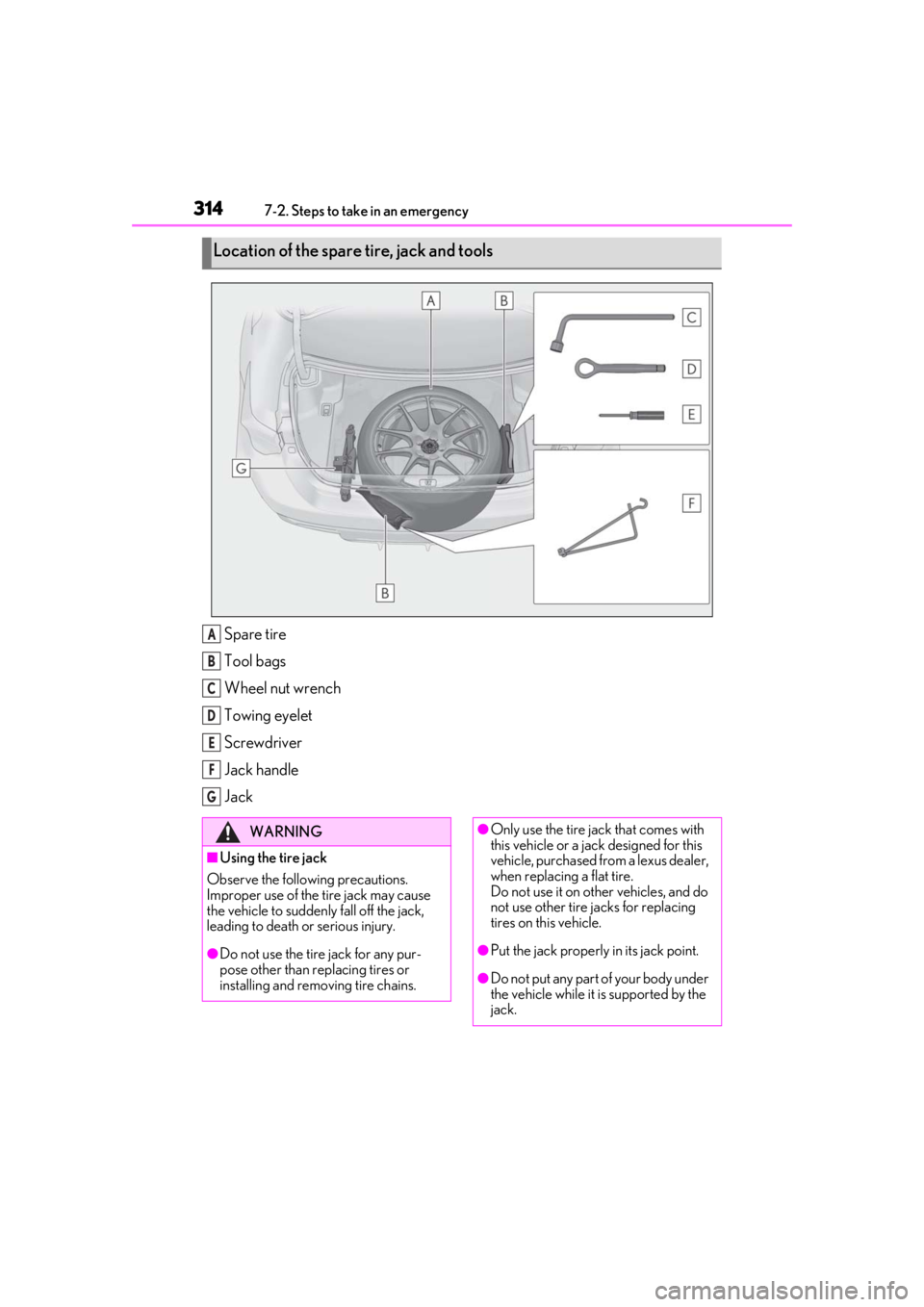
Spare tire
Tool bags
Wheel nut wrench
Towing eyelet
Screwdriver
Jack handle
Jack
Location of the spare tire, jack and tools
A
B
C
D
E
F
G
WARNING
■Using the tire jack
Observe the following precautions.
Improper use of the tire jack may cause
the vehicle to suddenly fall off the jack,
leading to death or serious injury.
●Do not use the tire jack for any pur-
pose other than replacing tires or
installing and removing tire chains.
●Only use the tire jack that comes with
this vehicle or a jack designed for this
vehicle, purchased from a lexus dealer,
when replacing a flat tire.
Do not use it on other vehicles, and do
not use other tire jacks for replacing
tires on this vehicle.
●Put the jack properly in its jack point.
●Do not put any part of your body under
the vehicle while it is supported by the
jack.
Page 316 of 408
3167-2. Steps to take in an emergency
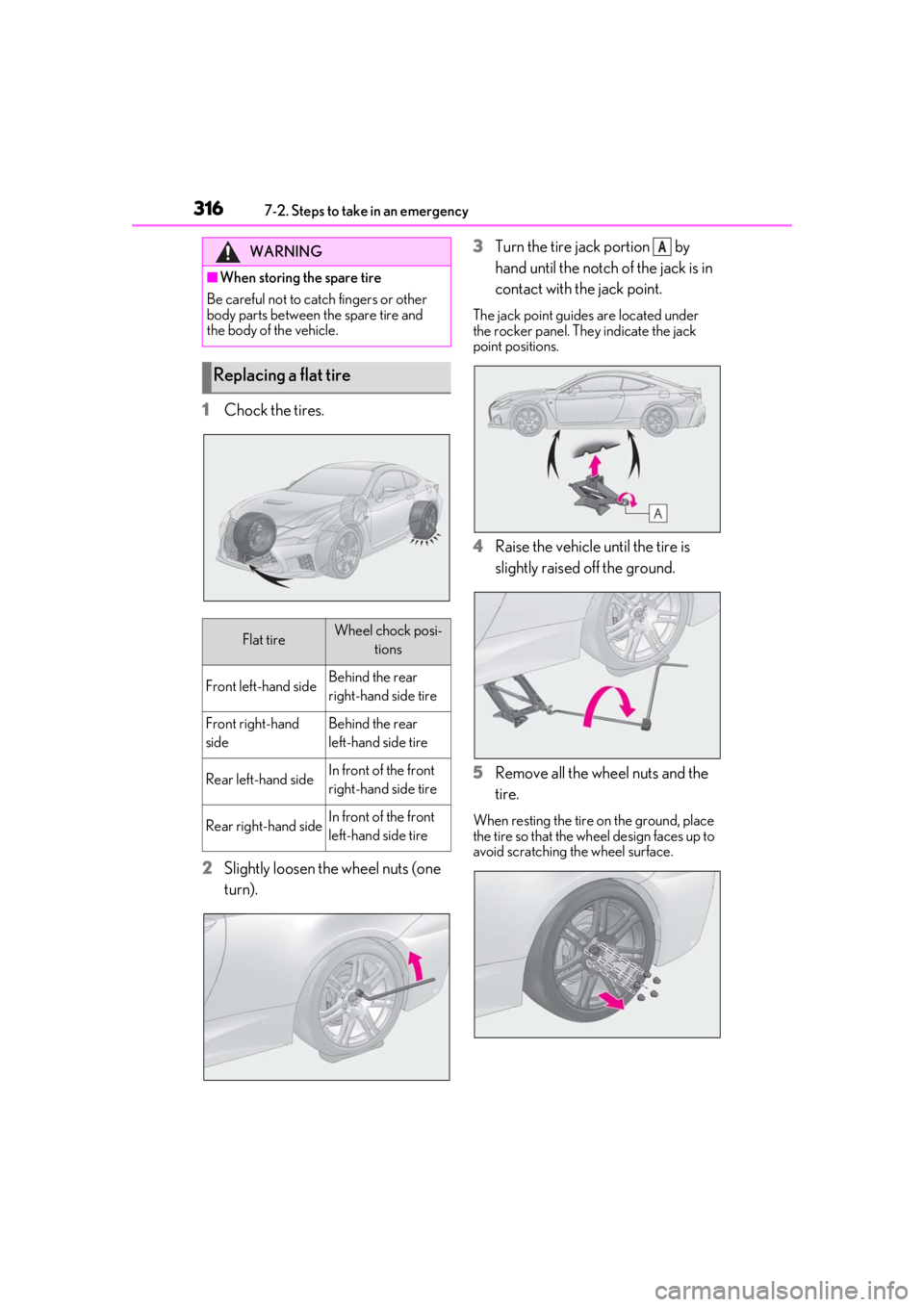
1Chock the tires.
2 Slightly loosen the wheel nuts (one
turn). 3
Turn the tire jack portion by
hand until the notch of the jack is in
contact with the jack point.
The jack point guides are located under
the rocker panel. They indicate the jack
point positions.
4 Raise the vehicle until the tire is
slightly raised off the ground.
5 Remove all the wheel nuts and the
tire.
When resting the tire on the ground, place
the tire so that the wheel design faces up to
avoid scratching the wheel surface.
WARNING
■When storing the spare tire
Be careful not to catch fingers or other
body parts between the spare tire and
the body of the vehicle.
Replacing a flat tire
Flat tireWheel chock posi- tions
Front left-hand sideBehind the rear
right-hand side tire
Front right-hand
sideBehind the rear
left-hand side tire
Rear left-hand sideIn front of the front
right-hand side tire
Rear right-hand sideIn front of the front
left-hand side tire
A
Page 318 of 408
3187-2. Steps to take in an emergency
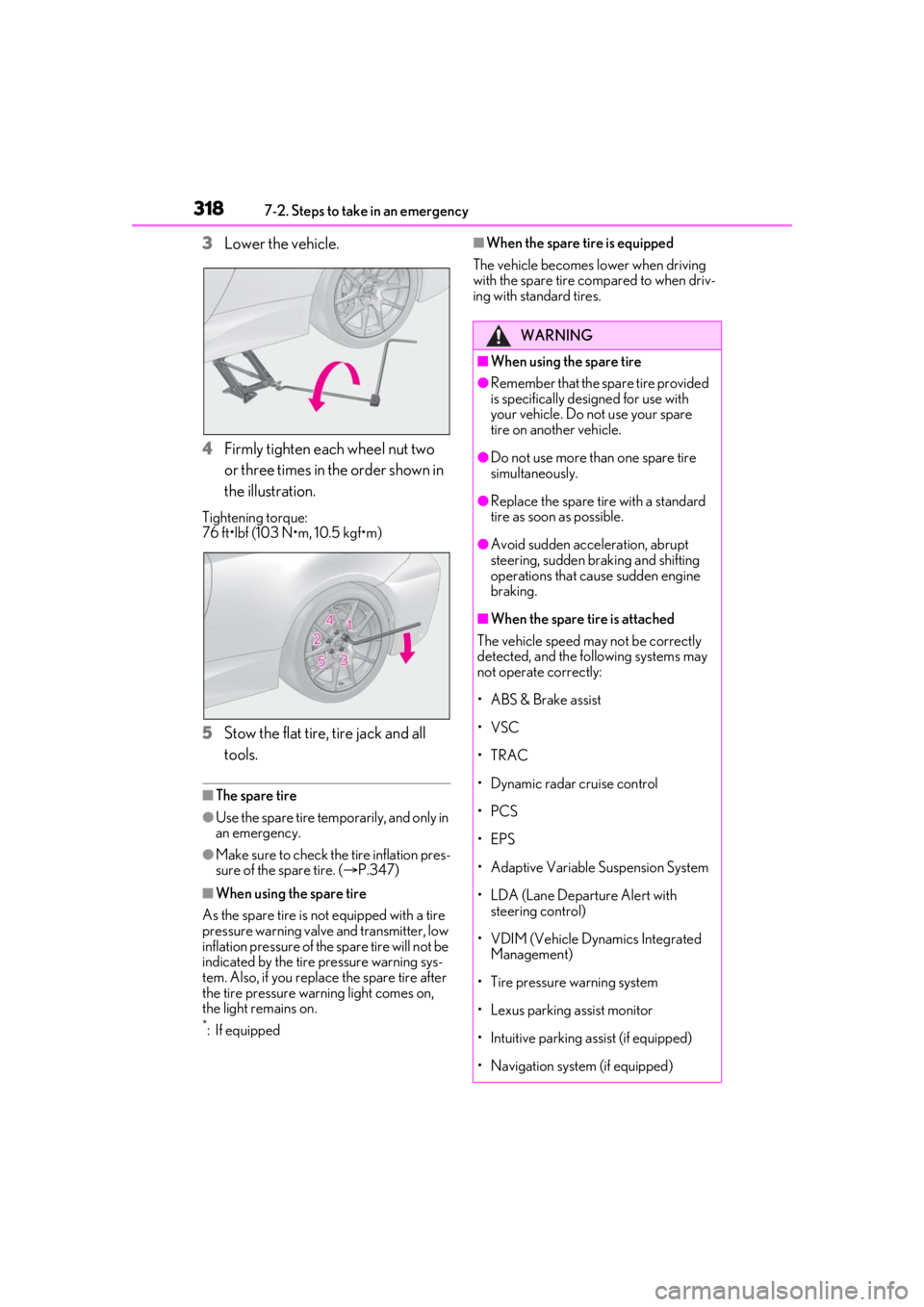
3Lower the vehicle.
4 Firmly tighten each wheel nut two
or three times in the order shown in
the illustration.
Tightening torque:
76 ft•lbf (103 N•m, 10.5 kgf•m)
5Stow the flat tire, tire jack and all
tools.
■The spare tire
●Use the spare tire temporarily, and only in
an emergency.
●Make sure to check the tire inflation pres-
sure of the spare tire. ( P.347)
■When using the spare tire
As the spare tire is not equipped with a tire
pressure warning valve and transmitter, low
inflation pressure of the spare tire will not be
indicated by the tire pressure warning sys-
tem. Also, if you replace the spare tire after
the tire pressure warning light comes on,
the light remains on.
*:If equipped
■When the spare tire is equipped
The vehicle becomes lower when driving
with the spare tire compared to when driv-
ing with standard tires.
WARNING
■When using the spare tire
●Remember that the sp are tire provided
is specifically designed for use with
your vehicle. Do not use your spare
tire on another vehicle.
●Do not use more than one spare tire
simultaneously.
●Replace the spare tire with a standard
tire as soon as possible.
●Avoid sudden acceleration, abrupt
steering, sudden br aking and shifting
operations that cause sudden engine
braking.
■When the spare tire is attached
The vehicle speed may not be correctly
detected, and the following systems may
not operate correctly:
• ABS & Brake assist
•VSC
•TRAC
• Dynamic radar cruise control
•PCS
•EPS
• Adaptive Variable Suspension System
• LDA (Lane Departure Alert with steering control)
• VDIM (Vehicle Dynamics Integrated Management)
• Tire pressure warning system
• Lexus parking assist monitor
• Intuitive parking assist (if equipped)
• Navigation system (if equipped)
Page 319 of 408
3197-2. Steps to take in an emergency
7
When trouble arises
Stop the vehicle in a safe place on a
hard, flat surface.
Set the parking brake.
Shift the shift lever to P.
Stop the engine.
Turn on the emergency flashers.
( P.294)
Check the degree of the tire dam-
age.
A tire should only be repaired with the
emergency tire puncture repair kit if
the damage is caused by a nail or
WARNING
■Speed limit when using the spare tire
Do not drive at speeds in excess of 50
mph (80 km/h) when a spare tire is
installed on the vehicle.
The spare tire is not designed for driving
at high speeds. Failu re to observe this
precaution may lead to an accident caus-
ing death or serious injury.
■After using the tools and jack
Before driving, make sure all the tools
and jack are securely in place in their
storage location to reduce the possibility
of personal injury during a collision or
sudden braking.
NOTICE
■Driving with tire chains and the spare
tire
Do not fit tire chains to the spare tire.
Tire chains may damage the vehicle body
and adversely affect driving perfor-
mance.
■When replacing the tires
When removing or fitting the wheels,
tires or the tire pressure warning valve
and transmitter, contact your Lexus
dealer as the tire pr essure warning valve
and transmitter may be damaged if not
handled correctly.
■Precaution for CCB (Carbon
Ceramic Brake) discs (if equipped)
P.317
If you have a flat tire (vehi-
cles with an emergency tire
puncture repair kit)
Your vehicle is not equipped with a
spare tire, but instead is equipped
with an emergency tire puncture
repair kit.
A puncture caused by a nail or
screw passing through the tire
tread can be repaired temporarily
with the emergency tire puncture
repair kit.
WARNING
■If you have a flat tire
Do not continue driving with a flat tire.
Driving even a short distance with a flat
tire can damage the tire and the wheel
beyond repair. Driving with a flat tire may
cause a circumferential groove on the
side wall. In such a case, the tire may
explode when using the emergency tire
puncture repair kit, re sulting in death or
serious injury.
Before repairing the vehicle
Page 322 of 408
3227-2. Steps to take in an emergency
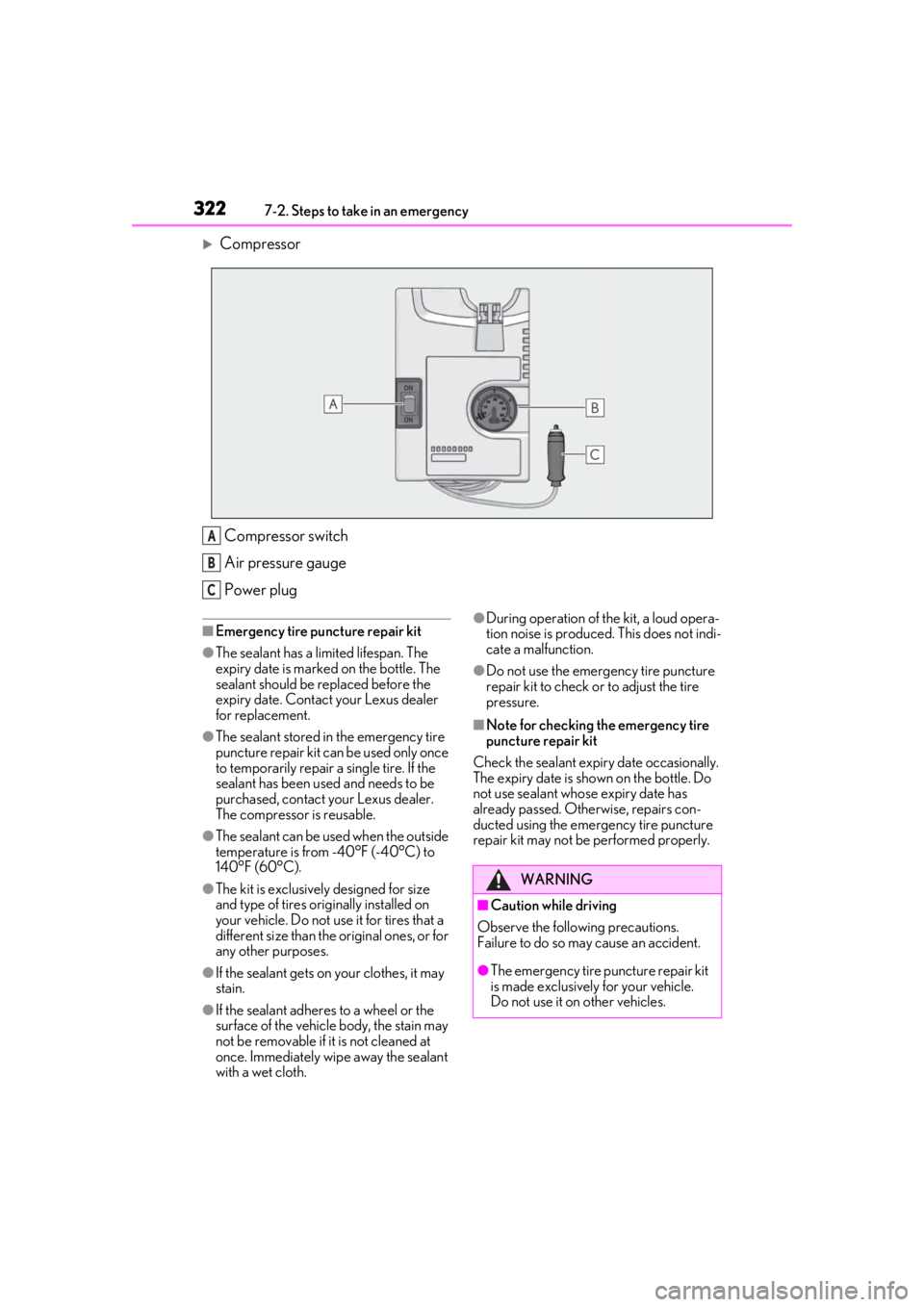
CompressorCompressor switch
Air pressure gauge
Power plug
■Emergency tire puncture repair kit
●The sealant has a lim ited lifespan. The
expiry date is marked on the bottle. The
sealant should be replaced before the
expiry date. Contact your Lexus dealer
for replacement.
●The sealant stored in the emergency tire
puncture repair kit ca n be used only once
to temporarily repair a single tire. If the
sealant has been used and needs to be
purchased, contact your Lexus dealer.
The compressor is reusable.
●The sealant can be used when the outside
temperature is from -40°F (-40°C) to
140°F (60°C).
●The kit is exclusively designed for size
and type of tires originally installed on
your vehicle. Do not use it for tires that a
different size than the original ones, or for
any other purposes.
●If the sealant gets on your clothes, it may
stain.
●If the sealant adheres to a wheel or the
surface of the vehicle body, the stain may
not be removable if it is not cleaned at
once. Immediately wipe away the sealant
with a wet cloth.
●During operation of the kit, a loud opera-
tion noise is produced. This does not indi-
cate a malfunction.
●Do not use the emergency tire puncture
repair kit to check or to adjust the tire
pressure.
■Note for checking the emergency tire
puncture repair kit
Check the sealant expiry date occasionally.
The expiry date is shown on the bottle. Do
not use sealant whose expiry date has
already passed. Otherwise, repairs con-
ducted using the emergency tire puncture
repair kit may not be performed properly.
A
B
C
WARNING
■Caution while driving
Observe the following precautions.
Failure to do so may cause an accident.
●The emergency tire puncture repair kit
is made exclusively for your vehicle.
Do not use it on other vehicles.
Page 323 of 408
3237-2. Steps to take in an emergency
7
When trouble arises
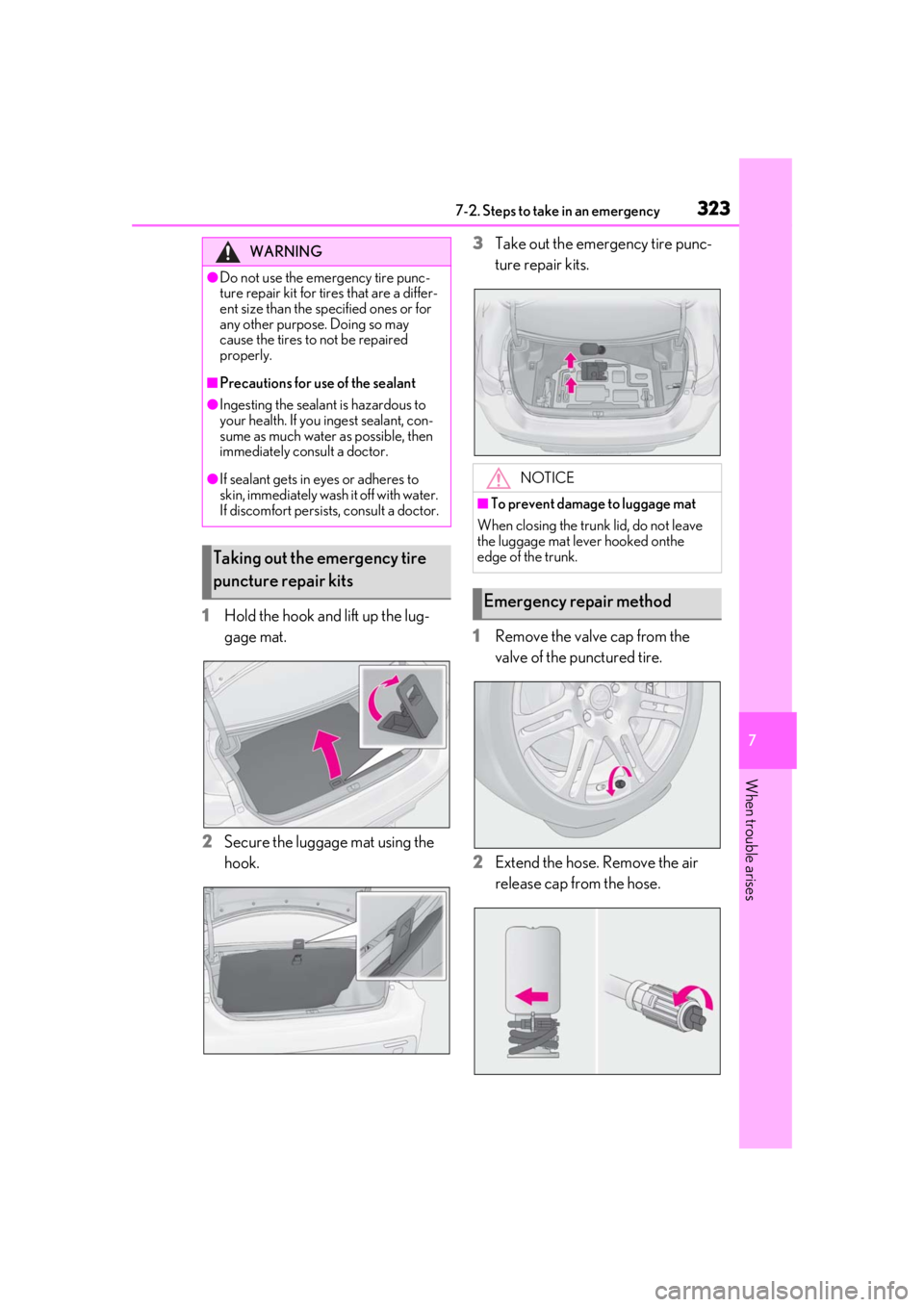
1Hold the hook and lift up the lug-
gage mat.
2 Secure the luggage mat using the
hook. 3
Take out the emergency tire punc-
ture repair kits.
1 Remove the valve cap from the
valve of the punctured tire.
2 Extend the hose. Remove the air
release cap from the hose.
WARNING
●Do not use the emergency tire punc-
ture repair kit for ti res that are a differ-
ent size than the specified ones or for
any other purpose. Doing so may
cause the tires to not be repaired
properly.
■Precautions for use of the sealant
●Ingesting the sealant is hazardous to
your health. If you ingest sealant, con-
sume as much water as possible, then
immediately consult a doctor.
●If sealant gets in eyes or adheres to
skin, immediately wash it off with water.
If discomfort persists, consult a doctor.
Taking out the emergency tire
puncture repair kits
NOTICE
■To prevent damage to luggage mat
When closing the trunk lid, do not leave
the luggage mat lever hooked onthe
edge of the trunk.
Emergency repair method
Page 339 of 408
3397-2. Steps to take in an emergency
7
When trouble arises
1Stop the engine. Set the parking
brake and shift the shift lever to P.
2 Remove the mud, snow or sand
from around the rear wheels.
3 Place wood, stones or some other
material under the rear wheels to
help provide traction.
4 Restart the engine.
5 Shift the shift lever to D or R and
release the parking brake. Then,
while exercising caution, depress
the accelerator pedal.
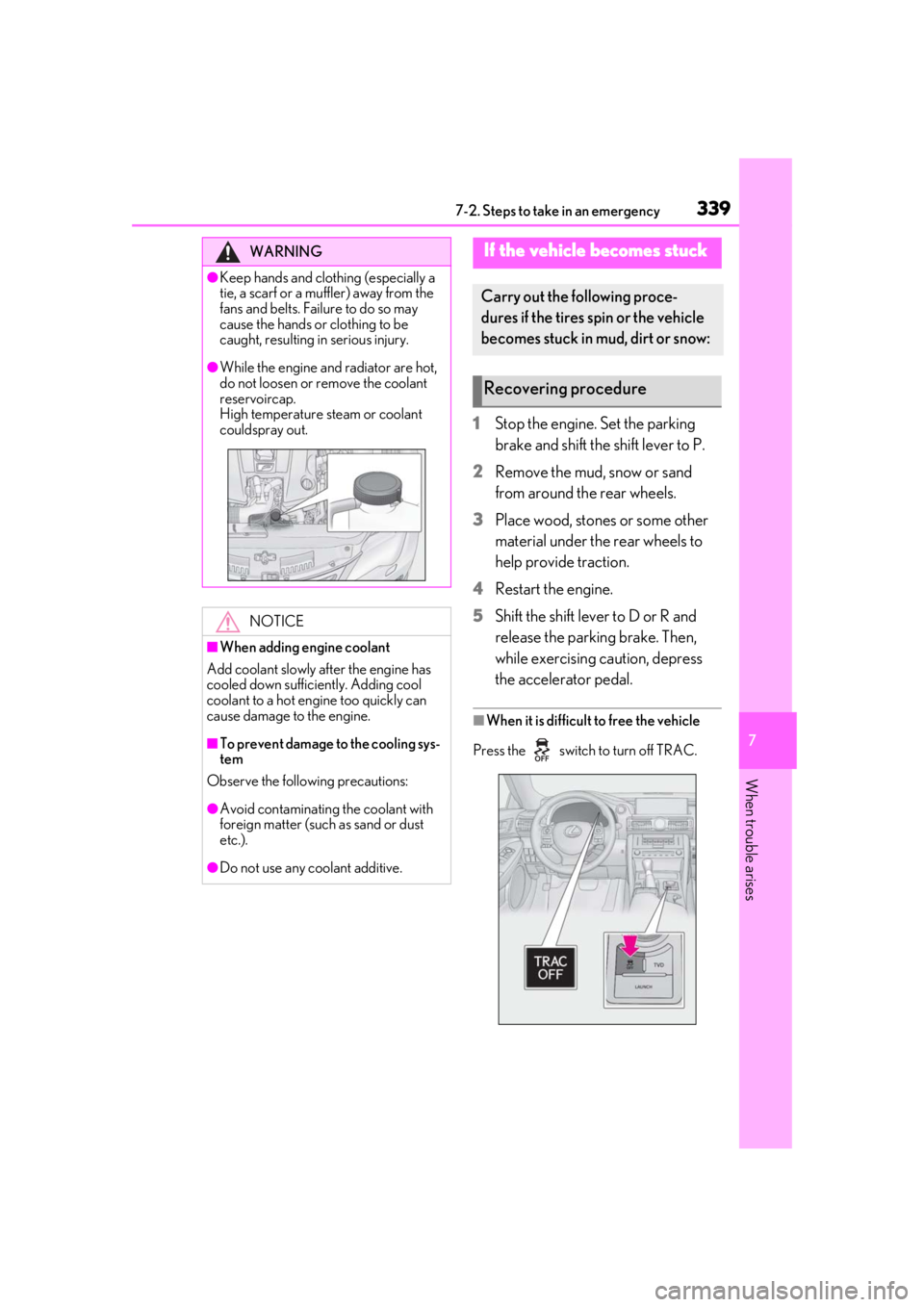
■When it is difficult to free the vehicle
Press the switch to turn off TRAC.
WARNING
●Keep hands and clothing (especially a
tie, a scarf or a muffler) away from the
fans and belts. Failure to do so may
cause the hands or clothing to be
caught, resulting in serious injury.
●While the engine and radiator are hot,
do not loosen or remove the coolant
reservoircap.
High temperature steam or coolant
couldspray out.
NOTICE
■When adding engine coolant
Add coolant slowly after the engine has
cooled down sufficiently. Adding cool
coolant to a hot engine too quickly can
cause damage to the engine.
■To prevent damage to the cooling sys-
tem
Observe the following precautions:
●Avoid contaminating the coolant with
foreign matter (such as sand or dust
etc.).
●Do not use any coolant additive.
If the vehicle becomes stuck
Carry out the following proce-
dures if the tires spin or the vehicle
becomes stuck in mud, dirt or snow:
Recovering procedure
Page 347 of 408
3478-1. Specifications
8
Vehicle specifications
*1: Minimum pedal clearance when depressed with a force of 112.4 lbf (500 N, 51.0 kgf)
while the engine is running.
*2: Parking brake pedal travel when depressed wi th a force of 67.4 lbf (300 N, 30.6 kgf)
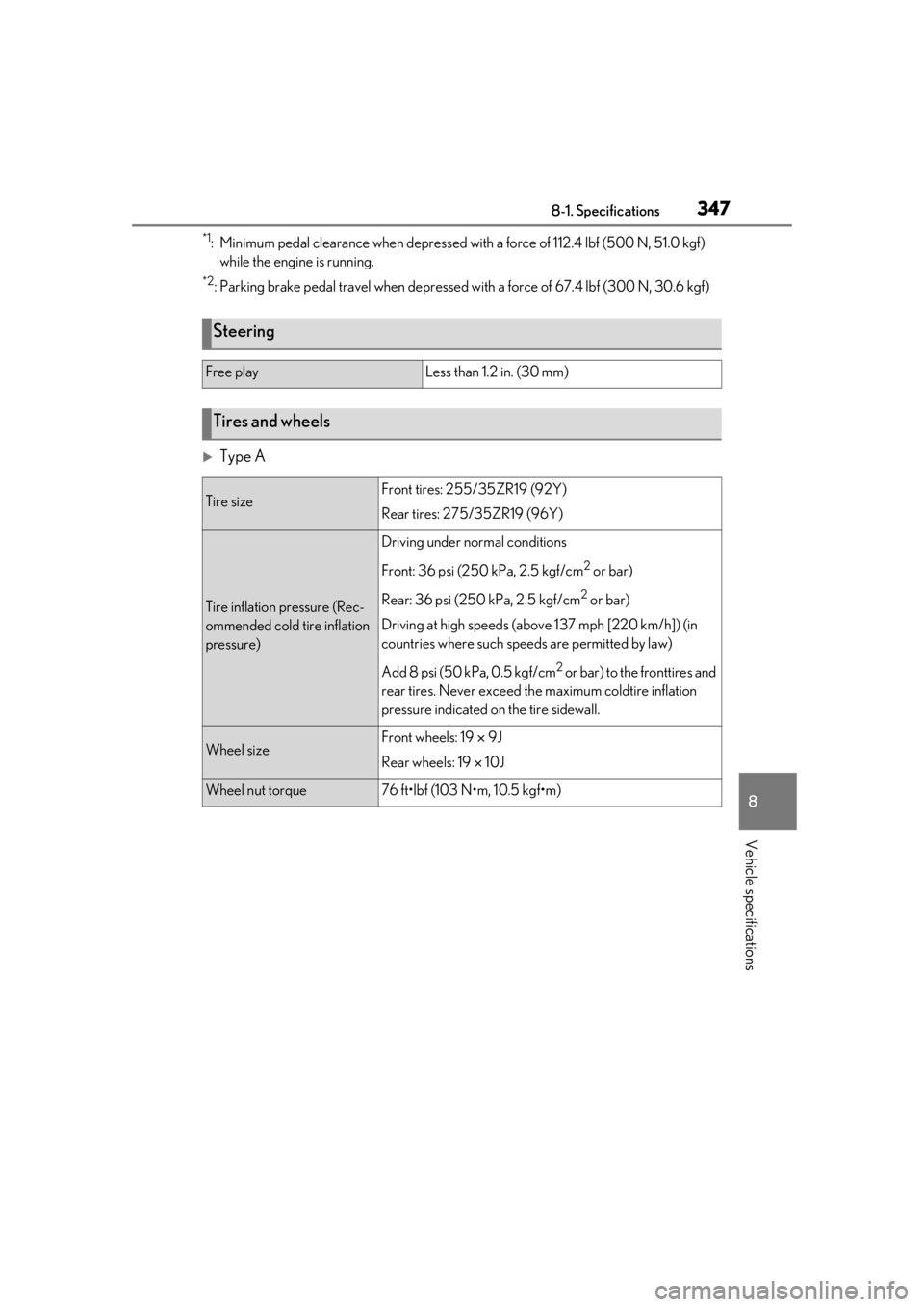
Type A
Steering
Free playLess than 1.2 in. (30 mm)
Tires and wheels
Tire sizeFront tires: 255/35ZR19 (92Y)
Rear tires: 275/35ZR19 (96Y)
Tire inflation pressure (Rec-
ommended cold tire inflation
pressure)
Driving under normal conditions
Front: 36 psi (250 kPa, 2.5 kgf/cm
2 or bar)
Rear: 36 psi (250 kPa, 2.5 kgf/cm
2 or bar)
Driving at high speeds (above 137 mph [220 km/h]) (in
countries where such speeds are permitted by law)
Add 8 psi (50 kPa, 0.5 kgf/cm
2 or bar) to the fronttires and
rear tires. Never exceed th e maximum coldtire inflation
pressure indicated on the tire sidewall.
Wheel sizeFront wheels: 19 9J
Rear wheels: 19 10J
Wheel nut torque76 ft•lbf (103 N•m, 10.5 kgf•m)
Page 348 of 408
3488-1. Specifications
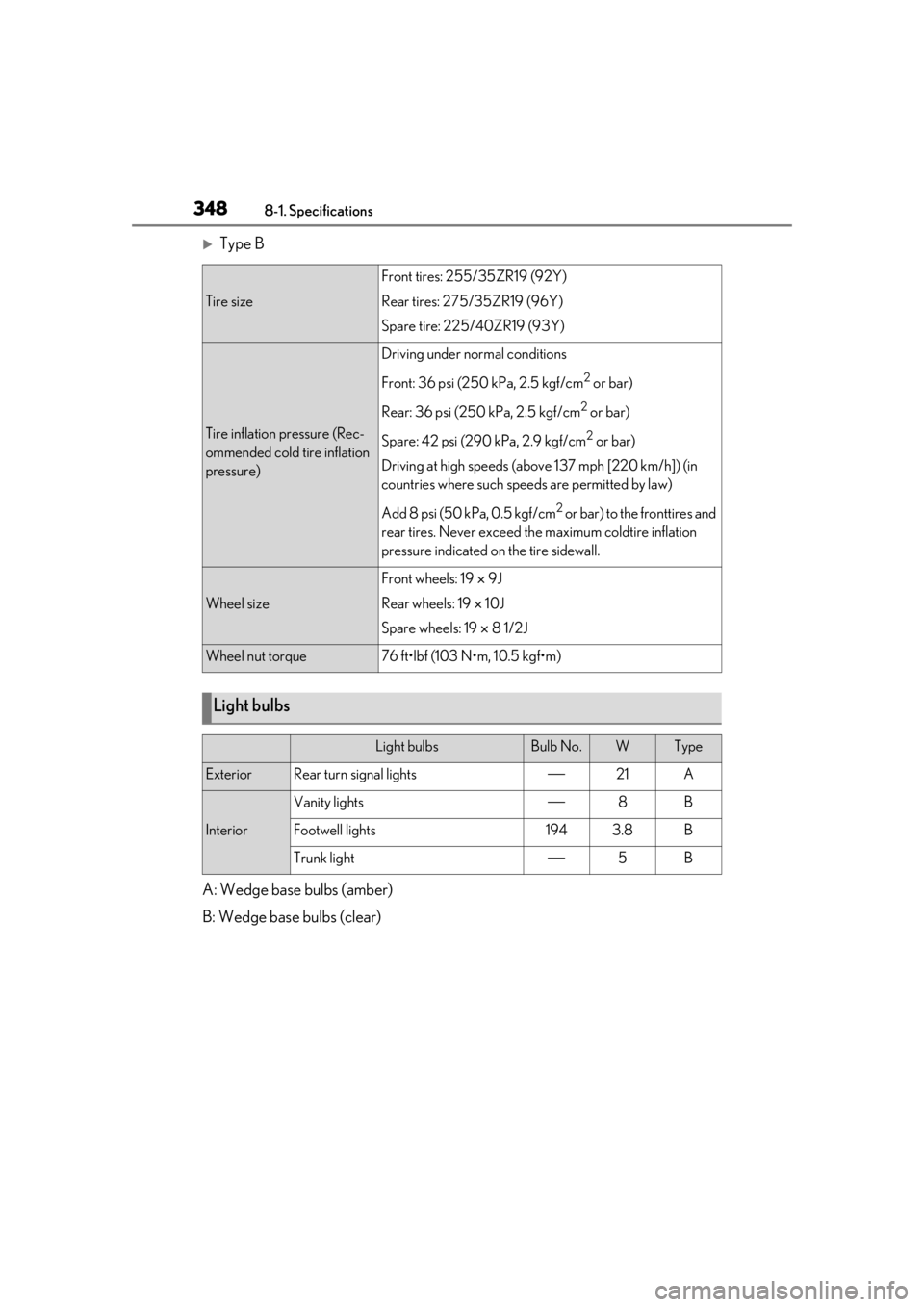
Type B
A: Wedge base bulbs (amber)
B: Wedge base bulbs (clear)
Tire size
Front tires: 255/35ZR19 (92Y)
Rear tires: 275/35ZR19 (96Y)
Spare tire: 225/40ZR19 (93Y)
Tire inflation pressure (Rec-
ommended cold tire inflation
pressure)
Driving under normal conditions
Front: 36 psi (250 kPa, 2.5 kgf/cm
2 or bar)
Rear: 36 psi (250 kPa, 2.5 kgf/cm
2 or bar)
Spare: 42 psi (290 kPa, 2.9 kgf/cm
2 or bar)
Driving at high speeds (above 137 mph [220 km/h]) (in
countries where such speeds are permitted by law)
Add 8 psi (50 kPa, 0.5 kgf/cm
2 or bar) to the fronttires and
rear tires. Never exceed th e maximum coldtire inflation
pressure indicated on the tire sidewall.
Wheel size
Front wheels: 19 9J
Rear wheels: 19 10J
Spare wheels: 19 8 1/2J
Wheel nut torque76 ft•lbf (103 N•m, 10.5 kgf•m)
Light bulbs
Light bulbsBulb No.WType
ExteriorRear turn signal lights21A
Interior
Vanity lights8B
Footwell lights1943.8B
Trunk light5B