wheel LEXUS RCF 2021 Manual Online
[x] Cancel search | Manufacturer: LEXUS, Model Year: 2021, Model line: RCF, Model: LEXUS RCF 2021Pages: 408, PDF Size: 8.25 MB
Page 320 of 408
3207-2. Steps to take in an emergency
screw passing through the tire tread.
• Do not remove the nail or screw from the tire. Removing the object
may widen the opening and disen-
able emergency repair with the kit.
• To avoid sealant leakage, move the vehicle until the area of the punc-
ture, if known, is positioned at the
top of the tire.■A flat tire that cann ot be repaired with
the emergency tire puncture repair kit
In the following cases, the tire cannot be
repaired with the emergency tire puncture
repair kit. Contact your Lexus dealer.
●When the tire is damaged due to driving
without sufficient air pressure
●When the tire lost air pressure due to a
crack or damage in the tire sidewall
●When the tire is visibly separated from
the wheel
●When the cut or damage to the tread is
0.16 in. (4 mm) long or more
●When the wheel is damaged
●When 2 or more shar p objects, such as
nails or screws, have passed through the
tread on a single tire
●When there is more than one hole or cut
in the damaged tire
●When the sealant has expired
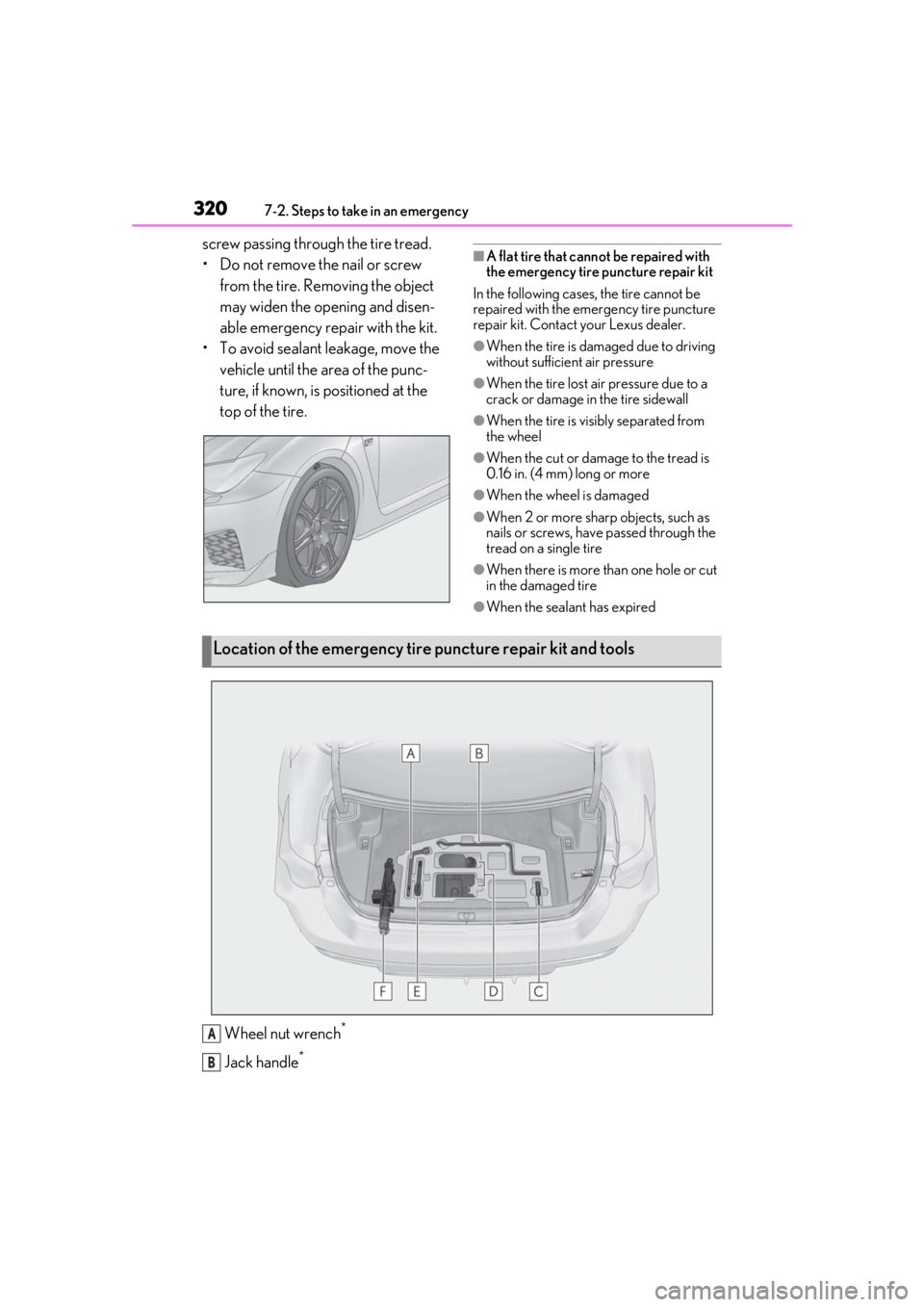
Wheel nut wrench*
Jack handle*
Location of the emergency tire puncture repair kit and tools
A
B
Page 322 of 408
3227-2. Steps to take in an emergency
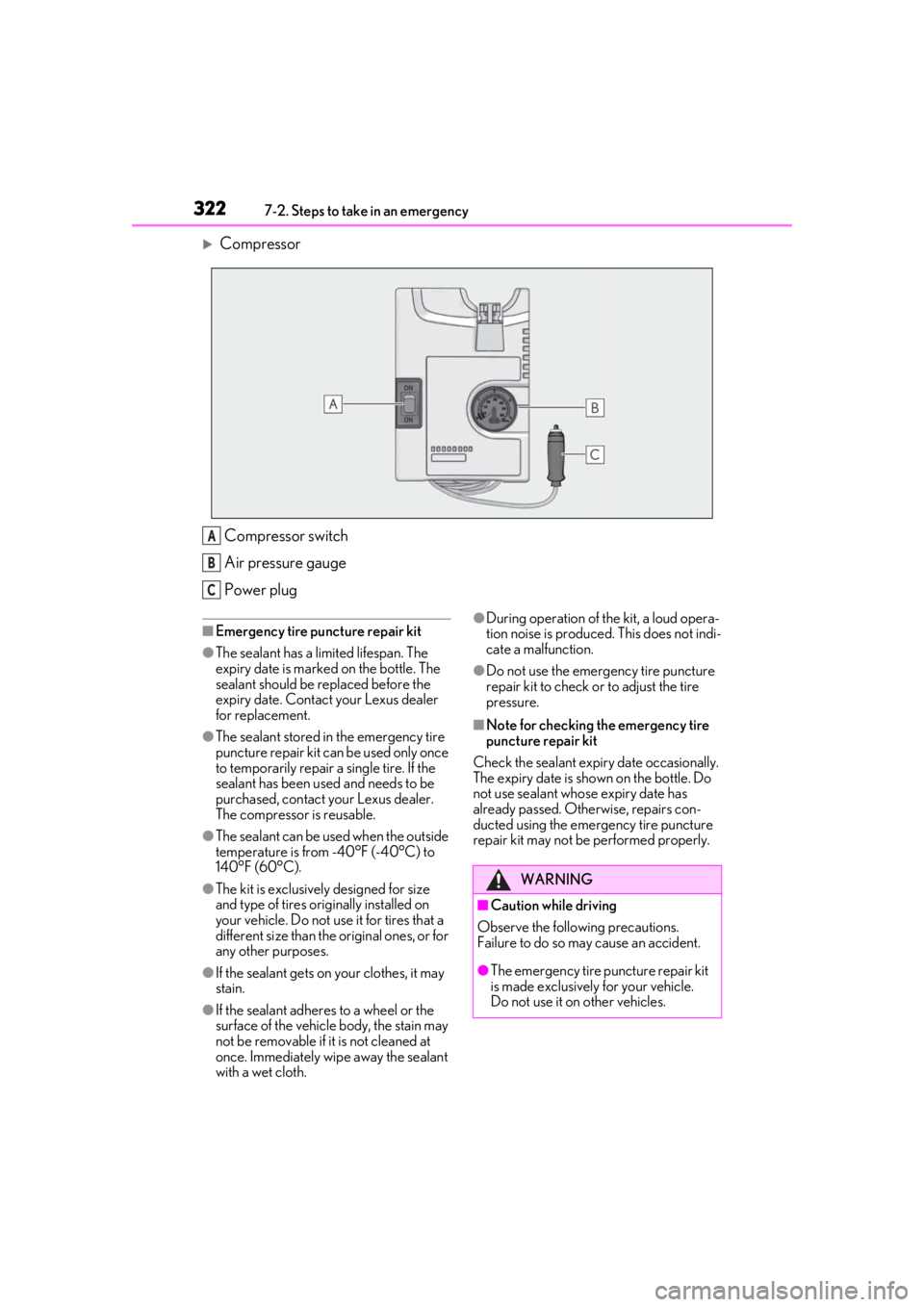
CompressorCompressor switch
Air pressure gauge
Power plug
■Emergency tire puncture repair kit
●The sealant has a lim ited lifespan. The
expiry date is marked on the bottle. The
sealant should be replaced before the
expiry date. Contact your Lexus dealer
for replacement.
●The sealant stored in the emergency tire
puncture repair kit ca n be used only once
to temporarily repair a single tire. If the
sealant has been used and needs to be
purchased, contact your Lexus dealer.
The compressor is reusable.
●The sealant can be used when the outside
temperature is from -40°F (-40°C) to
140°F (60°C).
●The kit is exclusively designed for size
and type of tires originally installed on
your vehicle. Do not use it for tires that a
different size than the original ones, or for
any other purposes.
●If the sealant gets on your clothes, it may
stain.
●If the sealant adheres to a wheel or the
surface of the vehicle body, the stain may
not be removable if it is not cleaned at
once. Immediately wipe away the sealant
with a wet cloth.
●During operation of the kit, a loud opera-
tion noise is produced. This does not indi-
cate a malfunction.
●Do not use the emergency tire puncture
repair kit to check or to adjust the tire
pressure.
■Note for checking the emergency tire
puncture repair kit
Check the sealant expiry date occasionally.
The expiry date is shown on the bottle. Do
not use sealant whose expiry date has
already passed. Otherwise, repairs con-
ducted using the emergency tire puncture
repair kit may not be performed properly.
A
B
C
WARNING
■Caution while driving
Observe the following precautions.
Failure to do so may cause an accident.
●The emergency tire puncture repair kit
is made exclusively for your vehicle.
Do not use it on other vehicles.
Page 324 of 408
3247-2. Steps to take in an emergency
You will use the air release cap again.
Therefore keep it in a safe place.
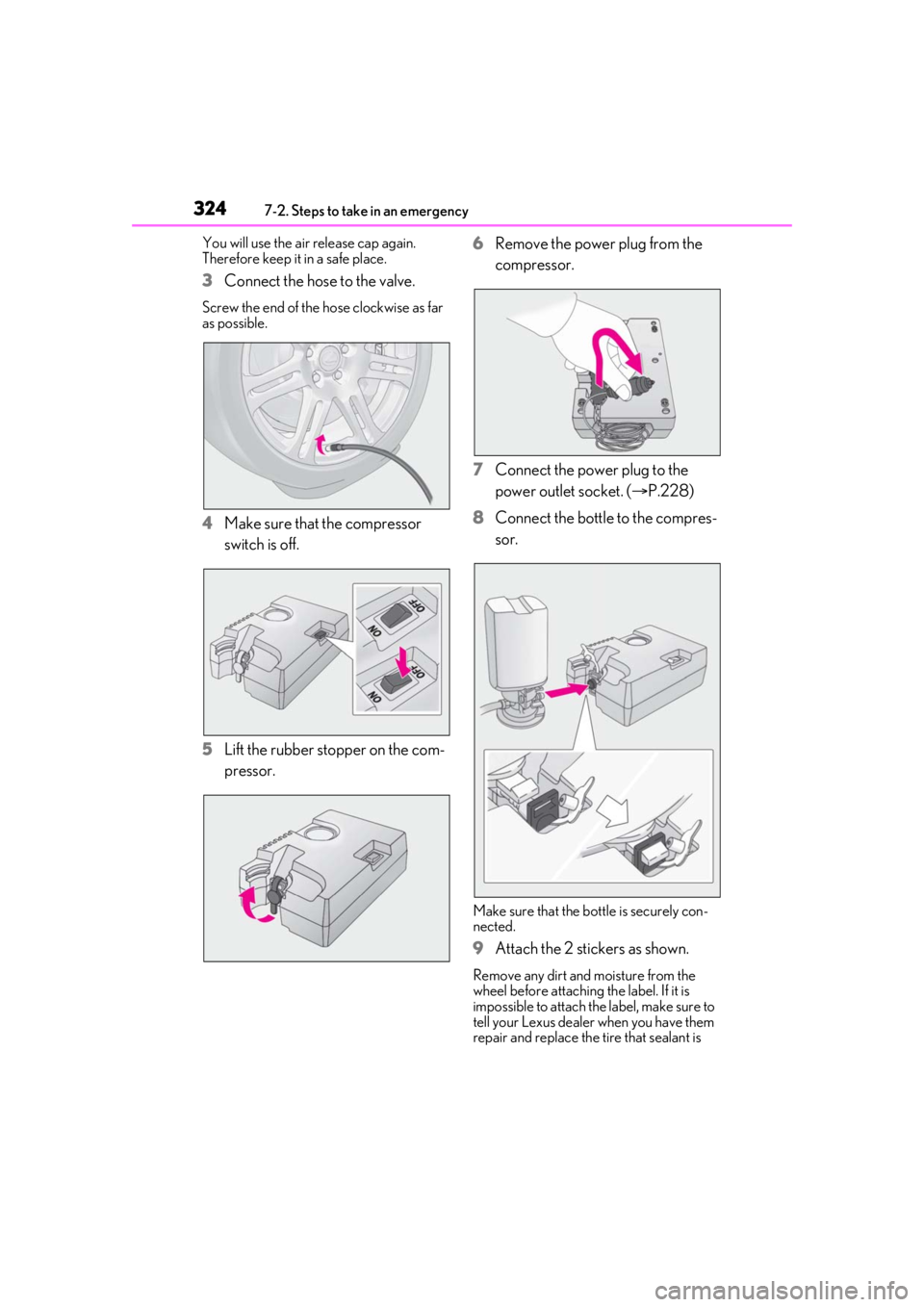
3Connect the hose to the valve.
Screw the end of the hose clockwise as far
as possible.
4Make sure that the compressor
switch is off.
5 Lift the rubber stopper on the com-
pressor. 6
Remove the power plug from the
compressor.
7 Connect the power plug to the
power outlet socket. ( P.228)
8 Connect the bottle to the compres-
sor.
Make sure that the bo ttle is securely con-
nected.
9 Attach the 2 stickers as shown.
Remove any dirt and moisture from the
wheel before attaching the label. If it is
impossible to attach the label, make sure to
tell your Lexus dealer when you have them
repair and replace the tire that sealant is
Page 327 of 408
3277-2. Steps to take in an emergency
7
When trouble arises
step 22.
21 Turn the compressor switch on to
inflate the tire until the recom-
mended tire inflation pressure is
reached. Drive for about 3 miles (5
km) and then perform step 19 .
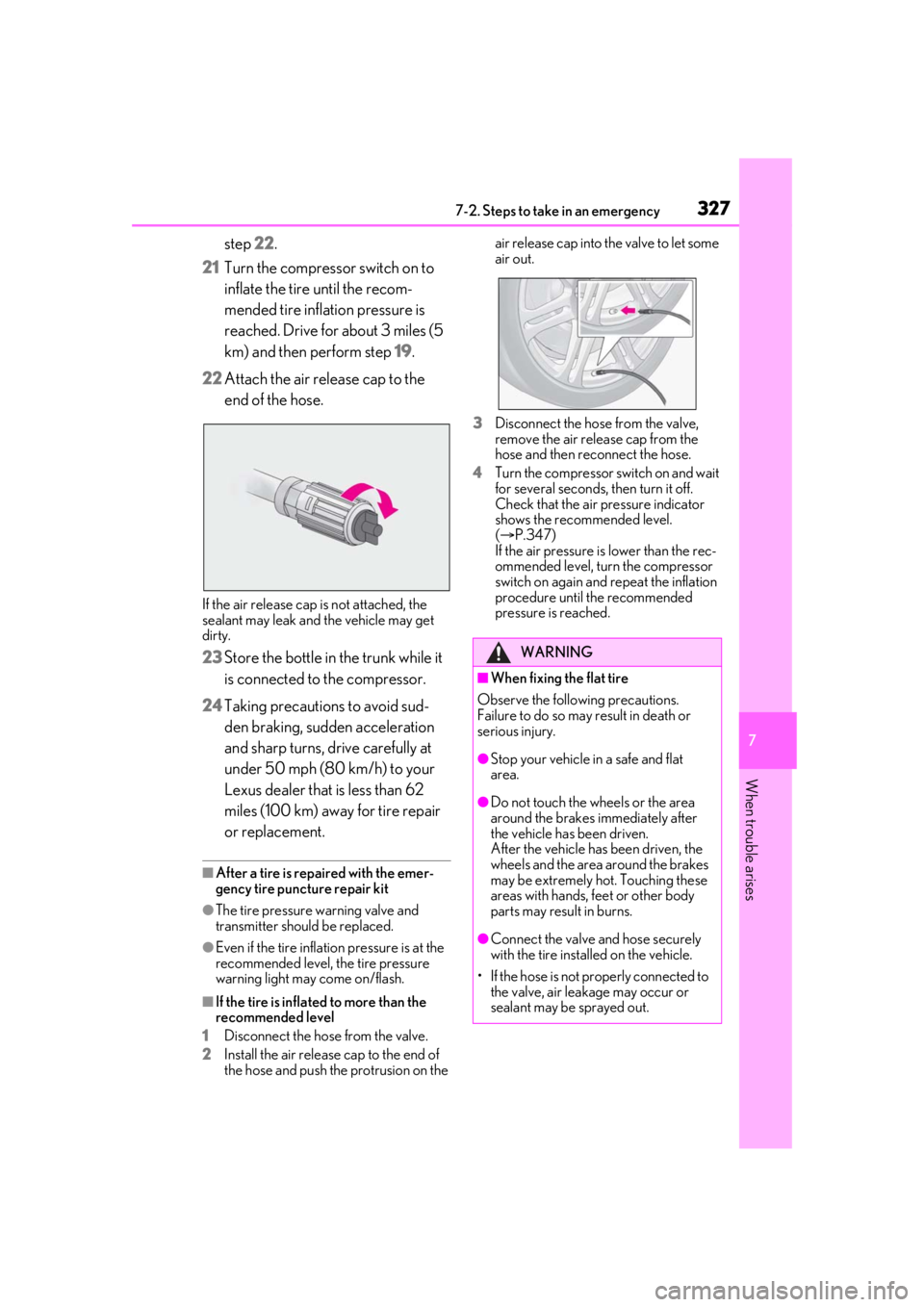
22 Attach the air release cap to the
end of the hose.
If the air release cap is not attached, the
sealant may leak and the vehicle may get
dirty.
23Store the bottle in the trunk while it
is connected to the compressor.
24 Taking precautions to avoid sud-
den braking, sudd en acceleration
and sharp turns, drive carefully at
under 50 mph (80 km/h) to your
Lexus dealer that is less than 62
miles (100 km) away for tire repair
or replacement.
■After a tire is repaired with the emer-
gency tire puncture repair kit
●The tire pressure warning valve and
transmitter should be replaced.
●Even if the tire inflat ion pressure is at the
recommended level, the tire pressure
warning light may come on/flash.
■If the tire is inflated to more than the
recommended level
1 Disconnect the hose from the valve.
2 Install the air release cap to the end of
the hose and push th e protrusion on the air release cap into the valve to let some
air out.
3 Disconnect the hose from the valve,
remove the air release cap from the
hose and then reconnect the hose.
4 Turn the compressor switch on and wait
for several seconds, then turn it off.
Check that the air pressure indicator
shows the recommended level.
( P.347)
If the air pressure is lower than the rec-
ommended level, turn the compressor
switch on again and repeat the inflation
procedure until the recommended
pressure is reached.
WARNING
■When fixing the flat tire
Observe the following precautions.
Failure to do so may result in death or
serious injury.
●Stop your vehicle in a safe and flat
area.
●Do not touch the wheels or the area
around the brakes immediately after
the vehicle has been driven.
After the vehicle has been driven, the
wheels and the area around the brakes
may be extremely hot. Touching these
areas with hands, feet or other body
parts may result in burns.
●Connect the valve and hose securely
with the tire installed on the vehicle.
• If the hose is not properly connected to the valve, air leakage may occur or
sealant may be sprayed out.
Page 328 of 408
3287-2. Steps to take in an emergency
WARNING
• If the hose comes off the valve while inflating the tire, there is a risk that the
hose will move abruptly due to air
pressure.
• After inflation of the tire has com- pleted, the sealant may splatter when
the hose is disconnected or some air is
let out of the tire.
●Follow the operation procedure to
repair the tire. If the procedure is not
followed, the sealant may spray out.
●Keep back from the tire while it is
being repaired, as th ere is a chance of
it bursting while the repair operation is
being performed. If you notice any
cracks or deformation of the tire, turn
off the compressor switch and stop the
repair operation immediately.
●The kit may overheat if operated for a
long period of time. Do not operate
the compressor continuously for more
than 35 minutes.
●Parts of the kit become hot during
operation. Be careful handling the kit
during and after operation. Do not
touch the metal part around the con-
necting area between the bottle and
compressor. It will be extremely hot.
●Do not attach the vehicle speed warn-
ing sticker to an area other than the
one indicated. If the sticker is attached
to an area where an SRS airbag is
located, such as the pad of the steering
wheel, it may prevent the SRS airbag
from operating properly.
■Driving to spread the liquid sealant
evenly
●Drive the vehicle carefully at a low
speed. Be especially careful when
turning and cornering.
●If the vehicle does not drive straight or
you feel a pull through the steering
wheel, stop the vehicle and check the
following:
• Tire condition. The tire may have sepa- rated from the wheel.
• Tire inflation pressure. If tire inflation pressure is 19 psi (130 kPa, 1.3 kgf/cm
2
or bar) or below, this may indicate
severe tire damage.
NOTICE
■When performing an emergency
repair
●Perform the emergency repair with-
out removing the nail or screw that has
punctured the tread of the tire. If the
object that has punctured the tire is
removed, repair by the emergency tire
puncture repair kit may not be possi-
ble.
●The kit is not waterproof. Make sure
that the kit is not exposed to water,
such as when it is being used in the
rain.
●Do not put the kit directly onto dusty
ground such as sand at the side of the
road. If the kit vacuums up dust etc., a
malfunction may occur.
●Make sure to stand the kit with the bot-
tle vertical. The kit cannot work prop-
erly if it is laid on its side.
■Handling the emergency tire punc-
ture repair kit
●The compressor power source should
be 12 V DC suitable for vehicle use.
Do not connect the compressor to any
other source.
●If gasoline splatters on the kit, the kit
may deteriorate. Take care not to allow
gasoline to contact it.
Page 339 of 408
3397-2. Steps to take in an emergency
7
When trouble arises
1Stop the engine. Set the parking
brake and shift the shift lever to P.
2 Remove the mud, snow or sand
from around the rear wheels.
3 Place wood, stones or some other
material under the rear wheels to
help provide traction.
4 Restart the engine.
5 Shift the shift lever to D or R and
release the parking brake. Then,
while exercising caution, depress
the accelerator pedal.
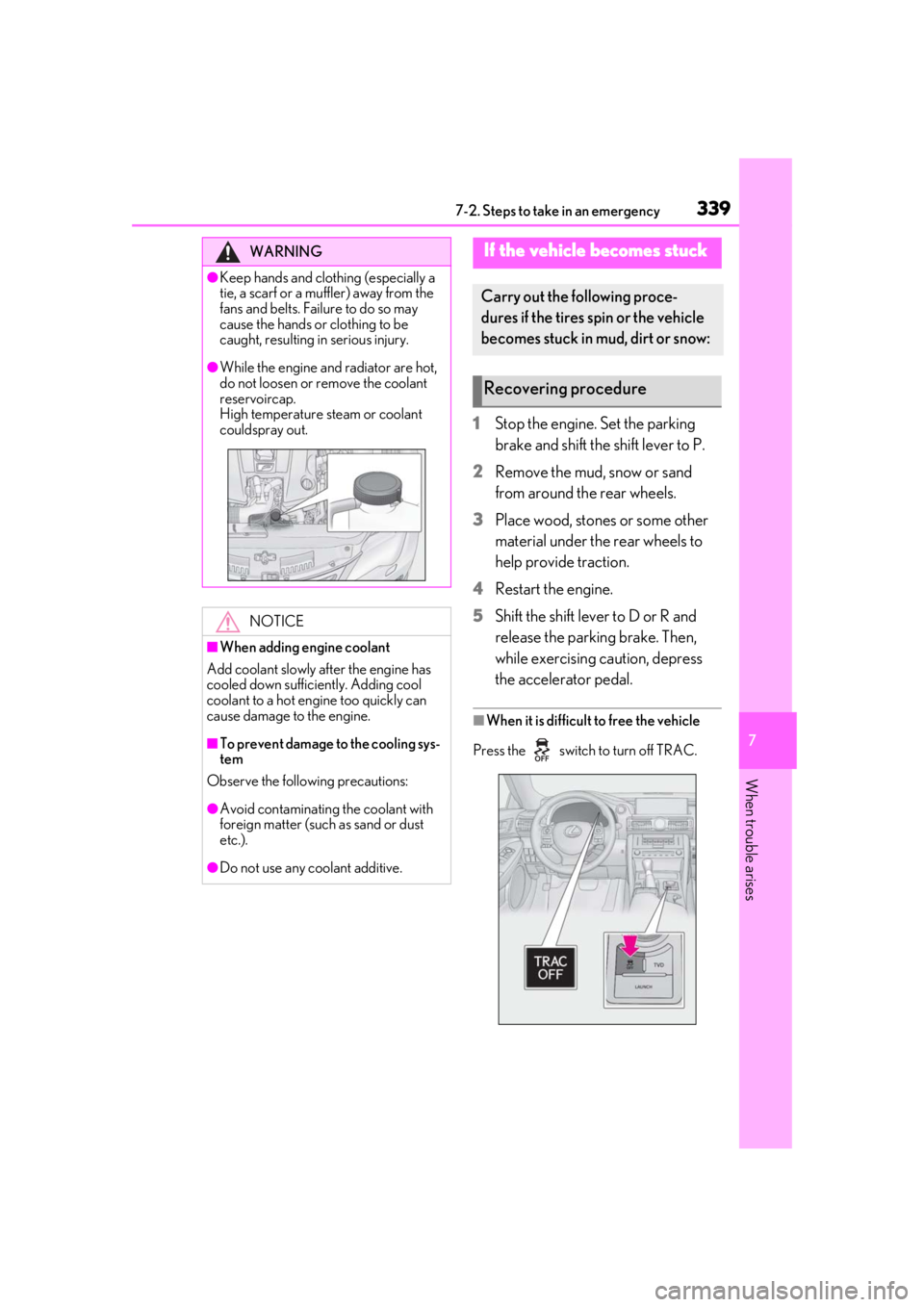
■When it is difficult to free the vehicle
Press the switch to turn off TRAC.
WARNING
●Keep hands and clothing (especially a
tie, a scarf or a muffler) away from the
fans and belts. Failure to do so may
cause the hands or clothing to be
caught, resulting in serious injury.
●While the engine and radiator are hot,
do not loosen or remove the coolant
reservoircap.
High temperature steam or coolant
couldspray out.
NOTICE
■When adding engine coolant
Add coolant slowly after the engine has
cooled down sufficiently. Adding cool
coolant to a hot engine too quickly can
cause damage to the engine.
■To prevent damage to the cooling sys-
tem
Observe the following precautions:
●Avoid contaminating the coolant with
foreign matter (such as sand or dust
etc.).
●Do not use any coolant additive.
If the vehicle becomes stuck
Carry out the following proce-
dures if the tires spin or the vehicle
becomes stuck in mud, dirt or snow:
Recovering procedure
Page 340 of 408
3407-2. Steps to take in an emergency
WARNING
■When attempting to free a stuck vehi-
cle
If you choose to push the vehicle back
and forth to free it, make sure the sur-
rounding area is clear to avoid striking
other vehicles, objects or people. The
vehicle may also lunge forward or lunge
back suddenly as it becomes free. Use
extreme caution.
■When shifting the shift lever
Be careful not to shif t the shift lever with
the accelerator pedal depressed.
This may lead to unexpected rapid accel-
eration of the vehicle that may cause an
accident resulting in death or serious
injury.
NOTICE
■To avoid damaging the transmission
and other components
●Avoid spinning the rear wheels and
depressing the accelerator pedal
more than necessary.
●If the vehicle remains stuck even after
these procedures are performed, the
vehicle may require towing to be freed.
Page 342 of 408

3428-1. Specifications
8-1.Specifications
*:Unladen vehicle
■Vehicle identification number
The vehicle identification number
(VIN) is the legal identifier for your
vehicle. This is the primary identifica-
tion number for your Lexus. It is used in
registering the ownership of your vehi-
cle.
This number is stamped on the top left
of the instrument panel and in the
engine compartment.
This number is also on the Certification
Maintenance data (fuel, oil level, etc.)
Dimensions and weight
Overall length185.4 in. (4710 mm)
Overall width72.6 in. (1845 mm)
Overall height*54.7 in. (1390 mm)
Wheelbase107.5 in. (2730 mm)
Tread*Front61.2 in. (1555 mm)
Rear61.4 in. (1560 mm)
Vehicle capacity weight (Occupants + luggage)700 lb. (320 kg)
Seating capacity
Seating capacity4 (Front 2, Rear 2)
Vehicle identification
Page 347 of 408
3478-1. Specifications
8
Vehicle specifications
*1: Minimum pedal clearance when depressed with a force of 112.4 lbf (500 N, 51.0 kgf)
while the engine is running.
*2: Parking brake pedal travel when depressed wi th a force of 67.4 lbf (300 N, 30.6 kgf)
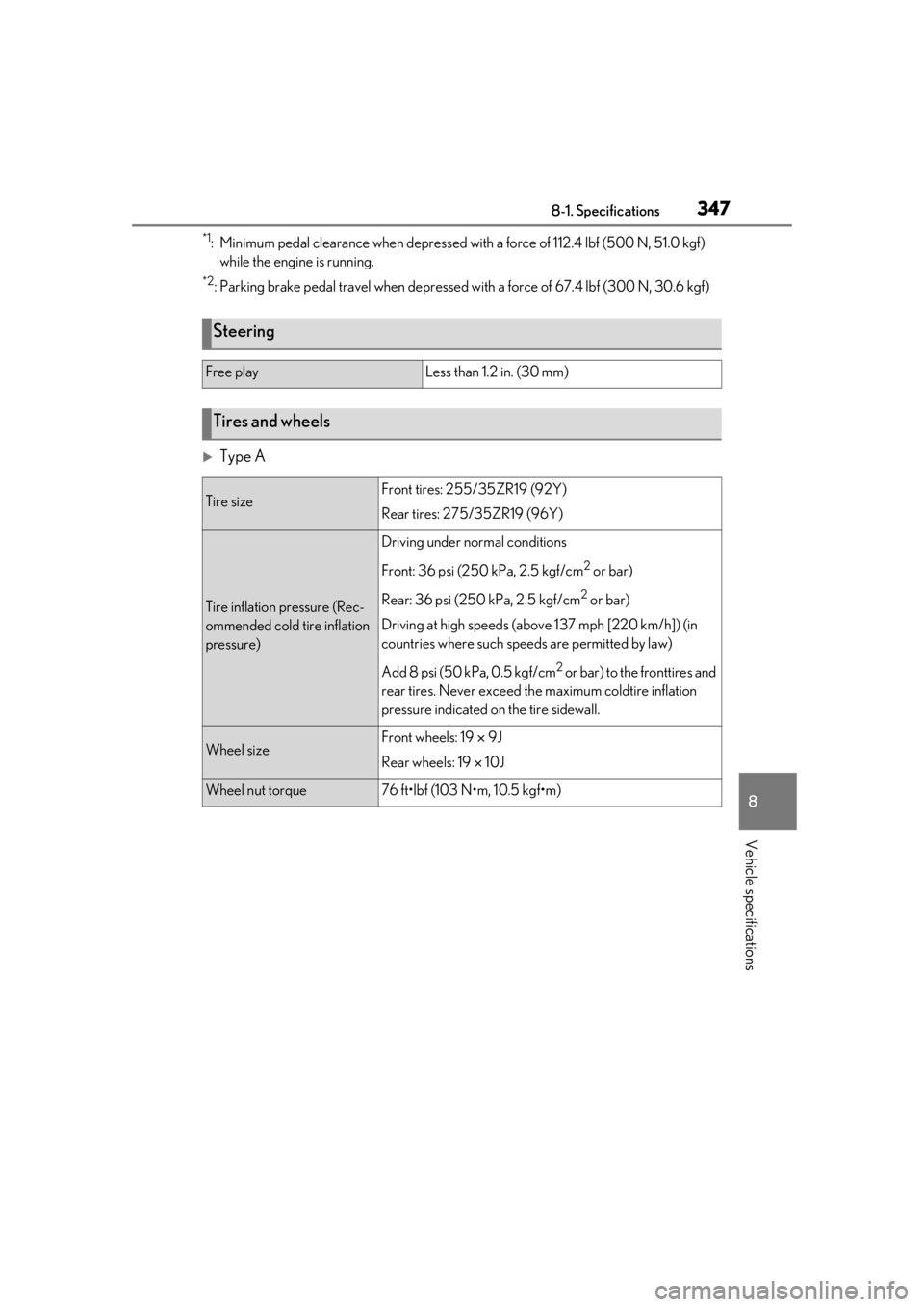
Type A
Steering
Free playLess than 1.2 in. (30 mm)
Tires and wheels
Tire sizeFront tires: 255/35ZR19 (92Y)
Rear tires: 275/35ZR19 (96Y)
Tire inflation pressure (Rec-
ommended cold tire inflation
pressure)
Driving under normal conditions
Front: 36 psi (250 kPa, 2.5 kgf/cm
2 or bar)
Rear: 36 psi (250 kPa, 2.5 kgf/cm
2 or bar)
Driving at high speeds (above 137 mph [220 km/h]) (in
countries where such speeds are permitted by law)
Add 8 psi (50 kPa, 0.5 kgf/cm
2 or bar) to the fronttires and
rear tires. Never exceed th e maximum coldtire inflation
pressure indicated on the tire sidewall.
Wheel sizeFront wheels: 19 9J
Rear wheels: 19 10J
Wheel nut torque76 ft•lbf (103 N•m, 10.5 kgf•m)
Page 348 of 408
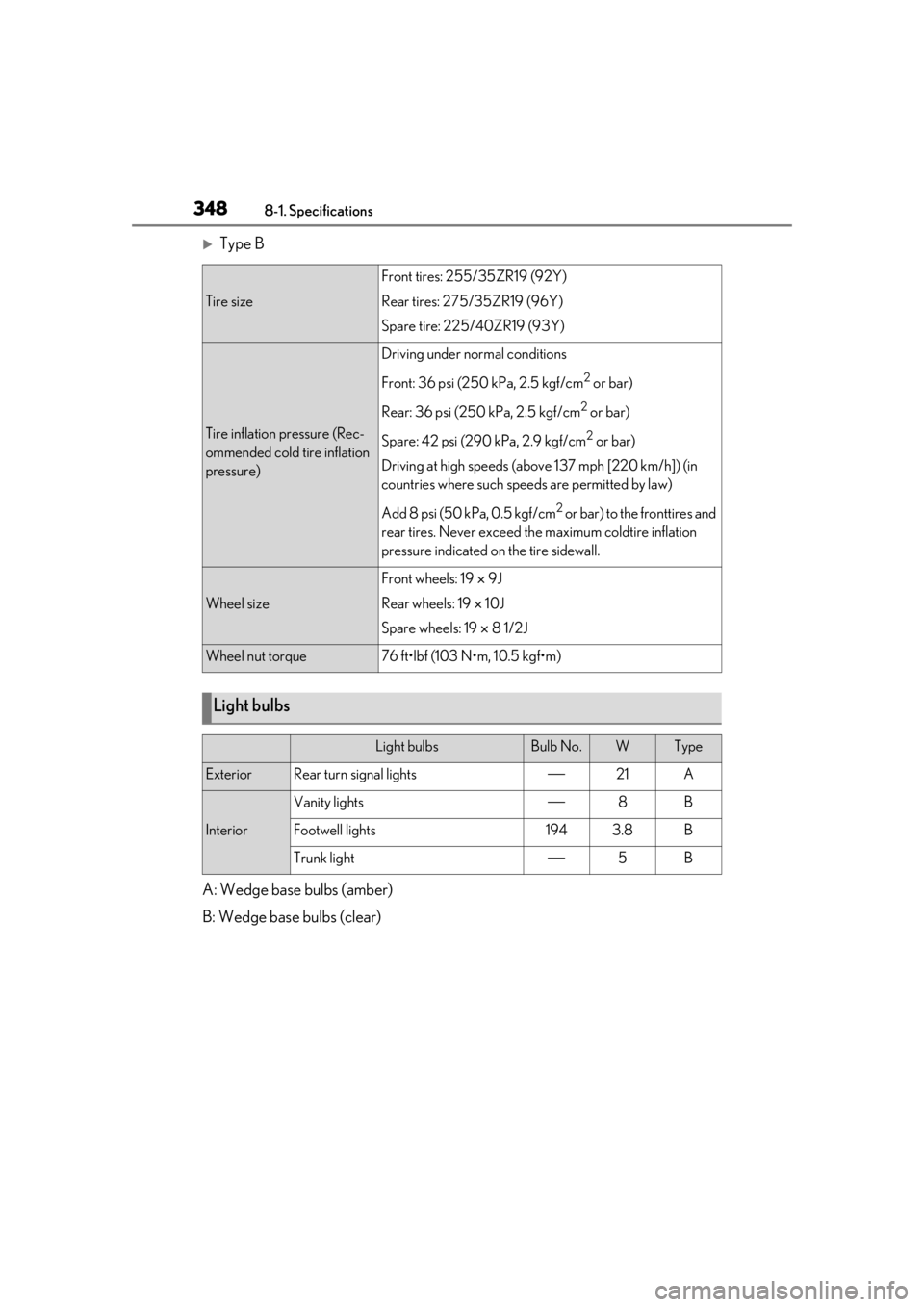
3488-1. Specifications
Type B
A: Wedge base bulbs (amber)
B: Wedge base bulbs (clear)
Tire size
Front tires: 255/35ZR19 (92Y)
Rear tires: 275/35ZR19 (96Y)
Spare tire: 225/40ZR19 (93Y)
Tire inflation pressure (Rec-
ommended cold tire inflation
pressure)
Driving under normal conditions
Front: 36 psi (250 kPa, 2.5 kgf/cm
2 or bar)
Rear: 36 psi (250 kPa, 2.5 kgf/cm
2 or bar)
Spare: 42 psi (290 kPa, 2.9 kgf/cm
2 or bar)
Driving at high speeds (above 137 mph [220 km/h]) (in
countries where such speeds are permitted by law)
Add 8 psi (50 kPa, 0.5 kgf/cm
2 or bar) to the fronttires and
rear tires. Never exceed th e maximum coldtire inflation
pressure indicated on the tire sidewall.
Wheel size
Front wheels: 19 9J
Rear wheels: 19 10J
Spare wheels: 19 8 1/2J
Wheel nut torque76 ft•lbf (103 N•m, 10.5 kgf•m)
Light bulbs
Light bulbsBulb No.WType
ExteriorRear turn signal lights21A
Interior
Vanity lights8B
Footwell lights1943.8B
Trunk light5B