flat tire LEXUS RCF 2022 Owner's Guide
[x] Cancel search | Manufacturer: LEXUS, Model Year: 2022, Model line: RCF, Model: LEXUS RCF 2022Pages: 412, PDF Size: 26.28 MB
Page 308 of 412

3067-2. Steps to take in an emergency
RC F Owner's Manual
buckle switch, seat belt pretensioners,
airbags, interconnect ing wiring and power
sources. ( P.29)
■Front passenger detection sensor, seat
belt reminder and warning buzzer
●If luggage is placed on the front passen-
ger seat, the front passenger detection
sensor may cause the warning light to
flash and the warning buzzer to sound
even if a passenger is not sitting in the
seat.
●If a cushion is placed on the seat, the sen-
sor may not detect a passenger, and the
warning light may not operate properly.
■If the malfunction indicator lamp comes
on while driving
First check the following:
●Is the fuel tank empty?
If it is, fill the fuel tank immediately.
●Is the fuel tank cap loose?
If it is, tighten it securely.
The light will go off after several driving
trips.
If the light does not go off even after several
trips, contact your Lexus dealer as soon as
possible.
■Electric power steering system warning
light (warning buzzer)
When the battery charge becomes insuffi-
cient or the voltage temporarily drops, the
electric power steeri ng system warning
light may come on and the warning buzzer
may sound.
■When the tire pressure warning light
comes on
Check the tire inflation pressure and adjust
to the appropriate level. Pushing the tire
pressure warning reset switch will not turn
off the tire pressure warning light.
■The tire pressure warning light may
come on due to natural causes
The tire pressure warning light may come
on due to natural causes such as natural air
leaks and tire inflation pressure changes
caused by temperature. In this case, adjust-
ing the tire inflation pressure will turn off the
warning light (after a few minutes).
■When a tire is replaced with a spare tire
The spare tire is not equipped with a tire
pressure warning valve and transmitter. If a
tire goes flat, the tire pressure warning light
will not turn off even th ough the flat tire has
been replaced with the spare tire.
■Conditions that the tire pressure warn-
ing system may not function properly
P.274
■If the tire pressure warning light fre-
quently comes on after blinking for 1
minute
If the tire pressure warning light frequently
comes on after blinking for 1 minute when
the engine switch is turned to IGNITION
ON mode, have it checked by your Lexus
dealer.
WARNING
■If both the ABS and the brake system
warning lights remain on
Stop your vehicle in a safe place immedi-
ately and contact your Lexus dealer. The
vehicle will become extremely unstable
during braking, and the ABS system may
fail, which could cause an accident
resulting in death or serious injury.
■When the electric power steering
system warning light comes on
The steering wheel may become
extremely heavy.
When steering wheel operations are
heavier than usual, grip the steering
wheel firmly and operate it using more
force than usual.
■If the tire pressure warning light
comes on
Be sure to observe the following precau-
tions. Failure to do so could cause a loss
of vehicle control and result in death or
serious injury.
Vehicles with a spare tire
●Stop your vehicle in a safe place as
soon as possible. Adjust the tire infla-
tion pressure immediately.
Page 309 of 412

3077-2. Steps to take in an emergency
RC F Owner's Manual
7
When trouble arises
WARNING
●If the tire pressure warning light comes
on even after tire inflation pressure
adjustment, it is probable that you have
a flat tire. Check the tires. If a tire is flat,
change it with the spare tire and have
the flat tire repaired by the nearest
Lexus dealer.
●Avoid abrupt maneuvering and brak-
ing. If the vehicle tires deteriorate, you
could lose control of the steering
wheel or the brakes.
Vehicles with an emergency tire punc-
ture repair kit
●Stop your vehicle in a safe place as
soon as possible. Adjust the tire infla-
tion pressure immediately.
●If the tire pressure warning light comes
on even after tire inflation pressure
adjustment, it is probable that you have
a flat tire. Check the tires. If a tire is flat,
repair the flat tire by using emergency
tire puncture repair kit.
●Avoid abrupt maneuvering and brak-
ing. If the vehicle tires deteriorate, you
could lose control of the steering
wheel or the brakes.
■If a blowout or sudden air leakage
should occur
The tire pressure warning system may
not activate immediately.
■Maintenance of the tires
Each tire, including the spare (if pro-
vided), should be checked monthly when
cold and inflated to the inflation pressure
recommended by the vehicle manufac-
turer on the vehicle placard or tire infla-
tion pressure label (tire and load
information label). (If your vehicle has
tires of a different size than the size indi-
cated on the vehicle placard or tire infla-
tion pressure label [tire and load
information label], you should determine
the proper tire infl ation pressure for
those tires.)
As an added safety fe ature, your vehicle
has been equipped with a tire pressure
monitoring system (TPMS-tire pressure
warning system) that illuminates a low
tire pressure telltale (tire pressure warn-
ing light) when one or more of your tires
is significantly under-inflated. Accord-
ingly, when the low ti re pressure telltale
(tire pressure warnin g light) illuminates,
you should stop and check your tires as
soon as possible, and inflate them to the
proper pressure. Driving on a signifi-
cantly under-inflated tire causes the tire
to overheat and can lead to tire failure.
Under-inflation also reduces fuel effi-
ciency and tire tread life, and may affect
the vehicle’s handling and stopping abil-
ity.
Please note that the TPMS (tire pressure
warning system) is not a substitute for
proper tire maintena nce, and it is the
driver’s responsibility to maintain correct
tire pressure, even if under-inflation has
not reached the level to trigger illumina-
tion of the TPMS low tire pressure telltale
(tire pressure warning light).
Your vehicle has also been equipped with
a TPMS (tire pressure warning system)
malfunction indicator to indicate when
the system is not operating properly. The
TPMS (tire pressure warning system)
malfunction indicator is combined with
the low tire pressure telltale (tire pres-
sure warning light) . When the system
detects a malfunction, the telltale will
flash for approximately one minute and
then remain continuously illuminated.
This sequence will continue upon subse-
quent vehicle start-ups as long as the
malfunction exists. When the malfunction
indicator is illuminated, the system may
not be able to detect or signal low tire
pressure as intended.
Page 313 of 412

3117-2. Steps to take in an emergency
RC F Owner's Manual
7
When trouble arises
■If “See Owner’s Manual” is displayed
●If the following messages are shown, fol-
lowing the instructions, accordingly.
• “Engine Coolant Temp High” ( P.336)
• “Transmission Fluid Temp High” ( P.132)
●If any of the following messages are
shown on the multi-information display, it
may indicate a malf unction. Have the
vehicle inspected by your Lexus dealer
immediately.
• “Access System with Elec. Key Malfunc-
tion”
●If any of the following messages are
shown on the multi-info rmation display, it
may indicate a malfunction. Immediately
stop the vehicle and contact your Lexus
dealer.
• “Braking Power Low”
• “Charging System Malfunction”
• “Oil Pressure Low”
Stop the vehicle in a safe place on a
hard, flat surface.
Set the parking brake.
Shift the shift lever to P.
Stop the engine.
Turn on the emergency flashers.
( P.292)
Check the degree of the tire dam-
age.
A tire should only be repaired with the
emergency tire puncture repair kit if
the damage is caused by a nail or
NOTICE
■“High Power Consumption Partial
Limit On AC/Heater Operation” is
frequently shown
There is a possible malfunction relating
to the charging system or the battery
may be deteriorating. Have the vehicle
inspected by your Lexus dealer.
If you have a flat tire (vehi-
cles with an emergency tire
puncture repair kit)
Your vehicle is not equipped with a
spare tire, but instead is equipped
with an emergency tire puncture
repair kit.
A puncture caused by a nail or
screw passing through the tire
tread can be repaired temporarily
with the emergency tire puncture
repair kit.
WARNING
■If you have a flat tire
Do not continue drivin g with a flat tire.
Driving even a short distance with a flat
tire can damage the tire and the wheel
beyond repair. Driving with a flat tire may
cause a circumferential groove on the
side wall. In such a case, the tire may
explode when using the emergency tire
puncture repair kit, resulting in death or
serious injury.
Before repairing the vehicle
Page 314 of 412

3127-2. Steps to take in an emergency
RC F Owner's Manual
screw passing through the tire tread.
• Do not remove the nail or screw from the tire. Removing the object
may widen the opening and
disenable emergency repair with
the kit.
• To avoid sealant leakage, move the vehicle until the area of the punc-
ture, if known, is positioned at the
top of the tire.■A flat tire that cann ot be repaired with
the emergency tire puncture repair kit
In the following cases, the tire cannot be
repaired with the emergency tire puncture
repair kit. Contact your Lexus dealer.
●When the tire is damaged due to driving
without sufficient air pressure
●When the tire lost air pressure due to a
crack or damage in the tire sidewall
●When the tire is visibly separated from
the wheel
●When the cut or damage to the tread is
0.16 in. (4 mm) long or more
●When the wheel is damaged
●When 2 or more shar p objects, such as
nails or screws, have passed through the
tread on a single tire
●When there is more than one hole or cut
in the damaged tire
●When the sealant has expired
Wheel nut wrench*
Jack handle*
Location of the emergency tire puncture repair kit and tools
A
B
Page 319 of 412
3177-2. Steps to take in an emergency
RC F Owner's Manual
7
When trouble arises
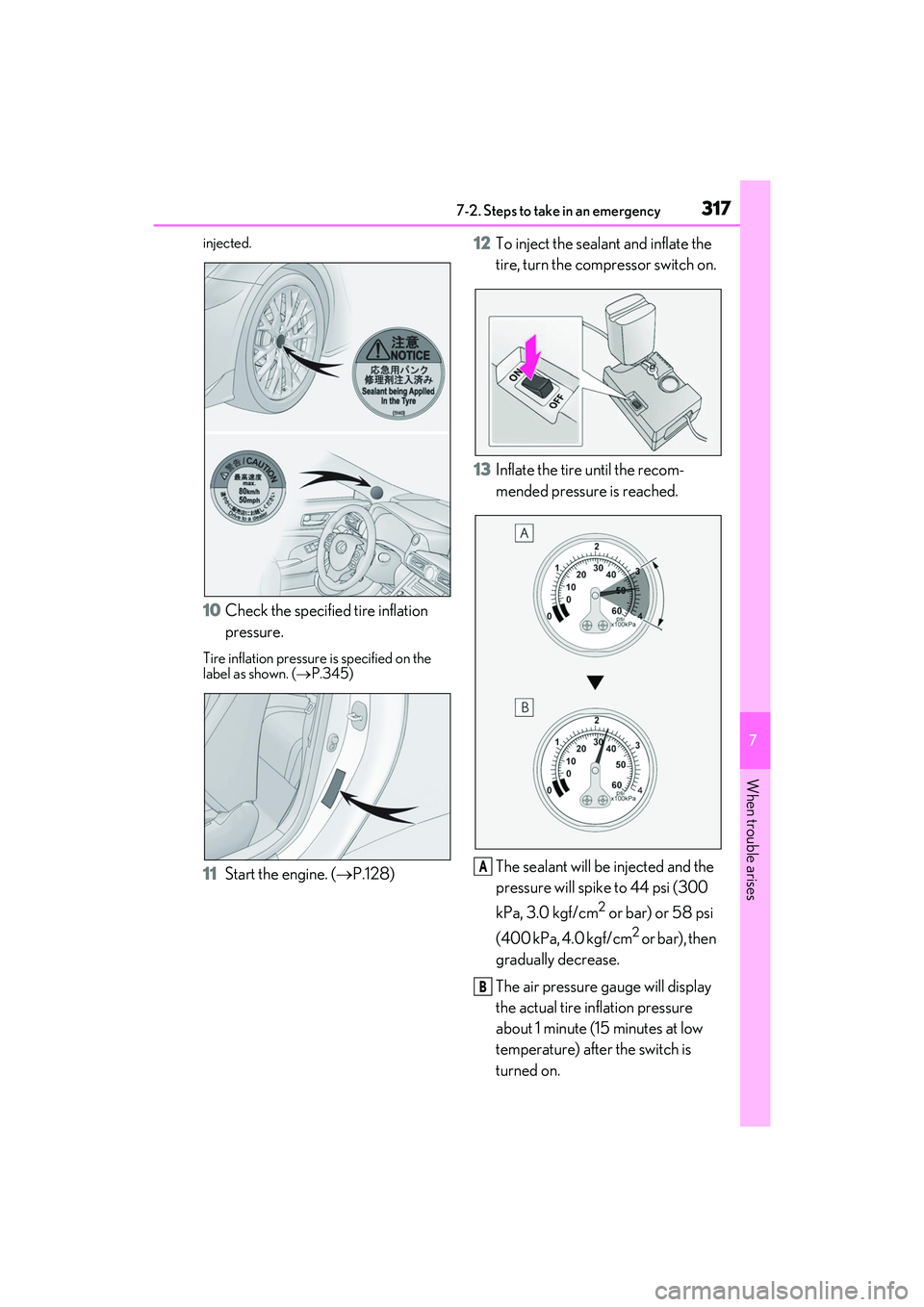
injected.
10Check the specified tire inflation
pressure.
Tire inflation pressure is specified on the
label as shown. ( P.345)
11 Start the engine. ( P.128) 12
To inject the sealant and inflate the
tire, turn the compressor switch on.
13 Inflate the tire until the recom-
mended pressure is reached.
The sealant will be injected and the
pressure will spike to 44 psi (300
kPa, 3.0 kgf/cm
2 or bar) or 58 psi
(400 kPa, 4.0 kgf/cm
2 or bar), then
gradually decrease.
The air pressure gauge will display
the actual tire inflation pressure
about 1 minute (15 minutes at low
temperature) after the switch is
turned on.
A
B
Page 320 of 412

3187-2. Steps to take in an emergency
RC F Owner's Manual
Turn the compressor switch off and then
check the tire inflation pressure. Being
careful not to over inflate, check and
repeat the inflation procedure until the rec-
ommended tire inflation pressure is
reached.
If the tire inflation pre ssure is still lower than
the recommended level after inflation for
10 minutes (35 minutes at low tempera-
ture) with the switch on, the tire is too dam-
aged to be repaired. Turn the compressor
switch off and contact your Lexus dealer.
If the tire inflation pressure exceeds the
recommended level, let out some air to
adjust the tire inflation pressure. ( P.319,
345)
14 With the compressor switch off, dis-
connect the hose from the valve on
the tire and then pull out the power
plug from the power outlet socket.
Some sealant may leak when the hose is
removed.
15Install the valve cap onto the valve
of the emergency repaired tire.
16 Attach the air release cap to the
end of the hose.
If the air release cap is not attached, the
sealant may leak and the vehicle may get
dirty.
17Temporarily store the bottle in the
trunk while it is connected to the
compressor.
18 To spread the liquid sealant evenly
within the tire, immediately drive safely for about 3 miles (5 km)
below 50 mph (80 km/h).
19 After driving, stop your vehicle in a
safe place on a hard, flat surface
and reconnect the compressor.
20 Turn the compressor switch on and
wait for several seconds, then turn it
off. Check the tire inflation pres-
sure.
If the tire inflation pressure is below
19 psi (130 kPa, 1.3 kgf/cm
2 or bar):
The puncture cannot be repaired.
Contact your Lexus dealer.
If the tire inflation pressure is
between 19 psi (130 kPa, 1.3
kgf/cm
2 or bar) and a point below
the recommended level: The tire
can be repaired. Proceed to step
21 .
If the tire inflation pressure is at the
recommended level: Proceed to
A
B
C
Page 321 of 412

3197-2. Steps to take in an emergency
RC F Owner's Manual
7
When trouble arises
step 22.
21 Turn the compressor switch on to
inflate the tire until the recom-
mended tire inflation pressure is
reached. Drive for about 3 miles (5
km) and then perform step 19.
22 Attach the air release cap to the
end of the hose.
If the air release cap is not attached, the
sealant may leak and the vehicle may get
dirty.
23Store the bottle in the trunk while it
is connected to the compressor.
24 Taking precautions to avoid sud-
den braking, sudd en acceleration
and sharp turns, drive carefully at
under 50 mph (80 km/h) to your
Lexus dealer that is less than 62
miles (100 km) away for tire repair
or replacement.
■After a tire is repaired with the emer-
gency tire puncture repair kit
●The tire pressure warning valve and
transmitter should be replaced.
●Even if the tire inflat ion pressure is at the
recommended level, the tire pressure
warning light may come on/flash.
■If the tire is inflated to more than the
recommended level
1 Disconnect the hose from the valve.
2 Install the air release cap to the end of
the hose and push the protrusion on the air release cap into the valve to let some
air out.
3 Disconnect the hose from the valve,
remove the air release cap from the
hose and then reconnect the hose.
4 Turn the compressor sw itch on and wait
for several seconds, then turn it off.
Check that the air pressure indicator
shows the recommended level.
( P.345)
If the air pressure is lower than the rec-
ommended level, tu rn the compressor
switch on again and repeat the inflation
procedure until the recommended
pressure is reached.
WARNING
■When fixing the flat tire
Observe the following precautions.
Failure to do so may result in death or
serious injury.
●Stop your vehicle in a safe and flat
area.
●Do not touch the wheels or the area
around the brakes immediately after
the vehicle has been driven.
After the vehicle has been driven, the
wheels and the area around the brakes
may be extremely hot. Touching these
areas with hands, feet or other body
parts may result in burns.
●Connect the valve and hose securely
with the tire installed on the vehicle.
• If the hose is not properly connected to the valve, air leakage may occur or
sealant may be sprayed out.
Page 322 of 412

3207-2. Steps to take in an emergency
RC F Owner's Manual
WARNING
• If the hose comes off the valve while inflating the tire, there is a risk that the
hose will move abruptly due to air
pressure.
• After inflation of the tire has com- pleted, the sealant may splatter when
the hose is disconnected or some air is
let out of the tire.
●Follow the operation procedure to
repair the tire. If the procedure is not
followed, the sealant may spray out.
●Keep back from the tire while it is
being repaired, as th ere is a chance of
it bursting while the repair operation is
being performed. If you notice any
cracks or deformation of the tire, turn
off the compressor switch and stop the
repair operation immediately.
●The kit may overheat if operated for a
long period of time. Do not operate
the compressor continuously for more
than 35 minutes.
●Parts of the kit become hot during
operation. Be carefu l handling the kit
during and after operation. Do not
touch the metal part around the con-
necting area between the bottle and
compressor. It will be extremely hot.
●Do not attach the vehicle speed warn-
ing sticker to an area other than the
one indicated. If the sticker is attached
to an area where an SRS airbag is
located, such as the pad of the steering
wheel, it may prev ent the SRS airbag
from operating properly.
■Driving to spread the liquid sealant
evenly
●Drive the vehicle carefully at a low
speed. Be especially careful when
turning and cornering.
●If the vehicle does not drive straight or
you feel a pull through the steering
wheel, stop the vehicle and check the
following:
• Tire condition. The tire may have sepa- rated from the wheel.
• Tire inflation pressure. If tire inflation p r e s s u r e i s 1 9 p s i ( 1 3 0 k P a , 1 . 3 k g f / c m
2
or bar) or below, this may indicate
severe tire damage.
NOTICE
■When performing an emergency
repair
●Perform the emergency repair with-
out removing the nail or screw that has
punctured the tread of the tire. If the
object that has punc tured the tire is
removed, repair by the emergency tire
puncture repair kit may not be possi-
ble.
●The kit is not waterproof. Make sure
that the kit is not exposed to water,
such as when it is being used in the
rain.
●Do not put the kit directly onto dusty
ground such as sand at the side of the
road. If the kit vacuums up dust etc., a
malfunction may occur.
●Make sure to stand the kit with the bot-
tle vertical. The kit cannot work prop-
erly if it is laid on its side.
■Handling the emergency tire punc-
ture repair kit
●The compressor power source should
be 12 V DC suitable for vehicle use.
Do not connect the compressor to any
other source.
●If gasoline splatters on the kit, the kit
may deteriorate. Take care not to allow
gasoline to contact it.
Page 323 of 412

3217-2. Steps to take in an emergency
RC F Owner's Manual
7
When trouble arises
Stop the vehicle in a safe place on a
hard, flat surface.
Set the parking brake.
Shift the shift lever to P.
Stop the engine.
Turn on the emergency flashers.
( P.292)
NOTICE
●Store the emergency tire puncture
repair kit in the trunk. The kit may be
thrown around during sudden braking
and so forth, damaging the kit.
●Store the kit in its assigned place out of
reach of children.
●Do not disassemble or modify the kit.
Do not subject parts such as the air
pressure indicator to impacts. This may
cause a malfunction.
■To avoid damage to the tire pressure
warning valves and transmitters
When a tire is repair ed with liquid seal-
ants, the tire pressure warning valve and
transmitter may not operate properly. If a
liquid sealant is used , contact your Lexus
dealer as soon as possible. After use of
liquid sealant, make sure to replace the
tire pressure warnin g valve and transmit-
ter when repairing or replacing the tire.
(
P.275)
If you have a flat tire (vehi-
cles with a spare tire)
Your vehicle is equipped with a
spare tire. The flat tire can be
replaced with the spare tire.
For details about tires: P.271
WARNING
■If you have a flat tire
Do not continue driving with a flat tire.
Driving even a short distance with a flat
tire can damage the tire and the wheel
beyond repair, which could result in an
accident.
Before jacking up the vehicle
Page 324 of 412

3227-2. Steps to take in an emergency
RC F Owner's Manual
Spare tire
Tool bags
Wheel nut wrench
Towing eyelet
Screwdriver
Jack handle
Jack
Location of the spare tire, jack and tools
A
B
C
D
E
F
G
WARNING
■Using the tire jack
Observe the following precautions.
Improper use of the tire jack may cause
the vehicle to suddenly fall off the jack,
leading to death or serious injury.
●Do not use the tire jack for any pur-
pose other than replacing tires or
installing and removing tire chains.
●Only use the tire jack that comes with
this vehicle or a jack designed for this
vehicle, purchased from a lexus dealer,
when replacing a flat tire.
Do not use it on other vehicles, and do
not use other tire jacks for replacing
tires on this vehicle.
●Put the jack properly in its jack point.
●Do not put any part of your body under
the vehicle while it is supported by the
jack.