height LEXUS RX200T 2017 Owners Manual
[x] Cancel search | Manufacturer: LEXUS, Model Year: 2017, Model line: RX200T, Model: LEXUS RX200T 2017Pages: 776, PDF Size: 44.51 MB
Page 36 of 776
361-1. For safe use
RX350/RX200t_EE_OM48F32E
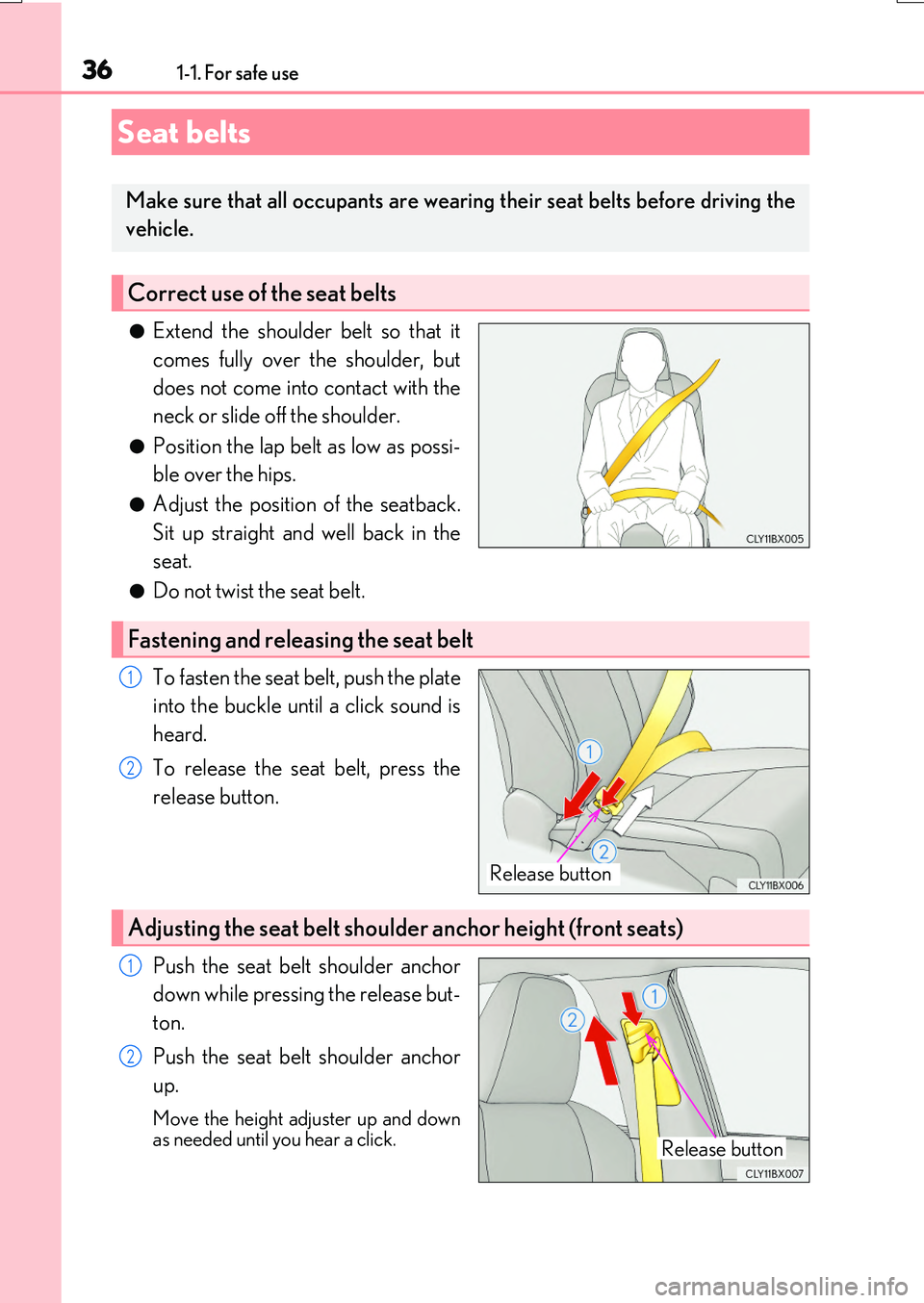
●Extend the shoulder belt so that it
comes fully over the shoulder, but
does not come into contact with the
neck or slide off the shoulder.
●Position the lap belt as low as possi-
ble over the hips.
●Adjust the position of the seatback.
Sit up straight and well back in the
seat.
●Do not twist the seat belt.
To fasten the seat belt, push the plate
into the buckle until a click sound is
heard.
To release the seat belt, press the
release button.
Push the seat belt shoulder anchor
down while pressing the release but-
ton.
Push the seat belt shoulder anchor
up.
Move the height adjuster up and down as needed until you hear a click.
Seat belts
Make sure that all occupants are wearin g their seat belts before driving the
vehicle.
Correct use of the seat belts
Fastening and releasing the seat belt
Release button
1
2
Adjusting the seat belt shoulder anchor height (front seats)
Release button
1
2
Page 56 of 776
561-2. Child safety
RX350/RX200t_EE_OM48F32E
Install the available child restraint system in vehicle upon confirming the following
items.
■Standards for child restraint systems
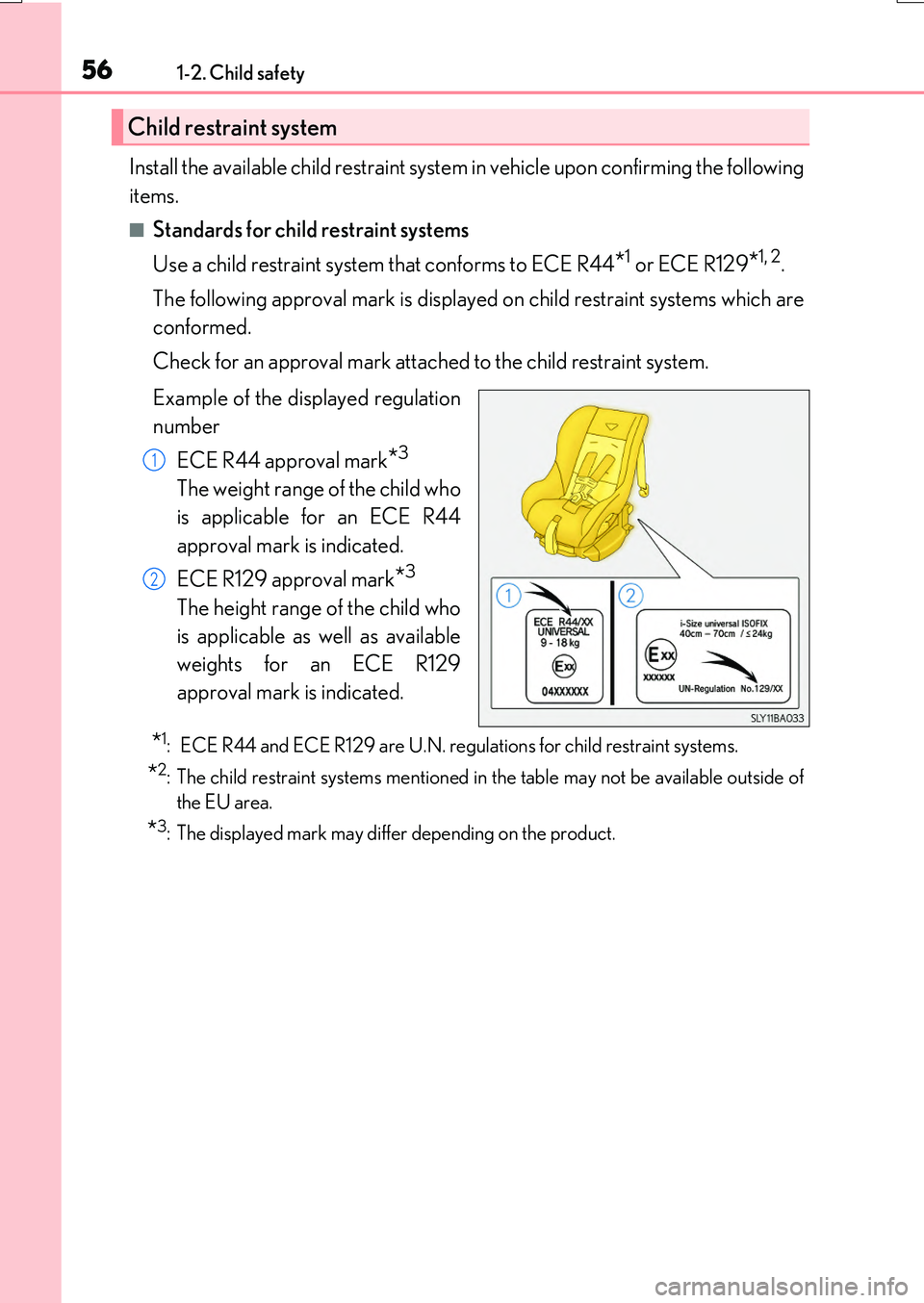
Use a child restraint system that conforms to ECE R44*1 or ECE R129*1, 2.
The following approval mark is displaye d on child restraint systems which are
conformed.
Check for an approval mark attached to the child restraint system.
Example of the displayed regulation
number
ECE R44 approval mark*3
The weight range of the child who
is applicable for an ECE R44
approval mark is indicated.
ECE R129 approval mark*3
The height range of the child who
is applicable as well as available
weights for an ECE R129
approval mark is indicated.
*1: ECE R44 and ECE R129 are U.N. regu lations for child restraint systems.
*2: The child restraint systems mentioned in the table may not be available outside of
the EU area.
*3: The displayed mark may differ depending on the product.
Child restraint system
1
2
Page 65 of 776
651-2. Child safety
1
For safety and security
RX350/RX200t_EE_OM48F32E
Key of letters inserted in the above table:
X: Not suitable seat position for children in this mass group.
U: Suitable for “universal” category child restraint systems approved for use in
this mass group.
UF: Suitable for forward-facing “universal” category child restraint systems
approved for use in this mass group.
L: Suitable for “specific vehicles”, “restricted”, or “semi-universal”, category
child restraint system s approved for use in this mass group.
*1: Adjust the seatback angle to the most upright position. Move the front seat fully rear-
ward. If the passenger seat height can be adjusted, move it to the upper most position.
*2: If the head restraint interferes with your child restraint system, and the head restraint
can be removed, remove the head restraint. Otherwise, put the head restraint in the
upper most position.
When securing some types of child restrain t systems in second row seats, it may
not be possible to properly use the seat belts in positions next to the child
restraint without interfering with it or affecting seat belt effectiveness. Be sure
your seat belt fits snugly across your shoulder and low on your hips. If it does not,
or if it interferes with the child restraint, move to a different position. Failure to do
so may result in death or serious injury.
The child restraint systems mentioned in the table may not be available outside
the EU area.
●When installing a child restraint in the rear seats, adjust the front seat so that it
does not interfere with the child or child restraint system.
●When installing a child seat with support base, if the child seat interferes with
the seatback when latching it into the support base, adjust the seatback rear-
ward until there is no interference.
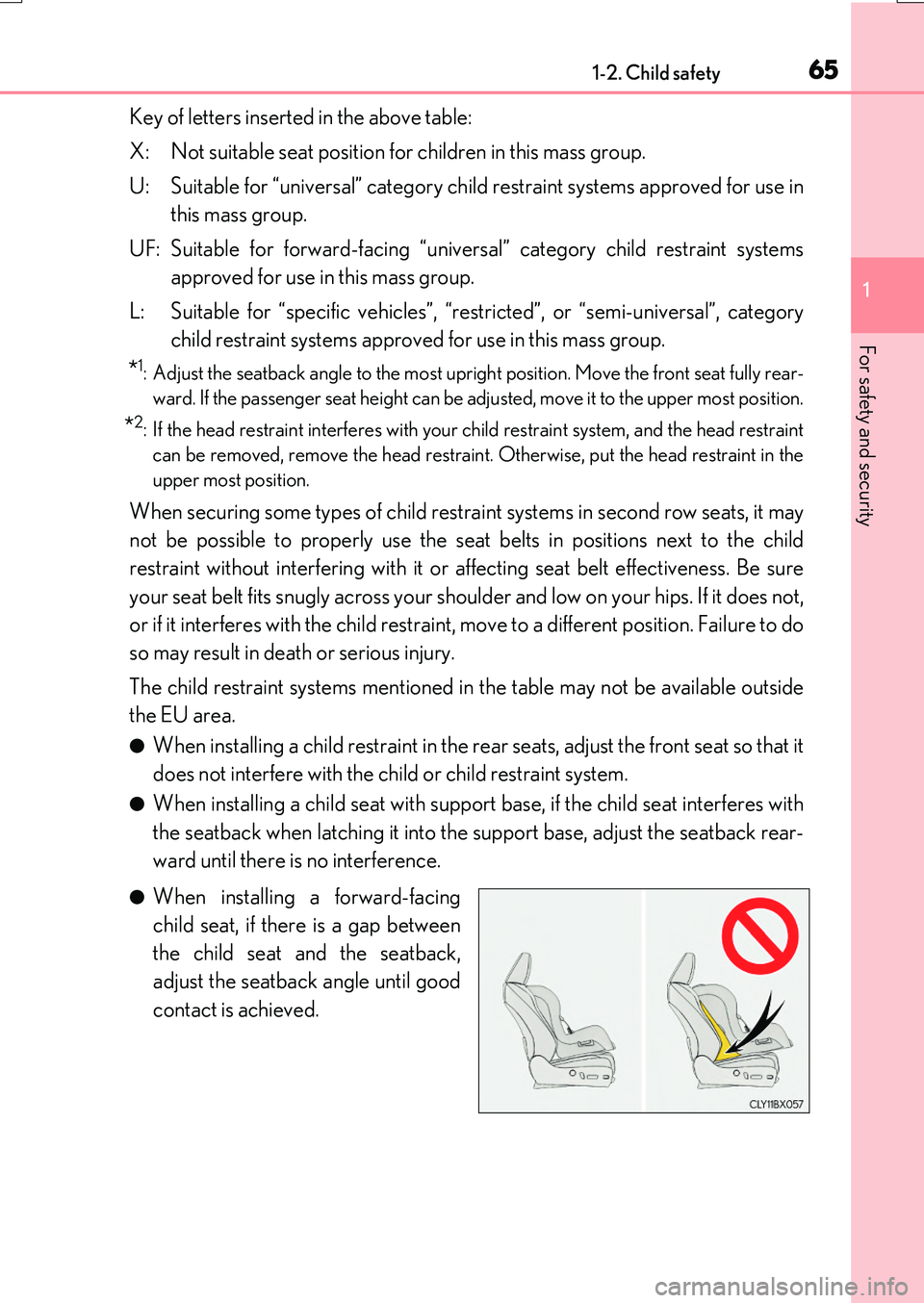
●When installing a forward-facing
child seat, if there is a gap between
the child seat and the seatback,
adjust the seatback angle until good
contact is achieved.
Page 70 of 776
![LEXUS RX200T 2017 Owners Manual 701-2. Child safety
RX350/RX200t_EE_OM48F32E
■Child restraint system suitability table
(Installed using ISOFIX [Child restraint system conforms with ECE R44])
ISOFIX child restraint systems are d](/img/36/58026/w960_58026-69.png "LEXUS RX200T 2017 Owners Manual 701-2. Child safety
RX350/RX200t_EE_OM48F32E
■Child restraint system suitability table
(Installed using ISOFIX [Child restraint system conforms with ECE R44])
ISOFIX child restraint systems are d")
701-2. Child safety
RX350/RX200t_EE_OM48F32E
■Child restraint system suitability table
(Installed using ISOFIX [Child restraint system conforms with ECE R44])
ISOFIX child restraint systems are divided in different “size class”. According
to this “size class”, you will be allowed to use it in the vehicle seating position
mentioned in the table below. To know your child restraint system “size class”
and “mass group”, please refer to the child restraint system manual. If your
child restraint system has no “size class” (or if you cannot find information in
the table below), please refer to the child restraint system “vehicle list” for
compatibility information or ask the retailer of your child seat.
Size classDescription
A Full-height, forward-facing child restraint systems
B Reduced-height forward-facing child restraint systems
B1 Reduced-height forward-facing child restraint systems
C Full-size rearward-facing child restraint systems
D Reduced-size rearward-facin g child restraint systems
E Rearward-facing infant seat
F Left lateral-facing (carrycot) infant seat
G Right lateral-facing (carrycot) infant seat
Page 185 of 776
185
3
Operation of each component
RX350/RX200t_EE_OM48F32E
3-3. Adjusting the seats
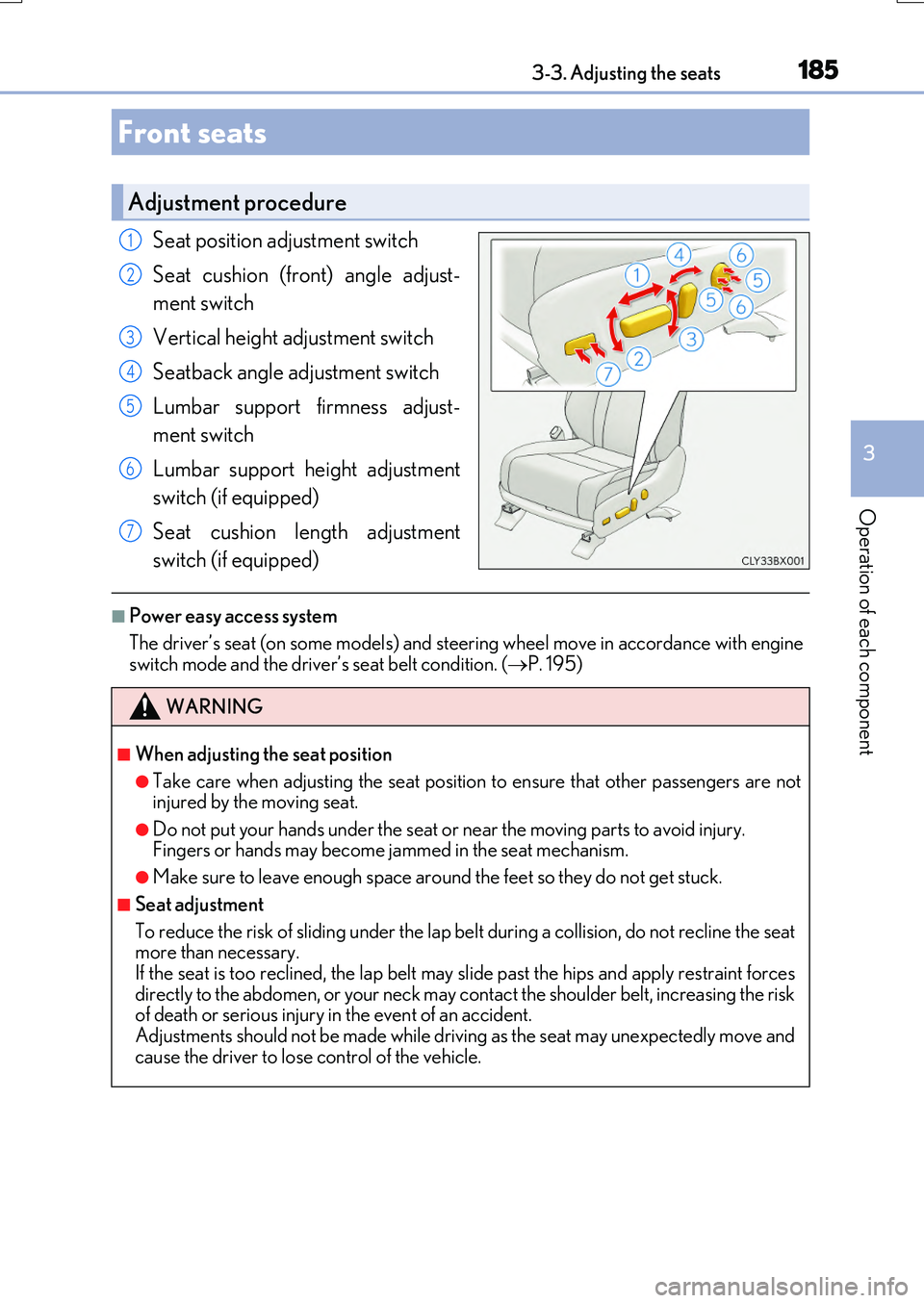
Seat position adjustment switch
Seat cushion (front) angle adjust-
ment switch
Vertical height adjustment switch
Seatback angle adjustment switch
Lumbar support firmness adjust-
ment switch
Lumbar support height adjustment
switch (if equipped)
Seat cushion length adjustment
switch (if equipped)
■Power easy access system
The driver’s seat (on some models) and steering wheel move in accordance with engine switch mode and the driver’s seat belt condition. ( P. 195)
Front seats
Adjustment procedure
1
2
3
4
5
6
7
WARNING
■When adjusting the seat position
●Take care when adjusting the seat position to ensure that other passengers are not injured by the moving seat.
●Do not put your hands under the seat or near the moving parts to avoid injury. Fingers or hands may become jammed in the seat mechanism.
●Make sure to leave enough space around the feet so they do not get stuck.
■Seat adjustment
To reduce the risk of sliding under the lap be lt during a collision, do not recline the seat more than necessary.
If the seat is too reclined, th e lap belt may slide past the hips and apply restraint forces directly to the abdomen, or your neck may contact the shoulder belt, increasing the riskof death or serious injury in the event of an accident.
Adjustments should not be made while driving as the seat may unexpectedly move and cause the driver to lose control of the vehicle.
Page 201 of 776
2013-3. Adjusting the seats
3
Operation of each component
RX350/RX200t_EE_OM48F32E
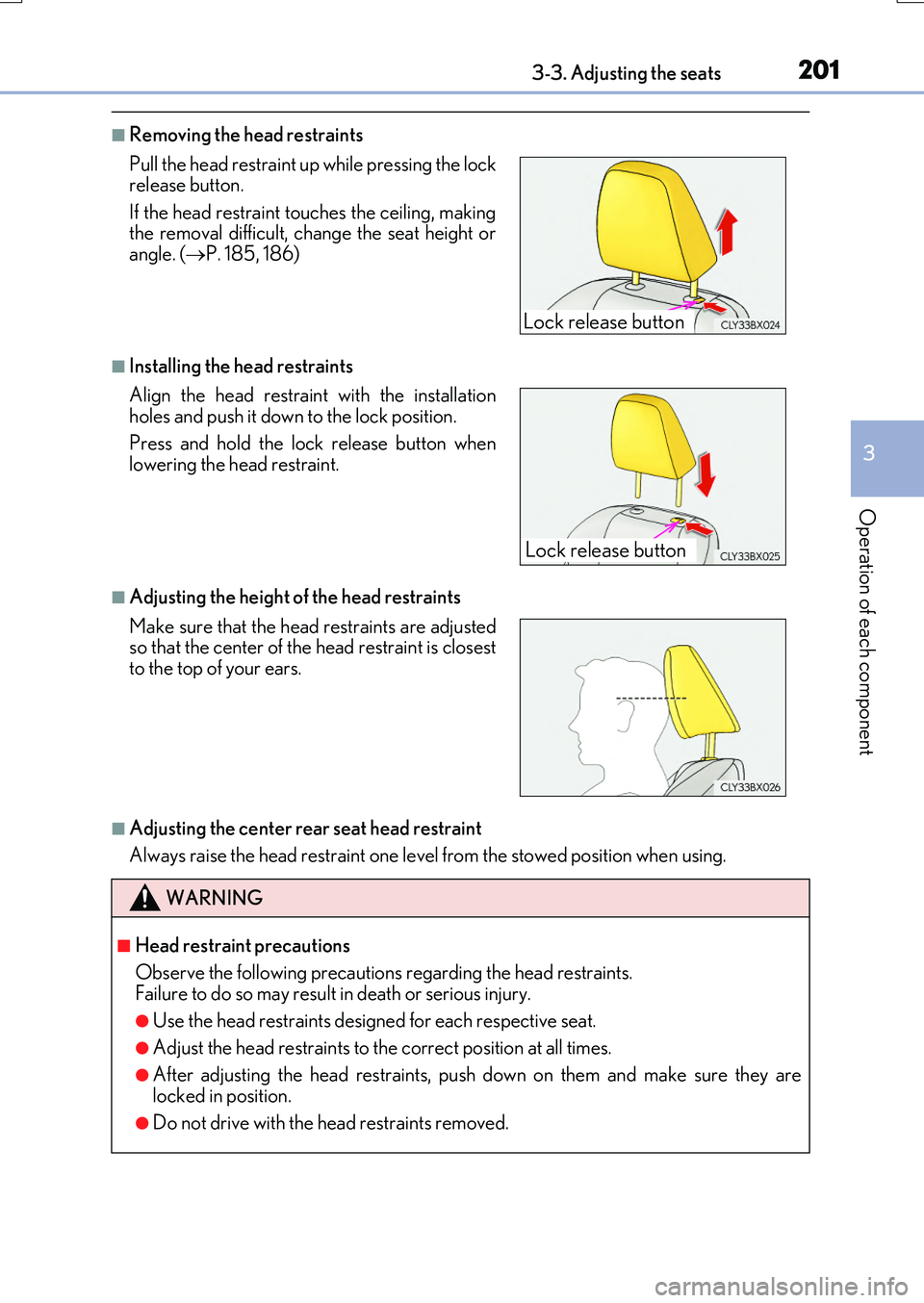
■Removing the head restraints
■Installing the head restraints
■Adjusting the height of the head restraints
■Adjusting the center rear seat head restraint
Always raise the head restraint one leve l from the stowed position when using.
Pull the head restraint up while pressing the lock release button.
If the head restraint to uches the ceiling, making the removal difficult, change the seat height orangle. ( P. 185, 186)
Align the head restraint with the installation holes and push it down to the lock position.
Press and hold the lock release button when lowering the head restraint.
Make sure that the head restraints are adjusted so that the center of the head restraint is closestto the top of your ears.
WARNING
■Head restraint precautions
Observe the following precautions regarding the head restraints.
Failure to do so may result in death or serious injury.
●Use the head restraints designed for each respective seat.
●Adjust the head restraints to the correct position at all times.
●After adjusting the head restraints, push down on them and make sure they are locked in position.
●Do not drive with the head restraints removed.
Lock release button
Lock release button
Page 204 of 776
2043-4. Adjusting the steering wheel and mirrors
RX350/RX200t_EE_OM48F32E
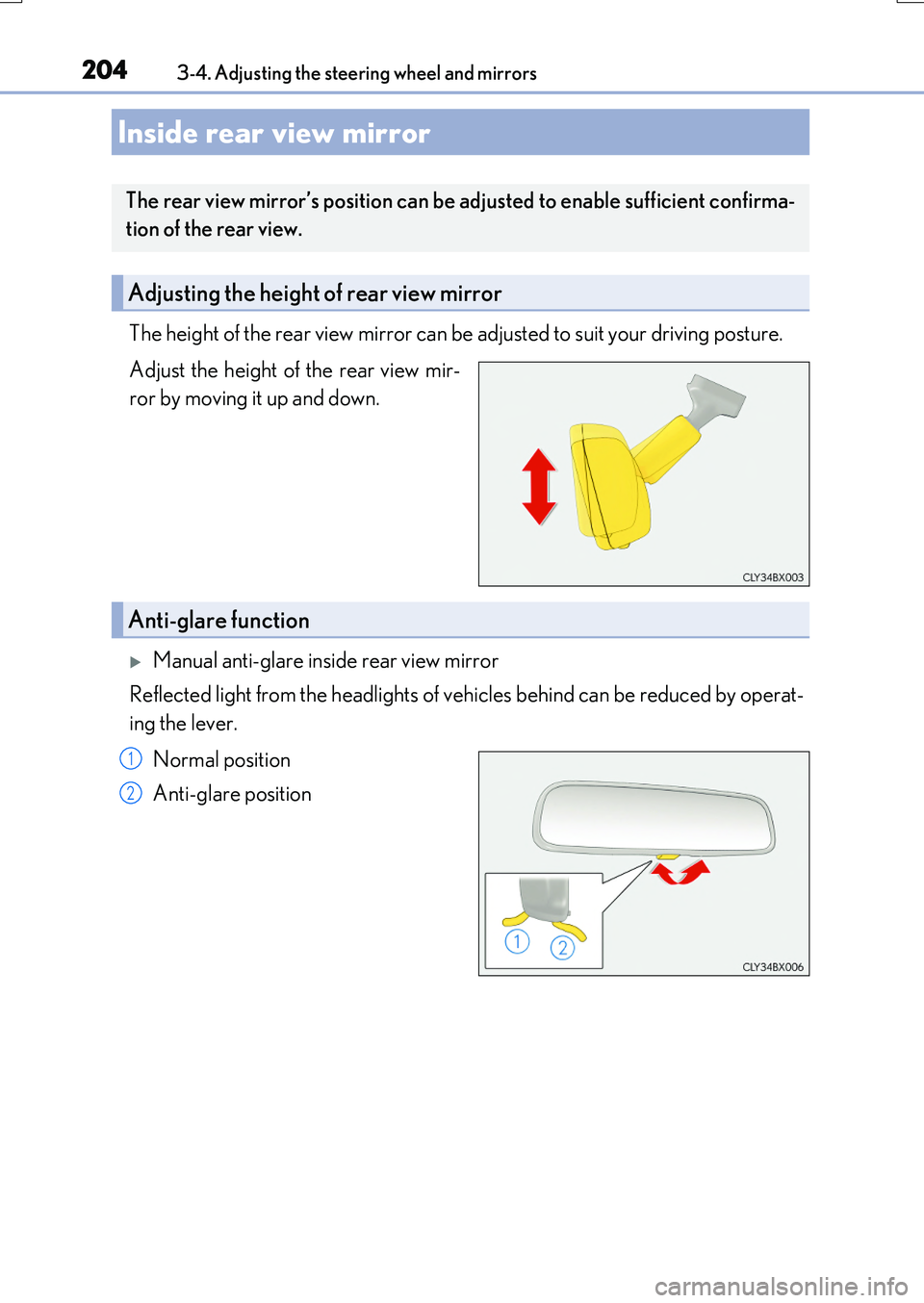
The height of the rear view mirror can be adjusted to suit your driving posture.
Adjust the height of the rear view mir-
ror by moving it up and down.
Manual anti-glare inside rear view mirror
Reflected light from the headlights of vehicles behind can be reduced by operat-
ing the lever.
Normal position
Anti-glare position
Inside rear view mirror
The rear view mirror’s position can be adjusted to enable sufficient confirma-
tion of the rear view.
Adjusting the height of rear view mirror
Anti-glare function
1
2
Page 364 of 776
3644-5. Using the driving support systems
RX350/RX200t_EE_OM48F32E
■Conditions under which the BSM function may not function correctly
●The BSM function may not detect vehicles correctly in the following situations:
• When the sensor is misaligned due to a strong impact to the sensor or its surround-
ing area • When mud, snow, ice, a sticker, etc. is covering the sensor or surrounding area onthe rear bumper
• When driving on a road surface that is wet with standing water during bad weather, such as heavy rain, snow, or fog• When multiple vehicles are approaching wi th only a small gap between each vehicle
• When the distance between your vehicle and a following vehicle is short • When there is a significant difference in speed between your vehicle and the vehiclethat enters the detection area
• When the difference in speed between your vehicle and another vehicle is changing • When a vehicle enters a detection area traveling at about the same speed as yourvehicle
• As your vehicle starts from a stop, a vehicle remains in the detection area • When driving up and down consecutive steep inclines, such as hills, dips in the road, etc.
• When driving on roads with sharp bends, consecutive curves, or uneven surfaces • When vehicle lanes are wide, or when driving on the edge of a lane, and the vehiclein an adjacent lane is far away from your vehicle
• When towing a trailer (vehicles with towing package) • When items such as a bicycle carrier are installed on the rear of the vehicle• When there is a significant difference in height between your vehicle and the vehicle
that enters the detection area • Immediately after the BSM function is turned on
●Instances of the BSM function unnecessarily detecting a vehicle and/or object mayincrease in the following situations:
• When the sensor is misaligned due to a strong impact to the sensor or its surround- ing area• When the distance between your vehicle and a guardrail, wall, etc. that enters the
detection area is short • When driving up and down consecutive steep inclines, such as hills, dips in the road, etc.
• When vehicle lanes are narrow, or when driving on the edge of a lane, and a vehicle traveling in a lane other than the adjacent lanes enters the detection area• When driving on roads with sharp bends, consecutive curves, or uneven surfaces
• When the tires are slipping or spinning • When the distance between your vehicle and a following vehicle is short• When a bicycle carrier or other accessory is installed to the rear of the vehicle
• When towing a trailer (vehicles with towing package)
Page 392 of 776
3924-5. Using the driving support systems
RX350/RX200t_EE_OM48F32E
WARNING
■Limitations of the Intelligent Clearance Sonar system
Do not overly rely on the system, as doing so may lead to an accident.
●The driver is solely responsible for safe dr iving. Always drive carefully, taking care to
observe your surroundings. The Intelligent Clearance Sonar system is designed to provide support to lessen the severity of collisions. However, it may not operate in some situations.
●The Intelligent Clearance Sonar system is not designed to stop the vehicle com- pletely. Additionally, even if the system has stopped the vehicle, it is necessary todepress the brake pedal immediately as brak e control will be canceled after approxi-
mately 2 seconds.
■To ensure the Intelligent Clearance Sonar system can operate properly
Observe the following precautions regarding the sensors ( P. 383). Failure to do so
may cause a sensor to not operate properly, and may cause an accident.
●Do not modify, disassemble or paint the sensors.
●Do not replace a sensor with a part other than a genuine part.
●Do not subject a sensor or its surrounding area to a strong impact.
●Do not damage the sensors, and always keep them clean.
Observe the following precautions regarding the radar sensors ( P. 360). Failure to
do so may cause a radar sensor to not operate properly, and may cause an accident.
●Do not modify, disassemble or paint the sensors.
●Do not replace a radar sensor with a part other than a genuine part.
●Do not subject a radar sensor or its surrounding area to a strong impact.
●Do not damage the radar sensors, and alwa ys keep the radar sensors and their sur- rounding area on the bumper clean.
■Handling the suspension
Do not modify the suspension, as changes to the height or inclination of the vehicle may prevent the sensors from detecting objects correctly or cause the system to not oper-
ate or operate unnecessarily.
Page 433 of 776
4334-6. Driving tips
4
Driving
RX350/RX200t_EE_OM48F32E
●Specific design characteristics give it a higher center of gravity than ordinary
passenger cars. This vehicle design feature causes this type of vehicle to be
more likely to rollover. And, utility vehicles have a significantly higher rollover
rate than other types of vehicles.
●An advantage of the higher ground clearance is a better view of the road
allowing you to anticipate problems.
●It is not designed for cornering at the same speeds as ordinary passenger cars
any more than low-slung sports cars are designed to perform satisfactorily
under off-road conditions. Therefore, sharp turns at excessive speeds may
cause the vehicle to rollover.
Utility vehicle precautions
This vehicle belongs to the utility vehicle class, which has higher ground clear-
ance and narrower tread in relation to the height of its center of gravity.
Utility vehicle feature
WARNING
■Utility vehicle precautions
Always observe the following precautions to minimize the risk of death, serious injury or damage to your vehicle:
●In a rollover crash, an unbelted person is significantly more likely to die than a person
wearing a seat belt. Therefore, the driver and all passengers should always fasten their seat belts.
●Avoid sharp turns or abrupt maneuvers, if at all possible.
Failure to operate this vehicle correctly may re sult in loss of control or vehicle rollover causing death or serious injury.
●Loading cargo on the roof luggage carrier wi ll make the center of the vehicle gravity
higher. Avoid high speeds, sudden starts, sharp turns, sudden braking or abrupt maneuvers, otherwise it may result in loss of control or vehicle rollover due to failure to operate this vehicle correctly.
●Always slow down in gusty crosswinds. Because of its profile and higher center ofgravity, your vehicle is more sensitive to side winds than an ordinary passenger car.Slowing down will allow you to have better control.
●Do not drive horizontally across steep slopes . Driving straight up or straight down is preferred. Your vehicle (or any similar off- road vehicle) can tip over sideways much
more easily than forward or backward.