belt LEXUS RX270 2014 Owner's Guide
[x] Cancel search | Manufacturer: LEXUS, Model Year: 2014, Model line: RX270, Model: LEXUS RX270 2014Pages: 652, PDF Size: 48.98 MB
Page 153 of 652
153
1-7. Safety information
1
Before driving
RX350/270_EE
Installing child restraints using a seat belt
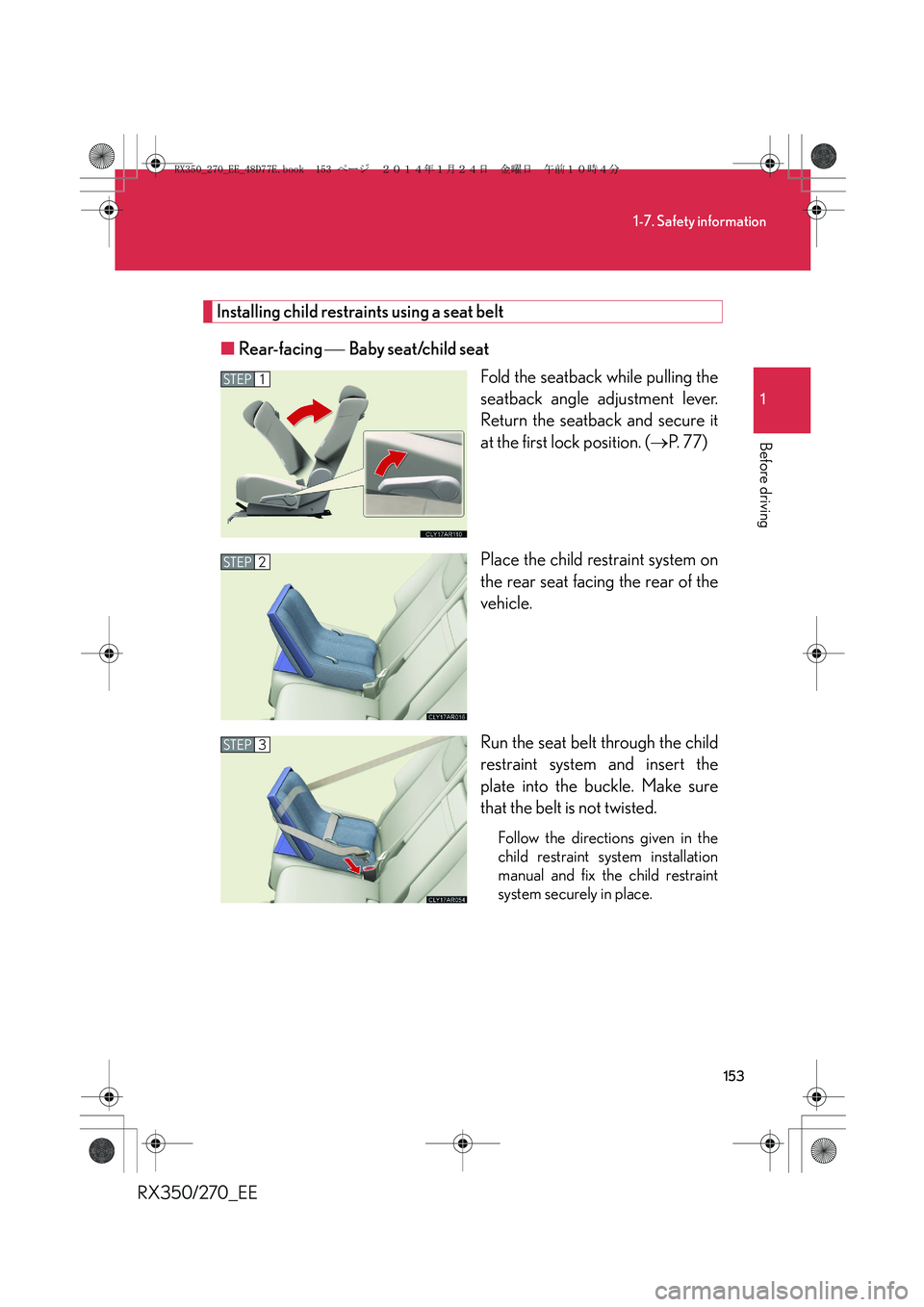
■Rear-facing Baby seat/child seat
Fold the seatback while pulling the
seatback angle adjustment lever.
Return the seatback and secure it
at the first lock position. (→P. 7 7 )
Place the child restraint system on
the rear seat facing the rear of the
vehicle.
Run the seat belt through the child
restraint system and insert the
plate into the buckle. Make sure
that the belt is not twisted.
Follow the directions given in the
child restraint system installation
manual and fix the child restraint
system securely in place.
STEP1
STEP2
STEP3
RX350_270_EE_48D77E.book 153 ページ 2014年1月24日 金曜日 午前10時4分
Page 154 of 652
154
1-7. Safety information
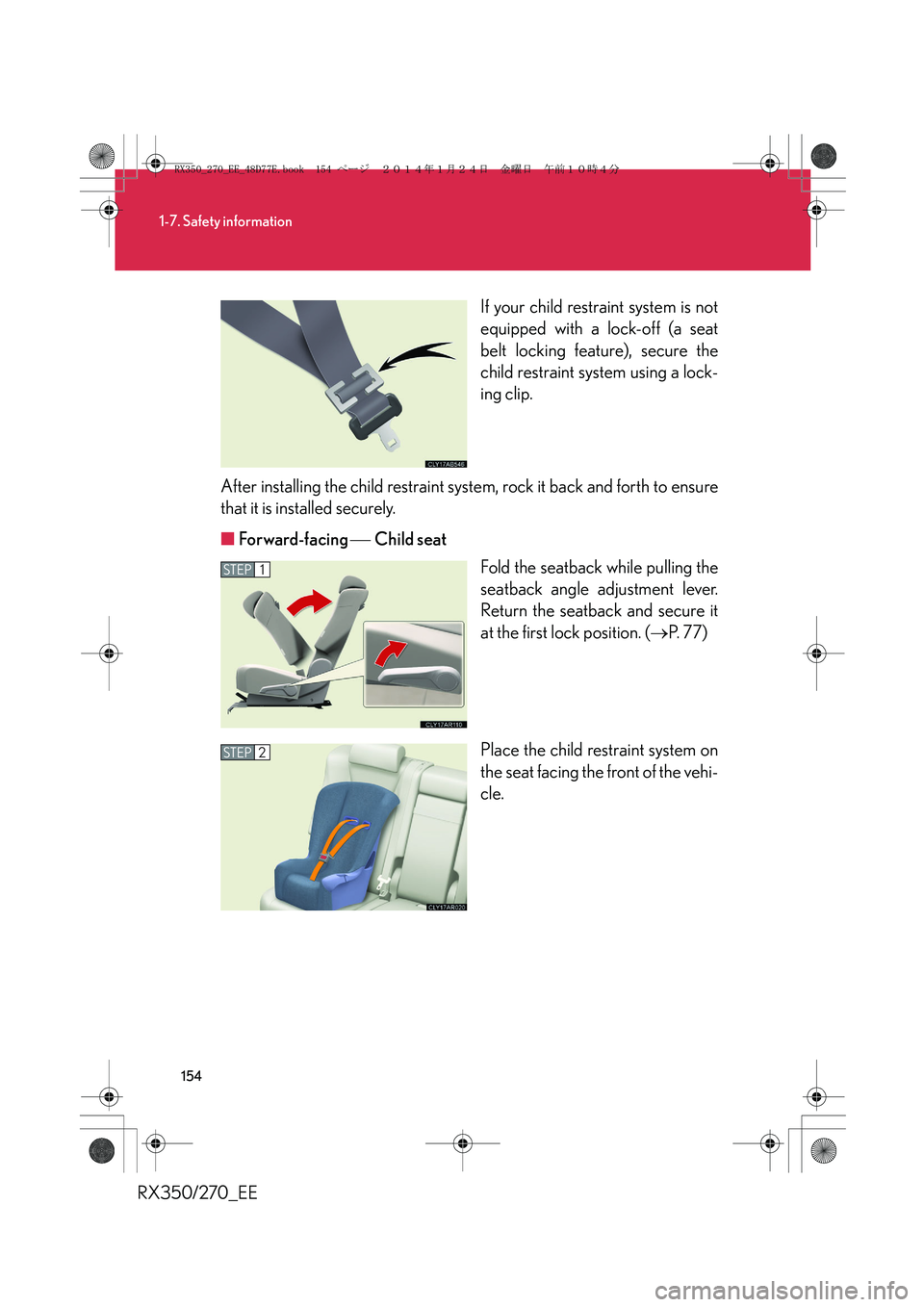
RX350/270_EEIf your child restraint system is not
equipped with a lock-off (a seat
belt locking feature), secure the
child restraint system using a lock-
ing clip.
After installing the child restraint system, rock it back and forth to ensure
that it is installed securely.
■Forward-facing Child seat
Fold the seatback while pulling the
seatback angle adjustment lever.
Return the seatback and secure it
at the first lock position. (→P. 7 7 )
Place the child restraint system on
the seat facing the front of the vehi-
cle.
STEP1
STEP2
RX350_270_EE_48D77E.book 154 ページ 2014年1月24日 金曜日 午前10時4分
Page 155 of 652
155
1-7. Safety information
1
Before driving
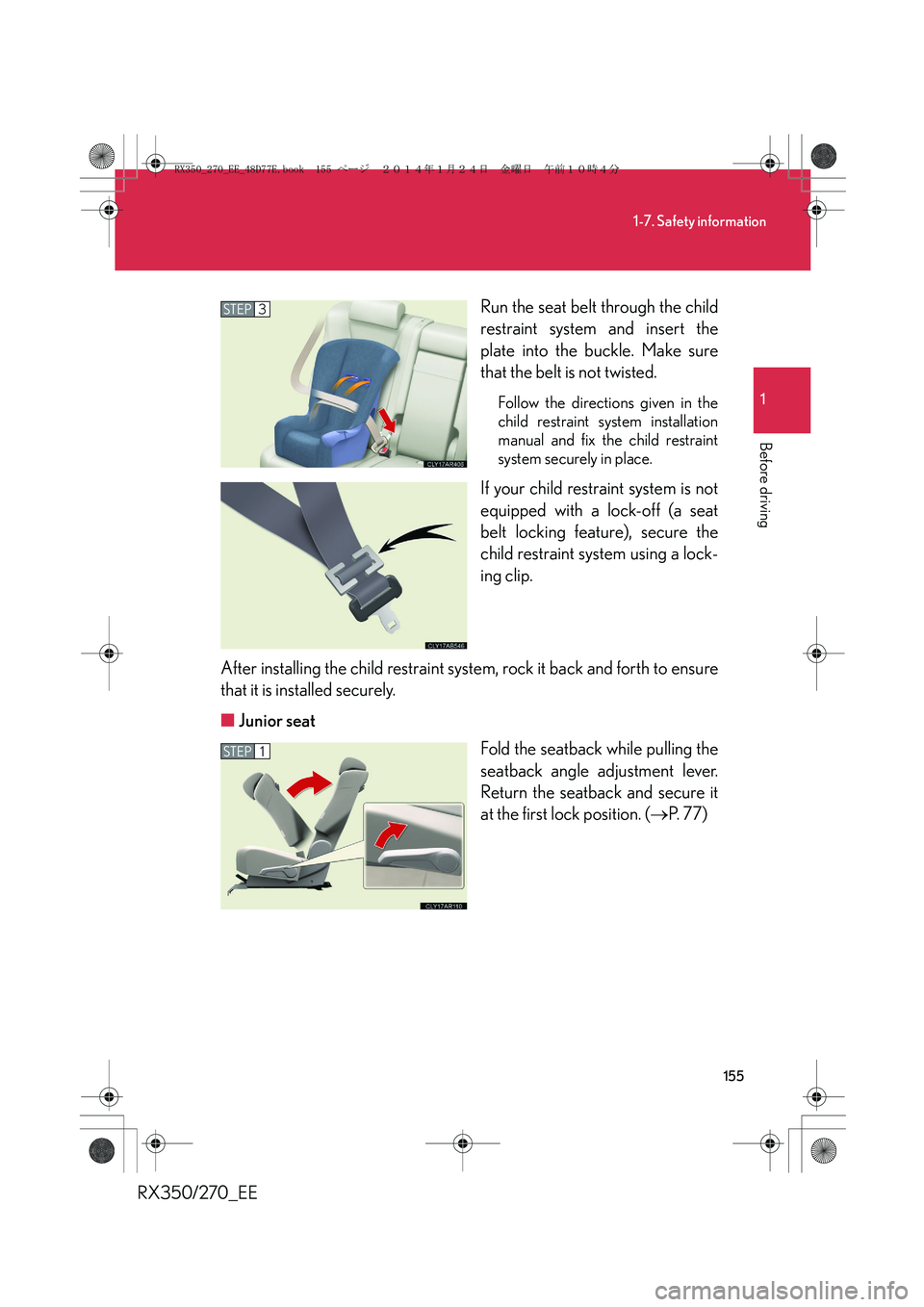
RX350/270_EERun the seat belt through the child
restraint system and insert the
plate into the buckle. Make sure
that the belt is not twisted.
Follow the directions given in the
child restraint system installation
manual and fix the child restraint
system securely in place.
If your child restraint system is not
equipped with a lock-off (a seat
belt locking feature), secure the
child restraint system using a lock-
ing clip.
After installing the child restraint system, rock it back and forth to ensure
that it is installed securely.
■Junior seat
Fold the seatback while pulling the
seatback angle adjustment lever.
Return the seatback and secure it
at the first lock position. (→P. 7 7 )
STEP3
STEP1
RX350_270_EE_48D77E.book 155 ページ 2014年1月24日 金曜日 午前10時4分
Page 156 of 652
156
1-7. Safety information
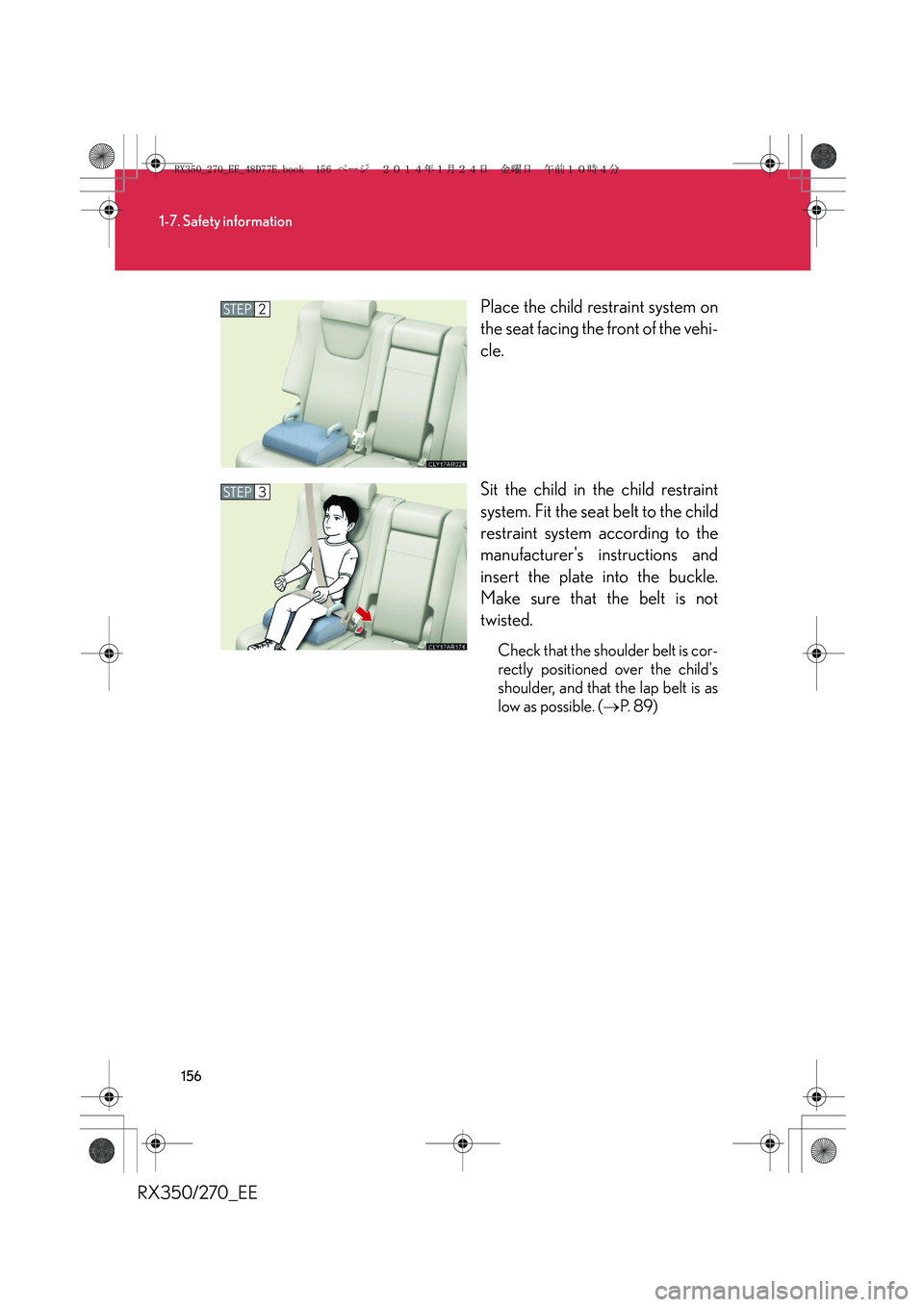
RX350/270_EEPlace the child restraint system on
the seat facing the front of the vehi-
cle.
Sit the child in the child restraint
system. Fit the seat belt to the child
restraint system according to the
manufacturer's instructions and
insert the plate into the buckle.
Make sure that the belt is not
twisted.
Check that the shoulder belt is cor-
rectly positioned over the child's
shoulder, and that the lap belt is as
low as possible. (→P. 8 9 )
STEP2
STEP3
RX350_270_EE_48D77E.book 156 ページ 2014年1月24日 金曜日 午前10時4分
Page 158 of 652
158
1-7. Safety information
RX350/270_EE
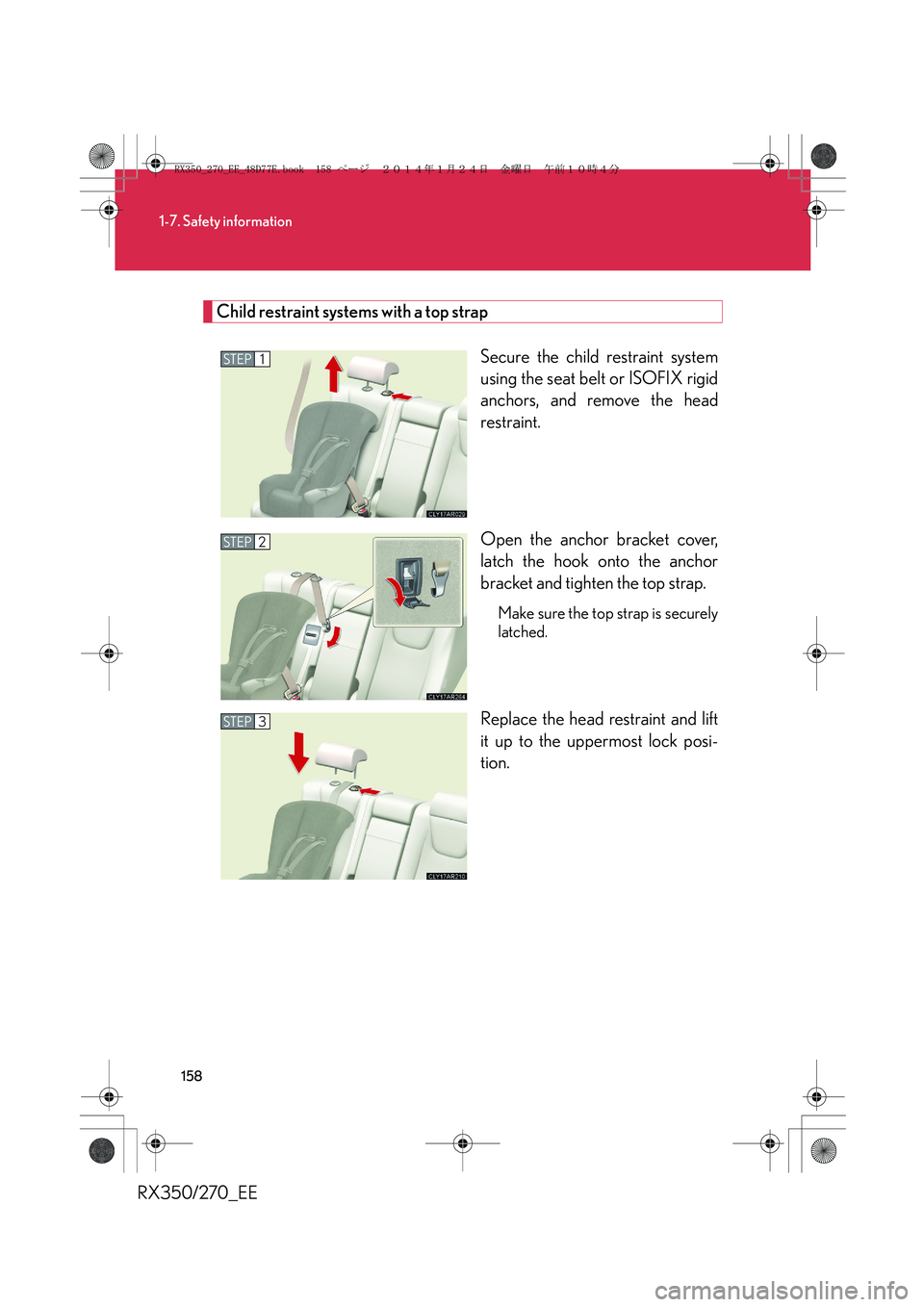
Child restraint systems with a top strap
Secure the child restraint system
using the seat belt or ISOFIX rigid
anchors, and remove the head
restraint.
Open the anchor bracket cover,
latch the hook onto the anchor
bracket and tighten the top strap.
Make sure the top strap is securely
latched.
Replace the head restraint and lift
it up to the uppermost lock posi-
tion.
STEP1
STEP2
STEP3
RX350_270_EE_48D77E.book 158 ページ 2014年1月24日 金曜日 午前10時4分
Page 162 of 652
162
1-7. Safety information
RX350/270_EE
CAUTION
■When installing a child restraint system
●If child restraint system regulations exist in the country where you reside, please
contact any authorized Lexus dealer or repairer, or another duly qualified and
equipped professional for the child restraint system installation.
●When a junior seat is installed, always ensure that the shoulder belt is positioned
across the center of the child's shoulder. The belt should be kept away from the
child's neck, but not so that it could fall off the child's shoulder. Failing to do so
may result in death or serious injury in the event of sudden braking, sudden
swerving or an accident.
●Ensure that the belt and tab are securely locked and the seat belt is not twisted.
●Shake the child restraint system left and right, and forward and backward to
ensure that it has been securely installed.
●After securing a child restraint system, never adjust the seat.
●Follow all installation instructions provided by the child restraint system manufac-
turer.
■To correctly attach a child restraint system to the anchors
When using the lower anchors, be sure that there are no foreign objects around the
anchors and that the seat belt is not caught behind the child restraint system. Make
sure the child restraint system is securely attached, or it may cause death or serious
injury to the child or other passengers in the event of a sudden stop, sudden swerve
or accident.
RX350_270_EE_48D77E.book 162 ページ 2014年1月24日 金曜日 午前10時4分
Page 280 of 652
280
2-4. Using other driving systems
RX350/270_EE
Pre-Crash Safety system∗
When the radar sensor detects the possibility of a frontal collision, the pre-
crash safety system such as the brakes and seat belts are automatically
engaged to lessen impact as well as vehicle damage.
■Pre-crash seat belts (front seat belts only)
If the pre-crash sensor detects that a collision is unavoidable, the pre-
crash safety system will retract the seat belt before the collision occurs.
The same will happen if the driver makes an emergency braking or loses
control of the vehicle. (→P. 9 0 )
However, the system will not operate in the event of skidding when the
VSC system is disabled.
■Pre-crash brake assist
When there is a high possibility of a frontal collision, the system applies
greater braking force in relation to how strongly the brake pedal is
depressed. The system may not warn the driver using a warning light,
warning display and buzzer when the system detects and judges braking
operations.
■Pre-crash braking
When there is a high possibility of a frontal collision, the system warns the
driver using a warning light, warning display and buzzer. If the system
determines that a collision is unavoidable, the brakes are automatically
applied to reduce the collision speed. Pre-crash braking can be disabled
using the pre-crash braking off switch.
∗: If equipped
RX350_270_EE_48D77E.book 280 ページ 2014年1月24日 金曜日 午前10時4分
Page 282 of 652
282
2-4. Using other driving systems
RX350/270_EE
■The pre-crash safety system is operational when
●Pre-crash seat belts (type A):
• Vehicle speed is greater than about 5 km/h (4 mph).
• The speed at which your vehicle is approaching the obstacle or the vehicle
running ahead of you is greater than about 30 km/h (19 mph).
• The front occupants are wearing a seat belt.
●Pre-crash seat belts (type B):
• Vehicle speed is greater than about 30 km/h (19 mph).
• The system detects sudden braking or skidding.
• The front occupants are wearing a seat belt.
●Pre-crash brake assist:
• Vehicle speed is greater than about 30 km/h (19 mph).
• The speed at which your vehicle is approaching the obstacle or the vehicle
running ahead of you is greater than about 30 km/h (19 mph).
• The brake pedal is depressed.
●Pre-crash braking:
• The pre-crash braking off switch is not pressed.
• Vehicle speed is greater than about 15 km/h (10 mph).
• The speed at which your vehicle is approaching the obstacle or the vehicle
running ahead of you is greater than about 15 km/h (10 mph).
RX350_270_EE_48D77E.book 282 ページ 2014年1月24日 金曜日 午前10時4分
Page 283 of 652
283
2-4. Using other driving systems
2
When driving
RX350/270_EE
■Conditions that may trigger the system even if there is no possibility of collision
●When there is an object by the roadside at the entrance to a curve
●When passing an oncoming vehicle on a curve
●When driving over a narrow iron bridge
●When there is a metal object on the road surface
●When driving on an uneven road surface
●When passing an oncoming vehicle on a left-turn
●When your vehicle rapidly closes on the vehicle in front
●When a grade separation/interchange, sign, billboard, or other structure
appears to be directly in the vehicle’s line of travel
●When climbing a steep hill causes an overhead billboard or other metallic struc-
ture to appear directly in the vehicle’s line of travel
●When an extreme change in vehicle height occurs
●When the axis of the radar is out of adjustment
●When passing through certain toll gates
●When driving on a bridge
●When passing through a tunnel
When the system is activated in the situations described above, there is also a possi-
bility that the seat belts will retract quickly and the brakes will be applied with a force
greater than normal. When the seat belt is locked in the retracted position, stop the
vehicle in a safe place, release the seat belt and refasten it.
■Obstacles not detected
The sensor cannot detect plastic obstacles such as traffic cones. There may also be
occasions when the sensor cannot detect pedestrians, animals, bicycles, motorcy-
cles, trees, or snowdrifts.
RX350_270_EE_48D77E.book 283 ページ 2014年1月24日 金曜日 午前10時4分
Page 290 of 652
290
2-5. Driving information
RX350/270_EE
Off-road driving
When driving your vehicle off-road, please observe the following precau-
tions to ensure your driving enjoyment and to help prevent the closure of
areas to off-road vehicles.
●Drive your vehicle only in areas where off-road vehicles are permitted
to travel.
●Respect private property. Get owner’s permission before entering pri-
vate property.
●Do not enter areas that are closed. Honor gates, barriers and signs
that restrict travel.
CAUTION
■Off-road vehicle precautions
Always observe the following precautions to minimize the risk of death or serious
injury or damage to your vehicle:
●In a rollover crash, an unbelted person is significantly more likely to die than a
person wearing a seat belt. Therefore, the driver and all passengers should fasten
their seat belts whenever the vehicle is moving.
●Avoid sharp turns or abrupt maneuvers, if at all possible.
Failure to operate this vehicle correctly may result in loss of control or vehicle roll-
over causing death or serious injury.
●Loading cargo on the roof luggage carrier will make the center of the vehicle
gravity higher. Avoid high speeds, sudden starts, sharp turns, sudden braking or
abrupt maneuvers, otherwise it may result in loss of control or vehicle rollover
due to failure to operate this vehicle correctly.
●Always slow down in gusty crosswinds. Because of its profile and higher center of
gravity, your vehicle is more sensitive to side winds than an ordinary passenger
car. Slowing down will allow you to have better control.
●Do not drive horizontally across steep slopes. Driving straight up or straight down
is preferred. Your vehicle (or any similar off-road vehicle) can tip over sideways
much more easily than forward or backward.
RX350_270_EE_48D77E.book 290 ページ 2014年1月24日 金曜日 午前10時4分