trailer LEXUS RX350 2015 User Guide
[x] Cancel search | Manufacturer: LEXUS, Model Year: 2015, Model line: RX350, Model: LEXUS RX350 2015Pages: 886, PDF Size: 11 MB
Page 308 of 886
3082-5. Driving information
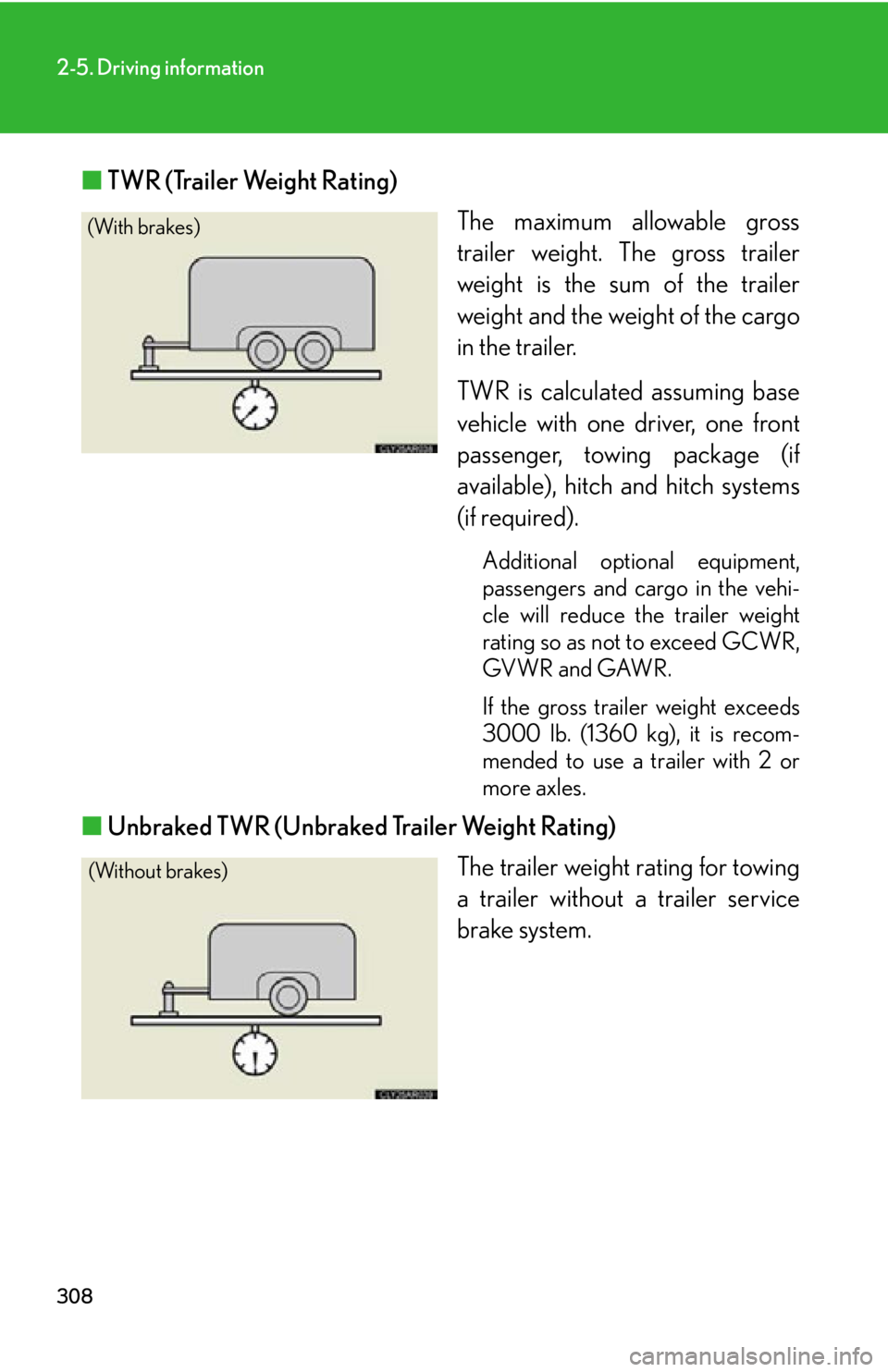
■ TWR (Trailer Weight Rating)
The maximum allowable gross
trailer weight. The gross trailer
weight is the sum of the trailer
weight and the weight of the cargo
in the trailer.
TWR is calculated assuming base
vehicle with one driver, one front
passenger, towing package (if
available), hitch and hitch systems
(if required). Additional optional equipment,
passengers and cargo in the vehi-
cle will reduce the trailer weight
rating so as not to exceed GCWR,
GVWR and GAWR.
If the gross trailer weight exceeds
3000 lb. (1360 kg), it is recom-
mended to use a trailer with 2 or
more axles.
■ Unbraked TWR (Unbraked Trailer Weight Rating)
The trailer weight rating for towing
a trailer without a trailer service
brake system.(With brakes)
(Without brakes)
Page 309 of 886
3092-5. Driving information
2
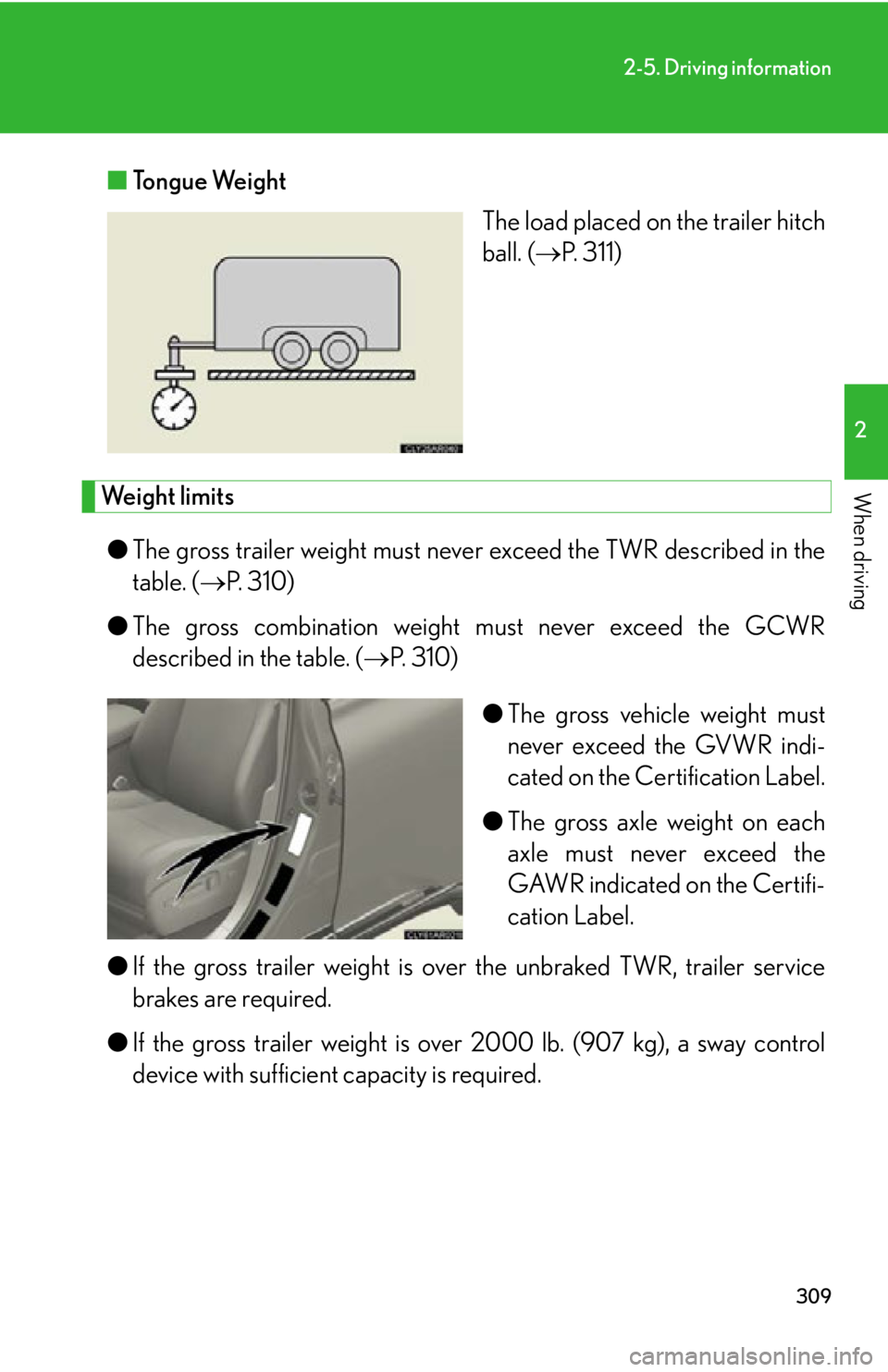
When driving ■ Tongue Weight
The load placed on the trailer hitch
ball. ( P. 311)
Weight limits
● The gross trailer weight must neve r exceed the TWR described in the
table. ( P. 310)
● The gross combination weight must never exceed the GCWR
described in the table. ( P. 310)
● The gross vehicle weight must
never exceed the GVWR indi-
cated on the Certification Label.
● The gross axle weight on each
axle must never exceed the
GAWR indicated on the Certifi-
cation Label.
● If the gross trailer weight is over the unbraked TWR, trailer service
brakes are required.
● If the gross trailer weight is over 2000 lb. (907 kg), a sway control
device with sufficient capacity is required.
Page 310 of 886
3102-5. Driving information
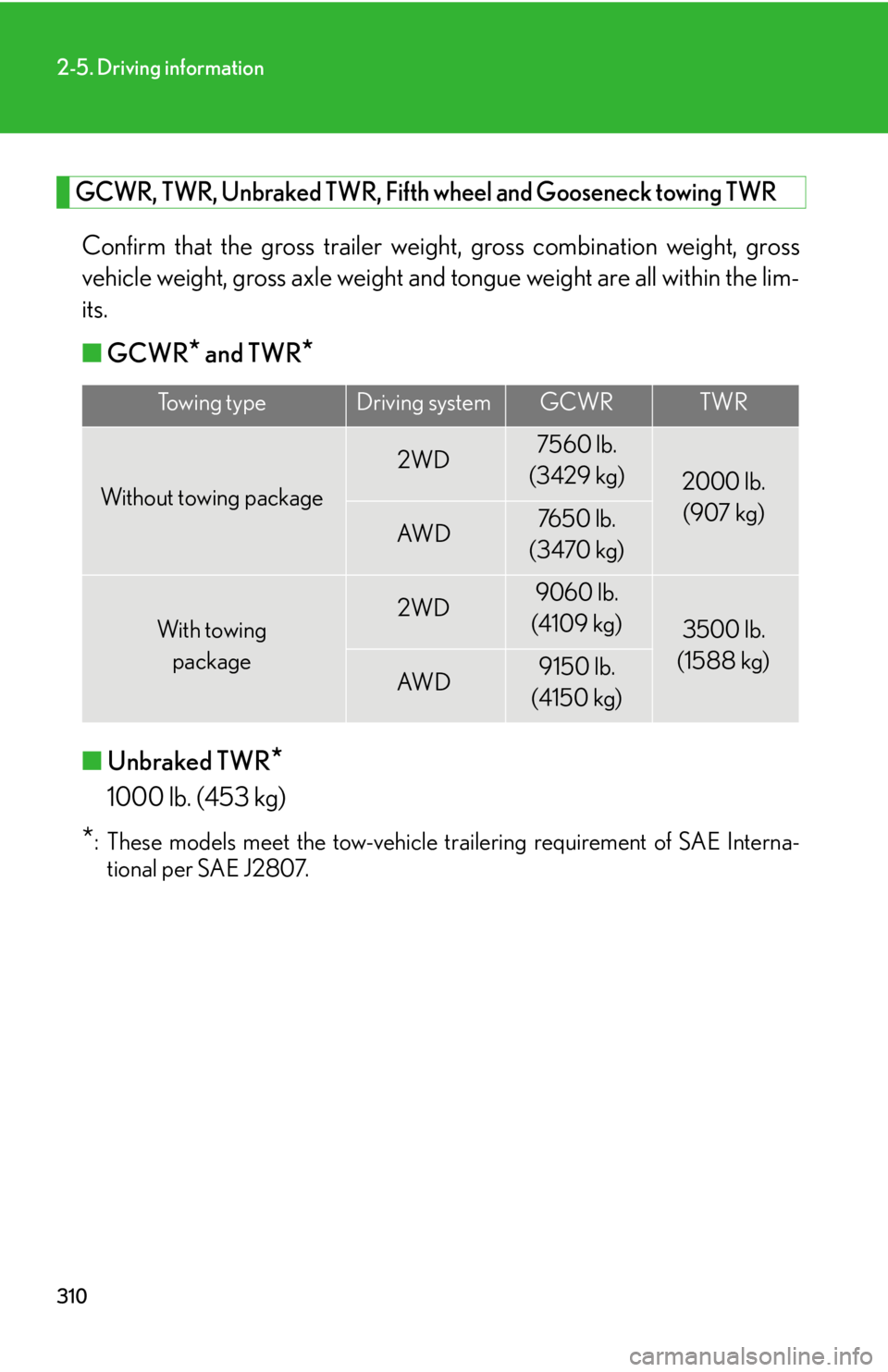
GCWR, TWR, Unbraked TWR, Fifth wheel and Gooseneck towing TWR
Confirm that the gross trailer weight , gross combination weight, gross
vehicle weight, gross axle weight and tongue weight are all within the lim-
its.
■ GCWR
* and TWR
*
■ Unbraked TWR
*1000 lb. (453 kg)
* : These models meet the tow-vehicle trailering requirement of SAE Interna-
tional per SAE J2807. To w i n g t y p e Driving system GCWR TWR
Without towing package 2WD 7560 lb.
(3429 kg)
2000 lb.
(907 kg)
AW D 7650 lb.
(3470 kg)
With towing
package 2WD 9060 lb.
(4109 kg)
3500 lb.
(1588 kg)
AW D 9150 lb.
(4150 kg)
Page 311 of 886
3112-5. Driving information
2
When driving Trailer Tongue Weight
● A recommended tongue weight varies in accordance with the types of
trailers or towing as described below.
● To ensure the recommended values shown below, the trailer must be
loaded by referring to the following instructions.
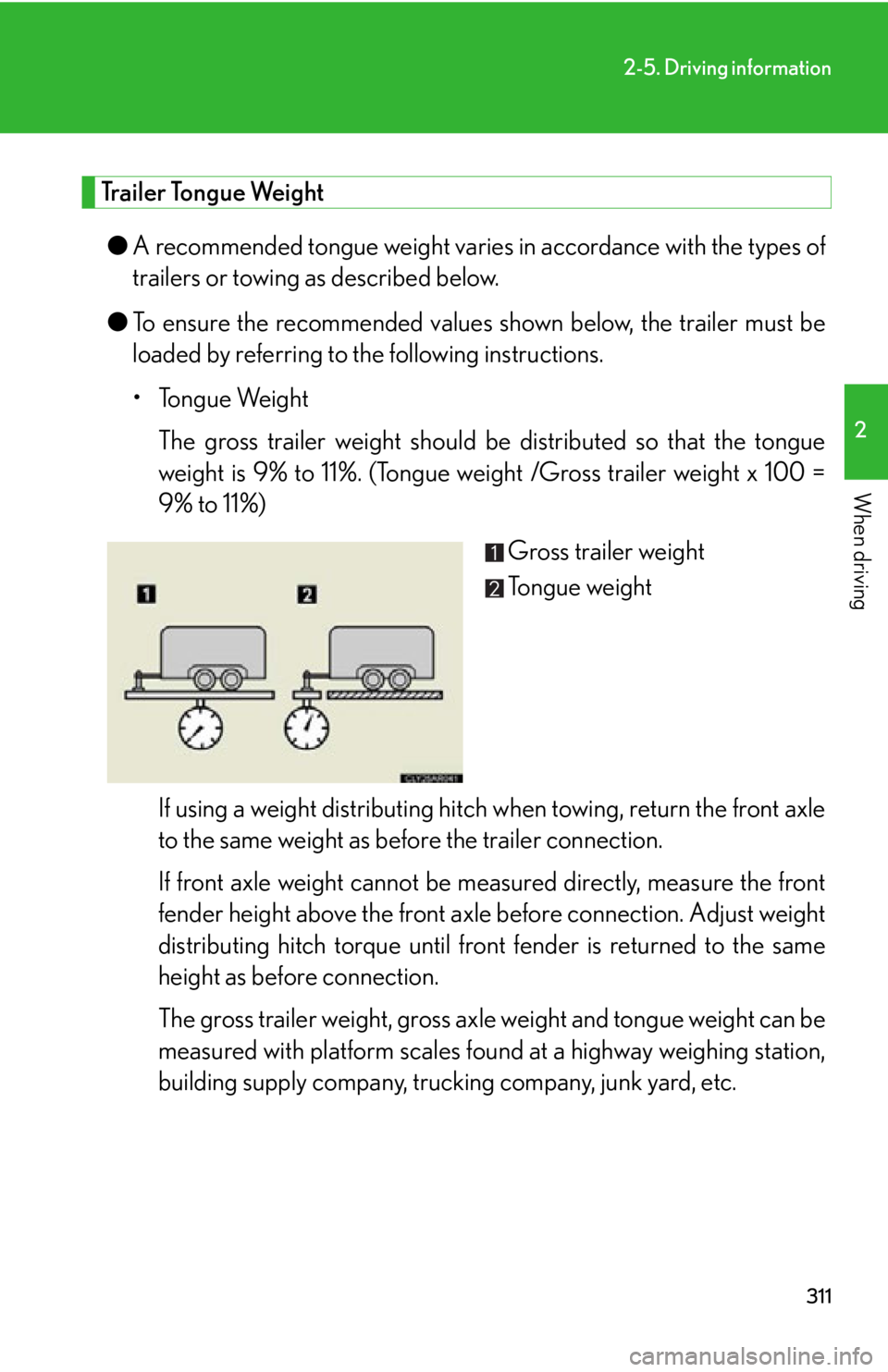
• Tongue Weight
The gross trailer weight should be distributed so that the tongue
weight is 9% to 11%. (Tongue weight /Gross trailer weight x 100 =
9% to 11%)
Gross trailer weight
Tongue weight
If using a weight distri buting hitch when towing , return the front axle
to the same weight as before the trailer connection.
If front axle weight cannot be mea sured directly, measure the front
fender height above the front axle before connection. Adjust weight
distributing hitch torque until fr ont fender is returned to the same
height as before connection.
The gross trailer weight, gross axle weight and tongue weight can be
measured with platform scales foun d at a highway weighing station,
building supply company, truck ing company, junk yard, etc.
Page 312 of 886

3122-5. Driving information
Hitch
Trailer hitch assemblies have differ ent weight capacities. Lexus recom-
mends the use of Lexus hitch/bracket for your vehicle. For details, con-
tact your Lexus dealer.
● If you wish to install a trailer hitch, contact your Lexus dealer.
● Use only a hitch that conforms to the gross tr ailer weight requirement
of your vehicle.
● Follow the directions supplied by the hitch manufacturer.
● Lubricate the hitch ball with a light coating of grease.
● Remove the trailer hitch whenever you are not towing a trailer. After
removing the hitch, seal any mount ing hole in the vehicle body to pre-
vent entry of any substances into the vehicle.
Page 313 of 886
3132-5. Driving information
2
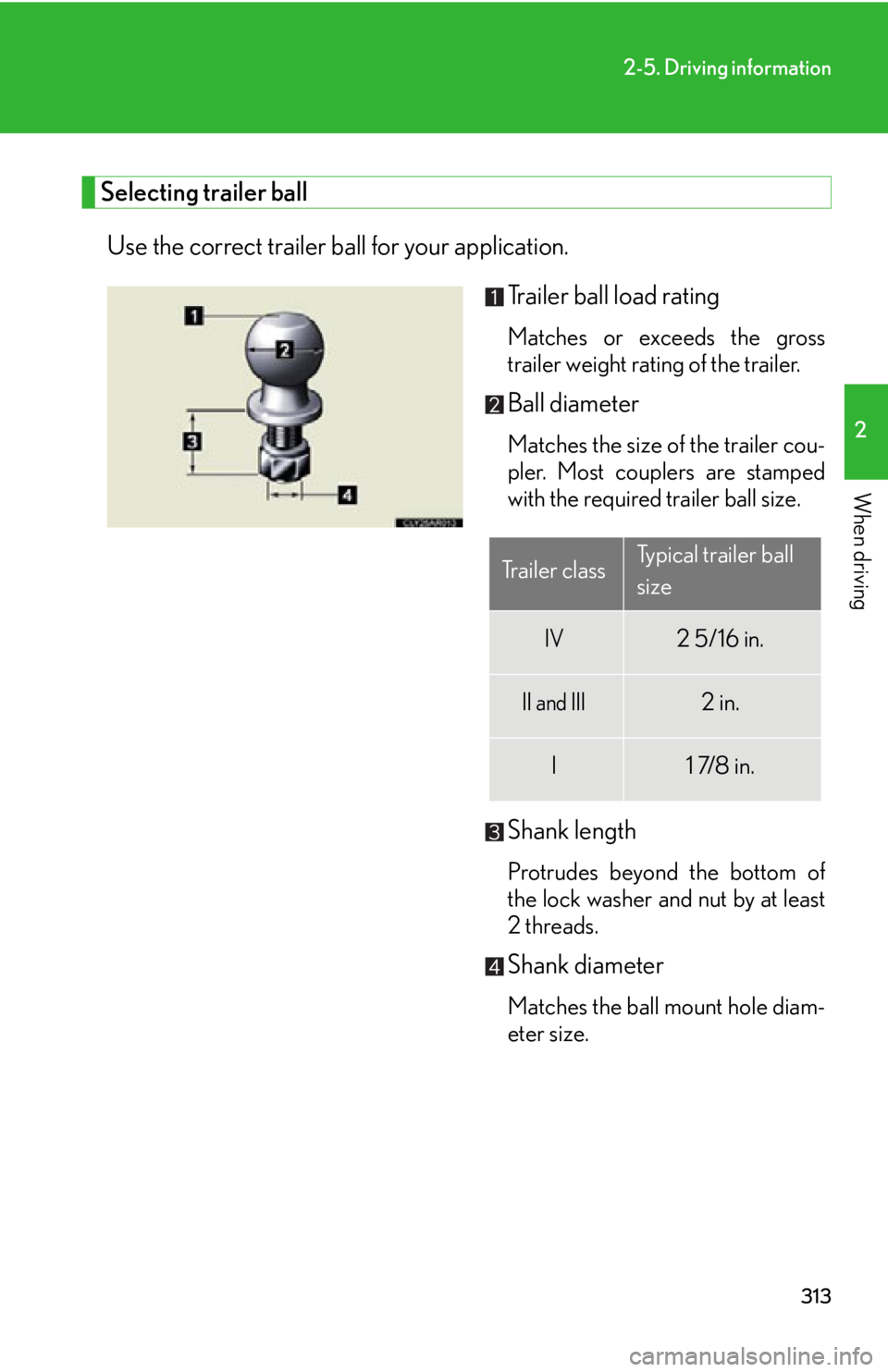
When driving Selecting trailer ball
Use the correct trailer ball for your application.
Trailer ball load rating Matches or exceeds the gross
trailer weight rating of the trailer.
Ball diameter Matches the size of the trailer cou-
pler. Most couplers are stamped
with the required trailer ball size.
Shank length Protrudes beyond the bottom of
the lock washer and nut by at least
2 threads.
Shank diameter
Matches the ball mount hole diam-
eter size.Trailer class Typical trailer ball
size
IV 2 5/16 in.
II and III 2 in.
I 1 7/8 in.
Page 314 of 886
3142-5. Driving information
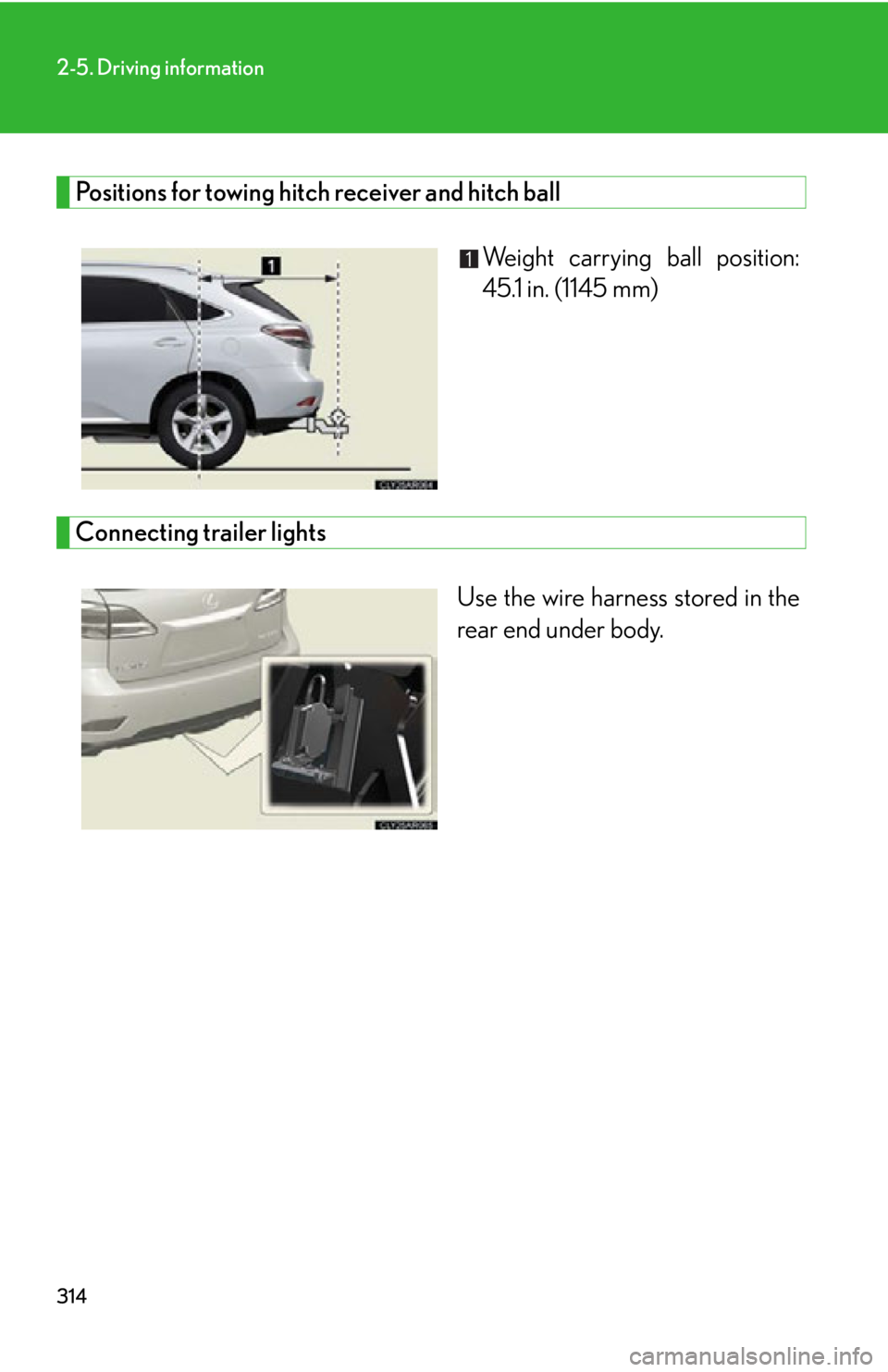
Positions for towing hitch receiver and hitch ball
Weight carrying ball position:
45.1 in. (1145 mm)
Connecting trailer lights
Use the wire harness stored in the
rear end under body.
Page 315 of 886

3152-5. Driving information
2
When driving ■
Auto current cut-off function
In case of over current, the auto cut-off function stops the power flowing to the
trailer lights to prevent damage to the vehicle’s electrical system.
This function is activated when the rated current of any of the following trailer light
circuit components is exceeded: ●
Tail lights: maximum 7.8 A ●
Stop/turn signal light (right): maximum 4.5 A●
Stop/turn signal light (left): maximum 4.5 A■
When the auto current cut function is activated
If a trailer light does not come on due to the activation of the auto current cut func-
tion, the light system will need to be reset.
Follow the reset procedure shown below. ●
If a tail light does not come on, turn off the headlight switch.●
If the right-side stop/turn signal light does not come on, put the turn signal in the
off position or remove foot from the brake pedal.●
If the left-side stop/turn signal light does not come on, put the turn signal in the
off position or remove foot from the brake pedal.
If the emergency flashers do not operate, press the emergency flasher switch to
turn them off.
After the light system is reset, operate the light switches again to see if the lights
operate normally.
If the lights do not operate normally, have the vehicle inspected by your Lexus
dealer.
Page 316 of 886

3162-5. Driving information
Trailer towing tips
Your vehicle will handle differently when towing a trailer. Help to avoid an
accident, death or serious injury, keep the following in mind when towing:
● Speed limits for towing a trailer va ry by state or province. Do not
exceed the posted towing speed limit.
● Lexus recommends that the vehicle-trailer speed limit is 65 mph (104
km/h) on a flat, straight, dry road. Do not exceed this limit, the posted
towing speed limit or the speed limit for your trailer as set forth in your
trailer owner’s manual, whichever is lowest. Instability of the towing
vehicle-trailer combination (trailer sway) increases as speed increases.
Exceeding speed limits may cause loss of control.
● Before starting out, check the trailer lights, tires and the vehicle-trailer
connections. Recheck after driving a short distance.
● Practice turning, stopping and reversing with th e trailer attached in an
area away from traffic until you be come accustomed to the feel of the
vehicle-trailer combination.
● Reversing with a trailer attached is difficult and requires practice. Grip
the bottom of the steering wheel and move your hand to the left to
move the trailer to the left. Move yo ur hand to the right to move the
trailer to the right. (This is gene rally opposite to reversing without a
trailer attached.) Avoid sharp or prolonged turning. Have someone
guide you when reversing to redu ce the risk of an accident.
● As stopping distance is increased when towing a trailer, vehicle-to-
vehicle distance should be increas ed. For each 10 mph (16 km/h) of
speed, allow at least one vehicle and trailer length.
● Avoid sudden braking as you may skid, resulting in the trailer jackknif-
ing and a loss of vehicle control. Th is is especially true on wet or slip-
pery surfaces.
● Avoid jerky starts or sudden acceleration.
Page 317 of 886

3172-5. Driving information
2
When driving ● Avoid jerky steering and sharp turns, and slow down before making a
turn.
● Note that when making a turn, the tr ailer wheels will be closer than the
vehicle wheels to the inside of th e turn. Compensate by making a
wider than normal turning radius.
● Slow down before making a turn, in cross winds, on wet or slippery sur-
faces, etc.
Increasing vehicle speed can destabilize the trailer.
● Take care when passing other vehi cles. Passing requires considerable
distance. After passing a vehicle, do not forget the length of your
trailer, and be sure you have plenty of room before changing lanes.
● To maintain engine braking efficiency and charging system perfor-
mance when using engine braking, do not put the transmission in D.
● Instability happens more frequently when descending steep or long
downhill grades. Before descending, slow down and downshift. Do not
make sudden downshifts while descending steep or long downhill
grades.
● Avoid holding the brake pedal down too long or applying the brakes
too frequently. This could cause th e brakes to overheat and result in
reduced braking efficiency.
● Due to the added load of the trailer, your vehicle’s engine may overheat
on hot days (at temperatures over 85°F [30°C]) when driving up a
long or steep grade. If the eng ine coolant temperature gauge indicates
overheating, immediately turn off th e air conditioning (if in use), pull
your vehicle off the road and stop in a safe spot. ( P. 799)