transmission LEXUS RX350 2015 User Guide
[x] Cancel search | Manufacturer: LEXUS, Model Year: 2015, Model line: RX350, Model: LEXUS RX350 2015Pages: 886, PDF Size: 11 MB
Page 294 of 886
2942-5. Driving information
CAUTION■
Off-road driving precautions
Always observe the following precautions to minimize the risk of death or serious
injury or damage to your vehicle: ●
Drive carefully when off the road. Do not take unnecessary risks by driving in
dangerous places.●
Do not grip the steering wheel spokes wh en driving off-road. A bad bump could
jerk the wheel and injure your hands. Keep both hands and especially your
thumbs on the outside of the rim.●
Always check your brakes for effectiveness immediately after driving in sand,
mud, water or snow.●
After driving through tall grass, mud, rock , sand, water, etc., check that there is no
grass, bush, paper, rags, stone, sand, etc. adhering or trapped to the underbody.
Clear off any such matter from the underbody. If the vehicle is used with these
materials trapped or adhering to the underbody, a breakdown or fire could occur.●
When driving off-road or in rugged te rrain, do not drive at excessive speeds,
jump, make sharp turns, strike objects, etc. This may cause loss of control or vehi-
cle rollover causing death or serious injury. You are also risking expensive dam-
age to your vehicle’s suspension and chassis.
NOTICE■
To prevent water damage
Take all necessary safety measures to ensure that water damage to the engine or
other components does not occur. ●
Water entering the engine air intake will cause severe engine damage. ●
Water entering the automatic transmission will cause deterioration in shift quality,
locking up of your transmission accompanied by vibration, and ultimately dam-
age.
●
Water can wash the grease from wheel bearings, causing rusting and premature
failure, and may also enter the differentials, transmission and transfer case, reduc-
ing the gear oil’s lubricating qualities.
Page 317 of 886

3172-5. Driving information
2
When driving ● Avoid jerky steering and sharp turns, and slow down before making a
turn.
● Note that when making a turn, the tr ailer wheels will be closer than the
vehicle wheels to the inside of th e turn. Compensate by making a
wider than normal turning radius.
● Slow down before making a turn, in cross winds, on wet or slippery sur-
faces, etc.
Increasing vehicle speed can destabilize the trailer.
● Take care when passing other vehi cles. Passing requires considerable
distance. After passing a vehicle, do not forget the length of your
trailer, and be sure you have plenty of room before changing lanes.
● To maintain engine braking efficiency and charging system perfor-
mance when using engine braking, do not put the transmission in D.
● Instability happens more frequently when descending steep or long
downhill grades. Before descending, slow down and downshift. Do not
make sudden downshifts while descending steep or long downhill
grades.
● Avoid holding the brake pedal down too long or applying the brakes
too frequently. This could cause th e brakes to overheat and result in
reduced braking efficiency.
● Due to the added load of the trailer, your vehicle’s engine may overheat
on hot days (at temperatures over 85°F [30°C]) when driving up a
long or steep grade. If the eng ine coolant temperature gauge indicates
overheating, immediately turn off th e air conditioning (if in use), pull
your vehicle off the road and stop in a safe spot. ( P. 799)
Page 318 of 886
3182-5. Driving information
● Always place wheel bloc ks under both the vehi cle’s and the trailer’s
wheels when parking. Apply the pa rking brake firmly, and put the
transmission in P. Avoid parking on a slope, but if unavoidable, do so
only after performing the following:
Apply the brakes and keep them applied.
Have someone place wheel blocks under both the vehicle’s and
trailer’s wheels.
When the wheel blocks are in pl ace, release the brakes slowly
until the blocks absorb the load.
Apply the parking brake firmly.
Shift into P and turn off the engine.
● When restarting after parking on a slope:
With the transmission in P, start th e engine. Be sure to keep the
brake pedal depressed.
Shift into a forward gear. If reversing, shift into R.
Release the parking brake and br ake pedal, and slowly pull or
back away from the wheel blocks. Stop and apply the brakes.
Have someone retrieve the blocks.STEP 1
STEP 2
STEP 3
STEP 4
STEP 5
STEP 1
STEP 2
STEP 3
STEP 4
Page 320 of 886

3202-5. Driving information
■
Break-in schedule
If your vehicle is new or equipped with any new power train components (such as
an engine, transmission, differential or wheel bearing), Lexus recommends that you
do not tow a trailer until the vehicle has been driven for over 500 miles (800 km).
After the vehicle has been driven for over 500 miles (800 km), you can start tow-
ing. However, for the next 500 miles (800 km), drive the vehicle at a speed of less
than 50 mph (80 km/h) when towing a trailer, and avoid full throttle acceleration.■
Maintenance ●
If you tow a trailer, your vehicle will require more frequent maintenance due to
the additional load. (See “Warranty and Services Guide”, “Owner's Manual
Supplement” or “Scheduled Maintenance”.)●
Retighten the fixing bolts of the towing ball and bracket after approximately
600 miles (1000 km) of trailer towing.■
If trailer sway occurs
One or more factors (crosswinds, passing vehicles, rough roads, etc.) can adversely
affect handling of your vehicle and trailer, causing instability. ●
If trailer swaying occurs:
• Firmly grip the steering wheel. Steer straight ahead.
Do not try to control trailer sway ing by turning the steering wheel.
• Begin releasing the accelerator peda l immediately but very gradually to
reduce speed.
Do not increase speed. Do not apply vehicle brakes.
If you make no extreme correction with the steering or brakes, your vehicle and
trailer should stabilize. ●
After the trailer swaying has stopped:
• Stop in a safe place. Get all occupants out of the vehicle.
• Check the tires of the vehicle and the trailer.
• Check the load in the trailer.
Make sure the load has not shifted.
Make sure the tongue weight is appropriate, if possible.
• Check the load in the vehicle.
Make sure the vehicle is not ov erloaded after occupants get in.
If you cannot find any problems, the speed at which trailer swaying occurred is
beyond the limit of your particular vehicle-trailer combination.
Drive at a lower speed to prevent instability. Remember that swaying of the towing
vehicle-trailer increases as speed increases.
Page 323 of 886
3232-5. Driving information
2
When driving Dinghy towing NOTICE■
To avoid serious damage to your vehicle
■
To prevent causing serious damage to th e transmission and Active Torque Con-
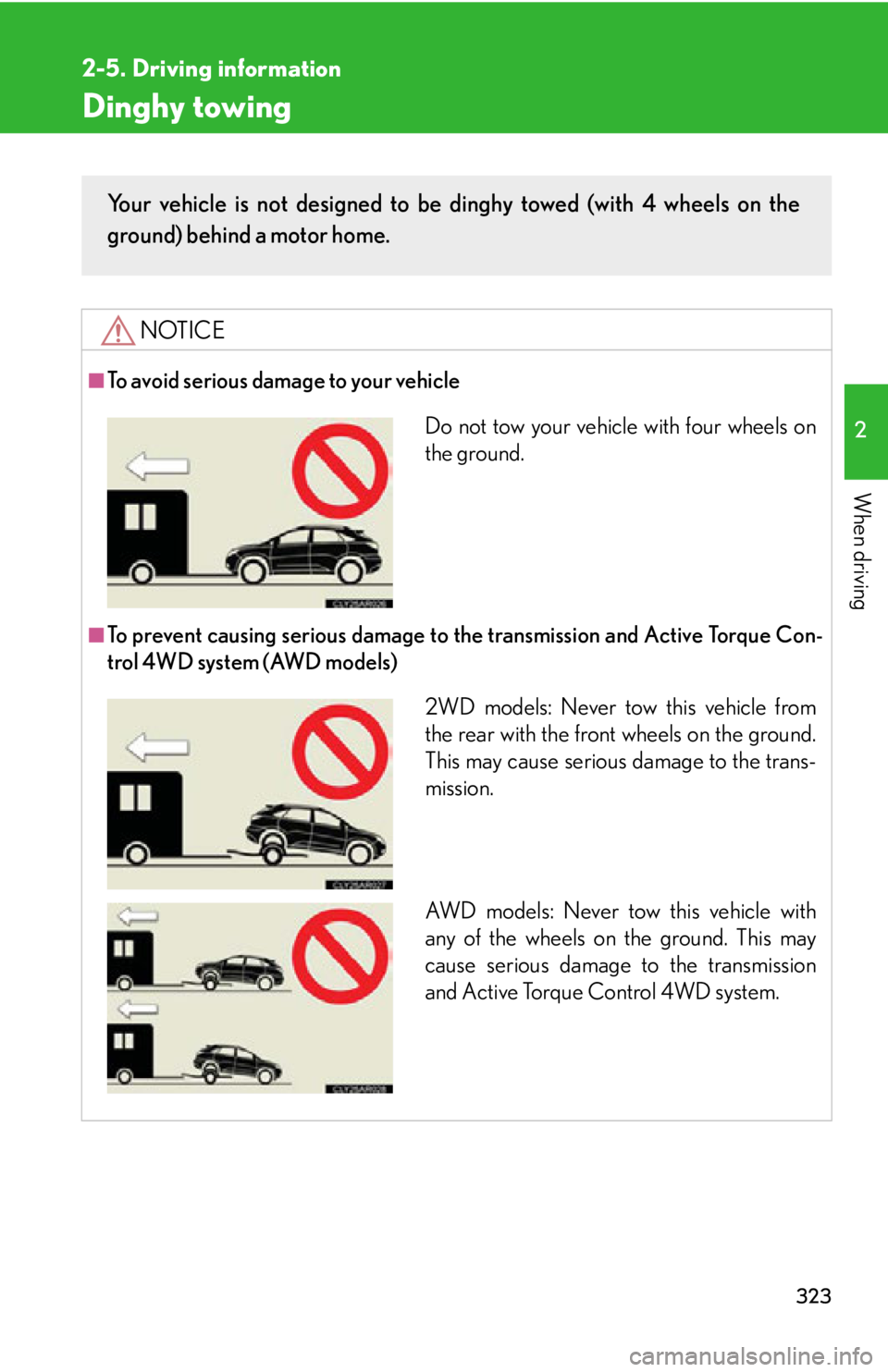
trol 4WD system (AWD models)Your vehicle is not designed to be dinghy towed (with 4 wheels on the
ground) behind a motor home.
Do not tow your vehicle with four wheels on
the ground.
2WD models: Never tow this vehicle from
the rear with the front wheels on the ground.
This may cause serious damage to the trans-
mission.
AW D m o d e l s : N e v e r t o w this vehicle with
any of the wheels on the ground. This may
cause serious damage to the transmission
and Active Torque Control 4WD system.
Page 660 of 886
6604-2. Maintenance
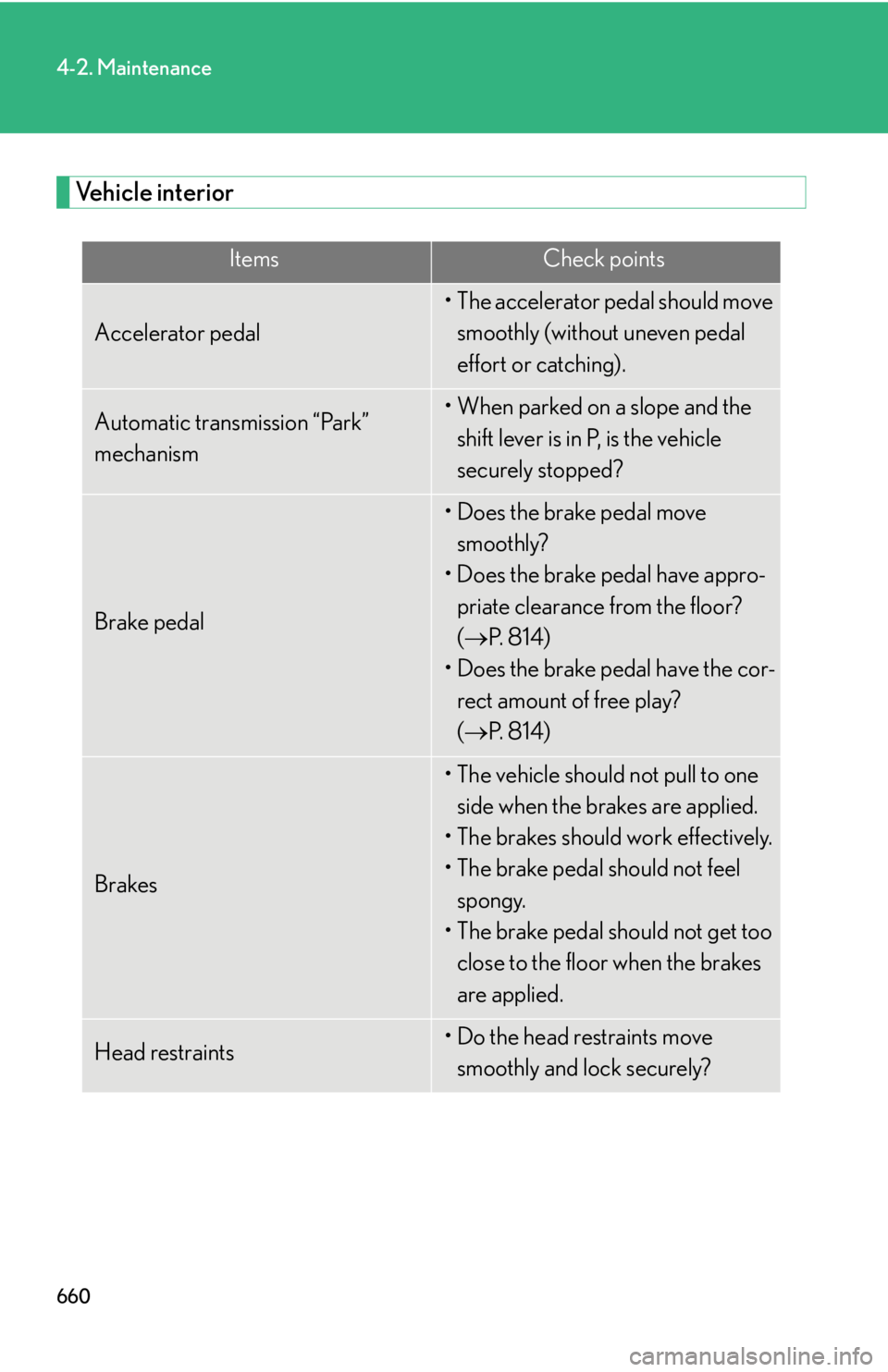
Vehicle interior Items Check points
Accelerator pedal • The accelerator pedal should move
smoothly (without uneven pedal
effort or catching).
Automatic transmission “Park”
mechanism • When parked on a slope and the
shift lever is in P, is the vehicle
securely stopped?
Brake pedal • Does the brake pedal move
smoothly?
• Does the brake pedal have appro-
priate clearance from the floor?
( P. 8 1 4 )
• Does the brake pedal have the cor-
rect amount of free play?
( P. 8 1 4 )
Brakes • The vehicle should not pull to one
side when the brakes are applied.
• The brakes should work effectively.
• The brake pedal should not feel
spongy.
• The brake pedal should not get too
close to the floor when the brakes
are applied.
Head restraints • Do the head restraints move
smoothly and lock securely?
Page 709 of 886
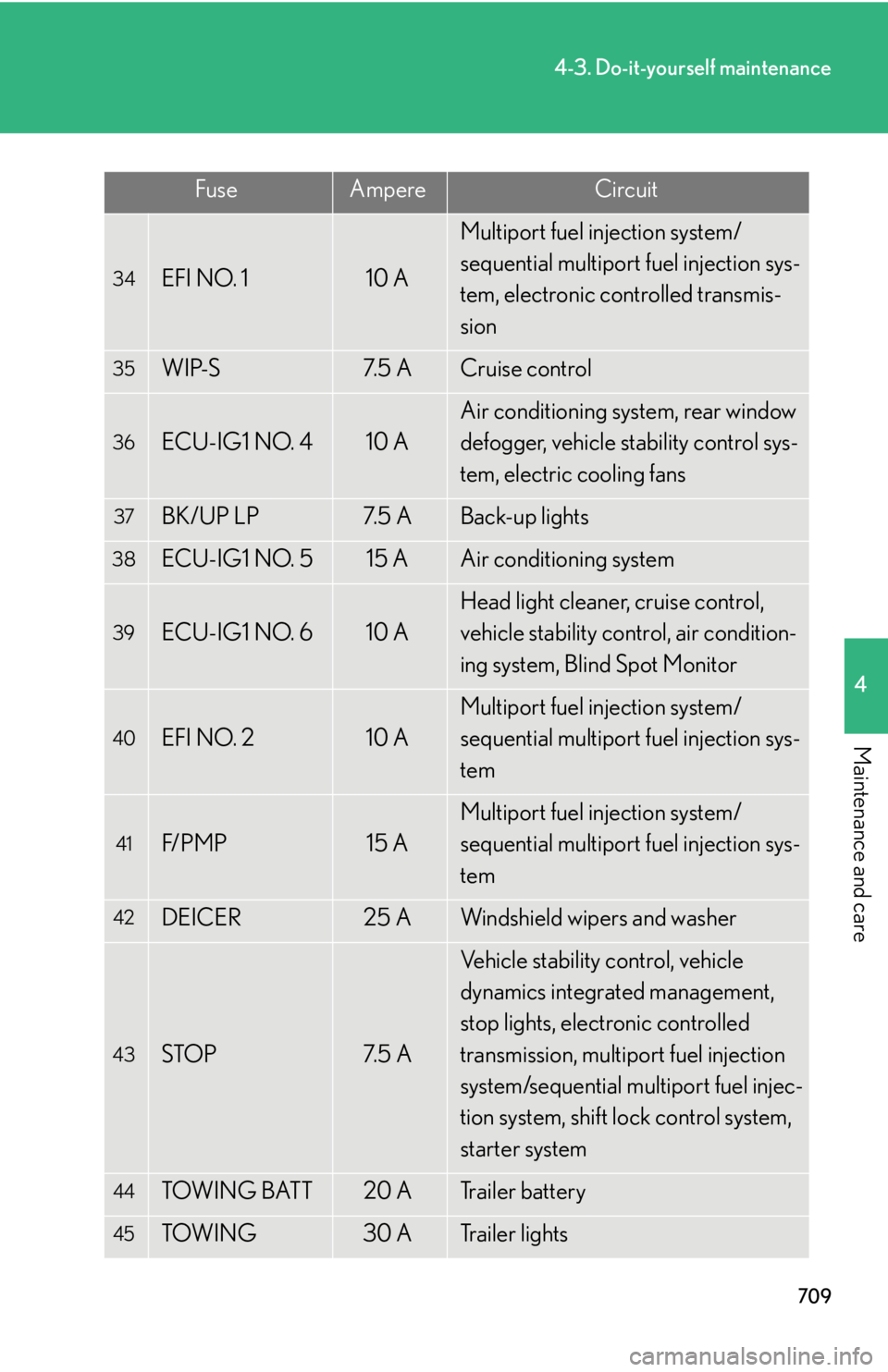
7094-3. Do-it-yourself maintenance
4
Maintenance and care 34
EFI NO. 1 10 A Multiport fuel injection system/
sequential multiport fuel injection sys-
tem, electronic controlled transmis-
sion35
WIP-S 7. 5 A Cruise control36
ECU-IG1 NO. 4 10 A Air conditioning system, rear window
defogger, vehicle stability control sys-
tem, electric cooling fans37
BK/UP LP 7. 5 A Back-up lights38
ECU-IG1 NO. 5 15 A Air conditioning system39
ECU-IG1 NO. 6 10 A Head light cleaner, cruise control,
vehicle stability control, air condition-
ing system, Blind Spot Monitor40
EFI NO. 2 10 A Multiport fuel injection system/
sequential multiport fuel injection sys-
tem41
F/ P M P 15 A Multiport fuel injection system/
sequential multiport fuel injection sys-
tem42
DEICER 25 A Windshield wipers and washer
43
STOP 7. 5 A Vehicle stability control, vehicle
dynamics integrated management,
stop lights, electronic controlled
transmission, multiport fuel injection
system/sequential multiport fuel injec-
tion system, shift lock control system,
starter system
44
TOW I N G BAT T 20 A Trailer battery
45
TOW I N G 30 A Trailer lightsFuse Ampere Circuit
Page 712 of 886

7124-3. Do-it-yourself maintenance
7
ECU-IG1 NO. 1 10 A Multiplex communication system,
steering sensor, shift lock control sys-
tem, tilt and telescopic steering, auto-
matic transmission system, power
back door, pre-collision system, vehi-
cle stability control system, tire pres-
sure warning system8
S/ROOF 30 A Moon roof9
FUEL OPN 7. 5 A Fuel filler door opener10
PSB 30 A Pre-collision seat belt11
TI & TE 30 A Tilt and telescopic steering system12
DR LOCK 10 A13
FR FOG 7. 5 A Front fog lights14
P-S E AT L H 30 A Po w e r s e a t ( l e f t - s i d e )15
4WD 7. 5 A AW D s y s t e m16
INVERTER 20 A Po w e r o u t l e t17
RR FOG 7. 5 A18
D/L ALT B 25 A Multiplex communication system,
power door lock system, power back
door19
EPS 10 A Electric power steering system20
ECU-IG1 NO. 2 10 A Intuitive parking assist, AWD system,
pre-collision seat beltFuse Ampere Circuit
Page 713 of 886
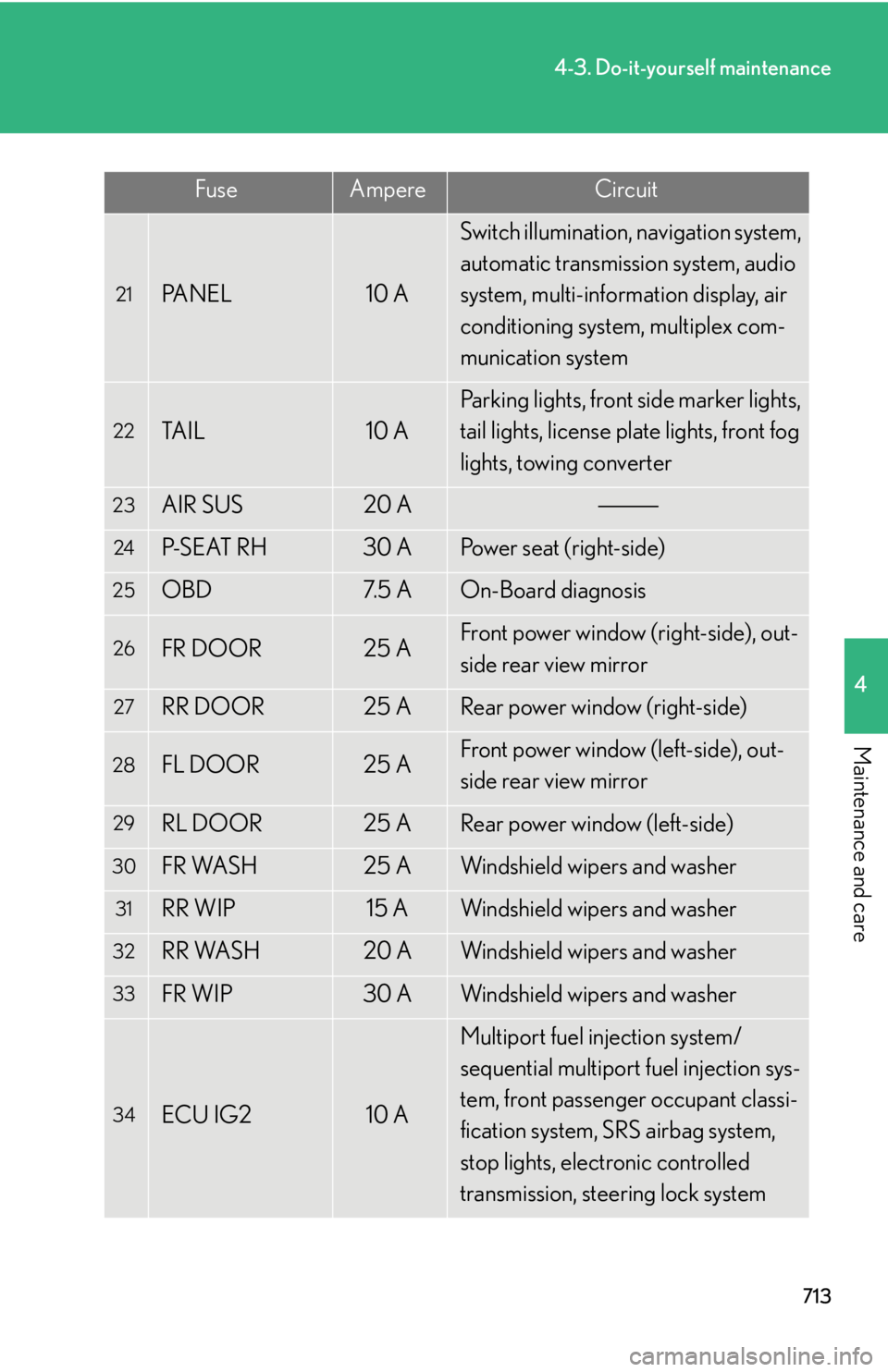
7134-3. Do-it-yourself maintenance
4
Maintenance and care 21
PA N E L 10 A Switch illumination, navigation system,
automatic transmission system, audio
system, multi-information display, air
conditioning system, multiplex com-
munication system22
TA I L 10 A Parking lights, front side marker lights,
tail lights, license plate lights, front fog
lights, towing converter23
AIR SUS 20 A24
P-S E AT R H 30 A Power seat (right-side)25
OBD 7. 5 A On-Board diagnosis26
FR DOOR 25 A Front power window (right-side), out-
side rear view mirror27
RR DOOR 25 A Rear power window (right-side)28
FL DOOR 25 A Front power window (left-side), out-
side rear view mirror29
RL DOOR 25 A Rear power window (left-side)30
FR WASH 25 A Windshield wipers and washer31
RR WIP 15 A Windshield wipers and washer32
RR WASH 20 A Windshield wipers and washer33
FR WIP 30 A Windshield wipers and washer
34
ECU IG2 10 A Multiport fuel injection system/
sequential multiport fuel injection sys-
tem, front passenger occupant classi-
fication system, SRS airbag system,
stop lights, electronic controlled
transmission, steering lock systemFuse Ampere Circuit
Page 735 of 886
5
When trouble arises
7355-1. Essential information
If your vehicle needs to be towed
Situations needs to contact dealers before towing
The following may indicate a problem with your transmission. Contact
your Lexus dealer before towing.
● The engine is running but the vehicle will not move.
● The vehicle makes an abnormal sound.
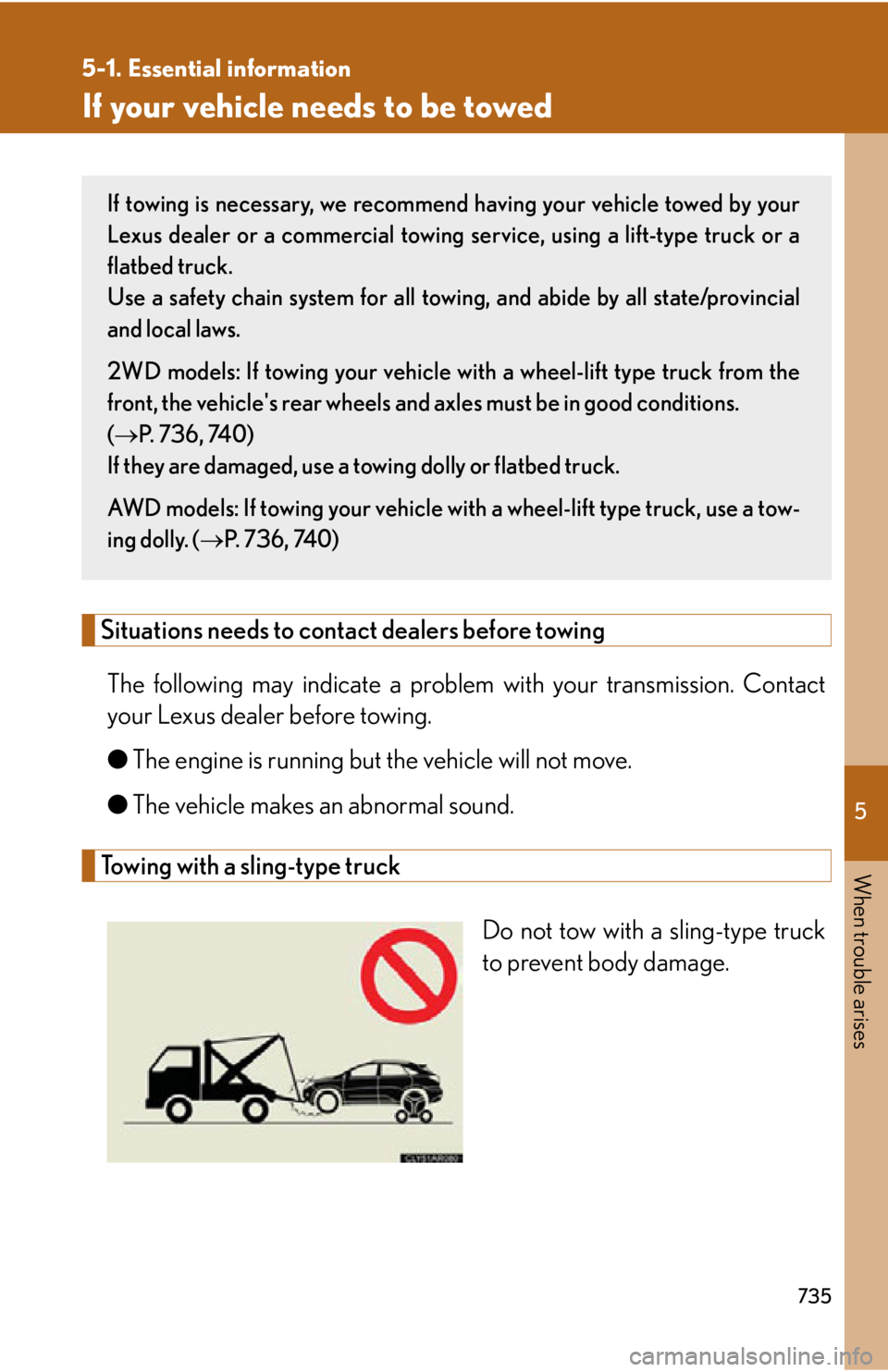
Towing with a sling-type truck
Do not tow with a sling-type truck
to prevent body damage.If towing is necessary, we recommend having your vehicle towed by your
Lexus dealer or a commercial towing service, using a lift-type truck or a
flatbed truck.
Use a safety chain system for all towi ng, and abide by all state/provincial
and local laws.
2WD models: If towing your vehicle wi th a wheel-lift type truck from the
front, the vehicle's rear wheels and axles must be in good conditions.
( P. 7 3 6 , 74 0 )
If they are damaged, use a to wing dolly or flatbed truck.
AWD models: If towing your vehicle with a wheel-lift type truck, use a tow-
ing dolly. ( P. 7 3 6 , 74 0 )