radio LEXUS RX350 2015 Repair Manual
[x] Cancel search | Manufacturer: LEXUS, Model Year: 2015, Model line: RX350, Model: LEXUS RX350 2015Pages: 886, PDF Size: 11 MB
Page 562 of 886

5623-4. Using the audio system
■
Compatible models
Compatible with HFP (Hands Free Profile) Ver. 1.0 or higher (Conformed: Ver. 1.5)
and OPP (Object Push Profile) Ver. 1.1.
If your mobile phone does not support HFP, you cannot enter the Bluetooth ®
phone. If your mobile phone supports OPP alone, you cannot use the Bluetooth ®
phone.■
Certification for the hands-free system
FCC ID: AJDK018
IC ID: 775E-K018
This device complies with Part 15 of FCC Rules and Industry Canada licence-
exempt RSS standard(s). Operation is subject to the following two conditions: (1)
this device may not cause interference, and (2) this device must accept any inter-
ference, including interference that may cause undesired operation of this device.
Le présent appareil est conforme aux la partie 15 des règles de la FCC et CNR
d’Industrie Canada applicables aux appareils radio exempts de licence. L’exploita-
tion est autorisée aux deux conditions suivantes : (1) l’appareil ne doit pas produire
de brouillage, et (2) l’utilisateur de l’appareil doit accepter tout brouillage
radioélectrique subi, même si le brouilla ge est susceptible d’en compromettre le
fonctionnement.
Page 563 of 886
5633-4. Using the audio system
3
Interior features CAUTION■
FCC WARNING
Changes or modifications not expressly approved by the party responsible for
compliance could void the user's authority to operate the equipment.
This equipment complies with FCC/IC radiation exposure limits set forth for an
uncontrolled environment and meets the FCC radio frequency (RF) Exposure
Guidelines in Supplement C to OET65 and RSS-102 of the IC radio frequency
(RF) Exposure rules. This equipment has very low levels of RF energy that it
deemed to comply without maximum permis sive exposure evaluation (MPE). But it
is desirable that it should be installed and operated keeping the radiator at least 20
cm or more away from person’s body (excluding extremities: hands, wrists, feet and
ankles).
Cet équipement est conforme aux limites d’exposition aux rayonnements énon-
cées pour un environnement non contrôlé et respecte les règles les radioélec-
triques (RF) de la FCC lignes directrice s d’exposition dans le Supplément C à
OET65 et d’exposition aux fréquences ra dioélectriques (RF) CNR-102 de l’IC.
Cet équipement émet une énergie RF très faible qui est considérée conforme sans
évaluation de l’exposition maximale autorisée.
Cependant, cet équipement doit être instal lé et utilisé en gardant une distance de
20 cm ou plus entre le dispositif rayonnan t et le corps (à l’exception des extrémités
: mains, poignets, pieds et chevilles).
This transmitter must not be co-located or operated in conjunction with any other
antenna or transmitter.
Under Industry Canada regulations, this radio transmitter may only operate using
an antenna of a type and maximum (or lesser) gain approved for the transmitter by
Industry Canada. To reduce potential radio interference to other users, the antenna
type and its gain should be so chosen that the equivalent isotropically radiated
power (e.i.r.p.) is not more than that necessary for successful communication.
Conformément à la réglementation d’Indu strie Canada, le présent émetteur radio
peut fonctionner avec une antenne d’un ty pe et d’un gain maximal (ou inférieur)
approuvé pour l’émetteur par Industrie Ca nada. Dans le but de réduire les risques
de brouillage radioélectrique à l’intention des autres utilisateurs, il faut choisir le
type d’antenne et son gain de sorte que la puissance isotrope rayonnée équivalente
(p.i.r.e.) ne dépasse pas l’intensité nécessaire à l’établissement d’une communica-
tion satisfaisante.
Page 564 of 886
5643-4. Using the audio system
CAUTION■
Caution while driving
Do not use a mobile phone or connect the Bluetooth ®
phone.■
Caution regarding interference with electronic devices ●
Your audio unit is fi tted with Bluetooth ®
antennas. People with implantable car-
diac pacemakers, cardiac resynchronization therapy-pacemakers or implantable
cardioverter defibrillators should maintain a reasonable distance between them-
selves and the Bluetooth ®
antennas. The radio waves may affect the operation of
such devices.●
Before using Bluetooth ®
devices, users of any electrical medical device other
than implantable cardiac pacemakers, cardiac resynchronization therapy-pace-
makers or implantable cardioverter defibrillators should consult the manufac-
turer of the device for information about its operation under the influence of radio
waves. Radio waves could have unexpected effects on the operation of such
medical devices.
NOTICE■
To prevent damage to mobile phones
Do not leave mobile phones in the vehicle. The temperature inside the vehicle may
become high, resulting in damage to the phone.
Page 636 of 886
6363-7. Other interior features
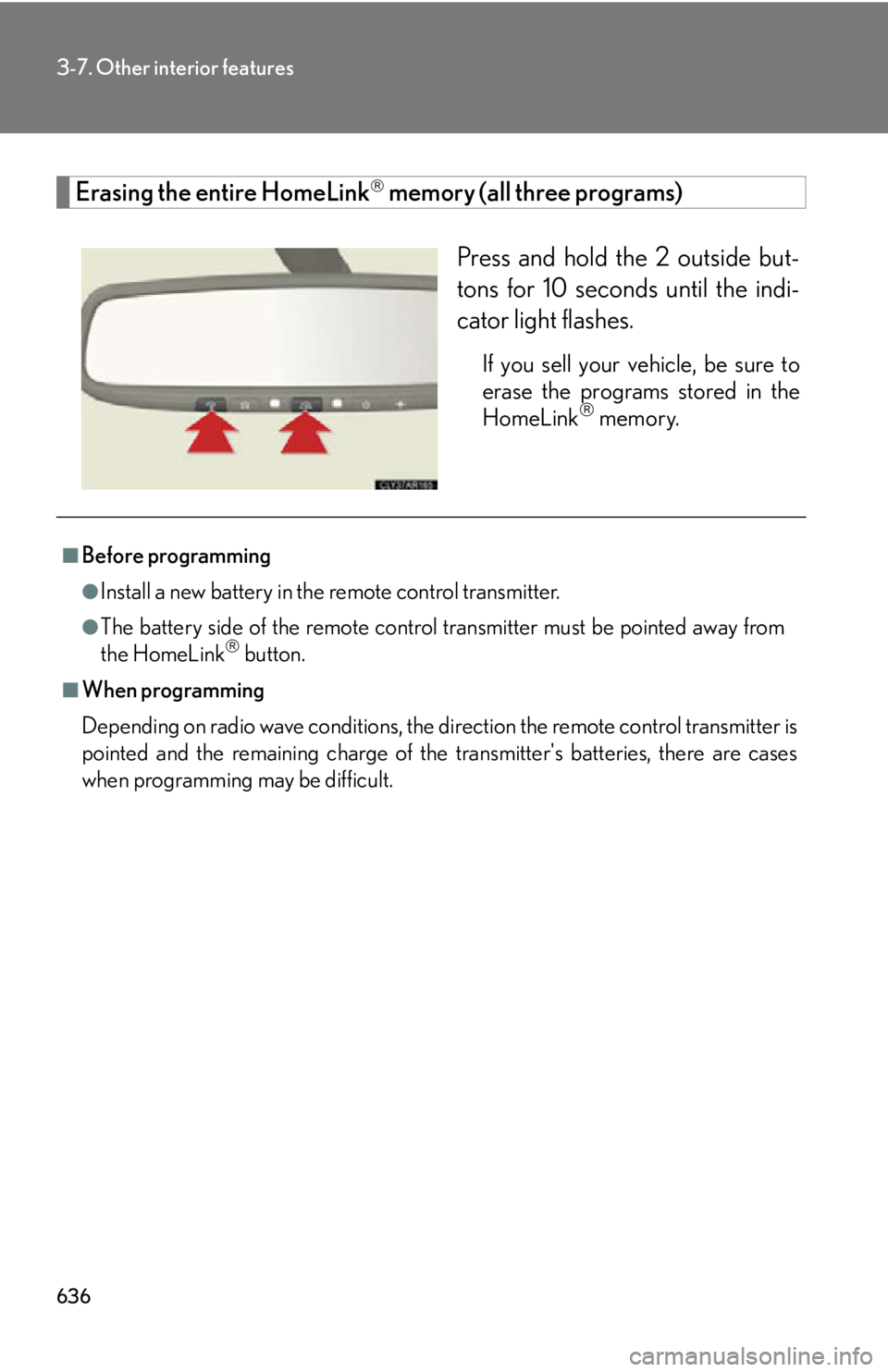
Erasing the entire HomeLink
memory (all three programs)
Press and hold the 2 outside but-
tons for 10 seconds until the indi-
cator light flashes. If you sell your vehicle, be sure to
erase the programs stored in the
HomeLink
memory.
■
Before programming ●
Install a new battery in the remote control transmitter.●
The battery side of the remote control transmitter must be pointed away from
the HomeLink
button.■
When programming
Depending on radio wave conditions, the di rection the remote control transmitter is
pointed and the remaining charge of the transmitter's batteries, there are cases
when programming may be difficult.
Page 647 of 886

6473-7. Other interior features
3
Interior features Safety information for Safety Connect
Important! Read this information before using Safety Connect.
■ Exposure to radio frequency signals
The Safety Connect sy stem installed in your vehicle is a low-power
radio transmitter and receiver. It receives and also sends out radio fre-
quency (RF) signals.
In August 1996, the Federal Communications Commission (FCC)
adopted RF exposure guidelines with safety levels fo r mobile wireless
phones. Those guidelines are consistent with th e safety standards pre-
viously set by the following U.S. and international standards bodies.
● ANSI (American National Standards Institute) C95.1 [1992]
● NCRP (National Council on Radiation Protection and Measure-
ment) Report 86 [1986]
● ICNIRP (International Commission on Non-Ionizing Radiation Pro-
tection) [1996]
Those standards were based on co mprehensive and periodic evalua-
tions of the relevant scientific literature. Over 120 scientists, engineers,
and physicians from universities, an d government health agencies and
industries reviewed the available body of research to develop the
ANSI Standard (C95.1).
The design of Safety Connect co mplies with the FCC guidelines in
addition to those standards.
Page 690 of 886

6904-3. Do-it-yourself maintenance
■
Certification for tire pressure warning system
TPMS Transmitter FCC ID: PAXPMV107J
For vehicles sold in the U.S.A.
NOTE:
This device complies with part 15 of the FCC Rules. Operation is subject to the fol-
lowing two conditions: (1) This device may not cause harmful interference, and (2)
this device must accept any interference received, including interference that may
cause undesired operation.
FCC WARNING:
Changes or modifications not expressly approved by the party responsible for
compliance could void the user’s authority to operate the equipment.
For vehicles sold in Canada
NOTE:
Operation is subject to the following two conditions: (1) this device may not cause
interference, and (2) this device must a ccept any interference, including interfer-
ence that may cause undesired operation of the device.
L’utilisation de ce dispositif est autori sée seulement aux deux conditions suivantes:
(1) il ne doit pas produire de brouillage, et (2) l’utilisateur du dispositif doit être prêt
à accepter tout brouillage radioélectrique reçu, même si ce brouillage est
susceptible de compromettre le fonctionnement du dispositif.
TPMS Receiver FCC ID: HYQ13BCX
NOTE:
This device complies with part 15 of the FCC Rules. Operation is subject to the fol-
lowing two conditions: (1) This device may not cause harmful interference, and (2)
this device must accept any interference received, including interference that may
cause undesired operation.
FCC WARNING:
Changes or modifications not expressly approved by the party responsible for
compliance could void the user’s authority to operate the equipment.
Page 707 of 886
7074-3. Do-it-yourself maintenance
4
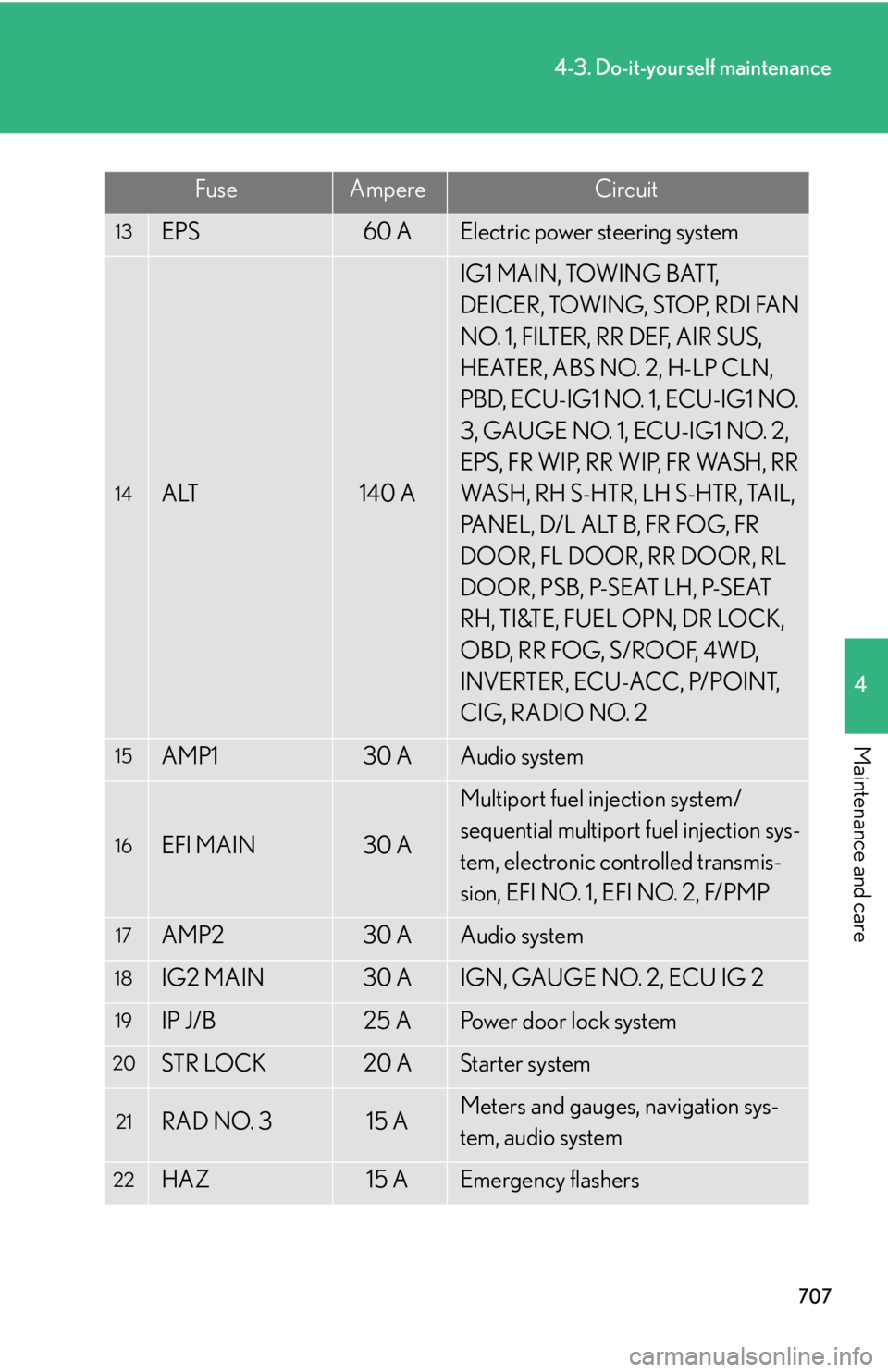
Maintenance and care 13
EPS 60 A Electric power steering system
14
ALT 140 A IG1 MAIN, TOWING BATT,
DEICER, TOWING, STOP, RDI FAN
NO. 1, FILTER, RR DEF, AIR SUS,
HEATER, ABS NO. 2, H-LP CLN,
PBD, ECU-IG1 NO. 1, ECU-IG1 NO.
3, GAUGE NO. 1, ECU-IG1 NO. 2,
EPS, FR WIP, RR WIP, FR WASH, RR
WASH, RH S-HTR, LH S-HTR, TAIL,
PANEL, D/L ALT B, FR FOG, FR
DOOR, FL DOOR, RR DOOR, RL
DOOR, PSB, P-SEAT LH, P-SEAT
RH, TI&TE, FUEL OPN, DR LOCK,
O B D, R R F O G, S / R O O F, 4 W D,
INVERTER, ECU-ACC, P/POINT,
CIG, RADIO NO. 215
AMP1 30 A Audio system16
EFI MAIN 30 A Multiport fuel injection system/
sequential multiport fuel injection sys-
tem, electronic controlled transmis-
sion, EFI NO. 1, EFI NO. 2, F/PMP17
AMP2 30 A Audio system18
IG2 MAIN 30 A IGN, GAUGE NO. 2, ECU IG 219
IP J/B 25 A Power door lock system20
STR LOCK 20 A Starter system
21
RAD NO. 3 15 A Meters and gauges, navigation sys-
tem, audio system
22
HAZ 15 A Emergency flashersFuse Ampere Circuit
Page 711 of 886
7114-3. Do-it-yourself maintenance
4
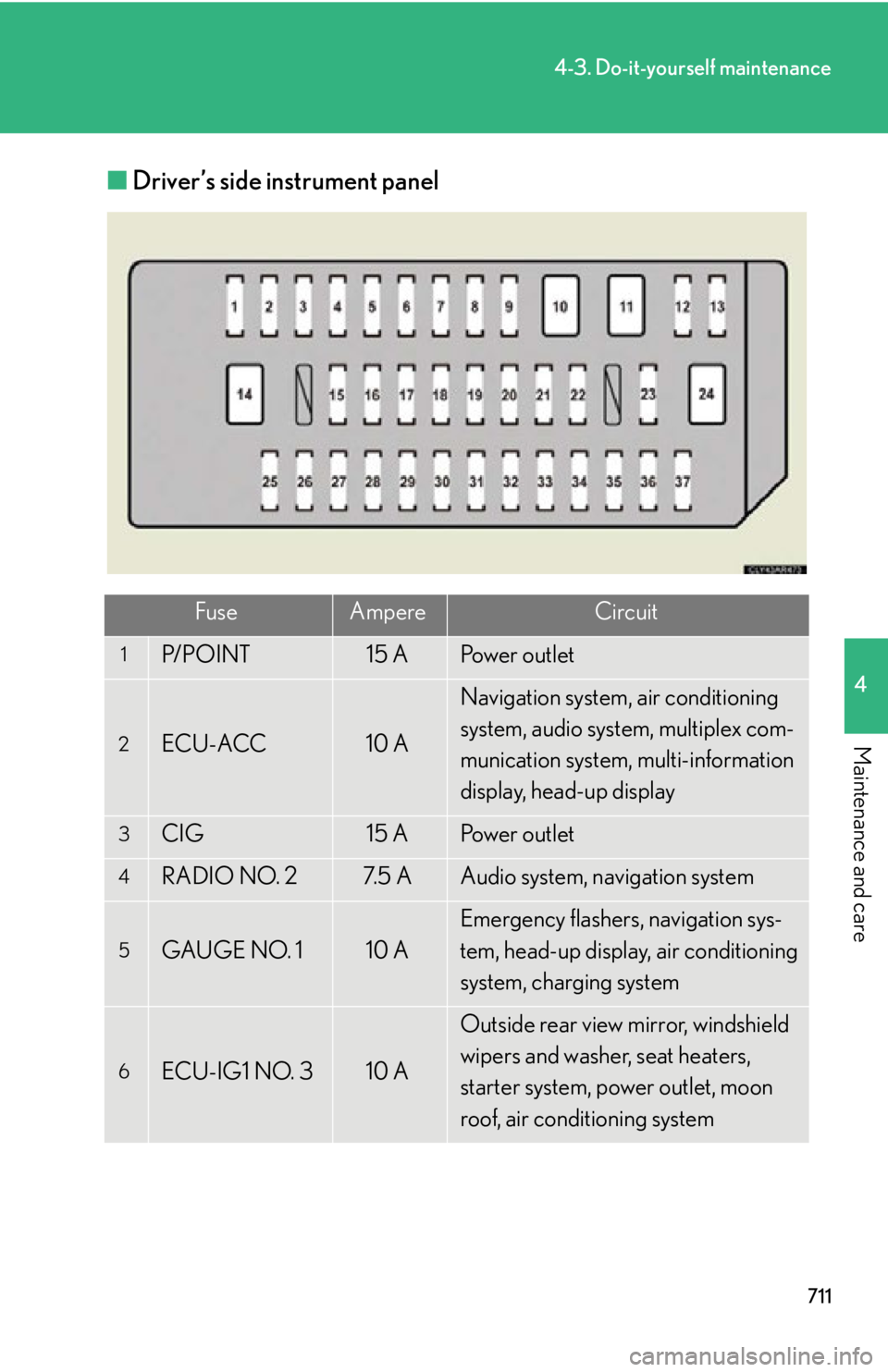
Maintenance and care ■ Driver’s side instrument panel
Fuse Ampere Circuit1
P/ P O I N T 15 A Po w e r o u t l e t2
ECU-ACC 10 A Navigation system, air conditioning
system, audio system, multiplex com-
munication system, multi-information
display, head-up display3
CIG 15 A Po w e r o u t l e t4
RADIO NO. 2 7. 5 A Audio system, navigation system5
GAUGE NO. 1 10 A Emergency flashers, navigation sys-
tem, head-up display, air conditioning
system, charging system
6
ECU-IG1 NO. 3 10 A Outside rear view mirror, windshield
wipers and washer, seat heaters,
starter system, power outlet, moon
roof, air conditioning system
Page 750 of 886
7505-2. Steps to take in an emergency
■
The tire pressure warning light may come on due to natural causes
The tire pressure warning light may come on due to natural causes such as natural
air leaks and tire inflation pressure chan ges caused by temperature. In this case,
adjusting the tire inflation pressure will turn off the warning light (after a few min-
utes).■
When a tire is replaced with a spare tire
Vehicles with a compact spare tire
The compact spare tire is not equipped with a tire pressure warning valve and trans-
mitter. If a tire goes flat, the tire pressure warning light will not turn off even though
the flat tire has been replaced with the spare tire. Replace the spare tire with the
repaired tire and adjust the tire inflatio n pressure. The tire pressure warning light
will go off after a few minutes.
Vehicles with a full-size spare tire
The spare tire is also equipped with the tire pressure warning valve and transmitter.
The tire pressure warning light will turn on if the tire inflation pressure of the spare
tire is low. If a tire goes flat, even though the flat tire is replaced with the spare tire,
the tire pressure warning light does not turn off. Replace the spare tire with the
repaired tire and adjust to the proper tire inflation pressure. The tire pressure warn-
ing light will turn off after a few minutes.■
If the tire pressure warning system is not functioning
The tire pressure warning system will be disabled in the following conditions:
(When the condition becomes normal, the system will work properly.) ●
If tires not equipped with tire pressure warning valves and transmitters are used●
If the ID code on the tire pressure warning valves and transmitters is not regis-
tered in the tire pressure warning computer●
If the tire inflation pressure is 73 psi (500 kPa, 5.1 kgf/cm 2
or bar) or higher
The tire pressure warning system may be disabled in the following conditions:
(When the condition becomes normal, the system will work properly.)
●
If electronic devices or facilities using similar radio wave frequencies are nearby
●
If a radio set at similar frequencies is in use in the vehicle
●
If a window tint that affects the radio wave signals is installed
●
If there is a lot of snow or ice on the vehicle, in particular around the wheels or
wheel housings
Page 751 of 886
5
When trouble arises
7515-2. Steps to take in an emergency
●
If non-genuine Lexus wheels are used (Even if you use Lexus wheels, the tire
pressure warning system may not work properly with some types of tires.)●
If tire chains are used●
Vehicles with a full-size spare tire: If the spare tire is in a location subject to poor
radio wave signal reception●
Vehicles with a full-size spare tire: If a large metallic object which can interfere
with signal reception is pu t in the luggage compartment■
If the tire pressure warning light freque ntly comes on after blinking for 1 minute
If the tire pressure warning light frequently comes on after blinking for 1 minute
when the “ENGINE START STOP” switch is turned to IGNITION ON mode, have
it checked by your Lexus dealer.■
Customization
The vehicle speed linked seat belt reminder buzzer can be disabled.
(Customizable features P. 8 3 4 )
CAUTION■
When the electric power steering system warning light comes on
The steering wheel may become extremely heavy.
If the steering wheel becomes heavier than usual when operating, hold firmly and
operate using more force than usual.■
If the tire pressure warning light comes on
Be sure to observe the following precautions. Failure to do so could cause loss of
vehicle control and result in death or serious injury. ●
Stop your vehicle in a safe place as soon as possible. Adjust the tire inflation pres-
sure immediately.●
If the tire pressure warning light comes on even after tire inflation pressure adjust-
ment, it is probable that you have a flat tire. Check the tires. If a tire is flat, change
it with the spare tire and have the flat tire repaired by the nearest Lexus dealer.
●
Avoid abrupt maneuvering and braking. If the vehicle tires deteriorate, you could
lose control of the steering wheel or the brakes.
■
If a blowout or sudden air leakage should occur
The tire pressure warning system may not activate immediately.