engine oil LEXUS RX350 2015 Owners Manual
[x] Cancel search | Manufacturer: LEXUS, Model Year: 2015, Model line: RX350, Model: LEXUS RX350 2015Pages: 886, PDF Size: 11 MB
Page 164 of 886

1642-1. Driving procedures
NOTICE■
When encountering flooded roads
Do not drive on a road that has flooded after heavy rain etc. Doing so may cause the
following serious damage to the vehicle: ●
Engine stalling●
Short in electrical components●
Engine damage caused by water immersion
In the event that you drive on a flooded road and the vehicle is flooded, be sure to
have your Lexus dealer check the following:●
Brake function●
Changes in quantity and quality of oil and fluid used for th e engine, transaxle,
transfer (AWD models), differential, etc.●
Lubricant condition for the propeller shaf t (AWD models), bearings and suspen-
sion joints (where possible), and the function of all joints, bearings, etc.
Page 294 of 886
2942-5. Driving information
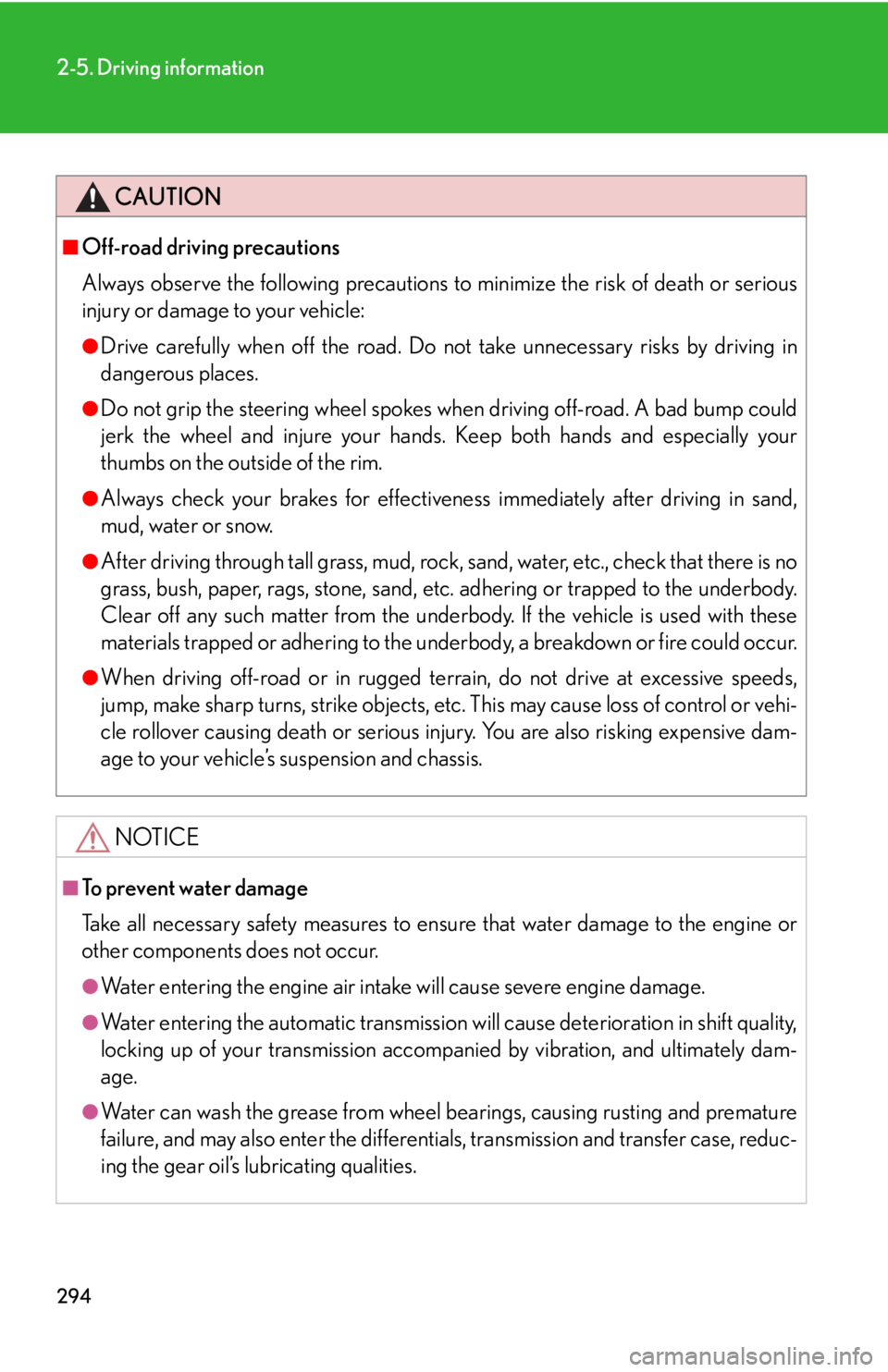
CAUTION■
Off-road driving precautions
Always observe the following precautions to minimize the risk of death or serious
injury or damage to your vehicle: ●
Drive carefully when off the road. Do not take unnecessary risks by driving in
dangerous places.●
Do not grip the steering wheel spokes wh en driving off-road. A bad bump could
jerk the wheel and injure your hands. Keep both hands and especially your
thumbs on the outside of the rim.●
Always check your brakes for effectiveness immediately after driving in sand,
mud, water or snow.●
After driving through tall grass, mud, rock , sand, water, etc., check that there is no
grass, bush, paper, rags, stone, sand, etc. adhering or trapped to the underbody.
Clear off any such matter from the underbody. If the vehicle is used with these
materials trapped or adhering to the underbody, a breakdown or fire could occur.●
When driving off-road or in rugged te rrain, do not drive at excessive speeds,
jump, make sharp turns, strike objects, etc. This may cause loss of control or vehi-
cle rollover causing death or serious injury. You are also risking expensive dam-
age to your vehicle’s suspension and chassis.
NOTICE■
To prevent water damage
Take all necessary safety measures to ensure that water damage to the engine or
other components does not occur. ●
Water entering the engine air intake will cause severe engine damage. ●
Water entering the automatic transmission will cause deterioration in shift quality,
locking up of your transmission accompanied by vibration, and ultimately dam-
age.
●
Water can wash the grease from wheel bearings, causing rusting and premature
failure, and may also enter the differentials, transmission and transfer case, reduc-
ing the gear oil’s lubricating qualities.
Page 302 of 886
3022-5. Driving information
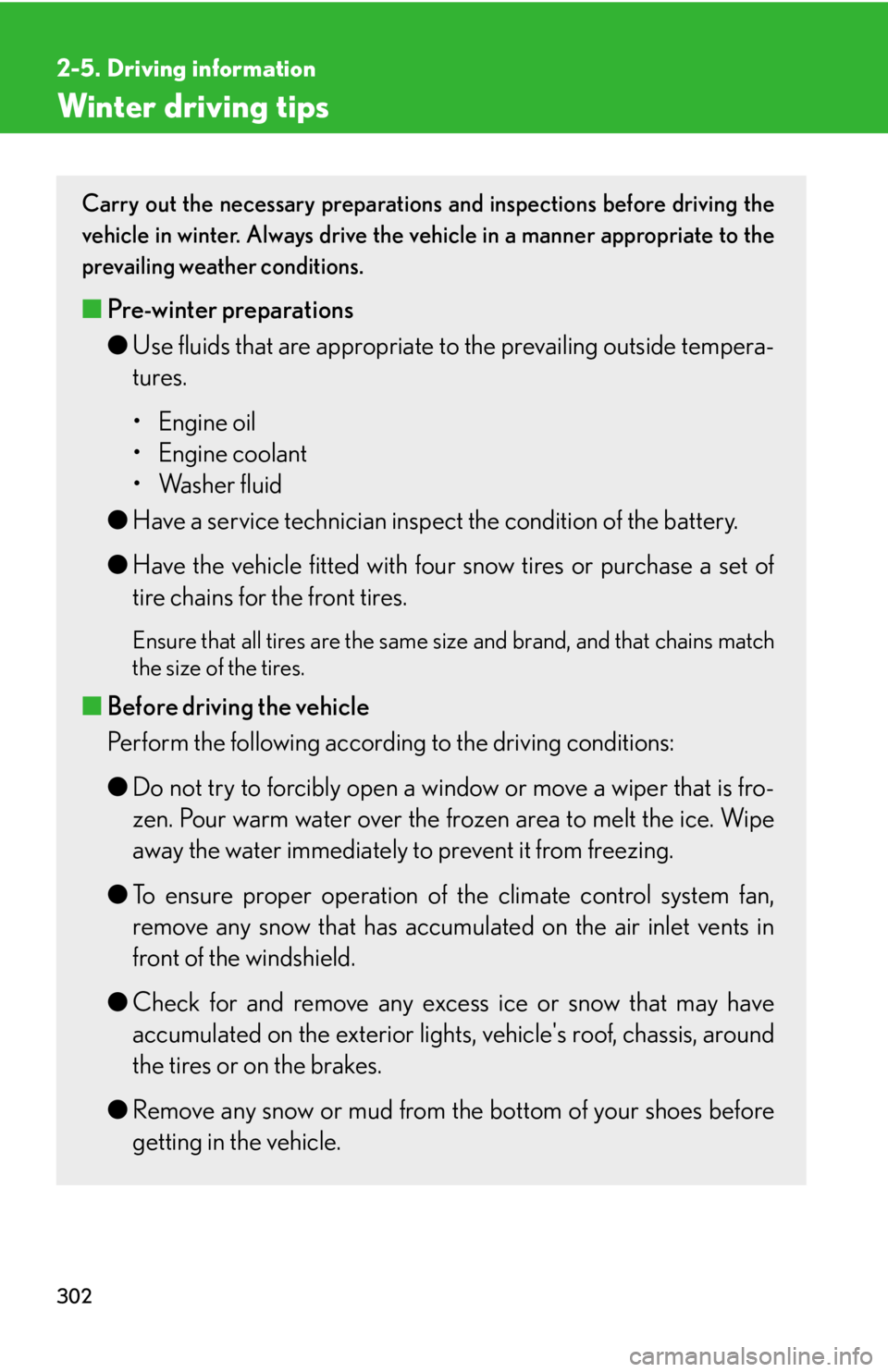
Winter driving tips Carry out the necessary preparations and inspections before driving the
vehicle in winter. Always drive the ve hicle in a manner appropriate to the
prevailing weather conditions.
■ Pre-winter preparations
● Use fluids that are appropria te to the prevailing outside tempera-
tures.
• Engine oil
• Engine coolant
• Washer fluid
● Have a service technician inspec t the condition of the battery.
● Have the vehicle fitted with four snow tires or purchase a set of
tire chains for the front tires. Ensure that all tires are the same size and brand, and that chains match
the size of the tires.
■ Before driving the vehicle
Perform the following accord ing to the driving conditions:
● Do not try to forcibly open a w indow or move a wiper that is fro-
zen. Pour warm water over the frozen area to melt the ice. Wipe
away the water immediately to prevent it from freezing.
● To ensure proper operation of the climate control system fan,
remove any snow that has accumu lated on the air inlet vents in
front of the windshield.
● Check for and remove any exce ss ice or snow that may have
accumulated on the exterior lights, vehicle's roof, chassis, around
the tires or on the brakes.
● Remove any snow or mud from the bottom of your shoes before
getting in the vehicle.
Page 658 of 886

6584-2. Maintenance
CAUTION■
If your vehicle is not properly maintained
Improper maintenance could result in se rious damage to the vehicle and possible
serious injury or death.■
Handling of the battery ●
Engine exhaust, some of its constituents, and a wide variety of automobile com-
ponents contain or emit chemicals known to the State of California to cause can-
cer and birth defects and other reproductive harm. Work in a well ventilated area.●
Oils, fuels and fluids contained in vehicles as well as waste produced by compo-
nent wear contain or emit chemicals known to the State of California to cause
cancer and birth defects or other reproductive harm. Avoid exposure and wash
any affected area immediately.●
Battery posts, terminals and related accessories contain lead and lead com-
pounds which are known to cause brain damage. Wash your hands after han-
dling. ( P. 6 8 1 )
Page 659 of 886
6594-2. Maintenance
4
Maintenance and care General maintenance
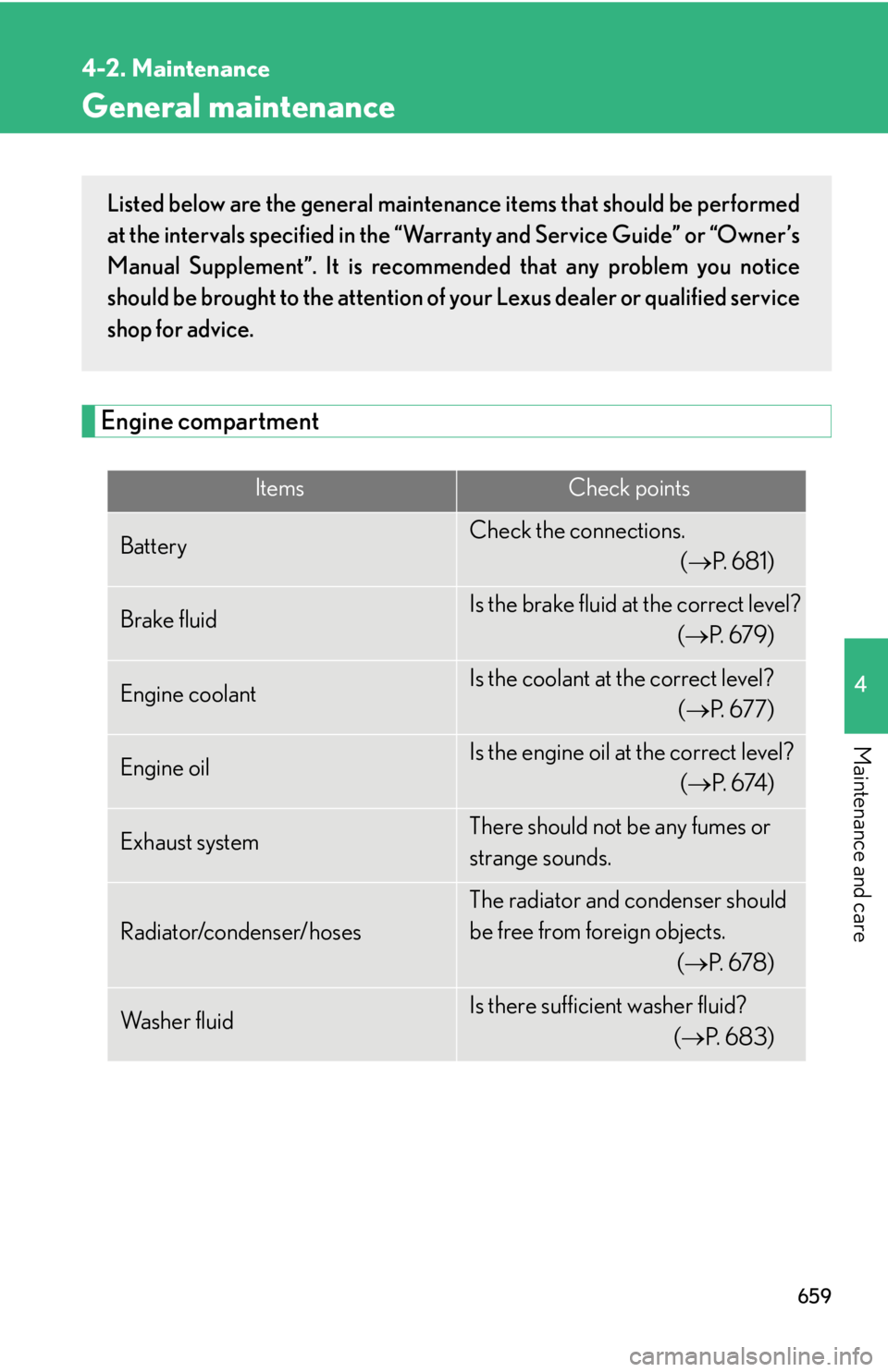
Engine compartment Items Check points
Battery Check the connections.
( P. 6 8 1 )
Brake fluid Is the brake fluid at the correct level?
( P. 6 7 9 )
Engine coolant Is the coolant at the correct level?
( P. 6 7 7 )
Engine oil Is the engine oil at the correct level?
( P. 6 74 )
Exhaust system There should not be any fumes or
strange sounds.
Radiator/condenser/hoses The radiator and condenser should
be free from foreign objects.
( P. 6 7 8 )
Wa s h e r f l u i d Is there sufficient washer fluid?
( P. 6 8 3 )Listed below are the general maintenance items that should be performed
at the intervals specified in the “Warranty and Service Guide” or “Owner’s
Manual Supplement”. It is recomme nded that any problem you notice
should be brought to the attention of your Lexus dealer or qualified service
shop for advice.
Page 665 of 886
6654-3. Do-it-yourself maintenance
4
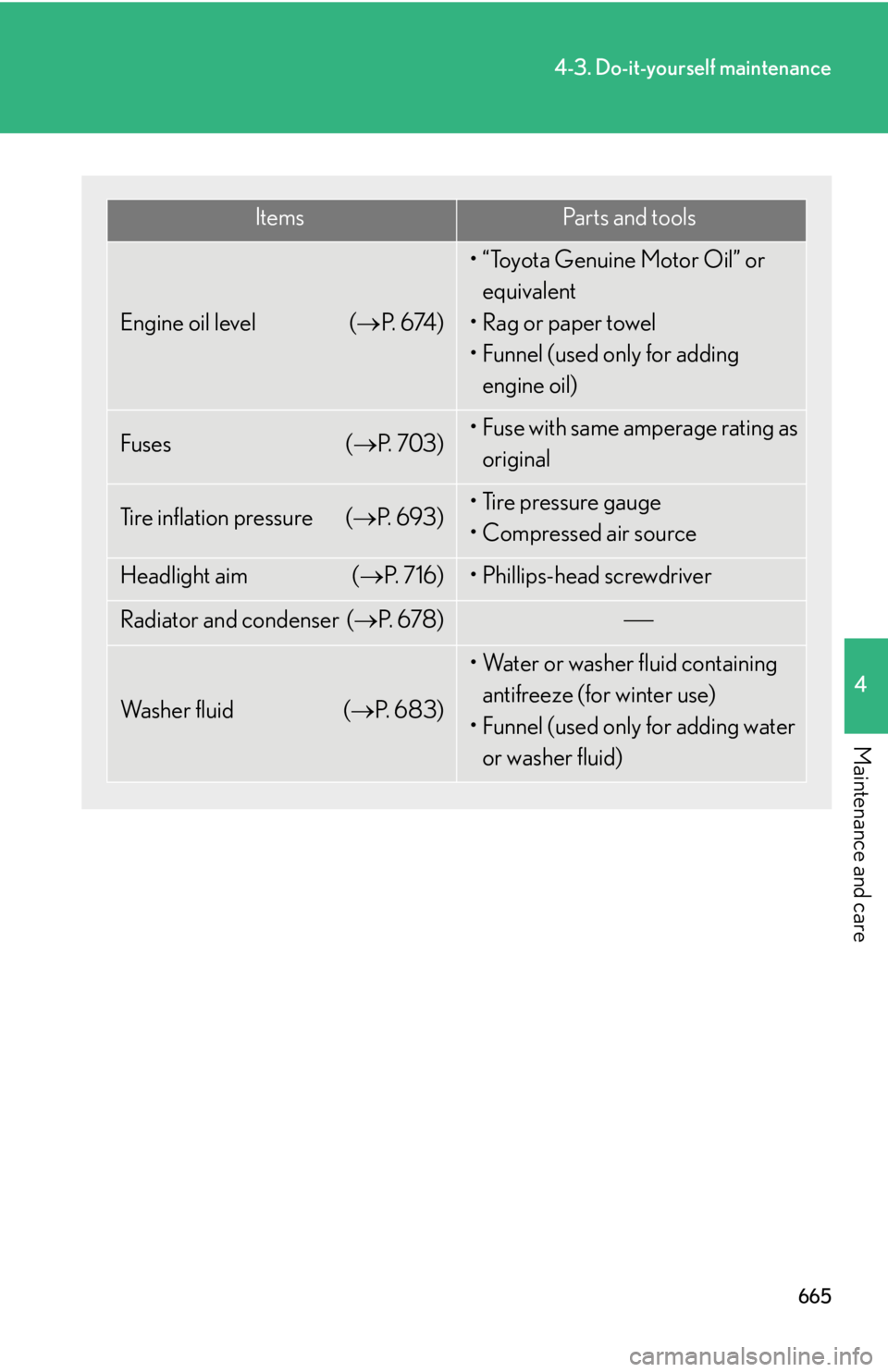
Maintenance and care Items Pa r t s a n d t o o l s
Engine oil level ( P. 6 74 ) • “Toyota Genuine Motor Oil” or
equivalent
•Rag or paper towel
• Funnel (used only for adding
engine oil)
Fuses ( P. 7 0 3 ) • Fuse with same amperage rating as
original
Tire inflation pressure ( P. 6 9 3 ) • Tire pressure gauge
• Compressed air source
Headlight aim ( P. 7 1 6 ) • Phillips-head screwdriver
Radiator and condenser ( P. 6 7 8 )
Wa s h e r f l u i d ( P. 6 8 3 ) • Water or washer fluid containing
antifreeze (for winter use)
• Funnel (used only for adding water
or washer fluid)
Page 666 of 886
6664-3. Do-it-yourself maintenance
CAUTIONThe engine compartment contains many mechanisms and fluids that may move sud-
denly, become hot, or become electrically energized. To avoid death or serious injury,
observe the following precautions: ■
When working on the engine compartment ●
Keep hands, clothing and tools away from the moving fans and engine drive belt.●
Be careful not to touch the engine, radiator , exhaust manifold, etc. right after driv-
ing as they may be hot. Oil and other fluids may also be hot.●
Do not leave anything that may burn easi ly, such as paper and rags, in the engine
compartment.●
Do not smoke, cause sparks or expose an open flame to fuel or the battery. Fuel
and battery fumes are flammable.●
Be extremely cautious when working on the battery. It contains poisonous and
corrosive sulfuric acid.■
When working near the electric cooling fans or radiator grille
Be sure the “ENGINE START STOP” switch is off.
With the “ENGINE START STOP” switch in IGNITION ON mode, the electric
cooling fans may automatically start to run if the air conditioning is on and/or the
coolant temperature is high. ( P. 6 7 8 )■
Safety glasses
Wear safety glasses to prevent flying or falling material, fluid spray, etc. from getting
in your eyes.
NOTICE■
If you remove the air cleaner filter
Driving with the air cleaner filter removed may cause excessive engine wear due to
dirt in the air.
Page 670 of 886
6704-3. Do-it-yourself maintenance
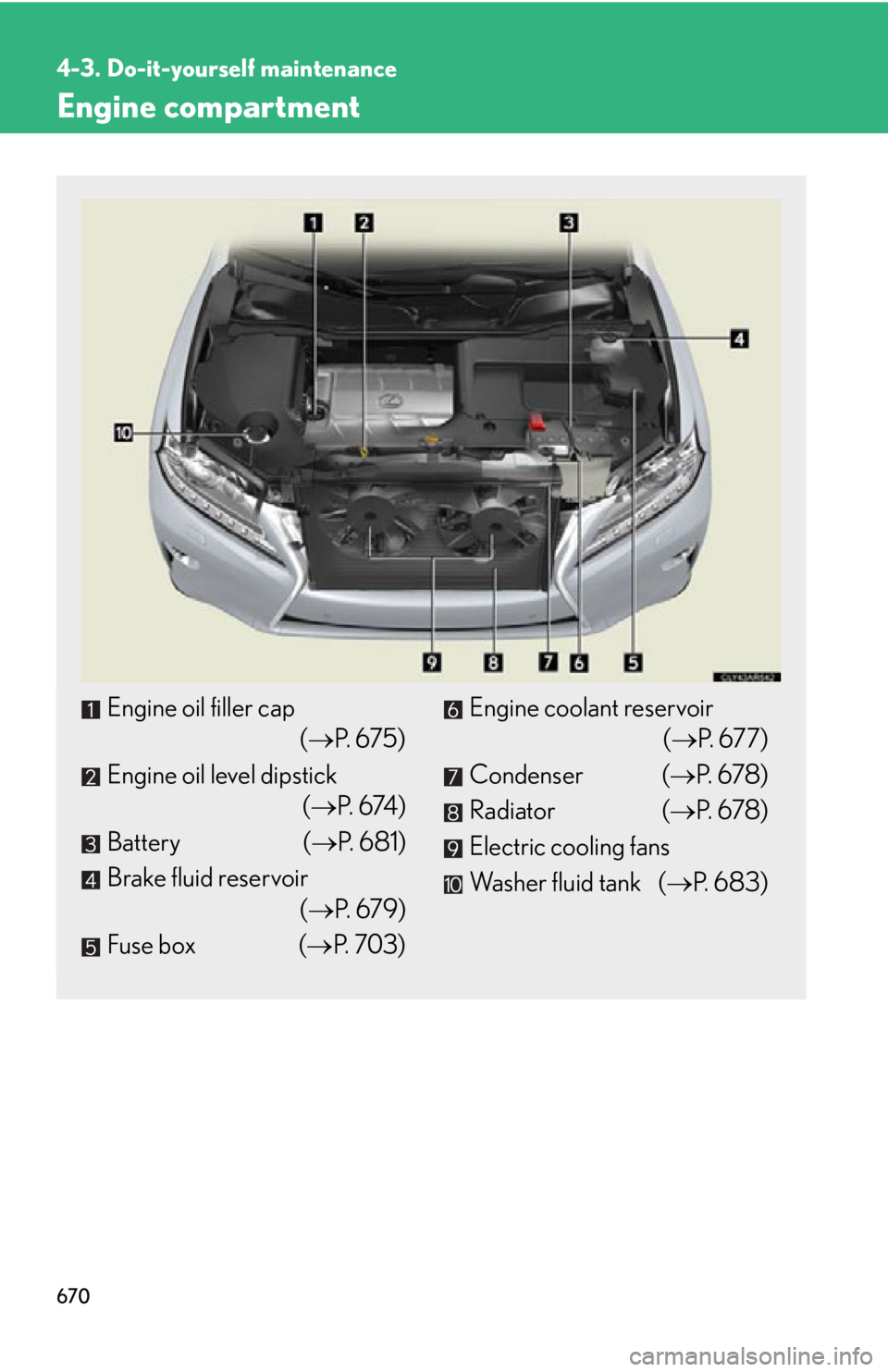
Engine compartment
Engine oil filler cap
( P. 675)
Engine oil level dipstick
( P. 6 74 )
Battery ( P. 6 8 1 )
Brake fluid reservoir
( P. 6 7 9 )
Fuse box ( P. 703) Engine coolant reservoir
( P. 677)
Condenser ( P. 6 7 8 )
Radiator ( P. 6 7 8 )
Electric cooling fans
Washer fluid tank ( P. 683)
Page 674 of 886
6744-3. Do-it-yourself maintenance
Engine oil
With the engine at operating temperat ure and turned off, check the oil
level on the dipstick.
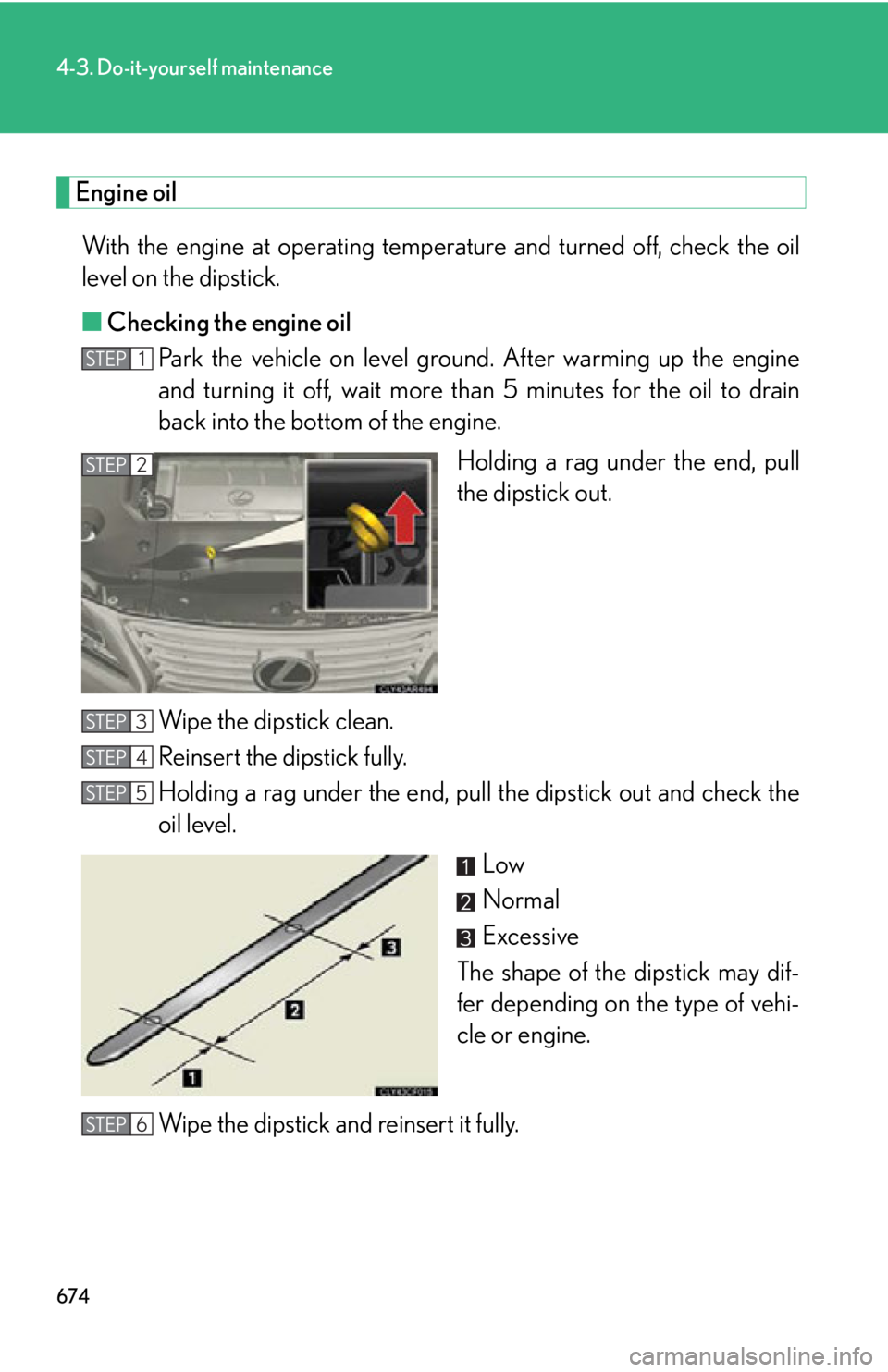
■ Checking the engine oil
Park the vehicle on level grou nd. After warming up the engine
and turning it off, wait more th an 5 minutes for the oil to drain
back into the bottom of the engine.
Holding a rag under the end, pull
the dipstick out.
Wipe the dipstick clean.
Reinsert the dipstick fully.
Holding a rag under the end, pull the dipstick out and check the
oil level.
Low
Normal
Excessive
The shape of the dipstick may dif-
fer depending on the type of vehi-
cle or engine.
Wipe the dipstick and reinsert it fully.STEP 1
STEP 2
STEP 3
STEP 4
STEP 5
STEP 6
Page 675 of 886
6754-3. Do-it-yourself maintenance
4
Maintenance and care ■ Adding engine oil
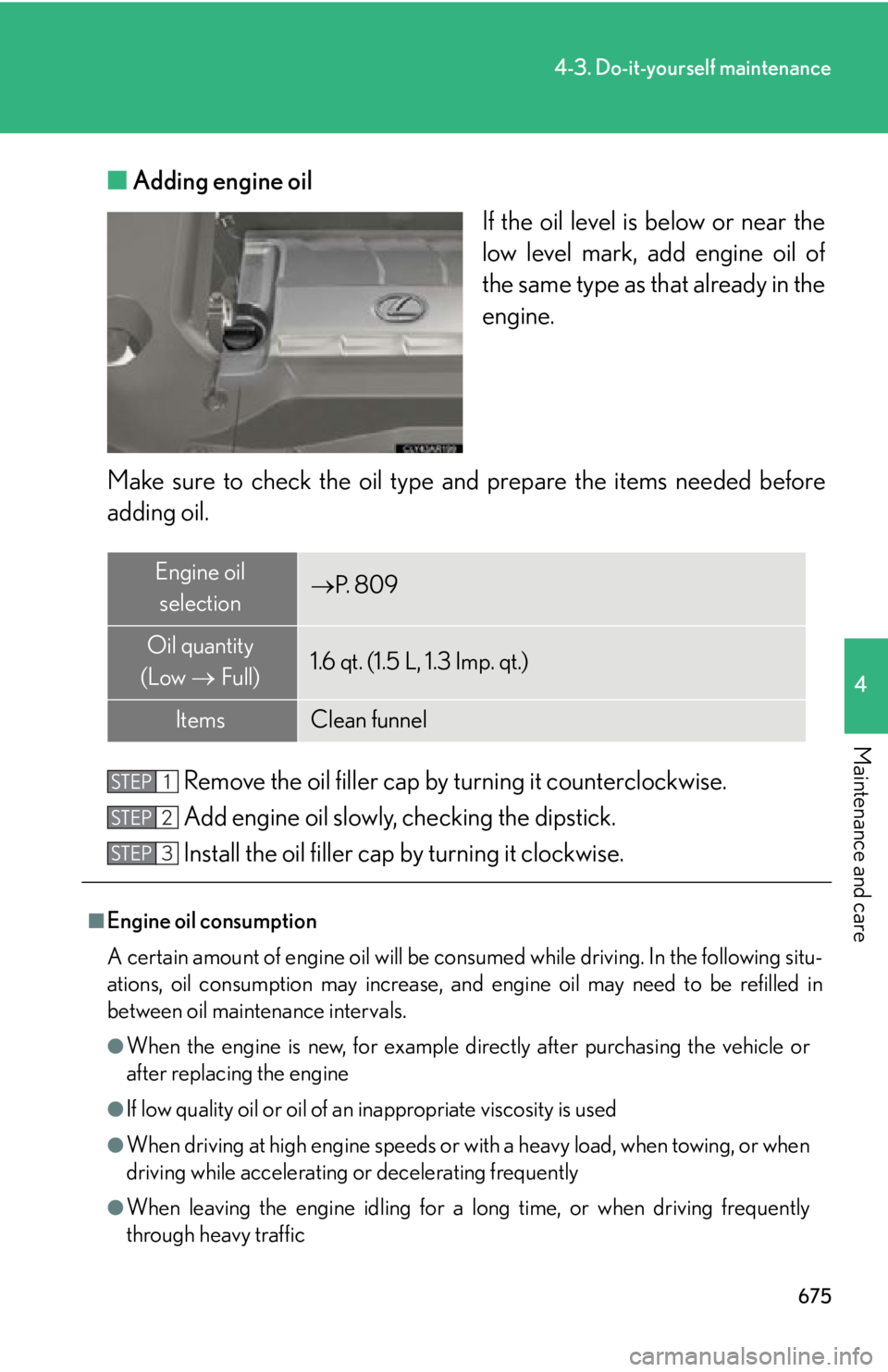
If the oil level is below or near the
low level mark, add engine oil of
the same type as th at already in the
engine.
Make sure to check th e oil type and prepare the items needed before
adding oil.
Remove the oil filler cap by turning it counterclockwise.
Add engine oil slowly, checking the dipstick.
Install the oil filler cap by turning it clockwise.Engine oil
selection P. 8 0 9
Oil quantity
(Low Full) 1.6 qt. (1.5 L, 1.3 Imp. qt.)
Items Clean funnel
■
Engine oil consumption
A certain amount of engine oil will be consumed while driving. In the following situ-
ations, oil consumption may increase, and engine oil may need to be refilled in
between oil maintenance intervals.
●
When the engine is new, for example di rectly after purchasing the vehicle or
after replacing the engine
●
If low quality oil or oil of an inappropriate viscosity is used
●
When driving at high engi ne speeds or with a heavy load, when towing, or when
driving while accelerating or decelerating frequently
●
When leaving the engine id ling for a long time, or when driving frequently
through heavy traffic STEP 1
STEP 2
STEP 3