brake LEXUS RX350 2019 Owner's Manual
[x] Cancel search | Manufacturer: LEXUS, Model Year: 2019, Model line: RX350, Model: LEXUS RX350 2019Pages: 777, PDF Size: 12.44 MB
Page 210 of 777
2094-1. Before driving
4
Driving
RX350/RX350L_U NOTICE ■
When driving the vehicle ●
Do not depress the accelerator and brake pedals at the same time during driving, as
this may restrain driving torque. ●
Do not use the accelerator pedal or depre ss the accelerator and brake pedals at the
same time to hold the vehicle on a hill. ■
When parking the vehicle
Always set the parking brake and shift the shift lever to P. Failure to do so may cause the
vehicle to move or the vehicle may accelerate suddenly if the accelerator pedal is acci-
dentally depressed. ■
Avoiding damage to vehicle parts ●
Do not turn the steering wheel fully in either direction and hold it there for an
extended period of time.
Doing so may damage the power steering motor. ●
When driving over bumps on the road, drive as slowly as possible to avoid damaging
the wheels, underside of the vehicle, etc. ■
If you get a flat tire while driving
A flat or damaged tire may cause the following situations . Hold the steering wheel
firmly and gradually depress the brake pedal to slow down the vehicle. ●
It may be difficult to control your vehicle. ●
The vehicle will make abnormal sounds or vibrations. ●
The vehicle will lean abnormally.
Information on what to do in case of a flat tire ( P. 666)■
When encountering flooded roads
Do not drive on a road that has flooded after heavy rain, etc. Doing so may cause the
following serious damage to the vehicle: ●
Engine stalling ●
Short in electrical components ●
Engine damage caused by water immersion
In the event that you drive on a flooded road and the vehicle is flooded, be sure to have
your Lexus dealer check the following: ●
Brake function ●
Changes in quantity and quality of oil and fluid used for the engine, transaxle, transfer
(AWD models), rear differential (AWD models), etc. ●
Lubricant condition for the propeller shaf t (AWD models), bearings and suspension
joints (where possible), and the func tion of all joints, bearings, etc.
Page 216 of 777
2154-1. Before driving
4
Driving
RX350/RX350L_U Contact your Lexus dealer for further in formation about additional requirements
such as a towing kit, etc.Trailer towing (vehicles with towing package) Your vehicle is designed primarily as a passenger-and-load-carrying vehicle.
Towing a trailer can have an adverse im pact on handling, performance, brak-
ing, durability, and fuel consumption. Fo r your safety and the safety of others,
you must not overload your vehicle or trailer. You must also ensure that you
are using appropriate towing equipment, that the towing equipment has been
installed correctly and used properly, and that you employ the requisite driv-
ing habits.
Vehicle-trailer stability and braking pe rformance are affected by trailer sta-
bility, brake performance and setting, tr ailer brakes, the hitch and hitch sys-
tems (if equipped).
To tow a trailer safely, use extreme ca re and drive the vehicle in accordance
with your trailer’s characteri stics and operating conditions.
Lexus warranties do not apply to damage or malfunction caused by towing a
trailer for commercial purposes.
Page 218 of 777
2174-1. Before driving
4
Driving
RX350/RX350L_U ■
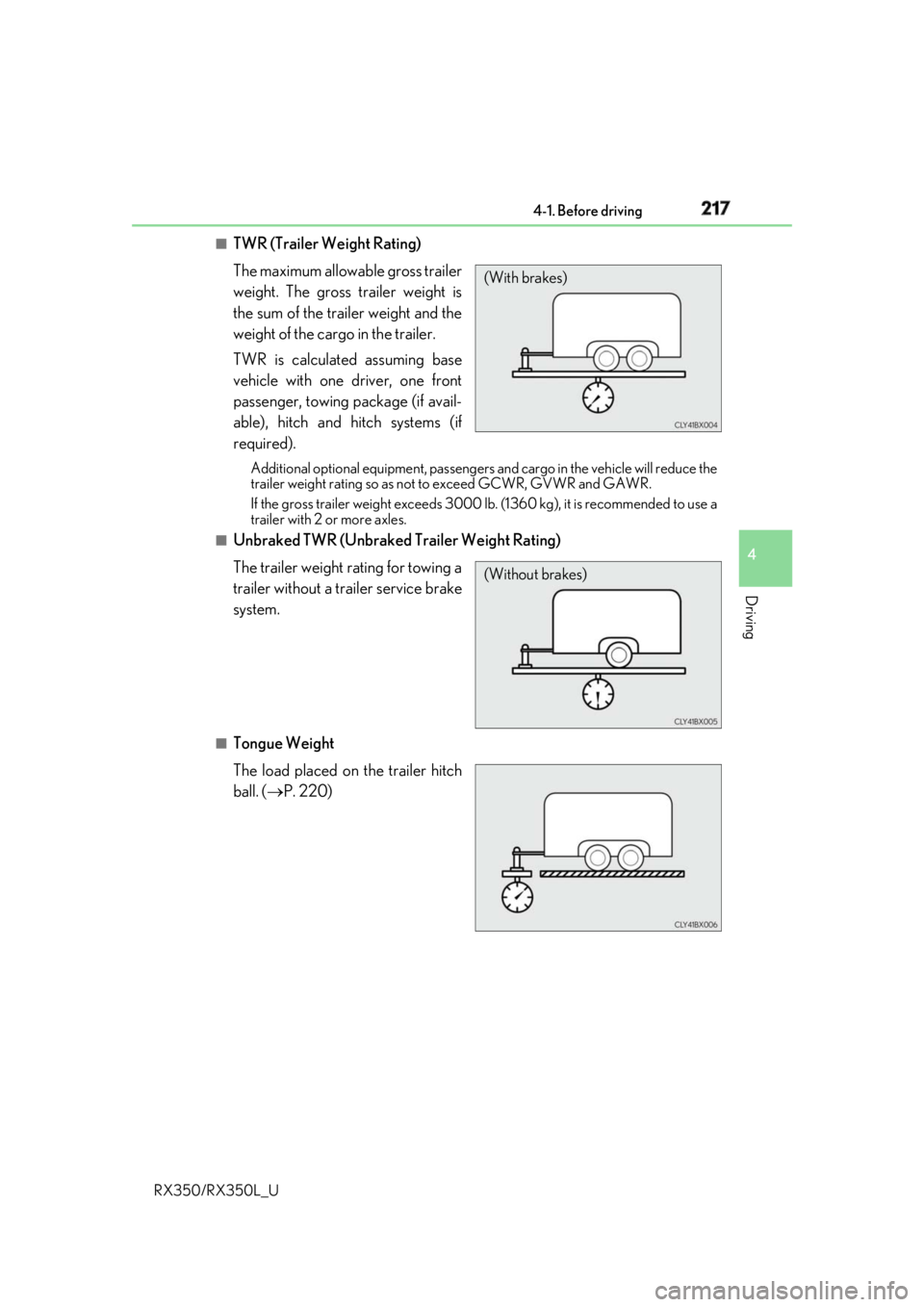
TWR (Trailer Weight Rating)
The maximum allowable gross trailer
weight. The gross trailer weight is
the sum of the trailer weight and the
weight of the cargo in the trailer.
TWR is calculated assuming base
vehicle with one driver, one front
passenger, towing package (if avail-
able), hitch and hitch systems (if
required). Additional optional equipment, passengers and cargo in the vehicle will reduce the
trailer weight rating so as not to exceed GCWR, GVWR and GAWR.
If the gross trailer weight exceeds 3000 lb. (1360 kg), it is recommend ed to use a
trailer with 2 or more axles.■
Unbraked TWR (Unbraked Trailer Weight Rating)
The trailer weight rating for towing a
trailer without a trailer service brake
system.
■
Tongue Weight
The load placed on the trailer hitch
ball. ( P. 220) (With brakes)
(Without brakes)
Page 219 of 777
218 4-1. Before driving
RX350/RX350L_U ●
The gross trailer weight must ne ver exceed 3500 lb. (1585 kg).●
The gross combination weight mu st never exceed the following:
RX350
2WD models: 9165 lb. (4157 kg)
AWD models: 9360 lb. (4246 kg)
RX350L
2WD models: 9205 lb. (4175 kg)
AWD models: 9360 lb. (4246 kg)●
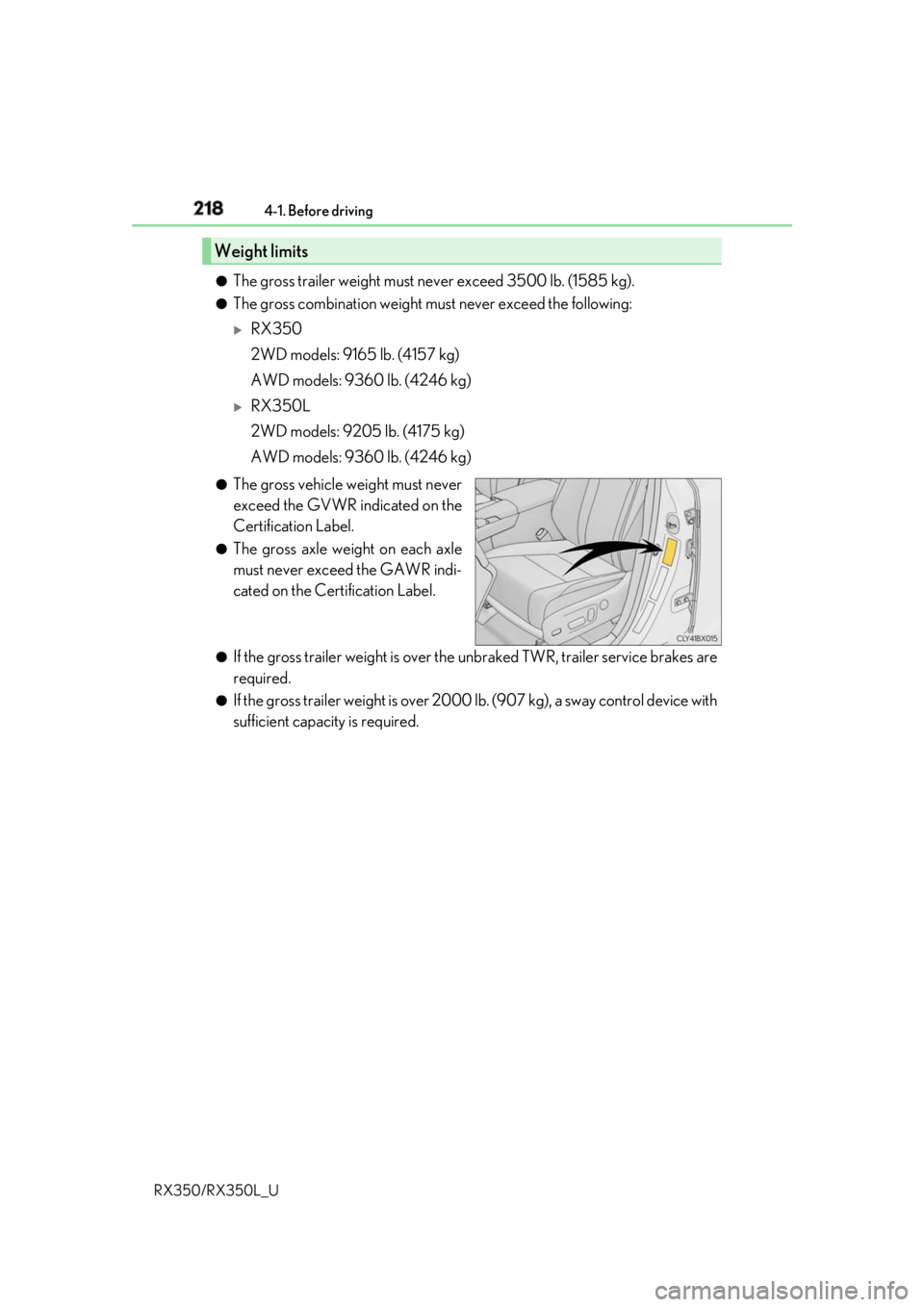
The gross vehicle weight must never
exceed the GVWR indicated on the
Certification Label. ●
The gross axle weight on each axle
must never exceed the GAWR indi-
cated on the Certification Label. ●
If the gross trailer weight is over the unbraked TWR, trailer service brakes are
required. ●
If the gross trailer weight is over 2000 lb. (907 kg), a sway control device with
sufficient capacity is required.Weight limits
Page 220 of 777

2194-1. Before driving
4
Driving
RX350/RX350L_U Confirm that the gross trailer weight, gross combination weight, gross vehicle
weight, gross axle weight and tongue weight are all within the limits.■
GCWR
*
RX350
2WD models: 9165 lb. (4157 kg)
AWD models: 9360 lb. (4246 kg)
RX350L
2WD models: 9205 lb. (4175 kg)
AWD models: 9360 lb. (4246 kg)■
TWR
* 3500 lb. (1585 kg) ■
Unbraked TWR
*1000 lb. (450 kg)
* : These models meet the tow-vehicle trailering requirement of SAE International per
SAE J2807.GCWR, TWR and Unbraked TWR
Page 223 of 777
222 4-1. Before driving
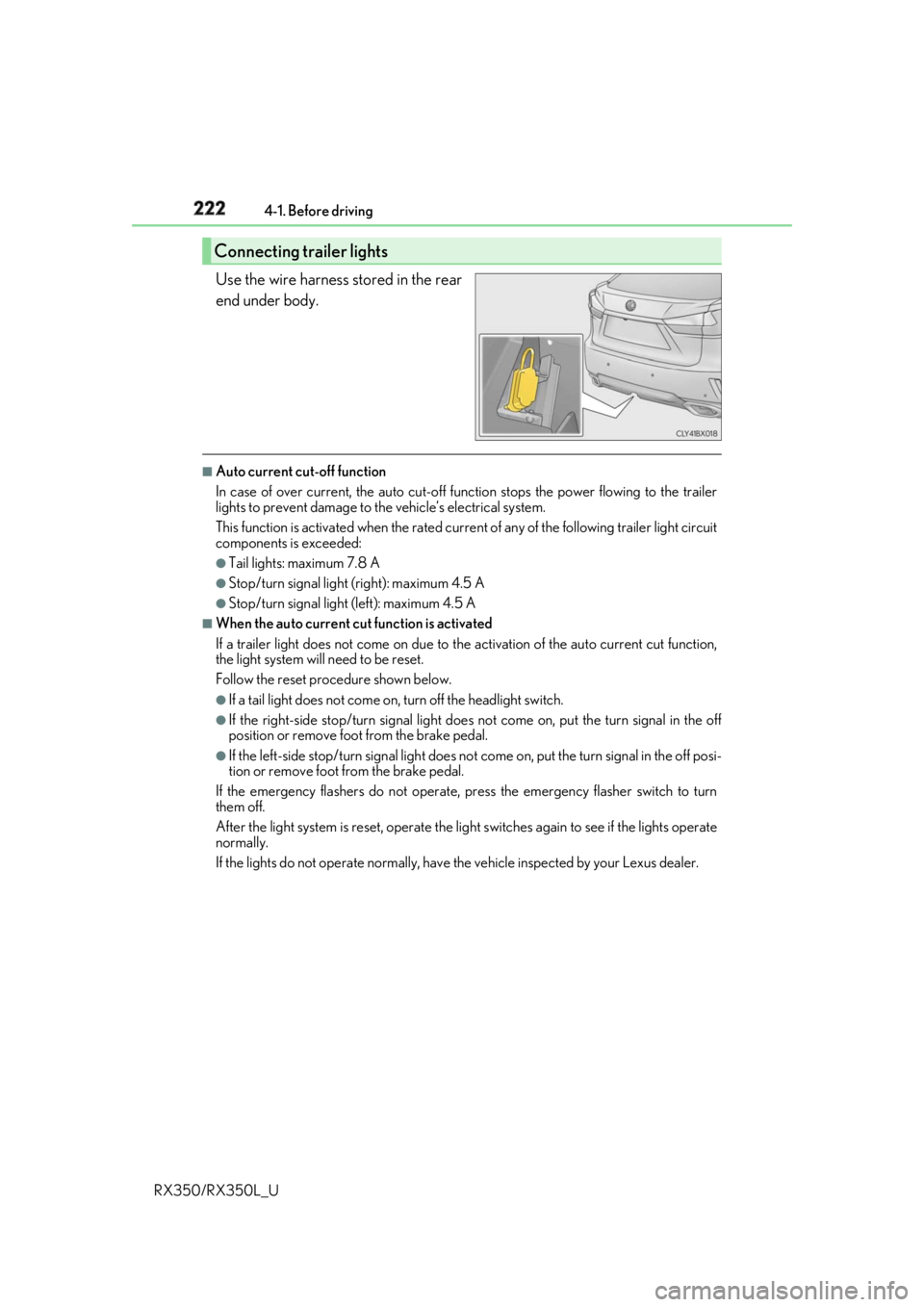
RX350/RX350L_U Use the wire harness stored in the rear
end under body. ■
Auto current cut-off function
In case of over current, the auto cut-off function stops the power flowing to the trailer
lights to prevent damage to the vehicle’s electrical system.
This function is activated when the rated current of any of the following trailer light circuit
components is exceeded: ●
Tail lights: maximum 7.8 A ●
Stop/turn signal light (right): maximum 4.5 A ●
Stop/turn signal light (left): maximum 4.5 A ■
When the auto current cu t function is activated
If a trailer light does not come on due to th e activation of the auto current cut function,
the light system will need to be reset.
Follow the reset procedure shown below. ●
If a tail light does not come on, turn off the headlight switch. ●
If the right-side stop/turn signal light does not come on, put the turn signal in the off
position or remove foot from the brake pedal.●
If the left-side stop/turn signal light does not come on, put the turn signal in the off posi-
tion or remove foot from the brake pedal.
If the emergency flashers do not operate, press the emergency flasher switch to turn
them off.
After the light system is reset, operate the lig ht switches again to see if the lights operate
normally.
If the lights do not operate normally, have the vehicle inspected by your Lexus dealer.Connecting trailer lights
Page 225 of 777

224 4-1. Before driving
RX350/RX350L_U ●
To maintain engine braking efficien cy and charging system performance
when using engine braking, do not put th e transmission in D. If in the M or S
mode, the transmission shift range po sition must be in 6 or lower. ( P. 240)●
Instability happens more fr equently when descending steep or long downhill
grades. Before descending, slow down and downshift. Do not make sudden
downshifts while descending st eep or long downhill grades.●
Avoid holding the brake pedal down too long or applying the brakes too fre-
quently. This could cause the brakes to overheat and result in reduced braking
efficiency. ●
Due to the added load of the trailer, yo ur vehicle’s engine may overheat on hot
days (at temperatures over 85 F [30 C]) when driving up a long or steep
grade. If the engine coolant temperat ure gauge indicates overheating, imme-
diately turn off the air conditioning (if in use), pull your vehicle off the road and
stop in a safe spot. ( P. 692)●
Always place wheel blocks under both the vehicle’s and the trailer’s wheels
when parking. Put the transmission in P and apply the parking brake. Avoid
parking on a slope, but if unavoidable, do so only after performing the follow-
ing:
Apply the brakes and keep them applied.
Have someone place wheel blocks under both the vehicle’s and trailer’s
wheels.
When the wheel blocks are in place, release the brakes slowly until the
blocks absorb the load.
Shift into P and apply the parking brake.
Turn off the engine.●
When restarting afte r parking on a slope:
With the transmission in P, start the en gine. Be sure to keep the brake pedal
depressed.
Shift into a forward gear. If reversing, shift into R.
If the parking brake is in manual mode, release the parking brake.
( P. 248)
Release the brake pedal, and slowly pull or back away from the wheel
blocks. Stop and apply the brakes.
Have someone retrieve the blocks. 1
2
3
4
5
1
2
3
4
5
Page 227 of 777

226 4-1. Before driving
RX350/RX350L_U ■
Break-in schedule
If your vehicle is new or equipped with any new power train components (such as an
engine, transaxle, transfer (AWD models), rear differential (AWD models) or wheel
bearing), Lexus recommends that you do not tow a trailer until the vehicle has been
driven for over 500 miles (800 km).
After the vehicle has been driven for over 500 miles (800 km), you can start towing.
However, for the next 500 miles (800 km), drive the vehicle at a speed of less than
50 mph (80 km/h) when towing a trailer, and avoid full throttle acceleration.■
Maintenance ●
If you tow a trailer, your vehicle will requir e more frequent maintenance due to the addi-
tional load. (See “Warranty and Services Guide”, “Owner’s Manual Supplement” or
“Scheduled Maintenance”.) ●
Retighten the fixing bolts of the towing ba ll and bracket after approximately 600 miles
(1000 km) of trailer towing. ■
If trailer sway occurs
One or more factors (crosswinds, passing ve hicles, rough roads, etc.) can adversely
affect handling of your vehicle and trailer, causing instability. ●
If trailer swaying occurs:
• Firmly grip the steering wh eel. Steer straight ahead.
Do not try to control trailer sway ing by turning the steering wheel.
• Begin releasing the accelerator pedal im mediately but very gradually to reduce
speed.
Do not increase speed. Do not apply vehicle brakes.
If you make no extreme correction with the st eering or brakes, your vehicle and trailer
should stabilize. (if enabled, Trailer Sway Control can also he lp to stabilize the vehicle and
trailer.) ●
After the trailer sw aying has stopped:
• Stop in a safe place. Get all occupants out of the vehicle.
• Check the tires of the vehicle and the trailer.
• Check the load in the trailer.
Make sure the load has not shifted.
Make sure the tongue weight is appropriate, if possible.
• Check the load in the vehicle.
Make sure the vehicle is not ov erloaded after occupants get in.
If you cannot find any problems, the speed at which trailer swaying occurred is beyond
the limit of your particular vehicle-trailer combination.
Drive at a lower speed to prevent instability. Remember that swaying of the towing vehi-
cle-trailer increases as speed increases.
Page 228 of 777
2274-1. Before driving
4
Driving
RX350/RX350L_U WARNING ■
Trailer towing precautions
To tow a trailer safely, use extreme care and drive the vehicle in accordance with the
trailer’s characteristics and operating conditio ns. Failure to do so could cause an acci-
dent resulting in deat h or serious injury. Vehicle stab ility and braking performance are
affected by trailer stability, brake setting an d performance, and the hitch. Your vehicle
will handle differently when towing a trailer. ■
To avoid accident or injury ●
Do not exceed the TWR, unbraked TWR, GCWR, GVWR or GAWR. ●
If the gross trailer weight is over 2000 lb. (907 kg), a sway control device with suffi-
cient capacity is required. ●
Adjust the tongue weight within the approp riate range. Place heavier loads as close
to the trailer axle as possible. ●
Do not exceed 65 mph (104 km/h), the posted towing speed limit or the speed limit
for your trailer as set forth in your trai ler owner’s manual, whichever is lowest. Slow
down sufficiently before making a turn, in cr oss winds, on wet or slippery surface, etc.
to help avoid an accident. If you experien ce a vehicle-trailer in stability from reducing
a certain speed, slow down and make sure you keep your vehicle speed under the
speed of which you expe rience the instability.●
Do not make jerky, abrupt or sharp turns. ●
Do not apply the brakes suddenly as you ma y skid, resulting in jackknifing and loss of
vehicle control. This is especially true on wet or slippery surfaces.●
Do not exceed the trailer hitch assembly weight, gross vehicle weight, gross axle
weight and trailer tongue weight capacities. ●
Do not use the following systems when trailer towing.
• Dynamic radar cruise cont rol with full-speed range
• LKA (Lane-Keeping Assist)
• PCS (Pre-Collision System)
• BSM (Blind Spot Monitor)
*
* : If equipped ●
Slow down and downshift before descending steep or long downhill grades. Do not
make sudden downshifts while descending steep or long downhill grades. ●
Vehicle-trailer instability is more likely on steep long downhills. Before descending
steep or long downhill grades, slow down and downshift. Do not make sudden down-
shifts when descending steep or long do wnhill grades. Avoid ho lding the brake pedal
down too long or applying the brakes too frequently. This could cause the brakes to
overheat and result in reduced braking efficiency. ●
Do not tow a trailer when the compact sp are tire is installed on your vehicle.
Page 229 of 777
228 4-1. Before driving
RX350/RX350L_U WARNING ■
Hitch
Trailer hitch assemblies have different weight capacities established by the hitch manu-
facturer. Even though the vehicle may be phys ically capable of towing a higher weight,
the operator must determine the maximum weight rating of the particular hitch assem-
bly and never exceed the maximum weight rating specified for the trailer-hitch.
Exceeding the maximum weight rating set by the trailer-hitch manufacturer can cause
an accident resulting in death or serious personal injuries. ■
When towing a trailer
Lexus recommends trailers with brakes that conform to any applicable federal and
state/provincial regulations. ●
If the gross trailer weight exceeds unbraked TWR, trailer brakes are required. Lexus
recommends trailers with brakes that conform to all applicable federal and state/pro-
vincial regulations. ●
Never tap into your vehicle’s hydraulic system, as this will lower the vehicle’s braking
effectiveness. ●
Never tow a trailer without using a safety chain securely attached to both the trailer
and the vehicle. If damage occurs to the co upling unit or hitch ball, there is danger of
the trailer wandering into another lane.
NOTICE ■
When installing a trailer hitch
Use only the position recommended by your Lexus dealer. Do not install the trailer
hitch on the bumper; this may cause body damage. ■
Do not directly splice trailer lights
Do not directly splic e trailer lights. Directly splicin g trailer lights may damage your
vehicle’s electrical system and cause a malfunction.