wheel LEXUS RX350 2020 Owners Manual
[x] Cancel search | Manufacturer: LEXUS, Model Year: 2020, Model line: RX350, Model: LEXUS RX350 2020Pages: 516, PDF Size: 17.3 MB
Page 434 of 516
4347-2. Steps to take in an emergency
come off.
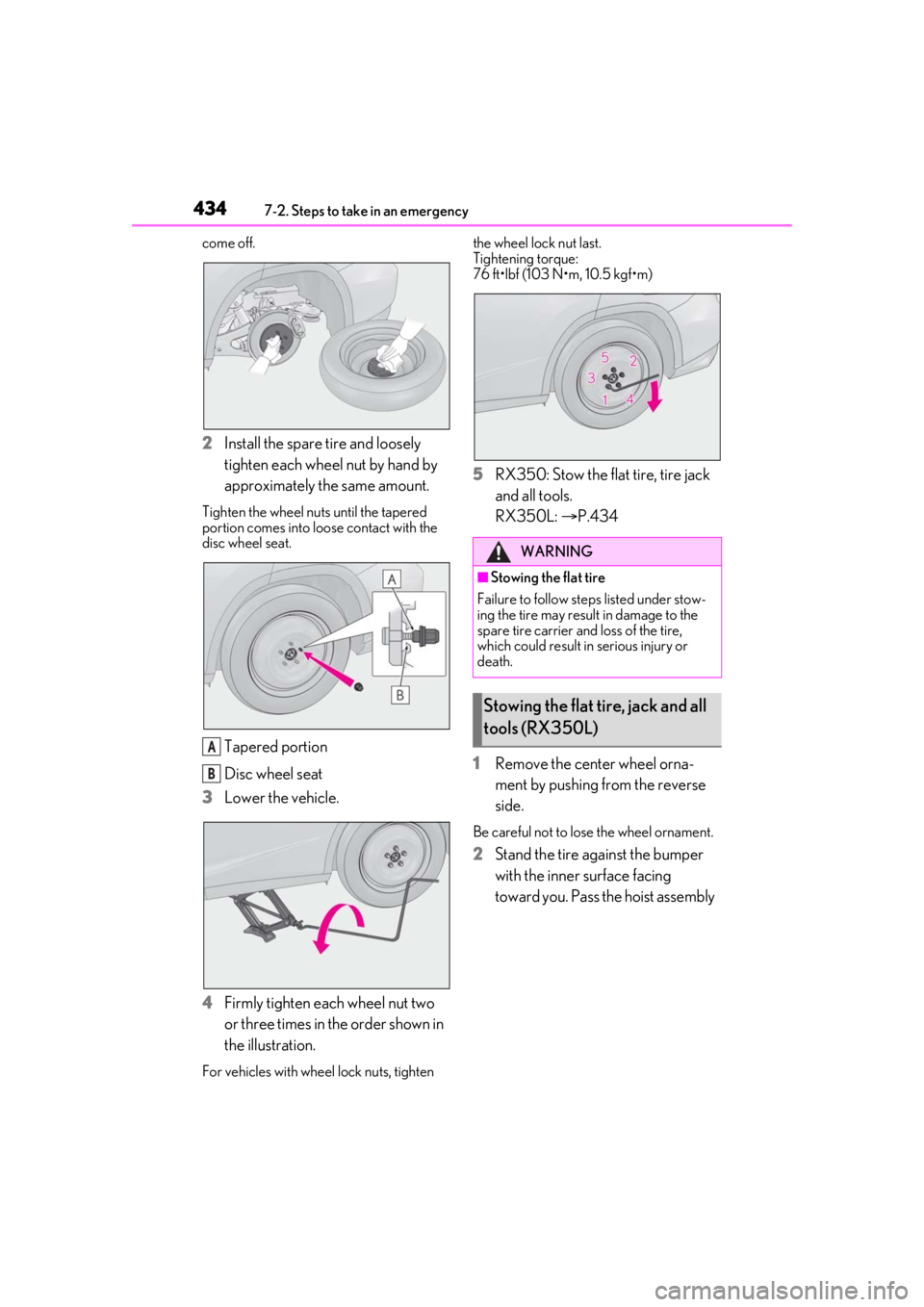
2Install the spare tire and loosely
tighten each wheel nut by hand by
approximately the same amount.
Tighten the wheel nuts until the tapered
portion comes into loose contact with the
disc wheel seat.
Tapered portion
Disc wheel seat
3 Lower the vehicle.
4 Firmly tighten each wheel nut two
or three times in the order shown in
the illustration.
For vehicles with wheel lock nuts, tighten the wheel lock nut last.
Tightening torque:
76 ft•lbf (103 N•m, 10.5 kgf•m)
5
RX350: Stow the flat tire, tire jack
and all tools.
RX350L: P.434
1 Remove the center wheel orna-
ment by pushing from the reverse
side.
Be careful not to lose the wheel ornament.
2Stand the tire against the bumper
with the inner surface facing
toward you. Pass the hoist assembly
A
B
WARNING
■Stowing the flat tire
Failure to follow st eps listed under stow-
ing the tire may result in damage to the
spare tire carrier and loss of the tire,
which could result in serious injury or
death.
Stowing the flat tire, jack and all
tools (RX350L)
Page 435 of 516
4357-2. Steps to take in an emergency
7
When trouble arises
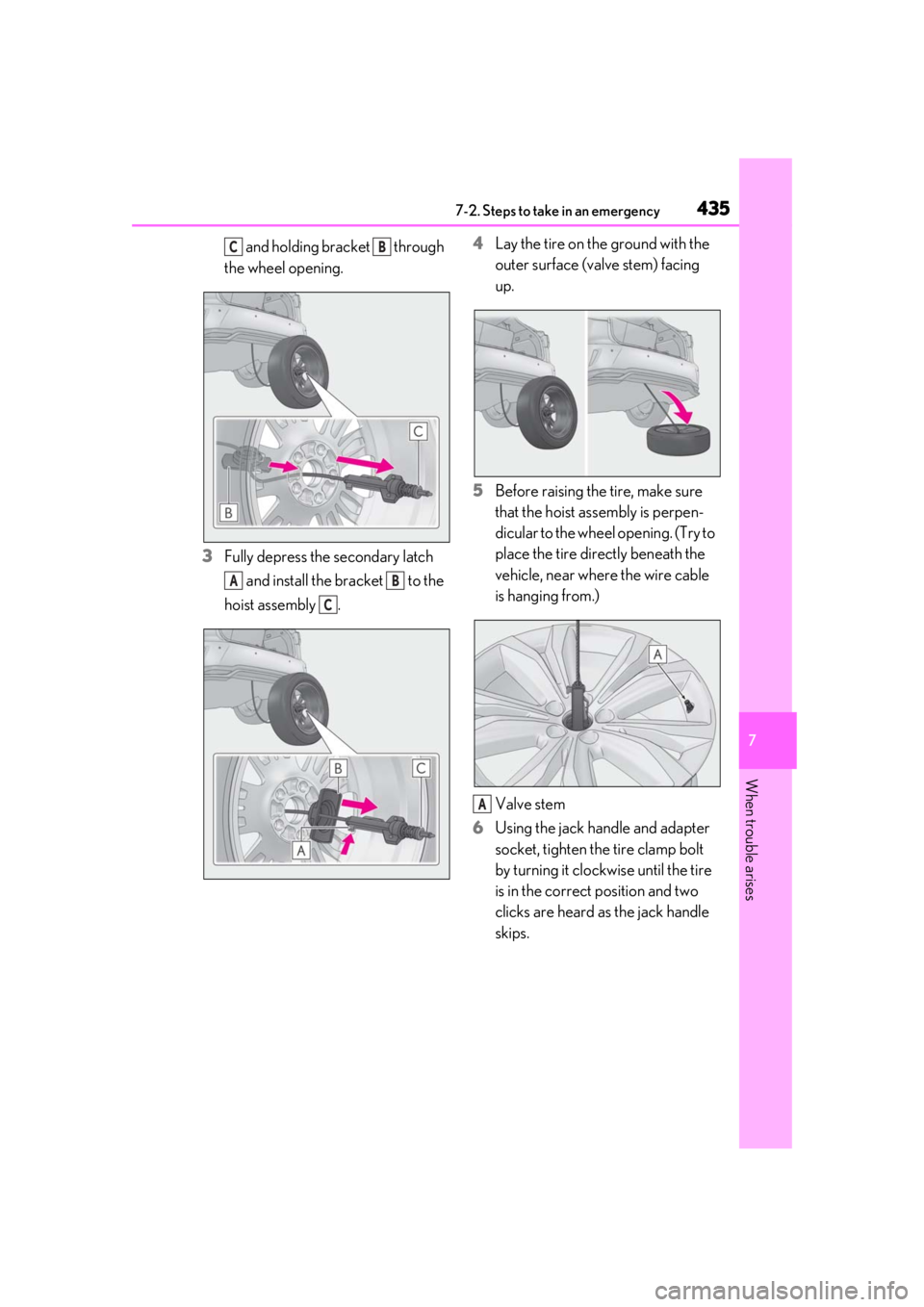
and holding bracket through
the wheel opening.
3 Fully depress the secondary latch
and install the bracket to the
hoist assembly . 4
Lay the tire on the ground with the
outer surface (valve stem) facing
up.
5 Before raising the tire, make sure
that the hoist assembly is perpen-
dicular to the wheel opening. (Try to
place the tire directly beneath the
vehicle, near where the wire cable
is hanging from.)
Valve stem
6 Using the jack handle and adapter
socket, tighten the tire clamp bolt
by turning it clockwise until the tire
is in the correct position and two
clicks are heard as the jack handle
skips.CB
AB
C
A
Page 436 of 516

4367-2. Steps to take in an emergency
7Confirm it is not loose after tighten-
ing:
1 Push and pull the tire
2 Try rotating
Visually check to ensure tire is not hung on
surrounding parts.
If looseness or misassembly exists, repeat
steps 2 to 7.
8 Repeat step 7, any time the tire is
lowered or disturbed.
9 Stow the jack and all tools.
■The compact spare tire
●The compact spare tire is identified by the
label “TEMPORARY USE ONLY” on
the tire sidewall. Use the compact spare
tire temporarily, and only in an emer-
gency.
●Make sure to check the tire inflation pres-
sure of the compact spare tire. ( P.457)
■When using the compact spare tire
As the compact spare tire is not equipped
with a tire pressure warning valve and trans-
mitter, low inflation pressure of the spare
tire will not be indicated by the tire pressure
warning system. Also, if you replace the
compact spare tire after the tire pressure
warning light comes on, the light remains
on.
■When the compact spare tire is
equipped
When driving with the compact spare tire
installed, the vehicle he ight will be different
than when driving with standard tires.
■If you have a flat front tire on a road cov-
ered with snow or ice
Install the compact spare tire on one of the
rear wheels of the vehicle. Perform the fol-
lowing steps and fit tire chains to the front
tires:
1 Replace a rear tire with the compact
spare tire.
2 Replace the flat front tire with the tire
removed from the rear of the vehicle.
3 Fit tire chains to the front tires.
WARNING
■When using the compact spare tire
●Remember that the compact spare tire
provided is specific ally designed for
use with your vehicle. Do not use your
compact spare tire on another vehicle.
●Do not use more than one compact
spare tire simultaneously.
●Replace the compact spare tire with a
standard tire as soon as possible.
●Avoid sudden acceleration, abrupt
steering, sudden br aking and shifting
operations that cause sudden engine
braking.
■When the compact spare tire is
attached
The vehicle speed may not be correctly
detected, and the following systems may
not operate correctly:
• ABS & Brake assist
•VSC
•TRAC
• Trailer Sway Control
•EPS
•VDIM (if equipped)
• Adaptive Variable Suspension System (if equipped)
• Dynamic radar cruise control with full-speed range
Page 437 of 516
4377-2. Steps to take in an emergency
7
When trouble arises
WARNING
• PCS (Pre-Collision System)
• LTA (Lane Tracing Assist)
• RSA (Road Sign Assist) (if equipped)
•Automatic High Beam
• AFS (Adaptive Front-lighting System) (if equipped)
• Tire pressure warning system
• Intuitive parking assist (if equipped)
• PKSB (Parking Support Brake) (if equipped)
• Lexus parking assist monitor (if equipped)
• Panoramic view monitor (if equipped)
• BSM (Blind Spot Monitor) (if equipped)
• Navigation system (if equipped)
Also, not only can the following system
not be utilized fully, but it may even nega-
tively affect the drive-train components:
• AWD system (AWD models)
■Speed limit when using the compact
spare tire
Do not drive at speeds in excess of 50
mph (80 km/h) when a compact spare
tire is installed on the vehicle.
The compact spare tire is not designed
for driving at high speeds. Failure to
observe this precaution may lead to an
accident causing deat h or serious injury.
■After using the tools and jack
Before driving, make sure all the tools
and jack are securely in place in their
storage location to reduce the possibility
of personal injury during a collision or
sudden braking.
NOTICE
■Be careful when driving over bumps
with the compact spare tire installed
on the vehicle
The vehicle becomes lower when driving
with the compact spar e tire compared to
when driving with standard tires. Be
careful when driving over uneven road
surfaces.
■Driving with tire chains and the com-
pact spare tire
Do not fit tire chains to the compact
spare tire. Tire chains may damage the
vehicle body and adversely affect driving
performance.
■When replacing the tires
When removing or fitting the wheels,
tires or the tire pr essure warning valve
and transmitter, contact your Lexus
dealer as the tire pressure warning valve
and transmitter may be damaged if not
handled correctly.
■When stowing the flat tire (RX350L)
●Ensure that there is no object caught
between the tire and the vehicle
underbody.
●Securely tighten the spare tire clamp
bolt to hold the spare wheel carrier by
the hook.
●Stow the flat tire in the spare tire loca-
tion. Failure to do so may cause dam-
age to the spare tire carrier. Proper
storage reduces the possibility of injury
in a collision or during sudden braking.
●Have the flat tire repaired and the
spare tire replaced with it as soon as
possible.
Page 438 of 516
4387-2. Steps to take in an emergency
One of the following may be the cause
of the problem:
There may not be sufficient fuel in
the vehicle’s tank.
Refuel the vehicle.
The engine may be flooded.
Try to restart the engine again fol-
lowing correct starting procedures.
( P.176)
There may be a malfunction in the
engine immobilizer system.
( P.64)
One of the following may be the cause
of the problem:
The battery may be discharged.
( P.443)
The battery terminal connections
may be loose or corroded.
( P.369)
NOTICE
■Proper storage of the spare tire
(RX350L)
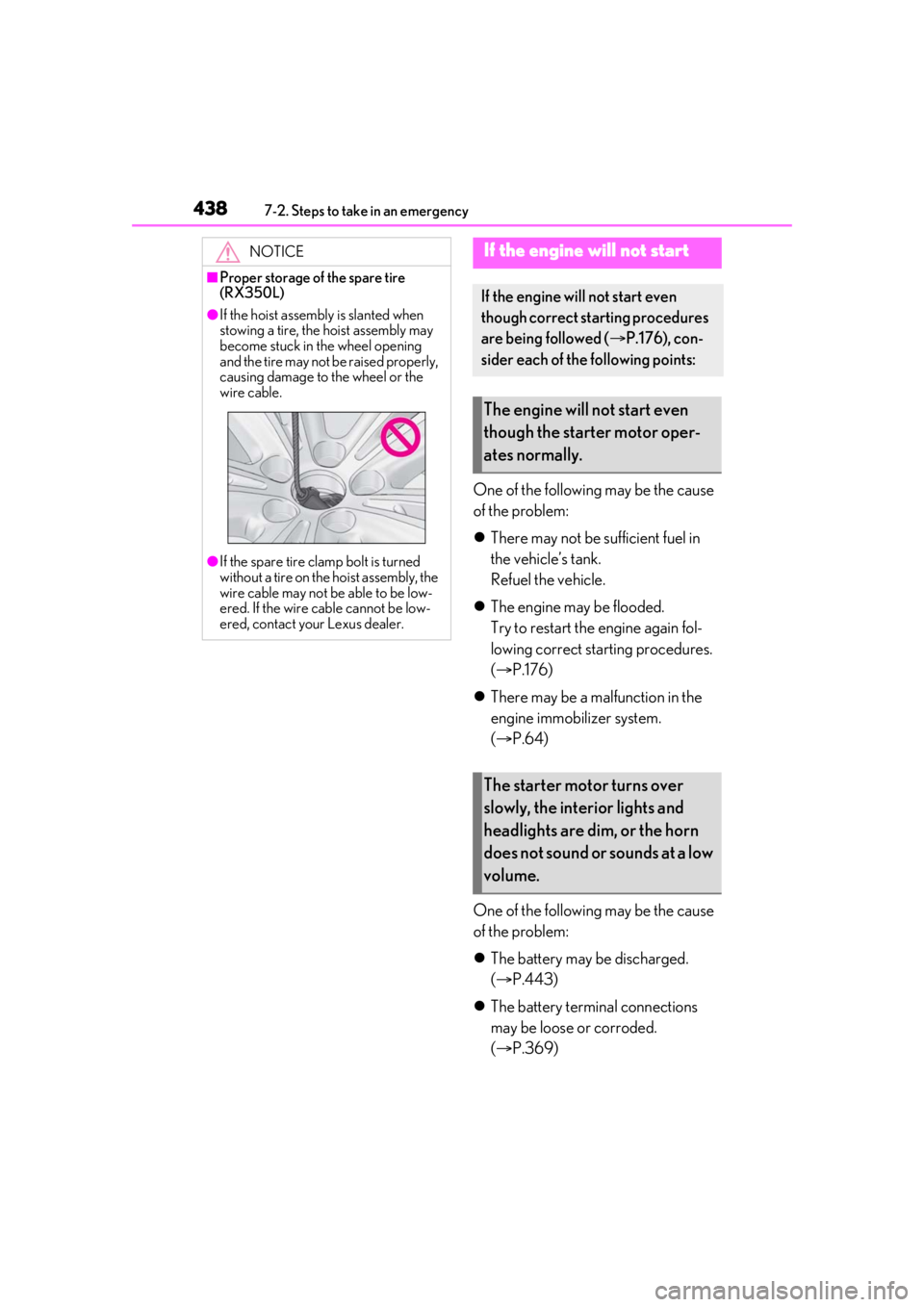
●If the hoist assembly is slanted when
stowing a tire, the hoist assembly may
become stuck in the wheel opening
and the tire may not be raised properly,
causing damage to the wheel or the
wire cable.
●If the spare tire clamp bolt is turned
without a tire on the hoist assembly, the
wire cable may not be able to be low-
ered. If the wire cable cannot be low-
ered, contact your Lexus dealer.
If the engine will not start
If the engine will not start even
though correct starting procedures
are being followed ( P.176), con-
sider each of the following points:
The engine will not start even
though the starter motor oper-
ates normally.
The starter motor turns over
slowly, the interior lights and
headlights are dim, or the horn
does not sound or sounds at a low
volume.
Page 449 of 516
4497-2. Steps to take in an emergency
7
When trouble arises
1Stop the engine. Shift the shift lever
to P and set the parking brake.
2 Remove the mud, snow or sand
from around the front wheels.
3 Place wood, stones or some other
material under the front wheels to
help provide traction.
4 Restart the engine.
5 AWD models: Activate all-wheel
drive lock mode. ( P.276)
6 Shift the shift lever to D or R and
release the parking brake. Then,
while exercising caution, depress
the accelerator pedal.
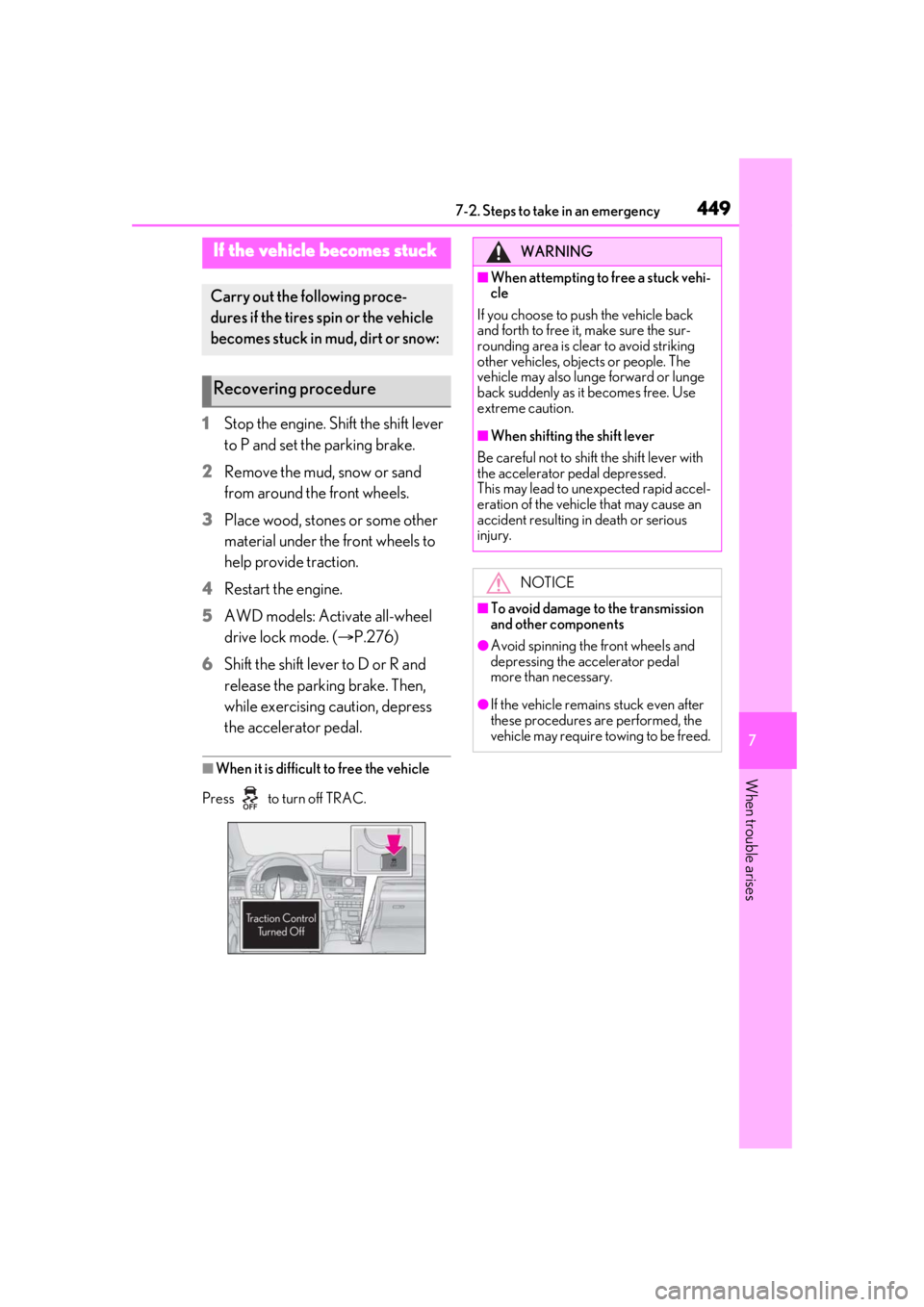
■When it is difficult to free the vehicle
Press to turn off TRAC.
If the vehicle becomes stuck
Carry out the following proce-
dures if the tires spin or the vehicle
becomes stuck in mud, dirt or snow:
Recovering procedure
WARNING
■When attempting to free a stuck vehi-
cle
If you choose to push the vehicle back
and forth to free it, make sure the sur-
rounding area is clear to avoid striking
other vehicles, obje cts or people. The
vehicle may also lunge forward or lunge
back suddenly as it becomes free. Use
extreme caution.
■When shifting the shift lever
Be careful not to shif t the shift lever with
the accelerator pedal depressed.
This may lead to un expected rapid accel-
eration of the vehicle that may cause an
accident resulting in death or serious
injury.
NOTICE
■To avoid damage to the transmission
and other components
●Avoid spinning the front wheels and
depressing the accelerator pedal
more than necessary.
●If the vehicle remains stuck even after
these procedures are performed, the
vehicle may require towing to be freed.
Page 452 of 516
4528-1. Specifications
8-1.Specifications
*1:RX350
*2:RX350L
*3:Unladen vehicle
*4: For GGL25L-BWZGBA models*9
*5
:Except for GGL25L-BWZGBA models*9
*6
: Vehicles with separate -type second-row seats
*7: Vehicles with bench-type second-row seats
*8: Vehicles with towing package
*9: The model code is indicated on the Certification Label. (P.452)
■Vehicle identification number
The vehicle identification number (VIN) is the legal identifier for your
vehicle. This is the primary identifica-
Maintenance data (fuel, oil level, etc.)
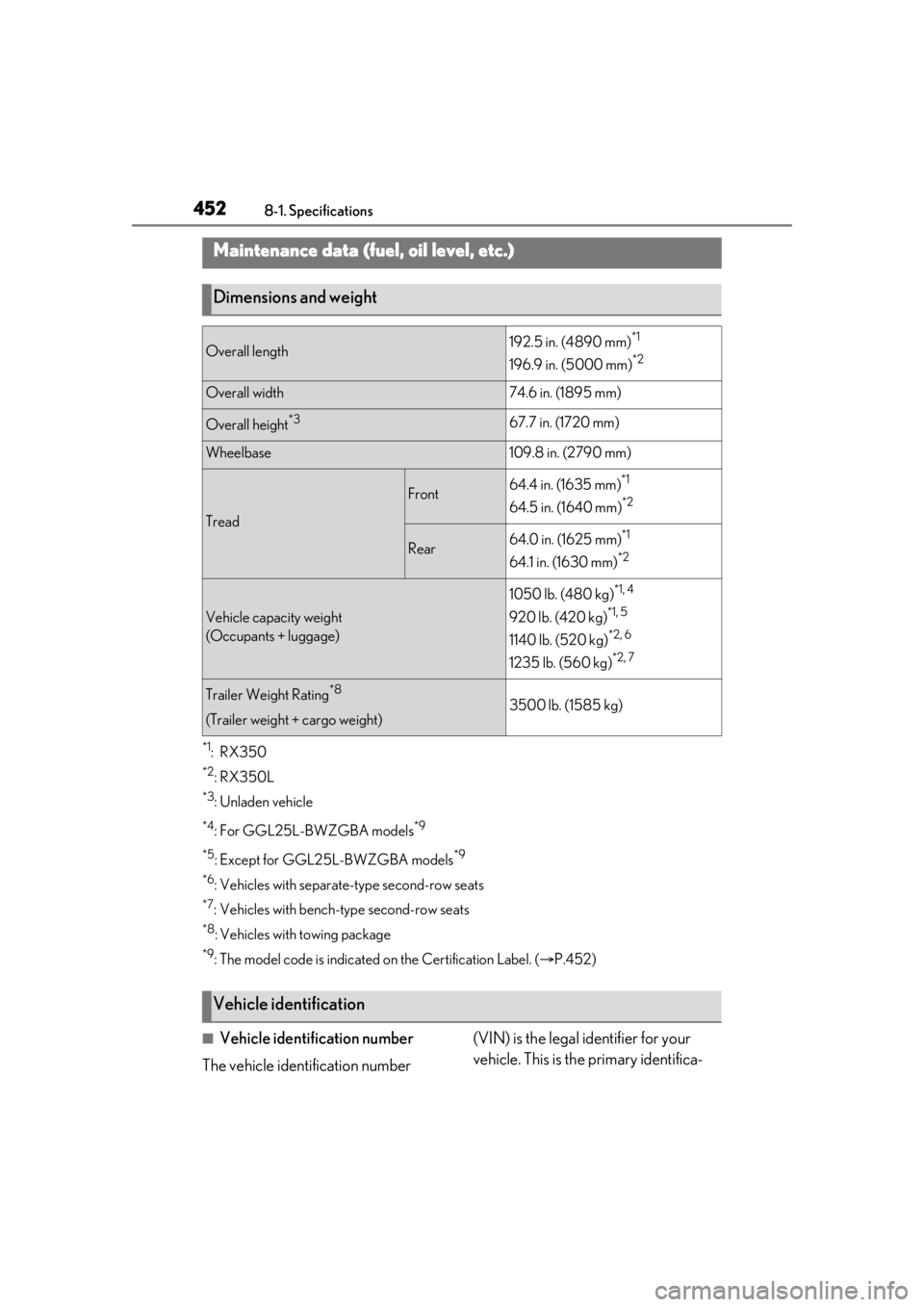
Dimensions and weight
Overall length192.5 in. (4890 mm)*1
196.9 in. (5000 mm)*2
Overall width74.6 in. (1895 mm)
Overall height*367.7 in. (1720 mm)
Wheelbase109.8 in. (2790 mm)
Tread
Front64.4 in. (1635 mm)*1
64.5 in. (1640 mm)*2
Rear64.0 in. (1625 mm)*1
64.1 in. (1630 mm)*2
Vehicle capacity weight
(Occupants + luggage)
1050 lb. (480 kg)*1, 4
920 lb. (420 kg)*1, 5
1140 lb. (520 kg)*2, 6
1235 lb. (560 kg)*2, 7
Trailer Weight Rating*8
(Trailer weight + cargo weight)3500 lb. (1585 kg)
Vehicle identification
Page 457 of 516
4578-1. Specifications
8
Vehicle specifications
Your Lexus vehicle is filled with “Toyota Genuine Differential Gear Oil” at the fac-
tory. Use Lexus approved “Toyota Genuine Di fferential Gear Oil” or an equivalent
of matching quality to satisfy the above specification. Please contact your Lexus
dealer for further details.
*: Minimum pedal clearance when depressed with a force of 110 lbf (490 N, 50 kgf) while
the engine is running.
Type A
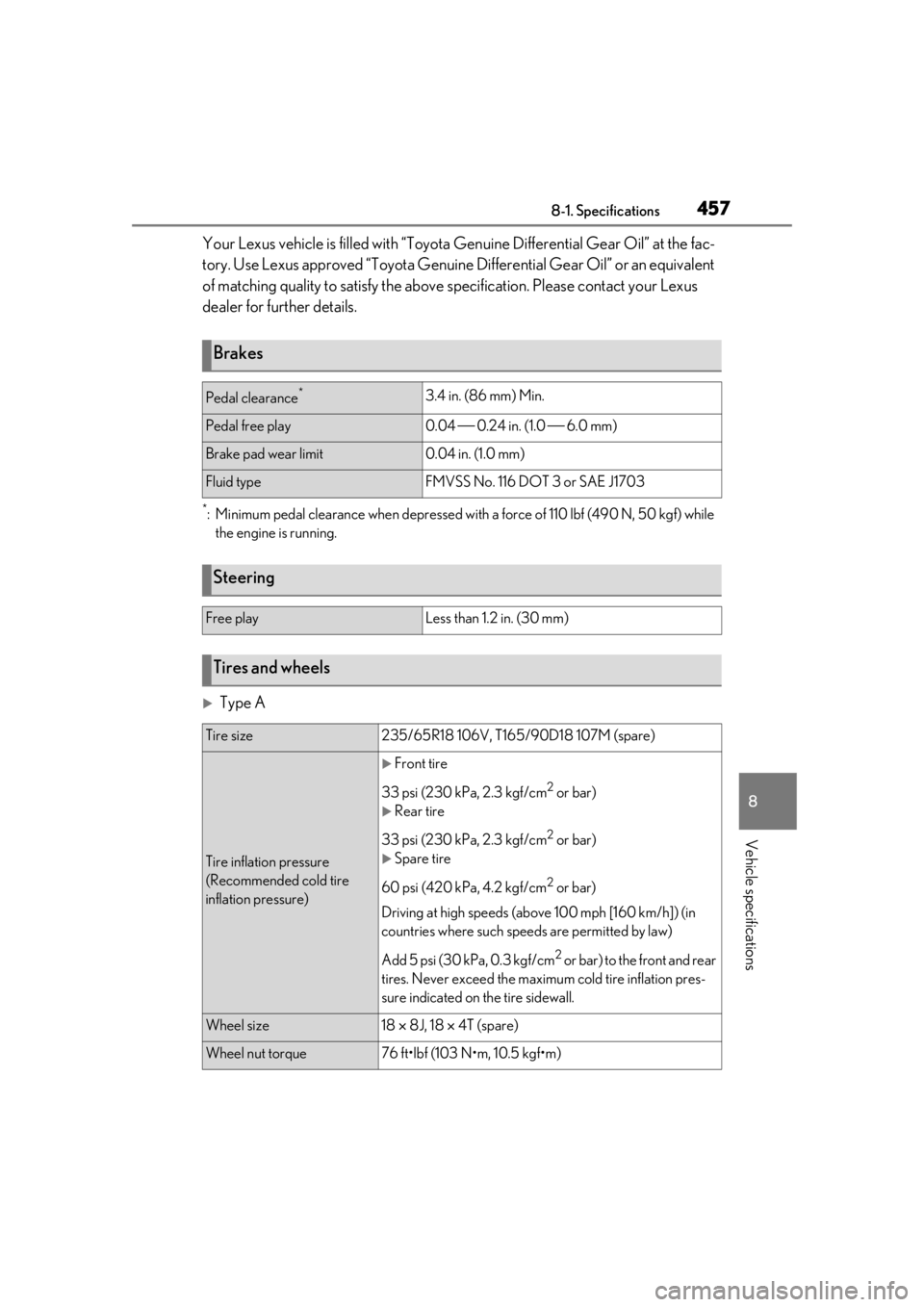
Brakes
Pedal clearance*3.4 in. (86 mm) Min.
Pedal free play0.04 0.24 in. (1.0 6.0 mm)
Brake pad wear limit0.04 in. (1.0 mm)
Fluid typeFMVSS No. 116 DOT 3 or SAE J1703
Steering
Free playLess than 1.2 in. (30 mm)
Tires and wheels
Tire size235/65R18 106V, T165/90D18 107M (spare)
Tire inflation pressure
(Recommended cold tire
inflation pressure)
Front tire
33 psi (230 kPa, 2.3 kgf/cm
2 or bar)
Rear tire
33 psi (230 kPa, 2.3 kgf/cm
2 or bar)
Spare tire
60 psi (420 kPa, 4.2 kgf/cm
2 or bar)
Driving at high speeds (above 100 mph [160 km/h]) (in
countries where such speeds are permitted by law)
Add 5 psi (30 kPa, 0.3 kgf/cm
2 or bar) to the front and rear
tires. Never exceed the maximum cold tire inflation pres-
sure indicated on the tire sidewall.
Wheel size18 8J, 18 4T (spare)
Wheel nut torque76 ft•lbf (103 N•m, 10.5 kgf•m)
Page 458 of 516
4588-1. Specifications
Type B
A: Wedge base bulbs (amber)
B: Wedge base bulbs (clear)
*1: Vehicles with sing le-beam headlights
*2: Vehicles without door trim ornament lights
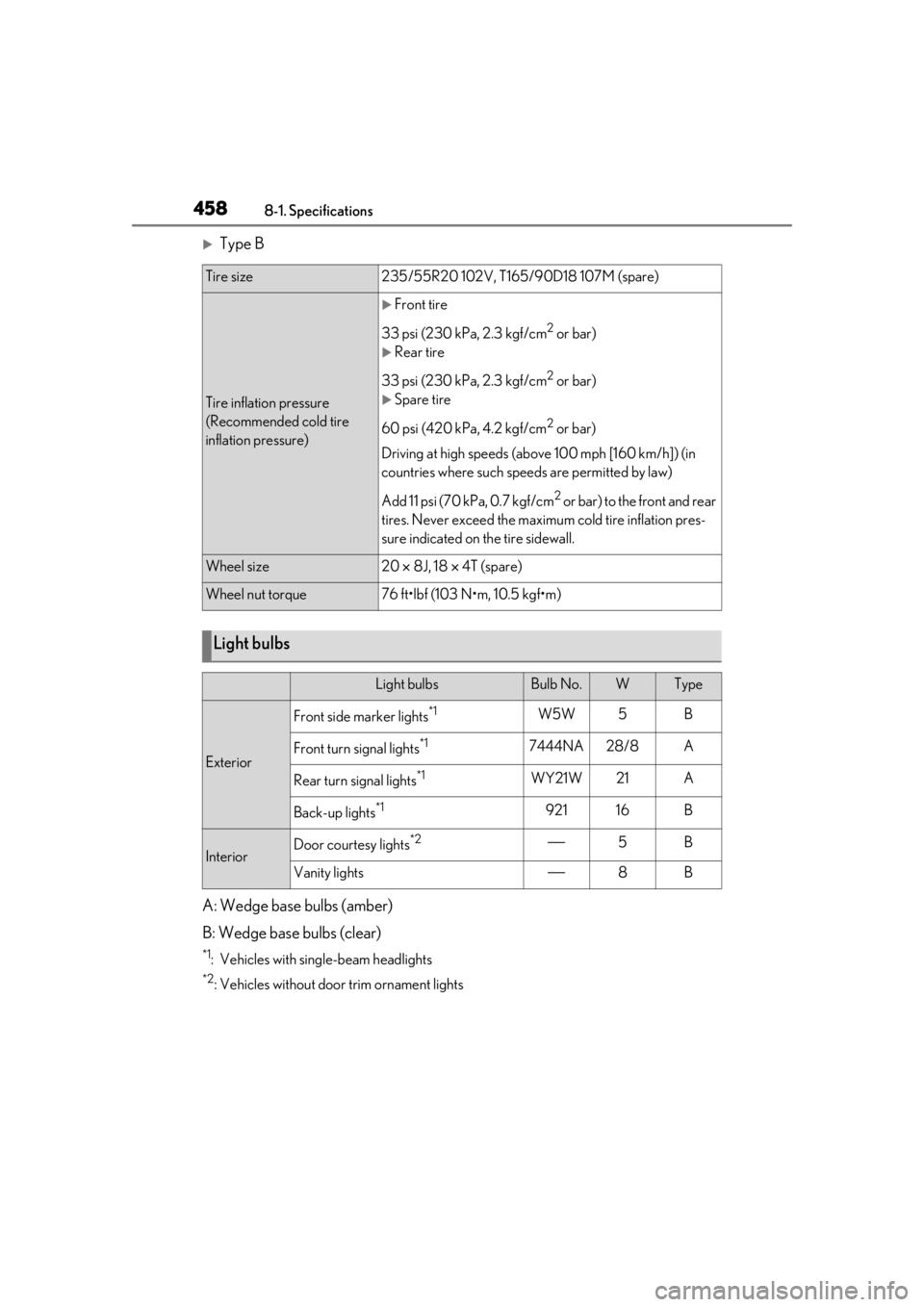
Tire size235/55R20 102V, T165/90D18 107M (spare)
Tire inflation pressure
(Recommended cold tire
inflation pressure)
Front tire
33 psi (230 kPa, 2.3 kgf/cm
2 or bar)
Rear tire
33 psi (230 kPa, 2.3 kgf/cm
2 or bar)
Spare tire
60 psi (420 kPa, 4.2 kgf/cm
2 or bar)
Driving at high speeds (above 100 mph [160 km/h]) (in
countries where such speeds are permitted by law)
Add 11 psi (70 kPa, 0.7 kgf/cm
2 or bar) to the front and rear
tires. Never exceed the maximum cold tire inflation pres-
sure indicated on the tire sidewall.
Wheel size20 8J, 18 4T (spare)
Wheel nut torque76 ft•lbf (103 N•m, 10.5 kgf•m)
Light bulbs
Light bulbsBulb No.WType
Exterior
Front side marker lights*1W5W5B
Front turn signal lights*17444NA28/8A
Rear turn signal lights*1WY21W21A
Back-up lights*192116B
InteriorDoor courtesy lights*25B
Vanity lights8B
Page 463 of 516
4638-1. Specifications
8
Vehicle specifications
Vehicle Safety Standards.
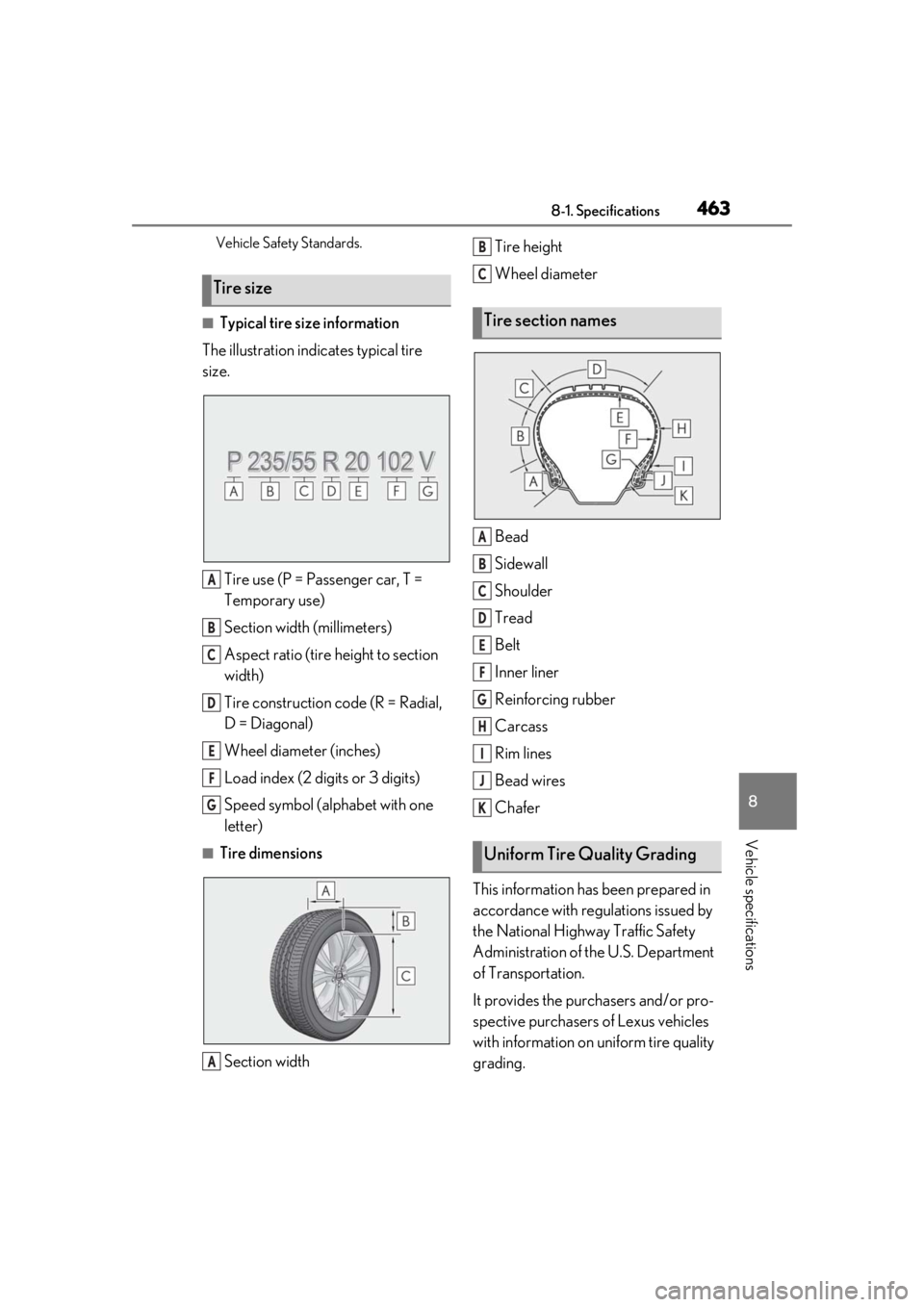
■Typical tire size information
The illustration indicates typical tire
size.
Tire use (P = Passenger car, T =
Temporary use)
Section width (millimeters)
Aspect ratio (tire height to section
width)
Tire construction code (R = Radial,
D = Diagonal)
Wheel diameter (inches)
Load index (2 digits or 3 digits)
Speed symbol (alphabet with one
letter)
■Tire dimensionsSection width Tire height
Wheel diameter
Bead
Sidewall
Shoulder
Tread
Belt
Inner liner
Reinforcing rubber
Carcass
Rim lines
Bead wires
Chafer
This information has been prepared in
accordance with regulations issued by
the National Highway Traffic Safety
Administration of the U.S. Department
of Transportation.
It provides the purchasers and/or pro-
spective purchasers of Lexus vehicles
with information on uniform tire quality
grading.
Tire size
A
B
C
D
E
F
G
A
Tire section names
Uniform Tire Quality Grading
B
C
A
B
C
D
E
F
G
H
I
J
K