towing LEXUS RX350 2022 Owner's Guide
[x] Cancel search | Manufacturer: LEXUS, Model Year: 2022, Model line: RX350, Model: LEXUS RX350 2022Pages: 508, PDF Size: 26.2 MB
Page 390 of 508
3887-2. Steps to take in an emergency
The following may indicate a problem
with your transmission. Contact your
Lexus dealer or commercial towing
service before towing.
The engine is running but the vehi-
cle does not move.
The vehicle makes an abnormal
sound.
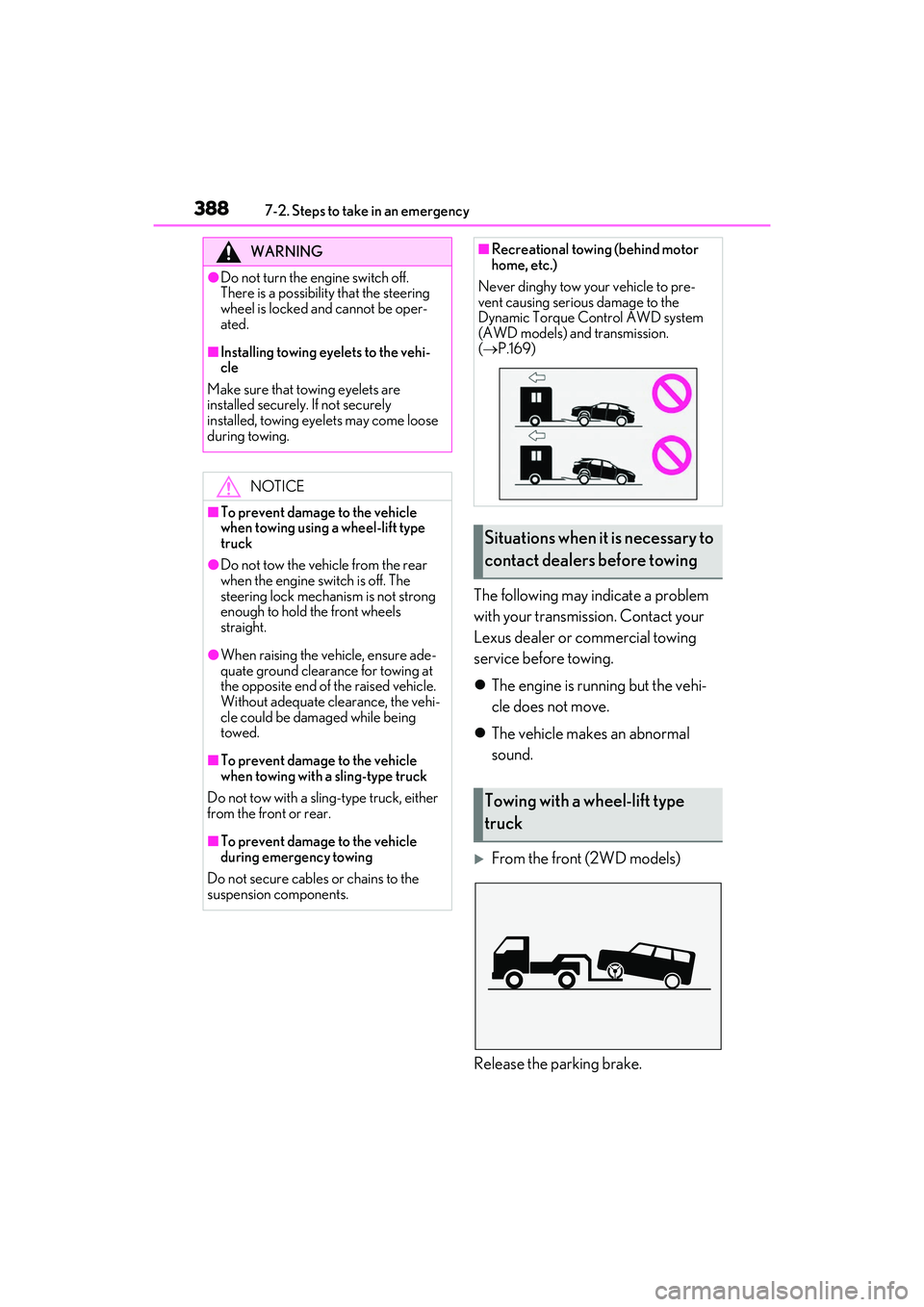
From the front (2WD models)
Release the parking brake.
WARNING
●Do not turn the engine switch off.
There is a possibility that the steering
wheel is locked and cannot be oper-
ated.
■Installing towing eyelets to the vehi-
cle
Make sure that towing eyelets are
installed securely. If not securely
installed, towing eyelets may come loose
during towing.
NOTICE
■To prevent damage to the vehicle
when towing using a wheel-lift type
truck
●Do not tow the vehicle from the rear
when the engine switch is off. The
steering lock mechanism is not strong
enough to hold the front wheels
straight.
●When raising the vehicle, ensure ade-
quate ground clearance for towing at
the opposite end of the raised vehicle.
Without adequate clearance, the vehi-
cle could be damaged while being
towed.
■To prevent damage to the vehicle
when towing with a sling-type truck
Do not tow with a sling-type truck, either
from the front or rear.
■To prevent damage to the vehicle
during emergency towing
Do not secure cables or chains to the
suspension components.
■Recreational towing (behind motor
home, etc.)
Never dinghy tow your vehicle to pre-
vent causing serious damage to the
Dynamic Torque Control AWD system
(AWD models) and transmission.
( P.169)
Situations when it is necessary to
contact dealers before towing
Towing with a wheel-lift type
truck
Page 391 of 508
3897-2. Steps to take in an emergency
7
When trouble arises
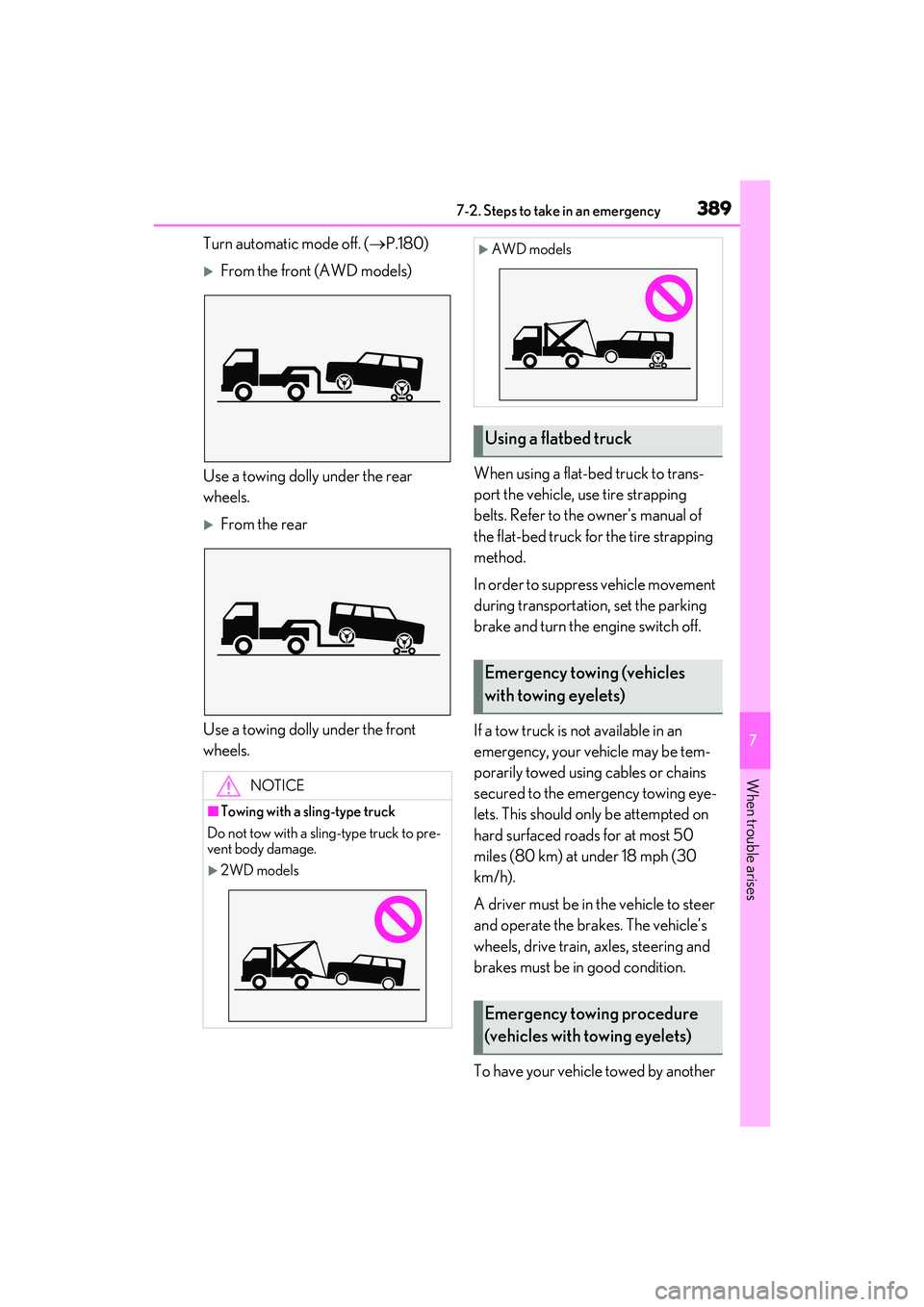
Turn automatic mode off. (P.180)
From the front (AWD models)
Use a towing dolly under the rear
wheels.
From the rear
Use a towing dolly under the front
wheels. When using a flat-bed truck to trans-
port the vehicle, use tire strapping
belts. Refer to the owner's manual of
the flat-bed truck for the tire strapping
method.
In order to suppress vehicle movement
during transportation, set the parking
brake and turn the engine switch off.
If a tow truck is not available in an
emergency, your vehicle may be tem-
porarily towed using cables or chains
secured to the emergency towing eye-
lets. This should only be attempted on
hard surfaced roads for at most 50
miles (80 km) at under 18 mph (30
km/h).
A driver must be in the vehicle to steer
and operate the brakes. The vehicle’s
wheels, drive train, axles, steering and
brakes must be in good condition.
To have your vehicle towed by another
NOTICE
■Towing with a sling-type truck
Do not tow with a sling-type truck to pre-
vent body damage.
2WD models
AWD models
Using a flatbed truck
Emergency towing (vehicles
with towing eyelets)
Emergency towing procedure
(vehicles with towing eyelets)
Page 392 of 508
3907-2. Steps to take in an emergency
vehicle, the towing eyelet must be
installed to your vehicle. Install the tow-
ing eyelet using the following proce-
dure.
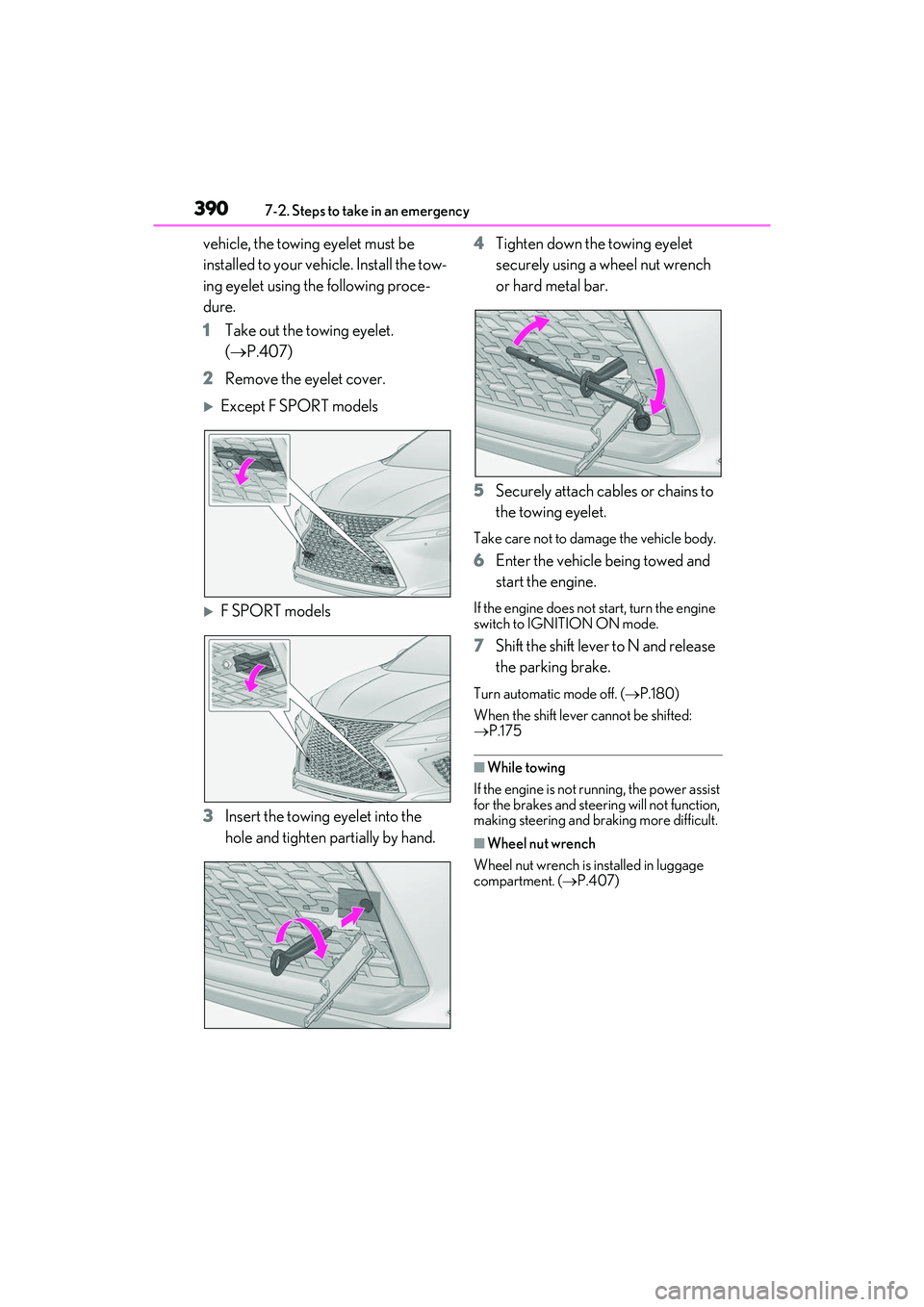
1 Take out the towing eyelet.
( P.407)
2 Remove the eyelet cover.
Except F SPORT models
F SPORT models
3 Insert the towing eyelet into the
hole and tighten partially by hand. 4
Tighten down the towing eyelet
securely using a wheel nut wrench
or hard metal bar.
5 Securely attach cables or chains to
the towing eyelet.
Take care not to damage the vehicle body.
6Enter the vehicle being towed and
start the engine.
If the engine does not start, turn the engine
switch to IGNITION ON mode.
7Shift the shift lever to N and release
the parking brake.
Turn automatic mode off. (P.180)
When the shift lever cannot be shifted:
P.175
■While towing
If the engine is not running, the power assist
for the brakes and steer ing will not function,
making steering and braking more difficult.
■Wheel nut wrench
Wheel nut wrench is installed in luggage
compartment. ( P.407)
Page 409 of 508
4077-2. Steps to take in an emergency
7
When trouble arises
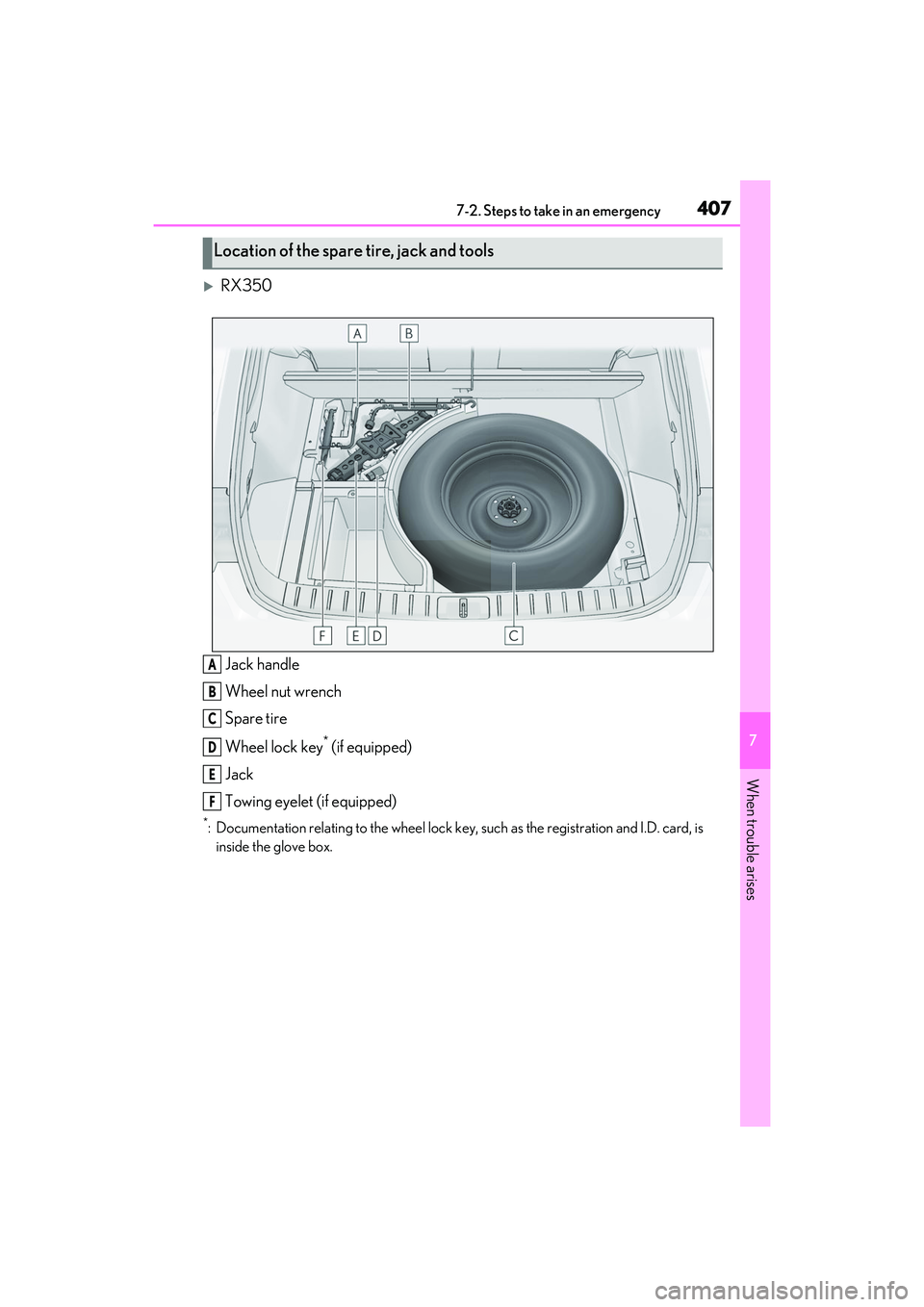
RX350Jack handle
Wheel nut wrench
Spare tire
Wheel lock key
* (if equipped)
Jack
Towing eyelet (if equipped)
*: Documentation relating to the wheel lock key, such as the registration and I.D. card, is
inside the glove box.
Location of the spare tire, jack and tools
A
B
C
D
E
F
Page 410 of 508
4087-2. Steps to take in an emergency
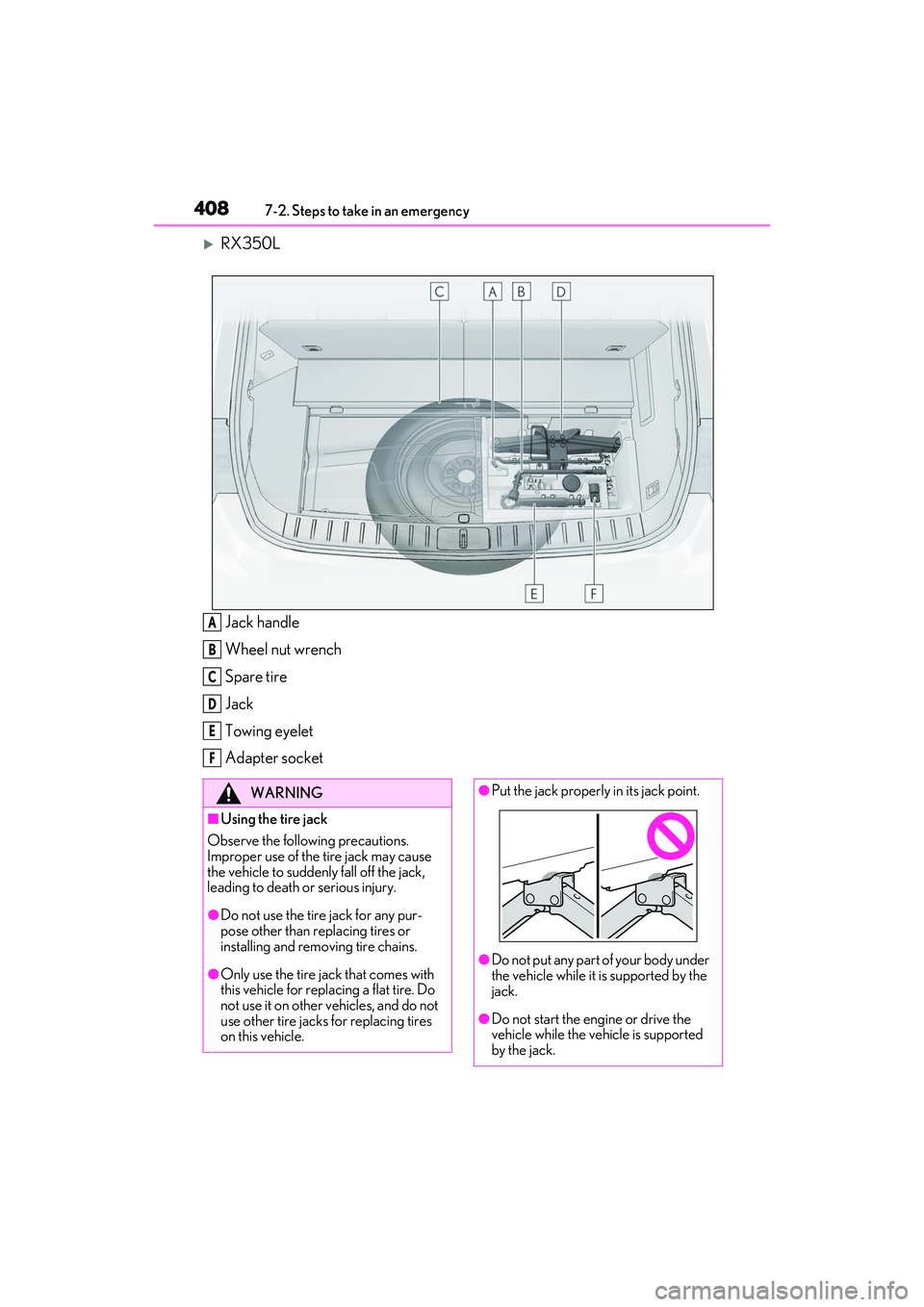
RX350LJack handle
Wheel nut wrench
Spare tire
Jack
Towing eyelet
Adapter socket
A
B
C
D
E
F
WARNING
■Using the tire jack
Observe the following precautions.
Improper use of the tire jack may cause
the vehicle to suddenly fall off the jack,
leading to death or serious injury.
●Do not use the tire jack for any pur-
pose other than replacing tires or
installing and removing tire chains.
●Only use the tire jack that comes with
this vehicle for replacing a flat tire. Do
not use it on other vehicles, and do not
use other tire jacks for replacing tires
on this vehicle.
●Put the jack properly in its jack point.
●Do not put any part of your body under
the vehicle while it is supported by the
jack.
●Do not start the engine or drive the
vehicle while the vehicle is supported
by the jack.
Page 416 of 508
4147-2. Steps to take in an emergency
Tapered portion
Disc wheel seat
3 Lower the vehicle.
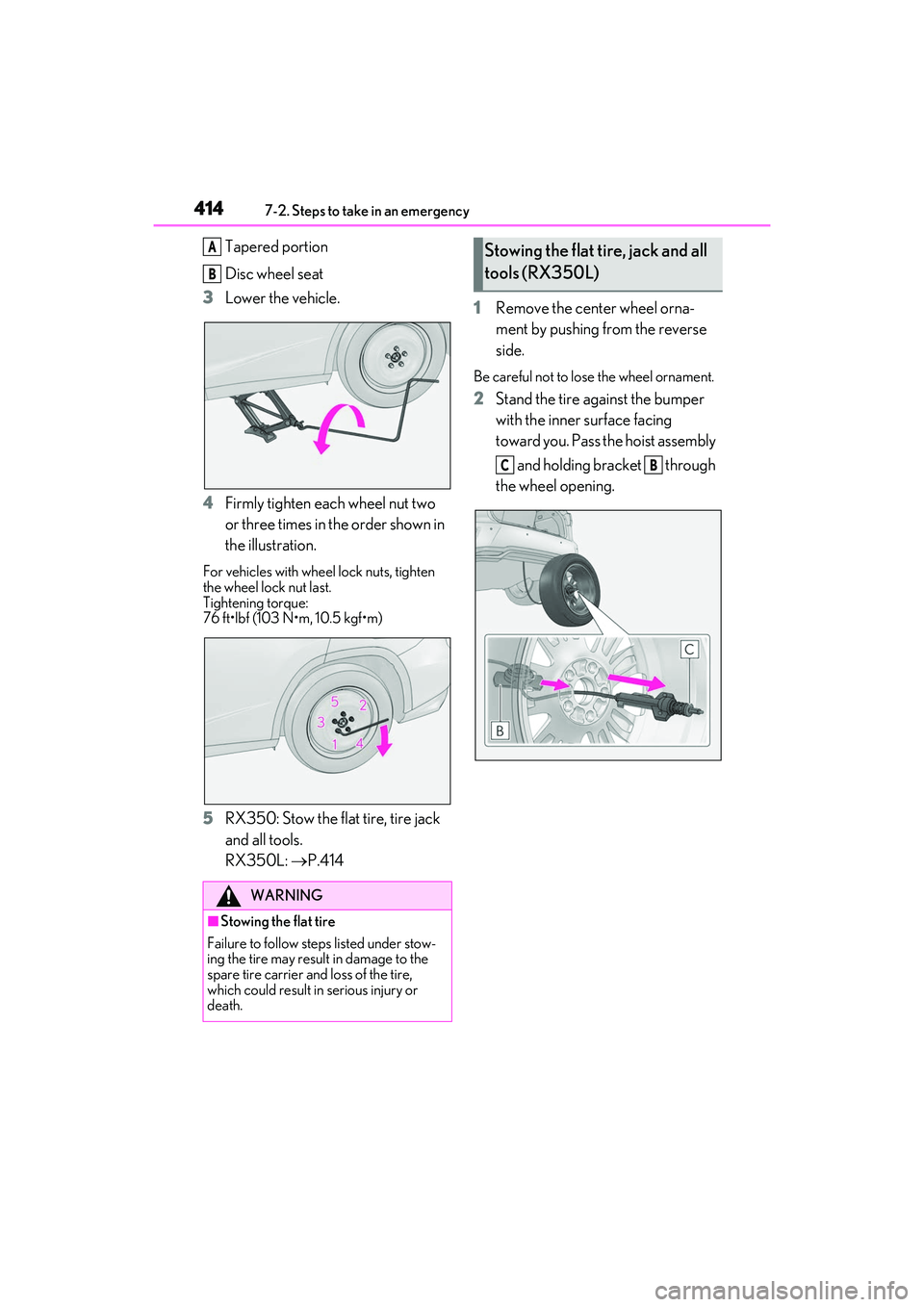
4 Firmly tighten each wheel nut two
or three times in the order shown in
the illustration.
For vehicles with wheel lock nuts, tighten
the wheel lock nut last.
Tightening torque:
76 ft•lbf (103 N•m, 10.5 kgf•m)
5RX350: Stow the flat tire, tire jack
and all tools.
RX350L: P.414 1
Remove the center wheel orna-
ment by pushing from the reverse
side.
Be careful not to lose the wheel ornament.
2Stand the tire against the bumper
with the inner surface facing
toward you. Pass the hoist assembly
and holding bracket through
the wheel opening.
WARNING
■Stowing the flat tire
Failure to follow step s listed under stow-
ing the tire may result in damage to the
spare tire carrier and loss of the tire,
which could result in serious injury or
death.
A
B
Stowing the flat tire, jack and all
tools (RX350L)
CB
Page 419 of 508
4177-2. Steps to take in an emergency
7
When trouble arises
WARNING
Also, not only can the following system
not be utilized fully, but it may even nega-
tively affect the drive-train components:
• AWD system (AWD models)
■Speed limit when using the compact
spare tire
Do not drive at speeds in excess of 50
mph (80 km/h) when a compact spare
tire is installed on the vehicle.
The compact spare tire is not designed
for driving at high speeds. Failure to
observe this precaution may lead to an
accident causing deat h or serious injury.
■After using the tools and jack
Before driving, make sure all the tools
and jack are securely in place in their
storage location to reduce the possibility
of personal injury during a collision or
sudden braking.
NOTICE
■Be careful when driving over bumps
with the compact spare tire installed
on the vehicle
The vehicle becomes lower when driving
with the compact spare tire compared to
when driving with standard tires. Be
careful when driving over uneven road
surfaces.
■Driving with tire chains and the com-
pact spare tire
Do not fit tire chains to the compact
spare tire. Tire chai ns may damage the
vehicle body and adversely affect driving
performance.
■When replacing the tires
When removing or fitting the wheels,
tires or the tire pressure warning valve
and transmitter, contact your Lexus
dealer as the tire pr essure warning valve
and transmitter may be damaged if not
handled correctly.
■When stowing the flat tire (RX350L)
●Ensure that there is no object caught
between the tire and the vehicle
underbody.
●Securely tighten the spare tire clamp
bolt to hold the spare wheel carrier by
the hook.
●Stow the flat tire in the spare tire loca-
tion. Failure to do so may cause dam-
age to the spare tire carrier. Proper
storage reduces the possibility of injury
in a collision or during sudden braking.
●Have the flat tire repaired and the
spare tire replaced wi th it as soon as
possible.
■Proper storage of the spare tire
(RX350L)
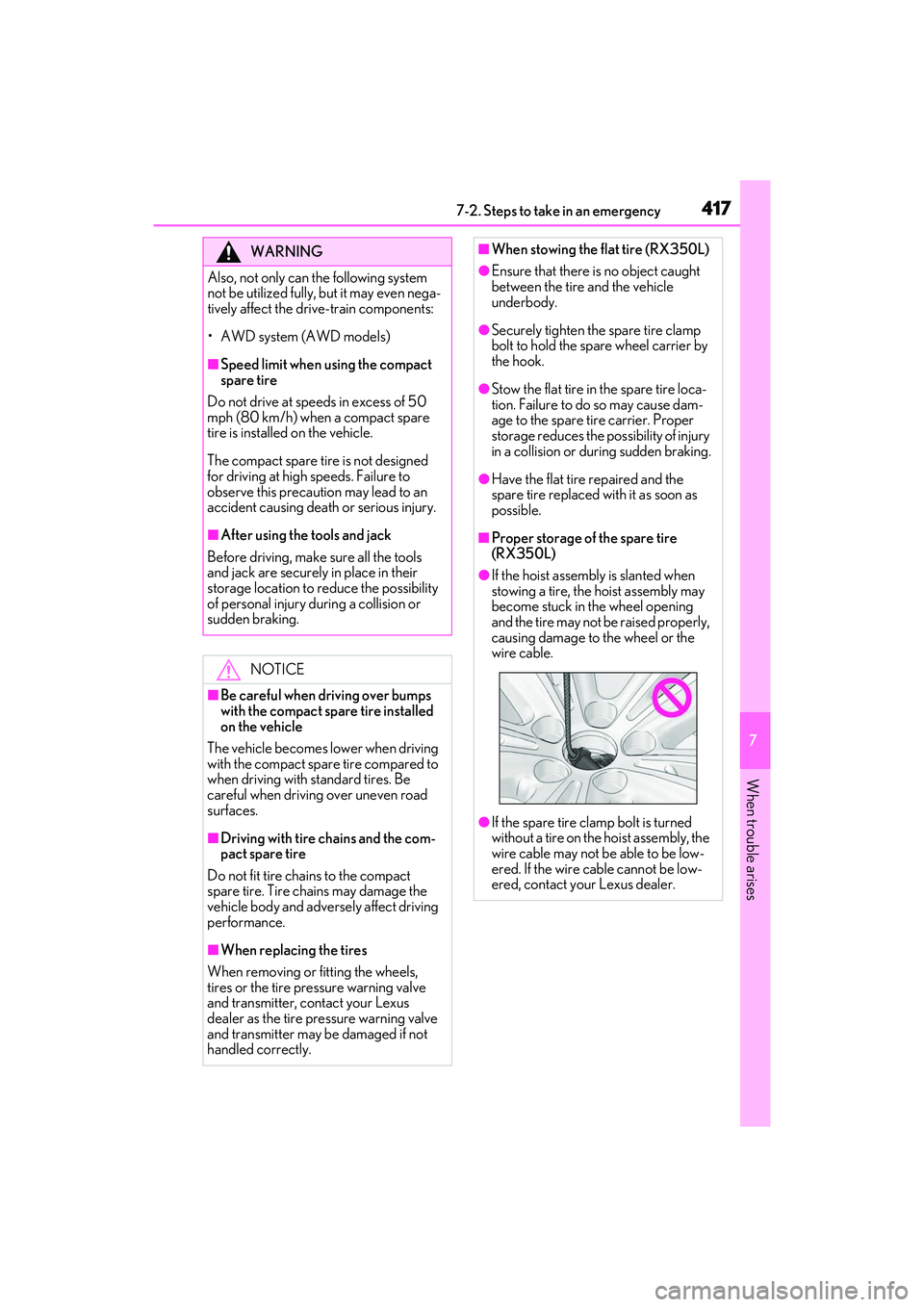
●If the hoist assembly is slanted when
stowing a tire, the hoist assembly may
become stuck in the wheel opening
and the tire may not be raised properly,
causing damage to the wheel or the
wire cable.
●If the spare tire clamp bolt is turned
without a tire on the hoist assembly, the
wire cable may not be able to be low-
ered. If the wire cable cannot be low-
ered, contact your Lexus dealer.
Page 430 of 508
4287-2. Steps to take in an emergency
1Stop the engine. Shift the shift lever
to P and set the parking brake.
2 Remove the mud, snow or sand
from around the front wheels.
3 Place wood, stones or some other
material under the front wheels to
help provide traction.
4 Restart the engine.
5 AWD models: Activate all-wheel
drive lock mode. ( P.264)
6 Shift the shift lever to D or R and
release the parking brake. Then,
while exercising caution, depress
the accelerator pedal.
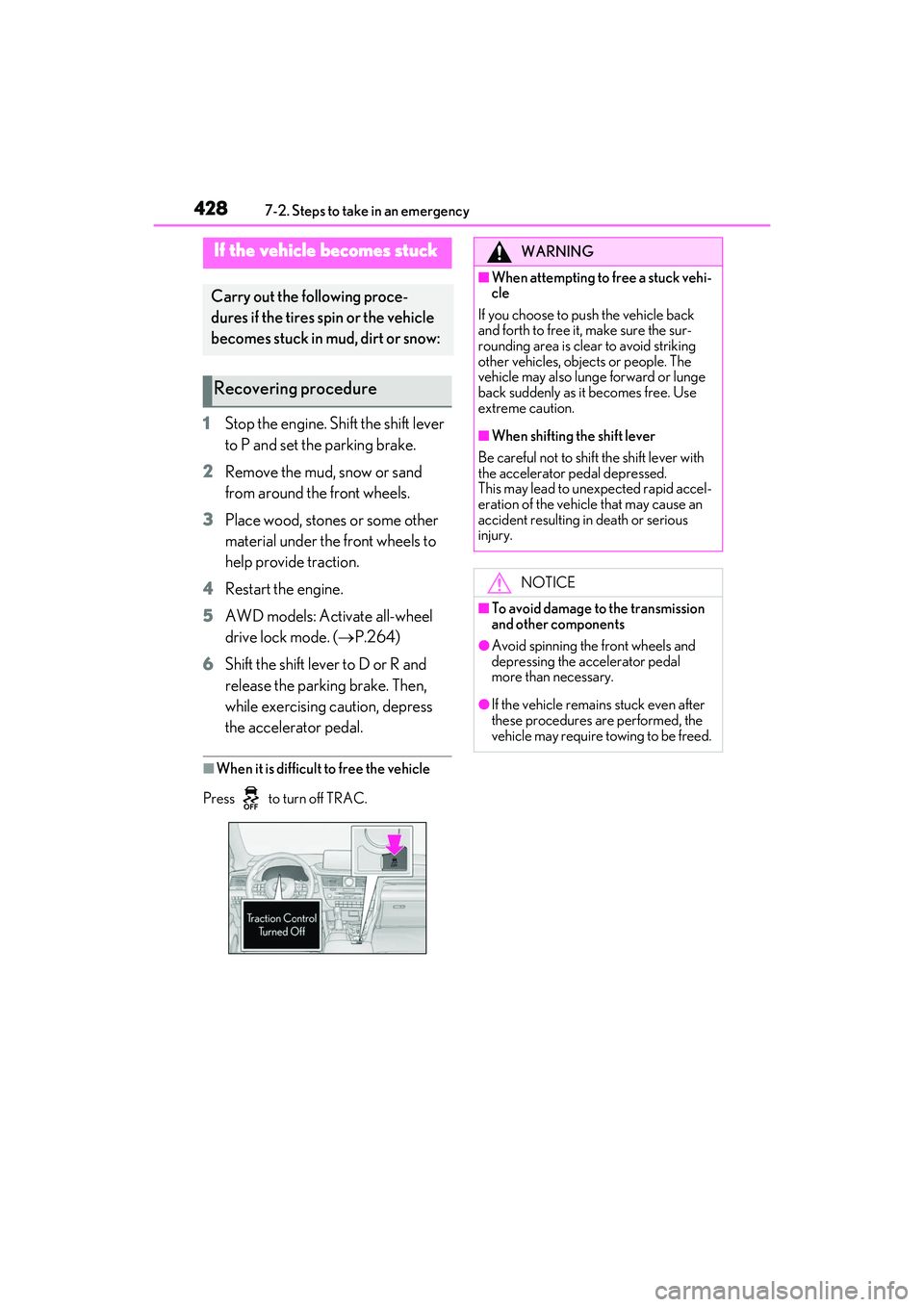
■When it is difficult to free the vehicle
Press to turn off TRAC.
If the vehicle becomes stuck
Carry out the following proce-
dures if the tires spin or the vehicle
becomes stuck in mud, dirt or snow:
Recovering procedure
WARNING
■When attempting to free a stuck vehi-
cle
If you choose to push the vehicle back
and forth to free it, make sure the sur-
rounding area is clear to avoid striking
other vehicles, obje cts or people. The
vehicle may also lunge forward or lunge
back suddenly as it becomes free. Use
extreme caution.
■When shifting the shift lever
Be careful not to shift the shift lever with
the accelerator pedal depressed.
This may lead to un expected rapid accel-
eration of the vehicle that may cause an
accident resulting in death or serious
injury.
NOTICE
■To avoid damage to the transmission
and other components
●Avoid spinning the front wheels and
depressing the accelerator pedal
more than necessary.
●If the vehicle remains stuck even after
these procedures are performed, the
vehicle may require towing to be freed.
Page 432 of 508

4308-1. Specifications
8-1.Specifications
*1:RX350
*2:RX350L
*3:Unladen vehicle
*4: For GGL25L-BWZGBA models*9
*5
: Except for GGL25L-BWZGBA models*9
*6
: Vehicles with separate -type second-row seats
*7: Vehicles with bench-type second-row seats
*8: Vehicles with towing package
*9: The model code is indicated on the Certification Label. (P.431)
Maintenance data (fuel, oil level, etc.)
Dimensions and weight
Overall length192.5 in. (4890 mm)*1
196.9 in. (5000 mm)*2
Overall width74.6 in. (1895 mm)
Overall height*367.7 in. (1720 mm)
Wheelbase109.8 in. (2790 mm)
Tread
Front64.4 in. (1635 mm)*1
64.5 in. (1640 mm)*2
Rear64.0 in. (1625 mm)*1
64.1 in. (1630 mm)*2
Vehicle capacity weight
(Occupants + luggage)
1050 lb. (480 kg)*1, 4
920 lb. (420 kg)*1, 5
1140 lb. (520 kg)*2, 6
1235 lb. (560 kg)*2, 7
Trailer Weight Rating*8
(Trailer weight + cargo weight)3500 lb. (1585 kg)
Page 434 of 508
4328-1. Specifications
■Oil capacity (Drain and refill ref-
erence
*)
*: The engine oil capacity is a reference
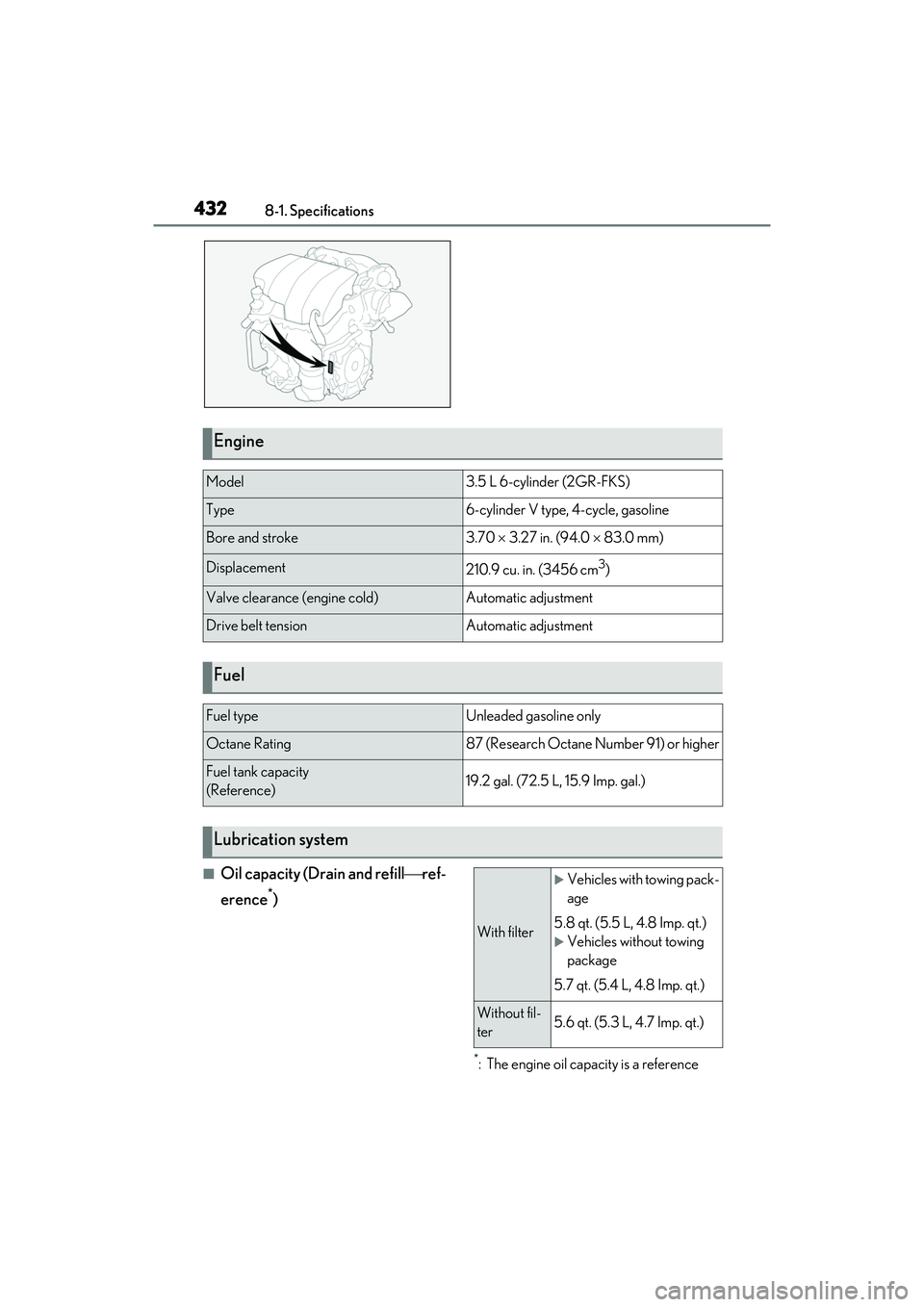
Engine
Model3.5 L 6-cylinder (2GR-FKS)
Type6-cylinder V type, 4-cycle, gasoline
Bore and stroke3.70 3.27 in. (94.0 83.0 mm)
Displacement210.9 cu. in. (3456 cm3)
Valve clearance (engine cold)Automatic adjustment
Drive belt tensionAutomatic adjustment
Fuel
Fuel typeUnleaded gasoline only
Octane Rating87 (Research Octane Number 91) or higher
Fuel tank capacity
(Reference)19.2 gal. (72.5 L, 15.9 Imp. gal.)
Lubrication system
With filter
Vehicles with towing pack-
age
5.8 qt. (5.5 L, 4.8 Imp. qt.)
Vehicles without towing
package
5.7 qt. (5.4 L, 4.8 Imp. qt.)
Without fil-
ter5.6 qt. (5.3 L, 4.7 Imp. qt.)