wheel LEXUS RX450h 2015 Owners Manual
[x] Cancel search | Manufacturer: LEXUS, Model Year: 2015, Model line: RX450h, Model: LEXUS RX450h 2015Pages: 878, PDF Size: 11.62 MB
Page 775 of 878
7745-2. Steps to take in an emergency
CAUTION■
Replacing a flat tire ●
Observe the following precautions.
Failure to do so may result in serious injury:
• Do not touch the disc wheels or the ar ea around the brakes immediately after
the vehicle has been driven.
After the vehicle has been driven the disc wheels and the area around the
brakes will be extremely hot. Touching these areas with hands, feet or other
body parts while changing a tire, etc. may result in burns.
• Do not attach a heavily damaged wheel ornament, as it may fly off the wheel
while the vehicle is moving.●
Failure to follow these precautions could cause the wheel nuts to loosen and the
tire to fall off, resulting in death or serious injury.
• Never use oil or grease on the wheel bolts or wheel nuts.
Oil and grease may cause the wheel nuts to be excessively tightened, leading
to bolt or disc wheel damage. In addition, the oil or grease can cause the
wheel nuts to loosen and the wheel may fall off, causing a serious accident.
Remove any oil or grease from the wheel bolts or wheel nuts.
• Have the wheel nuts tightened with a to rque wrench to 76 ft•lbf (103 N•m,
10.5 kgf•m) as soon as possible after changing wheels.
• When installing a tire, only use whee l nuts that have been specifically
designed for that wheel.
• If there are any cracks or deformations in the bolt screws, nut threads or bolt
holes of the wheel, have the vehicle inspected by your Lexus dealer.■
Replacing a flat tire for ve hicles with power back door
In cases such as when replacing tires, make sure to turn off the power back door
main switch ( P. 77). Failure to do so may cause the back door to operate uninten-
tionally if the power back door switch is accidentally touched, resulting in hands and
fingers being caught and injured.
Page 777 of 878
7765-2. Steps to take in an emergency
NOTICE■
Do not drive the vehicle with a flat tire
Do not continue driving with a flat tire.
Driving even a short distance with a flat tire can damage the tire and the wheel
beyond repair.■
Be careful when driving over bumps with the compact spare tire installed on the
vehicle.
The vehicle becomes lower when driving with the compact spare tire compared to
when driving with standard tires. Be careful when driving over uneven road sur-
faces.■
Driving with tire chains and the compact spare tire
Do not fit tire chains to the compact spare tire.
Tire chains may damage the vehicle body and adversely affect driving performance.■
When replacing the tires
When removing or fitting the wheels, tire s or the tire pressure warning valve and
transmitter, contact your Lexus dealer as the tire pressure warning valve and trans-
mitter may be damaged if not handled correctly.■
To avoid damage to the tire pressure warning valves and transmitters
When a tire is repaired with liquid seal ants, the tire pressure warning valve and
transmitter may not operate properly. If a liquid sealant is used, contact your Lexus
dealer or other qualified service shop as so on as possible. Make sure to replace the
tire pressure warning valve and transmitter when replacing the tire. ( P. 6 7 1 )
Page 794 of 878
5
When trouble arises
7935-2. Steps to take in an emergency
If the vehicle becomes stuck
■
When it is difficult to free the vehicleCarry out the following procedures if the tires spin or the vehicle becomes
stuck in mud, dirt or snow:
Stop the hybrid system. Set the parking brake and shift the shift
lever to P.
Remove the mud, snow or sand from around the front wheels.
Place wood, stones or some ot her material under the front
wheels to help provide traction.
Restart the hybrid system.
Shift the shift lever to the D or R position and release the park-
ing brake. Then, while exercising caution, depress the acceler-
ator pedal.STEP 1
STEP 2
STEP 3
STEP 4
STEP 5
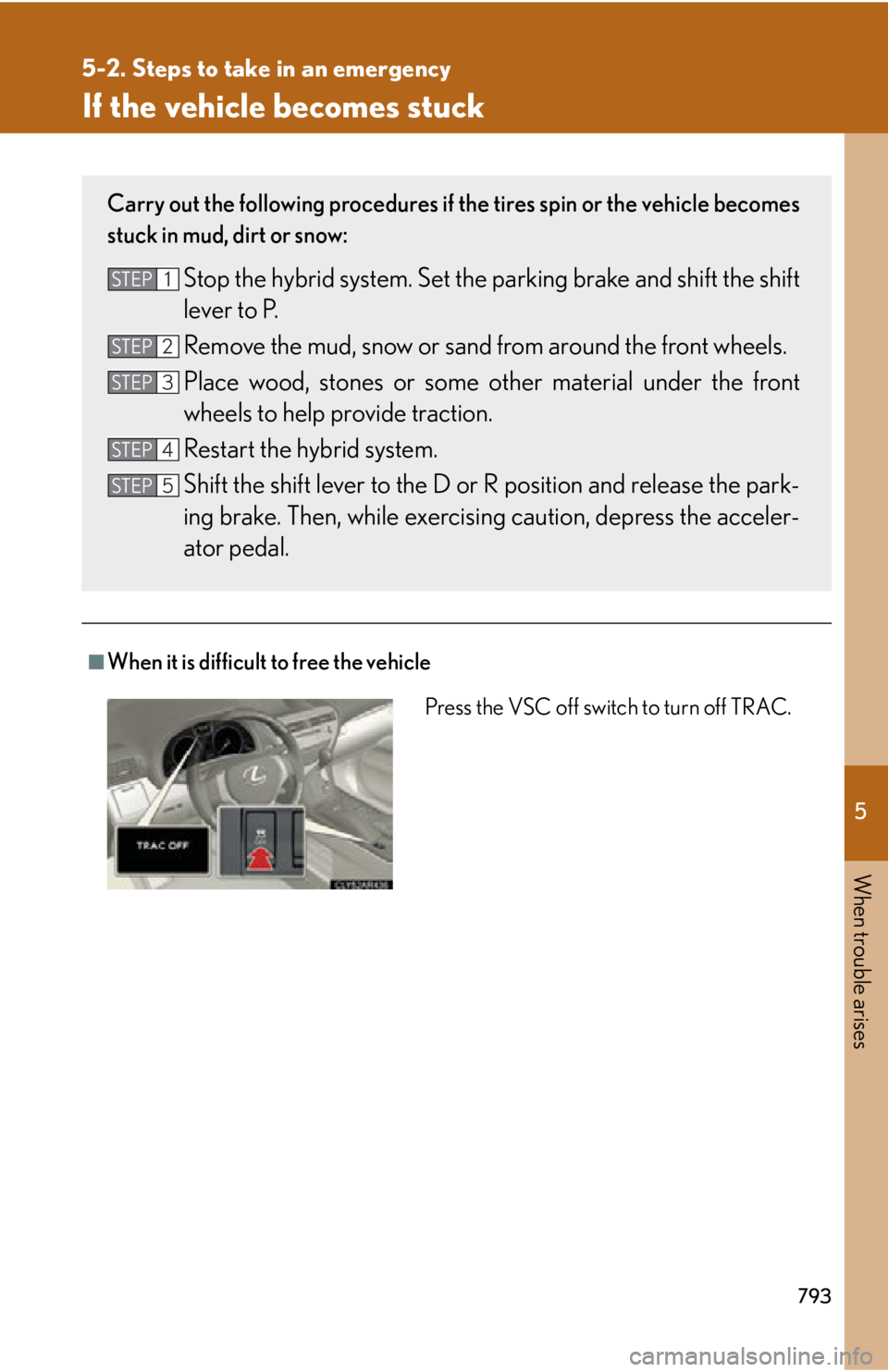
Press the VSC off switch to turn off TRAC.
Page 795 of 878
7945-2. Steps to take in an emergency
CAUTION■
When attempting to free a stuck vehicle
If you choose to push the vehicle back and forth to free it, make sure the surround-
ing area is clear to avoid striking other vehicles, objects or people. The vehicle may
also lunge forward or lunge back sudden ly as it becomes free. Use extreme cau-
tion.■
When shifting the shift lever
Be careful not to shift the shift lever with the accelerator pedal depressed.
This may lead to unexpected rapid acceleration of the vehicle that may cause an
accident resulting in death or serious injury.
NOTICE■
To avoid damage to the hybrid transmission and other components●
Avoid spinning the front wheels and depressing the accelerator pedal more than
necessary.●
If the vehicle remains stuck even after these procedures are performed, the vehi-
cle may require towing to be freed.
Page 796 of 878
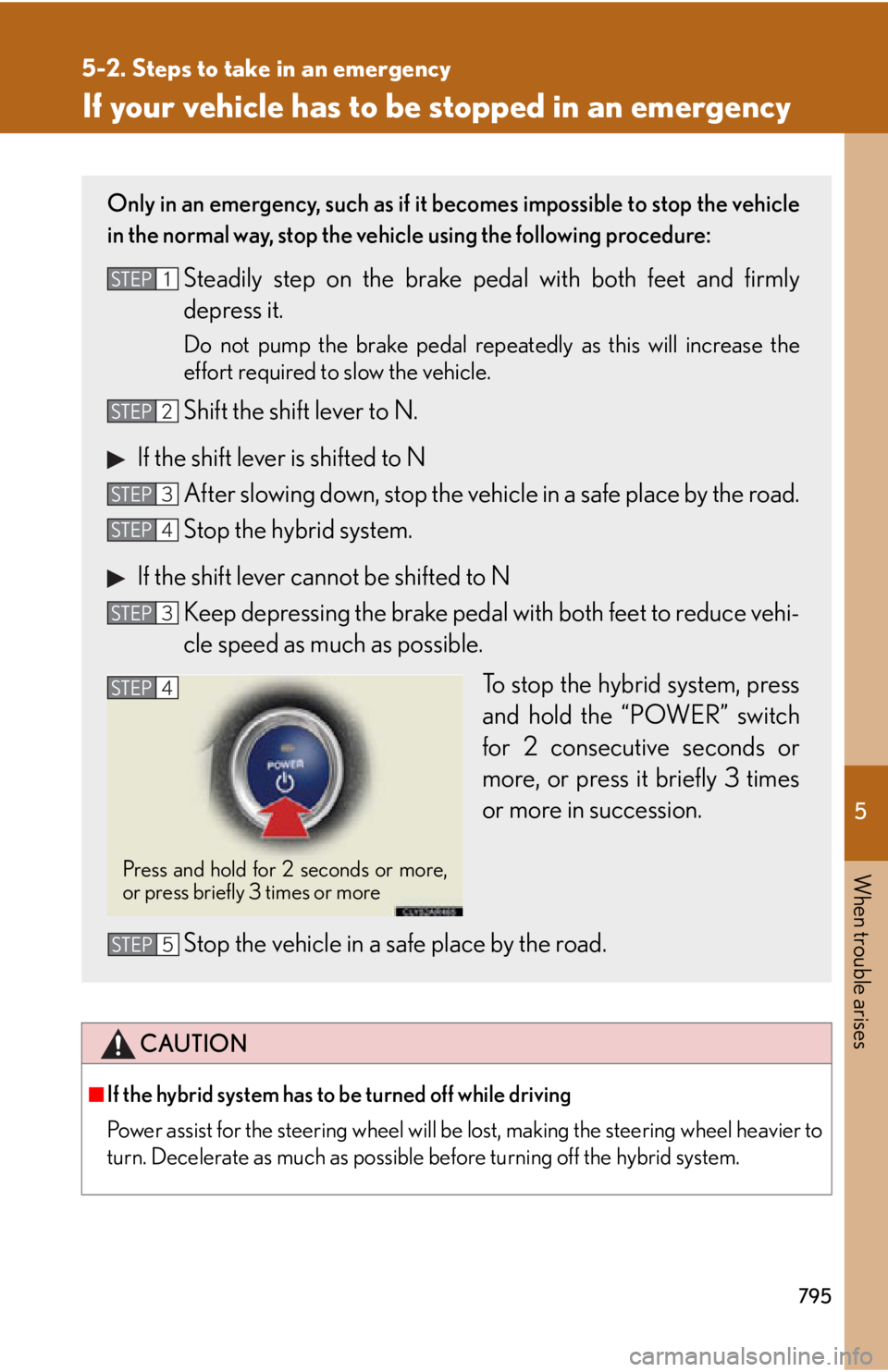
5
When trouble arises
7955-2. Steps to take in an emergency
If your vehicle has to be stopped in an emergency
CAUTION
■
If the hybrid system has to be turned off while driving
Power assist for the steering wheel will be lost, making the steering wheel heavier to
turn. Decelerate as much as possible before turning off the hybrid system.Only in an emergency, such as if it becomes impossible to stop the vehicle
in the normal way, stop the vehicle using the following procedure:
Steadily step on the brake pe dal with both feet and firmly
depress it. Do not pump the brake pedal repeatedly as this will increase the
effort required to slow the vehicle.
Shift the shift lever to N.
If the shift lever is shifted to N
After slowing down, stop the vehicl e in a safe place by the road.
Stop the hybrid system.
If the shift lever cannot be shifted to N
Keep depressing the brake pedal with both feet to reduce vehi-
cle speed as much as possible.
To stop the hybrid system, press
and hold the “POWER” switch
for 2 consecutive seconds or
more, or press it briefly 3 times
or more in succession.
Stop the vehicle in a safe place by the road.STEP 1
STEP 2
STEP 3
STEP 4
STEP 3
STEP 4
Press and hold for 2 seconds or more,
or press briefly 3 times or more
STEP 5
Page 799 of 878
7986-1. Specifications
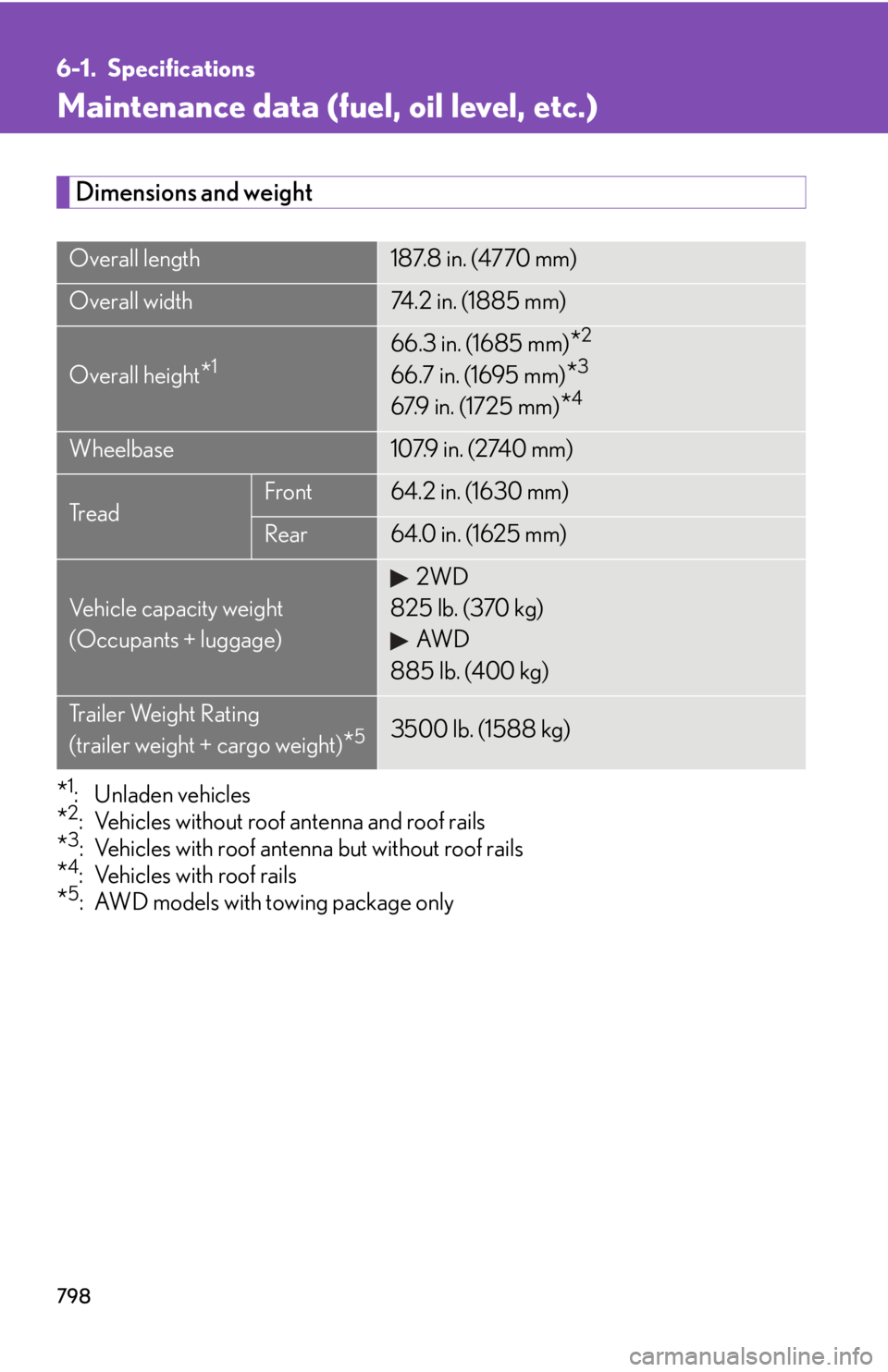
Maintenance data (fue l, oil level, etc.)Dimensions and weight
* 1
: Unladen vehicles
* 2
: Vehicles without roof antenna and roof rails
* 3
: Vehicles with roof antenna but without roof rails
* 4
: Vehicles with roof rails
* 5
: AWD models with towing package onlyOverall length 187.8 in. (4770 mm)
Overall width 74.2 in. (1885 mm)
Overall height
* 1
66.3 in. (1685 mm)
* 2
66.7 in. (1695 mm)
* 3
67.9 in. (1725 mm)
* 4
Wheelbase 107.9 in. (2740 mm)
Tr e a d Front 64.2 in. (1630 mm)
Rear 64.0 in. (1625 mm)
Vehicle capacity weight
(Occupants + luggage) 2WD
825 lb. (370 kg)
AW D
885 lb. (400 kg)
Trailer Weight Rating
(trailer weight + cargo weight)
* 5
3500 lb. (1588 kg)
Page 808 of 878
8076-1. Specifications
6
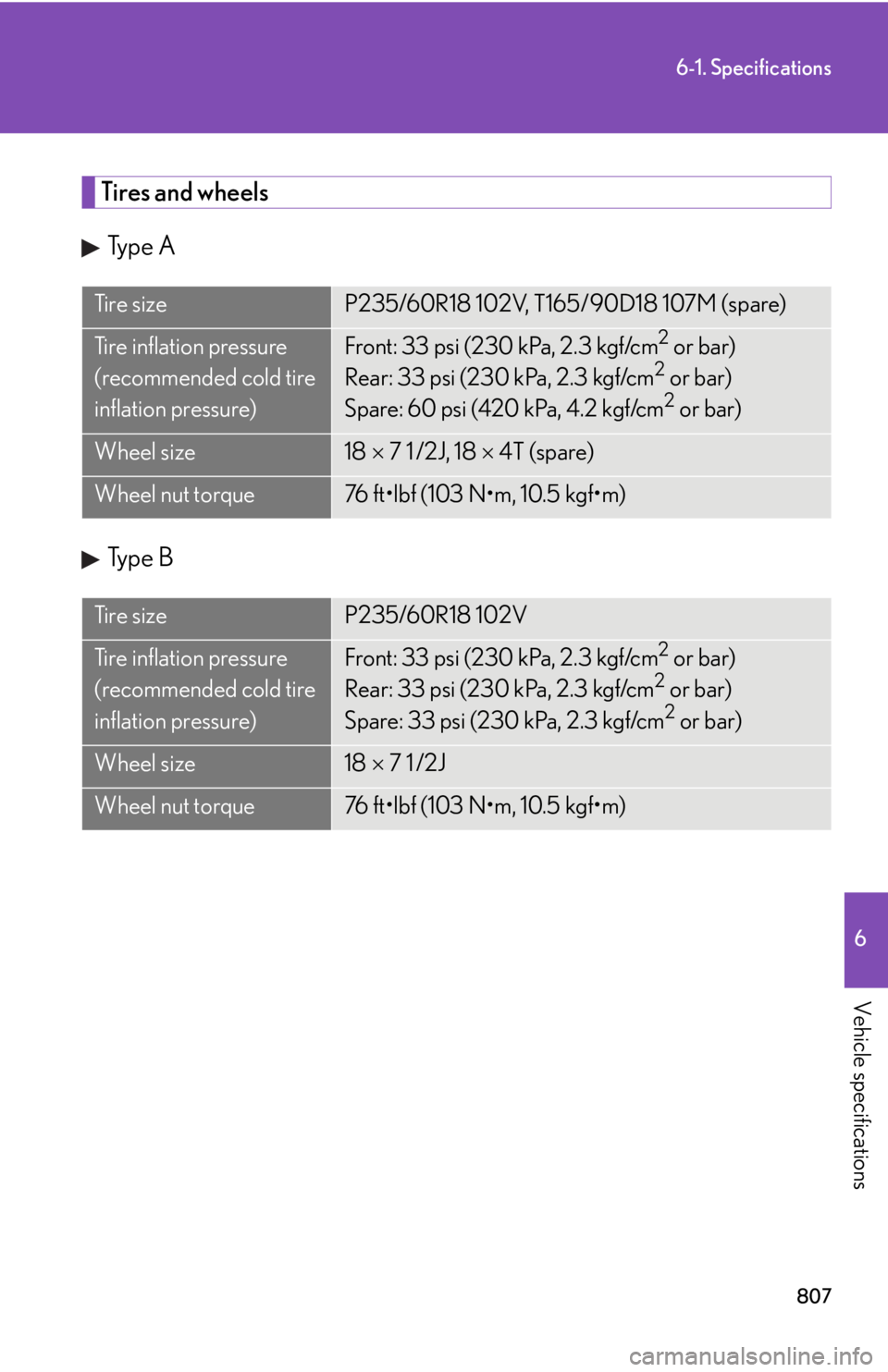
Vehicle specifications Tires and wheels
Type A
Type BTi r e s i z e P235/60R18 102V, T165/90D18 107M (spare)
Tire inflation pressure
(recommended cold tire
inflation pressure) Front: 33 psi (230 kPa, 2.3 kgf/cm 2
or bar)
Rear: 33 psi (230 kPa, 2.3 kgf/cm 2
or bar)
Spare: 60 psi (420 kPa, 4.2 kgf/cm 2
or bar)
Wheel size 18 7 1 /2J, 18 4T (spare)
Wheel nut torque 76 ft•lbf (103 N•m, 10.5 kgf•m)
Ti r e s i z e P235/60R18 102V
Tire inflation pressure
(recommended cold tire
inflation pressure) Front: 33 psi (230 kPa, 2.3 kgf/cm 2
or bar)
Rear: 33 psi (230 kPa, 2.3 kgf/cm 2
or bar)
Spare: 33 psi (230 kPa, 2.3 kgf/cm 2
or bar)
Wheel size 18 7 1 /2J
Wheel nut torque 76 ft•lbf (103 N•m, 10.5 kgf•m)
Page 809 of 878
8086-1. Specifications
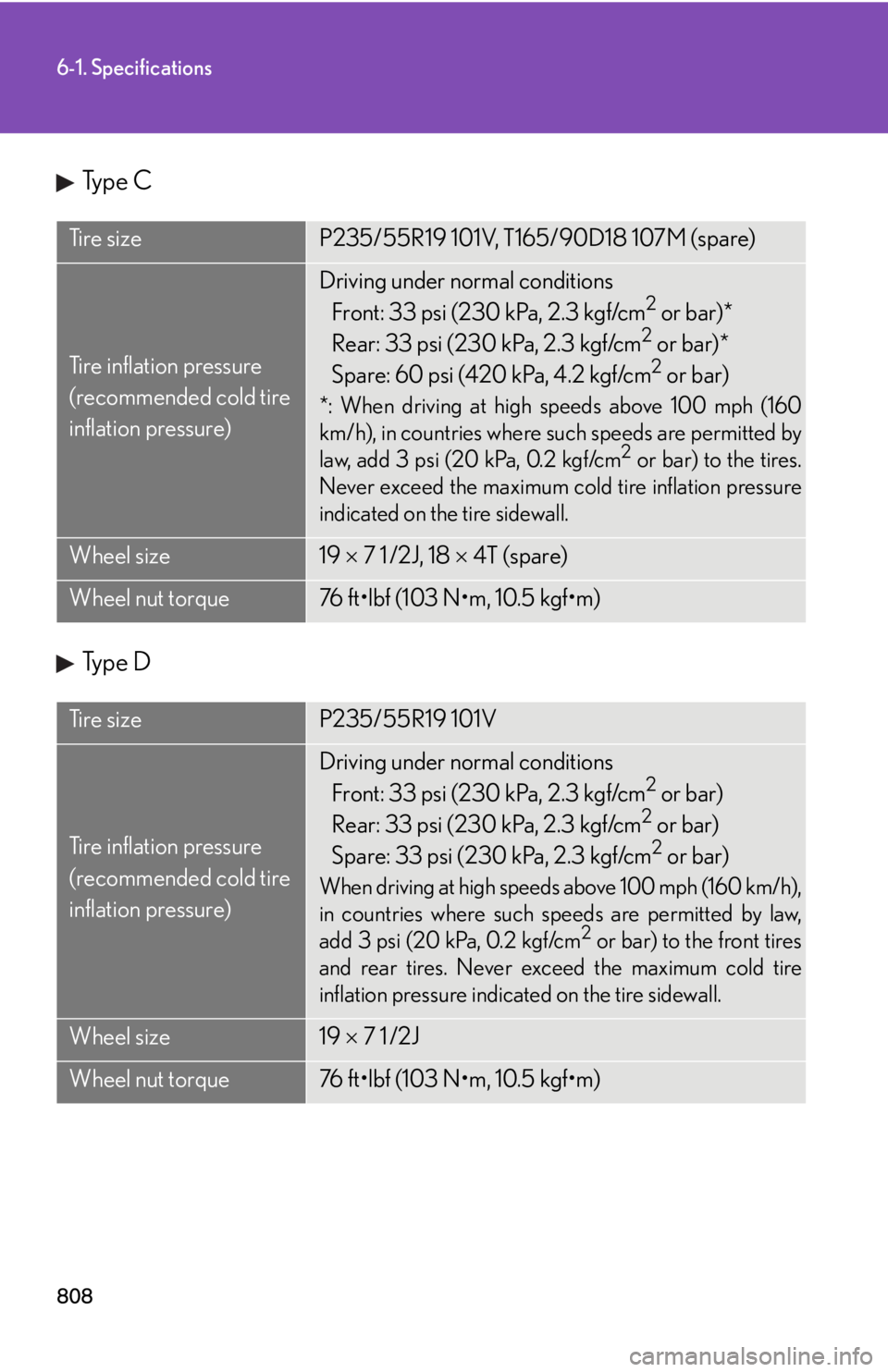
Ty p e C
Ty p e DTi r e s i z e P235/55R19 101V, T165/90D18 107M (spare)
Tire inflation pressure
(recommended cold tire
inflation pressure) Driving under normal conditions
Front: 33 psi (230 kPa, 2.3 kgf/cm 2
or bar)*
Rear: 33 psi (230 kPa, 2.3 kgf/cm 2
or bar)*
Spare: 60 psi (420 kPa, 4.2 kgf/cm 2
or bar)*: When driving at high speeds above 100 mph (160
km/h), in countries where such speeds are permitted by
law, add 3 psi (20 kPa, 0.2 kgf/cm 2
or bar) to the tires.
Never exceed the maximum cold tire inflation pressure
indicated on the tire sidewall.
Wheel size 19 7 1 /2J, 18 4T (spare)
Wheel nut torque 76 ft•lbf (103 N•m, 10.5 kgf•m)
Ti r e s i z e P235/55R19 101V
Tire inflation pressure
(recommended cold tire
inflation pressure) Driving under normal conditions
Front: 33 psi (230 kPa, 2.3 kgf/cm 2
or bar)
Rear: 33 psi (230 kPa, 2.3 kgf/cm 2
or bar)
Spare: 33 psi (230 kPa, 2.3 kgf/cm 2
or bar)
When driving at high speeds above 100 mph (160 km/h),
in countries where such speeds are permitted by law,
add 3 psi (20 kPa, 0.2 kgf/cm 2
or bar) to the front tires
and rear tires. Never exceed the maximum cold tire
inflation pressure indicated on the tire sidewall.
Wheel size 19 7 1 /2J
Wheel nut torque 76 ft•lbf (103 N•m, 10.5 kgf•m)
Page 816 of 878
8156-1. Specifications
6
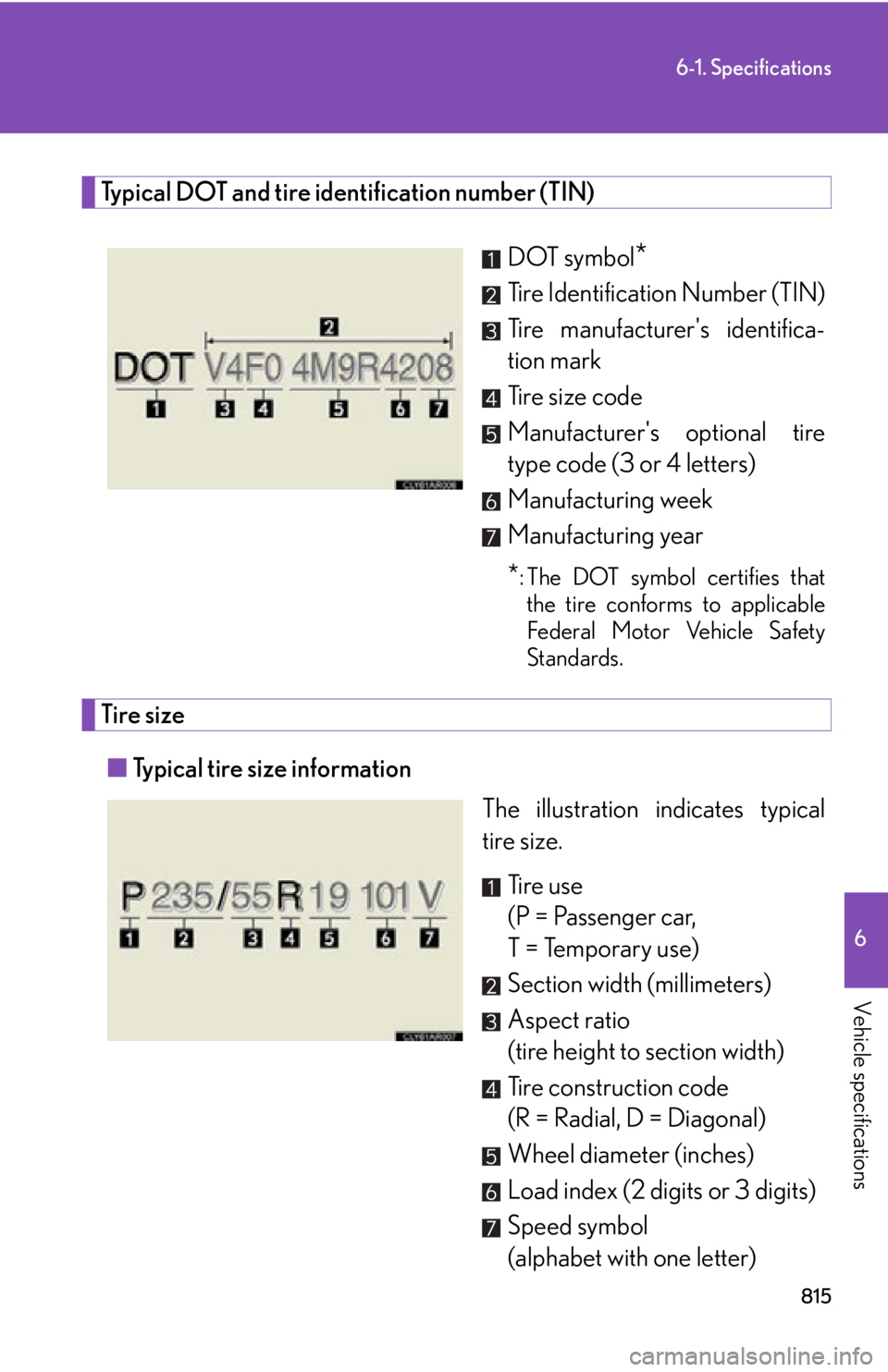
Vehicle specifications Typical DOT and tire identification number (TIN)
DOT symbol
*Tire Identificat ion Number (TIN)
Tire manufacturer's identifica-
tion mark
Tire size code
Manufacturer's optional tire
type code (3 or 4 letters)
Manufacturing week
Manufacturing year
* : The DOT symbol certifies that
the tire conforms to applicable
Federal Motor Vehicle Safety
Standards.
Tire size
■ Typical tire size information
The illustration indicates typical
tire size.
Ti r e u s e
(P = Passenger car,
T = Temporary use)
Section width (millimeters)
Aspect ratio
(tire height to section width)
Tire construction code
(R = Radial, D = Diagonal)
Wheel diameter (inches)
Load index (2 digits or 3 digits)
Speed symbol
(alphabet with one letter)
Page 817 of 878
8166-1. Specifications
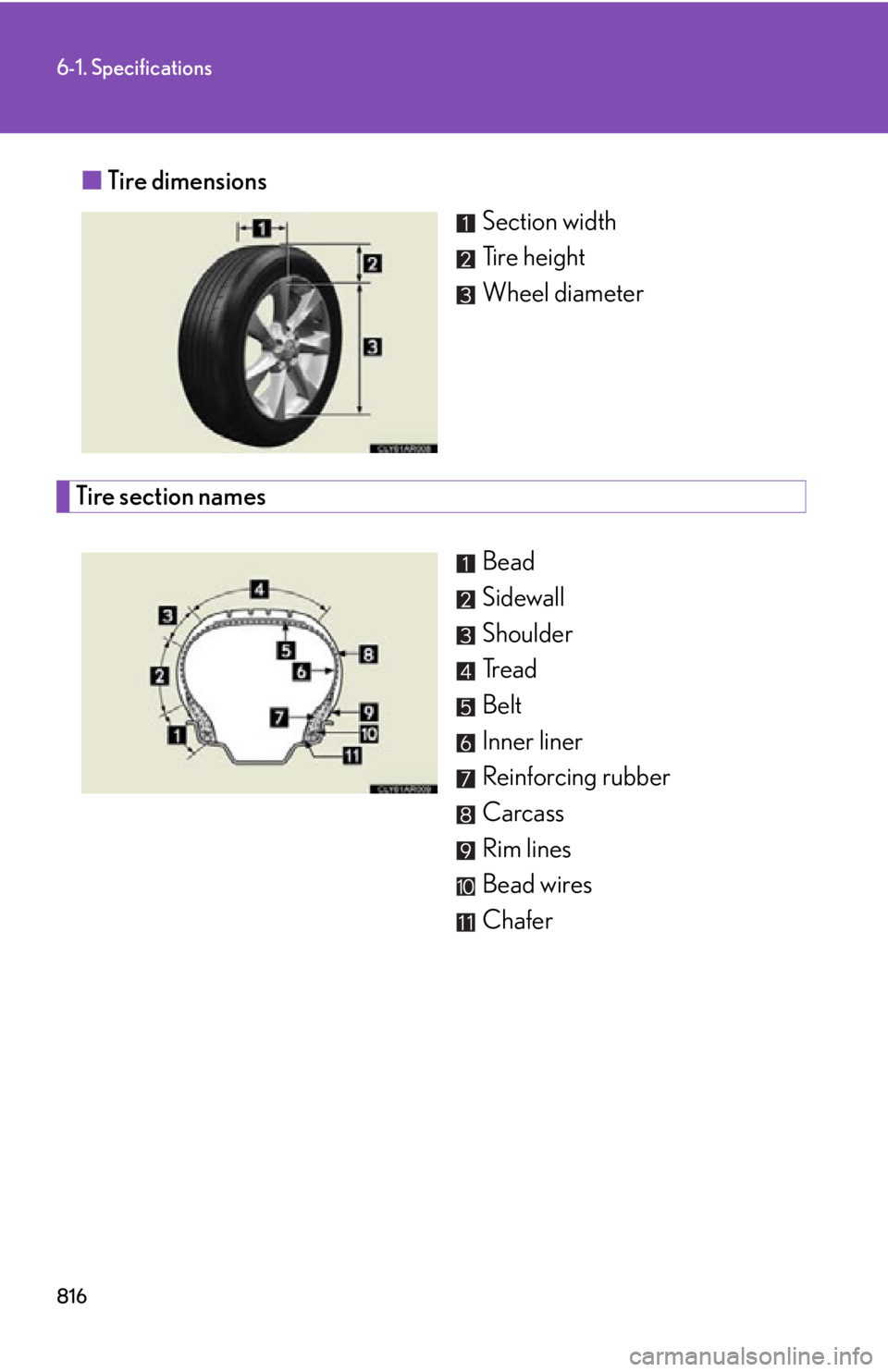
■ Tire dimensions
Section width
Ti r e h e i g h t
Wheel diameter
Tire section names
Bead
Sidewall
Shoulder
Tread
Belt
Inner liner
Reinforcing rubber
Carcass
Rim lines
Bead wires
Chafer