brake LEXUS RX450h 2015 User Guide
[x] Cancel search | Manufacturer: LEXUS, Model Year: 2015, Model line: RX450h, Model: LEXUS RX450h 2015Pages: 878, PDF Size: 11.62 MB
Page 166 of 878
1662-1. Driving procedures
Driving the vehicle
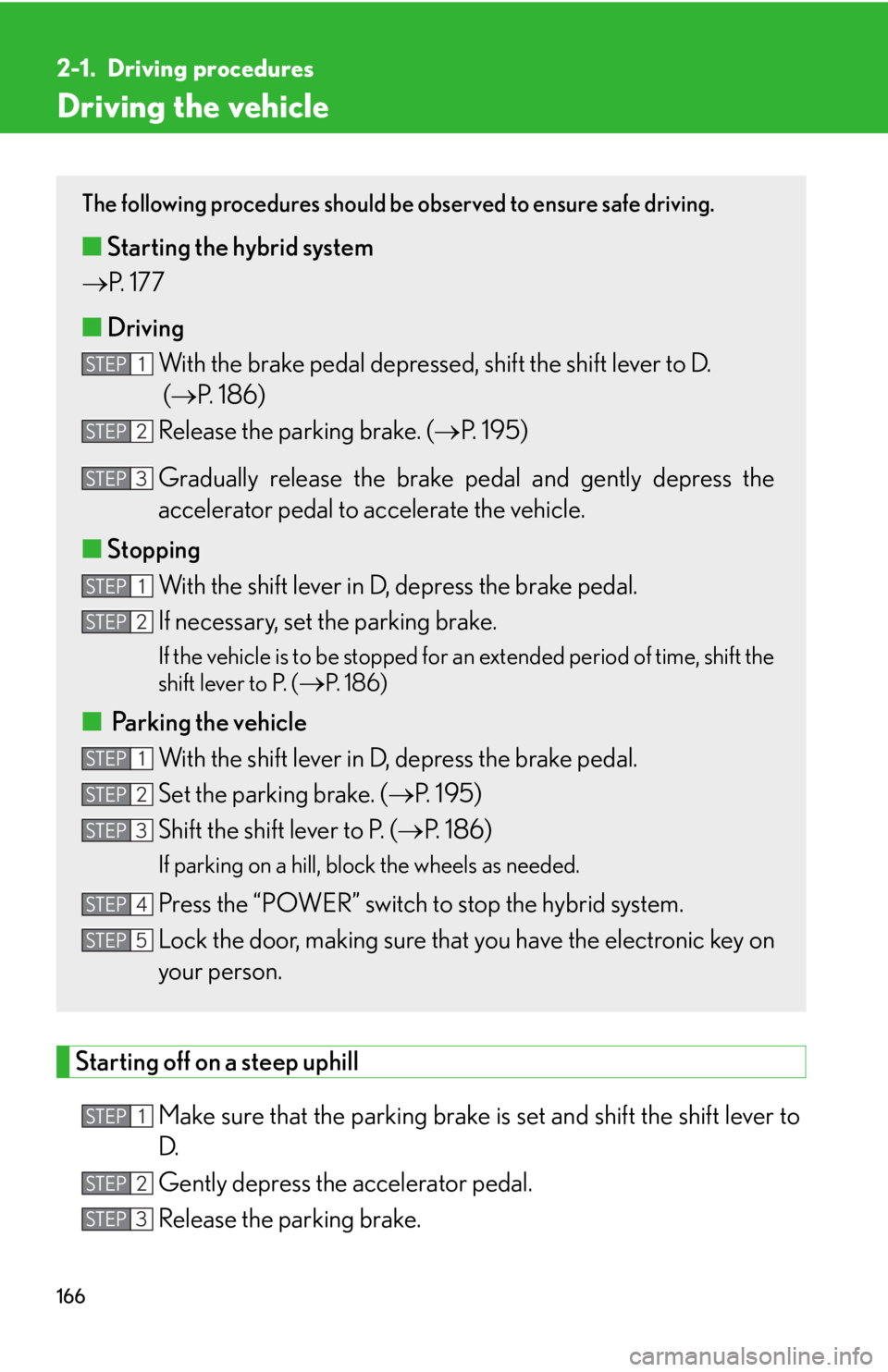
Starting off on a steep uphill
Make sure that the pa rking brake is set and shift the shift lever to
D.
Gently depress the accelerator pedal.
Release the parking brake. The following procedures should be observed to ensure safe driving.
■ Starting the hybrid system
P. 177
■ Driving
With the brake pedal depressed, shift the shift lever to D.
( P. 1 8 6 )
Release the parking brake. ( P. 195)
Gradually release the brake pedal and gently depress the
accelerator pedal to accelerate the vehicle.
■ Stopping
With the shift lever in D, depress the brake pedal.
If necessary, set the parking brake. If the vehicle is to be stopped for an extended period of time, shift the
shift lever to P. (
P. 1 8 6 )
■
Parking the vehicle
With the shift lever in D, depress the brake pedal.
Set the parking brake. ( P. 1 9 5 )
Shift the shift lever to P. ( P. 1 8 6 )If parking on a hill, block the wheels as needed.
Press the “POWER” switch to stop the hybrid system.
Lock the door, making sure that you have the electronic key on
your person.STEP 1
STEP 2
STEP 3
STEP 1
STEP 2
STEP 1
STEP 2
STEP 3
STEP 4
STEP 5
STEP 1
STEP 2
STEP 3
Page 167 of 878

1672-1. Driving procedures
2
When driving ■
When starting off on an uphill
The hill-start assist control is available. ( P. 2 76 )■
Driving in the rain ●
Drive carefully when it is raining, becaus e visibility will be reduced, the windows
may become fogged-up, and the road will be slippery.●
Drive carefully when it starts to rain, be cause the road surface will be especially
slippery.●
Refrain from high speeds when driving on an expressway in the rain, because
there may be a layer of water between th e tires and the road surface, preventing
the steering and brakes from operating properly.■
Engine speed while driving
In the following conditions, the engine speed may become high while driving. This is
due to automatic up-shifting control or down-shifting implementation to meet driv-
ing conditions. It does not indicate sudden acceleration.●
The vehicle is judged to be driving uphill or downhill●
When the accelerator pedal is released●
When the brake pedal is depresse d while sport mode is selected■
Breaking in your new Lexus
To extend the life of the vehicle, observing the following precautions is recom-
mended: ●
For the first 200 miles (300 km):
Avoid sudden stops.●
For the first 500 miles (800 km):
Do not tow a trailer.●
For the first 1000 miles (1600 km):
• Do not drive at extremely high speeds.
• Avoid sudden acceleration.
• Do not drive continuously in low gears.
• Do not drive at a constant speed for extended periods.
Page 168 of 878

1682-1. Driving procedures
■
Drum-in-disc type parking brake system
Your vehicle has a drum-in-disc type parking brake system. This type of brake sys-
tem needs bedding-down of the brake shoe s periodically or whenever the parking
brake shoes and/or drum are replaced. Have your Lexus dealer perform the bed-
ding down operation.■
Operating your vehicle in a foreign country
Comply with the relevant vehicle registration laws and confirm the availability of the
correct fuel. ( P. 800)■
For efficient use ●
Shift the shift lever to D when driving.
In the N position, the gasoline engine op erates but electricity cannot be gener-
ated. The hybrid battery (traction battery) will discharge, requiring unnecessary
engine power to recharge.●
Drive your vehicle smoothly.
Avoid abrupt acceleration and deceleration. Gradual acceleration and decel-
eration will make more effective use of the electric motor (t raction motor) with-
out having to use gasoline engine power.●
Avoid repeated acceleration.
Repeated acceleration consumes hybrid battery (traction battery) power,
resulting in poor acceleration. Battery power can be restored by driving with
the accelerator pedal slightly released.●
Shift the shift lever to P when parking.
In the N position, the hybrid battery (traction battery) does not recharge.
Leaving the shift lever in the N position for an extended period of time may dis-
charge the hybrid battery. The vehicle cannot run if the hybrid battery is dis-
charged.■
Eco-friendly driving
P. 1 9 9
CAUTION
■
When starting the vehicle
Always keep your foot on the brake pe dal while stopped with the hybrid system
operating. This prevents the vehicle from creeping.
Page 169 of 878

1692-1. Driving procedures
2
When driving CAUTION■
When driving the vehicle ●
Do not drive if you are unfamiliar with the location of the brake and accelerator
pedals to avoid depressing the wrong pedal.
• Accidentally depressing the accelerato r pedal instead of the brake pedal will
result in sudden acceleration that may le ad to an accident that could result in
death or serious injury.
• When backing up, you may twist your bo dy around, leading to a difficulty in
operating the pedals. Make sure to operate the pedals properly.
• Make sure to keep a correct driving posture even when moving the vehicle
only slightly. This allows you to depress the brake and accelerator pedals
properly.
• Depress the brake pedal using your right foot. Depressing the brake pedal
using your left foot may delay response in an emergency, resulting in an acci-
dent.●
When the hybrid vehicle is driven using the electric motor only, no engine noise is
made. As such, pedestrians, people riding bicycles or other people and vehicles
in the surrounding area may not realize that the vehicle is approaching. Even with
the Vehicle Proximity Notification System active, people may not realize the vehi-
cle is approaching when the surrounding area is noisy and so forth. Therefore,
take extra care while driving.●
Do not drive the vehicle over or stop the vehicle near flammable materials.
The exhaust system and exhaust gases can be extremely hot. These hot parts may
cause a fire if there is any flammable material nearby.●
Do not let the vehicle roll backward while the shift lever is in a driving position, or
roll forward while the shift lever is in R.
Doing so may result in an acci dent or damage to the vehicle.●
If the smell of exhaust is noticed inside the vehicle, open the windows and check
that the back door is closed. Large amounts of exhaust in the vehicle can cause
driver drowsiness and an accident, resulting in death or a serious health hazard.
Have the vehicle inspected by your Lexus dealer immediately.
●
Do not shift the shift lever to P while the vehicle is moving.
Doing so can damage the transmission and may result in a loss of vehicle control.
Page 170 of 878

1702-1. Driving procedures
CAUTION●
Do not shift the shift lever to R while the vehicle is moving forward.
Doing so can damage the transmission and may result in a loss of vehicle control.●
Do not shift the shift lever to D while the vehicle is moving backward.
Doing so can damage the transmission and may result in a loss of vehicle control.●
Moving the shift lever to N while the vehicle is moving will disengage the hybrid
system. Engine braking is not availabl e with the hybrid system disengaged.●
During normal driving, do not turn off the hybrid system. Turning the hybrid sys-
tem off while driving will not cause loss of steering or braking control, however,
power assist to the steering will be lost. This will make it more difficult to steer
smoothly, so you should pull over and stop the vehicle as soon as it is safe to do so.
In the event of an emergency, such as if it becomes impossible to stop the vehicle
in the normal way: P. 7 9 5●
Use engine braking (downshift) to maintain a safe speed when driving down a
steep hill.
Using the brakes continuously may cause the brakes to overheat and lose effec-
tiveness. ( P. 1 8 6 )●
When stopped on an incline, use the brake pedal and parking brake to prevent
the vehicle from rolling backward or forward, causing an accident. ●
Do not adjust the position of the steering wheel, the seat, or the inside or outside
rear view mirrors while driving.
Doing so may result in a loss of vehicle control that can cause accidents, resulting
in death or serious injury.●
Always check that all passengers' arms, heads or other parts of their body are not
outside the vehicle, as this may result in death or serious injury.●
Do not drive in excess of the speed limit. Even if the legal speed limit permits it, do
not drive over 85 mph (140 km/h) unless your vehicle has high-speed capability
tires. Driving over 85 mph (140 km/h) may result in tire failure, loss of control and
possible injury. Be sure to consult a tire dealer to determine whether the tires on
your vehicle are high-speed capability tires or not before driving at such speeds.
Page 171 of 878

1712-1. Driving procedures
2
When driving CAUTION■
When driving on slippery road surfaces ●
Sudden braking, acceleration and steering may cause tire slippage and reduce
your ability to control the vehi cle, resulting in an accident.●
Sudden acceleration, engine braking due to shift changing, or changes in engine
speed could cause the vehicle to skid, resulting in an accident.●
After driving through a pudd le, lightly depress the brak e pedal to make sure that
the brakes are functioning properly. Wet brake pads may prevent the brakes from
functioning properly. If the brakes on on ly one side are wet and not functioning
properly, steering control may be af fected, resulting in an accident.■
When shifting the shift lever
Be careful not to shift the shift lever with the accelerator pedal depressed.
This may lead to unexpected rapid acceleration of the vehicle that may cause an
accident and result in death or serious injury.■
If you hear a squealing or scraping no ise (brake pad wear limit indicators)
Have your Lexus dealer check and replac e the brake pads as soon as possible.
Rotor damage can result if the pads are not replaced when needed.
It is dangerous to drive the vehicle when the wear limits of the brake pads and/or
those of the brake discs are exceeded.
Page 172 of 878

1722-1. Driving procedures
CAUTION■
When the vehicle is stopped ●
Do not depress the accelerator pedal unnecessarily.
If the vehicle is in any gear other than P or N, the vehicle may accelerate suddenly
and unexpectedly, causing an accident.●
Do not leave the vehicle with the hybrid system on for a long time.
If such a situation cannot be avoided, park the vehicle in an open space and
check that exhaust fumes do no t enter the vehicle interior.●
In order to prevent accidents due to the vehicle rolling away, always keep
depressing the brake pedal while the “READY” indicator is on. Apply the parking
brake as necessary.●
If the vehicle is stopped on an incline, in order to prevent accidents caused by the
vehicle rolling forward or backward, always depress the brake pedal and securely
apply the parking brake as needed.●
Avoid revving or racing the engine.
Running the engine at high speed while the vehicle is stopped may cause the
exhaust system to overheat, which could result in a fire if combustible material is
nearby.
Page 173 of 878

1732-1. Driving procedures
2
When driving CAUTION■
When the vehicle is parked ●
Do not leave glasses, cigarett e lighters, spray cans, or soft drink cans in the vehi-
cle when it is in the sun.
Doing so may result in the following:
• Gas may leak from a cigarette lighter or spray can, and may lead to a fire.
• The temperature inside the vehicle may cause the plastic lenses and plastic
material of glasses to deform or crack.
• Soft drink cans may fracture, causing the contents to spray over the interior of
the vehicle, and may also cause a short circuit in the vehicle's electrical com-
ponents.●
Do not leave cigarette lighters in the vehicle. If a cigarette lighter is in a place such
as the glove box or on the floor, it may be lit accidentally when luggage is loaded
or the seat is adjusted, causing a fire.●
Do not attach adhesive discs to the wind shield or windows. Do not place contain-
ers such as air fresheners on the instru ment panel or dashboard. Adhesive discs
or containers may act as lenses, causing a fire in the vehicle.●
Do not leave a door or window open if the curved glass is coated with a metal-
lized film such as a silver-colored one. Reflected sunlight may cause the glass to
act as a lens, causing a fire.●
Always apply the parking brake, shift the shift lever to P, stop the hybrid system
and lock the vehicle.
Do not leave the vehicle unattended while the hybrid system is operating.●
Do not touch the exhaust pipes while the hybrid system is operating or immedi-
ately after turning the hybrid system off.
Doing so may cause burns.●
Do not leave the hybrid system operating in an area with snow build-up, or where
it is snowing. If snowbanks build up arou nd the vehicle while the hybrid system is
operating, exhaust gases may collect and enter the vehicle. This may lead to
death or a serious health hazard.
Page 174 of 878

1742-1. Driving procedures
CAUTION■
Exhaust gases
Exhaust gases include harmfu l carbon monoxide (CO) th at is colorless and odor-
less. Inhaling exhaust gases may lead to death or a serious health hazard. ●
If the vehicle is in a poorly ventilated area, stop the hybrid system. In a closed
area, such as a garage, exhaust gases may collect and enter the vehicle. This may
lead to death or a serious health hazard.●
The exhaust system should be checked occasionally. If there is a hole or crack
caused by corrosion, damage to a joint or abnormal exhaust noise, be sure to
have the vehicle inspected and repaired by your Lexus dealer . Failure to do so
may allow exhaust gases to enter the vehicl e, resulting in death or a serious health
hazard.■
When taking a nap in the vehicle
Always turn the hybrid system off. Otherwise, if you accidentally move the shift
lever or depress the accelerator pedal, this could cause an accident or fire due to
hybrid system overheating. Additionally, if the vehicle is parked in a poorly venti-
lated area, exhaust gases may collect and enter the vehicle, leading to death or a
serious health hazard.■
When braking the vehicle ●
When the brakes are wet, drive more cautiously.
Braking distance increases when the brakes are wet, and this may cause one side
of the vehicle to brake differently than the other side. Also, the parking brake may
not securely hold the vehicle.●
If the electronically controlled brake syst em does not operate, do not follow other
vehicles closely and avoid hills or sharp turns that require braking.
In this case, braking is still possible, but the brake pedal should be depressed
more firmly than usual. Also, the braking distance will increase. Have your brakes
fixed immediately.
●
The brake system consists of 2 or more individual hydraulic systems; if one of the
systems fails, the other(s) wi ll still operate. In this case, the brake pedal should be
depressed more firmly than usual and the braking distance will increase. Have
your brakes fixed immediately.
Page 175 of 878

1752-1. Driving procedures
2
When driving CAUTION■
If the vehicle becomes stuck
Do not spin the wheels excessively when any of the tires is up in the air, or the vehi-
cle is stuck in sand, mud, etc. This may damage the driveline components or propel
the vehicle forward or backward, causing an accident.
NOTICE■
When driving the vehicle ●
Do not depress the accelerator and brake pe dals at the same time during driving,
as this may restrain driving torque.●
Do not use the accelerator pedal or depress the accelerator and brake pedals at
the same time to hold the vehicle on a hill.■
When parking the vehicle
Always shift the shift lever to P. Failure to do so may cause the vehicle to move or the
vehicle may accelerate suddenly if the accel erator pedal is accidentally depressed.■
Avoiding damage to vehicle parts ●
Do not turn the steering wheel fully in either direction and hold it there for an
extended period of time.
Doing so may damage the power steering motor.●
When driving over bumps in the road, drive as slowly as possible to avoid damag-
ing the wheels, underside of the vehicle, etc. ■
If you get a flat tire while driving
A flat or damaged tire may cause the following situations. Hold the steering wheel
firmly and gradually depress the brak e pedal to slow down the vehicle.●
It may be difficult to control your vehicle.
●
The vehicle will make abnormal sounds.
●
The vehicle will behave abnormally.
Information on what to do in case of a flat tire ( P. 76 4 )